
Retail Media Optimization Services Market Size and Share
Market Overview
| Study Period | 2020 - 2031 |
|---|---|
| Market Size (2026) | USD 7.73 Billion |
| Market Size (2031) | USD 22.31 Billion |
| Growth Rate (2026 - 2031) | 23.61 % |
| Fastest Growing Market | Asia-Pacific |
| Largest Market | North America |
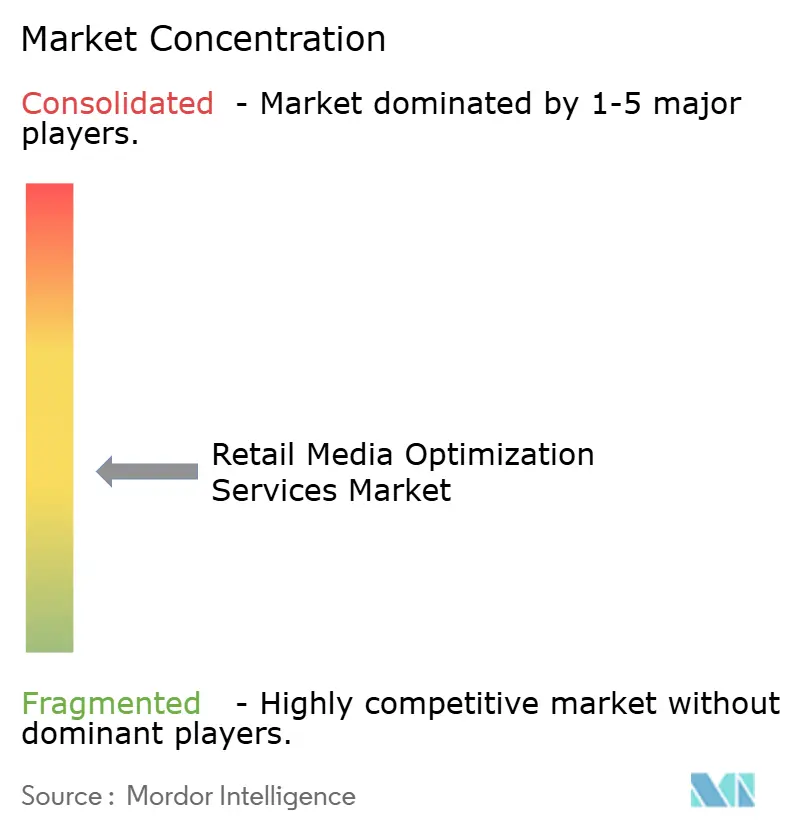
| Market Concentration | Medium |
Major Players *Disclaimer: Major Players sorted in no particular order Image © Mordor Intelligence. Reuse requires attribution under CC BY 4.0. | |
Retail Media Optimization Services Market Analysis by Mordor Intelligence
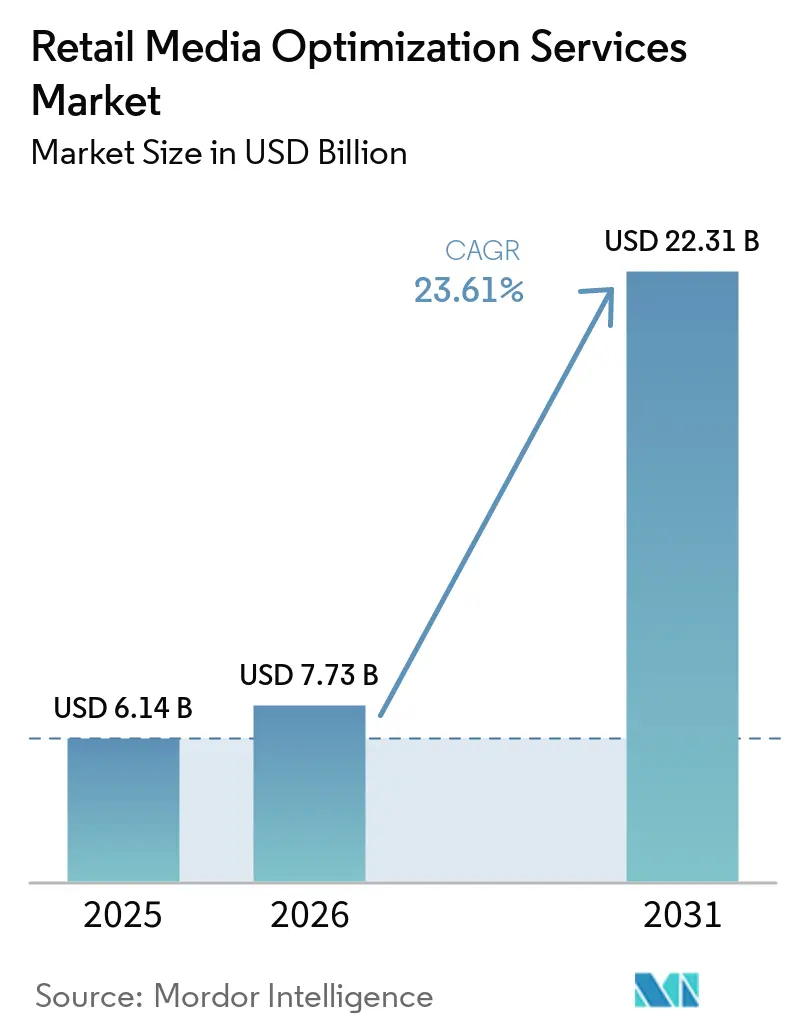
The retail media optimization services market size is projected to expand from USD 6.14 billion in 2025 and USD 7.73 billion in 2026 to USD 22.31 billion by 2031, registering a CAGR of 23.61% between 2026 to 2031. Retailers are directing more trade marketing budgets toward digital advertising channels supported by authenticated purchase data. Their owned websites, apps, and store environments have become advertising inventory with direct links to shopper activity. Brands need specialist support because campaigns now span more than 200 retail media networks, each with separate formats, bidding rules, and reporting practices. The retail media optimization services market is also being shaped by AI-led campaign automation, data clean rooms, and feed-ready product information. Providers that combine campaign delivery, audience activation, and attribution are better positioned to serve complex multi-network programs.
Key Report Takeaways
- By service type, Campaign Management and Activation Services held 39.11% of the retail media optimization services market share in 2025, while Measurement and Analytics Services is projected to expand at a CAGR of 24.18% through 2031.
- By geography, North America accounted for 40.12% of revenue in 2025, while Asia-Pacific is projected to expand at a CAGR of 24.42% through 2031.
Note: Market size and forecast figures in this report are generated using Mordor Intelligence’s proprietary estimation framework, updated with the latest available data and insights as of January 2026.
Market Trends and Insights
Drivers Impact Analysis of Retail Media Optimization Services Market*
| Driver | (~) % Impact on CAGR Forecast | Geographic Relevance | Impact Timeline |
|---|---|---|---|
| First-Party Shopper Data Monetization | +5.2% | Global, with early gains in North America and Western Europe | Long term (≥ 4 years) |
| Rapid Retail Media Network Proliferation | +4.8% | Global, with highest concentration in North America and Asia-Pacific | Medium term (2-4 years) |
| Omnichannel Inventory Expansion | +4.0% | North America and Europe, with Asia-Pacific scaling rapidly | Medium term (2-4 years) |
| AI-Driven Campaign Automation and Budget Orchestration | +3.5% | Global | Short term (≤ 2 years) |
| Incrementality and iROAS-Based Budgeting | +2.8% | North America and Asia-Pacific core, with spillover to Europe | Medium term (2-4 years) |
| Agentic Commerce and Feed-Ready Optimization | +2.0% | Global, with North America leading adoption | Short term (≤ 2 years) |
| Source: Mordor Intelligence | |||
First-Party Shopper Data Monetization
Retailers hold purchase histories, loyalty records, and cart behavior that support precise audience selection. These records are becoming useful beyond traditional consumer packaged goods advertising relationships. Home Depot extended loyalty-derived first-party data to Pinterest, Reddit, Yahoo, and The Trade Desk, including use by insurance and financial services brands. This expansion creates new activation, attribution, and reporting needs for the retail media optimization services market. The IAB Tech Lab finalized PAIR 1.1 in July 2025 to support privacy-safe audience matching across participating environments.[1] PAIR-compliant activation can broaden services from onsite campaign work to audience design, offsite delivery, and closed-loop attribution. Each additional non-endemic advertiser category can create work that retailer-owned channels did not previously support.
Rapid Retail Media Network Proliferation
The retail media optimization services market is expanding as more networks compete for brand budgets. More than 200 active retail media networks operated globally, and Germany had more than 30 active networks in 2026. Brands managed campaigns across an average of 6 networks at the time of the Skai survey. That number was projected to reach 11 by the end of 2026. Every new network brings different inventory, bidding mechanics, data fields, and reporting methods. These differences increase the integration and normalization workload facing brand teams. Mid-market and regional networks often rely on external support because in-house optimization capabilities require specialized systems and experienced staff.
Omnichannel Inventory Expansion Across Onsite, Offsite, and In-Store
Retail media inventory now extends beyond sponsored product listings on retailer websites. It includes off-site display, video advertising, connected television, in-store digital signage, and conversational commerce formats. Each format needs different creative assets, bidding rules, and measurement methods. This wider scope increases the value of integrated engagements in the retail media optimization services market. Flywheel launched Generative Engine Optimization capabilities in June 2026 for brands seeking AI-powered recommendations across Amazon, Walmart, and Target. The offering combines auditing, content optimization, and performance measurement within one commerce workflow. Structured product content is becoming more important where recommendation eligibility depends on data quality rather than bid price. The skills required for an omnichannel program differ from those required for onsite campaign management alone.
AI-Driven Campaign Automation and Budget Orchestration
AI-driven systems are shifting campaign management from routine bid adjustments to continuous optimization. These systems can evaluate shelf availability, buy-box status, keyword traffic, and competitive positioning within the same workflow. Pacvue is expected to launch its Prism platform in June 2026 as an agentic commerce grid. Its alpha participants reported increased impressions, lower CPM, higher total sales, and stronger new-to-brand growth. As a result, the retail media optimization services market needs professionals who can interpret automated outputs and establish incrementality frameworks. The Trade Desk is expected to announce an integration with Pacvue and Skai in April 2026 to support the unified management of connected television and retail media investments across a broad network of commerce media partners. Providers that combine automation with strategic review can offer services that general advertising teams may find difficult to replicate.
Restraints Impact Analysis of Retail Media Optimization Services Market*
| Restraint | (~) % Impact on CAGR Forecast | Geographic Relevance | Impact Timeline |
|---|---|---|---|
| Cross-Network Measurement Fragmentation | -2.8% | Global, most acute in North America | Short term (≤ 2 years) |
| Privacy and Data Access Constraints | -2.3% | Europe, with GDPR central, and North America, with CCPA | Long term (≥ 4 years) |
| Analytics Talent and Workflow Gaps | -1.8% | Global, most acute in emerging markets | Medium term (2-4 years) |
| Legacy MMM Under-Crediting Retail Media | -1.2% | North America and Europe | Medium term (2-4 years) |
| Source: Mordor Intelligence | |||
Cross-Network Measurement Fragmentation
Major networks use different attribution windows, conversion definitions, and reporting methods for similar campaigns. This makes direct performance comparisons difficult without an independent normalization layer. The IAB and Media Rating Council released store retail media definitions and measurement standards in January 2025. The IAB Tech Lab followed with ADMaP 1.0 in February 2025 for attribution data matching. These standards provide a common direction, but network participation remains voluntary. Fragmented measurement limits a brand's ability to show that additional retail media spending produced incremental results. At the same time, the problem creates demand for providers that can normalize data and manage the resulting reporting burden.
Privacy and Data Access Constraints
Privacy rules add complexity to audience activation and clean room operations across the retail media optimization services market. GDPR and the California Consumer Privacy Act require teams to consider how customer information can be collected, matched, and activated. Consent management can delay audience collaboration where personal information is used across several parties. Fewer than half of retail media networks offered data clean room capabilities in Q2 2025. This limited access concentrates specialist knowledge among a smaller group of providers. Brands operating in several jurisdictions must also work through differences between national and state-level rules. Providers with established clean room infrastructure and compliance procedures can be more competitive where off-site activation depends on data collaboration.
*Our forecasts treat driver/restraint impacts as directional, not additive. The impact forecasts reflect baseline growth, mix effects, and variable interactions.
Retail Media Optimization Services Market Segment Analysis
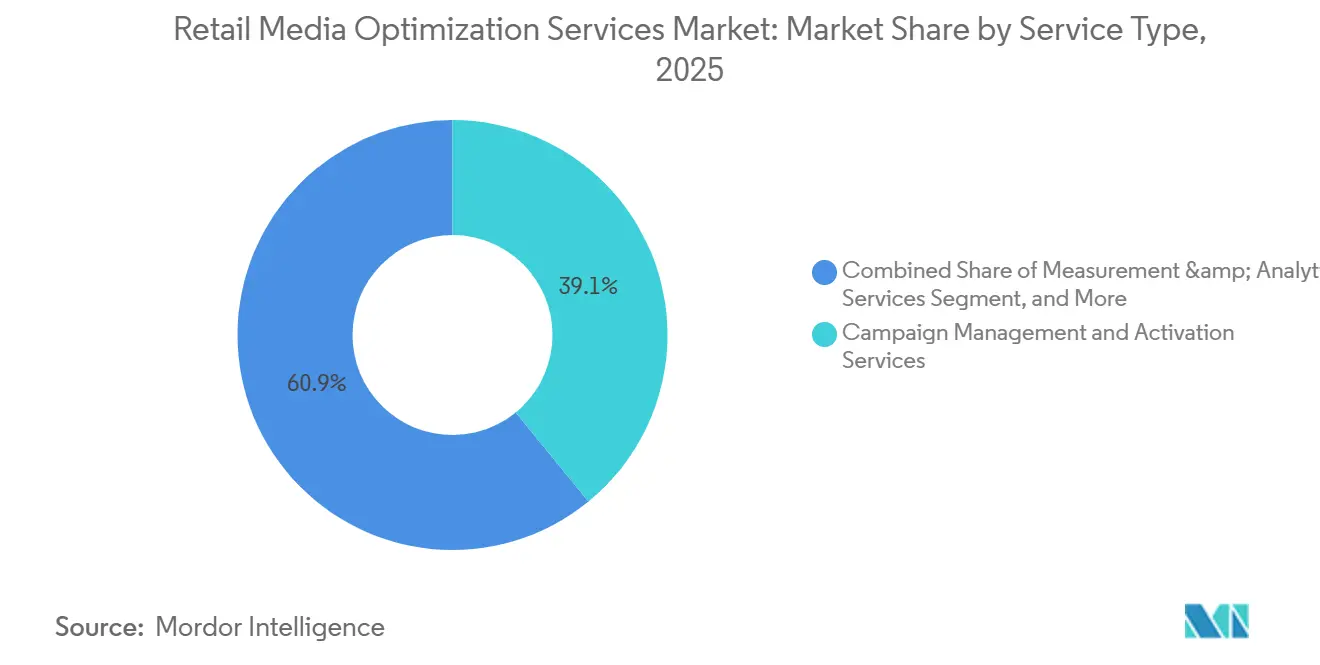
Campaign Management and Activation Services held 39.11% of the retail media optimization services market share in 2025, because brands continued to outsource campaign building, bid optimization, budget pacing, and reporting across a growing set of retailer platforms. Specialist firms maintain retail network partnerships and application programming interface integrations that many brand teams do not possess, particularly when execution must cover sponsored products, offsite inventory, and in-store formats. The leading position also reflects a structural dependence on external expertise among mid-market and regional advertisers, which often do not have enough staff to manage campaigns across several networks. Strategy and Consulting Services supports network selection, retail media maturity planning, and capability development before brands commit to larger managed-service arrangements. Creative Optimization Services benefits from the growth of onsite display, connected television, and shoppable video, where frequent variation testing is difficult to manage through manual production processes.
Training and Enablement Services is the smallest category, with demand concentrated in Asia-Pacific and parts of Europe where retail media infrastructure is newer and internal teams are still forming. Measurement and Analytics Services is projected to expand at a 24.18% CAGR through 2031, the highest rate among the service categories, as brands require incrementality testing, iROAS frameworks, and attribution models that ordinary campaign reports cannot provide. Its retail media optimization services market size is tied to a practical budget question, because credible closed-loop measurement can help marketing teams obtain approval to move trade promotion funding into retail media. Audience and Data Services includes clean room implementation, first-party segment construction, and privacy-compliant activation across onsite and offsite inventory, which are core requirements for both endemic and non-endemic advertisers. NIQ's October 2025 launch of a global data clean room on Snowflake showed how audience collaboration and performance measurement are converging around shared privacy-safe infrastructure.[2] This convergence favors integrated platforms that can connect data, activation, and measurement, while standalone offerings become less competitive for complex enterprise engagements in the retail media optimization services industry.

Geography Analysis
North America Retail Media Optimization Services Market
North America held 40.12% of global revenue in 2025, supported by a mature digital commerce environment and the scale of Amazon Advertising, Walmart Connect, and Target Roundel. Walmart Connect generated USD 3.4 billion in advertising revenue in 2024, according to Walmart's financial disclosures, demonstrating the commercial scale available to service providers that support large retailer networks. The region has a dense group of commerce media platforms and retail media agency practices, giving brands many choices for campaign delivery, data activation, and measurement support. This makes North America the most established part of the retail media optimization services market, where providers can apply established capabilities across a broad group of sophisticated advertiser and retailer relationships. Its retail media programs increasingly require cross-channel attribution as retailer websites, connected television, and programmatic inventory are used together. Canada and Mexico extend the regional demand base as domestic retailers establish retail media networks, creating further needs for campaign management, network integration, and repeatable operating processes.
APAC Retail Media Optimization Services Market
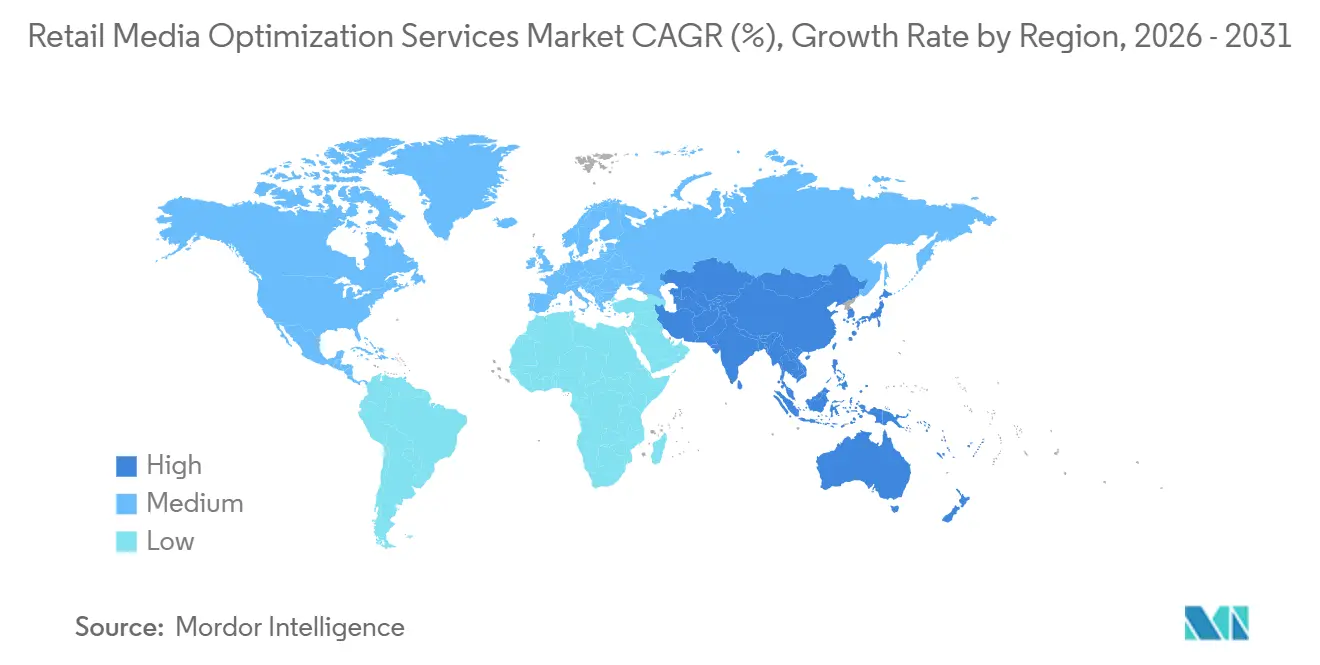
Asia-Pacific is projected to expand at a 24.42% CAGR through 2031, the fastest regional rate in the retail media optimization services market. Japan's fragmented retailer base requires brands to optimize activity across a larger number of smaller networks than in the United States. This creates a different operating requirement for the retail media optimization services market, because providers need to support varied retailer practices rather than rely on a small number of dominant platforms. China requires services designed for livestream commerce and short-form video, which differ from display-focused onsite advertising methods. India, South Korea, and Australia add demand as e-commerce advertising infrastructure develops, making localized expertise and adaptable workflows important to regional delivery.
EMEA and South America Retail Media Optimization Services Market
Europe sits between the more mature North American market and the rapidly expanding Asia-Pacific environment, with the United Kingdom ahead of France and Germany in retail media maturity. Germany had more than 30 active networks in 2026, including Rewe, Edeka, Otto, Kaufland, and Schwarz Media. Brands need specialist guidance in this fragmented setting because auction conditions, inventory options, and measurement approaches vary across networks. South America remains an emerging region where services engagement is mainly strategy and consulting-led while network infrastructure matures. The Middle East and Africa present longer-horizon opportunities, with early launches in the UAE, Saudi Arabia, South Africa, and Nigeria creating initial demand for managed campaign services and market-entry consulting.
Competitive Landscape
The retail media optimization services market is moderately fragmented, with specialized platforms winning many enterprise engagements through automation, network coverage, and measurement depth. Agencies, consulting firms, and newer technology providers compete through service breadth, client relationships, and geographic reach. Competitive strategies center on adding network integrations, improving performance measurement, and using AI to reduce manual work while expanding the scope of each client engagement. This leaves the retail media optimization services market open to providers that can combine operating scale with practical support for advertisers managing different retailer requirements.
Criteo became Google Search Ads 360's first onsite retail media supply partner in September 2025, linking sponsored product listing activation across its retailer network with enterprise search advertising workflows. The integration sought to create more unified incrementality measurement and shows how retail media is being connected to wider advertising systems. Major holding companies compete for the same enterprise opportunity, including Omnicom through Flywheel and Publicis through Epsilon's platform built on the CitrusAd acquisition. Epsilon describes its platform as interoperable by default, with application programming interface integrations intended to place retail media within broader advertising and marketing technology stacks. This design can deepen client relationships and raise switching costs where campaigns, data, and measurement are linked with wider organizational systems.
Kevel, Pentaleap, and Topsort help mid-market retailers establish networks with lower capital requirements, increasing the number of networks that service providers may need to support. Their growth favors platforms that consolidate campaign management across retailers, while also creating room for managed-service firms that support advertisers without specialist internal teams. Opportunities remain in mid-market network enablement, cross-border campaign delivery, and agentic commerce optimization, which is emerging as a distinct category with its own pricing model. Flywheel launched Generative Engine Optimization in June 2026 to help brands earn AI-powered recommendations across Amazon, Walmart, and Target. Pacvue's Prism launch and Skai Studio's introduction in 2026 likewise show that providers are bringing software, advisory capabilities, and measurement into broader commerce media operating systems.[3]
Retail Media Optimization Services Industry Leaders
-
Pacvue
-
Criteo S.A.
-
Flywheel Digital
-
Publicis Groupe S.A.
-
Skai (Kenshoo, Ltd.)
- *Disclaimer: Major Players sorted in no particular order
Retail Media Optimization Services Market Companies Covered in this Report
- Criteo S.A.
- Skai (Kenshoo, Ltd.)
- Pacvue
- Flywheel Digital, Inc.
- Publicis Groupe S.A.
- Dentsu Group Inc.
- WPP plc
- Tinuiti, Inc.
- Stackline, Inc.
- Koddi, Inc.
- Epsilon Data Management, LLC
- CommerceIQ
- Merkle, Inc.
- Accenture plc
- MikMak, Inc.
- Moloco
- Channel Bakers, Inc.
- Kevel, Inc.
- Pentaleap Limited
- Topsort, Inc.
Recent Industry Developments in Retail Media Optimization Services Market
- July 2026: NielsenIQ (NIQ) completed the acquisition of Flywheel's China and Southeast Asia eCommerce Data and Insights business, operating under the YiMian brand in China. The acquisition strengthens NIQ's AI-powered analytics for cross-channel consumer behavior measurement, expanding capabilities for more than 100 global and regional clients.
- June 2026: Flywheel launched Generative Engine Optimization (GEO) capabilities to help brands earn AI-powered product recommendations across Amazon, Walmart, and Target, combining AI auditing, content optimization, and performance measurement in a single commerce workflow.
- May 2026: Skai unveiled Skai Studio, the industry's first agent-native marketing operating system, alongside expanded Celeste AI capabilities and a new Strategic Advisory Services team at ShopAble 2026, integrating Measurement Hub and Agent-Ready Optimization across 300-plus publishers and retail media networks.
- January 2026: Flywheel integrated TPN (The Packaging Network), Omnicom's flagship retail and commerce agency, into its organization, combining TPN's shopper marketing capabilities with Flywheel's retail media technology and data infrastructure.
Global Retail Media Optimization Services Market Report Scope
Retail Media Optimization Services Market refers to the ecosystem of managed services, consulting, and technology-enabled support used to improve retail media campaign performance across retailer-owned and marketplace advertising channels. It includes campaign setup, bid and budget optimization, audience targeting, creative testing, measurement, and reporting designed to increase ROAS and sales outcomes.
The Retail Media Optimization Services Market Report is Segmented by Service Type (Campaign Management and Activation Services, Measurement and Analytics Services, Audience and Data Services, Strategy and Consulting Services, Creative Optimization Services, and Training and Enablement Services) and Geography (North America, South America, Europe, Asia-Pacific, Middle East, and Africa). The Market Forecasts are Provided in Terms of Value (USD).
Segmentation Overview
| Campaign Management and Activation Services |
| Measurement and Analytics Services |
| Audience and Data Services |
| Strategy and Consulting Services |
| Creative Optimization Services |
| Training and Enablement Services |
| North America | United States |
| Canada | |
| Mexico | |
| South America | Brazil |
| Argentina | |
| Chile | |
| Rest of South America | |
| Europe | Germany |
| United Kingdom | |
| France | |
| Italy | |
| Spain | |
| Russia | |
| Rest of Europe | |
| Asia-Pacific | China |
| Japan | |
| India | |
| South Korea | |
| Australia | |
| Rest of Asia-Pacific | |
| Middle East | United Arab Emirates |
| Saudi Arabia | |
| Turkey | |
| Rest of Middle East | |
| Africa | South Africa |
| Egypt | |
| Nigeria | |
| Rest of Africa |
| By Service Type | Campaign Management and Activation Services | |
| Measurement and Analytics Services | ||
| Audience and Data Services | ||
| Strategy and Consulting Services | ||
| Creative Optimization Services | ||
| Training and Enablement Services | ||
| By Geography | North America | United States |
| Canada | ||
| Mexico | ||
| South America | Brazil | |
| Argentina | ||
| Chile | ||
| Rest of South America | ||
| Europe | Germany | |
| United Kingdom | ||
| France | ||
| Italy | ||
| Spain | ||
| Russia | ||
| Rest of Europe | ||
| Asia-Pacific | China | |
| Japan | ||
| India | ||
| South Korea | ||
| Australia | ||
| Rest of Asia-Pacific | ||
| Middle East | United Arab Emirates | |
| Saudi Arabia | ||
| Turkey | ||
| Rest of Middle East | ||
| Africa | South Africa | |
| Egypt | ||
| Nigeria | ||
| Rest of Africa | ||
Key Questions Answered in the Report
What is the projected value of retail media optimization services?
The retail media optimization services market size is projected to reach USD 22.31 billion by 2031 from USD 7.73 billion in 2026, with a 23.61% CAGR. The estimate reflects demand for coordinated campaign execution, audience activation, and measurement across retailer media networks.
Which service type led retail media optimization services in 2025?
Campaign Management and Activation Services led with a 39.11% revenue share in 2025. Brands use these services for campaign building, bid optimization, budget pacing, reporting, and execution across retailer platforms.
Which service type is projected to grow fastest through 2031?
Measurement and Analytics Services is projected to expand at a CAGR of 24.18% through 2031. Demand is tied to incrementality testing, iROAS frameworks, and attribution models that support budget decisions.
Which region led retail media optimization services in 2025?
North America led with 40.12% of global revenue in 2025, supported by mature digital commerce infrastructure and major retailer networks. The region also has a high concentration of platforms and agencies with specialist retail media capabilities.
Which region is projected to expand fastest through 2031?
Asia-Pacific is projected to record a CAGR of 24.42% through 2031 as e-commerce advertising infrastructure expands. Fragmented network structures in several countries increase the need for localized campaign and measurement support.
What is the main challenge for cross-network retail media campaigns?
Different attribution windows, conversion definitions, and reporting methods make comparable cross-network measurement difficult. Brands may need an independent normalization layer to evaluate performance consistently across networks.