
Quantum Software Development Kit Market Size and Share
Market Overview
| Study Period | 2020 - 2031 |
|---|---|
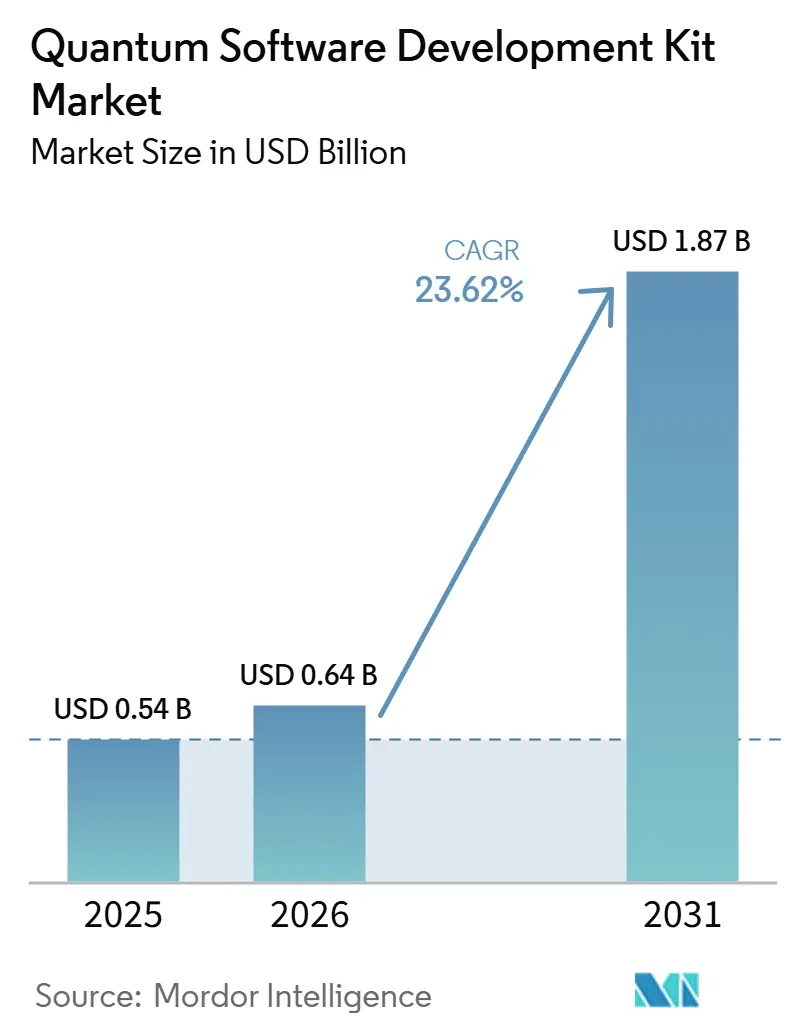
| Market Size (2026) | USD 0.64 Billion |
| Market Size (2031) | USD 1.87 Billion |
| Growth Rate (2026 - 2031) | 23.62% CAGR |
| Fastest Growing Market | Asia-Pacific |
| Largest Market | North America |
| Market Concentration | Medium |
Major Players *Disclaimer: Major Players sorted in no particular order Image © Mordor Intelligence. Reuse requires attribution under CC BY 4.0. | |
Quantum Software Development Kit Market Analysis by Mordor Intelligence
The Quantum Software Development Kit Market size is expected to grow from USD 0.54 billion in 2025 to USD 0.64 billion in 2026 and is forecast to reach USD 1.87 billion by 2031 at 23.92% CAGR over 2026-2031. Programmable access layers have become central to how enterprises interact with quantum processing units, making software capabilities as important as hardware access. Government funding, open-source frameworks, and enterprise work on algorithms have supported spending on development tools. Private investment in quantum technologies reached nearly USD 5 billion in 2025, more than double the prior-year level, which supported commercial confidence beyond hardware demonstrations. Cloud delivery remains the primary access model, though organizations with security and data-residency requirements continue to consider on-premises systems. Competition centers on developer communities, interoperability, and tools that can support both current hardware and future fault-tolerant systems.
Key Report Takeaways
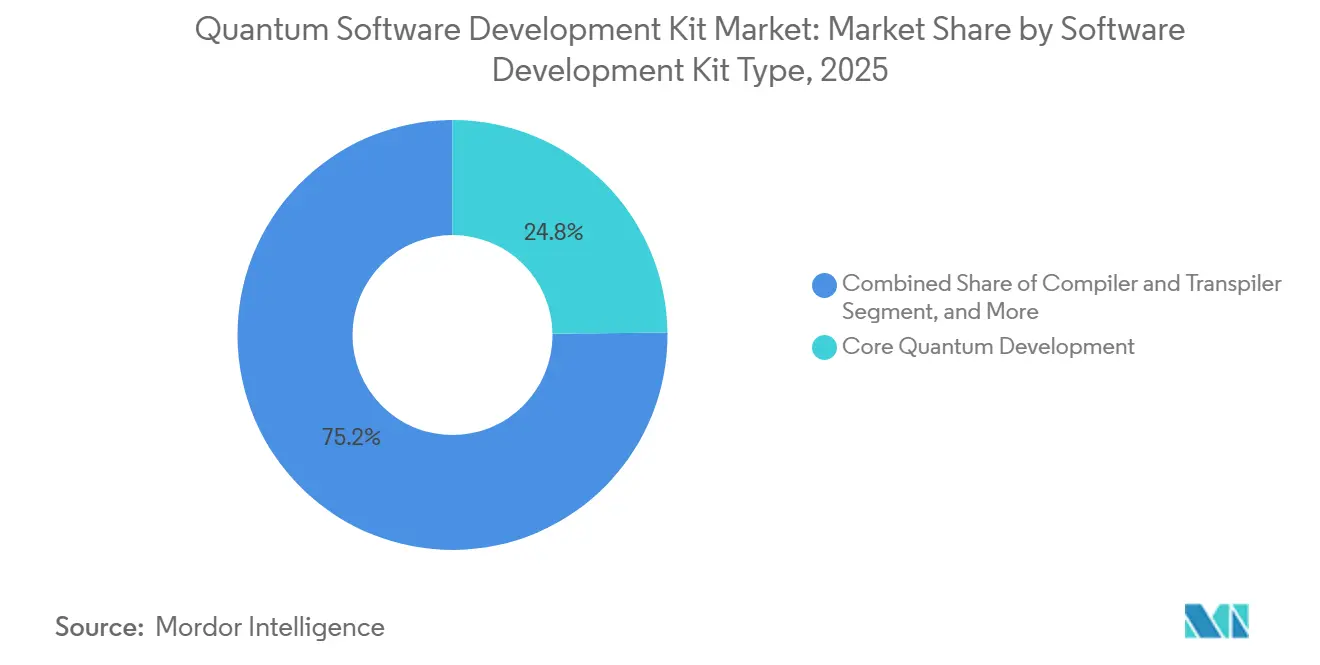
- By Software Development Kit Type, Core Quantum Development held 24.81% of the Quantum Software Development Kit Market share in 2025, while Compiler and Transpiler SDKs are projected to expand at a 27.14% CAGR through 2031.
- By deployment mode, Cloud-Based deployment held 72.36% of the Quantum Software Development Kit Market share in 2025, while Hybrid deployment is projected to expand at a 26.83% CAGR through 2031.
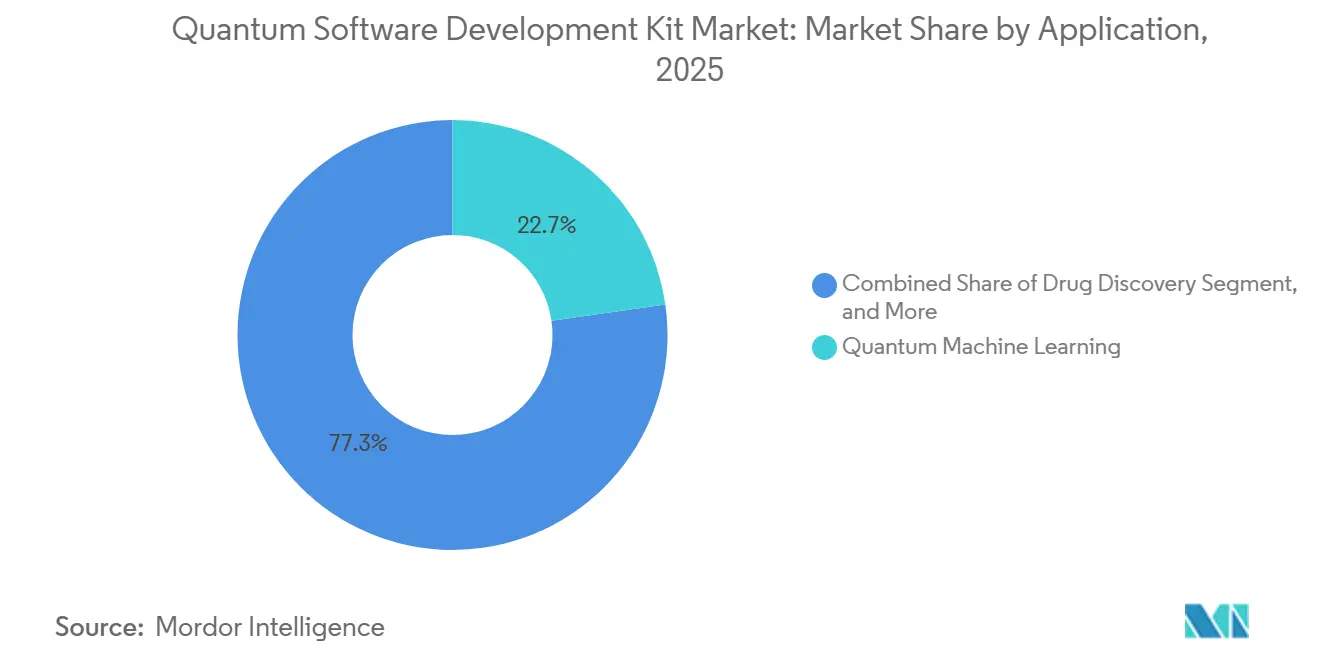
- By application, Quantum Machine Learning held 22.74% of the Quantum Software Development Kit Market share in 2025, while Drug Discovery is projected to expand at a 28.41% CAGR through 2031.
- By end user, Education and Research Institutions held 26.18% of the Quantum Software Development Kit Market share in 2025, while Healthcare and Life Sciences are projected to expand at a 27.92% CAGR through 2031.
- By geography, North America held 36.42% of the Quantum Software Development Kit Market share in 2025, while Asia-Pacific is projected to expand at a 29.16% CAGR through 2031.
Note: Market size and forecast figures in this report are generated using Mordor Intelligence’s proprietary estimation framework, updated with the latest available data and insights as of January 2026.
Global Quantum Software Development Kit Market Trends and Insights
Drivers Impact Analysis*
| Driver | (~) % Impact on CAGR Forecast | Geographic Relevance | Impact Timeline |
|---|---|---|---|
| Expansion of Hybrid Quantum-Classical Workloads | +6.8% | Global | Short term (≤ 2 years) |
| Government-Led Quantum Computing Programs and Research Funding | +5.2% | North America and EU core, spill-over to Asia-Pacific | Medium term (2-4 years) |
| Rising Enterprise Demand for Quantum Algorithm Development Platforms | +4.1% | Global | Medium term (2-4 years) |
| Growth of Open-Source Quantum Software Ecosystems | +3.2% | Global | Short term (≤ 2 years) |
| Hardware-Portability Requirements Across Fragmented QPU Architectures | +1.8% | Global | Short term (≤ 2 years) |
| Real-Time Error-Correction Software Requirements for Utility-Scale Quantum Systems | +1.4% | North America and Europe | Long term (≥ 4 years) |
| Source: Mordor Intelligence | |||
Expansion of Hybrid Quantum-Classical Workloads
Tier-1 supercomputing centers, including Oak Ridge, Argonne, RIKEN, Jülich, and the Barcelona Supercomputing Center, have committed to co-located QPU integration by 2028. This creates a defined procurement path for middleware and orchestration tools above individual platform application programming interfaces in the quantum software development kit market. The commercial contest is increasingly focused on control of hybrid workflow orchestration, where NVIDIA CUDA-Q and IBM Quantum Compute Service are key participants. CUDA-Q benchmarks showed that a hybrid algorithm converged up to 5x faster than CPU-only optimization loops, although this result comes from a company source. Cleveland Clinic and IBM published a hybrid workflow for the electronic structure of the 303-atom Trp-cage miniprotein in March 2026, using IBM Quantum Heron r2 hardware.[1]IBM, “Release News: Qiskit v2.5 Is Here,” IBM Quantum, ibm.com The work broadens the expected workflow from QPU-only circuits to CPU-GPU-QPU environments, giving classical high-performance computing and data science teams a more direct role in adoption.
Government-Led Quantum Computing Programs and Research Funding
Government programs are shaping product roadmaps because their funding is linked to specific hardware and ecosystem milestones. In May 2026, the U.S. Department of Commerce signed letters of intent for USD 2.013 billion in CHIPS and Science Act incentives across 9 quantum companies.[2]D-Wave Quantum, “Anduril, Davidson and D-Wave Collaborate to Develop Quantum Applications for US Air and Missile Defense,” D-Wave Quantum, dwavequantum.com The allocation included USD 1 billion for IBM and USD 100 million each for Atom Computing, Infleqtion, Quantinuum, D-Wave, and Rigetti. The Department of Energy announced Quantum Genesis in June 2026, targeting scientifically relevant fault-tolerant computing by 2028 and a user facility that integrates quantum and high-performance computing resources. EuroHPC systems inaugurated in Poznan, Ostrava, and Munich also require compatible software layers for scientific users. Emerging interoperability requirements may increase compliance work in the quantum software development kit market, but they also allow early adopters to influence common technical practices.
Rising Enterprise Demand for Quantum Algorithm Development Platforms
Enterprise use is broadening beyond financial services, and each vertical requires different forms of algorithm support in the quantum software development kit market. Quantinuum entered partnerships in 2026 with BMW Group, HPE, Rolls-Royce, Riverlane, and Mitsubishi Electric across materials research, high-performance computing integration, turbine simulation, and industrial analysis.[3]U.S. Department of Commerce, “Department of Commerce Announces Letters of Intent with 9 Companies for USD 2 Billion to Accelerate U.S. Leadership in Quantum Computing,” National Institute of Standards and Technology, nist.gov These relationships show that customers are seeking algorithm development support together with system access rather than buying hardware access alone. Software providers must balance customized vertical tools with the open interfaces expected by developer communities. Classiq Technologies and Algorithmiq have positioned domain-specific layers above common software foundations. D-Wave, Davidson Technologies, and Anduril announced work on hybrid applications for U.S. air and missile defense planning in January 2026, creating demand in a security-cleared procurement setting.
Growth of Open-Source Quantum Software Ecosystems
In the quantum software development kit market, open-source frameworks have reduced the barrier for developers who need to test quantum algorithms and connect them to classical tools. IBM released the Qiskit SDK v2.5 on July 14, 2026, adding fault-tolerant compilation pipelines, a multi-representation compiler framework, improvements to the C application programming interface, and transpiler performance updates. Xanadu released PennyLane v0.45 and Catalyst v0.15 in May 2026, including resource estimation tools, a quantum-chemistry state-preparation method, and expanded compilation support.[4]Xanadu, “Assemble Meaningful Algorithms with PennyLane v0.45 and Catalyst v0.15,” PennyLane, pennylane.ai These releases help keep frameworks relevant as hardware systems and programming approaches change. Developer certifications, summer schools, and coding challenges can also build familiarity with a specific toolchain. This familiarity can influence later enterprise purchasing decisions when trained developers select the tools their teams use.
Restraints Impact Analysis*
| Restraint | (~) % Impact on CAGR Forecast | Geographic Relevance | Impact Timeline |
|---|---|---|---|
| Limited Quantum Hardware Availability and Performance Variability | -3.8% | Global | Medium term (2-4 years) |
| Shortage of Quantum Software Engineering and Algorithm Development Talent | -2.9% | Global | Long term (≥ 4 years) |
| SDK Fragmentation and Incomplete Interoperability Standards | -2.1% | Global | Medium term (2-4 years) |
| High Cost of Maintaining Hardware-Specific Compilation and Control Stacks | -1.6% | Asia-Pacific core, spill-over to North America | Long term (≥ 4 years) |
| Source: Mordor Intelligence | |||
Limited Quantum Hardware Availability and Performance Variability
The quantum software development kit market depends on hardware that remains scarce and has uneven performance across vendors. Two-qubit gate fidelity ranged from 99.1% on Rigetti's Cepheus-1-108Q system to above 99.9% on Quantinuum Helios trapped-ion systems. Compiler and transpiler tools, therefore, need continuing adjustment for each hardware generation. This reduces the portability that cloud access is expected to provide. Hardware procurement often follows multi-year public budgets, while software releases can occur each quarter. The timing difference can leave software functions ahead of the hardware required for commercial deployment, delaying enterprise production decisions.
Shortage of Quantum Software Engineering and Algorithm Development Talent
The supply of qualified developers has not kept pace with demand for people who understand algorithms, software engineering, and hardware constraints. A World Economic Forum article citing McKinsey stated that there was 1 qualified quantum candidate for every 3 open roles globally. IonQ projected a shortfall of 850,000 qualified professionals by 2036 against the estimated university output of 250,000 graduates. Training programs have expanded, yet the available evidence indicates that the number of students remains below employer demand. The issue is not only the number of graduates, because roles require both algorithm design and hardware-specific compilation knowledge. This gap may limit how quickly organizations move from experiments to sustained development programs during the forecast period in the quantum software development kit market.
*Our forecasts treat driver/restraint impacts as directional, not additive. The impact forecasts reflect baseline growth, mix effects, and variable interactions.
Segment Analysis
By Software Development Kit Type: Core Development Leads While Compiler Tools Grow Fastest
Core Quantum Development held 24.81% of the Quantum Software Development Kit Market share in 2025 because foundational circuit programming frameworks remained the starting point for many developers. IBM Qiskit and Google Cirq remained important tools in this category. Qiskit v2.5 introduced a multi-representation compiler framework that has begun to narrow the distinction between core development and dedicated compilation functions. Hardware-specific SDKs, including tools for IQM, Pasqal Pulser, and Quantinuum backends, serve users who need direct access to specific systems. Quantum Error Correction, Quantum Control, and Quantum Calibration tools have gained widespread use as providers pursue fault-tolerant demonstrations. Wider adoption of these tools depends on the hardware readiness targets linked to 2027 and 2028.
Compiler and Transpiler SDKs are projected to record a 27.14% CAGR through 2031, the fastest rate across SDK types. Every QPU architecture needs tailored compilation optimization because general circuit compilers still require hardware-specific tuning. Amazon Braket released Qiskit-Braket provider v0.11 in February 2026 with flexible circuit compilation for Qiskit users running optimized circuits on Braket-native backends, including Rigetti's Cepheus-1-108Q. Domain-Specific and Hybrid Quantum-Classical SDKs support use cases such as financial modeling, drug discovery, and materials simulation. Their adoption is tied to enterprise demand in those fields. The Others category includes specialized simulation and visualization tools. It is growing steadily, though it lacks the same demand drivers as compiler and vertical software layers.



By Deployment Mode: Cloud Access Leads as Hybrid Environments Expand
Cloud-Based deployment accounted for 72.36% of the Quantum Software Development Kit Market share in 2025. Most users accessed quantum hardware through managed offerings such as IBM Quantum, Amazon Braket, Microsoft Azure Quantum, and IonQ Cloud. A local deployment requires cryogenic infrastructure, microwave control electronics, and specialized maintenance in addition to capital spending. Cloud access is therefore the default option for many users. Local systems remain relevant for national laboratories, defense contractors, and financial institutions with data residency requirements. IBM planned to install one of India's first quantum computers in Amaravati by September 2026, indicating a potential local-access model for countries seeking greater infrastructure control.
Hybrid deployment is projected to expand at a 26.83% CAGR through 2031. These environments route circuits across local simulators, local QPUs, and cloud backends based on circuit depth, noise profiles, and execution cost. This is more than a combination of access methods because it requires reliable coordination across different computing environments. NVIDIA CUDA-Q has sought this role, with company benchmarks showing up to 5x faster hybrid-algorithm convergence than CPU-only optimization loops. The expected co-location of QPUs at Tier-1 supercomputing centers by 2028 supports demand for hybrid-capable interfaces. Such interfaces will need to give scientific and enterprise users consistent access across classical and quantum workflows.
By Application: Quantum Machine Learning Leads While Drug Discovery Accelerates
Quantum Machine Learning accounted for 22.74% of the Quantum Software Development Kit Market share in 2025. Its position reflects its integration with established data science tools, enabling users familiar with TensorFlow and PyTorch to work through PennyLane integrations. Optimization remained another important application, especially in logistics, supply chains, and portfolio construction. D-Wave Ocean continued to support discrete optimization work, while hybrid variational approaches expanded use on gate-model systems. Financial Modeling, Cryptography, and Security remained established mid-tier applications. Quantum Natural Language Processing was earlier in its development and had mainly research-oriented demand.
Drug Discovery is projected to expand at a 28.41% CAGR through 2031. Qubit Pharmaceuticals announced a 2-year collaboration with Singapore's Centre for Quantum Technologies in April 2026 to develop molecular discovery algorithms. Cleveland Clinic and IBM published a hybrid workflow for simulating the electronic structure of the 303-atom Trp-cage miniprotein on IBM Quantum Heron r2 in March 2026. Chemistry and Materials Simulation is a related growth area that addresses battery materials and catalyst research. The BioQL/qPharos platform showed how molecular docking workflows can connect quantum hardware with pharmaceutical research tools. This type of software layer can shorten application development by linking general programming frameworks with domain work.
By End User: Research Institutions Lead While Healthcare Adoption Rises
Education and Research Institutions held 26.18% of the Quantum Software Development Kit Market share in 2025. Foundational research, curriculum development, cloud credits, and software licenses kept universities and research centers as the main user group. Graduates trained on these frameworks are increasingly carrying their tool preferences into commercial roles. IT and Telecommunications represented another large user group due to post-quantum cryptography research and network optimization. BFSI adoption was supported by optimization and Monte Carlo simulation use cases. Portfolio risk management and derivatives pricing continued to offer defined targets for algorithm development.
Healthcare and Life Sciences are projected to expand at a 27.92% CAGR through 2031. Algorithmiq Aurora and Quantinuum InQuanto are examples of tools designed for quantum drug discovery and chemistry work. Industrial Manufacturing has also attracted attention through materials simulation efforts in the quantum software development kit industry. Quantinuum's 2026 relationships with BMW Group and Mitsubishi Electric established examples for automotive and industrial software deployments. National facilities and classified optimization programs in the United States, Europe, and Japan support government and Administration demand. Energy and Utilities is still emerging, with grid optimization and battery chemistry research producing early demand that is likely to begin with cloud-based trials.
Geography Analysis
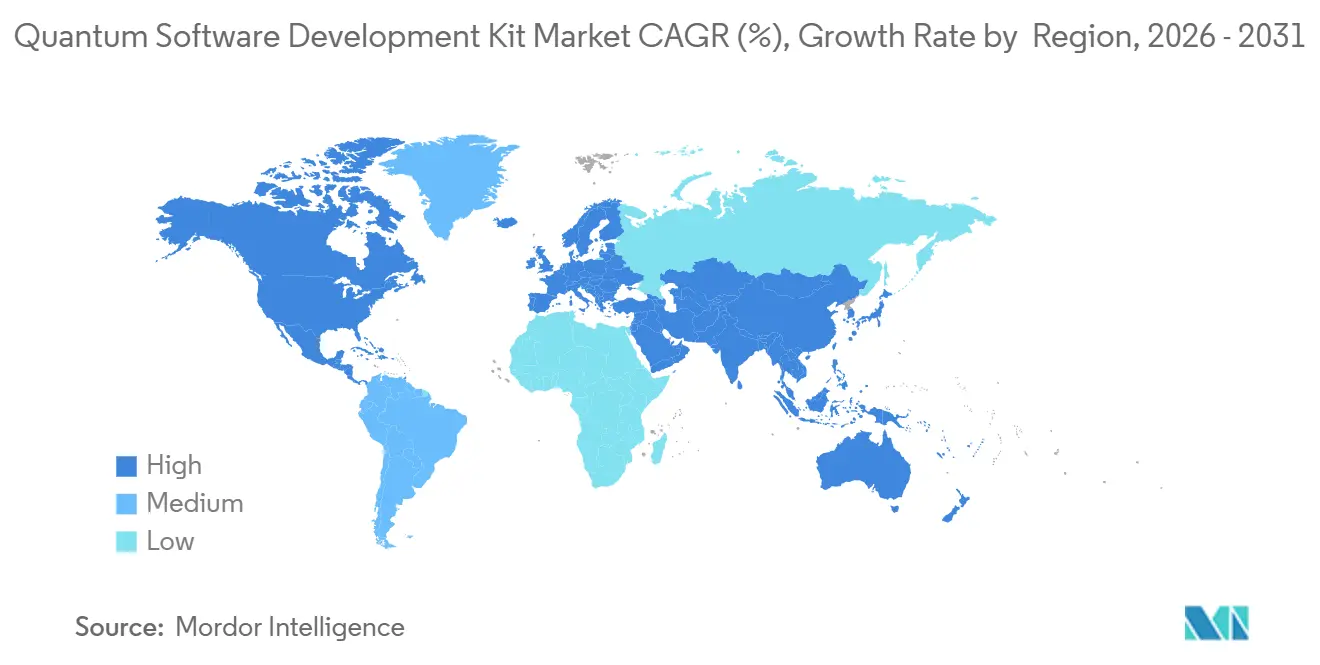
North America held 36.42% of the Quantum Software Development Kit Market share in 2025. The region combined a dense supplier base, deep capital markets, national laboratories, and major research institutions. U.S. Department of Commerce letters of intent totaling USD 2.013 billion in May 2026 strengthened domestic system and software roadmaps. The Department of Energy's Quantum Genesis initiative provided a 2028 target for fault-tolerant computing and an integrated user facility. Canada's role includes Xanadu and the Waterloo research cluster. Mexico remained at an earlier stage, with demand concentrated in academic settings.
Europe had a policy-led development path in the Quantum Software Development Kit Market. EuroHPC inaugurated quantum computers in Poznan in June 2025, Ostrava in September 2025, and Munich in February 2026, requiring compatible software for scientific users. Germany led commercial activity through mandates from Fraunhofer and DLR. The United Kingdom hosted Quantinuum, Riverlane, and Q-CTRL, which offer differentiated tools for compilation, error correction, and control. South America remained at an early stage of commercial development. Brazil had the region's most developed academic infrastructure through the CBPF and the University of São Paulo, but limited capital availability and access to hardware hindered broader adoption.
Asia-Pacific is projected to expand at a 29.16% CAGR through 2031, the fastest regional rate. China allocated RMB 121.8 billion, equivalent to USD 17.5 billion, across 3 regional quantum funds, while Japan directed JPY 50 billion, equivalent to USD 335 million, toward domestic quantum technology industrialization. Japan's program included support for Fujitsu, KDDI, and startup Jij. IBM planned its Amaravati installation for September 2026, which would provide a local access point for Indian pharmaceutical, software, and financial services organizations. South Korea's KAIST and national research programs continued to support academic demand with emerging commercial interest in semiconductors and materials in the quantum software development kit industry. The Middle East and Africa had early demand from the United Arab Emirates Technology Innovation Institute and Saudi Arabia's KAUST, but limited talent availability could delay commercial uptake.

Competitive Landscape
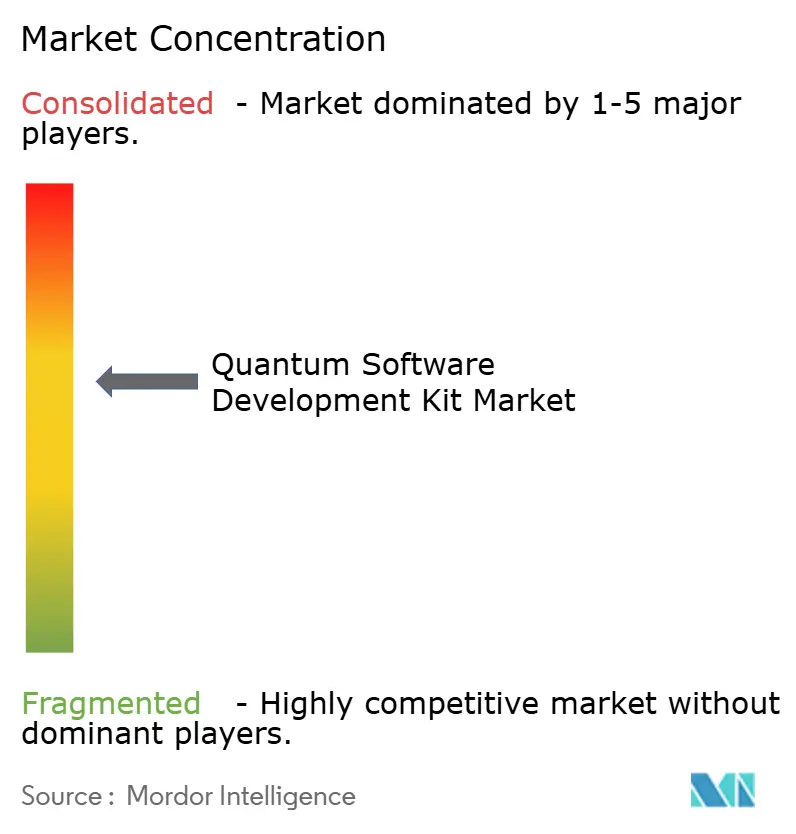
The Quantum Software Development Kit Market is moderately consolidated at the platform level. IBM Qiskit, Google Cirq, Microsoft Q#, Azure Quantum Development Kit, and Amazon Web Services Braket SDK have significant developer visibility through open-source tools, cloud access, and training programs. Their advantage is based on ecosystem depth as well as software features. Qiskit's developer community, PennyLane's integration with data science workflows, and Azure Quantum's enterprise compatibility create barriers to switching for users. IBM completed the end-of-life transition for Qiskit v1. x in June 2026 and released Qiskit v2.5 in July 2026. The company also renamed Qiskit Runtime Service to IBM Quantum Compute Service, linking the open-source SDK to a managed service model.
Hardware-specific optimization continues to counterbalance platform-neutral tools. Rigetti's Cepheus-1-108Q was available through Amazon Braket in April 2026 and supported Braket SDK, CUDA-Q, PennyLane, and Qiskit. The system's native CZ gate compilation can favor tools tailored to its architecture. Quantinuum has a strong specialist position through TKET for cross-platform compilation and InQuanto for quantum chemistry. The company announced a collaboration with HPE in June 2026 to integrate quantum and high-performance computing. It also signed an MOU with Mitsubishi Electric in June 2026 to explore use in industrial design lifecycles.
Competitive strategies include ecosystem partnerships, domain-specific products, and developer training in the quantum software development kit market. Algorithmiq Aurora and Classiq's abstract synthesis layer illustrate efforts to serve specialist use cases above broader software foundations. Quantinuum and BMW Group expanded their collaboration into a multiyear partnership for advanced materials science in May 2026. Quantinuum, Rolls-Royce, Riverlane, and the University of Edinburgh agreed in July 2026 to explore industrial design and simulation workflows. Quantum-HPC middleware remains an open area because no supplier has established a dominant position. The absence of binding international software standards allows contributors to QIR and OpenQASM to affect future requirements.
Quantum Software Development Kit Industry Leaders
IBM Corporation
Google LLC
Amazon Web Services, Inc.
Quantinuum Ltd.
Microsoft Corporation
- *Disclaimer: Major Players sorted in no particular order

Recent Industry Developments
- July 2026: Quantinuum and SoftBank Corp. published a joint white paper, "Quantum Computing Frontiers," mapping commercially relevant quantum use cases against Quantinuum's successive hardware roadmap, Helios, Sol planned for 2027, and Apollo planned for 2029, and examining quantum-AI-HPC convergence for data center infrastructure.
- July 2026: IBM released Qiskit SDK v2.5, introducing a multi-representation compiler framework, dedicated fault-tolerant compilation pipelines for Pauli-based computation and Clifford+T instruction sets, expanded C API control-flow capabilities, and transpiler performance improvements through LightSabre algorithm upgrades. Qiskit v1.x reached end-of-life on June 12, 2026.
- July 2026: Quantinuum, Rolls-Royce, Riverlane, and EPCC, University of Edinburgh's National Supercomputing Centre, signed an agreement to explore quantum computing for industrial workflows including gas turbine design. Quantinuum provided Helios system access and EPCC contributed supercomputing and hybrid workflow integration expertise.
- June 2026: The U.S. Department of Energy announced the Quantum Genesis initiative, targeting the world's first fault-tolerant, scientifically relevant quantum computing capability by 2028 and establishing a National Quantum Supercomputing User Facility integrating quantum and HPC resources.


Global Quantum Software Development Kit Market Report Scope
The quantum software development kit market refers to the ecosystem of specialized software tools, libraries, compilers, and application programming interfaces (APIs) that enable developers, researchers, and organizations to design, simulate, optimize, and execute quantum algorithms. This market encompasses a diverse range of SDK types, including core quantum development platforms, hardware-specific toolkits, transpilers, quantum error correction modules, and hybrid quantum-classical frameworks. Deployed across cloud-based, on-premises, and hybrid environments, these kits cater to a wide array of end users spanning IT, BFSI, healthcare, manufacturing, and academic institutions. By abstracting the underlying complexities of quantum physics and hardware architecture, quantum SDKs allow users to build and test applications for highly complex computational problems, such as quantum machine learning, molecular and materials simulation, drug discovery, and financial modeling. Ultimately, these development kits serve as the critical bridge between theoretical quantum algorithms and practical, executable code, driving the broader commercialization and accessibility of quantum computing technologies.
The Quantum Software Development Kit Market Report is Segmented by Software Development Kit Type (Core Quantum Development, Hardware-Specific, Compiler and Transpiler, Quantum Error Correction, Quantum Control and Calibration, Hybrid Quantum-Classical, Domain-Specific, and Others), Deployment Mode (Cloud-Based, On-Premises, and Hybrid), Application (Optimization, Quantum Machine Learning, Chemistry and Materials Simulation, Drug Discovery, Financial Modeling, Cryptography and Security, Quantum NLP, and Other Applications), End-User Industry (IT and Telecommunication, BFSI, Healthcare and Life Sciences, Retail and E-Commerce, Industrial Manufacturing, Education and Research Institutions, Media and Entertainment, Government and Administration, Energy and Utilities, and Other End-User Industries), and Geography (North America, South America, Europe, Asia-Pacific, and Middle East and Africa). The Market Forecasts are Provided in Terms of Value (USD).
| Core Quantum Development |
| Hardware-Specific |
| Compiler and Transpiler |
| Quantum Error Correction |
| Quantum Control and Calibration |
| Hybrid Quantum-Classical |
| Domain-Specific |
| Other Software Development Kit Types |
| Cloud-Based |
| On-Premises |
| Hybrid |
| Optimization |
| Quantum Machine Learning |
| Chemistry and Materials Simulation |
| Drug Discovery |
| Financial Modeling |
| Cryptography and Security |
| Quantum NLP |
| Other Applications |
| IT and Telecommunication |
| BFSI |
| Healthcare and Life Sciences |
| Retail and E-Commerce |
| Industrial Manufacturing |
| Education and Research Institutions |
| Media and Entertainment |
| Government and Administration |
| Energy and Utilities |
| Other End-User Industries |
| North America | United States | |
| Canada | ||
| Mexico | ||
| South America | Brazil | |
| Argentina | ||
| Rest of South America | ||
| Europe | Germany | |
| United Kingdom | ||
| France | ||
| Russia | ||
| Spain | ||
| Rest of Europe | ||
| Asia-Pacific | China | |
| Japan | ||
| India | ||
| South Korea | ||
| Southeast Asia | ||
| Rest of Asia-Pacific | ||
| Middle East and Africa | Middle East | Saudi Arabia |
| United Arab Emirates | ||
| Rest of Middle East | ||
| Africa | South Africa | |
| Nigeria | ||
| Rest of Africa | ||
| By Software Development Kit Type | Core Quantum Development | ||
| Hardware-Specific | |||
| Compiler and Transpiler | |||
| Quantum Error Correction | |||
| Quantum Control and Calibration | |||
| Hybrid Quantum-Classical | |||
| Domain-Specific | |||
| Other Software Development Kit Types | |||
| By Deployment Mode | Cloud-Based | ||
| On-Premises | |||
| Hybrid | |||
| By Application | Optimization | ||
| Quantum Machine Learning | |||
| Chemistry and Materials Simulation | |||
| Drug Discovery | |||
| Financial Modeling | |||
| Cryptography and Security | |||
| Quantum NLP | |||
| Other Applications | |||
| By End-User Industry | IT and Telecommunication | ||
| BFSI | |||
| Healthcare and Life Sciences | |||
| Retail and E-Commerce | |||
| Industrial Manufacturing | |||
| Education and Research Institutions | |||
| Media and Entertainment | |||
| Government and Administration | |||
| Energy and Utilities | |||
| Other End-User Industries | |||
| By Geography | North America | United States | |
| Canada | |||
| Mexico | |||
| South America | Brazil | ||
| Argentina | |||
| Rest of South America | |||
| Europe | Germany | ||
| United Kingdom | |||
| France | |||
| Russia | |||
| Spain | |||
| Rest of Europe | |||
| Asia-Pacific | China | ||
| Japan | |||
| India | |||
| South Korea | |||
| Southeast Asia | |||
| Rest of Asia-Pacific | |||
| Middle East and Africa | Middle East | Saudi Arabia | |
| United Arab Emirates | |||
| Rest of Middle East | |||
| Africa | South Africa | ||
| Nigeria | |||
| Rest of Africa | |||


Key Questions Answered in the Report
What is the size of the Quantum Software Development Kit Market?
The Quantum Software Development Kit Market is expected to increase from USD 0.54 billion in 2025 to USD 0.64 billion in 2026 and reach USD 1.87 billion by 2031.
What is driving demand for quantum software development kit?
Government funding, open-source development tools, hybrid computing workflows, and enterprise algorithm programs are supporting demand.
Which deployment model has the largest share?
Cloud-Based deployment held 72.36% in 2025 because managed services reduce the need for specialized local hardware infrastructure.
Which application is growing the fastest?
Drug Discovery is projected to expand at a 28.41% CAGR through 2031, supported by molecular simulation and algorithm development activity.
Which region is expected to grow the fastest?
Asia-Pacific is projected to record a 29.16% CAGR through 2031, supported by programs in China, Japan, India, and South Korea.
What are the main barriers to adoption?
Limited hardware availability, variable system performance, talent shortages, fragmented SDKs, and hardware-specific maintenance needs remain important constraints.
Page last updated on:






