
Qatar Lettuce and Strawberry Market Size and Share
Qatar Lettuce and Strawberry Market Analysis by Mordor Intelligence
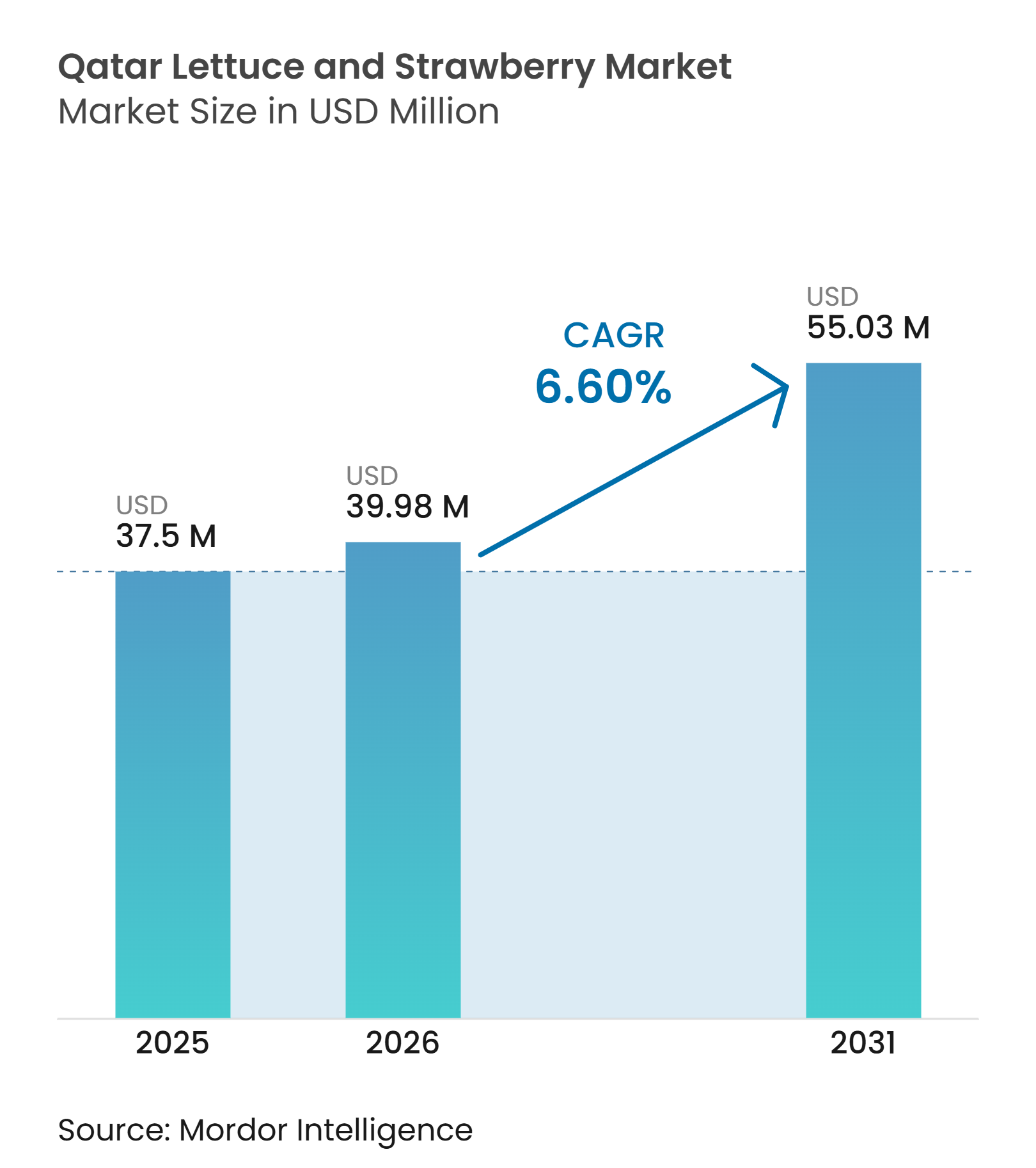
The Qatar Lettuce Strawberry Market size is projected to expand from USD 37.5 million in 2025 and USD 39.98 million in 2026 to USD 55.03 million by 2031, registering a CAGR of 6.60% between 2026 and 2031. The Qatar lettuce and strawberry market is moving toward a more domestic and technology-led supply model as greenhouse farming, hydroponics, and other controlled systems become the practical way to produce these crops in a harsh climate. Government food security policy remains the central support for this shift because it combines output targets, farm support, and distribution access into a single framework. Lettuce is closer to seasonal self-sufficiency, while strawberries still carry a stronger premium and more visible supply gap, which keeps the value mix in the Qatar lettuce and strawberry market uneven across the two crops. Another defining feature of the Qatar lettuce and strawberry market is that it depends on imported seeds, runners, and substrates even as local crop output rises, which means upstream supply resilience still matters as much as farm expansion. Investment is also shifting toward systems that connect crop production with renewable power, which gives operators a stronger case for long-term expansion in the Qatar lettuce and strawberry market.
Key Report Takeaways
- By geography, Doha-linked peri-urban greenhouse belts formed the largest production base, while decentralized expansion across wider agricultural districts represented the fastest structural shift.
Note: Market size and forecast figures in this report are generated using Mordor Intelligence’s proprietary estimation framework, updated with the latest available data and insights as of January 2026.
Market Trends and Insights
Drivers Impact Analysis of Qatar Lettuce and Strawberry Market*
| Driver | (~) % Impact on CAGR Forecast | Geographic Relevance | Impact Timeline |
|---|---|---|---|
| Expansion of controlled-environment farms for leafy greens and berries | +1.8% | Qatar-wide, with concentration in Doha peri-urban zones | Short term (≤ 2 years) |
| Government-backed food security investment and land support | +1.5% | National, with direct gains across all agricultural districts | Medium term (2-4 years) |
| Higher retail demand for fresh, locally grown, pesticide-light produce | +1.2% | National, strongest in modern retail hubs of Doha and Al Rayyan | Short term (≤ 2 years) |
| Water-saving hydroponics and aquaponics improving production economics | +0.9% | National, with spillover relevance across greenhouse farming clusters | Medium term (2-4 years) |
| Cold-chain and wholesale digitization improving route-to-market efficiency | +0.7% | Doha-centered, expanding into wider domestic distribution corridors | Medium term (2-4 years) |
| Year-round demand from food service, modern retail, and premium grocery channels | +0.6% | National, with strongest pull from Doha hospitality and premium retail clusters | Long term (≥ 4 years) |
| Source: Mordor Intelligence | |||
Expansion of Controlled-Environment Farms for Leafy Greens and Berries
The Qatar lettuce and strawberry market is being reshaped by the rapid spread of protected cultivation systems, enabling commercial production in an otherwise restrictive climate. Qatar had 8,420 operational greenhouse units by the end of 2025, and that base has continued to widen in 2026 through state-backed distribution of modern greenhouse units and irrigation systems. Lettuce benefits especially from this shift because hydroponic systems in Qatar have been shown to deliver annual yields of 41 kg per square meter, compared with 3.9 kg per square meter under conventional cultivation[1]. That yield advantage has made lettuce the operational starting point for many new projects in the Qatar lettuce and strawberry market because it turns limited land and water into more dependable output. The same buildout also supports strawberries, even though berries need tighter environmental control and therefore more careful system design. As this farm base expands, the Qatar lettuce and strawberry market is becoming less defined by simple farm count and more by the quality of climate control, energy management, and year-round consistency.
Government-Backed Food Security Investment and Land Support
Public policy remains one of the clearest supports for growth in the Qatar lettuce and strawberry market, as the state not only sets goals but also shapes the operating environment for farms. The National Food Security Strategy 2030 was launched in December 2024 with a clear focus on local production development, strategic reserves management, and trade diversification. That framework targets 55% vegetable self-sufficiency and also supports farms with seeds, fertilizers, pesticides, and packaging materials, thereby lowering entry barriers to protected cultivation. Hassad Food Company strengthened the policy-to-market link in February 2026 when it signed a contract to manage and operate Qatar’s Central Markets, giving the state a stronger hand in the flow of wholesale produce and service quality. This matters for the Qatar lettuce and strawberry market because growers gain a clearer route to market as well as a more visible domestic demand platform. Quality expectations are also rising, which means public support is pushing both output growth and higher operating standards.
Higher Retail Demand for Fresh, Locally Grown, Pesticide-Light Produce
Consumer preference is becoming a stronger commercial force in the Qatar lettuce and strawberry market because buyers are placing more value on freshness, traceability, and lower chemical exposure. The domestic organic farming area rose from 265.2 dunams in 2024 to 813.2 dunams in 2025, which shows a sharp broadening of interest in certified and differentiated produce[2]. That shift helps local lettuce because short shelf life and quality sensitivity make proximity to retail shelves a real advantage. It also helps strawberries because domestic fruit can reach stores with less transit time and less dependence on post-harvest preservation. The result is a more visible premium tier inside the Qatar lettuce and strawberry market, where local produce competes on quality and not only on availability. This pattern gives producers a reason to invest in certification, packaging, and tighter cultivation control instead of relying on volume alone.
Water-Saving Hydroponics and Aquaponics Improving Production Economics
Water efficiency is central to the Qatar lettuce and strawberry market because it directly shapes whether controlled production can scale in a country with severe natural constraints. Research cited in the source draft shows that hydroponic lettuce systems can use 20 liters of water per kilogram of output, compared with 250 liters per kilogram under conventional cultivation. That reduction supports farm economics and national sustainability goals because water use is one of the most limiting factors for local expansion. The push is reinforced by the country’s stated goal of cutting water use per metric ton of crops by 40% by 2030. QAFCO’s demonstration work with Agrico Agriculture Development Co. W.L.L. and Yara showed that precision nutrient delivery can increase output in controlled environments, which builds broader confidence in advanced production systems. In the Qatar lettuce and strawberry market, better water productivity is not a side benefit. It is one of the main reasons greenhouse and hydroponic models continue to attract support.
Restraints Impact Analysis of Qatar Lettuce and Strawberry Market*
| Restraint | (~) % Impact on CAGR Forecast | Geographic Relevance | Impact Timeline |
|---|---|---|---|
| Hyper-arid climate limits open-field cultivation economics | -0.7% | National, most acute in inland and southern agricultural zones | Long term (≥ 4 years) |
| High capital intensity for greenhouse and indoor growing systems | -0.9% | National, with the biggest barriers facing private smallholders | Medium term (2-4 years) |
| Dependence on imported seed, substrate, and controlled-environment inputs | -0.6% | National, with disruption risk centered on air and sea entry points | Medium term (2-4 years) |
| Skilled labor and crop-management constraints for high-yield specialty farming | -0.5% | National, concentrated in advanced controlled-environment operations | Long term (≥ 4 years) |
| Source: Mordor Intelligence | |||
Hyper-Arid Climate Limits Open-Field Cultivation Economics
The climate remains the most significant structural restraint on the Qatar lettuce and strawberry market, as summer conditions limit open cultivation for most of the year. The source draft notes that summer temperatures regularly exceed 45°C and annual rainfall stays below 80 mm, which narrows the practical field production window to the cooler months. That forces most meaningful production into greenhouses, vertical farms, or other protected systems where costs are far higher than in temperate import origins. The Qatar lettuce and strawberry market, therefore, operates under a cost structure shaped by climate adaptation rather than by conventional field agriculture. Even when state support reduces part of that burden, the climate still limits how cheaply and how widely production can expand. Hassad Food Company’s experimental greenhouse project using Korean humidity-based irrigation technology shows that operators are trying to extend the growing season, but the commercial outcome was still under evaluation in the source draft.
High Capital Intensity for Greenhouse and Indoor Growing Systems
The Qatar lettuce and strawberry market also faces a financing challenge because modern production systems require high upfront investment and incur higher operating costs than imported commodity produce. Economic work cited in the source draft estimated greenhouse-grown produce at USD 3.19 per kilogram and vertical-farm output at above USD 3.77 per kilogram in Qatar. Those economics make scale easier for operators with policy backing, secured channels, or stronger balance sheets than for smaller independent farms. Strawberries are especially affected because they need tighter humidity and temperature control than most leafy vegetables. That means the Qatar lettuce and strawberry market can expand, but not every farm can expand at the same pace or with the same risk profile. It also explains why private entry has tended to cluster around better-funded projects rather than spread evenly across the full agricultural base.
*Our forecasts treat driver/restraint impacts as directional, not additive. The impact forecasts reflect baseline growth, mix effects, and variable interactions.
Geography Analysis
Qatar accounted for the full Qatar lettuce and strawberry market in 2026. Within the country, production is concentrated in peri-urban belts near Doha because controlled cultivation works best where farms can access logistics, labor, and end buyers with less delay. The source draft identifies Al Wakrah, Umm Salal, and the Khour corridor as key zones for this greenhouse-led pattern. This makes the Doha-connected farm belt the largest domestic production base in the Qatar lettuce and strawberry market. It also explains why local supply gains have been most visible where protected cultivation and distribution infrastructure can work together.
Domestic output growth has been strong enough to change how geography functions inside the country. Vegetable production reached 75,000 metric tons in 2025 and is on track to reach 120,000 metric tons by the end of 2026, suggesting a much larger protected cultivation footprint than a few years ago. The Ministry of Municipality distributed 1,864 greenhouse units with modern irrigation networks to 715 productive farms in 2026, indicating that the fastest structural shift is the spread of protected cultivation across a wider farm base, rather than only in a few flagship sites. In peak season, local vegetables accounted for up to 98% of demand, indicating that geography in the Qatar lettuce and strawberry market is no longer defined solely by imports into Doha, but also by the local production window that can temporarily meet most demand. That seasonal strength matters most for lettuce, while strawberries still show a clearer year-round gap. As a result, geographic progress is uneven by crop, even though the production map is expanding for both.
The regional setting still matters because Qatar remains part of a wider Gulf fresh produce trade system. The source draft positions the country within a network that still draws heavily on imports from Egypt, Morocco, Jordan, and Turkey, especially outside the cooler domestic production window. That means the Qatar lettuce and strawberry market is becoming more localized in winter and remains more import-linked in hotter months. Organic and regenerative farms also add a second geographic layer by targeting premium urban buyers and reinforcing the value distinction between mainstream and differentiated local produce. Geography in this market, therefore, works on two levels: a production map that is widening across domestic farm districts and a trade map that still fills seasonal gaps when climate limits local output.
Competitive Landscape
The Qatar lettuce and strawberry market consists of a small group of well-supported operators and institutions that set standards, while a larger, more fragmented group of farms and suppliers operates alongside them. Hassad Food Company sits at the center of this structure because it combines a food security role with direct influence over wholesale distribution and sector coordination. The February 2026 contract for the management, operation, and service provision of Qatar’s Central Markets strengthened that position and tied the company more closely to fresh produce flow in the country. The company also became the food security partner for AgriteQ 2026, which reinforced its convening role across agriculture, supply chains, and production technology. This gives the Qatar lettuce and strawberry market a competitive center that is influenced by public strategy as much as by private production scale.
Competition is also being shaped by technology choices rather than by acreage alone. Hassad Food Company’s October 2025 experimental greenhouse project combined Korean humidity-based irrigation technology, renewable energy systems, and advanced sensing to extend the productive season. QAFCO’s demonstration work with Agrico Agriculture Development Co. W.L.L. and Yara showed how precision nutrient delivery can improve yields in controlled systems, which supports confidence in high-efficiency cultivation models. Al Sulaiteen Agricultural and Industrial Complex also moved to test and deploy a proprietary subsurface irrigation system through its partnership with Irigreen, which reflects the same push toward productivity and water efficiency[3]. These moves matter because the Qatar lettuce and strawberry market rewards operators that can combine agronomy, water savings, and quality assurance in one model. The field is therefore competitive, but the strongest advantage is not simply size, it is the ability to run reliable controlled-environment systems at commercial quality.
International suppliers still retain relevance because domestic production does not yet eliminate import needs across the full year. Fresh Del Monte Produce Inc. remained a notable external player in regional fresh produce supply and reported global net sales of USD 4.32 billion for fiscal 2025, which shows the scale advantage that large international distributors bring to Gulf produce trade. At the same time, the Qatar lettuce and strawberry market is creating more room for local operators that can meet premium retail and institutional standards. The main contest is therefore between year-round import reliability and seasonal local freshness, with wholesale access and quality consistency deciding who captures the higher-value channels. This is why strategic moves in the market are centered on distribution control, production technology, and sustainability-linked operating efficiency rather than on simple price competition alone.
Recent Industry Developments in Qatar Lettuce and Strawberry Market
- February 2026: Hassad Food Company signed a contract with the Ministry of Commerce and Industry to manage, operate, and provide services for Qatar's Central Markets, reinforcing its role as the country's primary wholesale distribution hub for fresh produce, including lettuce. The agreement aims to improve the business environment, elevate service quality for traders and consumers, and strengthen Qatar's food security infrastructure.
- February 2026: Hydrovest Technology Trading and Contracting W.L.L secured USD 275,000 (QAR 1 million) to establish a commercial-scale hydroponic lettuce production facility in Birkat Al Awamar, Al Wakrah. The company produces Lettuce Chips and Lettuce Tea from hydroponically cultivated lettuce grown in Doha and was approved for listing in the Qatar Development Bank's Exporter Directory, marking one of Qatar's first ventures linking CEA cultivation with branded consumer products.
- July 2025: Flow Farms, the largest hydroponic vertical farm in Qatar, has become fully operational, supplying pesticide-free leafy greens such as butterhead lettuce and red oak leaf to supermarkets and food outlets across the country. The facility employs a closed-loop hydroponic system that uses approximately 5% of the water required by traditional farming methods, setting a new standard for resource efficiency in Qatar's fresh produce market.
Qatar Lettuce and Strawberry Market Report Scope
Lettuce is a leafy green vegetable with crisp, mild-flavored leaves, widely grown as a staple for salads. Strawberry is a sweet, juicy red fruit dotted with tiny external seeds that grow on low-lying herbaceous plants. The Qatar Lettuce and Strawberry Market Report is Segmented by Production Analysis (Volume), Consumption Analysis (Value and Volume), Import Analysis (Value and Volume), Export Analysis (Value and Volume), Wholesale Price Trend Analysis and Forecast, List of Key Players, and More. The Market Forecasts are Provided in Terms of Value (USD) and Volume (Metric Tons).
Segmentation Overview
| Production Analysis | Production Volume | Area Harvested and Yield | |
| Consumption Analysis (Value and Volume) | |||
| Trade Analysis (Value and Volume) | Import Market Analysis | Import Value and Volume | |
| Key Supplying Markets | |||
| Export Market Analysis | Export Value and Volume | ||
| Key Destinations Markets | |||
| Wholesale Price Trend Analysis and Forecast | |||
| Regulatory Framework | |||
| Logistics and Infrastructure | |||
| Seasonality Analysis | |||
| Strawberries | Production Analysis | Production Volume | |
| Area Harvested and Yield | |||
| Consumption Analysis (Value and Volume) | |||
| Import Value and Volume | |||
| Key Supplying Markets | |||
| Export Value and Volume | |||
| Key Destinations Markets | |||
| Wholesale Price Trend Analysis and Forecast | |||
| Regulatory Framework | |||
| Logistics and Infrastructure | |||
| Seasonality Analysis | |||
| Lettuce | Production Analysis | Production Volume | Area Harvested and Yield | |
| Consumption Analysis (Value and Volume) | ||||
| Trade Analysis (Value and Volume) | Import Market Analysis | Import Value and Volume | ||
| Key Supplying Markets | ||||
| Export Market Analysis | Export Value and Volume | |||
| Key Destinations Markets | ||||
| Wholesale Price Trend Analysis and Forecast | ||||
| Regulatory Framework | ||||
| Logistics and Infrastructure | ||||
| Seasonality Analysis | ||||
| Strawberries | Production Analysis | Production Volume | ||
| Area Harvested and Yield | ||||
| Consumption Analysis (Value and Volume) | ||||
| Import Value and Volume | ||||
| Key Supplying Markets | ||||
| Export Value and Volume | ||||
| Key Destinations Markets | ||||
| Wholesale Price Trend Analysis and Forecast | ||||
| Regulatory Framework | ||||
| Logistics and Infrastructure | ||||
| Seasonality Analysis | ||||
Key Questions Answered in the Report
What is the 2026 size of the Qatar lettuce and strawberry sector?
The Qatar lettuce and strawberry market stood at USD 39.98 million in 2026 and is projected to reach USD 55.03 million by 2031 at a 6.6% CAGR.
Why is lettuce the largest crop segment in Qatar?
Lettuce fits hydroponic and greenhouse systems well because it has a short growth cycle, low water demand, and strong adaptability to controlled temperatures.
Why are strawberries considered the fastest value opportunity in Qatar?
Strawberries still face a local supply gap for much of the year, and domestic fruit can command a premium because of freshness and reduced transit time.
What is driving local production growth in Qatar?
Food security policy, greenhouse expansion, water-saving hydroponics, and better wholesale support are the main forces lifting local output.
How much local vegetable output is projected in 2026?
Local vegetable production is projected to reach 120,000 metric tons by the end of 2026, with self-sufficiency moving above 70% in peak seasons.
What is the biggest barrier to faster expansion?
High production costs remain a key barrier because Qatar depends on climate-controlled farming systems that require significant capital, energy, and imported inputs.