
Purpose-Driven Marketing Services Market Size and Share
Market Overview
| Study Period | 2020 - 2031 |
|---|---|
| Market Size (2026) | USD 15.96 Billion |
| Market Size (2031) | USD 30.14 Billion |
| Growth Rate (2026 - 2031) | 13.56 % |
| Fastest Growing Market | Middle East |
| Largest Market | North America |
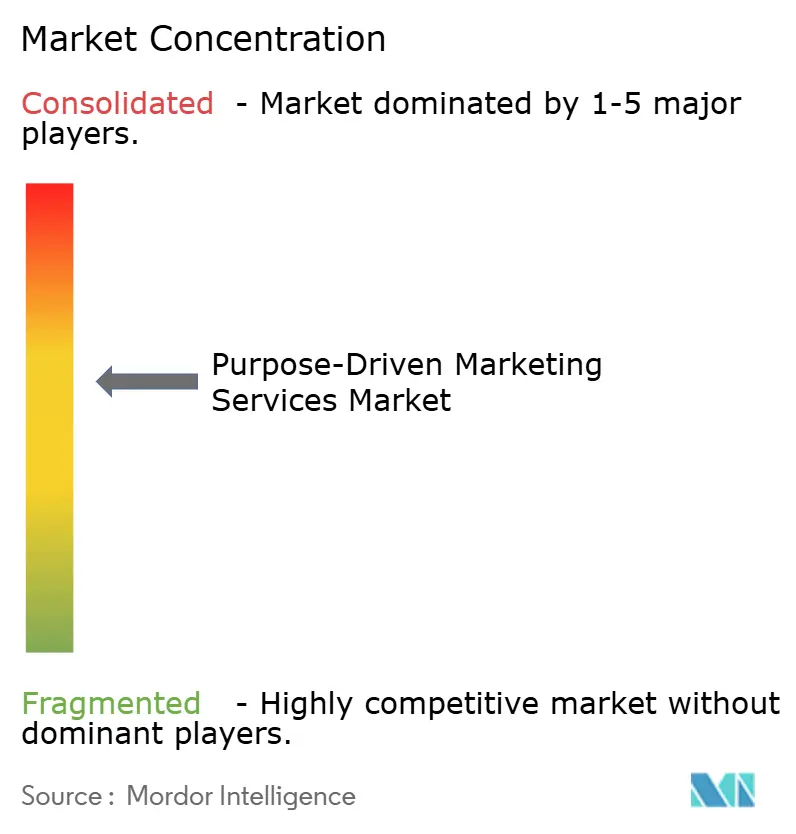
| Market Concentration | Medium |
Major Players *Disclaimer: Major Players sorted in no particular order Image © Mordor Intelligence. Reuse requires attribution under CC BY 4.0. | |
Purpose-Driven Marketing Services Market Analysis by Mordor Intelligence
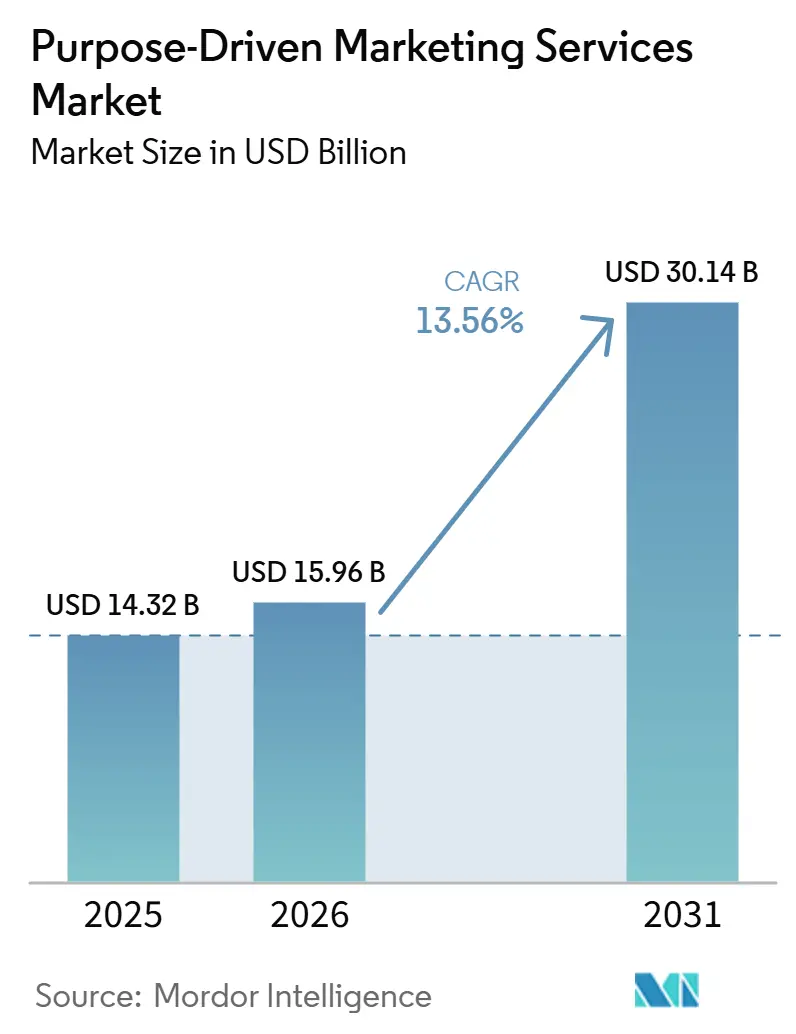
The purpose-driven marketing services market size was valued at USD 14.32 billion in 2025 and estimated to expand from USD 15.96 billion in 2026 to reach USD 30.14 billion by 2031, at a CAGR of 13.56% during the forecast period (2026-2031). Demand is widening as values-based purchasing moves beyond premium consumer categories and influences supplier selection in business-to-business relationships. Sustainability reporting also gives companies a larger body of evidence that must be communicated clearly to customers, investors, employees, and communities. The purpose-driven marketing services market therefore draws spending from marketing, sustainability, and reputation-management budgets, rather than relying only on conventional campaign allocations. Competitive strategies increasingly combine creative delivery with measurement systems, creator networks, and verified evidence to make claims more credible. Higher scrutiny of environmental and social claims makes agencies that can connect proof, narrative, and rapid response more valuable, although weak audience trust can limit campaign effectiveness.
Key Report Takeaways
- By service type, Creative and Content Development held 35.68% of the purpose-driven marketing services market in 2025, while Measurement, Reporting and Optimization is projected to expand at a 14.51% CAGR through 2031.
- By end-use industry, Consumer Goods and Retail accounted for 27.11% of the purpose-driven marketing services market in 2025, while Energy, Utilities and Industrials is expected to expand at a 14.27% CAGR through 2031.
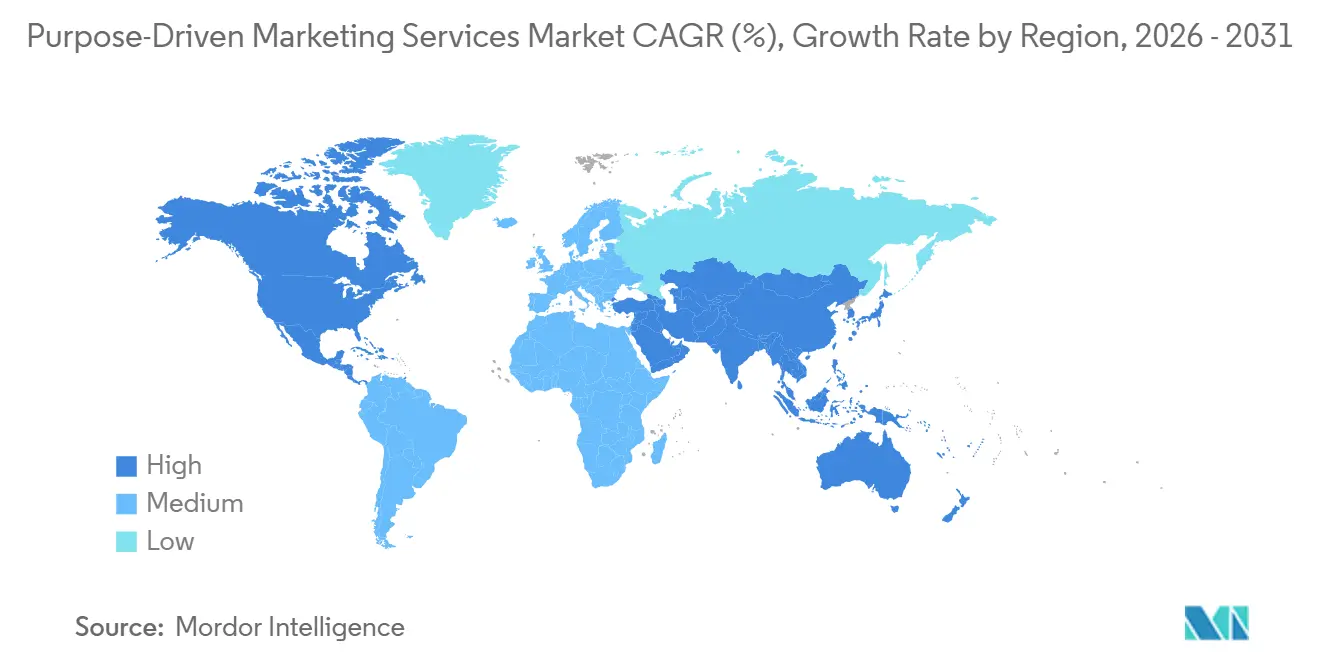
- By geography, North America held 35.38% of the purpose-driven marketing services market in 2025, while the Middle East is projected to expand at a 14.64% CAGR from 2026 to 2031.
Note: Market size and forecast figures in this report are generated using Mordor Intelligence’s proprietary estimation framework, updated with the latest available data and insights as of January 2026.
Market Trends and Insights
Drivers Impact Analysis of Purpose-Driven Marketing Services Market*
| Driver | (~) % Impact on CAGR Forecast | Geographic Relevance | Impact Timeline |
|---|---|---|---|
| Rising Consumer Preference for Values-Aligned Brands | +3.1% | Global, with North America and Europe leading adoption, and faster adoption in the Middle East and Asia-Pacific | Short term (≤ 2 years) |
| Expansion of Sustainability and Disclosure Programs into External Communications | +2.7% | Europe, with early adoption in North America and Asia-Pacific | Medium term (2-4 years) |
| Higher Brand-Reputation Exposure Across Social and Traditional Media | +2.2% | Global, with particular intensity in North America, Europe, and the Middle East | Short term (≤ 2 years) |
| Greater Use of Integrated Digital and Creator-Led Brand Purpose Activation | +1.8% | North America, Asia-Pacific, and the Middle East, with wider adoption in Europe and South America | Short term (≤ 2 years) |
| Anti-Greenwashing Compliance is Increasing Demand for Evidence-Backed Communications | +1.4% | Europe, with effects extending to North America, Australia, and Asia-Pacific | Short term (≤ 2 years) |
| Greenhushing is Creating Catch-Up Demand for Specialist Narrative Development | +1.0% | Global, concentrated in Europe and North America, with emerging demand in core Asia-Pacific markets | Medium term (2-4 years) |
| Source: Mordor Intelligence | |||
Rising Consumer Preference for Values-Aligned Brands
Values alignment now affects more than a narrow group of consumers, and it is also becoming relevant to corporate purchasing decisions. The purpose-driven marketing services market benefits when a brand must explain its social commitments to retail customers and to commercial buyers at the same time. The American Marketing Association New York reported in June 2026 that 80% of corporate business-to-business buyers directed spending toward companies with clear social commitments and accepted a 13% price premium. The same study found that the comparable premium among business-to-consumer buyers was 6%, which makes purpose communication relevant to supplier retention as well as consumer preference.[1] This wider audience creates demand for messages that can support product choice, retailer relationships, procurement reviews, and long-term brand trust. Agencies must still translate broad commitments into specific evidence because a general statement of values is less useful when buyers need to compare suppliers.
Expansion of Sustainability and Disclosure Programs Into External Communications
Mandatory reporting produces large volumes of technical environmental, social, and governance information that often cannot be used directly in customer communication. This creates a recurring role for the purpose-driven marketing services market because compliance documents need clear and credible explanation for audiences outside finance and legal teams. The European Commission established the Corporate Sustainability Reporting Directive framework to standardize sustainability reporting and improve the availability of comparable information for stakeholders.[2] Companies can use verified disclosures as the factual base for consumer, employee, investor, and procurement narratives, but only when the claims remain consistent with reported evidence. The opportunity is strongest where sustainability and communications teams have separate budgets and different approval processes. As more organizations bring reporting into routine operations, specialist agencies can help turn disclosure material into messages that are easier to understand without making the underlying claims broader.
Higher Brand-Reputation Exposure Across Social and Traditional Media
Social platforms have become a central place where corporate purpose claims are tested, challenged, and redistributed. The purpose-driven marketing services market gains relevance when brands need communications that can withstand questions from customers, employees, journalists, and advocacy groups. Faster public reaction has increased the value of preapproved evidence, clear claim boundaries, and response plans that fit the channel where the issue emerges. A claim that cannot be substantiated can create more than negative coverage because online communities can spread examples of inconsistency quickly. This condition places pressure on firms to connect campaign development with reputation monitoring and internal subject-matter review. It also favors agencies that can prepare practical narratives before a controversy arises, rather than relying on a late crisis response after audience confidence has already weakened.
Greater Use of Integrated Digital and Creator-Led Brand Purpose Activation
Creator partnerships give brands another way to explain social and sustainability commitments through local voices and formats that audiences recognize. The purpose-driven marketing services market is affected by this shift because creators can support regional language, cultural context, and community relevance that large standardized campaigns often miss. Creator-led programs can also include conversion tracking, affiliate attribution, and sentiment measurement, which brings more accountability to purpose campaigns. Accenture agreed in June 2026 to acquire Whalar, a creator and social agency that had executed more than USD 600 million in creator campaigns across 40+ countries and 15 languages.[3] The transaction shows that distributed creator capability is being treated as a strategic delivery asset rather than a peripheral media service. Agencies must still protect credibility by matching creators to claims they can explain honestly and by ensuring that campaign statements are supported by the client’s operations.
Restraints Impact Analysis of Purpose-Driven Marketing Services Market*
| Restraint | (~) % Impact on CAGR Forecast | Geographic Relevance | Impact Timeline |
|---|---|---|---|
| Consumer Skepticism and Greenwashing Backlash | -1.5% | Europe and North America, with effects spreading to Asia-Pacific and South America | Short term (≤ 2 years) |
| Budget Pressure and Longer Payback Than Performance Marketing | -1.2% | Global | Medium term (2-4 years) |
| Fragmented Impact Data Ownership Slows Campaign Deployment | -0.8% | Global, with higher complexity in Asia-Pacific and South America | Medium term (2-4 years) |
| Polarization Risk Raises Executive Approval Friction | -0.4% | North America and Europe, with effects in some Middle East markets | Short term (≤ 2 years) |
| Source: Mordor Intelligence | |||
Consumer Skepticism and Greenwashing Backlash
Consumer skepticism makes it harder for brands to use broad environmental language without supporting evidence. The purpose-driven marketing services market must respond to a higher compliance threshold as regulators restrict generic claims and audiences challenge statements that appear disconnected from business practice. Directive (EU) 2024/825 applies from September 27, 2026, and it limits unverified generic environmental claims and claims based only on carbon-offset schemes. The European Commission also stated that more than 53% of green claims examined before the intervention were vague, misleading, or unfounded. Brands therefore need substantiation processes before campaign approvals, which can increase cost and extend timing. This restraint also creates demand for agencies that can narrow claims appropriately, use third-party verification, and communicate progress without overstating outcomes.
Budget Pressure and Longer Payback Than Performance Marketing
Purpose-led programs face budget pressure because many companies assess marketing expenditure through short reporting cycles. Paid search, programmatic display, and social commerce can provide rapid attribution, while purpose campaigns often require 18 to 36 months before changes in loyalty, pricing power, or net promoter scores become visible. The purpose-driven marketing services market is also affected when sustainability, communications, and marketing teams own separate budgets and must approve a single campaign together. This can slow deployment during a reputational event, even when a company has the required evidence and creative material. The case for investment becomes stronger when purpose communication can support supplier retention and commercial account relationships, instead of relying only on broad brand-equity measures. Measurement, Reporting and Optimization can reduce this pressure if providers connect campaign activity to customer lifetime value and account-level outcomes without presenting unsupported causal claims.
*Our forecasts treat driver/restraint impacts as directional, not additive. The impact forecasts reflect baseline growth, mix effects, and variable interactions.
Purpose-Driven Marketing Services Market Segment Analysis
By Service Type:
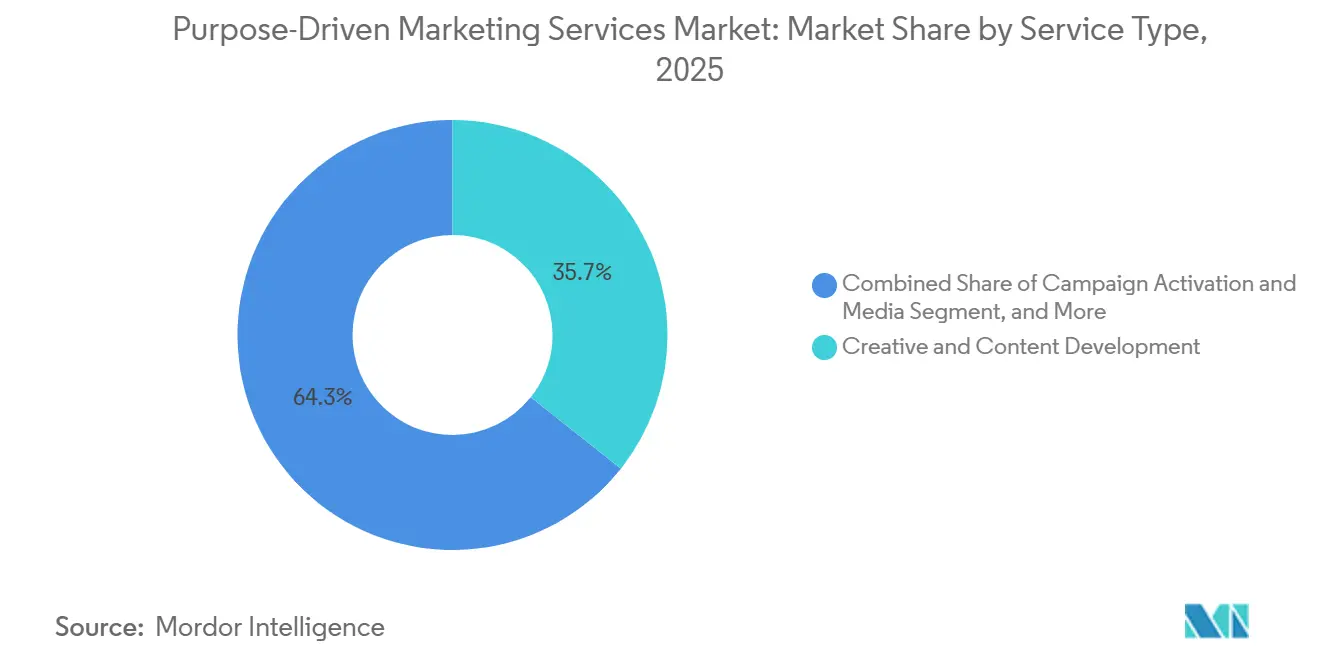
Creative Delivery Anchors Spend While Measurement AcceleratesCreative and Content Development held 35.68% of the purpose-driven marketing services market share in 2025, making it the largest service category. Every purpose-led engagement needs some form of creative execution, even when the assignment begins with strategy, reporting, or media planning. This work converts sustainability data, corporate commitments, and community activity into formats that customers, employees, and investors can understand. It can include social-first visual content, purpose films, stakeholder materials, and consumer-facing explanations of verified initiatives. Walmart published its FY2026 ESG Report in July 2026, showing how purpose narratives can sit alongside disclosures on customer value, community investment, and supply-chain sustainability. Such reports still require careful translation when the intended audience is a retail customer rather than an institutional reader. Strategy and Advisory commands high fees per engagement because positioning, materiality assessment, and stakeholder mapping require specialized judgment. Its volume is lower than creative delivery because companies often commission this work for annual reviews or major repositioning exercises. Campaign Activation and Media then carries approved messages across paid, owned, and earned channels, with creators becoming more important for younger audiences. This sequence makes creative delivery a persistent spending category across the purpose-driven marketing services industry.
Measurement, Reporting and Optimization is projected to expand at a 14.51% CAGR through 2031, the fastest rate among service types in the purpose-driven marketing services market. Brands need a clearer connection between the content they produce, the evidence behind their statements, and the business results used to justify future budgets. Publicis Groupe acquired AdgeAI in March 2026 to add real-time content measurement and predictive performance capabilities to its production offering. The move reflects the greater importance placed on measurement infrastructure, not only creative capacity. Product-level sustainability claims in consumer goods also require verification that is consistent with ISO 14024 principles when clients use environmental labels. Agencies that can organize evidence, monitor results, and explain limitations can improve client confidence in continued spending. Purpose-linked creator work is also adopting conversion, affiliate, and sentiment metrics, narrowing the gap between brand programs and performance marketing. The category remains important because reliable measurement helps internal teams defend activity that otherwise may appear difficult to attribute. This service line can also make campaign optimization more disciplined by identifying which claims, channels, and audiences produce a credible response.

By End-Use Industry:
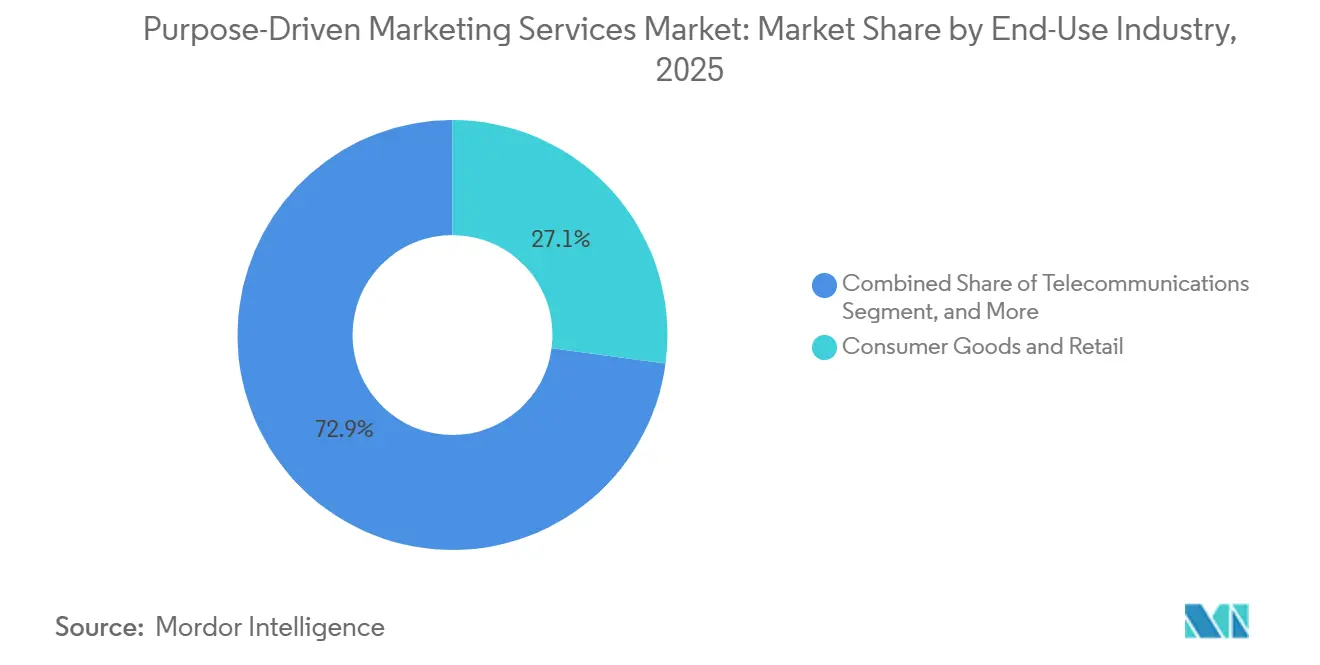
Retail Anchors Demand as Energy Sector TransitionsConsumer Goods and Retail accounted for 27.11% of the purpose-driven marketing services market share in 2025. These companies depend heavily on brand equity in categories where product differences can be difficult to maintain over time. Sustainability credentials, community investment, and values-led identity can support loyalty and premium positioning when they are backed by credible actions. Retailers also communicate with consumers frequently, which increases their exposure to questions about sourcing, pricing, packaging, labor, and product claims. Financial Services held the second-largest position because banks, insurers, and asset managers use sustainability-linked communications to address investor expectations under reporting frameworks. Regulatory sensitivity around impact claims can lengthen approval cycles in this field, particularly where statements affect investment or product decisions. Healthcare and Life Sciences campaigns focus on patient access, health equity, and clinical-trial transparency, but advertising rules limit the range of emotional claims. Telecommunications brands use connectivity access and digital-equity narratives, especially where network expansion has a visible community benefit. Travel, Hospitality and Leisure reduced purpose spending during 2024 and 2025 as companies focused more on demand recovery and less on long-term brand positioning. The purpose-driven marketing services market therefore has different campaign timing and claim requirements across each client category.
Energy, Utilities and Industrials is expected to expand at a 14.27% CAGR through 2031, the fastest rate among end-use industries. The sector is moving from defensive sustainability disclosure toward purpose programs aimed at consumers, procurement teams, and institutional investors. J.D. Power reported in 2026 that only 41% of electric utility customers recalled any communication from their provider, while communication practices contributed to weaker brand appeal. This gap matters as utilities and industrial firms undertake major infrastructure and transition programs that require public understanding and trust. Companies need narratives that explain technical investment without making claims that go beyond verified operational progress. CSRD-related transparency obligations also encourage industrial firms to turn emissions and supply-chain information into procurement-facing material. This expands demand beyond listed companies because first-tier suppliers may need evidence-based communication to remain included in customer supply chains. Agencies with technical subject knowledge can support this work by making complex information accessible to nontechnical audiences. The sector’s progression depends on long-term consistency because a single campaign cannot establish confidence in capital-intensive transition commitments. This makes the purpose-driven marketing services industry relevant to ongoing stakeholder communication rather than only product promotion.
Geography Analysis
North America Purpose-Driven Marketing Services Market
North America held 35.38% of the purpose-driven marketing services market size in 2025. The region has a deep pool of specialist agencies, high per-campaign spending by multinational companies, and well-developed creator and data capabilities. Large companies headquartered in New York and Chicago support demand for complex campaigns that must serve consumer, investor, and employee audiences. Mexico also acts as an activation hub for bilingual programs that address North American audiences. The Omnicom and Interpublic combination completed in November 2025 and created a company with combined revenue exceeding USD 25 billion, increasing the scale available for large regional assignments. This raises the competitive threshold for mid-sized agencies on large accounts and encourages independent firms to specialize. Canada adds demand through carbon-pricing communications and financial-services activity involving sustainability-themed investor communications.
Europe and South America Purpose-Driven Marketing Services Market
Europe remains the principal regulatory demand center in the purpose-driven marketing services market because sustainability reporting and consumer-protection rules influence how companies explain purpose claims. Directive (EU) 2024/825 applies from September 27, 2026, while national implementation adds further detail to advertising and consumer-protection requirements. The region creates demand for agencies that can align technical reporting, legal review, and stakeholder communication without weakening the evidence behind a claim. South America has a smaller but expanding role, particularly in consumer goods, financial inclusion, and retail communication. Brazil recorded BRL 37.9 billion in digital advertising expenditure in 2025, equivalent to USD 6.9 billion using the stated 2025 average exchange rate. Agencies cannot assume that a global sustainability framework will receive the same response across South America because local consumer priorities differ. Regional adaptation is therefore necessary when a campaign seeks credible engagement rather than broad reach alone.
MEA and APAC Purpose-Driven Marketing Services Market
The Middle East is projected to expand at a 14.64% CAGR from 2026 to 2031, the fastest regional rate in the purpose-driven marketing services market. The UAE and Saudi Arabia support demand through national transformation programs that place long-term brand investment alongside development priorities. Saudi Arabia’s Vision 2030 framework provides a setting for purpose campaigns linked to national development goals. Expo 2030 visibility commitments also support longer-term communication planning. Asia-Pacific is the second-fastest-growing regional cluster, supported by local capability building among global networks and purpose-led activity in India. Africa remains at an earlier stage, with demand concentrated among multinational subsidiaries and pan-African financial-services brands in South Africa, Nigeria, and Kenya. These markets require governance-focused narratives for institutional stakeholders as well as consumer communications.
Competitive Landscape
The purpose-driven marketing services market is moderately concentrated at the holding-company level and fragmented in specialist delivery. Omnicom completed its acquisition of Interpublic Group in November 2025, combining networks including McCann Worldgroup, Ogilvy, Weber Shandwick, and Acxiom with Omnicom’s portfolio. The combined company has the scale to serve global accounts that need creative delivery, public relations, data, and media capabilities in one structure. Publicis Groupe has used acquisitions to build measurement and data capabilities, including AdgeAI and its May 2026 agreement to acquire LiveRamp for USD 2.167 billion. This strategy places data collaboration and attribution alongside creative capability. Specialist firms such as Salterbaxter and Futerra, together with purpose-focused public relations networks, retain an advantage where clients value dedicated sustainability methodology. Their relevance is strongest on briefs where credibility and technical understanding matter more than holding-company scale.
Technology is becoming an important differentiator in the purpose-driven marketing services market because agencies need to connect campaign activity with evidence and audience outcomes. WPP acquired InfoSum in April 2025 and integrated the platform into its Open Intelligence offering for privacy-safe data connectivity. This supports measurement across data sources without relying on deprecated cookie-based identity approaches. WPP also announced its Elevate28 plan in February 2026, which targets GBP 500 million, equivalent to USD 677 million, in annualized gross cost savings and reorganizes operations around 4 core units. Dentsu revised its 2030 Sustainability Strategy in June 2025 into a 2030 Value Creation Strategy that integrates sustainability objectives into client delivery and operational performance. These moves show that major groups are treating purpose capability as part of integrated client work, not as a separate advisory line. Smaller firms must show that they can translate audited sustainability information into creative work while also demonstrating campaign performance.
Accenture Song agreed to acquire Whalar in June 2026, bringing creator and social capability into a consulting-led marketing model. Its earlier acquisition of Superdigital in August 2025 also strengthened social-first delivery. This adds a competitive model that sits between traditional agency groups and narrow sustainability specialists. Havas is building sustainability advisory capabilities to position itself as an integrated alternative to these groups. The central capability gap remains the link between CSRD-grade data and consumer narratives that are engaging without overreaching. Agencies that can combine subject expertise, creative skill, and measurement discipline are better positioned for complex assignments.
Purpose-Driven Marketing Services Industry Leaders
-
WPP plc
-
Publicis Groupe S.A.
-
Omnicom Group Inc.
-
Accenture plc
-
Dentsu Group Inc.
- *Disclaimer: Major Players sorted in no particular order
Purpose-Driven Marketing Services Market Companies Covered in this Report
- Accenture plc
- Publicis Groupe S.A.
- Omnicom Group Inc.
- WPP plc
- Dentsu Group Inc.
- Havas N.V.
- The Interpublic Group of Companies, Inc.
- Daniel J. Edelman Holdings, Inc.
- FleishmanHillard Inc.
- Weber Shandwick, Inc.
- Porter Novelli, LLC
- Burson Global, LLC
- Merkle Inc.
- VML Group LLC
- Ogilvy Group LLC
- McCann Worldgroup, LLC
- Landor Associates International Limited
- Salterbaxter Limited
- Futerra Sustainability Communications Ltd.
- Matter Unlimited
Recent Industry Developments in Purpose-Driven Marketing Services Market
- July 2026: Walmart published its FY2026 ESG Report, embedding purpose-led narratives around customer savings of USD 1.64 billion on fresh food price gaps, community investment, and supply chain sustainability into its core investor and consumer communications, reinforcing the consumer goods sector's treatment of purpose reporting as a primary stakeholder-relations vehicle.
- June 2026: Accenture agreed to acquire Whalar, a leading creator and social agency, from Whalar Group, integrating it into Accenture Song. Whalar had executed over USD 600 million in creator campaigns across 40+ countries and 15 languages. The transaction is described by the parties as the largest creator-economy acquisition to date, and it marks management consulting firms' direct entry into scaled purpose-aligned creator delivery.
- May 2026: Publicis Groupe entered into an agreement to acquire LiveRamp, a global data collaboration platform, for a total enterprise value of USD 2.167 billion in an all-cash transaction, a 29.8% premium to LiveRamp's May 15 closing share price. The deal targets data co-creation infrastructure for AI-driven marketing and will allow Publicis to link purpose campaign activations to first-party audience outcomes with greater attribution precision, raising the Groupe's 2027-2028 net revenue growth objectives.
- April 2026: Publicis Groupe signed a definitive agreement to acquire 160over90, a global sports and culture-first agency. The acquisition builds on Publicis Sports' 2025 acquisitions of Adopt and Bespoke and a strategic partnership with Magic Johnson Enterprises, creating an integrated platform for purpose-driven campaigns anchored in sports, culture, and talent ecosystems.
Global Purpose-Driven Marketing Services Market Report Scope
The Global Purpose-Driven Marketing Services Market comprises professional marketing, branding, advertising, communications, and consulting services that help organizations align their commercial objectives with social, environmental, ethical, and community-focused causes to build stronger stakeholder relationships and enhance brand value.
The Purpose-Driven Marketing Services Market Report is Segmented by Service Type (Strategy and Advisory, Creative and Content Development, Campaign Activation and Media, Measurement, Reporting and Optimization), End-Use Industry (Consumer Goods and Retail, Financial Services, Healthcare and Life Sciences, Telecommunications, Energy, Utilities and Industrials, Travel, Hospitality and Leisure, and Other End-Use Industries), and Geography (North America, South America, Europe, Asia-Pacific, Middle East, and Africa). The Market Forecasts are Provided in Terms of Value (USD).
Segmentation Overview
| Strategy and Advisory |
| Creative and Content Development |
| Campaign Activation and Media |
| Measurement, Reporting and Optimization |
| Consumer Goods and Retail |
| Financial Services |
| Healthcare and Life Sciences |
| Telecommunications |
| Energy, Utilities and Industrials |
| Travel, Hospitality and Leisure |
| Other End-Use Industries |
| North America | United States |
| Canada | |
| Mexico | |
| South America | Brazil |
| Argentina | |
| Chile | |
| Rest of South America | |
| Europe | United Kingdom |
| Germany | |
| France | |
| Italy | |
| Spain | |
| Netherlands | |
| Russia | |
| Rest of Europe | |
| Asia-Pacific | China |
| Japan | |
| India | |
| South Korea | |
| Australia | |
| Singapore | |
| Rest of Asia-Pacific | |
| Middle East | United Arab Emirates |
| Saudi Arabia | |
| Turkey | |
| Rest of Middle East | |
| Africa | South Africa |
| Nigeria | |
| Kenya | |
| Rest of Africa |
| By Service Type | Strategy and Advisory | |
| Creative and Content Development | ||
| Campaign Activation and Media | ||
| Measurement, Reporting and Optimization | ||
| By End-Use Industry | Consumer Goods and Retail | |
| Financial Services | ||
| Healthcare and Life Sciences | ||
| Telecommunications | ||
| Energy, Utilities and Industrials | ||
| Travel, Hospitality and Leisure | ||
| Other End-Use Industries | ||
| By Geography | North America | United States |
| Canada | ||
| Mexico | ||
| South America | Brazil | |
| Argentina | ||
| Chile | ||
| Rest of South America | ||
| Europe | United Kingdom | |
| Germany | ||
| France | ||
| Italy | ||
| Spain | ||
| Netherlands | ||
| Russia | ||
| Rest of Europe | ||
| Asia-Pacific | China | |
| Japan | ||
| India | ||
| South Korea | ||
| Australia | ||
| Singapore | ||
| Rest of Asia-Pacific | ||
| Middle East | United Arab Emirates | |
| Saudi Arabia | ||
| Turkey | ||
| Rest of Middle East | ||
| Africa | South Africa | |
| Nigeria | ||
| Kenya | ||
| Rest of Africa | ||
Key Questions Answered in the Report
What is the purpose-driven marketing services market size?
The purpose-driven marketing services market size was USD 15.96 billion in 2026 and is forecast to reach USD 30.14 billion by 2031 at a 13.56% CAGR.
What service type leads purpose-driven marketing services?
Creative and Content Development led with 35.68% share in 2025, while Measurement, Reporting and Optimization is the fastest-growing service type at a 14.51% CAGR.
Which end-use sector is expanding fastest?
Energy, Utilities and Industrials is projected to expand at a 14.27% CAGR through 2031 as companies increase evidence-based stakeholder communication.
Which region has the largest share?
North America held 35.38% in 2025, supported by specialist agencies, multinational budgets, creator capability, and data infrastructure.
Which region is forecast to expand fastest?
The Middle East is projected to expand at a 14.64% CAGR from 2026 to 2031, supported by UAE and Saudi Arabian transformation programs.
Why is measurement important for purpose-led campaigns?
Measurement helps companies connect campaign activity with verified evidence and audience outcomes, which can support budget decisions and reduce unsupported claims.