
Pulsed Eddy Current Imaging Systems Market Size and Share
Market Overview
| Study Period | 2020 - 2031 |
|---|---|
| Market Size (2026) | USD 181.89 Million |
| Market Size (2031) | USD 283.75 Million |
| Growth Rate (2026 - 2031) | 9.31 % |
| Fastest Growing Market | Middle East and Africa |
| Largest Market | Asia-Pacific |
| Market Concentration | Medium |
Major Players *Disclaimer: Major Players sorted in no particular order Image © Mordor Intelligence. Reuse requires attribution under CC BY 4.0. | |
Pulsed Eddy Current Imaging Systems Market Analysis by Mordor Intelligence
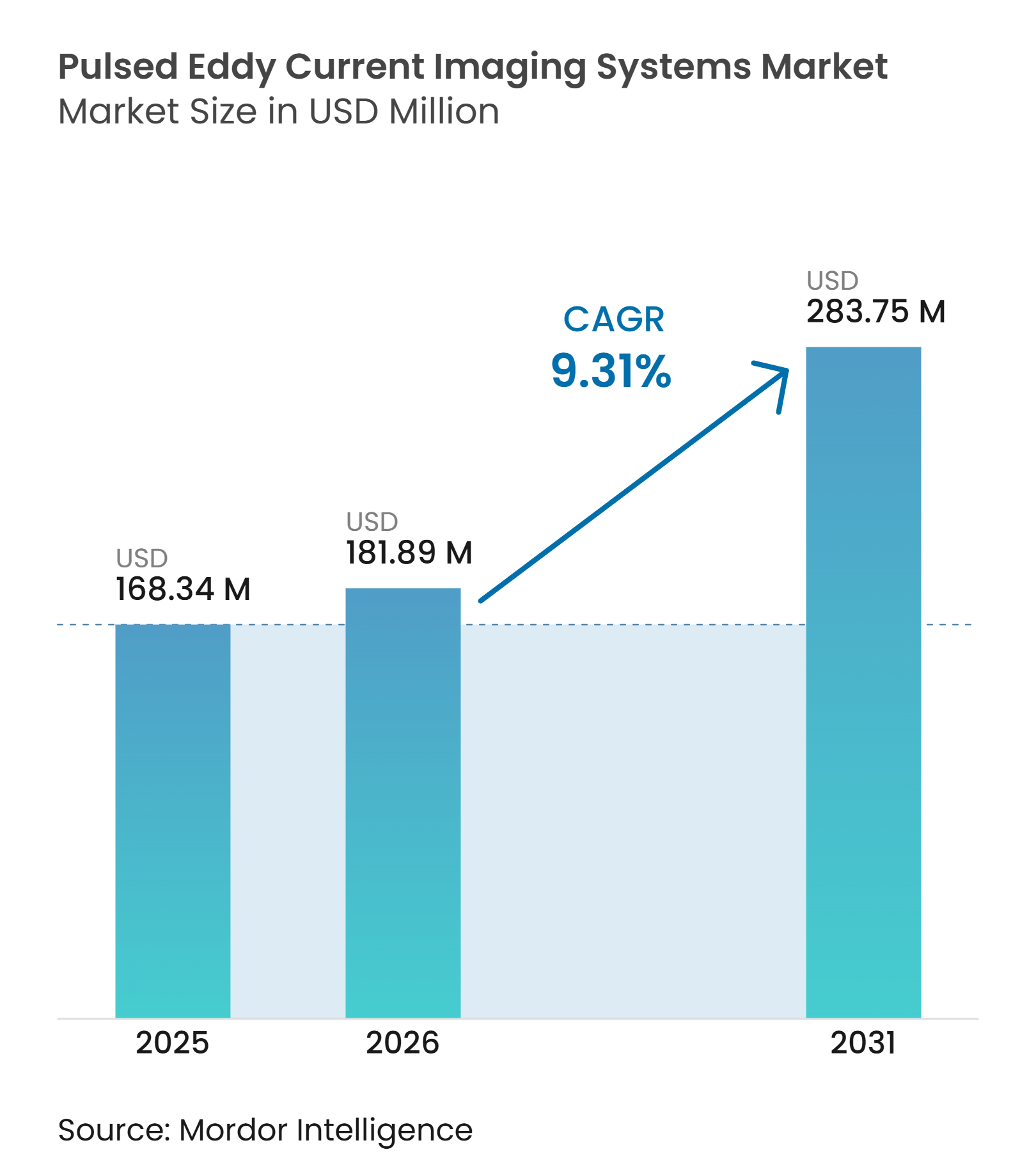
The pulsed eddy current imaging systems market size was valued at USD 168.34 million in 2025 and is estimated to increase from USD 181.89 million in 2026 to USD 283.75 million by 2031, at a CAGR of 9.31% during the forecast period 2026-2031. The pulsed eddy current imaging systems market serves operators of aging insulated piping and vessels that require wall-thickness screening without removing insulation. This method supports inspection programs where conventional insulation removal and ultrasonic testing can be disruptive and costly. API guidance identifies corrosion under insulation as a material damage mechanism for fixed equipment, which supports sustained inspection demand. The pulsed eddy current imaging systems market also benefits from wider use of digital inspection records in asset integrity programs. Equipment suppliers and service providers are positioning portable systems, encoded imaging, and managed inspection services around this operational need.
Key Report Takeaways
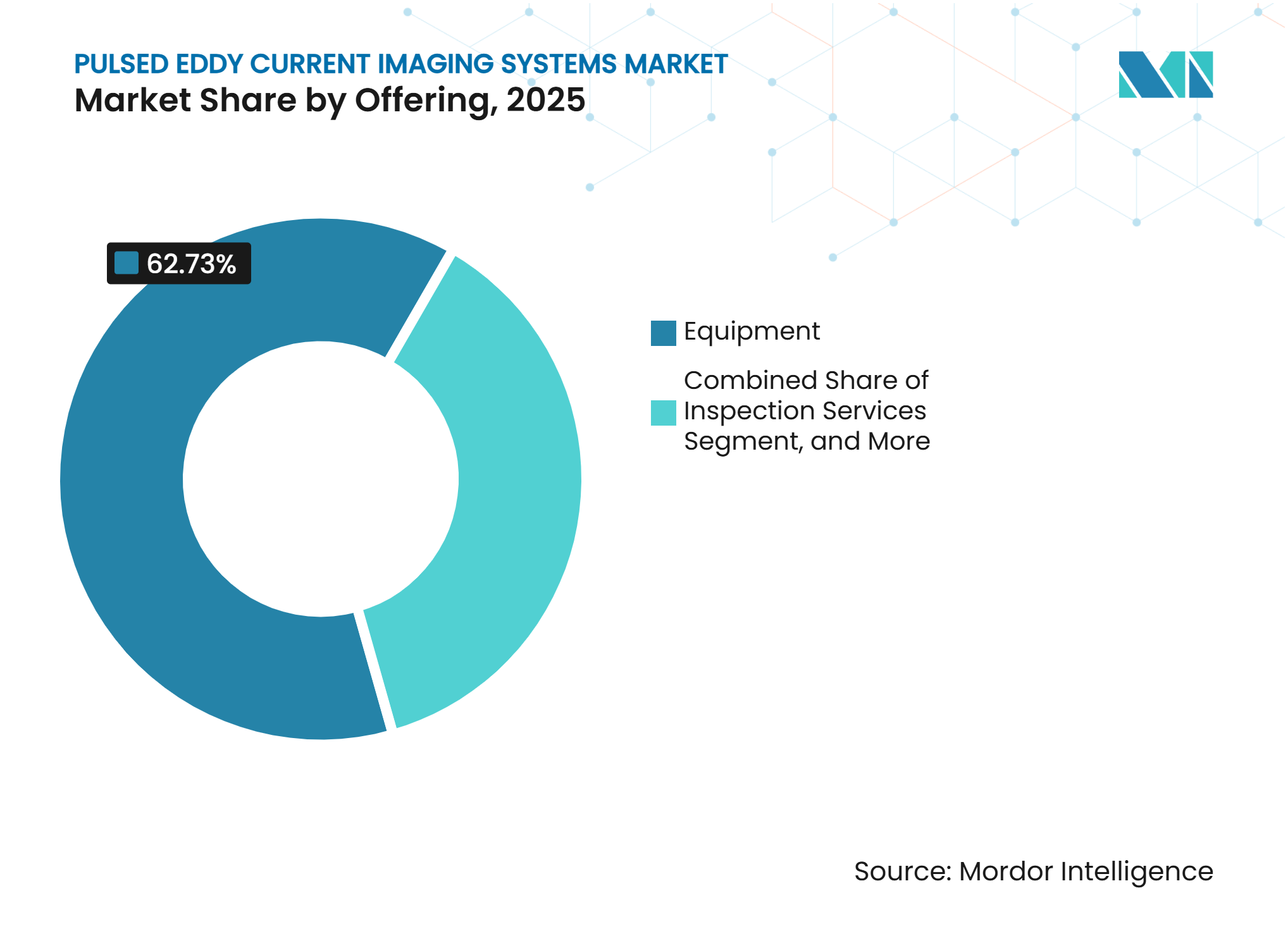
- By offering, equipment held 62.73% of revenue in 2025, while inspection services are projected to expand at an 11.27% CAGR through 2031.
- By system type, single-element PEC systems held 41.67% of revenue in 2025, while automated and encoded PEC imaging systems are projected to expand at a 12.39% CAGR through 2031.
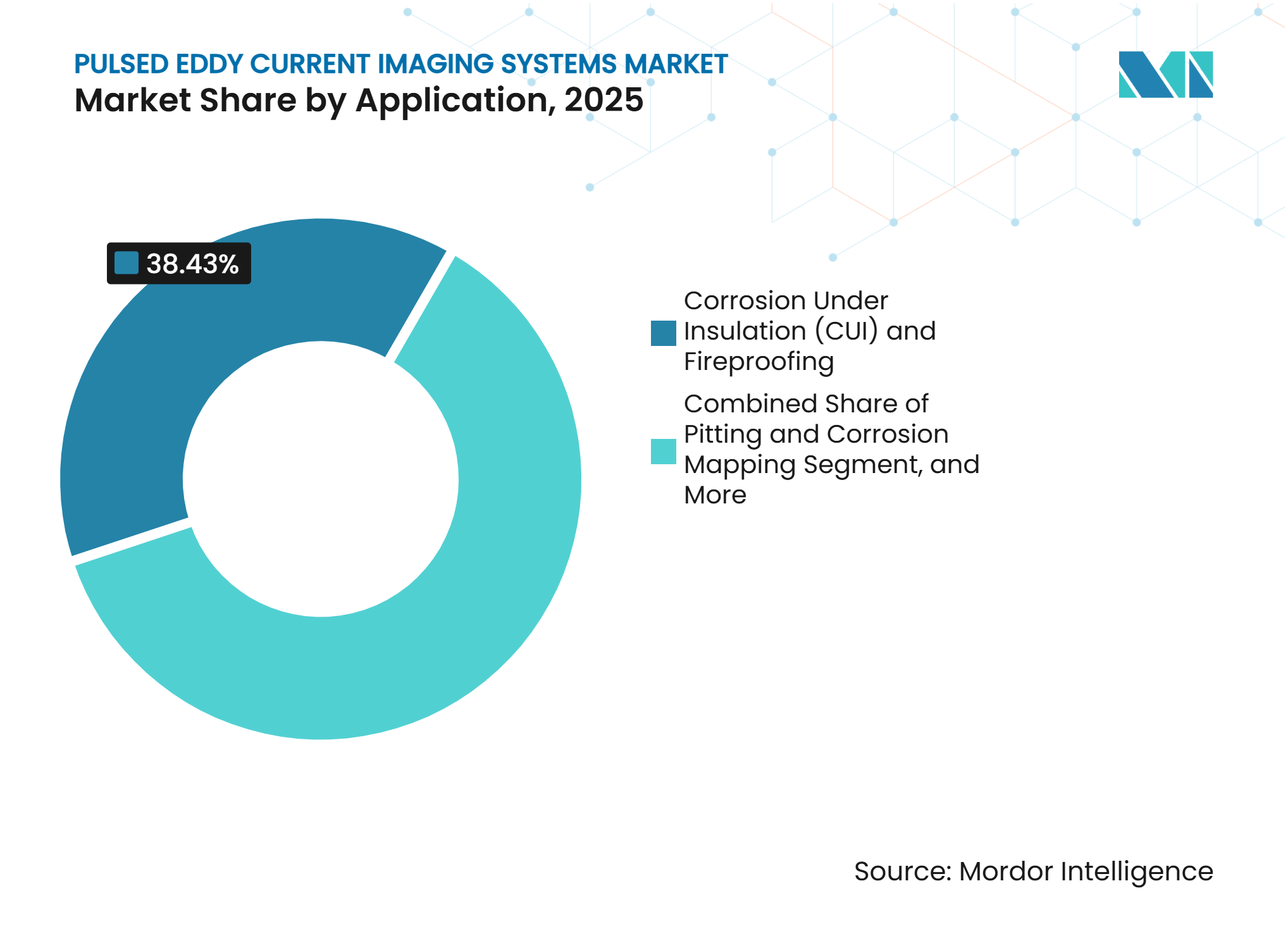
- By application, CUI and fireproofing held 38.43% of revenue in 2025, while hidden-flaw and crack detection are projected to expand at a 12.83% CAGR through 2031.
- By end-user industry, oil and gas held 34.86% of revenue in 2025, while aerospace and defense are projected to expand at a 12.16% CAGR through 2031.
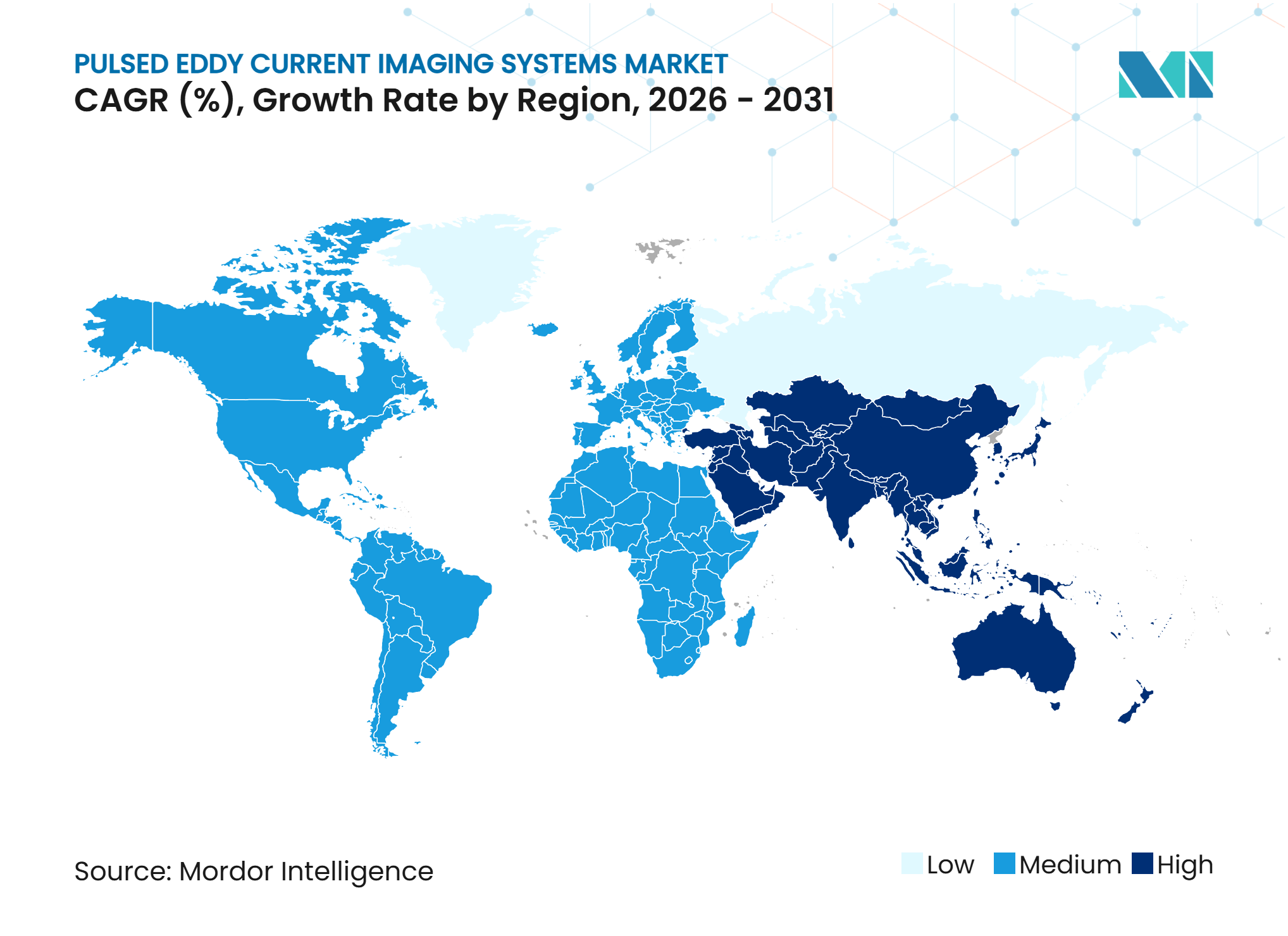
- By geography, Asia-Pacific held 35.74% of revenue in 2025, while the Middle East and Africa are projected to expand at an 11.79% CAGR through 2031.
Note: Market size and forecast figures in this report are generated using Mordor Intelligence’s proprietary estimation framework, updated with the latest available data and insights as of January 2026.
Market Trends and Insights
Drivers Impact Analysis of Pulsed Eddy Current Imaging Systems Market*
| Driver | (~) % Impact on CAGR Forecast | Geographic Relevance | Impact Timeline |
|---|---|---|---|
| Aging Industrial Assets and Corrosion Inspection Backlogs | +2.6% | Global | Long term (≥ 4 years) |
| In-Service Inspection Without Insulation Removal | +2.1% | Global | Medium term (2-4 years) |
| Asset Integrity and Safety Requirements | +1.6% | North America and Europe, spillover to Asia-Pacific | Long term (≥ 4 years) |
| Digital C-Scan Imaging and Inspection Productivity | +1.1% | Global | Medium term (2-4 years) |
| Array-Probe Adoption for Large-Area Coverage | +0.7% | Asia-Pacific core, spillover to the Middle East and Africa | Medium term (2-4 years) |
| Portable PEC for Remote and Hard-to-Access Assets | +0.5% | Middle East, Asia-Pacific, and Africa | Short term (≤ 2 years) |
| Source: Mordor Intelligence | |||
Aging Industrial Assets and Rising Corrosion Inspection Backlogs
The pulsed eddy current imaging systems market draws recurring demand from oil and gas, power, and chemical facilities with aging insulated assets. A substantial installed base of insulated piping remains exposed to corrosion under insulation. API identifies moisture-related corrosion under insulation within the 0°C to 175°C operating range as a major mechanism for fixed-equipment damage.[1] Operators can delay capital projects, but integrity work remains important when equipment condition creates safety and operating risks. Deferred inspection campaigns have left some facilities with overlapping reinspection requirements across several asset classes. A 2026 review identified petrochemical, liquefied natural gas, and liquid hydrogen assets as priority areas for the development of pulsed eddy current technology.
Expansion of In-Service Inspection Without Insulation Removal
The pulsed eddy current imaging systems market benefits when operators need to inspect equipment while it remains in service. Removing insulation from a refinery circuit can incur substantial per-campaign costs and may require a partial shutdown. PEC can screen through nonconductive insulation and fireproofing, reducing the number of locations that require direct follow-up testing. MFE stated that its screening workflow typically identifies 5 to 15 locations for confirmatory ultrasonic testing from every 100 PEC screening points. MFE launched the PulsePro in February 2026 for in-service CUI screening, with an operating range from -200°C to 800°C and an integrated EMAT probe for ultrasonic testing handoff. These capabilities make the pulsed eddy current imaging systems market relevant to facilities that want to limit insulation removal, surface preparation, and process interruption.
Tightening Asset Integrity and Safety Requirements
The pulsed eddy current imaging systems market is supported by inspection rules that require documented procedures and qualified personnel. ASME Section V’s 2025 edition covers requirements for nondestructive examination procedures and personnel qualification. API RP 583 provides a framework for assessing corrosion under insulation and fireproofing risks by temperature, moisture exposure, and construction characteristics. These requirements make qualified inspection processes more important for insulated equipment that cannot be measured directly without strip-out. North America and Europe widely apply such frameworks, while similar qualification practices are becoming increasingly relevant in the Gulf Cooperation Council countries and Southeast Asia. Renewal cycles for certification and integrity management can help preserve inspection demand during periods of weaker investment.
Digital C-Scan Imaging and Faster Inspection Productivity
The pulsed eddy current imaging systems market is changing as digital C-scan systems produce two-dimensional thickness maps during inspection. These records can shorten field routines and provide a clearer view of corrosion distribution than manual point measurements. Encoded scans also help technicians link findings to equipment location and inspection history. Digital outputs can be transferred into SAP PM and IBM Maximo systems for corrosion-rate and remaining-life assessments. Focused array research is also improving signal quality for difficult inspection conditions. A 2026 study reported a 13.9 dB improvement in outer-wall detection signal-to-noise ratio at 100 mm lift-off for a focused array magnetized PEC sensor compared with a traditional single-coil design.
Restraints Impact Analysis of Pulsed Eddy Current Imaging Systems Market*
| Restraint | (~) % Impact on CAGR Forecast | Geographic Relevance | Impact Timeline |
|---|---|---|---|
| Average-Footprint Measurement and Small-Pit Undersizing | -1.4% | Global | Long term (≥ 4 years) |
| Shortage of Qualified PEC Analysts and Inspectors | -1.1% | North America and Europe | Medium term (2-4 years) |
| Calibration Dependence Across Lift-Off, Cladding, and Geometry | -0.8% | Global | Long term (≥ 4 years) |
| Limited Defect Discrimination Near Edges, Straps, and Metallic Obstructions | -0.5% | Global | Long term (≥ 4 years) |
| Source: Mordor Intelligence | |||
Average-Footprint Measurement and Small-Pit Undersizing
The pulsed eddy current imaging systems market faces a technical limitation: PEC measures average thickness over the probe footprint. The footprint can span 50 to 100 mm in diameter, which can understate a small, deep pit. A location with severe localized pitting can therefore show lower wall loss than the true local condition. Operators use PEC as a screening method and perform confirmatory ultrasonic testing at locations requiring closer assessment. Reducing the probe footprint can reduce penetration depth, so hardware changes alone do not solve the resolution tradeoff. Array configurations and improved signal processing are intended to narrow this gap, as evidenced by research on focused array sensors.
Shortage of Qualified PEC Analysts and Inspectors
The pulsed eddy current imaging systems market depends on personnel who can interpret signals from varied equipment conditions. PEC analysis requires understanding signal morphology, lift-off correction, cladding interference, and geometry-related noise. ISO 9712 and ASNT CP-105 qualification practices require documented field experience for relevant inspection work. This requirement cannot be replaced simply by purchasing more instruments or increasing training budgets. The shortage of experienced analysts can limit the number of inspections each deployed system can complete. It also supports demand for specialist inspection service providers that already maintain qualified analyst teams.
*Our forecasts treat driver/restraint impacts as directional, not additive. The impact forecasts reflect baseline growth, mix effects, and variable interactions.
Pulsed Eddy Current Imaging Systems Market Segment Analysis
By Offering:
Equipment Leads While Inspection Services Advance FastestEquipment held 62.73% of the pulsed eddy current imaging systems market share in 2025. The category includes handheld single-element scanners, multichannel array consoles, and automated encoded trolley systems. Operator procurement programs and rental-fleet replacement cycles supported equipment demand. In-house inspection teams often purchase systems when recurring asset coverage justifies ownership. Equipment rental gives midsize operators access to advanced capability without a full capital commitment. This option is useful when inspection frequency does not support permanent ownership. The pulsed eddy current imaging systems industry includes calibration, training, and data-analysis services alongside instrument supply. Those service lines matter because an instrument without qualified users cannot deliver field inspection capacity.
Inspection services are projected to expand at an 11.27% CAGR from 2026 to 2031. Operators are moving toward managed CUI screening contracts that place more delivery responsibility with specialist providers. MISTRAS received a December 2025 NDT services award for Woodside’s USD 17.5 billion Louisiana LNG terminal project. The scope covered radiography, magnetic particle testing, liquid penetrant testing, positive material identification, ultrasonic testing, and leak testing. Such assignments show the value of providers that can offer multiple methods under a single quality framework. Bundled contracts can combine equipment, certified inspectors, digital data delivery, and CMMS integration. This structure raises the entry requirements for smaller firms that cannot provide a complete package. The pulsed eddy current imaging systems market gives established service teams a route to recurring screening work. It also allows asset owners to use specialist skills without expanding their permanent inspection staff.



By System Type:
Automation Changes the PEC Technology StackSingle-element PEC systems held 41.67% of the pulsed eddy current imaging systems market share in 2025. Their portability, lower acquisition cost, and simpler operation support continued use in field inspections. These systems are particularly relevant for smaller operator budgets and developing-market deployments. Technicians can use them where manual screening remains more practical than a motorized platform. Multichannel and PEC array systems provide greater coverage for larger inspection campaigns. They sit between single-probe tools and fully automated systems in terms of capability and cost. The pulsed eddy current imaging systems market continues to require simple field tools when access conditions or budget constraints limit automation. These tools also provide a familiar entry point for operators beginning PEC programs.
Automated and encoded PEC imaging systems are projected to expand at a 12.39% CAGR from 2026 to 2031. Encoder synchronization produces C-scan records that can improve repeatability across large inspection areas. Automated systems are suited to campaigns where consistent scan coverage and digital documentation are essential. Integrated PEC and eddy current systems support bimetal composite pipelines and heat exchangers that need inner-wall and outer-wall characterization. A 2025 study validated magnetically saturated PECT for detecting inner-liner collapse in bimetal composite underground gas storage pipelines and reported a 15.9 dB inner-wall signal-to-noise ratio. JFE Steel introduced Scan-WALKER in March 2025 for wireless inspection of large-diameter steel pipework using magnetized eddy current sensors. The system supports remote screening without scaffolding. These developments point to rising interest in encoded and remotely operated inspection workflows. The pulsed eddy current imaging systems industry can use such platforms where manual coverage is slow or unsafe.
By Application:
CUI Supports Demand While Crack Detection ExpandsCUI and fireproofing held 38.43% of the pulsed eddy current imaging systems market share in 2025. API RP 571 identifies corrosion under insulation as a major damage mechanism affecting fixed equipment API.ORG. API RP 583 also provides risk-based guidance for managing CUI and fireproofing corrosion API.ORG. PEC is useful for insulated pipework and vessels where conventional thickness measurement requires removing the insulation. General wall loss and thickness assessment support corrosion rate modeling and retirement planning. Pitting and corrosion mapping use C-scan images to show the distribution of deterioration on tank floors and vessel shells. The pulsed eddy current imaging systems market, therefore, remains linked to practical corrosion screening needs in refinery and petrochemical operations. Its use is strongest where operators need coverage across broad insulated surfaces.
Hidden-flaw and crack detection are projected to expand at a 12.83% CAGR from 2026 to 2031. This application extends the use of PEC to aerospace and structural inspection work. A 2025 IEEE study examined a PEC- and giant magnetoresistive-sensor approach for detecting flaws in riveted multilayer aircraft joints. The work addressed the difficulty of detecting concealed defects in complex multilayer structures. Aerospace applications have distinct airworthiness requirements under the EASA and FAA frameworks. These requirements differ from the corrosion-under-insulation programs used by oil and gas operators. Other applications include subsea pipeline inspection through concrete weight coatings. An AMPP publication described approaches for inspecting unpiggable offshore and subsea pipelines. The pulsed eddy current imaging systems market can address these applications when defect dimensions and coating conditions are suitable for the inspection method.

By End-User Industry:
Oil and Gas Leads While Aerospace and Defense AdvanceOil and gas held 34.86% of the pulsed eddy current imaging systems market share in 2025. Upstream, midstream, and downstream sites contain extensive insulated pipework. These assets are exposed to CUI risk within the 0°C to 175°C operating range identified in API guidance. Petrochemical and chemical processing facilities have similar asset types and corrosion profiles. Power generation also creates recurring requirements around steam headers, boilers, and heat-recovery circuits. Marine and offshore operators use advanced inspection techniques for subsea pipelines and related assets. Nuclear power, automotive, manufacturing, and construction represent smaller applications. Their demand often follows integrity events or specific regulatory requirements.
Aerospace and defense are projected to expand at a 12.16% CAGR from 2026 to 2031. This segment requires nonintrusive inspection methods to detect hidden cracks and fatigue in safety-critical multilayer structures. Fixed-wing fleets enter mid-life inspection intervals that require detailed assessment without unnecessary disassembly. Research from the Royal Military College of Canada examined PEC inspection of F-35 Lightning II inner wing spars and aircraft fasteners. The work considered differential coil probes and principal component analysis for subsurface crack discrimination. Military infrastructure also includes missile silos, radar towers, hangars, and structural steel. These assets may be subject to CUI requirements similar to those in industrial facilities. Operational security constraints can favor methods that minimize intrusive access. The pulsed eddy current imaging systems market is most relevant where asset availability and nondestructive access are both important.
Geography Analysis
Asia-Pacific held 35.74% of the pulsed eddy current imaging systems market share in 2025. The region combines substantial industrial asset scale with increasing inspection technology adoption. China’s downstream petrochemical buildout added substantial volumes of insulated piping. Japan has a mature inspection culture and continuing interest in automated inspection equipment. JFE Steel’s Scan-WALKER supports remote screening of large-diameter steel pipework.
North America and Europe account for the largest combined revenue base in the pulsed eddy current imaging systems market. Established integrity management practices and recurring inspection requirements support their demand. ASME Section V’s 2025 edition reinforced the importance of qualified nondestructive examination procedures. North American activity is concentrated in the Permian Basin, the Gulf Coast refining corridor, and Canadian oil sands. European providers also serve offshore wind platforms and aging LNG import infrastructure. South America remains an earlier-stage market, although Brazil’s pre-salt offshore activity supports selective marine and offshore demand.[2]
The Middle East and Africa are projected to expand at an 11.79% CAGR through 2031. Saudi Arabia’s industrial diversification initiatives have continued to support petrochemical investments across the Jubail and Yanbu industrial corridors, strengthening demand for related industrial equipment and services. In the United Arab Emirates, aligning equipment certification practices with ISO 9712 can streamline compliance requirements and facilitate market entry for global inspection service providers.
Competitive Landscape
Market Concentration
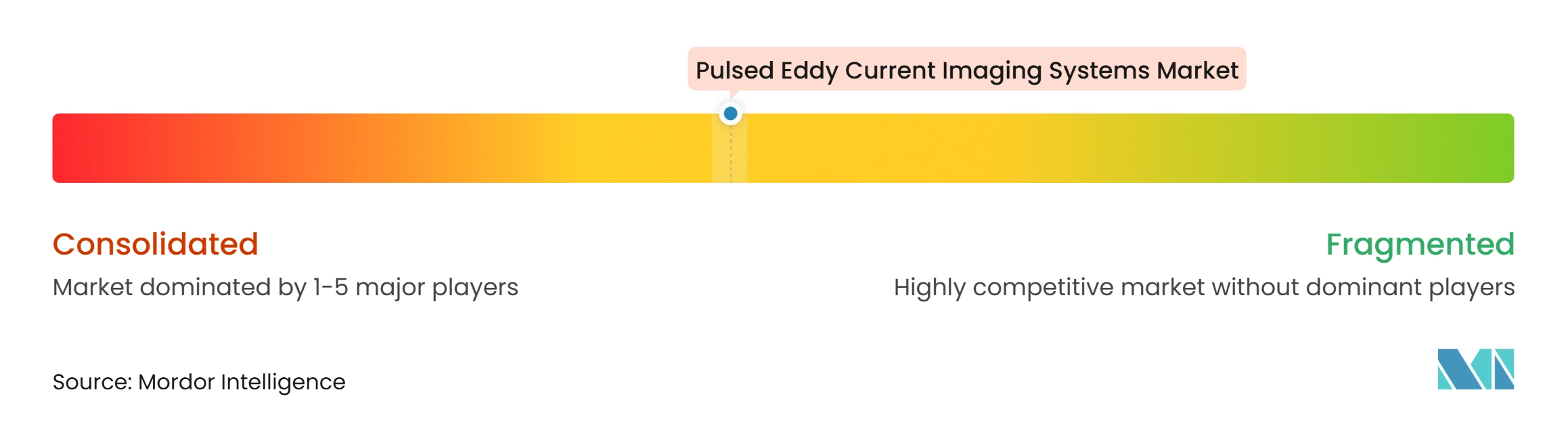
The pulsed eddy current imaging systems market is moderately concentrated among instrument manufacturers. Eddyfi Technologies, now part of ESAB, Olympus Corporation, and Zetec, hold established technology positions. The inspection-services layer is more fragmented and includes Bureau Veritas, SGS, Intertek, TÜV Rheinland, and specialist operators. ESAB signed a definitive agreement to acquire Eddyfi Technologies for USD 1.45 billion in February 2026. The transaction places Lyft PEC and PECA array platforms within a broader portfolio of fabrication and inspection workflows.
SGS completed its Applied Technical Services acquisition in January 2026, adding 2,100 specialists in North American testing, inspection, calibration, and forensics. SGS stated that the transaction advanced 80% toward its objective of doubling North American sales by 2027.[3] Bureau Veritas agreed to acquire LotusWorks in April 2026, extending its presence in critical-asset commissioning and quality assurance. These actions support competition based on geographic reach, qualified personnel, and multi-method inspection capability. The pulsed eddy current imaging systems market favors providers that combine specialized PEC work with established client relationships.
Focused array magnetized PEC research combines multicoil excitation, differential reception, and DC-bias magnetization for localized corrosion detection. Compliance requirements under ASME Section V and ISO 9712 favor providers with documented procedures and certified analyst pools. Drone-delivered PEC and automated crawlers remain areas where bundled hardware-service models are still developing. The competitive environment combines established equipment specialists with broader inspection providers.
Pulsed Eddy Current Imaging Systems Industry Leaders
-
Eddyfi Technologies
-
MISTRAS Group, Inc.
-
TUV Rheinland AG
-
General Electric Company
-
Ether NDE Limited
- *Disclaimer: Major Players sorted in no particular order
Pulsed Eddy Current Imaging Systems Market Companies Covered in this Report
- Eddyfi Technologies
- MISTRAS Group, Inc.
- General Electric Company
- Olympus Corporation
- TUV Rheinland AG
- Ether NDE Limited
- Zetec Inc.
- Ashtead Technology Ltd.
- Rohmann GmbH
- Waygate Technologies (Baker Hughes Company)
- UniWest Corporation
- MFE Inspection Solutions
- TSC Inspection Systems
- Voliro AG
- ROSEN Group
- TÜV NORD AG
- Bureau Veritas SA
- Intertek Group plc
- Applus+ Services, S.A.
- SGS SA
- IRISNDT Inc.
- Vincotte International SA
Recent Industry Developments in Pulsed Eddy Current Imaging Systems Market
- July 2026: Eddyfi Technologies released Lyft Software version 2.6R11, maintaining its PEC data acquisition and analysis platform roadmap under ESAB ownership and signaling continuity in product development for existing Lyft and PECA users globally.
- April 2026: Bureau Veritas signed an agreement to acquire Lotusworks, a global leader in mission-critical asset commissioning and quality assurance, for EUR 300 million (USD 346.10), thereby establishing a new data center and semiconductor inspection platform and reflecting the TIC sector's expansion beyond traditional oil-and-gas addressable markets.
- February 2026: ESAB Corporation and Eddyfi Technologies signed a definitive acquisition agreement valued at CAD 2 billion (USD 1.45 billion) in cash, with USD 318 million in fully committed equity, and the transaction is expected to close in mid-2026, subject to regulatory approvals.
- January 2026: SGS completed the acquisition of Applied Technical Services following all regulatory clearances, adding 2,100 North American testing, inspection, calibration, and forensics specialists and advancing 80% of SGS's target to double its North American sales by 2027.
Global Pulsed Eddy Current Imaging Systems Market Report Scope
The Pulsed Eddy Current Imaging Systems Market comprises revenue generated from the sale, rental, integration, calibration, and operation of equipment and services that use transient electromagnetic pulses to detect, estimate, map, and image wall-thickness loss, corrosion, and hidden flaws in electrically conductive, primarily ferromagnetic, structures. Pulsed eddy current (PEC) systems analyze the decay of induced eddy currents to estimate relative or average wall thickness, often through insulation, fireproofing, coatings, cladding, deposits, or other non-conductive coverings. This enables non-contact or low-preparation screening of pipes, vessels, tanks, structural members, and other assets without removing insulation or exposing the underlying metal.
The Pulsed Eddy Current Imaging Systems Market Report is Segmented by Offering (Equipment, Inspection Services, Equipment Rental, and Calibration, Training and Data Analysis Services), System Type (Single-Element PEC Systems, Multi-Channel / PEC Array Systems, Integrated PEC + Eddy Current Systems, and Automated / Encoded PEC Imaging Systems), Application (Corrosion Under Insulation (CUI) and Fireproofing, General Wall-Loss and Thickness Assessment, Pitting and Corrosion Mapping, Hidden-Flaw and Crack Detection, and Other Applications), End-User Industry (Oil and Gas, Petrochemical and Chemical Processing, Power Generation, Aerospace and Defense, Marine and Offshore, Manufacturing and Heavy Equipment, Automotive and Transportation, Construction and Public Infrastructure, Nuclear Power, and Other End-User Industries), and Geography (North America, South America, Europe, Asia-Pacific, and Middle East and Africa). The Market Forecasts are Provided in Terms of Value (USD).
Segmentation Overview
| Equipment |
| Inspection Services |
| Equipment Rental |
| Calibration, Training and Data Analysis Services |
| Single-Element PEC Systems |
| Multi-Channel / PEC Array Systems |
| Integrated PEC + Eddy Current Systems |
| Automated / Encoded PEC Imaging Systems |
| Corrosion Under Insulation (CUI) and Fireproofing |
| General Wall-Loss and Thickness Assessment |
| Pitting and Corrosion Mapping |
| Hidden-Flaw and Crack Detection |
| Other Applications |
| Oil and Gas |
| Petrochemical and Chemical Processing |
| Power Generation |
| Aerospace and Defense |
| Marine and Offshore |
| Manufacturing and Heavy Equipment |
| Automotive and Transportation |
| Construction and Public Infrastructure |
| Nuclear Power |
| Other End-User Industries |
| North America | United States | |
| Canada | ||
| Mexico | ||
| South America | Brazil | |
| Argentina | ||
| Rest of South America | ||
| Europe | Germany | |
| United Kingdom | ||
| France | ||
| Italy | ||
| Spain | ||
| Rest of Europe | ||
| Asia-Pacific | China | |
| Japan | ||
| India | ||
| South Korea | ||
| ASEAN | ||
| Rest of Asia-Pacific | ||
| Middle East and Africa | Middle East | Saudi Arabia |
| United Arab Emirates | ||
| Turkey | ||
| Rest of the Middle East | ||
| Africa | South Africa | |
| Nigeria | ||
| Rest of Africa | ||
| By Offering | Equipment | ||
| Inspection Services | |||
| Equipment Rental | |||
| Calibration, Training and Data Analysis Services | |||
| By System Type | Single-Element PEC Systems | ||
| Multi-Channel / PEC Array Systems | |||
| Integrated PEC + Eddy Current Systems | |||
| Automated / Encoded PEC Imaging Systems | |||
| By Application | Corrosion Under Insulation (CUI) and Fireproofing | ||
| General Wall-Loss and Thickness Assessment | |||
| Pitting and Corrosion Mapping | |||
| Hidden-Flaw and Crack Detection | |||
| Other Applications | |||
| By End-User Industry | Oil and Gas | ||
| Petrochemical and Chemical Processing | |||
| Power Generation | |||
| Aerospace and Defense | |||
| Marine and Offshore | |||
| Manufacturing and Heavy Equipment | |||
| Automotive and Transportation | |||
| Construction and Public Infrastructure | |||
| Nuclear Power | |||
| Other End-User Industries | |||
| By Geography | North America | United States | |
| Canada | |||
| Mexico | |||
| South America | Brazil | ||
| Argentina | |||
| Rest of South America | |||
| Europe | Germany | ||
| United Kingdom | |||
| France | |||
| Italy | |||
| Spain | |||
| Rest of Europe | |||
| Asia-Pacific | China | ||
| Japan | |||
| India | |||
| South Korea | |||
| ASEAN | |||
| Rest of Asia-Pacific | |||
| Middle East and Africa | Middle East | Saudi Arabia | |
| United Arab Emirates | |||
| Turkey | |||
| Rest of the Middle East | |||
| Africa | South Africa | ||
| Nigeria | |||
| Rest of Africa | |||
Key Questions Answered in the Report
What is the pulsed eddy current imaging systems market size?
The market was valued at USD 168.34 million in 2025 and is estimated at USD 181.89 million in 2026. It is forecast to reach USD 283.75 million by 2031 at a 9.31% CAGR.
What is driving adoption of pulsed eddy current imaging systems?
Demand is supported by corrosion under insulation screening, aging insulated assets, and the need to avoid insulation removal during in-service inspection.
Which offering leads demand for pulsed eddy current imaging systems?
Equipment held 62.73% of revenue in 2025. Inspection services are projected to expand faster, at an 11.27% CAGR through 2031.
Which application has the strongest position for PEC inspection?
CUI and fireproofing held 38.43% of revenue in 2025 because PEC can screen insulated equipment without widespread strip-out.
Which region leads pulsed eddy current imaging systems adoption?
Asia-Pacific held 35.74% of revenue in 2025. The Middle East and Africa are projected to expand fastest at an 11.79% CAGR through 2031.
Why are automated and encoded PEC systems gaining use?
They are projected to expand at a 12.39% CAGR through 2031 because encoded C-scan records can improve inspection coverage and digital documentation.