
Propylene Carbonate Market Size and Share
Market Overview
| Study Period | 2021 - 2031 |
|---|---|
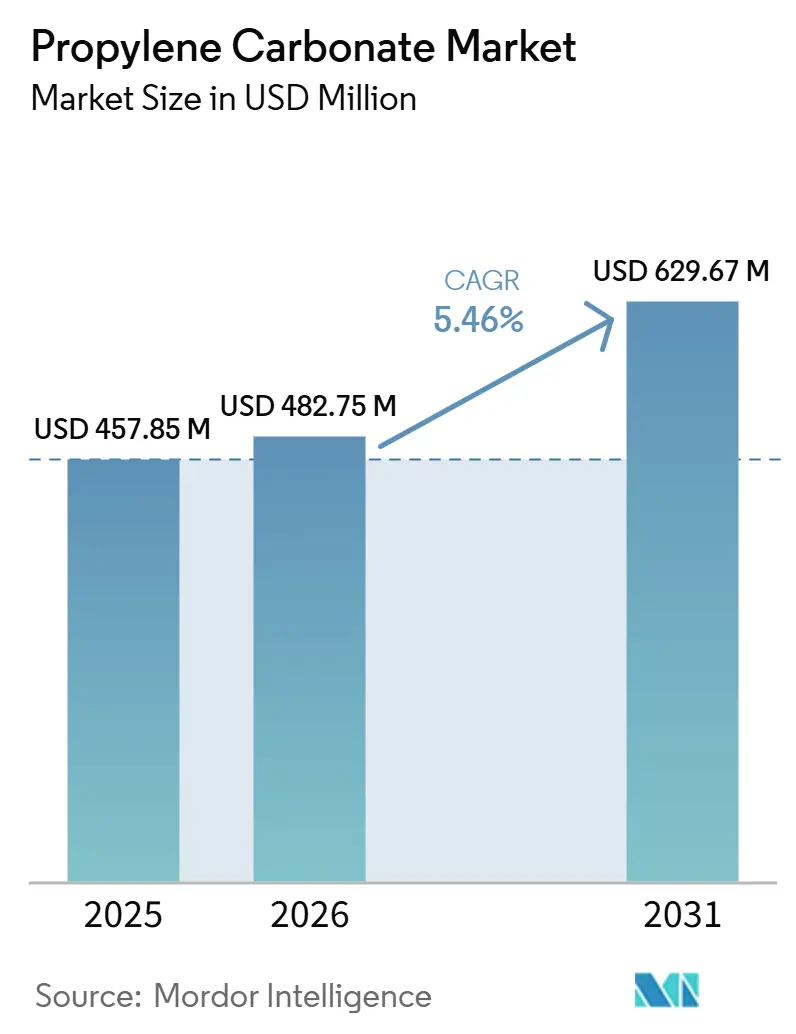
| Market Size (2026) | USD 482.75 Million |
| Market Size (2031) | USD 629.67 Million |
| Growth Rate (2026 - 2031) | 5.46 % |
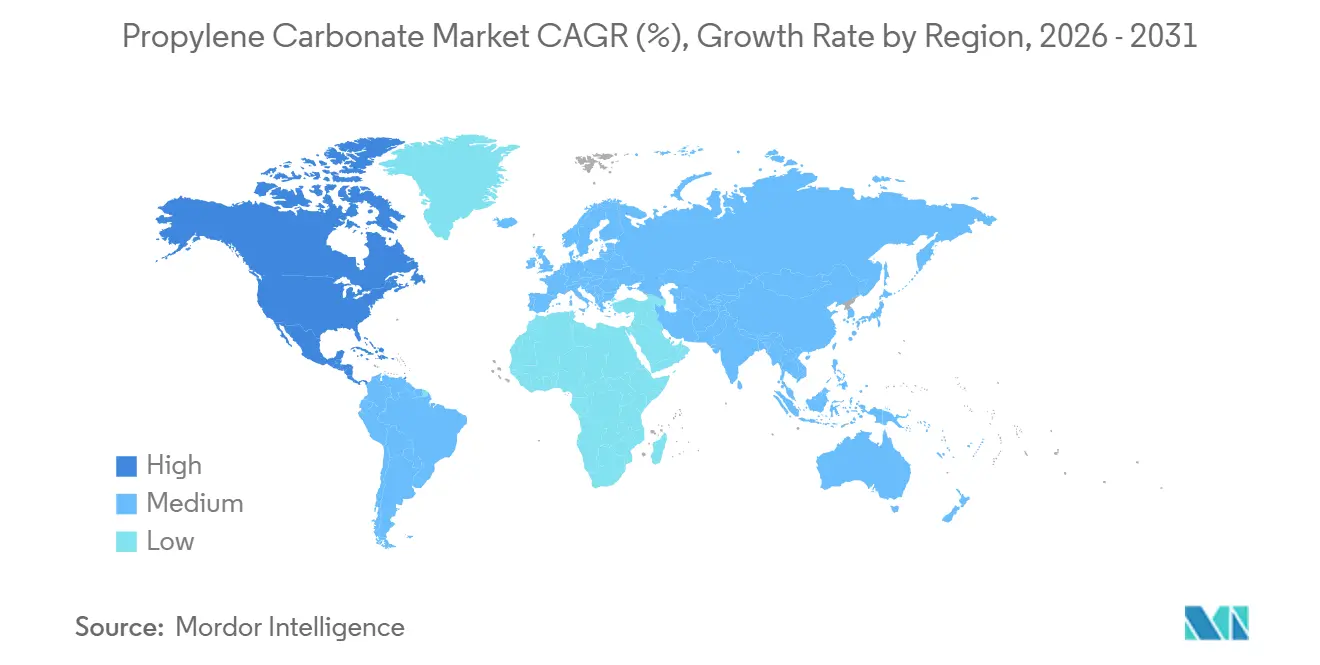
| Fastest Growing Market | North America |
| Largest Market | Asia-Pacific |
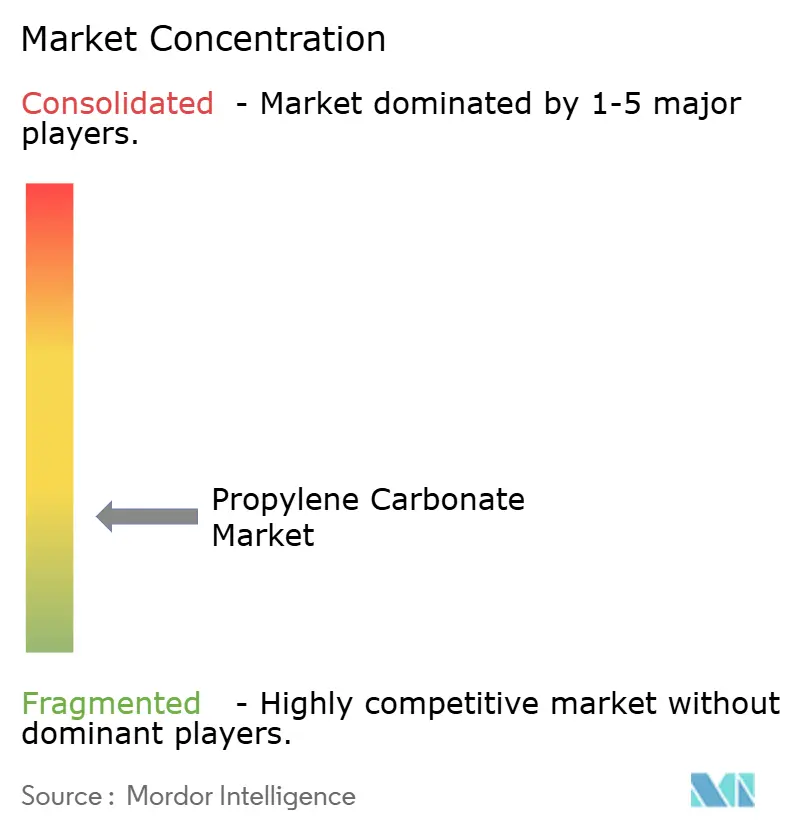
| Market Concentration | Low |
Major Players *Disclaimer: Major Players sorted in no particular order Image © Mordor Intelligence. Reuse requires attribution under CC BY 4.0. | |
Propylene Carbonate Market Analysis by Mordor Intelligence
The Propylene Carbonate Market size was valued at USD 457.85 million in 2025 and is estimated to grow from USD 482.75 million in 2026 to reach USD 629.67 million by 2031, at a CAGR of 5.46% during the forecast period (2026-2031). Demand from energy storage, specialty coatings, pharmaceutical excipients, and formulation chemistry supports the propylene carbonate market and reduces its dependence on any single end market. Demand is strengthening as battery supply chains expand across Asia-Pacific, North America, and Europe, and as regulated applications shift solvent selection toward lower-toxicity and lower-VOC alternatives. The market also benefits from propylene carbonate’s use in both mature applications, such as reaction media and industrial cleaning, and emerging applications linked to battery materials and electronics fabrication. This broadens the propylene carbonate market’s demand base compared to many specialty solvents, while creating a clear distinction between commodity grades, which face pricing pressure, and high-purity grades, which retain stronger margins. Therefore, competitive positioning depends less on volume alone and more on purification capability, feedstock access, regulatory alignment, and the ability to qualify materials for demanding downstream users.
Key Report Takeaways
- By purity, industrial grade held 58.14% of the propylene carbonate market share in 2025, while battery grade is projected to expand at 6.78% CAGR through 2031.
- By application, solvent accounted for 38.72% of the propylene carbonate market size in 2025, while electrolyte is projected to advance at 7.24% CAGR through 2031.
- By end-use industry, the chemical industry held 35.61% share in 2025, while electronics is projected to record the highest CAGR at 6.82% through 2031.
- By geography, Asia-Pacific held 52.83% share in 2025, while North America is forecast to grow at the fastest CAGR of 6.33% through 2031.
Note: Market size and forecast figures in this report are generated using Mordor Intelligence’s proprietary estimation framework, updated with the latest available data and insights as of January 2026.
Market Trends and Insights
Drivers Impact Analysis of Propylene Carbonate Market *
| Driver | (~) % Impact on CAGR Forecast | Geographic Relevance | Impact Timeline |
|---|---|---|---|
| Growing Use In Lithium-Ion Battery Electrolytes | +1.5% | Global, with APAC core and spill-over to North America and Europe | Long term (≥ 4 years) |
| Expanding Demand As A High-Polarity Solvent In Specialty Formulations | +0.8% | Global, concentrated in APAC and North America | Medium term (2-4 years) |
| Increasing Adoption In Paints, Coatings, And Industrial Cleaners | +0.7% | North America and Europe, with regulatory compliance as a major factor | Medium term (2-4 years) |
| Shift Toward Safer, Low-VOC Solvent Alternatives | +0.6% | North America and Europe primarily, APAC emerging | Long term (≥ 4 years) |
| Rising Demand For High-Purity Grades In Electronics And Battery Applications | +0.5% | APAC core, especially Japan, South Korea, and China, with spill-over to North America | Medium term (2-4 years) |
| Increasing Use In Pharmaceutical And Personal Care Formulations | +0.4% | Global, with North America and Europe as the main regulatory influence zones | Long term (≥ 4 years) |
| Source: Mordor Intelligence | |||
Growing Use In Lithium-Ion Battery Electrolytes
The propylene carbonate market is gaining support from lithium-ion battery development because propylene carbonate combines a high dielectric constant with a wide liquid temperature range, which helps maintain electrolyte performance under demanding thermal conditions. Research published in 2025 showed that weakly solvating electrolyte systems and additive design can materially improve the historical compatibility issue between propylene carbonate and graphite anodes, which had long limited broader battery use. A 2026 Green Chemistry study reported that steric-hindrance-directed interfacial regulation can further reduce this incompatibility, which indicates that the technical barriers to wider adoption are narrowing rather than remaining fixed [1]Royal Society of Chemistry, “Organic Carbonates as Green Media, From Laboratory Syntheses to Industrial Applications,” Green Chemistry, doi.org. This matters because the propylene carbonate market can now participate more directly in cold-climate EV battery design, where stable low-temperature performance is valued more heavily than in standard cell configurations. As more battery producers move from pilot work into commercial qualification, the propylene carbonate market is increasingly tied to a demand stream that is both specification-driven and multi-year in nature.
Expanding Demand As A High-Polarity Solvent In Specialty Formulations
The propylene carbonate market is also benefiting from broader use in specialty formulations where high polarity, stability, and safer handling carry more weight than simple volume economics. A 2025 Green Chemistry study showed that propylene carbonate and dimethyl carbonate can replace DMF and acetonitrile in organic electrosynthesis while delivering comparable preparative-scale yields and selectivities, which broadens its relevance in fine chemical processing. A 2025 Green Chemistry review further described the role of organic carbonates in catalytic transformations and industrial chemistry, reinforcing that propylene carbonate is becoming a practical process medium rather than only a legacy solvent. This shift improves the demand profile of the propylene carbonate market because specialty uses tend to value consistency, recovery, and process performance more than purely low purchase cost. As a result, the propylene carbonate market is extending into areas where customer qualification is slower, but margin resilience is usually stronger.
Increasing Adoption In Paints, Coatings, And Industrial Cleaners
The propylene carbonate market is seeing a stronger pull from coatings and industrial cleaning because regulatory compliance is becoming a larger part of solvent selection in developed markets. Propylene carbonate benefits from VOC-exempt positioning in the United States, and that gives formulators a practical route to maintain performance while meeting tighter environmental expectations in coatings and specialty cleaning systems. The material also brings a combination of slow evaporation, a high flash point, and strong solvency for several resin systems, which supports coating quality in applications where vapor pressure and worker exposure need closer control. In industrial cleaning, the propylene carbonate market gains from use cases that require the removal of oils, greases, and polymer residues without relying on more restricted solvent systems. A 2025 ChemSusChem study is also relevant here because it showed that propylene carbonate can function as a viable NMP replacement in cathode slurry processing under industrially relevant conditions, which links traditional solvent demand with battery manufacturing expansion.
Increasing Use In Pharmaceutical And Personal Care Formulations
The propylene carbonate market has a secondary but meaningful demand floor in pharmaceutical and personal care formulations, where safety review and formulation familiarity shape adoption. The Expert Panel for Cosmetic Ingredient Safety confirmed in March 2025 that propylene carbonate is safe in cosmetics at current practices of use and at concentrations up to 17.9% in leave-on products when formulated to be non-irritating [2]Expert Panel for Cosmetic Ingredient Safety, “Amended Safety Assessment of Propylene Carbonate as Used in Cosmetics,” CIR Safety, cir-safety.org. The same assessment noted that the number of cosmetic formulations using propylene carbonate increased from 178 in 2002 to 2003 to 13,340 in 2024, which shows how deeply the ingredient has entered formulation practice over time. This matters for the propylene carbonate market because it adds a base of demand that is less exposed to the project timing of battery plants or cyclical swings in coatings. It also supports the broader case for propylene carbonate as a solvent and excipient that can move across multiple regulated end uses without losing relevance.
Restraints Impact Analysis of Propylene Carbonate Market *
| Restraint | (~) % Impact on CAGR Forecast | Geographic Relevance | Impact Timeline |
|---|---|---|---|
| Feedstock Price Volatility In Propylene Oxide And Carbon Dioxide Based Production Routes | -0.8% | Global, most acute in North America and Europe where PO prices track crude oil closely | Short term (≤ 2 years) |
| Stringent Handling, Transport, And Occupational Safety Requirements | -0.3% | Global, particularly relevant in regulated markets, including the EU and North America | Medium term (2-4 years) |
| Substitution Risk From Alternative Polar Solvents And Carbonate Derivatives | -0.5% | Global, most acute in APAC where DMC and EC capacity competes with PC at commodity pricing | Long term (≥ 4 years) |
| Quality Sensitivity And Purity-Driven Cost Pressure In High-End Applications | -0.4% | APAC for battery OEM procurement, and North America and Europe for semiconductor and pharma uses | Medium term (2-4 years) |
| Source: Mordor Intelligence | |||
Feedstock Price Volatility In Propylene Oxide And Carbon Dioxide Based Production Routes
The propylene carbonate market remains exposed to feedstock volatility because propylene oxide is the core cost input in most conventional production routes. That exposure matters even when downstream demand is stable, since solvent customers often operate under contracts or qualification cycles that do not allow fast pass-through of higher raw material costs. Producers with upstream integration are therefore better placed to defend margins when feedstock conditions change quickly. The propylene carbonate market also has limited immediate protection from alternative synthesis routes, because CO2-based production remains a smaller part of global capacity even though it offers a different cost profile. This leaves the propylene carbonate market structurally sensitive to swings in petrochemical conditions, especially for suppliers focused on standard-grade output where pricing power is weaker.
Stringent Handling, Transport, And Occupational Safety Requirements
The propylene carbonate market faces a practical restraint from handling and transport requirements that increase complexity for regulated customers, even when the material is considered safer than several alternative solvents. Compliance obligations still affect packaging, storage, documentation, and plant procedures, and these costs can weigh more heavily on smaller users or new entrants. In applications such as electronics, pharmaceuticals, and battery materials, the burden is even higher because trace contamination from storage or transfer systems can disrupt qualification. This means that adoption is not driven only by chemical performance, it also depends on whether suppliers can support consistent logistics and controlled delivery. As a result, the propylene carbonate market favors producers that combine product quality with strong technical service and supply discipline.
*Our forecasts treat driver/restraint impacts as directional, not additive. The impact forecasts reflect baseline growth, mix effects, and variable interactions.
Propylene Carbonate Market Segment Analysis
By Purity:
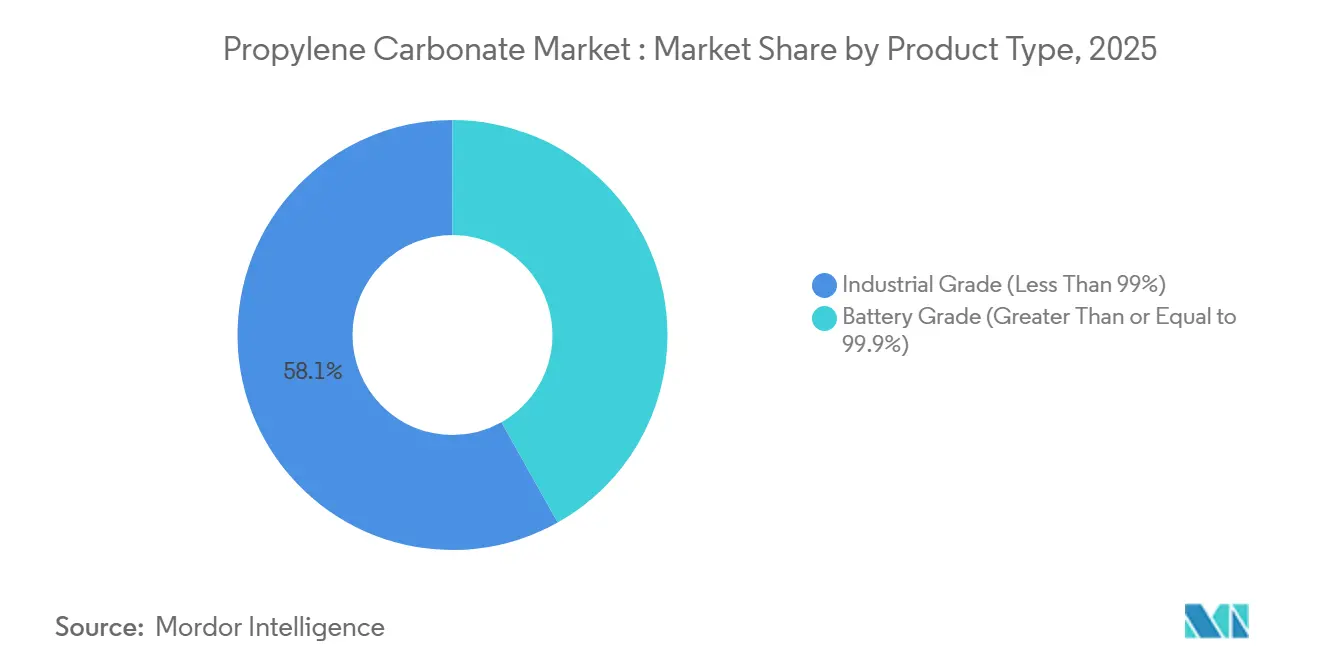
Battery Grade Drives Premiumization Above the Commodity FloorIndustrial grade (less than 99%) accounted for 58.14% of the purity segment in 2025, reflecting its broad use in chemical processing, coatings, and industrial cleaning, where impurity limits are less restrictive. This demand base keeps the propylene carbonate market anchored in mature applications that continue to require a high-polarity solvent with an established operating profile. However, standard-grade material faces greater price competition, as a wider supplier pool can meet these specifications, especially across Asia-based production clusters. As a result, the propylene carbonate market is showing a clearer divide between volume-led industrial sales and premium-led high-purity sales. The industrial-grade segment remains important for scale, while high-purity grades are becoming increasingly important for profitability and strategic positioning.
Battery grade (greater than or Equal to 99.9%) is projected to grow at a CAGR of 6.78% through 2031, supported by tighter procurement standards from EV battery manufacturers and broader investments in localized battery supply chains. Huntsman’s ULTRAPURE EV grade shows how suppliers are responding by developing dedicated product grades for demanding electrochemical performance requirements. The propylene carbonate industry is therefore moving toward more formal grade segmentation, with battery, semiconductor, and pharmaceutical applications following different qualification pathways and commanding different pricing levels. This trend strengthens incumbent suppliers, as approval cycles can extend for several months and slow customer switching after a material is qualified. In practical terms, the propylene carbonate market is becoming less uniform, with high-purity supply emerging as the main value pool above a more competitive commodity base.



By Application:
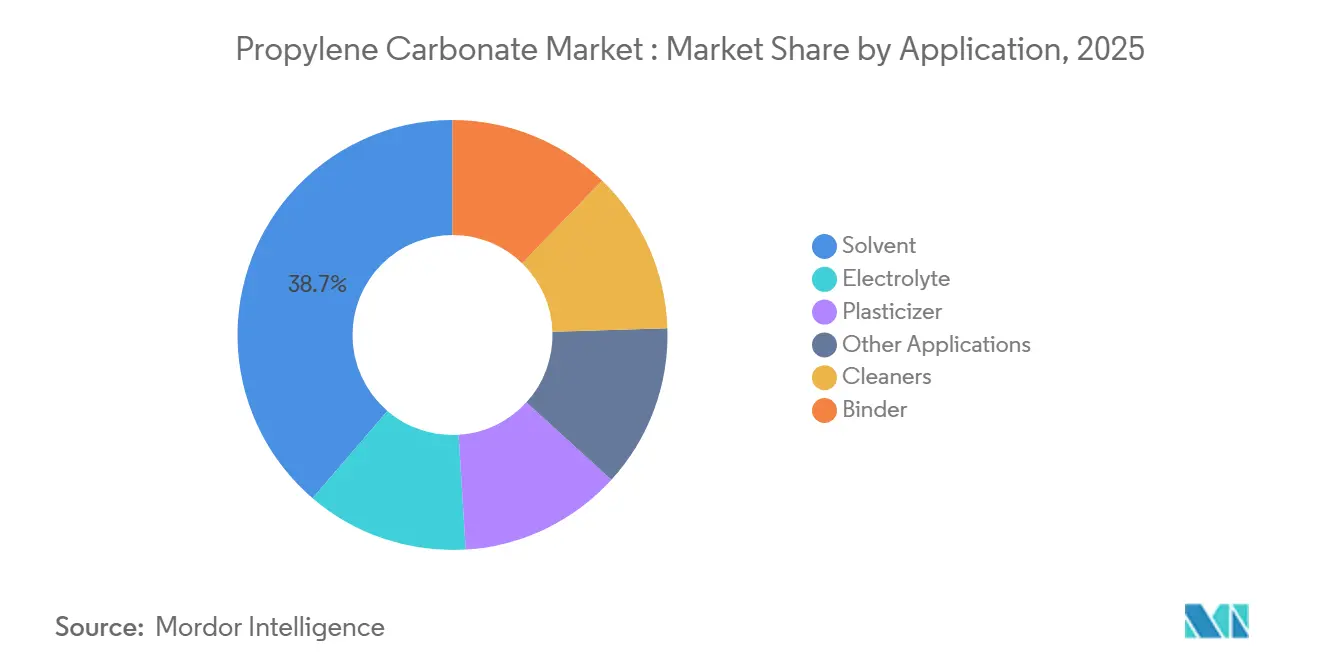
Electrolyte Momentum Reshapes Segment Revenue MixSolvent applications accounted for 38.72% of the propylene carbonate market size in 2025, which shows that broad formulation chemistry still represents the largest application base. This leadership reflects the material’s compatibility with a wide range of organic and inorganic systems, which has made it difficult to displace across established industrial and specialty processes. The cleaner, binder, and plasticizer categories remain meaningful because each draws on the same core features of solvency, low odor, and process stability. Even so, the propylene carbonate market is gradually shifting toward uses that carry more demanding qualification needs and stronger growth visibility. That shift is visible most clearly in battery-linked applications, where procurement is becoming more structured and long-term.
Electrolyte is projected to grow at 7.24% CAGR through 2031, and that pace is closely tied to new cell manufacturing capacity and more exact purity requirements in regulated battery markets. A 2025 ChemSusChem study also broadens the application outlook because it showed that propylene carbonate can replace NMP in cathode slurry processing under industrially relevant conditions, which supports both electrolyte and adjacent manufacturing demand. The propylene carbonate market could therefore see binder-related upside as cathode producers look for solvent systems that align more closely with tightening regulatory expectations. Other application areas such as gas absorption, extraction, and specialty binding remain smaller in volume, but they help preserve diversity within the propylene carbonate market. This mix matters because it reduces the risk that faster electrolyte growth will fully displace value from mature specialty uses.
By End-Use Industry:
Chemical Anchor Gives Way to Electronics SurgeThe chemical industry held 35.61% of end-use share in 2025, which kept it as the largest end-use base for propylene carbonate. This position reflects the role of the material as a polar reaction medium, process solvent, and co-solvent in synthesis pathways where reformulation can trigger new validation work and operational disruption. The propylene carbonate market therefore retains an important anchor in chemical processing even as battery and electronics demand expands more quickly. Paints and coatings remain the second major outlet because compliance needs and formulation performance continue to support use in water-based and high-solids systems. Cosmetics and personal care also contribute a stable layer of demand as propylene carbonate remains accepted in regulated formulation practice.
Electronics is projected to grow at 6.82% CAGR through 2031, driven by battery cell production and by the use of high-purity solvent systems in semiconductor cleaning and wet processing. Huntsman’s E-GRADE propylene carbonate shows how suppliers are aligning product development with electronics fabrication requirements, including low trace metals and low vapor pressure. The propylene carbonate industry is therefore extending beyond simple battery exposure and into a broader advanced manufacturing base that rewards purity control and supply consistency. Industrial cleaning remains smaller, but it is steady because users continue to replace restricted solvents in automotive and manufacturing environments. Together, these patterns show that the propylene carbonate market is moving from a chemically anchored profile toward a more balanced mix that gives electronics greater strategic weight.
Geography Analysis
APAC Propylene Carbonate Market
Asia-Pacific is expected to account for 52.83% of the propylene carbonate market share in 2025, making it the largest regional block by a wide margin. The region combines large-scale battery cell manufacturing with deep chemical production networks, supporting both local demand and export-oriented supply. China remains central, as its production base and battery ecosystem create a direct link between solvent capacity, electrolyte demand, and aggressive pricing in standard grades. Japan supports the propylene carbonate market from a different angle, with established electronics and automotive supply chains that prioritize stable premium-grade procurement. South Korea further strengthens the region through its concentrated battery manufacturing base and role in advanced materials qualification.
APAC and India Propylene Carbonate Market
This regional structure gives the Asia-Pacific propylene carbonate market both scale and internal diversity, as it includes low-cost commodity competition alongside demand from premium applications. India is becoming more relevant as specialty chemicals investment and electric mobility policies expand the addressable base for higher-purity materials. As a result, Asia-Pacific is not only the largest consumption center but also the primary arena where pricing pressure and product upgrading occur simultaneously. For many suppliers, success in the propylene carbonate market depends on how effectively they balance exposure to China-led volume competition with access to higher-value customers elsewhere in the region.
The Americas and EMEA Propylene Carbonate Market
North America is projected to grow at a CAGR of 6.33% through 2031, making it the fastest-growing regional market during the current forecast period. Battery supply chain localization, coatings and cleaning applications that benefit from VOC-related compliance positioning, and a stronger preference for domestic sourcing in strategic materials are supporting growth. Huntsman’s 2025 annual report states that the company is the sole North American producer of propylene carbonate and ethylene carbonate, giving it a meaningful structural position as regional battery investment accelerates. LyondellBasell’s approval of a propylene expansion project in 2025 also signals confidence in regional feedstock demand and helps strengthen the broader value chain that supports the propylene carbonate market. Europe remains commercially important as battery regulation tightens purity expectations for vehicle battery inputs and low-temperature electrolyte formulations gain relevance in colder operating environments. South America, the Middle East, and Africa remain smaller markets, but they offer gradual opportunities through industrial cleaning, chemicals diversification, and renewable energy investment, which can support storage-related solvent demand over time.

Competitive Landscape
The propylene carbonate market is moderately fragmented, with no single company controlling global supply across all grades and regions. Competition remains divided between suppliers with strong purification capabilities and those that compete mainly on volume in standard-grade categories. This dynamic creates a two-track market structure: one group targets premium electronics and battery materials, while another competes more aggressively in industrial solvent applications. As a result, plant scale matters, but it does not independently secure the most attractive customers. Qualification support, impurity control, and feedstock stability are becoming more important competitive levers than headline capacity.
Huntsman remains a key reference point, as the company reported that it is the sole North American producer of propylene carbonate and ethylene carbonate. This position strengthens its relevance in a region that is localizing battery and specialty materials supply. Huntsman has also sharpened its competitive position through grade-specific offerings, such as ULTRAPURE for EV batteries and E-GRADE for semiconductor and PCB applications. These offerings show how the propylene carbonate market is shifting toward targeted product families rather than a single broad specification. LyondellBasell’s 2025 propylene expansion decision is another strategic move relevant to the propylene carbonate market, as stronger upstream investment supports long-term feedstock confidence in North America. These developments show that competition extends beyond downstream solvent sales to include raw material security and portfolio alignment with battery and electronics growth.
The propylene carbonate market continues to reward suppliers that invest in advanced purification and testing systems, as premium buyers increasingly demand very low water and trace metal content. This requirement can exclude otherwise capable commodity producers from higher-margin accounts if they cannot fund the necessary process upgrades or support lengthy customer qualification processes. Regional Chinese suppliers remain influential in standard-grade output and play an important role in setting the pricing tone. However, access to premium market segments still depends on their ability to consistently meet tighter application thresholds. Therefore, the propylene carbonate market is likely to remain regionally diverse, with pricing pressure concentrated in lower-purity products and stronger defensibility in specialized grades. Over the next several years, competitive strength in the propylene carbonate market will continue to depend on certification discipline, customer qualification depth, and access to feedstock rather than on capacity announcements alone.
Propylene Carbonate Industry Leaders
Shandong Shida Shenghua Chemical Group Co., Ltd.
Mitsubishi Chemical Corporation
Jiangsu Hualun Chemical Industry Co., Ltd.
LOTTE Chemical Corporation
Empower Materials
- *Disclaimer: Major Players sorted in no particular order
Propylene Carbonate Market Companies Covered in this Report
- Dongying Hi-Tech Spring Chemical Industry Co., Ltd.
- Empower Materials
- Huntsman Petrochemical (Shanghai) Co., Ltd.
- Jiangsu Hualun Chemical Industry Co., Ltd.
- Linyi Evergreen Chemical Co., Ltd.
- LOTTE Chemical Corporation
- Mitsubishi Chemical Corporation
- Shandong Depu Chemical
- Shandong Huachao Chemical Co., Ltd.
- Shandong Senjie Cleantech Co., Ltd.
- Shandong Shida Shenghua Chemical Group Co., Ltd.
- Shandong Wells Chemicals Co., Ltd.
- Taizhou Lingguang Chemical Co., Ltd.
- Zibo Donghai Industries Co., Ltd.

Recent Industry Developments in Propylene Carbonate Market
- October 2025: Shandong province in China is expected to add 3.40 million tonnes per year of new propylene production capacity in 2025, increasing regional propylene capacity to 17.14 million tonnes per year and accounting for 21.52% of China’s national total. This expansion will directly strengthen the upstream feedstock base for Shandong-based propylene carbonate producers and reshape regional cost economics.
- March 2025: LyondellBasell approved a propylene capacity expansion project at its Channelview Complex near Houston, Texas, to increase upstream feedstock availability for North American PC producers and support the domestic carbonate supply chain as regional demand from EV battery gigafactories grows.


Global Propylene Carbonate Market Report Scope
Propylene carbonate (C₄H₆O₃) is a versatile, biodegradable, and VOC-exempt polar solvent derived from propylene glycol and carbon dioxide. Manufacturers widely use it in cosmetics, paint stripping, industrial degreasing, and lithium battery electrolytes. This odorless, colorless liquid offers a high boiling point and low toxicity.
The propylene carbonate market is segmented by purity, application, end-use industry, and geography. By purity, the market is segmented into industrial grade (less than 99%) and battery grade (greater than or equal to 99.9%). By application, the market is segmented into solvent, cleaners, binder, electrolyte, plasticizer, and other applications. By end-use industry, the market is segmented into chemical, paints and coatings, cosmetics and personal care, electronics, industrial cleaning, and other end-use industries. The report also covers the propylene carbonate market size and forecasts for the propylene carbonate market in 16 countries across major regions. For each segment, the market sizing and forecasts have been done on the basis of value (USD).
| Industrial Grade (Less Than 99%) |
| Battery Grade (Greater Than or Equal to 99.9%) |
| Solvent |
| Cleaners |
| Binder |
| Electrolyte |
| Plasticizer |
| Other Applications |
| Chemical |
| Paints and Coatings |
| Cosmetics and Personal Care |
| Electronics |
| Industrial Cleaning |
| Other End-Use Industries |
| Asia-Pacific | China |
| India | |
| Japan | |
| South Korea | |
| Rest of Asia-Pacific | |
| North America | United States |
| Canada | |
| Mexico | |
| Europe | Germany |
| United Kingdom | |
| France | |
| Italy | |
| Russia | |
| Rest of Europe | |
| South America | Brazil |
| Argentina | |
| Rest of South America | |
| Middle-East and Africa | Saudi Arabia |
| South Africa | |
| Rest of Middle-East and Africa |
| By Purity | Industrial Grade (Less Than 99%) | |
| Battery Grade (Greater Than or Equal to 99.9%) | ||
| By Application | Solvent | |
| Cleaners | ||
| Binder | ||
| Electrolyte | ||
| Plasticizer | ||
| Other Applications | ||
| By End-Use Industry | Chemical | |
| Paints and Coatings | ||
| Cosmetics and Personal Care | ||
| Electronics | ||
| Industrial Cleaning | ||
| Other End-Use Industries | ||
| By Geography | Asia-Pacific | China |
| India | ||
| Japan | ||
| South Korea | ||
| Rest of Asia-Pacific | ||
| North America | United States | |
| Canada | ||
| Mexico | ||
| Europe | Germany | |
| United Kingdom | ||
| France | ||
| Italy | ||
| Russia | ||
| Rest of Europe | ||
| South America | Brazil | |
| Argentina | ||
| Rest of South America | ||
| Middle-East and Africa | Saudi Arabia | |
| South Africa | ||
| Rest of Middle-East and Africa | ||


Key Questions Answered in the Report
What is the projected value of the propylene carbonate market by 2031?
The Propylene Carbonate Market size was valued at USD 457.85 million in 2025 and is estimated to grow from USD 482.75 million in 2026 to reach USD 629.67 million by 2031, at a CAGR of 5.46% during the forecast period (2026-2031).
Which purity grade leads the Propylene Carbonate Market?
Industrial grade led the market with a market share of 58.14%, because it offers an optimal balance of cost-effectiveness and performance, making it widely suitable for bulk applications such as solvents, electrolytes, and coatings where ultra-high purity is not essential.
Which region leads global demand for propylene carbonate?
Asia-Pacific led in 2025 with 52.83% share, supported by battery manufacturing concentration, broad chemical demand, and large production capacity.
What is the main growth engine for propylene carbonate demand?
Battery-related demand is the clearest growth engine, especially electrolyte application, which is projected to expand at 7.24% CAGR through 2031.
Page last updated on:





