
Power Plant Muffler Market Size and Share
Market Overview
| Study Period | 2021 - 2031 |
|---|---|
| Market Size (2026) | USD 372.32 Million |
| Market Size (2031) | USD 475.98 Million |
| Growth Rate (2026 - 2031) | 5.04 % |
| Fastest Growing Market | Asia-Pacific |
| Largest Market | Asia-Pacific |
| Market Concentration | Low |
Major Players *Disclaimer: Major Players sorted in no particular order Image © Mordor Intelligence. Reuse requires attribution under CC BY 4.0. | |
Power Plant Muffler Market Analysis by Mordor Intelligence
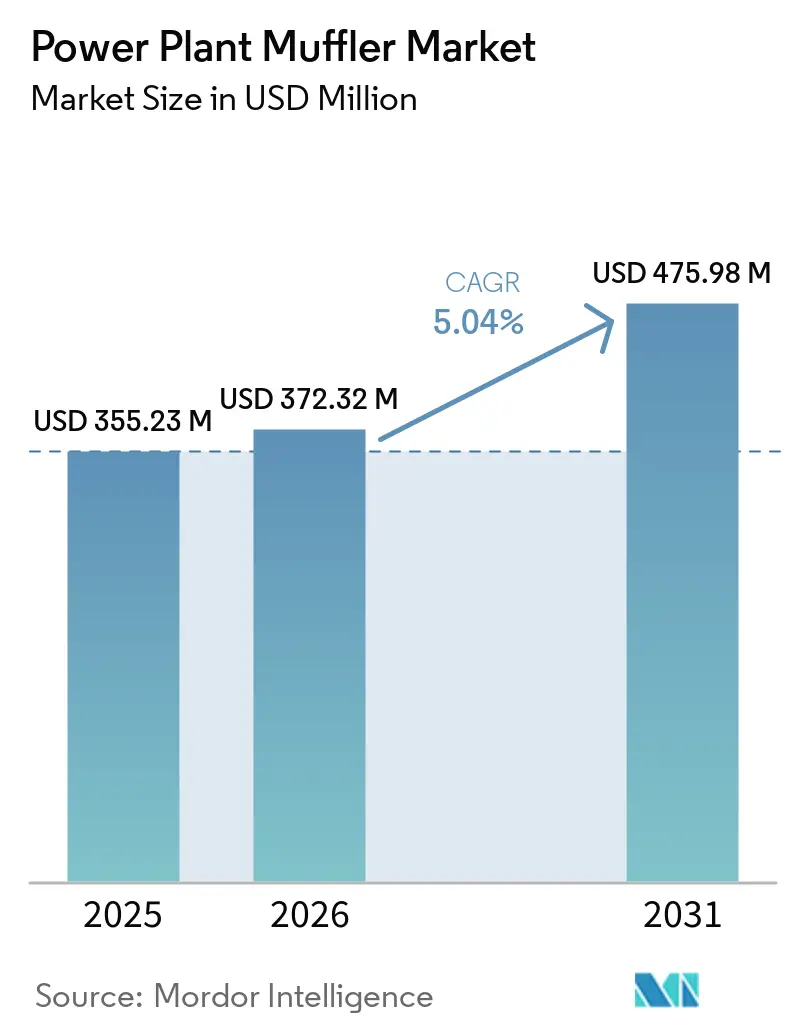
The Power Plant Muffler Market size is projected to expand from USD 355.23 million in 2025 and USD 372.32 million in 2026 to USD 475.98 million by 2031, at a CAGR of 5.04% between 2026 and 2031. The power plant muffler market is driven by new gas-fired capacity, combined heat and power, distributed generation, backup power, and data center standby fleets, all of which require exhaust systems matched to temperature, acoustic, space, and permitting conditions. As plants are located closer to residential and commercial areas, noise control has become a core design consideration. Permits can dictate equipment choice, exhaust placement, operating periods, and pre-startup validation, while occupational and environmental regulations increase the value of reliable test evidence. Suppliers increasingly compete through integrated packages that combine silencing with emissions controls, supported by test records, qualified materials, and engineering that balances attenuation, exhaust flow, and backpressure against engine performance. Material-cost volatility and potential long-term electrification may pressure margins, but near-term demand remains strong for gas systems, critical backup generation, and retrofits, particularly for large gas engines and turbines with high-temperature and broadband acoustic requirements. Selection depends on operating duty, engine configuration, installation space, schedules, material traceability, maintenance access, and the documentation required by engineering teams, contractors, and public authorities before installation, commissioning, and final acoustic performance testing.
Key Report Takeaways
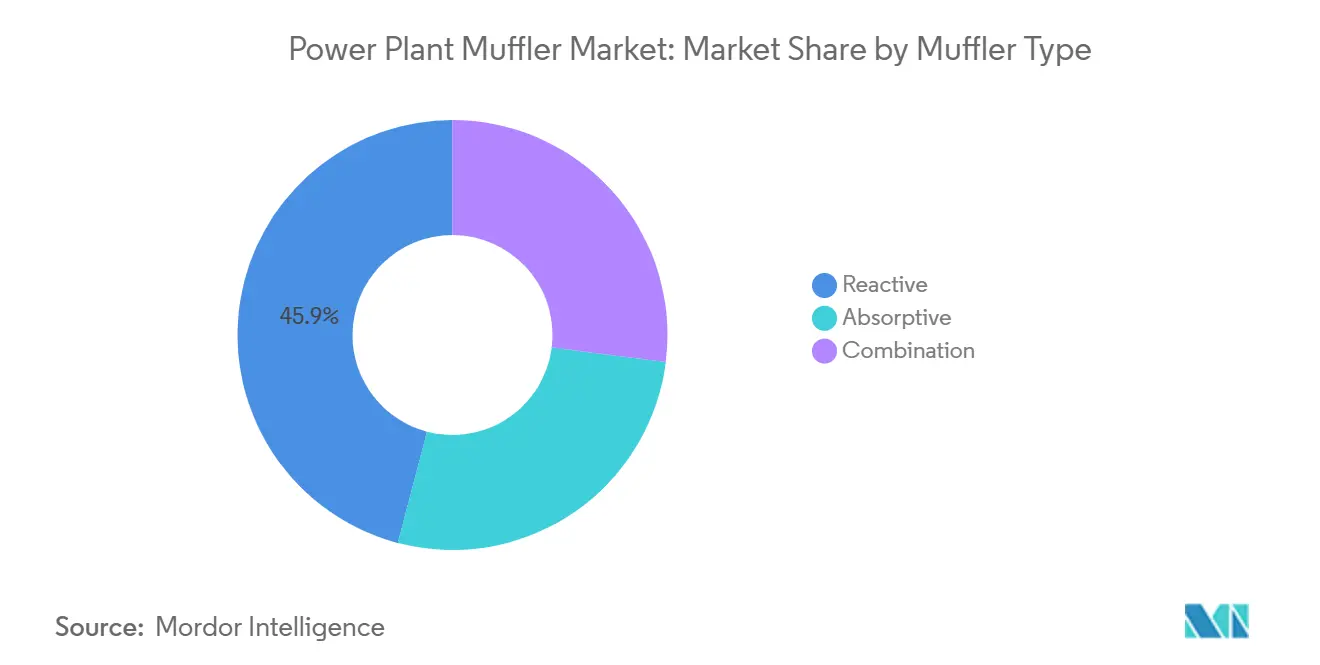
- By muffler type, absorptive mufflers held 45.9% of the Power plant muffler market share in 2025, while combination mufflers are forecast to grow at a 5.9% CAGR through 2031.
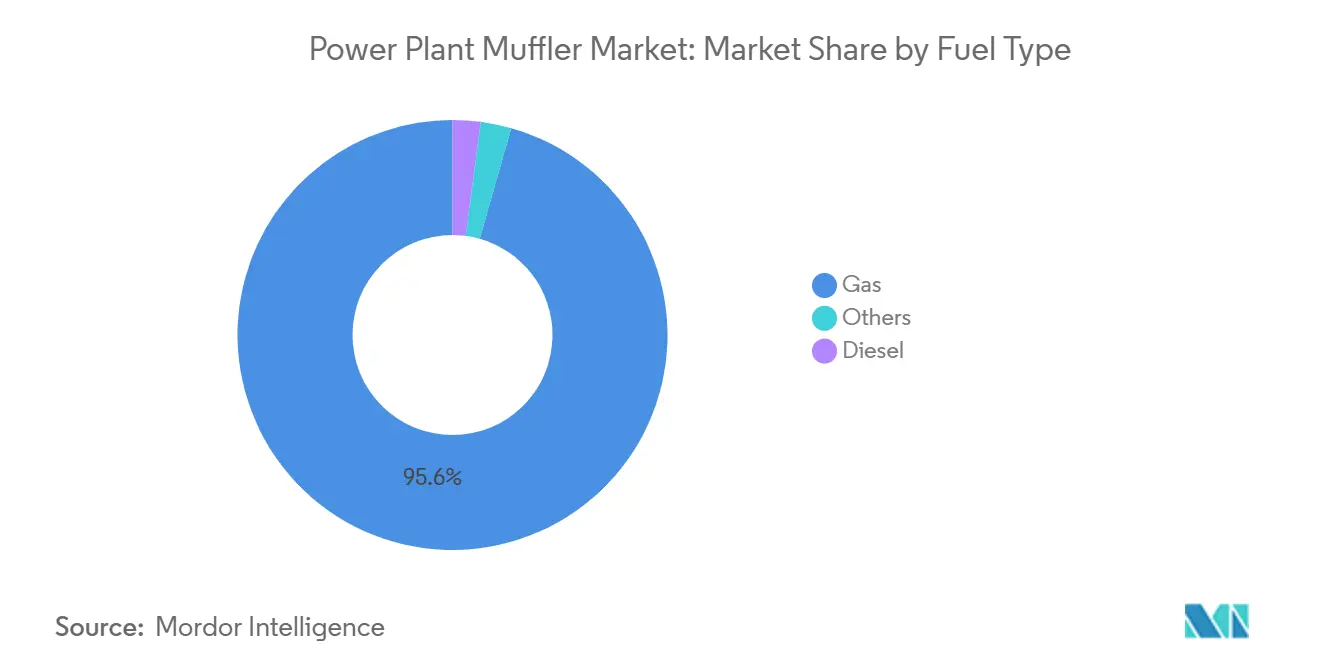
- By fuel type, gas-fired systems accounted for 95.6% of the Power plant muffler market share in 2025 and are forecast to expand at a 5.1% CAGR through 2031.
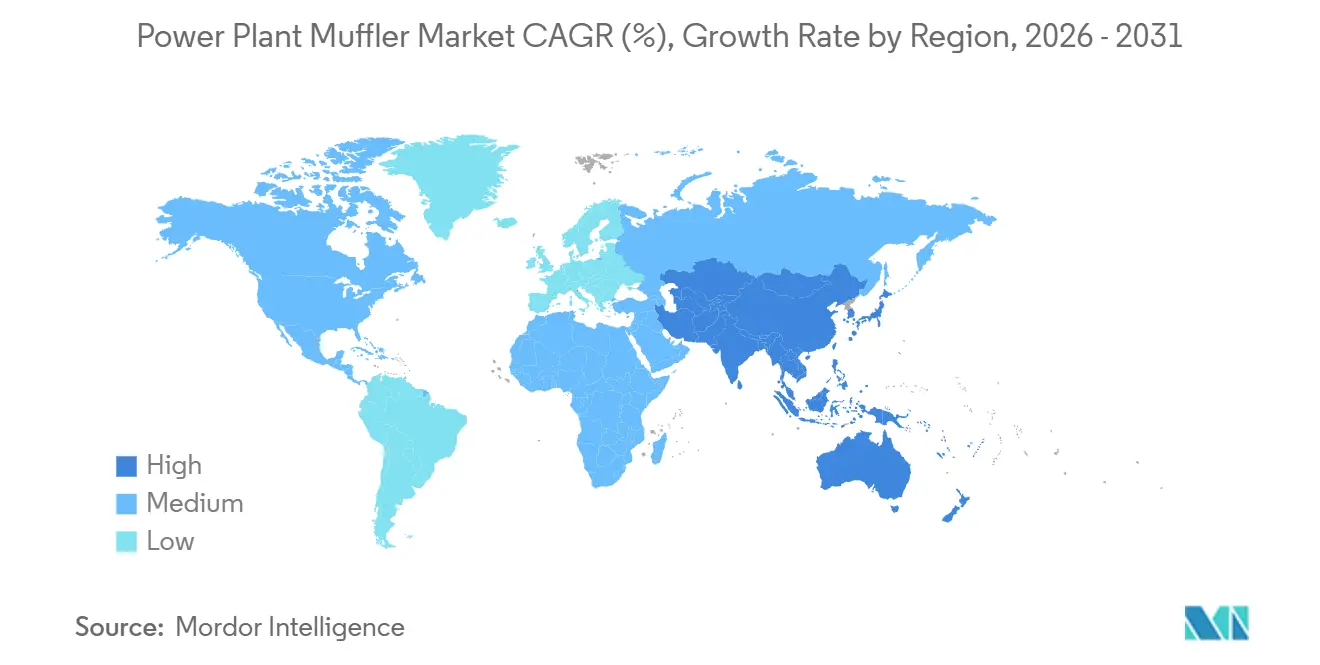
- By geography, Asia-Pacific held 39.6% of the Power plant muffler market share in 2025 and is projected to advance at a 6.2% CAGR through 2031.
Note: Market size and forecast figures in this report are generated using Mordor Intelligence’s proprietary estimation framework, updated with the latest available data and insights as of January 2026.
Market Trends and Insights
Drivers Impact Analysis of Power Plant Muffler Market*
| Driver | (~)% Impact on CAGR Forecast | Geographic Relevance | Impact Timeline |
|---|---|---|---|
| Expansion of Distributed and Backup Power Infrastructure | +1.50% | Global; concentrated in Asia-Pacific and North America | Medium term (2–4 years) |
| Tightening Noise and Exhaust-Emission Compliance Requirements | +1.20% | Global; strongest in EU, North America, Japan | Short term (≤ 2 years) |
| Growth of Data Centers and Mission-Critical Generator Fleets | +1.10% | North America and Asia-Pacific core; spill-over to Europe | Medium term (2–4 years) |
| Expansion of Gas-Fired and Combined Heat and Power Generation | +0.80% | APAC, Europe, North America | Long term (≥ 4 years) |
| Retrofit Demand from Integrated Muffler-Emission Control Systems | +0.60% | North America and EU | Medium term (2–4 years) |
| Site-Specific Acoustic Design for Renewable-Heavy Grids | +0.40% | Global; early gains in Europe and Australia | Long term (≥ 4 years) |
| Source: Mordor Intelligence | |||
Expansion of Distributed and Backup Power Infrastructure
Distributed energy networks and backup systems support demand for industrial exhaust silencers. Each containerized gas generator or behind-the-meter reciprocating engine requires an exhaust system suited to its site. Local noise limits and permit conditions make compliant attenuation equipment part of the initial equipment package. Dense urban districts and industrial parks near residential areas often require critical or hospital-grade attenuation. These applications give acoustic specialists opportunities to supply higher-value designs. The Power plant muffler market benefits when distributed generation is installed in locations with tighter siting limits.
The requirement is not limited to new capacity. Existing facilities can need upgrades when a change in use, an expansion, or a revised permit brings new noise conditions. Suppliers therefore have opportunities in replacement work as well as original equipment orders. The site setting determines the required attenuation level and installation configuration. This favors companies that can adapt designs to engine size, exhaust temperature, and available space. The Power plant muffler market is supported by this recurring need for site-specific engineering.
Tightening Noise and Exhaust-Emission Compliance Requirements
Occupational and environmental requirements are increasing the importance of documented acoustic performance. OSHA's occupational noise standard requires employers to use feasible engineering or administrative controls when workers are exposed above specified limits[1]. The European Environmental Noise Directive and plant-level emissions rules also place more attention on stationary-source noise. ISO published ISO 14001:2026 in April 2026, which updates environmental management system requirements. Certified operators must be able to show measurable environmental performance under their management systems. These conditions support demand for mufflers with clear testing and material documentation.
Standard attenuation designs may not meet the needs of facilities facing stricter review. Combination and multichamber absorptive products can address a broader range of frequencies than single-mechanism products. Procurement teams can also compare designs based on verified insertion-loss data. The Power plant muffler market, therefore, places greater value on test records and consistent manufacturing controls. Established suppliers can use certification and product documentation during tender qualification. Smaller firms may need to strengthen those capabilities to compete for regulated projects.
Growth of Data Centers and Mission-Critical Generator Fleets
Data centers are a growing demand channel for backup generator exhaust attenuation. These facilities depend on generator fleets to protect operations during grid interruptions. Their generator installations often sit near commercial, residential, or mixed-use areas. Permit conditions can therefore address noise and emissions at the same time. The Power plant muffler market gains from orders for higher-specification silencers that are suited to continuous testing and standby operation. These projects can also create maintenance and replacement work over the life of the generator fleet.
Caterpillar reported that power generation retail sales rose 72% year over year in the second quarter of 2026, supported by demand for large generator sets and turbines used in data center applications. The company also reported USD 8.2 billion in Power and Energy segment revenue for that quarter. The reported sales performance shows the pace at which the generator base is expanding. More installed units create a wider future base for exhaust noise equipment. The Power plant muffler market can benefit when developers specify acoustic systems at the same time as generator packages. The opportunity is stronger when local approvals require a defined noise outcome.
Expansion of Gas-Fired and Combined Heat and Power Generation
Gas-fired and combined heat and power projects create long engineering cycles for exhaust silencer suppliers. Exhaust specifications are commonly established during engineering, procurement, and construction planning. Early engagement can matter because later design changes may be costly. Gas turbines and large reciprocating engines also operate at temperatures and sound profiles that require careful equipment selection. The Power plant muffler market is therefore linked to both new combined-cycle capacity and cogeneration projects. Suppliers that enter the design process early can align acoustic design, backpressure limits, and material requirements.
GE Vernova secured a February 2026 contract to supply 2 LM6000VELOX gas turbine packages for Lincoln Electric System's Terry Bundy Generating Station in Nebraska[2]. The project adds nearly 100 MW and is scheduled for commercial operation in 2029. Such projects require site-specific exhaust noise controls under local permits. Gas systems also remain important for reliable capacity that supports renewable generation. The Power plant muffler market can serve this demand through engineered exhaust systems rather than standard catalog products.
Restraints Impact Analysis of Power Plant Muffler Market*
| Restraint | (~)% Impact on CAGR Forecast | Geographic Relevance | Impact Timeline |
|---|---|---|---|
| Thermal and Pressure-Drop Trade-Offs in High-Attenuation Designs | -0.30% | Global | Short term (≤ 2 years) |
| High Retrofit Complexity in Space-Constrained Existing Plants | -0.30% | North America and Europe (aging fleet) | Medium term (2–4 years) |
| Electrification and Renewable Generation Displacing Stationary IC Capacity | -0.60% | Europe, North America | Long term (≥ 4 years) |
| Volatility in Stainless Steel, Nickel Alloys, and Acoustic Packing Materials | -0.40% | Global | Short term (≤ 2 years) |
| Source: Mordor Intelligence | |||
Volatility in Stainless Steel, Nickel Alloys, and Acoustic Packing Materials
Material-cost changes can reduce margins for manufacturers working under fixed-price project contracts. Stainless steel and nickel alloys are important for equipment exposed to high exhaust temperatures. Acoustic packing materials also affect product cost and availability. Suppliers with long project backlogs may face greater risk when input prices rise after a contract is signed. The Power plant muffler market can therefore favor companies with purchasing scale and disciplined contract management. Smaller regional fabricators may have less room to absorb sudden cost changes.
Larger suppliers can use material hedging, dual sourcing, and escalation clauses where their contracts permit them. They can also source mineral wool or ceramic fiber from more than 1 supplier. These measures do not remove cost risk, but they can reduce exposure to a single input or supplier. Project schedules add another complication because material must meet performance and temperature requirements. The Power plant muffler market remains sensitive to the availability of qualified materials. The issue is most visible on high-temperature and custom-engineered orders.
Thermal and Pressure-Drop Trade-Offs in High-Attenuation Designs
High attenuation can restrict exhaust flow and increase backpressure. This creates a practical design limit for systems that must also protect engine output and efficiency. The trade-off is important for large-bore gas engines that operate for many hours. Dense fibrous or ceramic packing can provide broadband reduction but can also affect flow. The Power plant muffler market needs designs that balance acoustic targets with thermal and engine requirements. This balance can increase the engineering effort for each installation.
A January 2026 study in the European Physical Journal Plus tested a hybrid reactive and absorptive design. It reported a 14-15 dB(C) reduction at 7,500 rpm while maintaining acceptable backpressure through optimized half-elliptical baffles. The design redirected exhaust flow toward absorptive areas without large-scale recirculation. The study shows why engineering design matters for combination products. Custom work can raise project cost and extend lead times in constrained retrofit sites. These limits can slow adoption in lower-value and price-sensitive applications.
*Our forecasts treat driver/restraint impacts as directional, not additive. The impact forecasts reflect baseline growth, mix effects, and variable interactions.
Power Plant Muffler Market Segment Analysis
By Muffler Type:
Combination Designs Expand Broadband Attenuation ReachAbsorptive mufflers held 45.9% of the Power plant muffler market size in 2025. Their long deployment history reflects their use on natural gas reciprocating engines and diesel generator sets. Mineral wool and ceramic fiber packing can attenuate frequencies above 500 Hz. This design does not require the tuned cavity work used in reactive systems. It remains a practical option where broadband control is needed with familiar materials. The Power plant muffler industry continues to use absorptive products across established engine applications.
Reactive mufflers use resonators and expansion chambers to reflect low-frequency sound toward its source. They remain relevant for large gas turbine exhaust systems with discrete tonal frequencies. Combination mufflers are forecast to grow at a 5.9% CAGR through 2031, the fastest rate among muffler types. They combine low-frequency control from reactive chambers with broadband attenuation from absorptive packing. This makes them suited to gas turbines that create complex acoustic profiles. The Power plant muffler market has a growing need for products that can meet several acoustic requirements in one design.

By Fuel Type:
Gas Dominance Anchors Long-Term DemandGas-fired systems accounted for 95.6% of the Power plant muffler market size in 2025. They are also forecast to grow at a 5.1% CAGR through 2031. This structure shows that gas is both the largest fuel category and the main source of forecast growth. Combined-cycle and cogeneration projects support that position. Gas engines and turbines create broad exhaust noise spectra and high temperatures. The Power plant muffler industry must address both acoustic and thermal needs for these systems.
E.ON and MM Neuss commissioned a hydrogen-ready combined heat and power plant in Neuss, Germany, in July 2025. The facility provides 22 MW of electrical output and 59 MW of thermal output[3]. The project illustrates the changing technical requirements placed on gas-plant exhaust systems. Diesel equipment still has a role in data centers and other critical backup applications. The Others category includes dual-fuel engines and early hydrogen applications, but it remains commercially small. As fuel blends change, suppliers will need designs suited to different exhaust temperatures and acoustic conditions.
Geography Analysis
APAC Power Plant Muffler Market
Asia-Pacific held 39.6% of the Power plant muffler market size in 2025 and is forecast to grow at a 6.2% CAGR through 2031. The region combines new gas capacity, tighter urban noise controls, and expanding data center investment. China and India are important volume markets because industrial and infrastructure activity requires backup and distributed generation. Vietnam, Indonesia, Thailand, and South Korea also add demand through manufacturing growth and grid reliability needs. The Power plant muffler market can benefit as generator packages in these countries include compliant exhaust systems. Higher regulatory requirements can also create future upgrade demand across the installed base.
North America Power Plant Muffler Market
North America held the second-largest regional share in 2025. The region benefits from generator investment, regulated work environments, and demand for critical-grade acoustic equipment. OSHA requires employers to consider engineering controls in relevant occupational-noise situations. Data center generator fleets support premium orders where performance documentation is important. Williams announced USD 5.3 billion in committed capital for 5 behind-the-meter gas-fired Power Innovation projects in the United States in July 2026. These projects support a future demand base for engineered exhaust equipment.
EMEA and South America Power Plant Muffler Market
Europe's demand is shaped by environmental noise rules, industrial emissions requirements, and national requirements such as Germany's TA Lärm. Modernization and recommissioning work in gas capacity can support replacement and retrofit orders. South America is smaller but draws demand from diesel and gas generator installations at remote industrial and oil and gas facilities. The Middle East and Africa are adding gas-fired capacity under national diversification programs. Morocco's renewable development can require gas peaking capacity to support intermittent generation. The Power plant muffler market has opportunities in these locations where suppliers can meet tropical, desert, or variable operating requirements.
Competitive Landscape
The Power plant muffler market is moderately fragmented. MIRATECH Corporation, Nelson Global Products, IAC Acoustics, Fischer Abgastechnik GmbH, and Universal Silencer compete with exhaust-system divisions of generator original equipment manufacturers. Original equipment packages offer single-vendor delivery and supply-chain convenience. Specialist firms can compete where insertion-loss performance and documentation are contractual requirements. This is especially relevant for hospital-grade and critical applications. The Power plant muffler market allows specialists to focus on technically demanding retrofit and upgrade work.
MIRATECH acquired Exhaust Control Industries in the third quarter of 2025. The acquisition expanded MIRATECH's global manufacturing presence to more than 60 countries and integrated exhaust and emissions-control capabilities[4]. The move reflects a need for broader reach and integrated product offerings. Suppliers can differentiate by combining selective catalytic reduction, diesel particulate filter, and silencer equipment in one engineered package. This approach can be useful where plant operators need acoustic and emissions compliance together. It also increases the importance of technical design and coordination.
The Power plant muffler market can also reward companies that provide verified test results, computational acoustic design, and materials traceability. Finite element analysis, computational fluid dynamics, and ISO 5130:2019-compliant test packages can help suppliers address engineering-intensive orders. Market concentration score: 4 out of 10 because the available draft describes several specialists and generator original equipment manufacturers but provides no combined top-player share that would indicate a concentrated supplier base.
Power Plant Muffler Industry Leaders
-
MIRATECH Corporation
-
DCL International Inc.
-
G+H Group
-
SAI - Société d'Acoustique Industrielle
-
Nett Technologies Inc.
- *Disclaimer: Major Players sorted in no particular order

Power Plant Muffler Market Companies Covered in this Report
- Catalyst Products International
- Caterpillar Inc.
- Cummins Inc.
- DCL International Inc.
- Donaldson Company, Inc.
- Dürr Universal, Inc.
- ECI - Exhaust & Emissions Control
- Ergil Group
- Fischer Abgastechnik GmbH & Co. KG
- G+H Group
- IAC Acoustics
- Jeremias Abgastechnik GmbH
- MIRATECH Corporation
- Nelson Global Products
- Nett Technologies Inc.
- SAI - Société d'Acoustique Industrielle
- Schiedel GmbH & Co. KG
- STOPSON Italiana S.R.L.
- Universal Silencer
- Wärtsilä Corporation
Recent Industry Developments in Power Plant Muffler Market
- July 2026: Georgia Power broke ground on 2 natural gas combined-cycle units totaling nearly 1,500 MW at Plant Bowen in Euharlee, Georgia. A USD 26.5 billion federal loan supported the expansion at parent Southern Company. The project is expected to create engineering and procurement demand for high-temperature exhaust silencing equipment as it moves toward commercial operation in 2029 and 2030.
- July 2026: Williams Companies announced USD 5.34 billion in committed capital from Blackstone, Apollo, and KKR for 5 behind-the-meter gas-fired Power Innovation projects in the United States. The projects are Socrates, Apollo, Aquila, Socrates the Younger, and Neo. The program places exhaust emissions and acoustic requirements into the design stage for large gas infrastructure projects.
- February 2026: GE Vernova secured a contract with Lincoln Electric System to supply 2 LM6000VELOX aeroderivative gas turbine packages for the Terry Bundy Generating Station in Lincoln, Nebraska. The packages add nearly 100 MW. Commercial operation is scheduled for 2029, and the project will require site-specific exhaust noise controls under local environmental permits.
- February 2026: SK Multi Utility began full commercial operations at a 300 MW LNG-LPG cogeneration plant in Ulsan, South Korea. The facility completed a 40-month construction program. Its location in a densely populated industrial zone near petrochemical processing required a comprehensive acoustic design. The project demonstrates the demand for exhaust equipment in large-scale Asian gas-fired cogeneration.
Global Power Plant Muffler Market Report Scope
A power plant muffler is an acoustic and exhaust-control device installed in the exhaust systems of power-generating equipment, such as diesel generators, gas engines, gas turbines, and other combustion-based power plants. Its primary function is to reduce noise generated by high-pressure exhaust gases before they are released into the atmosphere, while allowing exhaust gases to flow with minimal restriction.
The Power Plant Muffler Market is segmented by muffler type, fuel type, and geography. By muffler type, the market is segmented into reactive mufflers, absorptive mufflers, and combination mufflers. By fuel type, the market is segmented into diesel, gas, and others. The report also covers the market size and forecasts for the global power plant muffler market across 26 countries in these regions. For each segment, the market sizing and forecasts have been provided on the basis of value (USD).
Segmentation Overview
| Reactive |
| Absorptive |
| Combination |
| Diesel |
| Gas |
| Others |
| North America | United States |
| Canada | |
| Mexico | |
| Europe | Germany |
| France | |
| Italy | |
| Spain | |
| United Kingdom | |
| Poland | |
| Russia | |
| Rest of Europe | |
| Asia-Pacific | China |
| India | |
| Japan | |
| South Korea | |
| Australia | |
| Indonesia | |
| Vietnam | |
| Thailand | |
| Rest of Asia-Pacific | |
| South America | Brazil |
| Argentina | |
| Chile | |
| Rest of South America | |
| Middle East and Africa | Saudi Arabia |
| United Arab Emirates | |
| Egypt | |
| South Africa | |
| Morocco | |
| Rest of Middle East and Africa |
| By Muffler Type | Reactive | |
| Absorptive | ||
| Combination | ||
| By Fuel Type | Diesel | |
| Gas | ||
| Others | ||
| By Geography | North America | United States |
| Canada | ||
| Mexico | ||
| Europe | Germany | |
| France | ||
| Italy | ||
| Spain | ||
| United Kingdom | ||
| Poland | ||
| Russia | ||
| Rest of Europe | ||
| Asia-Pacific | China | |
| India | ||
| Japan | ||
| South Korea | ||
| Australia | ||
| Indonesia | ||
| Vietnam | ||
| Thailand | ||
| Rest of Asia-Pacific | ||
| South America | Brazil | |
| Argentina | ||
| Chile | ||
| Rest of South America | ||
| Middle East and Africa | Saudi Arabia | |
| United Arab Emirates | ||
| Egypt | ||
| South Africa | ||
| Morocco | ||
| Rest of Middle East and Africa | ||
Key Questions Answered in the Report
What is the forecast for the Power plant muffler market?
The Power plant muffler market is forecast to increase from USD 372.32 million in 2026 to USD 475.98 million by 2031, representing a 5.04% CAGR. Demand is tied to gas generation projects, distributed power assets, backup systems, and stricter acoustic requirements at plant and generator sites.
Which muffler type is growing fastest for power plants?
Combination mufflers are forecast to grow at a 5.9% CAGR through 2031. They use reactive chambers for low-frequency control and absorptive packing for broader attenuation, which makes them appropriate for equipment with complex exhaust sound profiles.
Why are combination mufflers gaining use in power generation?
They provide low-frequency rejection and broadband attenuation in one design. Their selection can increase where suppliers must demonstrate acoustic performance while also maintaining acceptable backpressure, exhaust flow, temperature capability, and the engine operating conditions required by the project.
Which fuel type drives demand for power plant exhaust silencers?
Gas-fired systems held 95.6% of demand in 2025 and are forecast to grow at a 5.1% CAGR through 2031. Gas turbines, combined-cycle units, cogeneration equipment, and large gas engines create a large installed base that needs high-temperature acoustic exhaust systems.
Which region has the strongest growth outlook for power plant mufflers?
Asia-Pacific held 39.6% in 2025 and is forecast to grow at a 6.2% CAGR through 2031. New gas capacity, data center development, manufacturing activity, and tighter urban noise requirements support orders for compliant generator and plant exhaust systems.
How do data centers affect demand for generator silencers?
Data center backup fleets need permit-ready acoustic systems for standby operation, periodic testing, and maintenance. This supports demand for higher-specification silencers, detailed performance records, and replacement work as operators maintain critical power capacity over the generator fleet life.