
Potassium Sorbate Market Size and Share
Market Overview
| Study Period | 2022 - 2032 |
|---|---|
| Market Size (2027) | USD 243 Million |
| Market Size (2032) | USD 305.29 Million |
| Growth Rate (2027 - 2032) | 4.67 % |
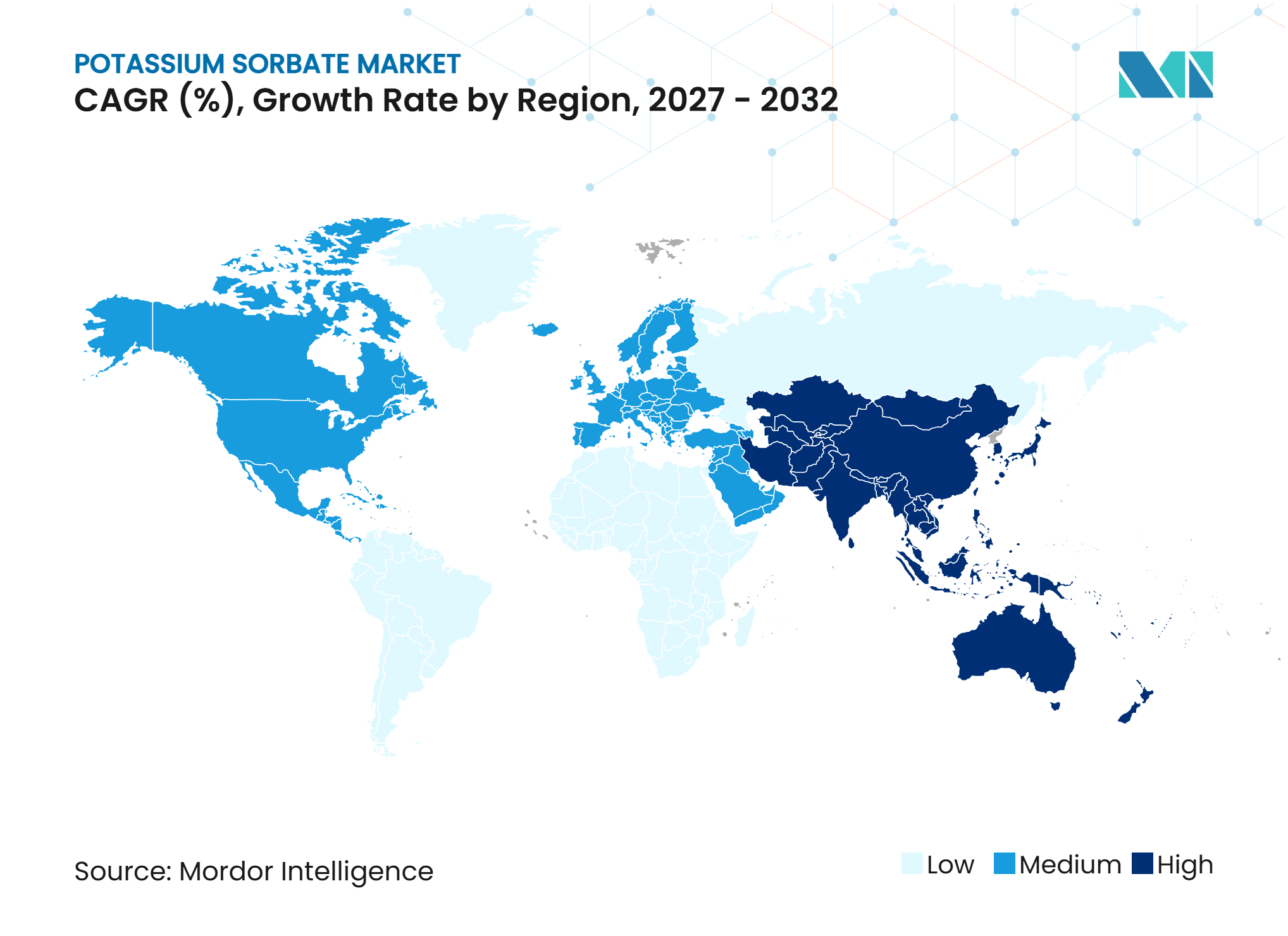
| Fastest Growing Market | Asia-Pacific |
| Largest Market | North America |
| Market Concentration | Low |
Major Players *Disclaimer: Major Players sorted in no particular order Image © Mordor Intelligence. Reuse requires attribution under CC BY 4.0. | |
Potassium Sorbate Market Analysis by Mordor Intelligence
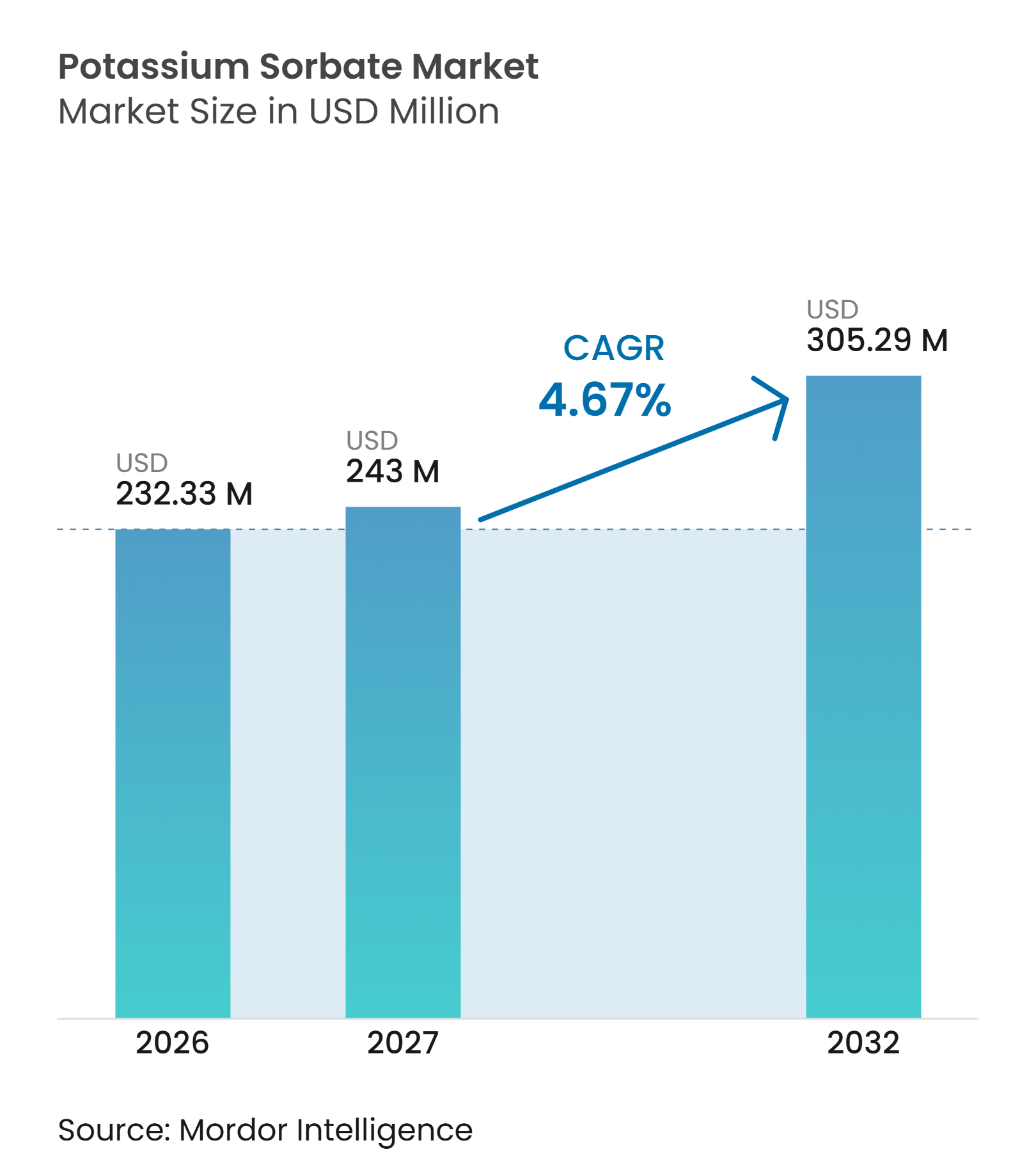
The Potassium Sorbate Market size was valued at USD 232.33 million in 2026 and is estimated to grow from USD 243.00 million in 2027 to reach USD 305.29 million by 2032, at a CAGR of 4.67% during the forecast period (2027-2032). The potassium sorbate market benefits from its established role in food, pharmaceutical, and personal care formulations, where manufacturers need dependable control of yeast and mold. U.S. Food and Drug Administration recognition under 21 Code of Federal Regulations (CFR) 182.3640 and European food additive rules support use across regulated applications. New European authorization for non-heat-treated plant-based mousses broadens the potassium sorbate market into an additional food category. Demand also reflects longer food distribution routes, more packaged products, and tighter documentation needs for pharmaceutical excipients. The potassium sorbate market remains concentrated in Chinese supply, which makes traceability, consistent quality, and alternate supply relationships important purchasing considerations.
Key Report Takeaways
- By form, powder held 52.56% of the potassium sorbate market share in 2026, while granules are projected to advance at a 5.84% CAGR through 2032.
- By grade, food grade held 50.12% of the potassium sorbate market share in 2026, while pharmaceutical grade is projected to advance at a 6.03% CAGR through 2032.
- By application, food and beverages held 34.75% of the potassium sorbate market share in 2026, while pharmaceuticals are projected to advance at a 6.21% CAGR through 2032.
- By geography, North America held 35.92% of the potassium sorbate market share in 2026, while Asia-Pacific is projected to advance at a 5.93% CAGR through 2032.
Note: Market numbers in this report are based on Mordor Intelligence's proprietary estimation framework, which combines nine months of actuals with Q4 projections for base year 2026.
Market Trends and Insights
Drivers Impact Analysis of Potassium Sorbate Market*
| Driver | (~) % Impact on CAGR Forecast | Geographic Relevance | Impact Timeline |
|---|---|---|---|
| Expansion of Packaged and Convenience Foods | +1.6% | Global, with intensity in Asia-Pacific and North America | Medium term (2-4 years) |
| Pharmaceutical Microbial-Stability Requirements | +1.1% | North America, Europe, and emerging growth in Asia-Pacific | Long term (≥ 4 years) |
| Rising Use in Paraben-Free Personal Care Formulations | +0.9% | Europe, North America, and South Korea | Medium term (2-4 years) |
| Growth of Shelf-Stable Food and Beverage Trade | +0.7% | Global, with early gains in India, Southeast Asia, and Middle East | Medium term (2-4 years) |
| Automated Dosing Demand for Low-Dust Granular Formats | +0.4% | North America, EU, and high-automation food processing hubs | Short term (≤ 2 years) |
| Source: Mordor Intelligence | |||
Expansion of Packaged and Convenience Foods
Packaged and convenience foods continue to support demand because products need protection during storage, retail display, and extended distribution. The potassium sorbate market therefore gains from products that move through multinational supply chains and require dependable yeast and mold control. India’s processed-food exports include ambient-temperature formats, which require stable preservation during transport and distribution. China’s GB 2760-2024 became effective on February 8, 2025, and restricted sorbates in canned products while maintaining or expanding permitted uses in categories that include bakery goods, beverages, and condiments[1]. This regulatory change redirected formulation work toward packaged categories that remain within approved use conditions. Food producers consequently need suppliers that can provide application guidance, documentation, and reliable delivery for reformulated products.
Pharmaceutical Microbial-Stability Requirements
Pharmaceutical demand is rising beyond traditional syrups and topical creams because aqueous liquid formulations need an antimicrobial preservative with clear quality documentation. Merck KGaA supplies potassium sorbate powder and granules under its EMPROVE ESSENTIAL range, with listed compliance against Ph. Eur., British Pharmacopoeia, Chinese Pharmacopoeia, National Formulary, Food Chemicals Codex, and E202 requirements. The British Pharmacopoeia retained its potassium sorbate monograph in the 2025 edition, while the United States Pharmacopeia preservative effectiveness framework remains relevant for liquid formulations. Merck KGaA’s Darmstadt site received renewed ExciPACT Good Distribution Practice and Good Manufacturing Practice certification in June 2025, valid through June 2028. These requirements favor qualified suppliers because pharmaceutical customers need material data, audit support, and consistent control of impurities. The potassium sorbate market also benefits from use in oral liquids, ophthalmics, nasal preparations, and topical formulations that need water-soluble preservation.
Rising Use in Paraben-Free Personal Care Formulations
Paraben-free personal care reformulation supports the potassium sorbate market where formulators need alternatives that work within controlled pH ranges. A 2024 peer-reviewed survey of 325 adult cosmetic products found potassium sorbate in 35.7% of sampled products. European cosmetics rules list potassium sorbate as an authorized preservative and set a maximum concentration of 0.6% expressed as sorbic acid[2]. Its performance is stronger in acidic formulations, so manufacturers often pair it with another antimicrobial component to cover bacterial control. This approach can increase use per formulation compared with a single-preservative system. The pattern is relevant in Europe, North America, and South Korea, where personal care and skincare producers manage regulatory, consumer, and export requirements at the same time.
Growth of Shelf-Stable Food and Beverage Trade
Cross-border food and beverage trade raises the need for preservation systems that remain effective through longer distribution routes. The European Union reported EUR 238.4 billion in agri-food exports in 2025, which illustrates the scale of food movement across markets with different compliance requirements. Codex specifications support common technical expectations for food additives, reducing the need for separate product specifications across some export destinations. The potassium sorbate market gains ground where exporters need one preservative system that fits destination-country use limits and product specifications. Halal and Kosher documentation can also influence supplier selection for food exports serving Gulf Cooperation Council and other certification-sensitive markets. Daicel Nanning Food Ingredients Co., Ltd. holds Star-K certification for potassium sorbate and sorbic acid through June 30, 2027. These credentials have become part of supplier qualification for some export-oriented food manufacturers.
Restraints Impact Analysis of Potassium Sorbate Market*
| Restraint | (~) % Impact on CAGR Forecast | Geographic Relevance | Impact Timeline |
|---|---|---|---|
| Clean-Label Substitution by Fermentates and Botanical Preservatives | -1.0% | North America and Europe, with spillover to premium Asia-Pacific segments | Medium term (2-4 years) |
| Oversupply and China-Centered Price Competition | -0.8% | Global, with intensity in Asia-Pacific core and spillover to MEA | Short term (≤ 2 years) |
| Tighter Impurity and Traceability Requirements | -0.4% | Europe (primary), North America and Asia-Pacific | Long term (≥ 4 years) |
| Source: Mordor Intelligence | |||
Clean-Label Substitution by Fermentates and Botanical Preservatives
Clean-label positioning creates substitution pressure in artisan bakery, premium dairy, functional beverages, and other food categories where ingredient declarations influence purchasing. Kemin Food Technologies introduced SHIELD V at Institute of Food Technologists (IFT) FIRST 2025 as a buffered vinegar and botanical extract solution positioned as a replacement for conventional synthetic preservatives. Fermentation-derived natamycin products are also used in some applications that previously relied on sorbate-benzoate systems. Botanical ingredients containing naturally occurring sorbic acid can support alternative label declarations in fruit preparations and nonalcoholic beverages. These alternatives remain more relevant in premium food formats than in pharmaceuticals, animal feed, and industrial applications. The potassium sorbate market thus faces a constraint in established food uses while retaining demand in applications that require familiar specifications, water solubility, and regulated documentation.
Oversupply and China-Centered Price Competition
China-centered capacity creates periodic price pressure because supply additions can continue after export demand normalizes. Shandong Kunda Biotechnology Company Ltd. identifies potassium sorbate among its core products and operates within the Hongda Group’s food-ingredient operations. Large Chinese producers compete through capacity, export logistics, food-grade specifications, and certification coverage. Environmental inspections in Chinese manufacturing regions during 2025 demonstrated that operating disruptions can also tighten supply for import-dependent buyers. The potassium sorbate market therefore experiences both recurring price competition and occasional short-term availability pressure. European and Indian suppliers can differentiate where customers value documented quality, pharmacopeial suitability, and supply-chain transparency over the lowest purchase price.
*Our forecasts treat driver/restraint impacts as directional, not additive. The impact forecasts reflect baseline growth, mix effects, and variable interactions.
Potassium Sorbate Market Segment Analysis
By Form:
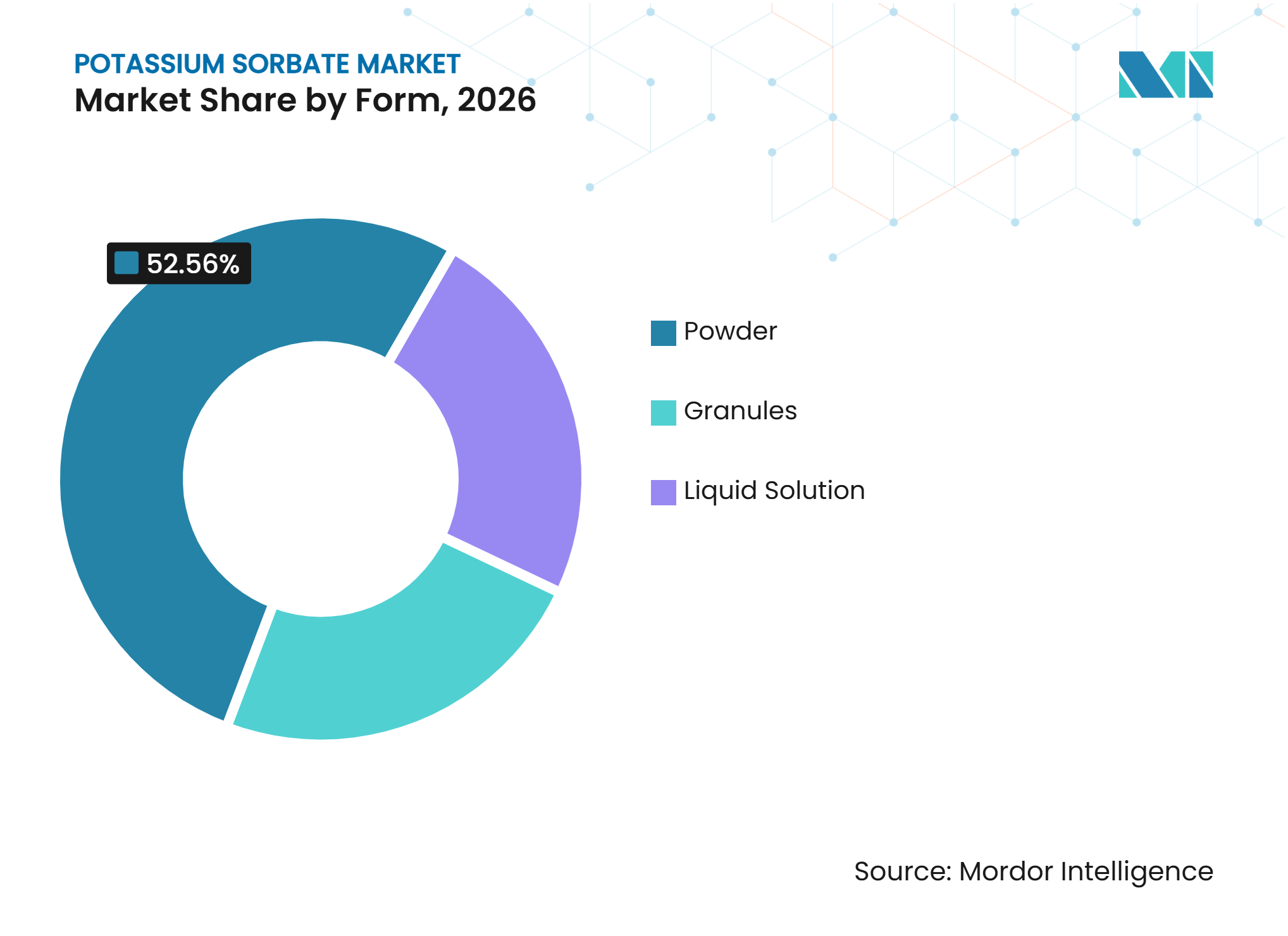
Powder Dominates, Granules Gain Share Through AutomationPowder held 52.56% of the potassium sorbate market share in 2026 because it dissolves readily in aqueous systems and remains familiar to food processors. It is widely used in bakery, beverage, dairy, condiment, and other batch operations where conventional ingredient handling is sufficient. The format suits established food-grade production because it can be incorporated into mixes and process streams without specialized equipment. Powder can create dust during handling, which affects worker exposure, measurement accuracy, cleaning needs, and equipment maintenance. These operational issues become more visible in facilities that use high-speed automated dosing. The potassium sorbate industry continues to use powder where procurement cost and handling simplicity remain the primary considerations.
Granules are projected to advance at a 5.84% CAGR through 2032 as manufacturers seek lower-dust handling and repeatable dosing. Granular material can help automated lines reduce airborne particles and maintain more consistent application. Spraying Systems Co. described a December 2025 cheese-processing installation that used its F1850+ controller and PulsaJet spray guns for potassium sorbate application. The case described reduced overspray and tighter application control, showing why precision systems are relevant in dairy processing. Liquid solution remains suitable for applications that require direct dosing into aqueous streams, including some wine and beverage processes. European impurity rules have also increased the importance of trace-contaminant control in every format, particularly for suppliers serving regulated customers.



By Grade:
Food Grade Leads, Pharmaceutical Grade Gains on Excipient DemandFood grade held 50.12% of the potassium sorbate market share in 2026 and remains the foundation for use across bakery, dairy, beverages, and condiments. Its broad use reflects the scale of packaged food production and the availability of food-grade material from suppliers across Asia. Chinese food additive rules recognize use in several packaged product categories, subject to the specified conditions and limits. Food processors focus on conformity with additive regulations, consistent dissolution, and reliable microbial protection. Certifications such as Food Chemicals Codex, Halal, Kosher, and food safety management standards can affect which producers qualify for export supply. The potassium sorbate market remains exposed to food-grade price competition because many producers serve this application base.
Pharmaceutical grade is projected to advance at a 6.03% CAGR through 2032 as liquid, ophthalmic, topical, and other dosage formats require qualified antimicrobial excipients. The grade requires documentation that demonstrates compliance with relevant pharmacopeial and quality expectations. Merck KGaA’s listed powder and granular products address formulation uses that include liquid, semi-solid, solid, and ophthalmic applications. The United States Pharmacopeia and European Pharmacopoeia frameworks make preservative effectiveness and quality documentation central to supplier approval. Cosmetic grade also benefits from paraben-free reformulation, while feed and industrial grade support animal nutrition and household cleaning applications. These grades broaden demand beyond food processing and reduce reliance on a single end-use base.
By Application:
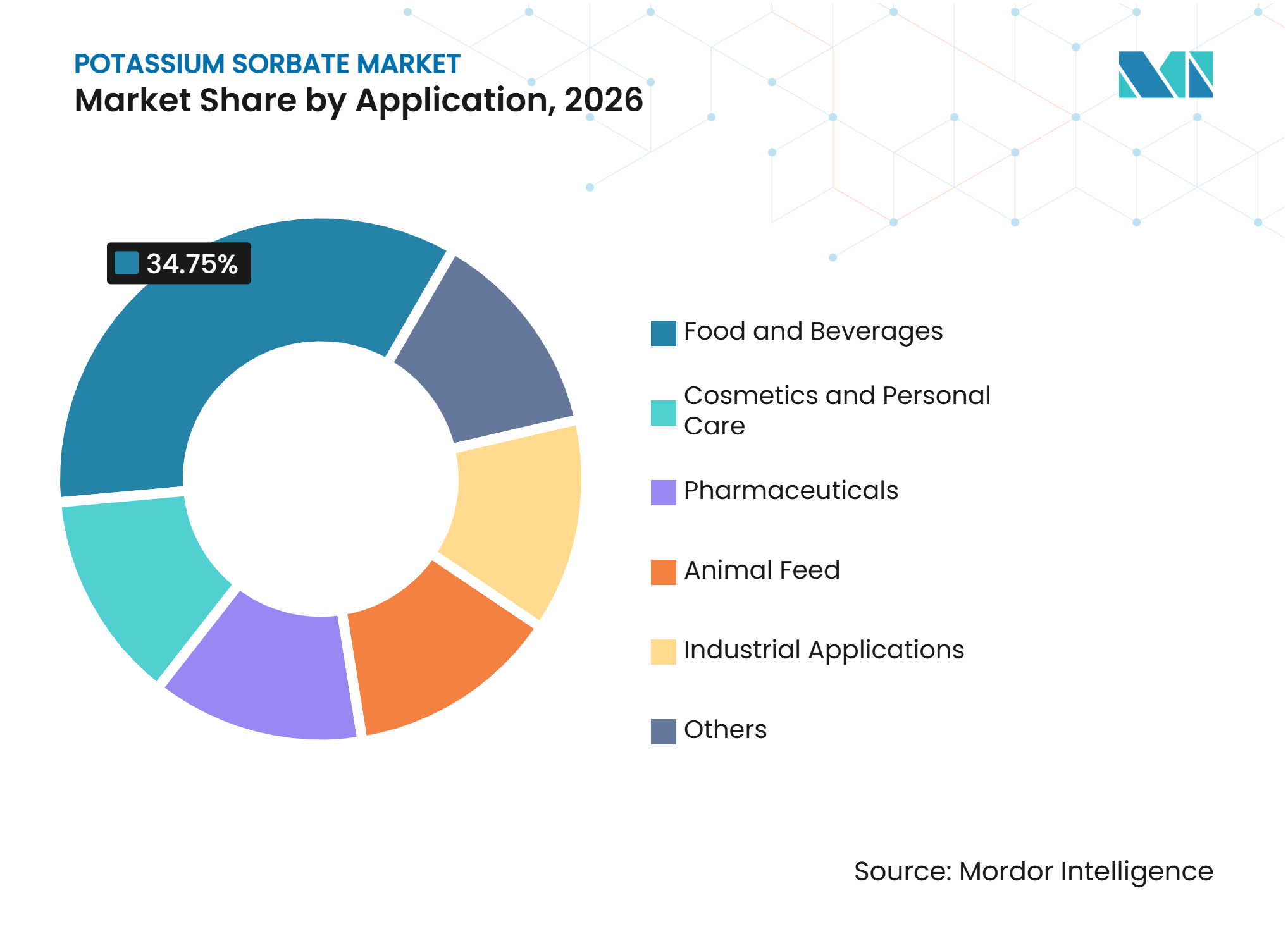
Food and Beverages Anchor Demand, Pharmaceuticals Advance FasterFood and beverages held 34.75% of the potassium sorbate market share in 2026, supported by use in bakery, dairy, beverages, meat products, condiments, and fruit preparations. The application is governed by food additive rules that vary by product and geography, including FDA requirements, European Union rules, and China’s GB 2760-2024 standard. Commission Regulation (EU) 2025/2060 authorized potassium sorbate in non-heat-treated plant-based mousses at a maximum level of 500 mg/kg. This adds a permitted application within European plant-based food production. Demand remains linked to shelf life, distribution distance, formulation pH, and customer requirements for ingredient declarations. Food customers also need suppliers that can support documentation across multiple export destinations.
Pharmaceuticals are projected to advance at a 6.21% CAGR through 2032, supported by oral liquids, eye drops, nasal preparations, and topical semi-solids that require water-soluble preservation. Potassium sorbate is relevant where formulation pH and antimicrobial effectiveness can be managed within approved product specifications. Clinical and compounding work has also discussed its role in pediatric preparations, including acidic liquid systems. Cosmetics and personal care continue to draw on paraben-free positioning and the European authorized-preservative framework. Animal Feed includes liquid veterinary preparations and animal health supplements requiring microbial stability. Industrial Applications include household cleaning products and adhesives, where low toxicity and product compatibility can support use.

Geography Analysis
North America
North America held 35.92% of the potassium sorbate market share in 2026, supported by packaged food, pharmaceutical compounding, and personal care manufacturing. The United States provides an important compliance foundation because potassium sorbate is listed as Generally Recognized as Safe under 21 CFR 182.3640. Oral liquid formulation work also relies on preservative effectiveness testing, which supports demand for documented excipient quality. Import reliance creates exposure to changes in Chinese production availability, and 2025 environmental inspections made buyers more attentive to supply continuity. Canada and Mexico contribute through integrated regional food supply chains and growing consumption of processed and convenience foods.
Asia-Pacific
Asia-Pacific is projected to advance at a 5.93% CAGR through 2032 as China combines large-scale production with expanding consumption of packaged food. China’s GB 2760-2024 changed permitted uses on February 8, 2025, restricting use in canned products while retaining coverage in several beverage, bakery, and condiment categories. India supports a distinct demand base through domestic food processing, pharmaceutical manufacturing, and exports of shelf-stable food formats. BIMAL PHARMA PVT. LTD. serves the Indian supply chain as an importer and distributor of sorbic acid and potassium sorbate. Japan and South Korea offer high-specification channels linked to research, cosmetics, and pharmaceutical manufacturing. Tokyo Chemical Industry Co., Ltd. supplies potassium sorbate for laboratory and research use, while other regional suppliers focus on food and pharmaceutical applications.
Europe, South America, and Middle East and Africa
Europe combines expanding permitted uses with stronger clean-label substitution pressure than many other regions. Commission Regulation (EU) 2025/2060 opened use in non-heat-treated plant-based mousses, while Regulation (EU) 2024/2597 tightened impurity specifications for food additive material. This compliance environment favors audited suppliers that can document impurity control and formulation suitability. South American demand is tied to organized retail, food exports, Brazil’s meat processing, and Argentina’s wine production. Middle East and Africa demand is linked to food manufacturing investment, established processing capacity, and certification requirements in export-oriented supply chains. Eurasian Economic Union requirements also affect regional access, with 2025 registrations for JINNENG Chemical (Qingdao) Co., Ltd. and Shandong Kunda Biotechnology Company Ltd. supporting conformity under applicable food additive rules.
Competitive Landscape
Market Concentration
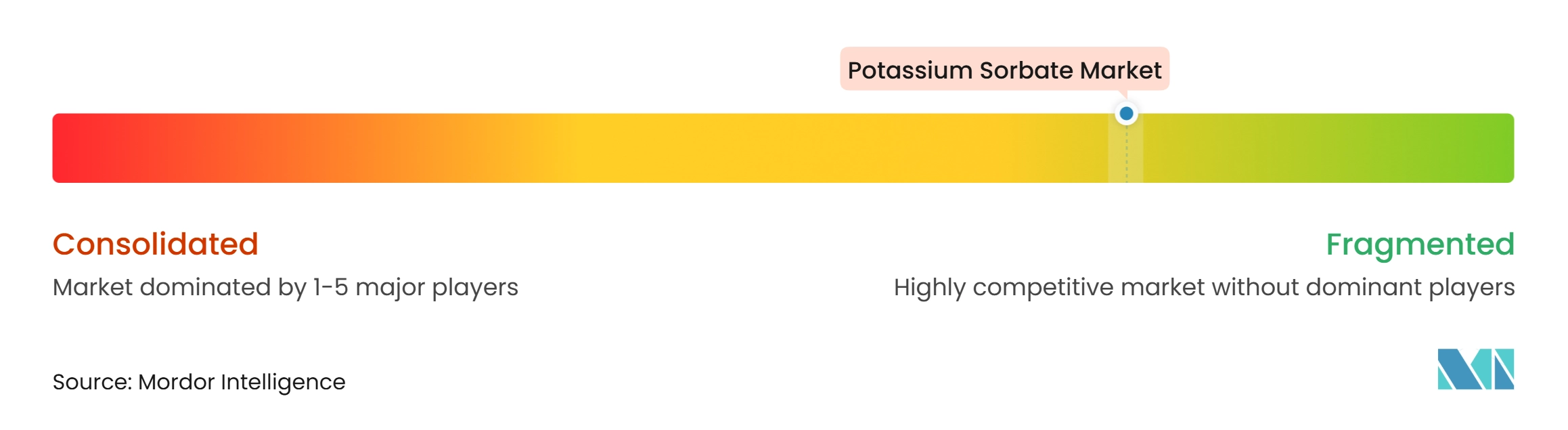
The potassium sorbate market is highly fragmented, with top players including Celanese Corporation, Ningbo Wanglong Techco., Ltd., Nantong Acetic Acid Chemical Co., Ltd., Shandong Kunda Biotechnology Company Ltd., and JINNENG Chemical (Qingdao) Co., Ltd. These suppliers compete through volume, export logistics, consistent specifications, and certification coverage. Jiangsu Mupro IFT Corp. reported net profit growth of 22.74%, reflecting the importance of margin control in a price-sensitive category. The company lists British Retail Consortium (BRC), Food Safety System Certification 22000, Kosher, Halal, and Feed Materials Assurance Scheme Quality System certifications for its production operations. Such certifications are increasingly necessary for export participation rather than being a primary source of differentiation.
The differentiated-grade tier places greater weight on pharmacopeial compliance, validated quality systems, and customer documentation. Merck KGaA uses the EMPROVE program to provide customers with qualification and quality documentation for regulated applications. Celanese Corporation supplies sorbates through its Nutrinova business for food, beverage, pharmaceutical, personal care, and household cleaning applications. Celanese Corporation has also positioned its ECO-B range as a reduced-carbon-footprint option for buyers with supplier sustainability requirements. Daicel Nanning Food Ingredients Co., Ltd. occupies a specialty position with production in Nanning and Star-K-certified products. BIMAL PHARMA PVT. LTD. and FBC Industries participate as distribution-focused companies, while Tokyo Chemical Industry Co., Ltd. serves laboratory and research demand.
Nantong Acetic Acid Chemical Co., Ltd. brought new 15,000-metric-ton capacity online in 2025 for acesulfame potassium demand, with shared infrastructure relevant to potassium sorbate volumes. This move shows how integrated organic-acid operations can improve utilization across related food ingredient lines. Daicel Nanning Food Ingredients Co., Ltd. maintains Kosher certification through June 2027, which supports qualification for certification-sensitive export customers. JINNENG Chemical (Qingdao) Co., Ltd. and Shandong Kunda Biotechnology Company Ltd. obtained 2025 Eurasian Economic Union certification, supporting their access to member-state markets. Hunan Huari Pharmaceutical Co., Ltd., Jiangbei Additive Co., Ltd., and suppliers that can combine dependable food-grade output with traceability, environmental management, and high-purity documentation are best placed to serve both commodity and regulated buyers.
Potassium Sorbate Industry Leaders
-
Celanese Corporation
-
Ningbo Wanglong Techco., Ltd.
-
Nantong Acetic Acid Chemical Co., Ltd.
-
Shandong Kunda Biotechnology Company Ltd
-
JINNENG Chemical (Qingdao) Co., Ltd
- *Disclaimer: Major Players sorted in no particular order
Potassium Sorbate Market Companies Covered in this Report
- BIMAL PHARMA PVT. LTD.
- Celanese Corporation
- Daicel Nanning Food Ingredients Co., Ltd.
- FBC Industries
- Hunan Huari Pharmaceutical Co., Ltd.
- Jiangbei Additive Co., Ltd.
- Jiangsu Mupro IFT Corp.
- JINNENG Chemical (Qingdao) Co., Ltd
- Merck KGaA
- Nantong Acetic Acid Chemical Co., Ltd.
- Ningbo Wanglong Techco., Ltd.
- Shandong Kunda Biotechnology Company Ltd
- Sorbic International PLC
- Titan Biotech
- Tokyo Chemical Industry Co., Ltd.
Recent Industry Developments in Potassium Sorbate Market
- January 2026: Shandong Kunda Biotechnology Company Ltd announced an investment in upgrading its functional food-additive production equipment, including the installation of an additional spray-drying system at its potassium sorbate manufacturing facility. The project will improve drying and packaging operations, while maintaining the plant's existing annual potassium sorbate capacity of 33,000 tonnes.
- January 2026: The European Commission granted Union authorization to Nutrinova Germany GmbH for its Nutrinova Potassium Sorbate BFX Granules as a Type 6 biocidal product used for preservation of products during storage. The authorization, effective from February 15, 2026, through January 31, 2036, expands the product's regulatory access for in-can preservation applications in the European Union.
Global Potassium Sorbate Market Report Scope
Potassium sorbate is the potassium salt of sorbic acid and is widely used as a preservative to inhibit the growth of molds, yeasts, and certain bacteria. It is available in powder, granule, and liquid forms and offers good solubility and stability across various formulations. Its antimicrobial properties support its use in food and beverages, cosmetics and personal care products, pharmaceuticals, animal feed, and industrial applications.
The Potassium Sorbate Market is segmented by form, grade, application, and geography. By form, the market is segmented into powder, granules, and liquid solution. By grade, the market is segmented into food grade, pharmaceutical grade, cosmetic grade, and feed and industrial grade. By application, the market is segmented into food and beverages, cosmetics and personal care, pharmaceuticals, animal feed, industrial, and others. The report also covers the market size and forecasts for potassium sorbate in 15 countries across major regions. For each segment, the market sizing and forecasts have been done on the basis of value (USD).
Segmentation Overview
| Powder |
| Granules |
| Liquid Solution |
| Food Grade |
| Pharmaceutical Grade |
| Cosmetic Grade |
| Feed and Industrial Grade |
| Food and Beverages |
| Cosmetics and Personal Care |
| Pharmaceuticals |
| Animal Feed |
| Industrial |
| Others |
| Asia-Pacific | China |
| India | |
| Japan | |
| South Korea | |
| ASEAN Countries | |
| Rest of Asia-Pacific | |
| North America | United States |
| Canada | |
| Mexico | |
| Europe | Germany |
| United Kingdom | |
| France | |
| Italy | |
| NORDIC Countries | |
| Rest of Europe | |
| South America | Brazil |
| Argentina | |
| Rest of South America | |
| Middle East and Africa | Saudi Arabia |
| South Africa | |
| Rest of Middle East and Africa |
| By Form | Powder | |
| Granules | ||
| Liquid Solution | ||
| By Grade | Food Grade | |
| Pharmaceutical Grade | ||
| Cosmetic Grade | ||
| Feed and Industrial Grade | ||
| By Application | Food and Beverages | |
| Cosmetics and Personal Care | ||
| Pharmaceuticals | ||
| Animal Feed | ||
| Industrial | ||
| Others | ||
| By Geography | Asia-Pacific | China |
| India | ||
| Japan | ||
| South Korea | ||
| ASEAN Countries | ||
| Rest of Asia-Pacific | ||
| North America | United States | |
| Canada | ||
| Mexico | ||
| Europe | Germany | |
| United Kingdom | ||
| France | ||
| Italy | ||
| NORDIC Countries | ||
| Rest of Europe | ||
| South America | Brazil | |
| Argentina | ||
| Rest of South America | ||
| Middle East and Africa | Saudi Arabia | |
| South Africa | ||
| Rest of Middle East and Africa | ||
Key Questions Answered in the Report
What is the size of the potassium sorbate market?
The potassium sorbate market size was valued at USD 232.33 million in 2026 and is estimated to grow from USD 243.00 million in 2027 to reach USD 305.29 million by 2032, at a CAGR of 4.67% during the forecast period (2027-2032).
What is driving demand for potassium sorbate?
Packaged food, longer food distribution routes, pharmaceutical liquid formulations, and paraben-free personal care products support demand.
Which form held the largest share in 2026?
Powder held a 52.56% share in 2026 because it remains widely used in conventional food processing and dissolves readily in aqueous systems.
Which application is projected to grow fastest through 2032?
Pharmaceuticals are projected to advance at a 6.21% CAGR through 2032 because liquid and topical formulations need qualified antimicrobial preservatives.