
Postbiotic Supplements Market Size and Share
Market Overview
| Study Period | 2027 - 2032 |
|---|---|
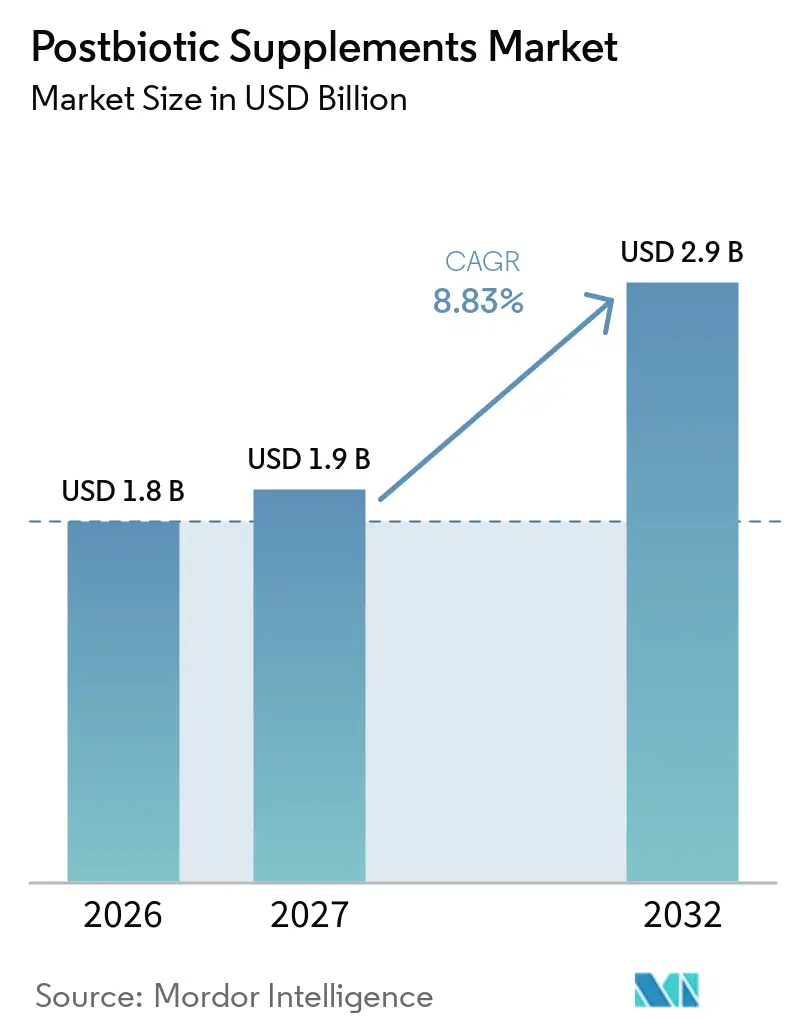
| Market Size (2027) | USD 1.9 Billion |
| Market Size (2032) | USD 2.9 Billion |
| Growth Rate (2027 - 2032) | 8.83 % |
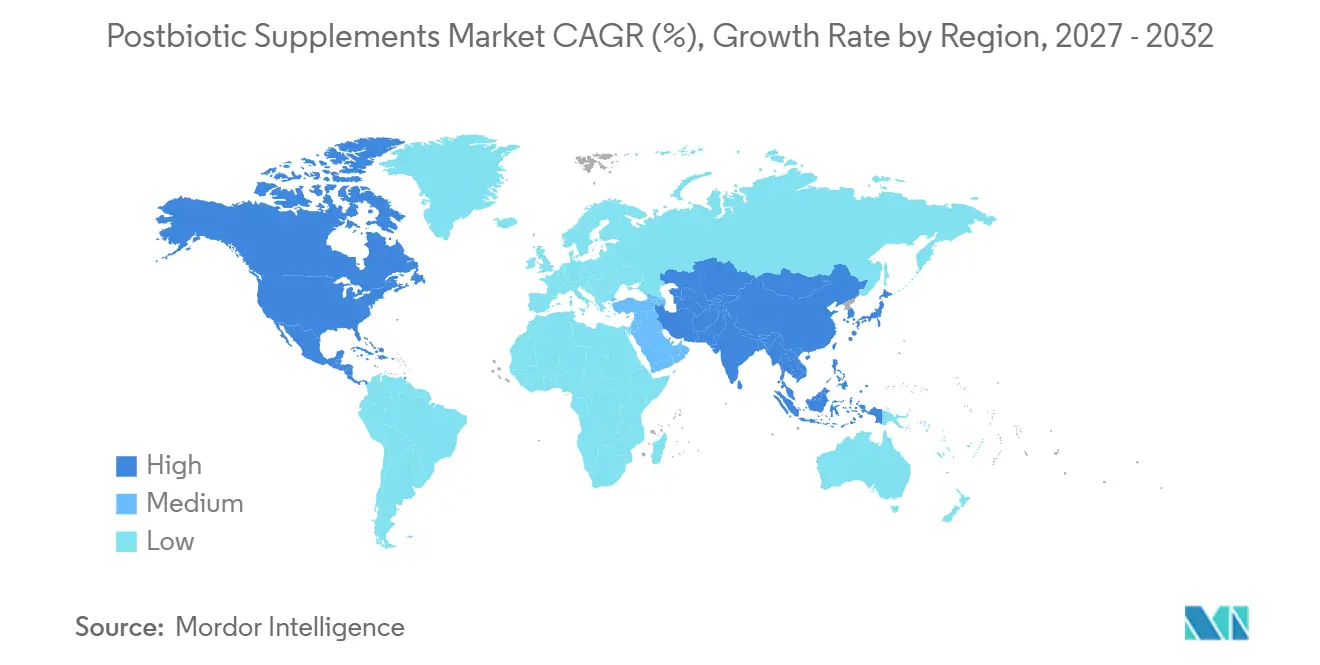
| Fastest Growing Market | Asia-Pacific |
| Largest Market | North America |
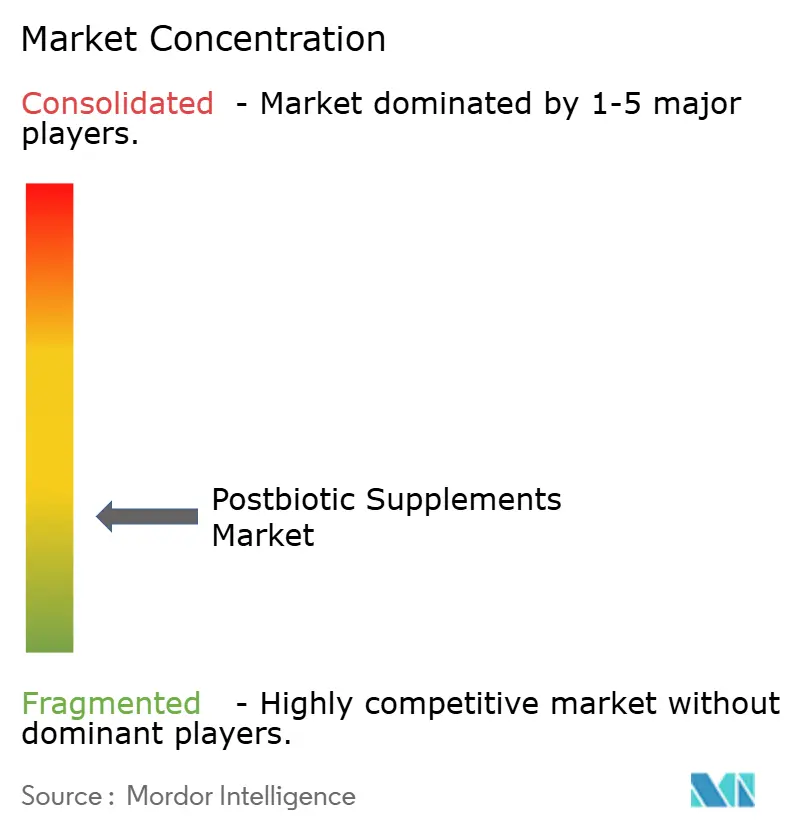
| Market Concentration | Low |
Major Players *Disclaimer: Major Players sorted in no particular order Image © Mordor Intelligence. Reuse requires attribution under CC BY 4.0. | |
Postbiotic Supplements Market Analysis by Mordor Intelligence
The global postbiotic supplements market size is valued at USD 1.8 billion in 2026 and is projected to reach USD 2.9 billion by 2032, registering a CAGR of 8.83% during the forecast period (2027–2032). Demand is supported by growing interest in digestive health, immune support, and preventive wellness, encouraging the development of postbiotic supplements for targeted health benefits. Capsules and tablets represent the largest product category, while powders are expected to record faster growth as manufacturers explore different formulation formats. Pharmacies and health stores remain an important distribution channel, whereas online retail is expected to expand as consumers increasingly access supplements through digital platforms. North America holds the largest regional market position, while Asia-Pacific is expected to register the fastest growth during the forecast period. The competitive landscape includes established ingredient suppliers, biotechnology companies, and specialist supplement manufacturers, with opportunities centred on formulation innovation, scientific substantiation, and consumer education.
Key Report Takeaways
- By product type, capsules and tablets accounted for the largest postbiotic supplements market share, at 42.0% in 2026, within a postbiotic supplements market valued at USD 1.8 billion.
- By target health benefit, digestive health accounted for the largest postbiotic supplements market share, at 37.8% in 2026, as demand focused on digestive wellness within the postbiotic supplements market.
- By distribution channel, Pharmacies & Health Stores held the largest postbiotic supplements market share, at 40.0% in 2026, reflecting the importance of pharmacy-based access within the postbiotic supplements market.
- By geography, North America accounted for the largest postbiotic supplements market share, at 36.0% in 2026, making it the leading regional market within the postbiotic supplements market.
Note: Market numbers in this report are based on Mordor Intelligence's proprietary estimation framework, which combines nine months of actuals with Q4 projections for base year 2026.
Market Trends and Insights
Drivers Impact Analysis of Postbiotic Supplements Market*
| Driver | (~) % Impact on CAGR Forecast | Geographic Relevance | Impact Timeline |
|---|---|---|---|
| Rising Awareness of Gut Health and Digestive Wellness | +2.1% | Global, with strong relevance in North America and Europe | Medium term (2-4 years) |
| Growing Demand for Immune-Support Supplements | +1.8% | Global, particularly North America and Asia-Pacific | Long term (4 years or more) |
| Preference for Shelf-Stable Alternatives to Live Probiotics | +1.5% | North America and Europe, with expanding relevance in Asia-Pacific | Short term (2 years or less) |
| Expansion of Preventive Healthcare and Functional Nutrition | +2.3% | Global, led by North America, with accelerating adoption in Asia-Pacific | Medium term (2-4 years) |
| Innovation in Postbiotic Supplement Formulations | +1.7% | North America and Europe, with global commercialization potential | Long term (4 years or more) |
| Expanding Online and Modern Retail Distribution | +1.9% | Global, with growing relevance across Asia-Pacific and North America | Medium term (2-4 years) |
| Source: Mordor Intelligence | |||
Rising Awareness of Gut Health and Digestive Wellness
Growing consumer awareness of gut health and digestive wellness creates opportunities for postbiotics, which are preparations of inanimate microorganisms and/or their components that confer a health benefit on the host. Their potential use in digestive health supplements and functional nutrition products allows manufacturers to target consumers seeking support for gastrointestinal wellness.[1] As digestive health remains a key category within the postbiotics market, companies can differentiate their offerings through clearly defined product benefits, evidence-based formulations, and transparent labelling. This creates opportunities to position postbiotics as an additional option within the broader digestive wellness market.
Growing Demand for Immune-Support Supplements
Growing interest in immune health creates opportunities for postbiotics as ingredients in dietary supplements and functional nutrition products. Postbiotic preparations are being investigated for their potential effects on host immune responses, although benefits depend on the specific microbial preparation and supporting evidence. The International Scientific Association for Probiotics and Prebiotics (ISAPP) emphasizes that a product must demonstrate a health benefit to qualify as a postbiotic under its consensus definition. Manufacturers can respond to this demand by developing targeted formulations supported by strain-specific research, appropriate safety assessments, and substantiated health claims. This creates opportunities to differentiate immune-support products while maintaining scientific credibility and avoiding unsupported generalizations about efficacy.
Preference for Shelf-Stable Alternatives to Live Probiotics
The preference for stable microbial ingredients creates opportunities for postbiotics as alternatives to formulations that depend on live microorganisms. Because postbiotics contain inactivated microorganisms or their components, they can offer practical advantages in product stability, storage, and incorporation into different supplement formats. ISAPP identifies improved stability and convenience as potential advantages of non-viable microbial preparations compared with their live counterparts. These characteristics can support the development of capsules, tablets, powders, and other formulations where maintaining microbial viability may otherwise present technical challenges. However, stability depends on the preparation and product formulation, and manufacturers must still demonstrate the safety and health benefits of the finished product.
Expansion of Preventive Healthcare and Functional Nutrition
The growing emphasis on preventive healthcare and everyday nutritional support creates opportunities for postbiotics in products designed for regular consumption. Their potential applications across digestive wellness, immune support, and other health-related categories align with the broader development of functional nutrition products. The scientific framework requires postbiotic preparations to demonstrate a health benefit, providing an important basis for product development and substantiation.[2]Ingredient suppliers and supplement manufacturers can capitalize on this opportunity by incorporating well-characterized postbiotic preparations into targeted nutritional products. Clear product positioning, evidence-based formulations, and transparent communication of intended benefits can help distinguish these products within the wider functional nutrition market.
Restraints Impact Analysis of Postbiotic Supplements Market*
| RESTRAINT | (~) % IMPACT ON CAGR FORECAST | GEOGRAPHIC RELEVANCE | IMPACT TIMELINE |
|---|---|---|---|
| Limited Consumer Awareness of Postbiotics | -0.8% | Global, particularly markets where postbiotics have limited consumer recognition | Medium term (2-4 years) |
| Regulatory and Labeling Challenges | -0.5% | Global, with requirements varying by jurisdiction | Short term (2 years or less) |
| Limited Clinical Evidence for Certain Health Claims | -0.7% | Global, across markets requiring scientific substantiation of health claims | Long term (4 years or more) |
| Competition from Probiotic and Prebiotic Supplements | -0.6% | Global, particularly markets with established probiotic and prebiotic product categories | Medium term (2-4 years) |
| Source: Mordor Intelligence | |||
Limited Consumer Awareness of Postbiotics
Limited familiarity with postbiotics and their distinction from probiotics and prebiotics may constrain consumer understanding and product adoption. Unlike more established supplement categories, postbiotics require consumers to understand that they contain inanimate microorganisms or their components and that benefits depend on the specific preparation. The U.S. National Institutes of Health's Office of Dietary Supplements provides consumer guidance on probiotics, including their potential benefits and limitations, illustrating the importance of accessible information when consumers evaluate microbial supplements[3]. Manufacturers may need to invest in consumer education, transparent ingredient descriptions, and clear explanations of product benefits to improve category understanding. Without effective communication and credible evidence, consumers may find it difficult to distinguish postbiotic products from established alternatives.
Regulatory and Labeling Challenges
Regulatory and labeling requirements can complicate the commercialization of postbiotic products because manufacturers must establish that their ingredients meet applicable product requirements and that their health-related claims are appropriately substantiated. In the United States, the Food and Drug Administration (FDA) distinguishes among health claims, nutrient-content claims, and structure/function claims, with different requirements governing their use on food and dietary supplement labels. For postbiotic manufacturers, navigating these requirements can increase the work involved in product formulation, documentation, label review, and market entry. Requirements also vary across jurisdictions, making international commercialization more complex.
*Our forecasts treat driver/restraint impacts as directional, not additive. The impact forecasts reflect baseline growth, mix effects, and variable interactions.
Postbiotic Supplements Market Segment Analysis
By Product Type:
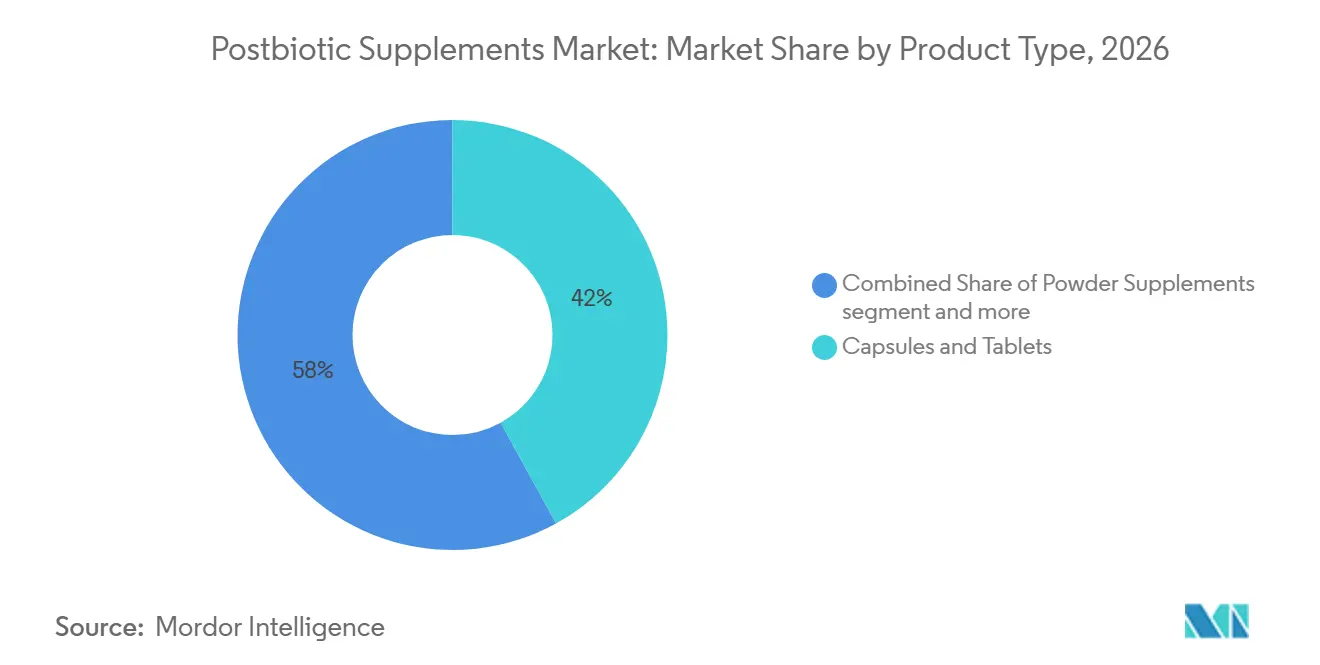
Capsules and Tablets Lead While Powder Supplements ExpandCapsules and tablets accounted for 42.00% of the global postbiotics market in 2026, making them the largest product-type segment. Their leading position reflects the established use of these formats in dietary supplements, where standardized serving sizes, portability, and convenient consumption support their suitability for daily wellness routines. These formats also allow manufacturers to incorporate postbiotic ingredients into products targeting digestive health, immune support, and general wellness.
Powder supplements are projected to be the fastest-growing product-type segment, with a CAGR of 10.50% from 2027 to 2032. Their growth potential is supported by their flexibility for incorporation into beverages, shakes, and other nutritional preparations, as well as the ability to adjust serving sizes and combine postbiotic ingredients with other functional components. For the postbiotics market assessment, the distinction between capsules and tablets and powder supplements is important because each format offers different consumption options and formulation possibilities.

By Target Health Benefit:
Digestive Health Leads the MarketDigestive health accounted for 37.80% of the global postbiotics market in 2026, making it the largest target health benefit segment. Its leading position reflects the relevance of postbiotic ingredients to products formulated for gastrointestinal wellness, an established area of interest within the broader microbiome and functional nutrition categories. Manufacturers can target this segment through formulations designed for digestive wellness, provided that the proposed benefits are supported by evidence specific to the ingredients and product.
The digestive health segment is projected to grow at a CAGR of 9.40% from 2027 to 2032. Continued product development focused on gut health and the inclusion of postbiotic ingredients in targeted wellness supplements may support opportunities within this segment. For the postbiotics market assessment, digestive health remains a key segment because it captures products positioned around gastrointestinal wellness while distinguishing them from formulations targeting immune support, general wellness, and other benefits.
By Distribution Channel:
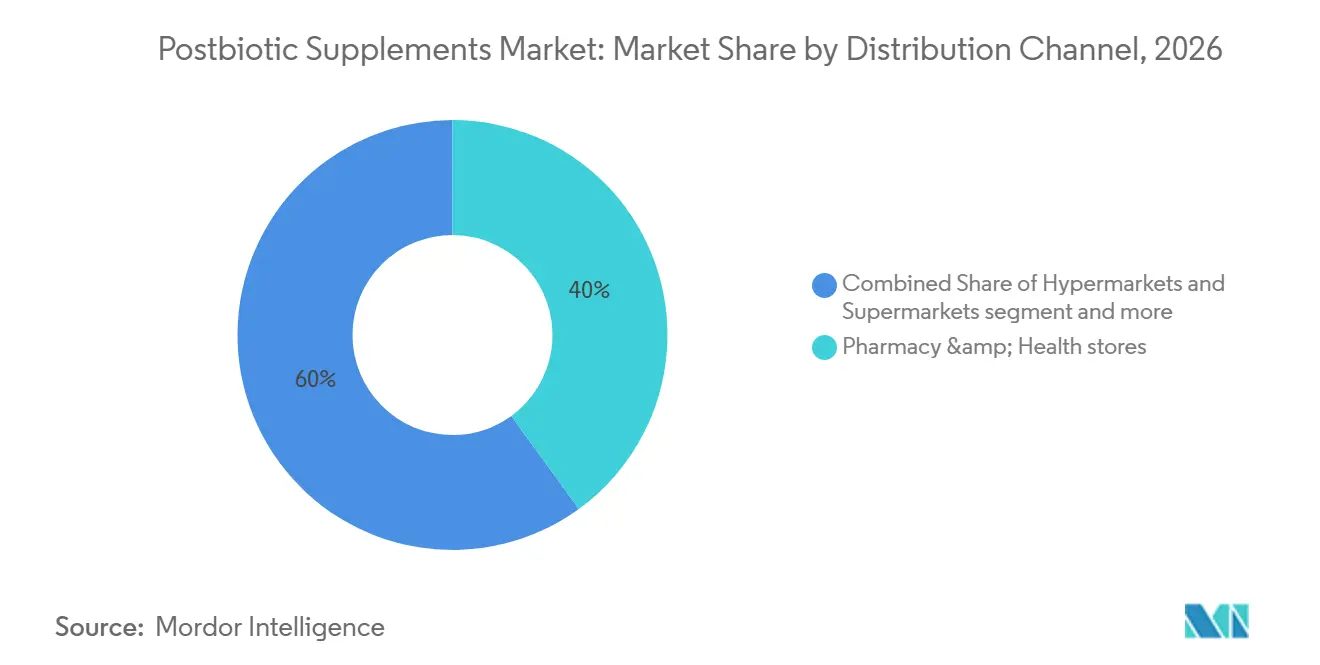
Pharmacies Lead While Online Retail ExpandsPharmacies accounted for 40.00% of the global postbiotics market in 2026, making them the largest distribution channel. Their leading position reflects their established role in distributing health-related products, including dietary supplements, and their relevance to consumers seeking products through healthcare-oriented retail environments. Pharmacies also provide a setting where consumers can compare supplement formats and product information when selecting formulations for digestive health, immune support, and general wellness.
Online retail stores are projected to be the fastest-growing distribution channel, with a CAGR of 9.80% from 2027 to 2032. Online platforms can expand access to a wider range of postbiotic supplements, support product comparisons, and allow brands to communicate ingredient information and intended uses directly to consumers. For the postbiotics market assessment, the distinction between pharmacy and online retail channels is important because each offers a different route to product discovery, information access, and purchase.
Geography Analysis
North America Postbiotic Supplements Market
North America was the largest regional market for postbiotics in 2026, accounting for 36.00% of the global market. The region's established dietary supplement industry and availability of products targeting digestive health, immune support, and general wellness provide a foundation for postbiotic product development. Manufacturers can differentiate their portfolios through evidence-based formulations, clearly communicated product benefits, and convenient formats distributed through pharmacies, health stores, and online retail channels. The verified 2025 regional market share has not been provided, so the 2026 figure is used for the regional comparison.
APAC Postbiotic Supplements Market
Asia-Pacific is projected to be the fastest-growing regional market, with a CAGR of 9.50% from 2027 to 2032. Opportunities may arise from the expansion of functional nutrition and dietary supplement categories, alongside the potential to increase postbiotic product availability through pharmacies, specialty health retailers, and e-commerce platforms. China, Japan, India, Thailand, Australia, and other markets within the region differ in consumer preferences, retail infrastructure, and regulatory requirements, creating varied opportunities for manufacturers. Market expansion will depend on consumer awareness, product affordability, suitable formulations, effective distribution, and compliance with local food and supplement regulations.
The Americas, EMEA and APAC Postbiotic Supplements Market
Across the global market, regional strategies need to reflect differences in consumer awareness, supplement purchasing behaviour, distribution infrastructure, and regulatory requirements. North America offers the largest established market, while Asia-Pacific presents the strongest forecast growth opportunity among the supplied regional comparisons. Europe, including the United Kingdom, Germany, France, Italy, Spain, and other markets, also provides opportunities for product development and distribution expansion. South America, including Brazil, Colombia, and other markets, may offer opportunities as postbiotic supplements become more accessible. In the Middle East and Africa, including South Africa, Saudi Arabia, the United Arab Emirates, and other markets, market development will depend on product availability, consumer awareness, and local regulatory conditions.
Competitive Landscape
Key players include DSM-Firmenich, Cargill, Archer Daniels Midland Company (ADM), Kerry Group, Sabinsa, Kirin Holdings, SCD Probiotics, Biofarma, Probi, Culturelle/i-Health, VSL, Ritual, Metagenics, Lallemand, ABbiotek Health, Sirio Pharma, Postbiotica, Lesaffre, Glac Biotech, and Postbiotics Inc. These companies operate across different parts of the postbiotic value chain, including ingredient development, microbial processing, formulation, and finished supplement products. Their capabilities and market positioning vary according to their product portfolios, scientific expertise, manufacturing capabilities, and route-to-market strategies. Competition therefore spans both business-to-business ingredient supply and consumer-facing supplement brands.
Product innovation remains an important competitive strategy, with companies exploring postbiotic strains, inactivated microbial preparations, and delivery formats suited to different supplement applications. Product development also depends on demonstrating the quality, stability, safety, and intended benefits of specific preparations. Scientific substantiation and compliance with applicable regulatory and labelling requirements can influence how products are developed and positioned in different markets. These considerations make evidence generation and formulation expertise relevant areas of competition.
Commercial opportunities also exist in expanding distribution through pharmacies, health stores, and online retail platforms. Pharmacies and health stores provide established channels for consumers seeking dietary supplements, while online platforms offer an additional route for product discovery and purchase. Companies may also seek to strengthen market access through distribution agreements, retail partnerships, and broader geographic availability.
Postbiotic Supplements Industry Leaders
-
dsm-firmenich
-
Cargill
-
Archer Daniels Midland (ADM)
-
Kerry Group
-
Sabinsa Corporation
- *Disclaimer: Major Players sorted in no particular order
Postbiotic Supplements Market Companies Covered in this Report
- DSM-Firmenich AG
- Cargill, Incorporated
- Archer-Daniels-Midland Company (ADM)
- Kerry Group plc
- Sabinsa Corporation
- Kirin Holdings Company, Limited
- SCD Probiotics
- Biofarma Group
- Probi AB
- Culturelle (i-Health, Inc.)
- VSL Pharmaceuticals
- Ritual
- Metagenics, Inc.
- Lallemand Inc.
- ABbiotek Health
- Sirio Pharma Co., Ltd.
- Postbiotica S.r.l.
- Lesaffre Group
- Glac Biotech Co., Ltd.
- Postbiotics Inc.
Recent Industry Developments in Postbiotic Supplements Market
- August 2026: Cargill reported findings from a study of its EpiCor® postbiotic, published in Frontiers in Nutrition on August 6, 2026. The randomized, double-blind, placebo-controlled crossover study included 30 healthy adults who received a single 500 mg dose of EpiCor or placebo on separate visits. Researchers observed changes in selected immune-related biomarkers within one to three hours of consumption. The findings provide mechanistic evidence about short-term immune responses to EpiCor, rather than establishing clinical benefits for all postbiotic ingredients.
- May 2026: Probi announced the launch of Rham271h™, its first postbiotic solution, derived from an inactivated Lacticaseibacillus rhamnosus 271 strain. Positioned for immune support, the ingredient offers heat, pH, and shelf-stability advantages for formulation in functional foods and beverages. The launch expands Probi's portfolio beyond live probiotic solutions and strengthens its presence in the postbiotics category.
- March 2026: ILDONG Bioscience announced that its BBR® and RHT® postbiotic ingredients had received Natural Product Number registrations in Canada under the Natural Health Products framework. BBR is associated with cardiovascular health positioning, while RHT is positioned for skin health applications.
- May 2025: Lallemand Health Solutions and Kirin Holdings announced a distribution agreement to expand the commercial reach of IMMUSE®, Kirin's heat-inactivated Lactococcus lactis strain Plasma postbiotic. The partnership combines Kirin's research-backed ingredient with Lallemand's distribution capabilities to increase market access for immune-support applications.
Global Postbiotic Supplements Market Report Scope
The postbiotics supplements market comprises postbiotic products marketed and sold for health and wellness applications, containing preparations of inanimate microorganisms and their components that confer a health benefit to the host. The global postbiotics market is classified by product type, target health benefit, distribution channel, and geography. Based on product type, the market is classified into capsules and tablets, powders, liquids, and other formats. Based on target health benefit, the market is classified into digestive health, immune support, general wellness and other benefits, and others. Based on distribution channel, the market is classified into hypermarkets and supermarkets, pharmacies and health stores, online retail stores, and other off-trade channels. Based on geography, the market is classified into North America, Europe, Asia-Pacific, South America, and the Middle East and Africa. The market forecasts are provided in terms of value (USD) and volume (tons).
Segmentation Overview
| Capsules and Tablets |
| Powders |
| Liquids |
| Other Formats |
| Digestive Health |
| Immune Support |
| General Wellness and Other Benefits |
| Others |
| Hypermarkets and Supermarkets | Pharmacies & Health Stores |
| Online Retail | |
| Other off-trade channels |
| North America | United States |
| Canada | |
| Europe | United Kingdom |
| Germany | |
| France | |
| Italy | |
| Spain | |
| Rest of Europe | |
| Asia-Pacific | China |
| Japan | |
| India | |
| Thailand | |
| Australia | |
| Rest of Asia-Pacific | |
| South America | Brazil |
| Colombia | |
| Rest of South America | |
| Middle East and Africa | South Africa |
| Saudi Arabia | |
| United Arab Emirates | |
| Rest of Middle East and Africa |
| By Product Type | Capsules and Tablets | |
| Powders | ||
| Liquids | ||
| Other Formats | ||
| By Target Health Benefit | Digestive Health | |
| Immune Support | ||
| General Wellness and Other Benefits | ||
| Others | ||
| By Distribution channel | Hypermarkets and Supermarkets | Pharmacies & Health Stores |
| Online Retail | ||
| Other off-trade channels | ||
| By Geography | North America | United States |
| Canada | ||
| Europe | United Kingdom | |
| Germany | ||
| France | ||
| Italy | ||
| Spain | ||
| Rest of Europe | ||
| Asia-Pacific | China | |
| Japan | ||
| India | ||
| Thailand | ||
| Australia | ||
| Rest of Asia-Pacific | ||
| South America | Brazil | |
| Colombia | ||
| Rest of South America | ||
| Middle East and Africa | South Africa | |
| Saudi Arabia | ||
| United Arab Emirates | ||
| Rest of Middle East and Africa | ||
Key Questions Answered in the Report
What is the postbiotics supplements market size?
The postbiotics supplements market is valued at USD 1.8 billion in 2026 and is projected to reach USD 2.9 billion by 2032.
What is the CAGR of the global postbiotics supplements market?
The global postbiotics supplements market is projected to register a CAGR of 8.83% from 2027 to 2032.
Which product type dominates the global postbiotics supplements market?
Capsules and tablets represent the largest product-type segment, accounting for 42.00% of the market in 2026.
Which region is expected to grow the fastest in the global postbiotics supplements market?
Asia-Pacific is projected to be the fastest-growing regional market, with a CAGR of 9.50% from 2027 to 2032.