
Porcelain Enamel Coatings Market Size and Share
Market Overview
| Study Period | 2022 - 2032 |
|---|---|
| Market Size (2027) | USD 2.06 Billion |
| Market Size (2032) | USD 2.49 Billion |
| Growth Rate (2027 - 2032) | 3.83 % |
| Fastest Growing Market | Asia-Pacific |
| Largest Market | Asia-Pacific |
| Market Concentration | Low |
Major Players *Disclaimer: Major Players sorted in no particular order Image © Mordor Intelligence. Reuse requires attribution under CC BY 4.0. | |
Porcelain Enamel Coatings Market Analysis by Mordor Intelligence
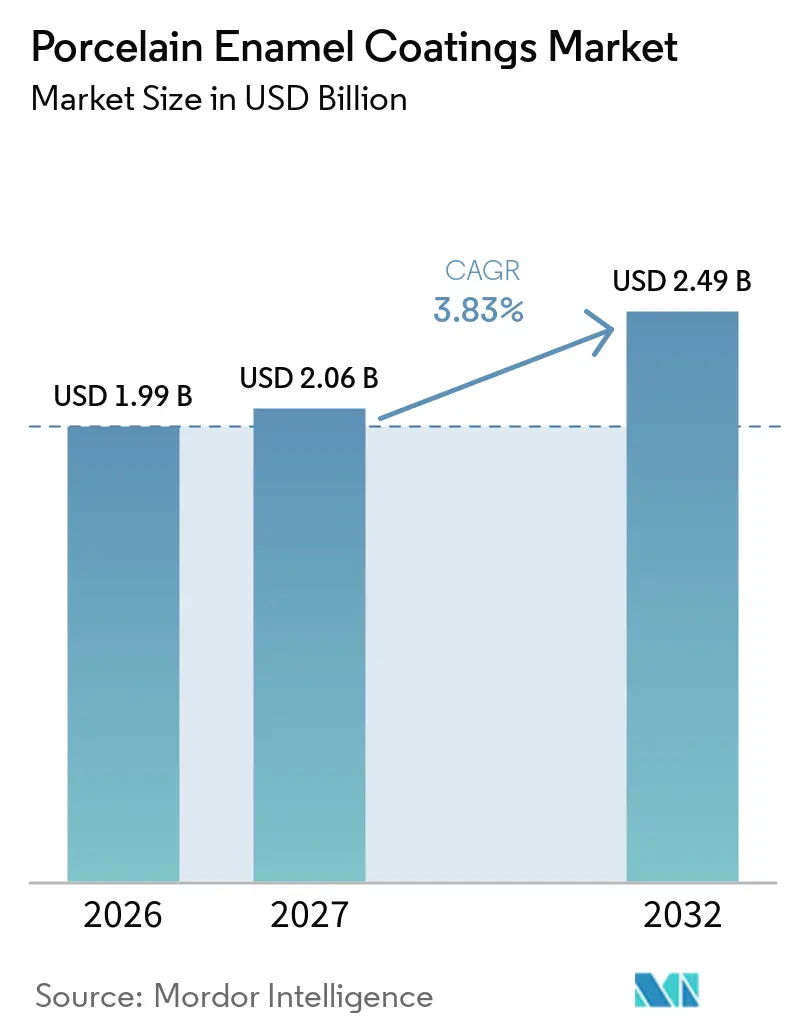
The porcelain enamel coatings market size was valued at USD 1.99 billion in 2026 and is estimated to grow from USD 2.06 billion in 2027 to USD 2.49 billion by 2032, at a CAGR of 3.83% during the forecast period (2027-2032). The porcelain enamel coatings market benefits from applications that require a hard, nonporous surface with stable color, resistance to household chemicals, and long service life. Demand is shifting toward higher-value formulations, including ready-to-use powders and cover coats designed for oven and water heater applications. This supports revenue growth even when unit demand rises at a measured pace. Suppliers are focusing on qualified formulations and process support, as appliance manufacturers cannot easily change an approved enamel system. Higher raw material and energy costs remain the main constraints on the porcelain enamel coatings market.
Key Report Takeaways
- By type, Powder Coatings held 62.14% of the porcelain enamel coatings market share in 2026 and are forecast to grow at a 4.23% CAGR through 2032.
- By application, Appliances accounted for 33.56% of the market share in 2026, while Heating and Cooling Equipment is forecast to record the highest CAGR of 4.76% through 2032.
- By geography, Asia-Pacific held 38.78% of the market share in 2026 and is forecast to expand at a 4.51% CAGR through 2032.
Note: Market numbers in this report are based on Mordor Intelligence's proprietary estimation framework, which combines nine months of actuals with Q4 projections for base year 2026.
Market Trends and Insights
Drivers Impact Analysis of Porcelain Enamel Coatings Market*
| Drivers | (~) % Impact on CAGR Forecast | Geographic Relevance | Impact Timeline |
|---|---|---|---|
| Demand for Durable, Heat-Resistant, and Easy-Clean Surfaces | +1.2% | Global, with the strongest demand in North America and the EU premium appliance markets | Long term (≥ 4 years) |
| Expansion of Appliance and Cookware Manufacturing in the Asia-Pacific | +0.9% | Asia-Pacific, especially China, India, Vietnam, and Thailand, with spillover to the Middle East and Africa | Medium term (2-4 years) |
| Urban Construction and Architectural Enamel Adoption | +0.5% | China, India, Saudi Arabia, the UAE, and emerging Southeast Asian markets | Medium term (2-4 years) |
| Powder Application and Low-VOC Process Preference | +0.5% | Global, with faster adoption in Europe and North America | Short term (≤ 2 years) |
| Pyrolytic and Steam-Clean Appliance Design Requirements | +0.3% | North America and Europe, with emerging demand in South Korea and Japan | Medium term (2-4 years) |
| Source: Mordor Intelligence | |||
Demand for Durable, Heat-Resistant, and Easy-Clean Surfaces
The porcelain enamel coatings market is supported by demand for surfaces that remain stable under heat, cleaning chemicals, and repeated use. Porcelain enamel creates an inorganic, nonporous glass surface that resists household acids and alkalis without requiring routine repainting. A 2025 study on architectural applications found that enameled steel outperformed conventional paints in accelerated tests for ultraviolet exposure, corrosion, and alkaline exposure. The same study linked the higher initial cost of enamel panels to lower maintenance requirements over the service life of a building. In cookware and appliances, enamel offers an alternative to polymer-based nonstick surfaces for buyers seeking long-lasting finishes. Vibrantz Technologies states that porcelain enamel resists bacterial growth better than non-enamel finishes, supporting its use in hygiene-focused product designs[1].
Expansion of Appliance and Cookware Manufacturing in the Asia-Pacific
Asia-Pacific manufacturing activity represents the largest demand base for the porcelain enamel coatings market. China has a high concentration of cookware, white goods, and water heater production, while India is generating additional appliance demand alongside urban development. New production capacity in Southeast Asia is also increasing demand for enamel systems that can be applied consistently at high output. China's GB/T 25025-2025 technical specification for glass-lined equipment, which became effective on October 1, 2025, raised performance requirements for industrial enamel applications. Higher specifications require suppliers to improve formulation quality and process control, which favors suppliers that can support qualification work as regional manufacturers move toward more reliable enamel finishes.
Urban Construction and Architectural Enamel Adoption
Architectural enamel supports the porcelain enamel coatings market, where building owners require durable panels for transit, retail, and exterior facade projects. Vitreous enamel panels are fused to steel at high temperatures and are selected where long service life and resistance to graffiti or weathering justify the initial cost. The Solitaire Mall in Riyadh, completed in 2025, used more than 16,000 m² of porcelain and ceramic facade panels in its external cladding system. China also approved a national standard plan in October 2025 covering performance requirements for enamel coatings applied to architectural steel panels. These developments give suppliers a clearer technical reference for panel design and testing. Architectural projects remain a smaller outlet, but their higher unit value broadens revenue opportunities for specialty formulations.
Powder Application and Low-Volatile Organic Compound (VOC) Process Preference
The porcelain enamel coatings market is shifting toward electrostatic powder application, as the process reduces water use and supports automated production. Ready-to-use powder systems eliminate the need for multiple wet-milling and wastewater-handling steps, thereby simplifying production at appliance plants that require repeatable coating coverage and efficient line operation. PEMCO International and Wagner S.p.A. held an Electrostatic Powder Enamel Academy in May 2025, covering charging methods, booth operation, and defect prevention. Powder porcelain enamels are inherently zero-VOC, which aligns with US emissions regulations and European chemical compliance requirements. Suppliers with expertise in powder application are therefore better positioned to strengthen their role in export-oriented appliance supply chains.
Restraints Impact Analysis of Porcelain Enamel Coatings Market*
| Restraints | (~) % Impact on CAGR Forecast | Geographic Relevance | Impact Timeline |
|---|---|---|---|
| Energy-Intensive Firing and Kiln Investment | -0.6% | Global, with the greatest pressure in Europe and Japan | Long term (≥ 4 years) |
| Volatility in Frit, Pigment, and Metal-Substrate Costs | -0.5% | Global, with the Democratic Republic of the Congo's cobalt shock affecting European and Korean producers | Short term (≤ 2 years) |
| Limited Substrate and Geometry Compatibility | -0.3% | Global, particularly industrial equipment and cookware with complex geometries | Medium term (2-4 years) |
| Source: Mordor Intelligence | |||
Energy-Intensive Firing and Kiln Investment
Firing remains a material restraint for the porcelain enamel coatings market because enamel production requires sustained temperatures between 450°C and 900°C. Kilns represent a major operating cost for enamel producers and create a high barrier to entry for small converters. They also require substantial capital investment, which can limit how quickly capacity responds to changes in demand. Colorobbia España has introduced a project to recover heat from the kiln exhaust to preheat the combustion inputs before they enter the melt tank[2]. The company reported an estimated 7% reduction in natural gas use for frit production through this approach. Such projects can reduce operating pressure, but they do not remove the underlying dependence on energy-intensive thermal processes.
Volatility in Frit, Pigment, and Metal-Substrate Costs
Raw material volatility constrains the porcelain enamel coatings market because pigments and mineral inputs account for a large share of frit production costs. ANFFECC reported that the Democratic Republic of the Congo's suspension of cobalt exports, announced in February 2025, contributed to a 177% increase in cobalt oxide prices between March and November 2025. Cobalt oxide is used in selected blue and opaque enamel formulations, and reformulation requires approval from the appliance customer. The input cost cycle also included increases of 67% for titanium dioxide, 40% for barium carbonate, and 16% for zinc oxide during 2025. These changes can reduce margins for suppliers that cannot hedge costs, quickly alter formulations, or pass higher prices on to concentrated original equipment manufacturers. Cost pressure is therefore strongest for mid-sized suppliers with limited purchasing scale and narrow product portfolios.
*Our forecasts treat driver/restraint impacts as directional, not additive. The impact forecasts reflect baseline growth, mix effects, and variable interactions.
Porcelain Enamel Coatings Market Segment Analysis
By Type:
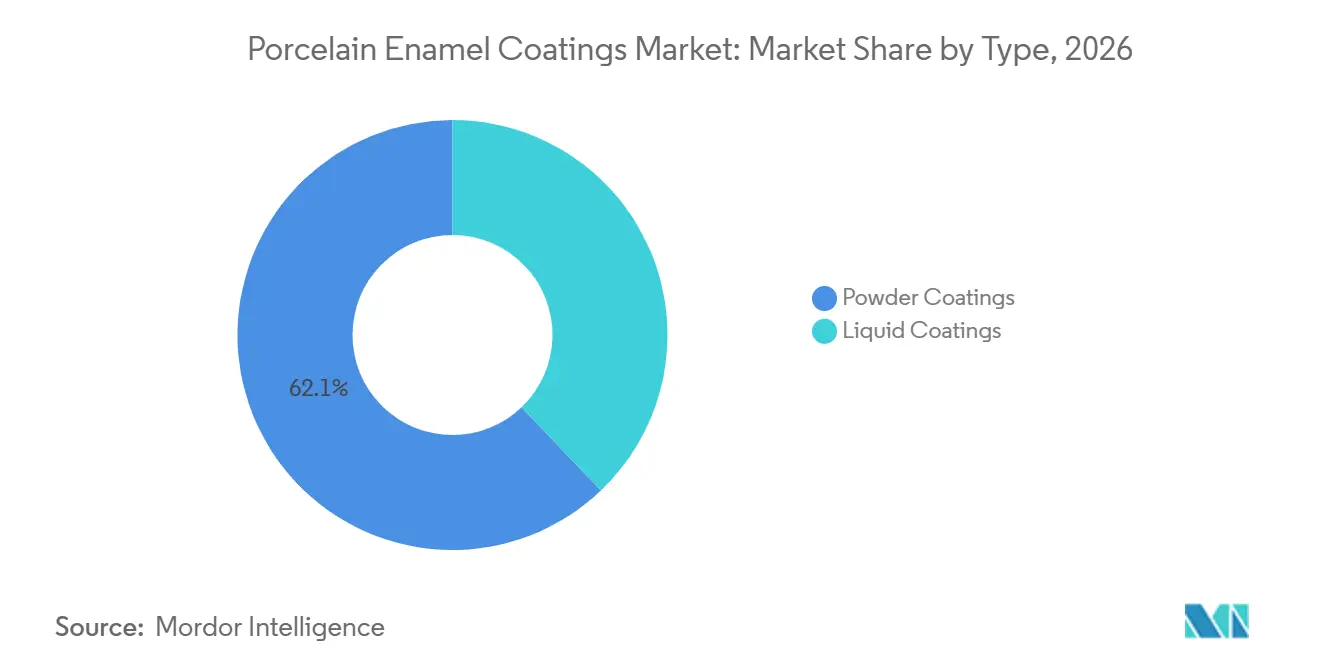
Powder Coatings Lead Through Process and Performance AdvantagePowder coatings accounted for 62.14% of the porcelain enamel coatings market share in 2026 and are expected to grow at a 4.23% CAGR through 2032. Their dominant share reflects wider use of electrostatic application in high-volume appliance and cookware production, where manufacturers require consistent coverage, short handling times, and predictable material use. Ready-to-use powders combine frits, pigments, and mill additions into a single prepared material, eliminating the need for in-house slurry preparation and reducing water use, drying requirements, wastewater handling, and laboratory work. Manufacturers can apply these advantages when designing production lines in cost-sensitive locations, while the porcelain enamel coatings industry increasingly values powder systems that combine process reliability with clean manufacturing.
Within the porcelain enamel coatings market, liquid coatings continue to serve applications that require thick coverage, precise color matching, or access to complex internal surfaces that powder equipment cannot easily reach. Glass-lined chemical reactors are a key example, as slurry dipping and flow coating can cover internal areas that must resist chemical attack and thermal shock. ISO 28721-2:2025, published in February 2025, sets out designations and specifications for chemical enamels on glass-lined process-plant equipment. Water-heater manufacturing also uses both methods within the same production sequence, with a powder-enameled exterior for speed and a wet-applied glass lining for the interior steel tank. The two formats, therefore, serve complementary manufacturing needs, and liquid enamel remains necessary where product geometry, coating thickness, and functional requirements limit the use of powder.

By Application:
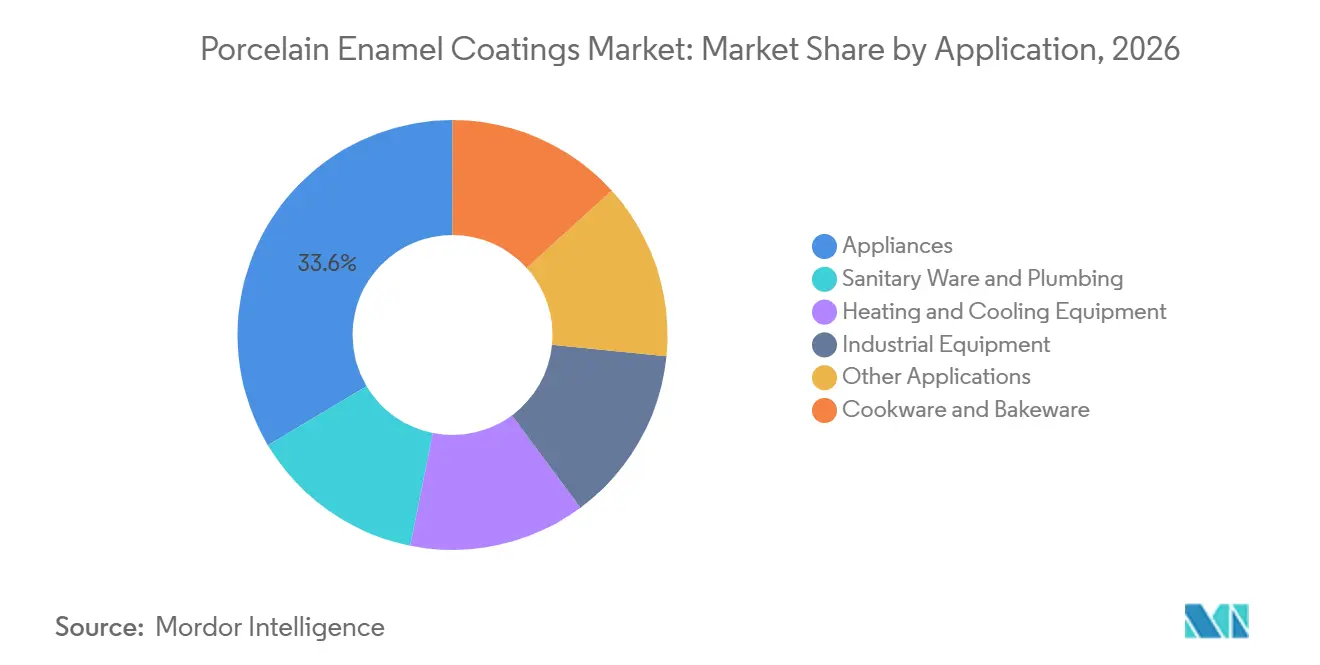
Appliances Hold Commanding Share as Heating Equipment AcceleratesAppliances held 33.56% of the global market value in 2026, while heating and cooling equipment is forecast to expand at a 4.76% CAGR through 2032. Ovens, cooktops, and washer drums use enamel because it provides thermal stability, acid resistance, and a surface that withstands repeated cleaning without loss of appearance. Water heaters represent an important growth outlet, as glass lining protects the steel tank wall from corrosion in residential and commercial systems. A. O. Smith reported that its McBee, South Carolina, tank plant recaptures and recycles 640,000 pounds of glass enamel each year from production. This level of recovery reflects both the material intensity of water-heater production and the value of closed-loop handling at established plants.
Within the porcelain enamel coatings market, cookware and bakeware benefit from demand for durable ceramic and enamel finishes as manufacturers seek alternatives to polytetrafluoroethylene-based coatings. Sanitary ware and plumbing are supported by replacement demand in developed economies and new installations in Southeast Asia and Africa, where durable surfaces are important in residential and public buildings. The European Union's Delegated Regulation 2024/369 establishes a positive-list framework for starting substances used in enamel materials that come into contact with drinking water. Compliance milestones through December 2026 are shaping investment in plumbing enamel formulations and related testing. Industrial equipment provides a stable outlet for corrosion-resistant coatings in reactors and heat exchangers, while other applications include architectural panels, signage, and transit infrastructure.
Geography Analysis
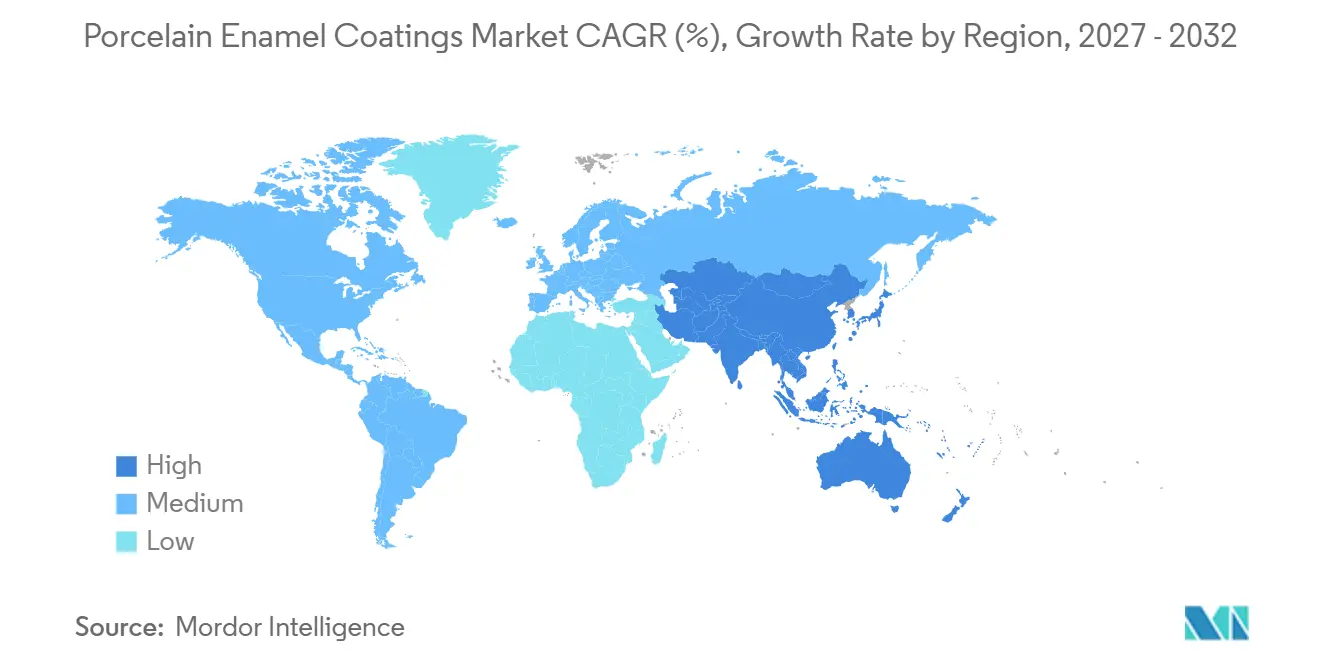
Asia-Pacific accounted for 38.78% of global value in 2026 and is projected to grow at a 4.51% CAGR through 2032. China anchors regional demand in the porcelain enamel coatings market through its large production of cookware, white goods, and water heaters, while domestic manufacturers are focusing on formulation consistency and application efficiency. In October 2025, the country published or updated several porcelain enamel standards, including methods for alkali resistance, thermal expansion measurement, and terminology. These standards reinforce the importance of reliable formulations, controlled firing, and documented performance in the porcelain enamel coatings market. India's demand is rising alongside growth in appliance ownership and urban development, while Japan remains a market for induction-heating (IH)-compatible cookware and high-gloss sanitary-ware frits.
North America's demand in the porcelain enamel coatings market is driven by appliance replacement, residential renovation, and sanitary ware, rather than by the rapid expansion of new production capacity. U.S. appliance coating facilities operate under the Environmental Protection Agency's National Emission Standards for Hazardous Air Pollutants for large appliances, which encourage lower-emission coating approaches. Canada contributes to appliance demand, and Mexico supports regional assembly and residential construction. Europe remains an important center for specialty enamel formulation, with producers in Belgium, Italy, Germany, and Austria competing through high-performance frits for pyrolytic ovens, architectural panels, and glass-lined equipment. Their position relies on technical service, production expertise, and formulations that meet demanding customer specifications.
In South America, demand in the porcelain enamel coatings market is concentrated in Brazil and Argentina, where appliance assembly and residential construction support enamel use. The Middle East and Africa are smaller markets, though construction activity is creating opportunities for architectural enamel systems, as demonstrated by the facade installation at Solitaire Mall in Riyadh. South Africa has a local enamel supply through Ferro South Africa for industrial and appliance applications, while infrastructure projects across Africa support demand for sanitary ware and signage. Imported frit costs and foreign exchange conditions remain significant constraints in several countries across the region.
Competitive Landscape
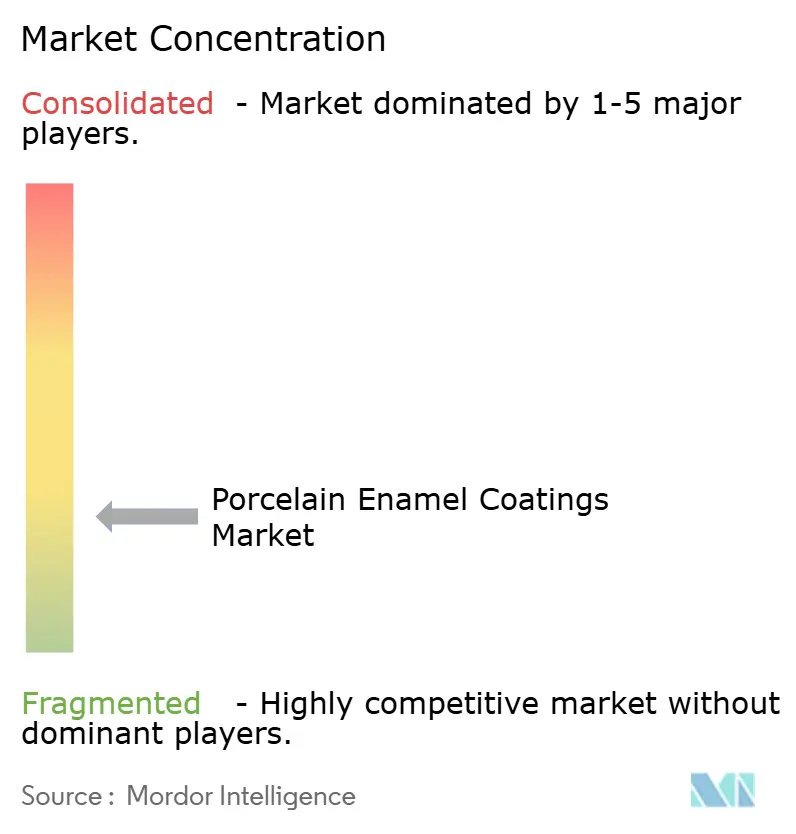
The porcelain enamel coatings market is fragmented. Vibrantz Technologies, Colorobbia, PEMCO International, and Akcoat are among the established suppliers serving appliance and industrial customers with standard and specialized formulations. Competition is strongest in ready-to-use powders and glass-lined process enamel, where customers can compare qualified products on performance, service, and cost. Western suppliers hold a strong position in pyrolytic ovens, steam-clean systems, and architectural applications, while Chinese suppliers are improving their capability in specialty grades. This development increases price pressure in mid-value appliance applications without reducing the importance of technical qualification.
OEM qualification is a central competitive advantage in the porcelain enamel coatings market because a replacement formulation must be validated alongside the finished appliance or equipment and may affect production settings, cleaning performance, and end-product approval. PEMCO International's May 2025 Electrostatic Powder Enamel Academy with Wagner S.p.A. provided converters with training in powder application and defect prevention. This type of technical support can strengthen customer relationships and raise the practical cost of switching suppliers. Vibrantz has positioned AquaRealEase as a ready-to-use enamel for appliance applications that require a lower-energy cleaning approach, while Akcoat continues to develop enamel solutions across its portfolio. Product qualification, process expertise, and compliance documentation are therefore important factors in securing premium contracts.
The porcelain enamel coatings market presents opportunities in lower-emission kiln technology, lead-free and heavy-metal-free architectural formulations, and hybrid coatings for energy-efficient appliance designs. Suppliers that help customers reduce water use, emissions, or energy consumption can enhance the value of their offerings and reinforce their position in qualified supply programs. High raw-material costs continue to place pressure on companies without long-term customer relationships, formulation depth, or purchasing scale. Sol-gel ceramic coatings are also being evaluated for some nonstick cookware applications, although porcelain enamel retains an established role where high-temperature durability and long service life are required.
Porcelain Enamel Coatings Industry Leaders
-
Vibrantz
-
Colorobbia Holding S.p.A.
-
TOMATEC CO., LTD.
-
PEMCO International
-
Akcoat
- *Disclaimer: Major Players sorted in no particular order
Porcelain Enamel Coatings Market Companies Covered in this Report
- A.O. Smith Corp.
- Akcoat
- Capron Manufacturing
- Cherokee Porcelain
- Colorobbia Holding S.p.A.
- Ferro SA
- HAE KWANG ENAMEL INDUSTRIAL CO., LTD.
- Hunan Noli Enamel Co., Ltd
- JIANGYIN GWIPPO ENAMEL CORP., LTD.
- PEMCO International
- Roesch Inc.
- Sinopigment & Enamel Chemicals Ltd.
- TIGER Coatings GmbH & Co. KG
- TOMATEC CO., LTD.
- Vibrantz
Recent Industry Developments in Porcelain Enamel Coatings Market
- October 2025: KPS Capital Partners initiated a competitive sale process for PEMCO International, a Belgium-headquartered porcelain enamel and glass coatings producer with manufacturing operations in Belgium, Italy, and the United States. This transaction would represent the largest M&A event in the specialty porcelain enamel coatings supply market in several years and could reshape supply partnerships with major appliance OEMs that depend on PEMCO for qualified porcelain enamel frit formulations.
- September 2025: Akcoat launched IonGuard Tourmaline Shield, a tourmaline-mineral-infused porcelain enamel coating product, at the ZUCHEX 2025 International Home and Kitchenware Fair in Istanbul. The product was Akcoat's first porcelain enamel formulation incorporating ionic mineral technology, targeting health-oriented consumer appliance and cookware markets.
Global Porcelain Enamel Coatings Market Report Scope
Porcelain enamel coatings (also known as vitreous enamel) are inorganic, glass-like layers fused onto metal or glass surfaces at high temperatures, typically between 450°C and 1,200°C. The process creates a chemical and mechanical bond between the powdered glass (frit) and the underlying substrate, such as cast iron, mild steel, stainless steel, or aluminum.
The porcelain enamel coatings market is segmented by type, application, and geography. By type, the market is segmented into powder coatings and liquid coatings. By application, the market is segmented into cookware and bakeware, appliances, sanitary ware and plumbing, heating and cooling equipment, industrial equipment, and other applications. The report also covers market sizes and forecasts for the porcelain enamel coatings across 15 countries in major regions. The market sizes and forecasts are provided in terms of value (USD).
Segmentation Overview
| Powder Coatings |
| Liquid Coatings |
| Cookware and Bakeware |
| Appliances |
| Sanitary Ware and Plumbing |
| Heating and Cooling Equipment |
| Industrial Equipment |
| Other Applications |
| Asia-Pacific | China |
| India | |
| Japan | |
| South Korea | |
| ASEAN Countries | |
| Rest of Asia-Pacific | |
| North America | United States |
| Canada | |
| Mexico | |
| Europe | Germany |
| United Kingdom | |
| France | |
| Italy | |
| NORDIC Countries | |
| Rest of Europe | |
| South America | Brazil |
| Argentina | |
| Rest of South America | |
| Middle East and Africa | Saudi Arabia |
| South Africa | |
| Rest of Middle East and Africa |
| By Type | Powder Coatings | |
| Liquid Coatings | ||
| By Application | Cookware and Bakeware | |
| Appliances | ||
| Sanitary Ware and Plumbing | ||
| Heating and Cooling Equipment | ||
| Industrial Equipment | ||
| Other Applications | ||
| By Geography | Asia-Pacific | China |
| India | ||
| Japan | ||
| South Korea | ||
| ASEAN Countries | ||
| Rest of Asia-Pacific | ||
| North America | United States | |
| Canada | ||
| Mexico | ||
| Europe | Germany | |
| United Kingdom | ||
| France | ||
| Italy | ||
| NORDIC Countries | ||
| Rest of Europe | ||
| South America | Brazil | |
| Argentina | ||
| Rest of South America | ||
| Middle East and Africa | Saudi Arabia | |
| South Africa | ||
| Rest of Middle East and Africa | ||
Key Questions Answered in the Report
What is current market size of Porcelain Enamel Coatings Market?
The porcelain enamel coatings market size was valued at USD 1.99 billion in 2026 and is estimated to grow from USD 2.06 billion in 2027 to USD 2.49 billion by 2032, at a CAGR of 3.83% during the forecast period (2027-2032).
Which coating type drives demand for porcelain enamel?
Powder Coatings lead with a 62.14% share in 2026 and are projected to grow at a 4.23% CAGR through 2032.
Which application is growing fastest?
Heating and Cooling Equipment is projected to expand at a 4.76% CAGR through 2032, supported by glass-lined water-heater tanks.
Which region leads global demand?
Asia-Pacific leads with a 38.78% share in 2026 and is forecast to record a 4.51% CAGR through 2032.