
Polymer Nanofiber Market Size and Share
Market Overview
| Study Period | 2021 - 2031 |
|---|---|
| Market Size (2026) | USD 0.96 Billion |
| Market Size (2031) | USD 2.05 Billion |
| Growth Rate (2026 - 2031) | 16.23 % |
| Fastest Growing Market | Asia-Pacific |
| Largest Market | Asia-Pacific |
| Market Concentration | Medium |
Major Players *Disclaimer: Major Players sorted in no particular order Image © Mordor Intelligence. Reuse requires attribution under CC BY 4.0. | |
Polymer Nanofiber Market Analysis by Mordor Intelligence
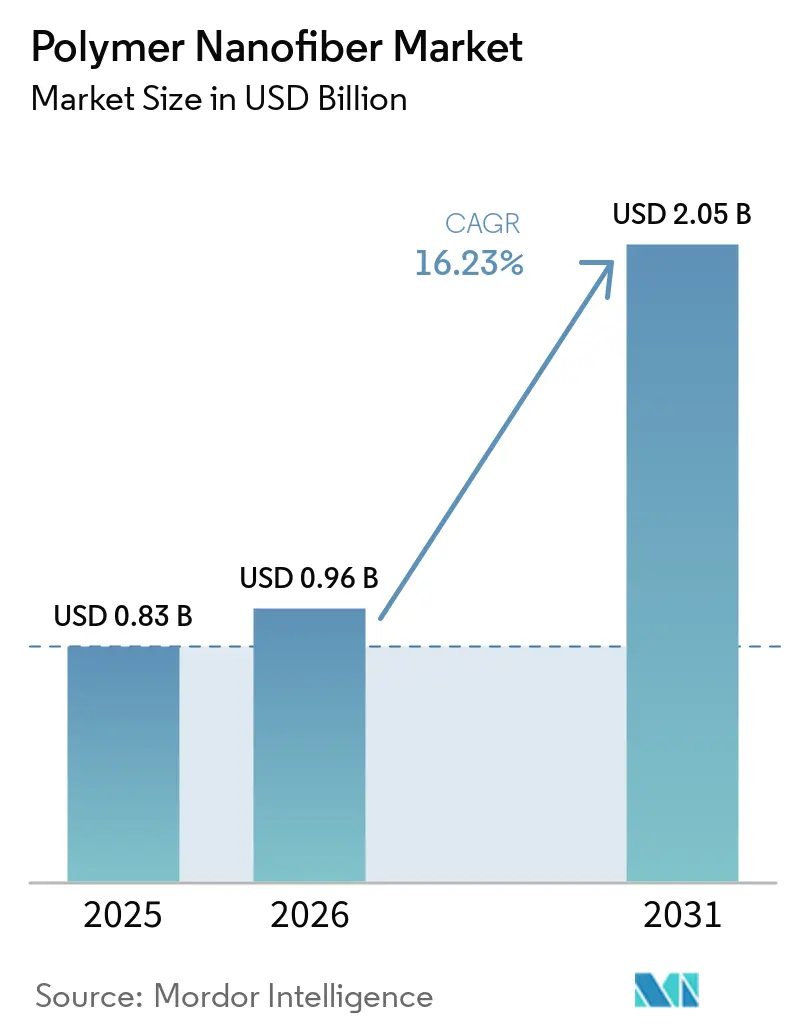
The Polymer Nanofiber Market size was valued at USD 0.83 billion in 2025 and is estimated to grow from USD 0.96 billion in 2026 to reach USD 2.05 billion by 2031, at a CAGR of 16.23% during the forecast period (2026-2031). The polymer nanofiber market is supported by demand for precision drug delivery, regenerative medicine, efficient air and water filtration, and advanced energy storage components. Producers can use shared polymer platforms across filtration and biomedical products, although medical-grade applications require stronger quality systems. Regulation of perfluoroalkyl and polyfluoroalkyl substances (PFAS) is increasing interest in polylactic acid (PLA) and polycaprolactone (PCL) membranes for filtration, protective textiles, and wound care. The polymer nanofiber market also depends on production systems that can deliver consistent fiber geometry at an industrial scale. Established suppliers retain an advantage through certification, distribution, and technical textile channels, while specialist suppliers compete through customized formulations and application knowledge.
Key Report Takeaways
- By polymer type, polyacrylonitrile (PAN) held 42.34% of the polymer nanofiber market share in 2025, while polycaprolactone (PCL) is projected to advance at a 17.15% CAGR through 2031.
- By production technology, needle-based electrospinning held 37.12% of the polymer nanofiber market share in 2025, while needleless electrospinning is projected to advance at a 17.89% CAGR through 2031.
- By application, filtration systems held 38.46% of the polymer nanofiber market share in 2025, while energy storage is projected to advance at an 18.43% CAGR through 2031.
- By geography, Asia-Pacific held 37.05% of the polymer nanofiber market share in 2025 and is projected to advance at an 18.04% CAGR through 2031.
Note: Market size and forecast figures in this report are generated using Mordor Intelligence’s proprietary estimation framework, updated with the latest available data and insights as of January 2026.
Market Trends and Insights
Drivers Impact Analysis of Polymer Nanofiber Market*
| Driver | (~) % Impact on CAGR Forecast | Geographic Relevance | Impact Timeline |
|---|---|---|---|
| Medical and Pharmaceutical Adoption | +4.5% | Global, with concentrated gains in North America, Europe, and Japan | Long term (≥ 4 years) |
| High-Efficiency Air and Water Filtration Demand | +3.8% | Global, particularly North America, Europe, and APAC core | Medium term (2–4 years) |
| Energy Storage Separator and Electrode Applications | +3.2% | APAC core (China, South Korea, Japan), spillover to North America and Europe | Medium term (2–4 years) |
| Needleless and High-Throughput Production Economics | +2.1% | Global, with early gains in the Czech Republic, China, and India | Medium term (2–4 years) |
| PFAS-Free and Compostable Nanofiber Membrane Substitution | +1.5% | Europe (regulatory epicenter), spillover to North America and APAC | Short term (≤ 2 years) |
| Source: Mordor Intelligence | |||
Medical and Pharmaceutical Adoption
Clinical demand for electrospun polymer nanofibers has moved from laboratory research into commercial product pipelines for drug delivery and tissue engineering. Electrospun structures can support sustained drug release and stronger adhesion to mucosal surfaces than conventional cast films, which can reduce dosing frequency in mucosal and transdermal applications. The same fiber architectures used in filtration membranes can be adapted for biomedical scaffolds without extensive process redesign. This gives polymer producers in the polymer nanofiber market an opportunity to serve filtration and biomedical customers from a shared material platform. Compliance with International Organization for Standardization (ISO) 13485 separates bulk industrial suppliers from specialized biomedical suppliers because medical applications require documented quality controls. Machine-learning-assisted optimization of spinning conditions can predict fiber morphology and release behavior before physical trials, which can shorten formulation development cycles.
High-Efficiency Air and Water Filtration Demand
Air-quality rules and water-reuse requirements are increasing the demand for nanofiber media that capture fine particles with limited pressure loss. The World Health Organization reported that exposure to particulate matter with a diameter of 2.5 micrometers or less contributed to 4.2 million premature deaths each year, supporting the focus on effective indoor and workplace filtration[1]. Published laboratory work showed that electrospun PLA filters achieved more than 90% particle-removal efficiency under F8 or F9 classifications, supporting their use in air-filtration applications. Municipal wastewater-reuse programs also require membranes with controlled pore geometry, which supports the use of electrospun ultrafiltration materials in the polymer nanofiber market. PAN membranes showed filtration efficiency above 97% in wastewater treatment and retained stable performance at temperatures above 80 °C. Data centers and hospitals require efficient media with low pressure loss to address indoor-air-quality and energy-efficiency requirements.
Energy Storage Separator and Electrode Applications
Battery manufacturers are evaluating polymer nanofiber separators as alternatives to polyolefin films in lithium-ion and sodium-ion cells. Nanofiber separators can provide broader electrochemical stability and higher thermal safety margins. Gradient nanopore separator designs showed higher ionic conductivity than conventional polyethylene separators and retained 85.3% capacity after 300 cycles at 5 °C. PAN separators can support more uniform lithium-ion distribution because their polar functional groups help limit dendrite-related short-circuit risk. PCL polymer electrolytes have a glass transition temperature of -60 °C, which supports ionic conductivity across the operating temperature range.
Needleless and High-Throughput Production Economics
Needleless systems are reducing the gap between laboratory electrospinning and industrial production. Industrial needleless free-surface equipment can produce fibers with diameters starting at 80 nanometers across PAN, PCL, polyamide, and polyvinyl alcohol (PVA) without material-specific equipment redesign. This reduces qualification costs across several polymer types and supports broader material portfolios in the polymer nanofiber market. Elmarco s.r.o. displayed a Nanospider NS 8S1600U system in 2025 that can produce up to 20,000 square meters of coated nanofiber material per production unit annually. Greater throughput can shift competition in filtration media toward tailored formulations, certified qualifications, and proprietary coatings rather than basic fiber output. ISO-certified humidity and temperature controls in spinning chambers remain important for distinguishing industrial-grade production from pilot-scale operations.
Restraints Impact Analysis of Polymer Nanofiber Market*
| Restraint | (~) % Impact on CAGR Forecast | Geographic Relevance | Impact Timeline |
|---|---|---|---|
| Manufacturing Scale-Up and Quality-Consistency Constraints | -1.8% | Global, most acute in emerging APAC producers | Long term (≥ 4 years) |
| High Equipment, Drying, and Process-Control Costs | -1.2% | Global, most restrictive in South America and MEA markets | Medium term (2–4 years) |
| Solvent Management and Application-Specific Regulatory Uncertainty | -0.8% | Europe and North America; spill-over to APAC | Medium term (2–4 years) |
| Source: Mordor Intelligence | |||
Manufacturing Scale-Up and Quality-Consistency Constraints
Industrial nanofiber production requires solutions beyond incremental changes to laboratory equipment. Single-needle laboratory electrospinning systems produce 0.01 grams per hour to 1 gram per hour of fiber, while commercial filtration, biomedical, and energy applications require output measured in kilograms per hour. Multi-nozzle and needleless systems have narrowed this gap but have not removed it. Producers must control fiber diameter, basis weight, and pore size across wide roll-to-roll webs to maintain consistent quality. Humidity, temperature, and airflow affect electrospinning performance, so controlled chambers add capital and operating costs. Batch consistency also affects regulatory submissions for medical and pharmaceutical products because ISO 13485 documentation must demonstrate reproducible output.
High Equipment, Drying, and Process-Control Costs
Specialty polymer inputs and industrial equipment create a high-cost base for the polymer nanofiber market. Commercial grades of PAN and PVA cost USD 5 to USD 15 per kilogram, while polyimides and fluoropolymers cost USD 50 to USD 100 per kilogram. Industrial electrospinning consumed 30 kilowatt-hours to 200 kilowatt-hours per kilogram of fiber, depending on system design and throughput. Full industrial electrospinning lines exceeded USD 500,000 before solvent recovery, drying systems, and environmental-monitoring equipment were included. These costs encourage mid-sized producers to license technology or use toll manufacturing when they cannot establish scale across several end markets. The cost burden is most restrictive where electricity costs or access to specialized equipment are unfavorable.
*Our forecasts treat driver/restraint impacts as directional, not additive. The impact forecasts reflect baseline growth, mix effects, and variable interactions.
Polymer Nanofiber Market Segment Analysis
By Polymer Type:
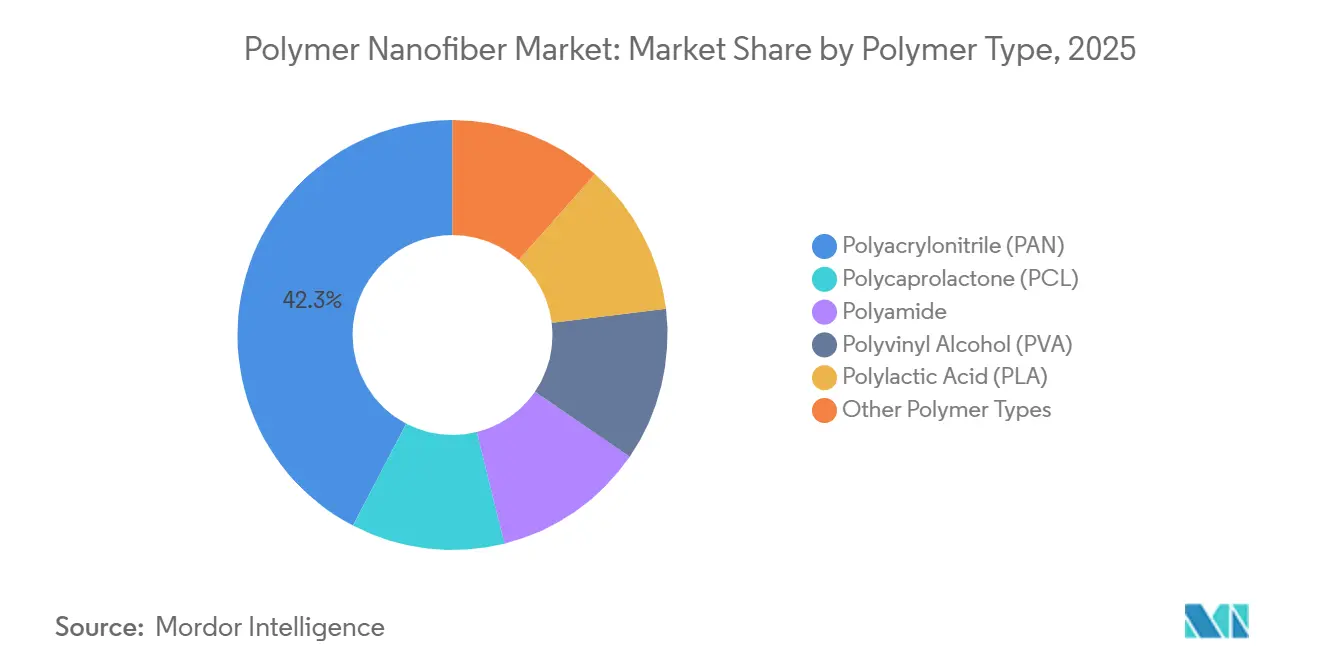
PAN Leads Market Share, While PCL Drives GrowthPAN held 42.34% of the polymer nanofiber market share by polymer type in 2025. Its position reflected compatibility with filtration and energy storage applications, which together represented a substantial portion of demand. PAN offers mechanical strength, thermal stability, and established electrospinning behavior. It is used as a precursor for carbon nanofibers and is relevant to battery-separator qualification work across Asian battery manufacturing. Polyamide serves filtration and protective textile uses that require high tensile strength in humid industrial conditions.
PVA supported biomedical scaffold applications because its water solubility enabled crosslinked structures used in sustained-release drug-delivery research. PLA gained use in environmentally oriented filtration media, and laboratory research showed more than 90% removal efficiency for particulate matter with diameters of 2.5 micrometers and 10 micrometers. PCL is projected to advance at a 17.15% CAGR through 2031. Its use in wound care, solid-electrolyte research, and PFAS-free membrane development supported this outlook. PLA and PCL also offer biodegradable material options for customers seeking alternatives to fluoropolymer-based membranes.

By Production Technology:
Needleless Electrospinning Improves Output EconomicsNeedle-based electrospinning held 37.12% of the polymer nanofiber market share by production technology in 2025. The installed equipment base and its ability to produce uniform fibers supported its use in research-grade and medical applications. Morphological precision remained more important than throughput for many of these uses. However, a single needle produced only 0.01 grams per hour to 1 gram per hour, which limited its suitability for demanding applications. Producers, therefore, needed additional equipment configurations to meet large-volume requirements.
Needleless electrospinning is projected to advance at a 17.89% CAGR through 2031. A comparative study reported PLA nanofiber porosity of 83% ± 5% for needleless electrospinning and 77% ± 2% for conventional electrospinning, alongside greater throughput. Elmarco s.r.o.'s Nanospider free-surface technology supports continuous fiber-mat production using collector materials that can extend to 100 meters[2]. Solution Blow Spinning and Melt Blowing provide reduced-solvent or solvent-free routes for certain applications. Melt Blowing faces viscosity limits that restrict fiber fineness, while Solution Blow Spinning can produce sub-micron fibers without high-voltage infrastructure. Controlled spinning conditions remain important for biomedical-grade material qualification.
By Application:
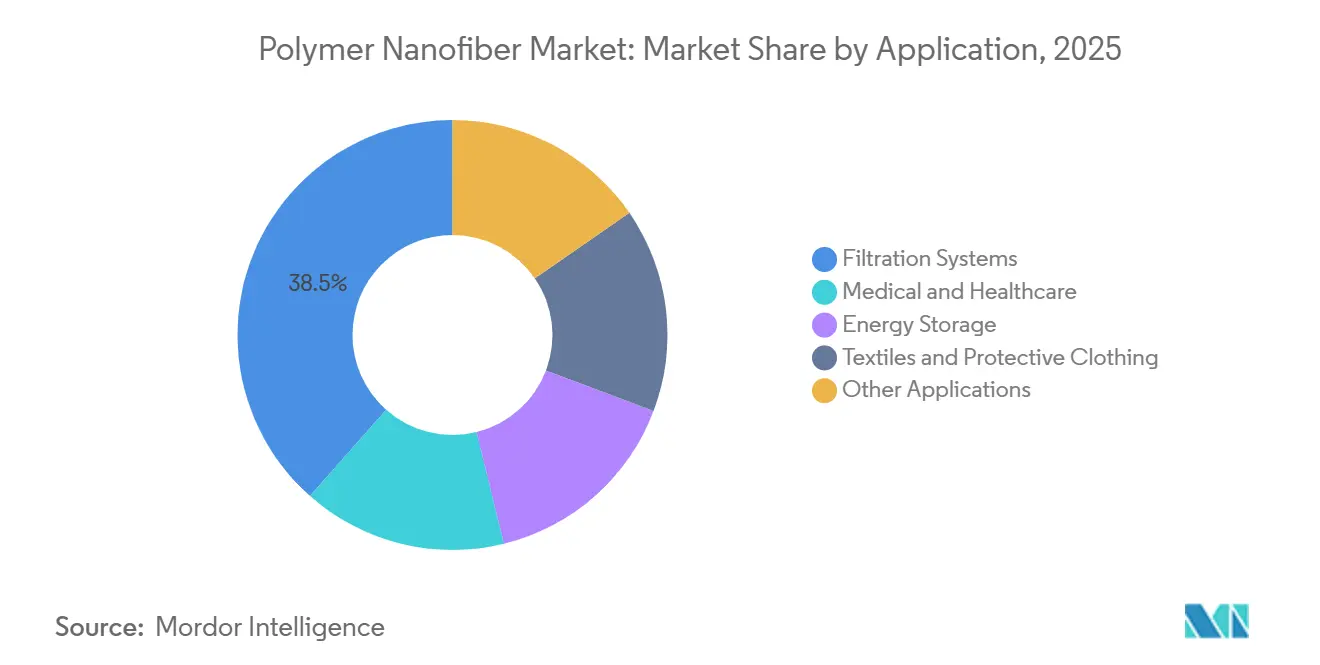
Filtration Systems Lead While Energy Storage Advances FastestFiltration systems held 38.46% of the polymer nanofiber market share by application in 2025. The segment benefited from established use in heating, ventilation, and air conditioning systems, industrial air treatment, liquid separation, and personal protective equipment. Pharmaceutical ultrafiltration systems increasingly use electrospun PAN membranes for protein concentration and biologics purification. PAN provides chemical resistance, narrow pore-size distribution, and stable performance at temperatures above 80 °C. These characteristics supported its use in precision-filtration settings.
Medical and Healthcare applications continued to develop in wound healing, tissue engineering, and drug delivery. PCL and PVA nanofibers have been evaluated in peer-reviewed in vivo wound-repair research. Energy storage is projected to advance at an 18.43% CAGR through 2031 as nanofiber membranes are used in battery separators and supercapacitor electrodes. Polyvinylidene fluoride (PVDF) piezoelectric nanofiber separators also supported self-charging supercapacitor configurations. Textiles and Protective Clothing applications supported demand for waterproof-breathable alternatives to expanded polytetrafluoroethylene (ePTFE) constructions.
Geography Analysis
APAC Polymer Nanofiber Market
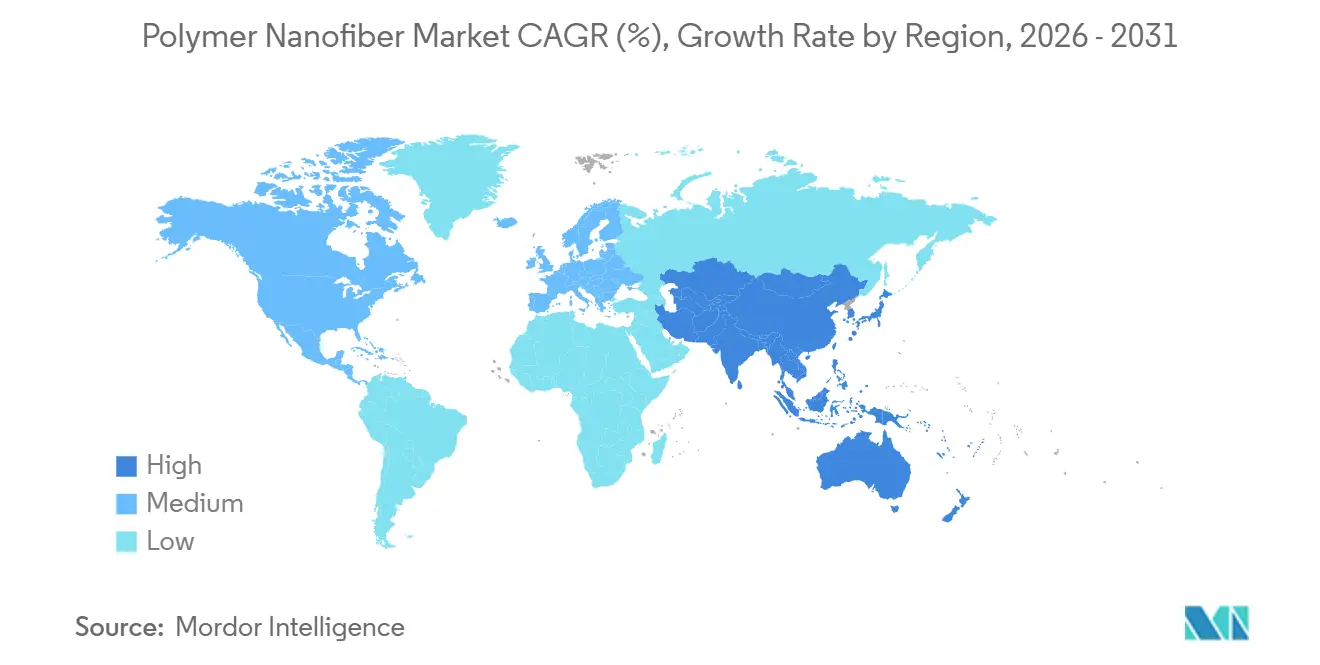
Asia-Pacific held 37.05% of the polymer nanofiber market share in 2025 and is projected to advance at an 18.04% CAGR through 2031. The polymer nanofiber market in the region combines a large manufacturing base with strong consumption in batteries, filtration, and pharmaceutical production. China supports separator demand through lithium-ion battery capacity additions, while India supports biomedical-grade demand through pharmaceutical manufacturing expansion. South Korea's cell manufacturers and material suppliers continued to support specialty nanofiber demand. Japanese companies remained important in high-performance fiber development and battery-separator supply chains.
North America Polymer Nanofiber Market
North America’s demand is centered on medical, pharmaceutical, defense, and industrial filtration applications. The polymer nanofiber market in the United States is supported by established channels for industrial and heating, ventilation, and air conditioning filtration. Donaldson Company, Inc. and Hollingsworth & Vose supplied filtration media through established distribution networks, while DuPont served several end markets through its polymer science portfolio. Canada supported demand from pharmaceutical manufacturing and cleanroom filtration, while Mexico offered an expanding industrial procurement base.
EMEA and South America Polymer Nanofiber Market
Europe remains an important consumption region for industrial filtration, automotive uses, and medical applications in 2025. Germany, the United Kingdom, and France were key demand centers in the region. Purchasers in the polymer nanofiber market were assessing alternative membrane materials for filtration, technical textiles, and medical devices. PLA, PCL, and polyethersulfone architectures offered material pathways for applications seeking PFAS-free options. South America and the Middle East and Africa represent smaller areas, with Brazil and Saudi Arabia supporting oil and gas filtration and water-treatment demand, while medical and energy uses remained at earlier stages of adoption.
Competitive Landscape
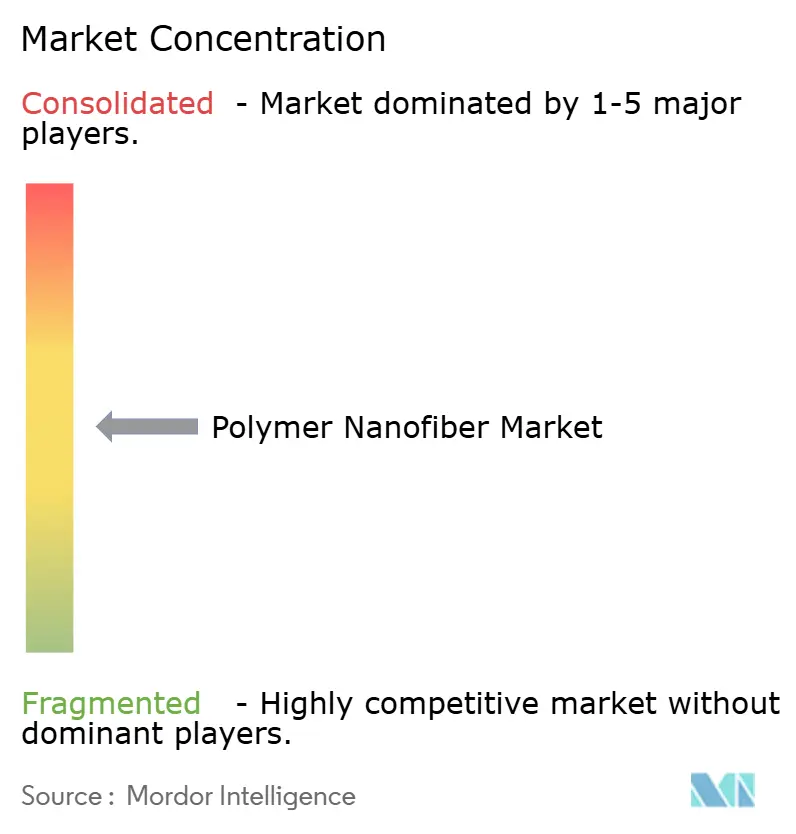
The polymer nanofiber market is moderately concentrated, with the top five players including Donaldson Company, Inc., Elmarco s.r.o., TORAY INDUSTRIES, INC., Hollingsworth & Vose, and DuPont. Their positions are supported by global distribution networks and established manufacturing capabilities. The field became more fragmented outside this group, with regional specialists, application-focused producers, and technology licensors. NanoLayr Limited and E-Spin NanoTech Pvt. Ltd. competed through customized materials and closer engagement with research-intensive customers.
Hollingsworth & Vose pursued patent activity in 2025 and 2026 to protect its filtration-media position in the polymer nanofiber market. Its work included polyethersulfone fine-fiber media with controlled polydispersity and coalescer media with nanofibrillated fibers. These developments focused on lower fiber loading, mechanical performance, flexibility, strength, and filtration efficiency. Donaldson Company, Inc. filed a 2025 patent application for surface-loading gas-filtration media using sub-micron fine fibers, supporting its position in precision industrial filtration and replacement demand.
PFAS-free waterproof-breathable membranes, sodium-ion battery separators, and biodegradable filtration media for single-use pharmaceutical applications remained areas of product-development interest. Elmarco s.r.o. expanded its role beyond equipment supply through its Elmarco Incubator Program in August 2026, providing selected concepts access to research and development facilities and industrial Nanospider equipment. ISO 13485 compliance created a barrier for suppliers seeking medical-grade material opportunities. Producers without the required qualification and quality-management capabilities faced difficulty competing in medical applications. This requirement could concentrate high-value biomedical demand among certified suppliers in the polymer nanofiber market.
Polymer Nanofiber Industry Leaders
-
Donaldson Company, Inc.
-
Elmarco s.r.o.
-
Hollingsworth & Vose
-
TORAY INDUSTRIES, INC.
-
DuPont
- *Disclaimer: Major Players sorted in no particular order
Polymer Nanofiber Market Companies Covered in this Report
- Ahlstrom
- Asahi Kasei Corporation
- Donaldson Company, Inc.
- DuPont
- Elmarco s.r.o.
- E-Spin NanoTech Pvt. Ltd.
- HIFYBER
- Hollingsworth & Vose
- Invenio Srl
- Japan Vilene Company, Ltd.
- NanoLayr Limited
- Pardam s.r.o.
- Stellenbosch Nanofiber Company
- Teijin Limited
- TORAY INDUSTRIES, INC.
Recent Industry Developments in Polymer Nanofiber Market
- June 2026: TORAY INDUSTRIES, INC., through Toray Advanced Materials Korea, completed its Gumi meta-aramid fiber expansion, adding 3,000 metric tons of annual capacity and raising total capacity to 5,400 metric tons. The expansion supported demand for high-performance polymer fibers used in EV components, transformers, semiconductors, and defense applications.
- April 2026: Elmarco s.r.o. introduced the NS 3S500U, a pilot-scale electrospinning system designed to bridge polymer nanofiber research and industrial production. The equipment supports scalable production and material development, helping accelerate the commercialization of polymer nanofiber applications.
Global Polymer Nanofiber Market Report Scope
Polymer nanofibers are ultrafine polymeric fibers with high surface area, interconnected porosity, and tunable structural properties. These characteristics enable their use in applications requiring selective filtration, controlled transport, lightweight structures, surface functionality, and specialized material performance.
The Polymer Nanofiber Market is segmented by polymer type, production technology, application, and geography. By polymer type, the market is segmented into polyacrylonitrile (PAN), polyamide, polyvinyl alcohol (PVA), polylactic acid (PLA), polycaprolactone (PCL), and other polymer types. By production technology, the market is segmented into needle-based electrospinning, needleless electrospinning, solution blow spinning, melt blowing, and other production technologies. By application, the market is segmented into filtration systems, medical and healthcare, energy storage, textiles and protective clothing, and other applications. The report also covers the market size and forecasts for polymer nanofibers in 15 countries across major regions. For each segment, the market sizing and forecasts have been done on the basis of value (USD).
Segmentation Overview
| Polyacrylonitrile (PAN) |
| Polyamide |
| Polyvinyl Alcohol (PVA) |
| Polylactic Acid (PLA) |
| Polycaprolactone (PCL) |
| Other Polymer Types |
| Needle-Based Electrospinning |
| Needleless Electrospinning |
| Solution Blow Spinning |
| Melt Blowing |
| Other Production Technologies |
| Filtration Systems |
| Medical and Healthcare |
| Energy Storage |
| Textiles and Protective Clothing |
| Other Applications |
| Asia-Pacific | China |
| India | |
| Japan | |
| South Korea | |
| Rest of Asia-Pacific | |
| North America | United States |
| Canada | |
| Mexico | |
| Europe | Germany |
| United Kingdom | |
| France | |
| Italy | |
| Rest of Europe | |
| South America | Brazil |
| Argentina | |
| Rest of South America | |
| Middle East and Africa | Saudi Arabia |
| South Africa | |
| Rest of Middle East and Africa |
| By Polymer Type | Polyacrylonitrile (PAN) | |
| Polyamide | ||
| Polyvinyl Alcohol (PVA) | ||
| Polylactic Acid (PLA) | ||
| Polycaprolactone (PCL) | ||
| Other Polymer Types | ||
| By Production Technology | Needle-Based Electrospinning | |
| Needleless Electrospinning | ||
| Solution Blow Spinning | ||
| Melt Blowing | ||
| Other Production Technologies | ||
| By Application | Filtration Systems | |
| Medical and Healthcare | ||
| Energy Storage | ||
| Textiles and Protective Clothing | ||
| Other Applications | ||
| By Geography | Asia-Pacific | China |
| India | ||
| Japan | ||
| South Korea | ||
| Rest of Asia-Pacific | ||
| North America | United States | |
| Canada | ||
| Mexico | ||
| Europe | Germany | |
| United Kingdom | ||
| France | ||
| Italy | ||
| Rest of Europe | ||
| South America | Brazil | |
| Argentina | ||
| Rest of South America | ||
| Middle East and Africa | Saudi Arabia | |
| South Africa | ||
| Rest of Middle East and Africa | ||
Key Questions Answered in the Report
What is the size of the polymer nanofiber market?
The polymer nanofiber market stands at USD 0.96 billion in 2026 and is projected to reach USD 2.05 billion by 2031.
What is driving demand for polymer nanofibers?
Demand is supported by medical drug delivery, tissue engineering, high-efficiency air and water filtration, and battery separators.
Which polymer type led the market demand in 2025?
Polyacrylonitrile (PAN) held 42.34% of revenue in 2025, supported by filtration and energy storage uses.
Which production technology is expected to grow fastest through 2031?
Needleless electrospinning is projected to advance at a 17.89% CAGR through 2031 because it improves industrial throughput.