
Political Campaign Marketing Services Market Size and Share
Market Overview
| Study Period | 2020 - 2031 |
|---|---|
| Market Size (2026) | USD 23.65 Billion |
| Market Size (2031) | USD 39.93 Billion |
| Growth Rate (2026 - 2031) | 11.04 % |
| Fastest Growing Market | Asia-Pacific |
| Largest Market | North America |
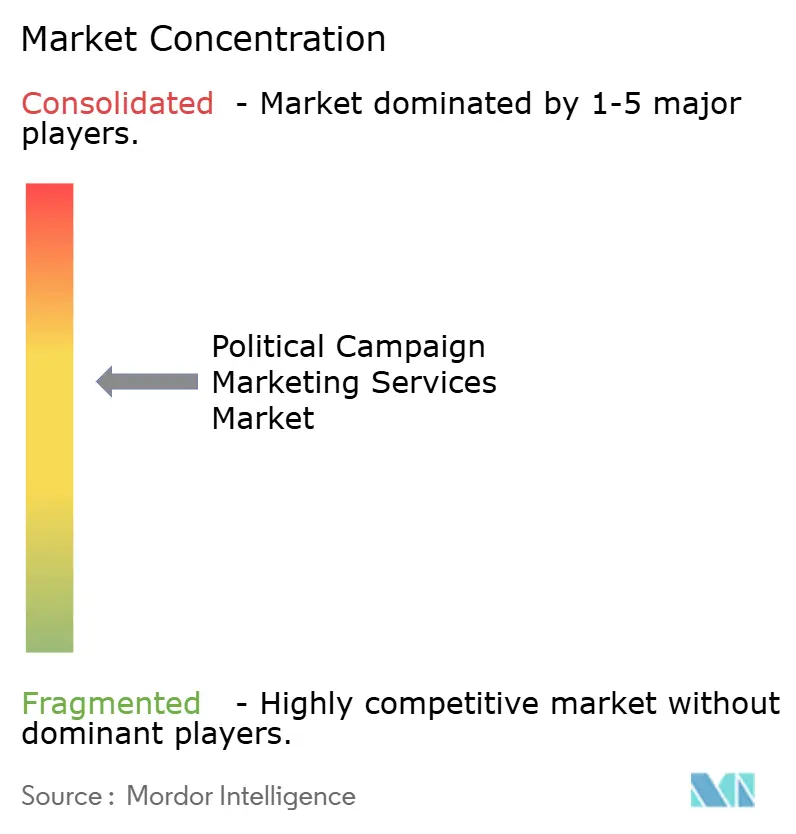
| Market Concentration | Medium |
Major Players *Disclaimer: Major Players sorted in no particular order Image © Mordor Intelligence. Reuse requires attribution under CC BY 4.0. | |
Political Campaign Marketing Services Market Analysis by Mordor Intelligence
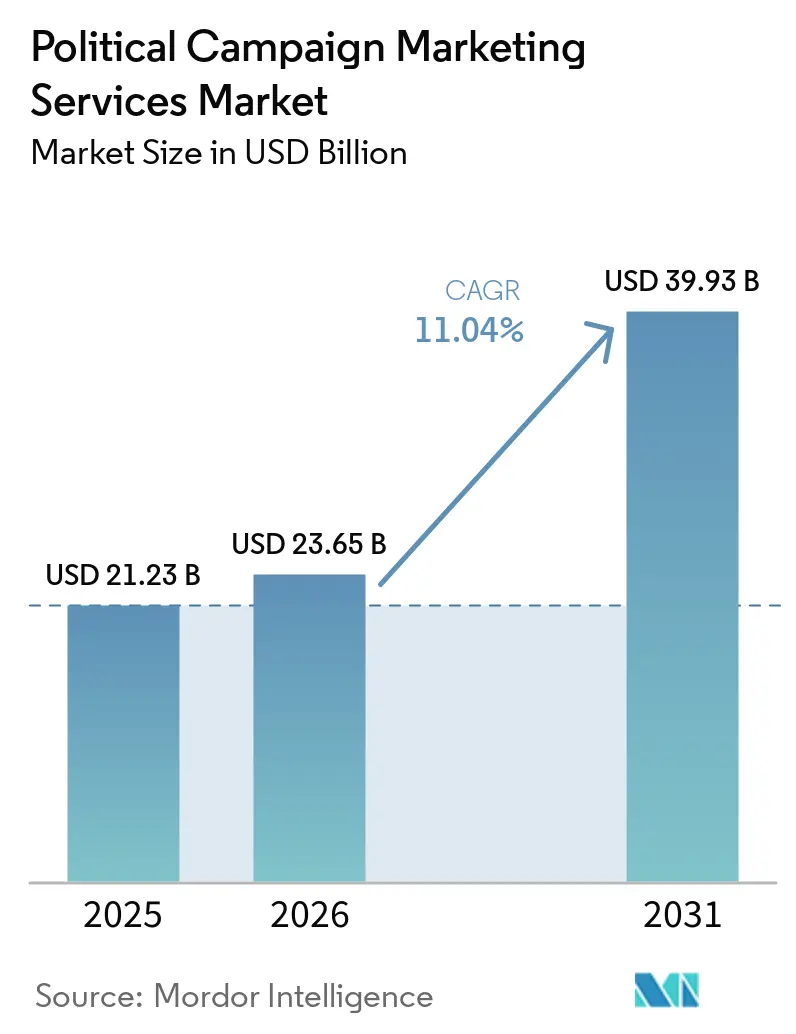
The political campaign marketing services market size was valued at USD 21.23 billion in 2025 and is estimated to expand from USD 23.65 billion in 2026 to reach USD 39.93 billion by 2031, at a CAGR of 11.04% during the forecast period 2026-2031. Election budgets are rising across major democracies, which increases demand for media placement, voter data, creative work, and campaign operations. The political campaign marketing services market is also shifting toward targeted digital outreach while retaining broad-reach television and streaming placements. This combination favors providers that can connect media planning with data activation and measurement. Regulatory rules are becoming more important in campaign planning, especially where voter data and political advertising disclosures are regulated. The political campaign marketing services market remains cyclical because much of the spending occurs shortly before major elections.
Key Report Takeaways
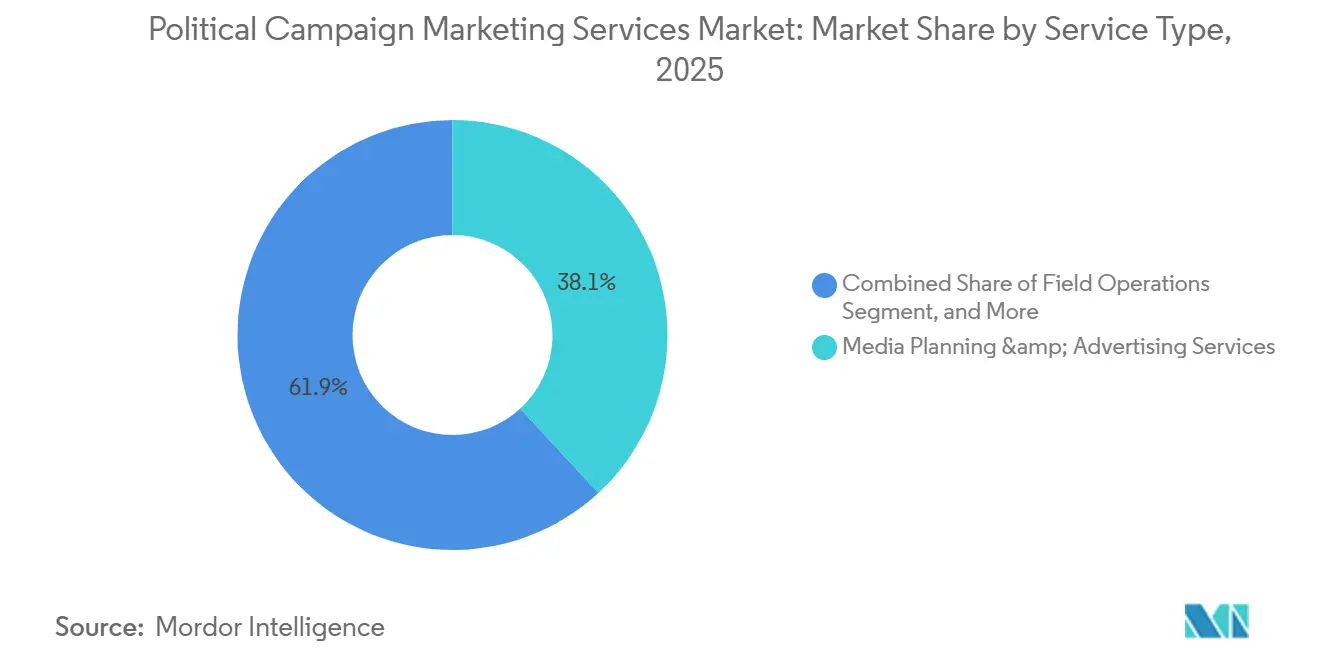
- By service type, media planning and advertising services held 38.13% of the political campaign marketing services market share in 2025, while voter data analytics and targeting services are projected to expand at a 12.34% CAGR through 2031.
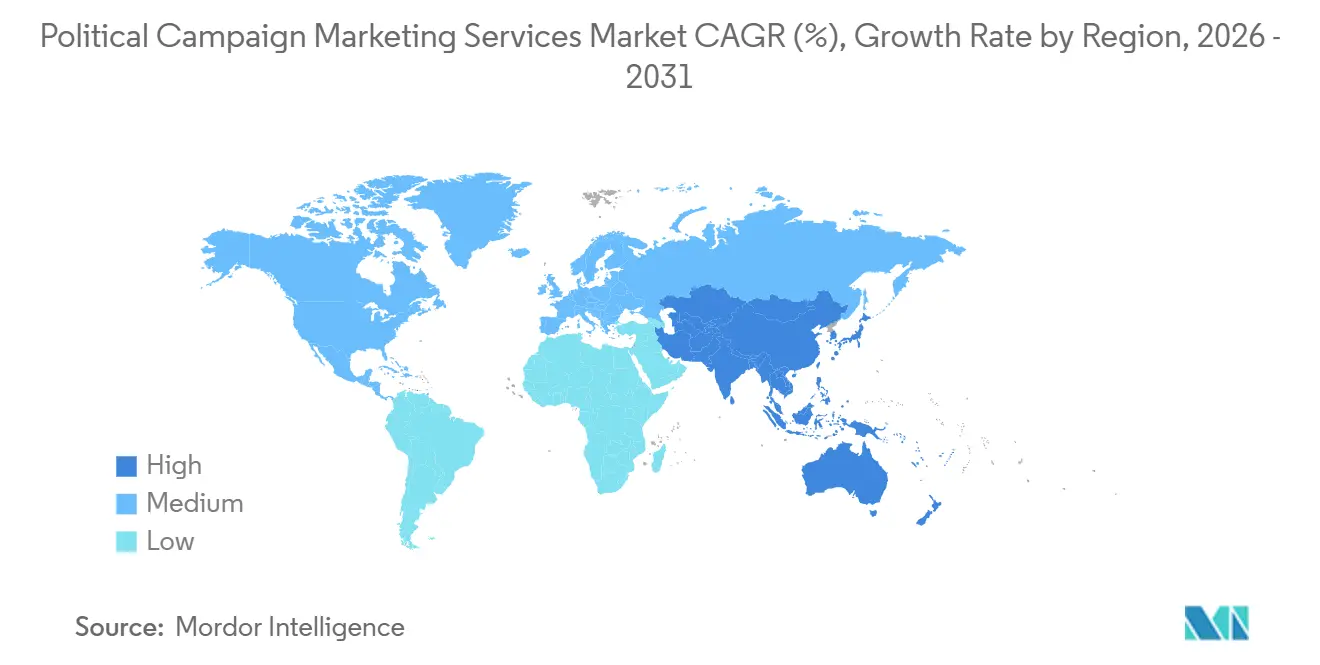
- By geography, North America held 42.81% of the political campaign marketing services market share in 2025, while Asia-Pacific is projected to expand at a 12.17% CAGR through 2031.
Note: Market size and forecast figures in this report are generated using Mordor Intelligence’s proprietary estimation framework, updated with the latest available data and insights as of January 2026.
Market Trends and Insights
Drivers Impact Analysis of Political Campaign Marketing Services Market*
| Driver | (~) % Impact on CAGR Forecast | Geographic Relevance | Impact Timeline |
|---|---|---|---|
| Rising Political Advertising Spending | +2.8% | Global, concentrated in North America | Short term (≤ 2 years) |
| Shift Toward Data-Driven Voter Targeting | +2.1% | Global, with early gains in North America and South Asia | Medium term (2-4 years) |
| Growth of Connected TV and Omnichannel Political Media | +1.6% | North America and Western Europe | Medium term (2-4 years) |
| Demand for Real-Time Analytics and Rapid Response Optimization | +1.2% | North America, Australia, and South Korea | Medium term (2-4 years) |
| Expanding Outsourcing by Down-Ballot Campaigns | +0.7% | North America and Western Europe | Short term (≤ 2 years) |
| Rising Need for Regional-Language and Community-Network Organizing | +0.4% | Asia-Pacific core, with spillover to the Middle East, Africa, and South America | Long term (≥ 4 years) |
| Source: Mordor Intelligence | |||
Rising Political Advertising Spending
The upcoming United States midterm cycle is projected to generate record-high advertising expenditure, making it the most expensive nonpresidential cycle on record. This figure is expected to be significantly higher than the spending recorded for the previous midterms. Senate contests are expected to account for a substantial share, while down-ballot spending is expected to exceed the prior midterm record. Federal political committees also provide a broad funding base, as active PACs raised and disbursed significant amounts during the recent reporting period.[1] Brazil has allocated significant public election funding across multiple parties for its 2026 general election, supporting demand for media, video production, internet content, and related services.
Shift Toward Data-Driven Voter Targeting
Campaign teams increasingly use voter files, predictive scoring, and contact data to guide messaging, field activity, and media allocation. i360 maintains extensive consumer and voter profiles with a broad range of data points for each person, showing the scale of data assets used in political targeting. DSPolitical and Catalist launched streaming audience models that score voters according to streaming platform use for connected television targeting.[2] India’s 2024 Lok Sabha election saw more than 50 million AI-generated robocalls addressing local issues such as irrigation in Maharashtra and health care in Bihar. Between October 2025 and April 2026, 5 major Indian political parties spent INR 70 crore (USD 8 million) on political advertising across Google platforms, with campaign budgets concentrated in Bihar and West Bengal during their election periods. The political campaign marketing services market benefits when providers refresh data continuously because campaigns become more reliant on their data systems between election cycles.
Growth of Connected TV and Omnichannel Political Media
Connected television is the only major media channel expected to increase its share of United States political advertising expenditure compared with the previous presidential cycle. Connected television spending is projected to grow substantially from the previous midterm level and exceed expected local cable television spending. Adults across key age groups spend a significant share of their television time with ad-supported streaming services, while older viewers also increasingly stream content. DSPolitical expanded its relationship with FreeWheel to enable first-party voter data activation through FreeWheel Buyer Cloud and Identity Network across premium streaming inventory. The political campaign marketing services market, therefore, requires media firms to offer consistent planning, audience activation, and attribution across television, streaming, social media, and other digital channels.
Demand for Real-Time Analytics and Rapid Response Optimization
Campaigns need systems that can process new voter contact information, revise creative messages, and shift media budgets quickly during an active contest. Erica Monteith of GMMB stated in April 2026 that campaigns need open platforms that can work with several data partners and measurement systems at the same time. This need is stronger when regulatory changes or platform decisions alter the conditions for audience targeting during a campaign.[3] NGP VAN announced a 7-figure investment in a dedicated API and Data Products Team in 2025 to extend data access and integration across the progressive technology ecosystem. The change moves staff effort away from manual data preparation and media placement toward optimization, measurement, and scenario planning. The political campaign marketing services market can support higher-value analytics work when campaigns need these capabilities throughout the cycle rather than only at the final media-buying stage.
Restraints Impact Analysis of Political Campaign Marketing Services Market*
| Restraint | (~) % Impact on CAGR Forecast | Geographic Relevance | Impact Timeline |
|---|---|---|---|
| Tightening Data Privacy and Political Ad Disclosure Rules | -1.0% | European Union and North America primarily, with spillover to Asia-Pacific | Medium term (2-4 years) |
| Revenue Cyclicality and Election-Dependent Budget Swings | -0.8% | Global | Short term (≤ 2 years) |
| Platform Microtargeting Restrictions and AI Labeling | -0.6% | Global, concentrated in North America and the European Union | Medium term (2-4 years) |
| Cybersecurity and Disinformation Risk Inflation | -0.5% | Global | Long term (≥ 4 years) |
| Source: Mordor Intelligence | |||
Tightening Data Privacy and Political Ad Disclosure Rules
Regulation (EU) 2024/900 took full effect on October 10, 2025, and established rules for the transparency and targeting of political advertising.[4] The regulation requires separate and explicit consent for personal data used in political targeting and prohibits profiling with special categories of personal data, including political opinions. It also requires machine-readable transparency notices that identify the sponsor, election, and targeting methods used in paid political advertisements. The European Data Protection Board held a stakeholder event in March 2026 to provide guidance on personal data processing for political advertising. These requirements raise compliance costs for smaller providers and strengthen the position of firms with established legal, data governance, and technical controls.
Revenue Cyclicality and Election-Dependent Budget Swings
Political campaign marketing services have an uneven revenue calendar because many contracts are billed in the period immediately before a major election. Spending in the election cycle is expected to be heavily concentrated in the months leading up to election day, with the final month accounting for a substantial share of full-cycle spending. This concentration increases temporary staffing and delivery demands while leaving smaller firms with lower activity in off-year periods. An analysis of federal campaign finance transactions found that many vendors from a prior cycle did not appear in the following cycle. The same analysis found that only a minority of vendors continued beyond a single election cycle, with digital firms showing the lowest longevity. The political campaign marketing services market consequently favors well-capitalized firms that can retain staff, invest in technology, and manage cash flow between election periods.
*Our forecasts treat driver/restraint impacts as directional, not additive. The impact forecasts reflect baseline growth, mix effects, and variable interactions.
Political Campaign Marketing Services Market Segment Analysis
By Service Type:
Voter Analytics Gains on Entrenched Media DominanceMedia planning and advertising services held 38.13% of the political campaign marketing services market share in 2025, making it the largest service category and the principal spending channel for broad-reach campaign communications. Broadcast television is still essential for statewide and federal campaigns because it can reach large audiences quickly, and it is projected to account for 49% of the United States political advertising expenditure in 2026. The segment now includes coordinating broadcast, local cable, connected television, social media, online video, and other paid digital placements, because campaigns need wide reach as well as audience-level precision. This work has become more demanding as campaigns seek common reporting and attribution across channels instead of separate media plans that cannot show how activity in one channel supports activity in another. The continuing shift toward streaming changes the mix of media buying, but it does not remove the need for experienced planning, placement, negotiation, creative scheduling, and rapid budget changes during a competitive contest.
Voter data analytics and targeting services are projected to expand at a 12.34% CAGR from 2026 to 2031, the fastest rate among service types and a key political campaign marketing services market size trend. The segment includes voter database management, predictive modeling, microtargeting, audience construction, contact-file updates, and the conversion of voter information into practical decisions about messages, channels, and field locations. Analytics are no longer limited to campaign research, because campaign managers increasingly use them to decide which voters receive a message, what message they receive, and when a media or field team should alter its approach. Campaign content and creative services benefit from AI-assisted production tools that shorten lead times and allow smaller campaigns to produce more frequent, localized, and narrative-focused material, while public relations and reputation management help candidates respond to changing social-media narratives. Grassroots and voter outreach services continue to require door-to-door canvassing, phone banking, volunteer mobilization, and sustained support for early voting and vote by mail, which means these services remain operationally important even as digital work expands. ActBlue’s purchases of Impactive in September 2025 and Hey Victor in January 2026 show how fundraising, voter contact, web presence, and organizing tools are being brought together in a combined campaign offering.

Geography Analysis
North America Political Campaign Marketing Services Market
North America held 42.81% of the political campaign marketing services market share in 2025, led by the United States and its decentralized electoral system. Federal, state, and municipal campaigns can run simultaneously, creating overlapping demand for media, data, creative, fundraising, public relations, and field services. Political advertising expenditure in the United States is expected to increase significantly during the upcoming midterm cycle. Senate races are projected to attract substantial funding, while down-ballot spending is expected to surpass the previous midterm record. The Federal Election Commission reported a large number of active federal PACs that raised and disbursed significant funds during the latest reporting period. Canada and Mexico contribute additional work in digital campaigning and grassroots outreach as competitive contests increase in urban and suburban voter markets.
APAC Political Campaign Marketing Services Market
Asia-Pacific is projected to be the fastest-growing region at a CAGR of 12.17% in 2025. India’s political advertising and publicity expenditure increased sharply from the prior year. The BJP spent substantially on political advertising on Google and Meta in West Bengal, Assam, Kerala, and Tamil Nadu during the early months of the election cycle. The Philippines recorded notable spending by its highest-spending senatorial candidate in the midterm election. Indonesia uses AI-generated content and social-media influence methods in campaign activity, while South Korea, Japan, and Australia are supplementing established broadcast strategies with more precise digital targeting.
EMEA and South America Political Campaign Marketing Services Market
Europe represents a significant part of the political campaign marketing services market, with activity centered on the United Kingdom, Germany, France, and the Netherlands. The EU’s political advertising regulation has changed how European providers manage consent, disclosures, platform design, and campaign contracts. Germany’s recent federal election faced synthetic videos and fabricated narratives across social platforms, increasing attention to campaign integrity and counter-disinformation services. South America is gaining relevance through Brazil, where substantial public election funding has been allocated across multiple parties for the upcoming general election. The Middle East and Africa remain smaller but expanding areas, supported by election activity in South Africa, Nigeria, and Kenya, and by Gulf investment in professionally managed public affairs communications.
Competitive Landscape
The political campaign marketing services market is moderately fragmented, although the United States vendor base is strongly organized by party affiliation. Democratic-aligned and Republican-aligned firms generally work in separate client ecosystems, which makes cross-party vendor movement uncommon. This arrangement limits each provider’s potential client base but gives established vendors durable relationships within their political networks. An analysis of campaign finance transactions found that a small share of vendors received a large share of disclosed spending. Voter file access, established media relationships, operational experience, and institutional trust are, therefore, important competitive assets. Digital content and social media work have lower entry barriers, while voter data services and field operations remain harder to enter because they depend on proprietary assets and long-standing campaign relationships.
Democratic-aligned providers include ActBlue, NGP VAN, DSPolitical, GMMB, SKDK, and TargetSmart across fundraising, data, media, creative, and field functions. Comparable Republican-aligned providers include i360, FP1 Strategies, Push Digital Group, and Majority Strategies. ActBlue acquired Impactive in September 2025 and Hey Victor in January 2026 to link fundraising, organizing, voter contact, and campaign websites through its Campaign in a Box approach. DSPolitical launched streaming audience models with Catalist in June 2026 and expanded its FreeWheel relationship to support first-party voter data activation in connected television inventory. NGP VAN’s API and Data Products investment focuses on improving interoperability between its voter database and third-party campaign tools.
SKDK combined with Wavelength Strategy to provide linear television, OTT, social media, and digital advertising capability through one relationship. The political campaign marketing services market is rewarding providers that can integrate platforms, data, planning, creative work, and campaign execution rather than offer a single isolated function. European technical rules for political advertising labels and transparency notices have also opened a service opportunity for firms that can combine compliance support with media planning and creative delivery. Smaller specialists can continue to compete in creative and social-media work, but off-cycle cash flow and the cost of maintaining data assets can constrain their ability to scale. Competition is thus likely to occur within party ecosystems, where campaigns can choose among firms that understand the same data systems, media rules, and political operating practices.
Political Campaign Marketing Services Industry Leaders
-
DSPolitical, LLC
-
GMMB, Inc.
-
i360, LLC
-
Majority Strategies, LLC
-
A L Media
- *Disclaimer: Major Players sorted in no particular order
Political Campaign Marketing Services Market Companies Covered in this Report
- A L Media
- ActBlue
- Bully Pulpit Interactive, LLC
- Contrast Campaigns, LLC
- Data Driven Campaigns, LLC
- DigiDems, LLC
- DSPolitical, LLC
- Field Strategies, LLC
- FP1 Strategies, LLC
- GMMB, Inc.
- HaystaqDNA, LLC
- i360, LLC
- Majority Strategies, LLC
- MissionWired, LLC
- NGP VAN, Inc.
- Precision Strategies, LLC
- Push Digital Group, LLC
- SKDKnickerbocker, LLC (SKDK)
- TargetSmart Communications, LLC
- The Messina Group, LLC
- The Pivot, LLC
Recent Industry Developments in Political Campaign Marketing Services Market
- June 2026: DSPolitical and Catalist launched 2 new streaming audience models, the FAST CTV Ad Viewer Model and the Paid Streamer Model, available exclusively through DSPolitical. The tools score voters based on streaming consumption patterns to enable more precise CTV and digital targeting, positioning DSPolitical's data offering ahead of the 2026 midterms, where CTV political spend is projected to reach USD 2.6 billion, per AdImpact.
- June 2026: DSPolitical extended its connected TV partnership with FreeWheel, enabling first-party voter data activation through FreeWheel Buyer Cloud and Identity Network across premium CTV inventory at scale. The arrangement allows campaigns to reach validated voters in premium streaming environments with deterministic identity matching ahead of the 2026 midterms.
- February 2026: GMMB elevated Erica Monteith and Jodi Quintero to partner status, recognizing their leadership of GMMB's political and advocacy practice. Monteith oversaw more than USD 400 million in paid media across streaming, online video, social, and display in the previous election cycle. Both promotions signal GMMB's investment in data-driven digital strategy leadership for the 2026 midterm cycle.
- January 2026: ActBlue acquired Hey Victor, a Democratic campaign website development platform now operating as Hey Victor by ActBlue. Priced at USD 40 per month, the platform extends professional-grade website tools to state and local candidates and integrates with ActBlue's fundraising infrastructure, field tools, NGP VAN, and Action Network as part of its Campaign in a Box vision.
Global Political Campaign Marketing Services Market Report Scope
Political Campaign Marketing Services Market refers to agencies, consultancies, and technology providers that help candidates, parties, advocacy groups, and ballot initiatives promote their messages and mobilize voters. It includes campaign strategy, branding, voter research, media planning, digital advertising, content creation, and grassroots outreach.
The Political Campaign Marketing Services Market Report is Segmented by Service Type (Media Planning and Advertising, Voter Data Analytics and Targeting, Campaign Content and Creative, Grassroots and Voter Outreach, Public Relations and Reputation Management, and Field Operations) and Geography (North America, South America, Europe, Asia-Pacific, Middle East, and Africa). The Market Forecasts are Provided in Terms of Value (USD).
Segmentation Overview
| Media Planning and Advertising Services |
| Voter Data Analytics and Targeting Services (Voter database management, Micro-targeting, Predictive modeling, etc) |
| Campaign Content and Creative Services |
| Grassroots and Voter Outreach Services (Volunteer mobilization, Door-to-door outreach, Phone banking campaigns, etc) |
| Public Relations and Reputation Management Services |
| Field Operations |
| North America | United States |
| Canada | |
| Mexico | |
| South America | Brazil |
| Argentina | |
| Chile | |
| Colombia | |
| Peru | |
| Rest of South America | |
| Europe | United Kingdom |
| Germany | |
| France | |
| Italy | |
| Spain | |
| Russia | |
| Netherlands | |
| Poland | |
| Rest of Europe | |
| Asia-Pacific | India |
| Japan | |
| Australia | |
| South Korea | |
| Indonesia | |
| Philippines | |
| Thailand | |
| Rest of Asia-Pacific | |
| Middle East | Turkey |
| Israel | |
| Saudi Arabia | |
| United Arab Emirates | |
| Rest of Middle East | |
| Africa | South Africa |
| Nigeria | |
| Kenya | |
| Egypt | |
| Rest of Africa |
| By Service Type | Media Planning and Advertising Services | |
| Voter Data Analytics and Targeting Services (Voter database management, Micro-targeting, Predictive modeling, etc) | ||
| Campaign Content and Creative Services | ||
| Grassroots and Voter Outreach Services (Volunteer mobilization, Door-to-door outreach, Phone banking campaigns, etc) | ||
| Public Relations and Reputation Management Services | ||
| Field Operations | ||
| By Geography | North America | United States |
| Canada | ||
| Mexico | ||
| South America | Brazil | |
| Argentina | ||
| Chile | ||
| Colombia | ||
| Peru | ||
| Rest of South America | ||
| Europe | United Kingdom | |
| Germany | ||
| France | ||
| Italy | ||
| Spain | ||
| Russia | ||
| Netherlands | ||
| Poland | ||
| Rest of Europe | ||
| Asia-Pacific | India | |
| Japan | ||
| Australia | ||
| South Korea | ||
| Indonesia | ||
| Philippines | ||
| Thailand | ||
| Rest of Asia-Pacific | ||
| Middle East | Turkey | |
| Israel | ||
| Saudi Arabia | ||
| United Arab Emirates | ||
| Rest of Middle East | ||
| Africa | South Africa | |
| Nigeria | ||
| Kenya | ||
| Egypt | ||
| Rest of Africa | ||
Key Questions Answered in the Report
What is the political campaign marketing services market size?
The political campaign marketing services market size is estimated at USD 23.65 billion in 2026 and is forecast to reach USD 39.93 billion by 2031 at an 11.04% CAGR.
Which service type has the largest share of political campaign marketing services?
Media planning and advertising services held the largest share at 38.13% in 2025, supported by the continuing reach of broadcast television in major contests.
Which political campaign service is expanding fastest?
Voter data analytics and targeting services are projected to record the fastest service-type CAGR at 12.34% through 2031.
Which region leads political campaign marketing services?
North America led with 42.81% share in 2025, supported by recurring United States federal, state, and local election activity.
Which region is projected to expand fastest through 2031?
Asia-Pacific is projected to record the fastest regional CAGR at 12.17%, supported by digital campaign activity across major democracies.
What is changing political advertising practices in Europe?
Regulation (EU) 2024/900 requires explicit consent for certain data use and machine-readable transparency notices, increasing the importance of compliance capabilities.