
Plastic Pigments Market Size and Share
Market Overview
| Study Period | 2021 - 2031 |
|---|---|
| Market Size (2026) | USD 12.93 Billion |
| Market Size (2031) | USD 18.18 Billion |
| Growth Rate (2026 - 2031) | 7.06 % |
| Fastest Growing Market | Asia-Pacific |
| Largest Market | Asia-Pacific |
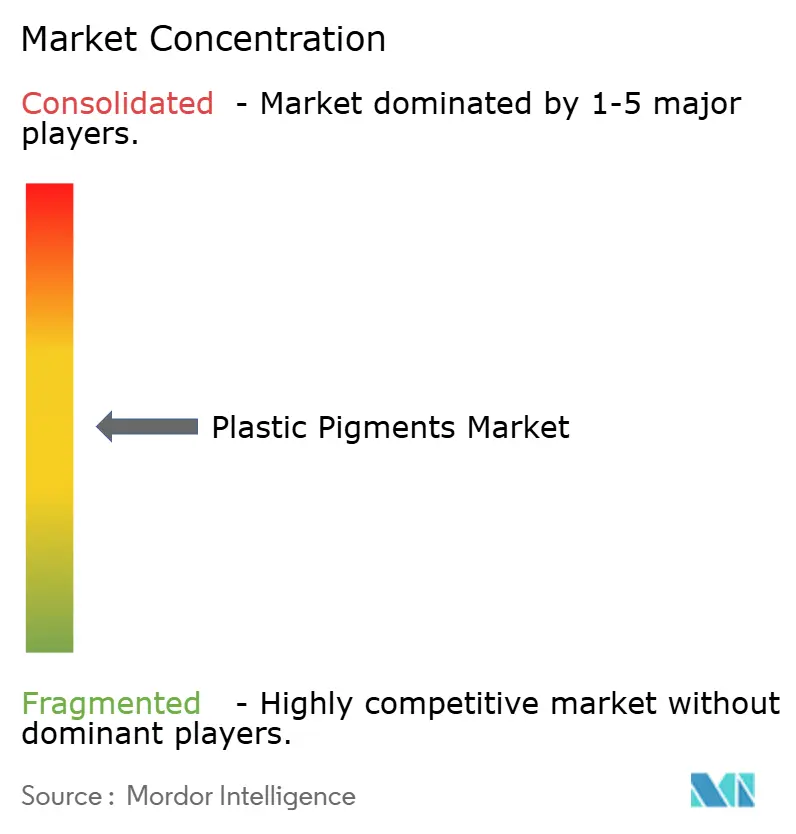
| Market Concentration | Medium |
Major Players *Disclaimer: Major Players sorted in no particular order Image © Mordor Intelligence. Reuse requires attribution under CC BY 4.0. | |
Plastic Pigments Market Analysis by Mordor Intelligence
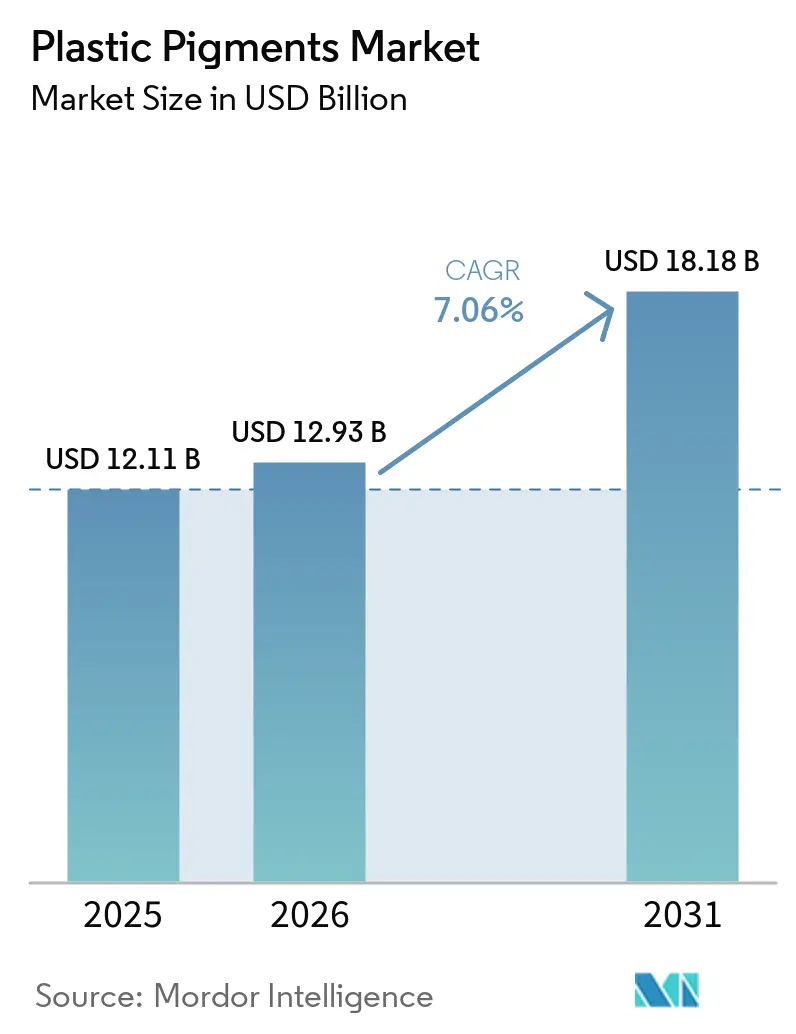
The Plastic Pigments Market size was valued at USD 12.11 billion in 2025 and is estimated to grow from USD 12.93 billion in 2026 to reach USD 18.18 billion by 2031, at a CAGR of 7.06% during the forecast period (2026-2031). Demand is moving toward colorants that remain stable during high-temperature polymer processing and meet tighter limits on heavy metals and migration. Brand owners and compounders are placing greater value on dispersion, thermal stability, and compatibility with recycled polymers. This shifts competition away from basic color matching and toward formulation capability and compliance support. Suppliers that can provide suitable colorants, test information, and material documentation are better placed to serve higher-specification applications. The plastic pigments market also faces pressure from titanium dioxide supply changes, food-contact requirements, and the challenge of maintaining recyclable plastic streams.
Key Report Takeaways
- By type, inorganic pigments held 62.45% of the plastic pigments market share in 2025, while organic pigments are projected to advance at a 7.67% CAGR through 2031.
- By end-use industry, packaging held 37.79% of the plastic pigments market share in 2025, while building and construction is projected to advance at an 8.14% CAGR through 2031.
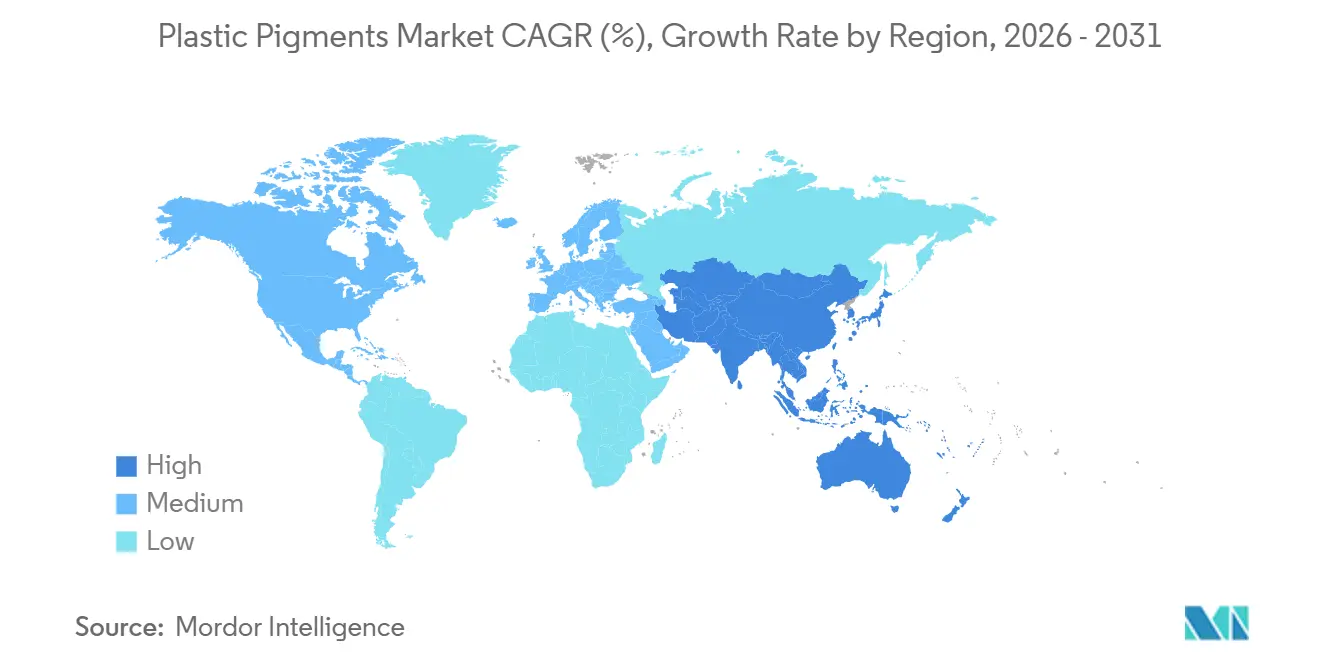
- By geography, Asia-Pacific held 44.24% of the plastic pigments market share in 2025 and is projected to advance at a 7.96% CAGR through 2031.
Note: Market size and forecast figures in this report are generated using Mordor Intelligence’s proprietary estimation framework, updated with the latest available data and insights as of January 2026.
Market Trends and Insights
Drivers Impact Analysis of Plastic Pigments Market*
| Driver | (~) % Impact on CAGR Forecast | Geographic Relevance | Impact Timeline |
|---|---|---|---|
| Packaging Premiumization and Brand Differentiation | +1.8% | Global, with highest intensity in Asia-Pacific and Western Europe | Medium term (2–4 years) |
| Lightweighting and Plastic Substitution in Automotive Components | +1.5% | Global, early gains in EU, China, and South Korea | Medium term (2–4 years) |
| High-Performance Pigments for Engineering Plastics | +1.4% | APAC core, spillover to North America and EU | Long term (≥ 4 years) |
| Asia-Pacific Packaging and Manufacturing Expansion | +1.2% | China, India, ASEAN, South Korea | Short term (≤ 2 years) |
| Regulatory Demand for Heavy-Metal-Free and Low-Migration Pigments | +1.0% | EU and North America, cascading to APAC export-oriented manufacturers | Medium term (2–4 years) |
| Source: Mordor Intelligence | |||
Packaging Premiumization and Brand Differentiation
Premium packaging is creating a more demanding formulation environment for the plastic pigments market, especially where a product’s appearance supports brand differentiation. Beauty, personal care, and premium food brands use metallic, pearlescent, and optically variable pigments to distinguish products on shelves and in digital retail settings. Regulation (EU) 2025/40 requires higher recycled content in packaging formats, which is changing how brands approach color, surface appearance, and the acceptable variability of recycled materials. Muted shades, visible speckling, and tonal variation can support the intended appearance of recycled-content packaging rather than being treated only as defects in a conventional color-matching process. This increases the need for organic and inorganic formulations that maintain acceptable color across virgin and recycled feedstocks while meeting the visual expectations of brand owners. The plastic pigments market, therefore, benefits from demand for masterbatch grades that manage color consistency within the same production run and across variable resin batches.
Lightweighting and Plastic Substitution in Automotive Components
Automotive applications are an important qualification environment for the plastic pigments market because component requirements test both pigment performance and material compliance. Plastics represent 20% of a modern vehicle’s weight, and the share is rising as manufacturers replace metal brackets, under-hood housings, and structural panels with polymer composites. Pigments used in polyamide and polyphthalamide components must withstand processing temperatures above 280 °C to 300 °C, ultraviolet exposure, and thermal aging during the expected life of the vehicle. They must also avoid heavy metals that can complicate end-of-life sorting and reduce the suitability of recovered materials. Automotive plastic documentation requirements are placing pigment suppliers closer to the compliance chain for original equipment manufacturers, rather than leaving them only in the compounder supply chain. BASF launched color-stable polyphthalamide grades for high-voltage electric vehicle connectors in June 2025, while Stellantis committed to 40% recycled-content plastics in vehicles by 2030. These conditions increase the value of pigment performance in engineering resins used in demanding automotive applications.
High-Performance Pigments for Engineering Plastics
Electrified powertrains and specialized industrial components are expanding demand for pigments used with polyether ether ketone, polyphenylene sulfide, polyetherimide, and high-heat polyamides. These polymers are used where color supports identification, safety signaling, and product branding in components that also face demanding operating conditions. Evonik Industries AG opened a dedicated polyether ether ketone laboratory in Shanghai in April 2026 for rectangular magnet wire and electric motor applications in new energy vehicles[1]. Complex inorganic color pigments (CICPs) and high-performance organic pigments (HPOPs) can withstand processing temperatures above 300 °C, resist ultraviolet degradation in outdoor electrical enclosures, and retain required color performance. They can also support compliance with Restriction of Hazardous Substances (RoHS) limits that restrict lead chromates and cadmium-based colorants in electronics applications. As new energy vehicle production grows in China, India, and South Korea, the plastic pigments market has an expanding application base in engineering plastic compounds that require these performance attributes.
Asia-Pacific Packaging and Manufacturing Expansion
Asia-Pacific is both the largest consuming region and a major production investment location for the plastic pigments market, combining substrate manufacturing with regional packaging demand. Changsu inaugurated its Indonesian manufacturing base in West Java in January 2026 with 90,000 metric tons of annual capacity, expanding the regional substrate base for pigment use. Clariant’s Daya Bay facility is operational in China and places specialty colorant supply closer to polymer processors in the Pearl River Delta. Surya Global Flexifilms is scaling its biaxially oriented polypropylene production to 22,000 metric tons per month by 2028, which will support sustained demand for packaging-grade pigments. The concentration of substrate manufacturing and packaging demand can reduce logistics requirements and shorten supply routes for pigment suppliers. It also increases price competition from domestic producers that serve regional customers with lower operating costs.
Restraints Impact Analysis of Plastic Pigments Market*
| Restraint | (~) % Impact on CAGR Forecast | Geographic Relevance | Impact Timeline |
|---|---|---|---|
| Petrochemical and Metal-Oxide Raw-Material Volatility | -0.9% | Global, acutely felt in EU, North America, and export-oriented Asian producers | Short term (≤ 2 years) |
| VOC, Heavy-Metal, PFAS, and Food-Contact Compliance Costs | -0.7% | EU and North America primarily; cascading to Asian manufacturers serving export markets | Medium term (2–4 years) |
| Color Contamination in Recycled Resin Streams | -0.5% | Global, highest friction in the EU | Long term (≥ 4 years) |
| Source: Mordor Intelligence | |||
Petrochemical and Metal-Oxide Raw-Material Volatility
Titanium dioxide (TiO2) has opposing price pressures that increase uncertainty for converters and compounders. European Union antidumping tariffs on Chinese TiO2 imports had reduced Chinese imports into Europe during 2025, changing procurement conditions for formulators. Tronox Holdings Plc idled its 90,000 metric ton per year Botlek plant in the Netherlands in March 2025. The company then announced the permanent closure of its 46,000 metric tons per year Fuzhou facility in January 2026 amid weak Chinese demand and higher sulfur raw-material costs. These capacity actions can tighten spot availability for white and opacifying grades. They also leave plastic pigment formulators more exposed when downstream demand recovers.
VOC, Heavy-Metal, PFAS, and Food-Contact Compliance Costs
Compliance with evolving chemical and food-contact rules raises costs for the plastic pigments market. The burden can create a barrier to entry that favors established suppliers with broader regulatory resources. The Environmental Protection Agency’s Per- and Polyfluoroalkyl Substances (PFAS) reporting requirement adds disclosure responsibilities for relevant manufacturers and importers in 2026[2]. The European Union’s 19th Amendment to Plastics Regulation EU 10/2011 is mandatory from September 16, 2026, and introduces purity requirements for non-intentionally added substances in food-contact plastic colorants. Suppliers must use testing and documentation processes to demonstrate that materials meet the applicable requirements. Longer reformulation cycles can redirect resources from color development toward qualification work.
*Our forecasts treat driver/restraint impacts as directional, not additive. The impact forecasts reflect baseline growth, mix effects, and variable interactions.
Plastic Pigments Market Segment Analysis
By Type:
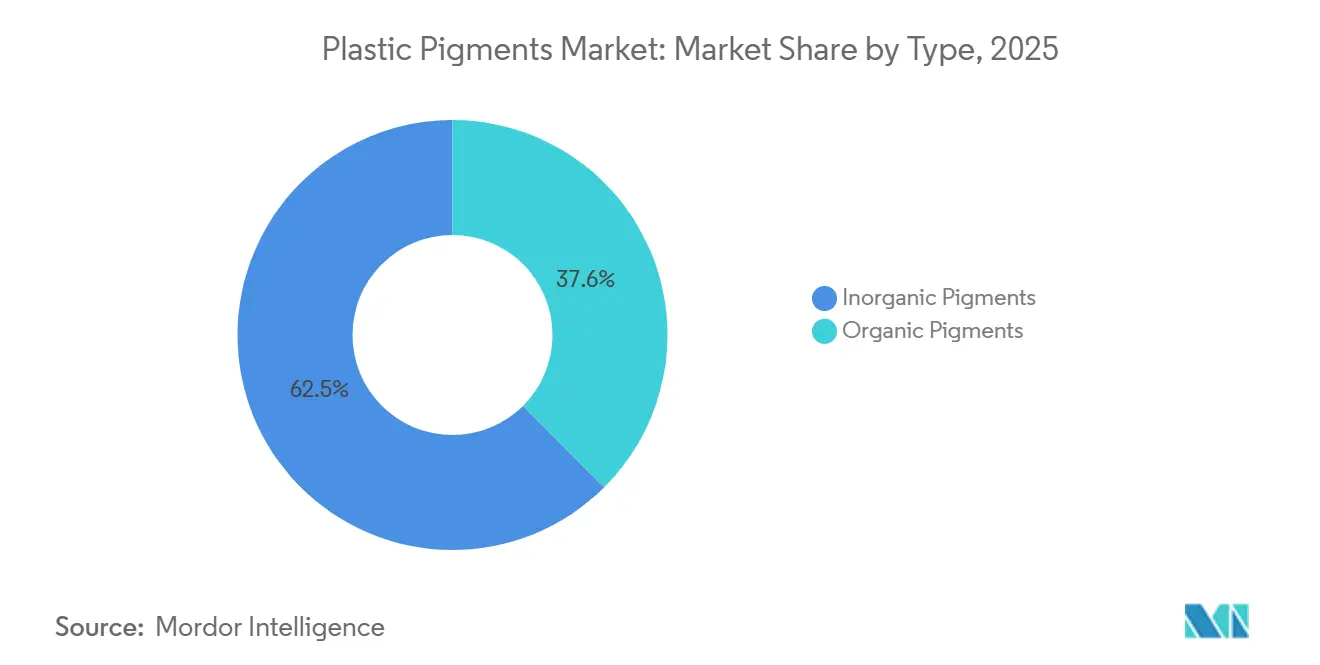
Inorganic Pigments Anchor Scale, Organic Pigments Narrow the GapInorganic pigments held 62.45% of the market share in 2025. Titanium dioxide supported opacity in white and pastel formulations, while iron oxides provided heat stability in engineering plastics. CICPs supported outdoor applications where ultraviolet resistance over 10-year weathering cycles was a qualification requirement. The wide application range of inorganic chemistries extended from polyethylene packaging film to glass-fiber-reinforced polyphthalamide used in electric vehicle battery housings, supporting their leading position in the plastic pigments market. LANXESS operates its iron oxide production facility at Krefeld-Uerdingen and expanded its Scopeblue portfolio in February 2025 with micronized yellow pigments that had a reduced product carbon footprint.
Organic pigments are projected to advance at a 7.67% CAGR through 2031. Their higher chroma intensity can produce vivid blues, reds, and fluorescent effects at lower loading levels than inorganic alternatives, reducing cost in use despite a higher price per kilogram. Sun Chemical announced a USD 10 million investment in quinacridone production at its Newport, Delaware, facility in February 2026. The investment indicated the need for additional supply of high-performance organic grades in the plastic pigments market. Restrictions on legacy lead chromates and cadmium reds in electronics and toys, together with food-contact requirements, are supporting the use of organic and CICP alternatives.
By End-Use Industry:
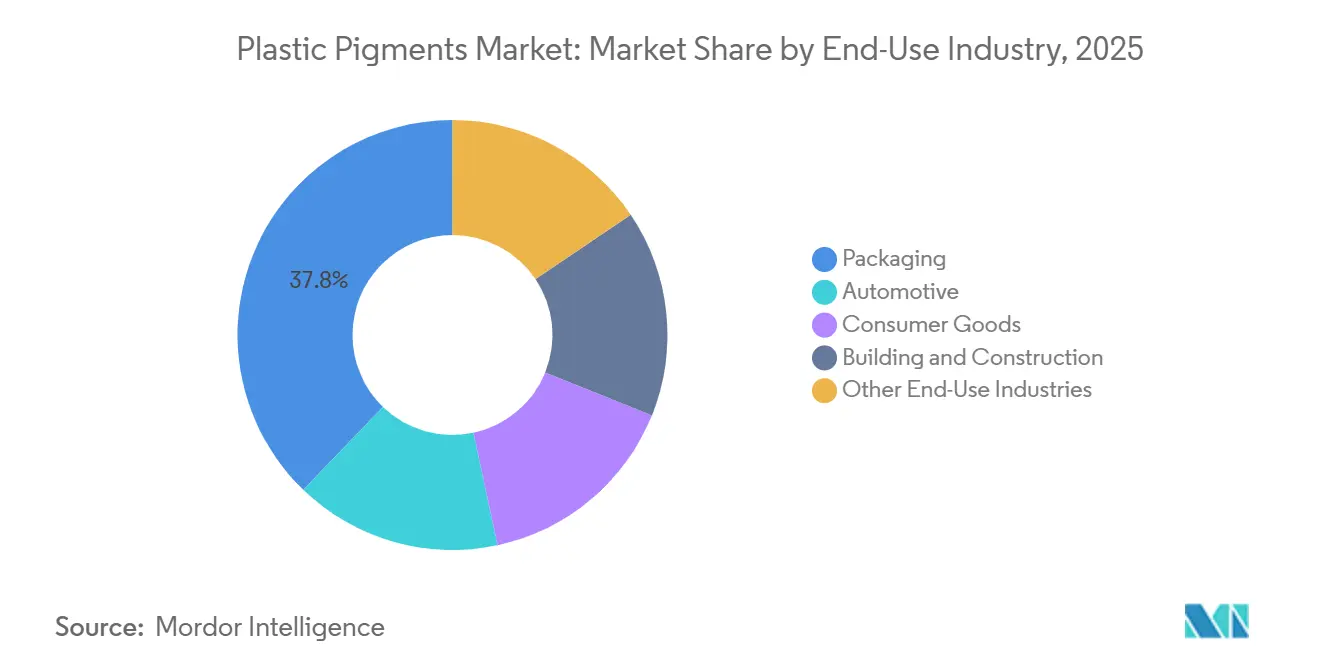
Packaging Anchors Revenue, Building and Construction Picks Up SpeedPackaging held 37.79% of the market share in 2025. Flexible and rigid plastic formats in food, personal care, and consumer goods supported the segment’s use of pigment concentrates. Packaging pigments are increasingly assessed for near-infrared sortability, food-contact migration limits, and compatibility with recycled resin. These criteria have become more important in plastic pigments market procurement decisions than they were in previous years, while consumer goods require effect pigments and consistent masterbatch performance in household products and appliance housings. The automotive industry also requires pigments for interior trim, exterior bumpers, and engineering polymer housings that retain color through thermal cycling and ultraviolet exposure.
The plastic pigments market size for building and construction is projected to advance at an 8.14% CAGR through 2031. Demand centers on polyvinyl chloride pipes and fittings, cladding panels, roofing membranes, and insulation jacketing. These applications require the weatherability and heat stability offered by inorganic pigments. Construction programs across South and Southeast Asia support the segment’s demand outlook. Other end-use industries, such as agricultural film, electronics housings, and medical devices, require biocompatible and static-dissipative colorant systems.

Geography Analysis
APAC Plastic Pigments Market
Asia-Pacific held 44.24% of the market share in 2025 and is projected to advance at a 7.96% CAGR through 2031. The region combines a large manufacturing base with expanding consumption of colorant-intensive plastics. China supports regional demand through packaging output, automotive parts exports, and construction activity. India is also increasing its demand for pigments used in waterproofing and infrastructure applications. Japan and South Korea remain important for automotive-grade and electronics-grade colorants that require high performance.
ASEAN, North America and Europe Plastic Pigments Market
The Association of Southeast Asian Nations is adding new pigment consumption locations as manufacturing capacity expands. ALPLA had operations in the Philippines from mid-2025, while Changsu inaugurated its Indonesian facility in January 2026. North America and Europe are Plastic Pigments Market regions where regulatory compliance, sustainability credentials, and supply-chain resilience matter more than price alone. In the United States, national pollution limits for dye and pigment manufacturing in 2026 target a 65% reduction in hazardous air emissions. These limits raise domestic production requirements while supporting demand for compliant pigment chemistries across European demand centers, including Germany, France, Italy, and the United Kingdom.
MEA and South America Plastic Pigments Market
South America and Middle East and Africa account for smaller portions of the plastic pigments market. Brazil’s food and beverage packaging and agricultural plastic film uses support regional pigment consumption. The Middle East and Africa are moving from raw polymer resin production toward finished plastic goods manufacturing. Saudi Arabia and the United Arab Emirates are increasing domestic processing investments and infrastructure projects that require masterbatch and colorant supply, including iron oxide and CICP materials for concrete and cladding applications.
Competitive Landscape
The plastic pigments market is moderately concentrated, with the top five players including Sun Chemical, Atul Ltd., The Chemours Company, Avient Corporation, and Sudarshan Chemical Industries Limited. Sudarshan Chemical Industries Limited completed its acquisition of the Heubach Group in March 2025. The combined company had more than 695 products, 19 manufacturing sites, and operations that had served customers in more than 85 nations. This increased the company’s ability to offer a broader pigment portfolio across global markets.
ALTANA AG invested EUR 216 million (approximately USD 234 million) in research and development in 2025, equivalent to 7% of sales, and secured a EUR 300 million (approximately USD 325 million) European Investment Bank credit line to support sustainable research and development. This supports its work on heavy-metal-free and laser-safe pigment platforms. Avient Corporation reported 4.3% organic revenue growth and increased its full-year 2026 adjusted EBITDA guidance to USD 575 million to USD 603 million in August 2026. It also presented Artisan pre-colored thermoplastics and OnColor Impress metallic effect colorants at PLASTINDIA 2026. These offerings targeted premium paint-replacement finishes and packaging applications in India and the Association of Southeast Asian Nations.
Near-Infrared (NIR)-detectable black pigments are a developing category because they can enable recycling facilities to identify dark-colored packaging. CICP materials for high-heat engineering polymers are another application area, as polyether ether ketone, polyphenylene sulfide, and polyphthalamide uses grow in electric vehicle components. Vibrantz has the largest global CICP portfolio, while Shepherd Color Company’s NTP Yellow and RTZ Orange technologies demonstrate the role of durable color in demanding applications. Plastic pigments market suppliers increasingly compete on colorant dossiers, migration test data, and material declarations alongside pigments. This makes compliance support an important part of the plastic pigments market offering.
Plastic Pigments Industry Leaders
-
Sun Chemical
-
Atul Ltd.
-
The Chemours Company
-
Avient Corporation
-
Sudarshan Chemical Industries Limited
- *Disclaimer: Major Players sorted in no particular order
Plastic Pigments Market Companies Covered in this Report
- ALTANA AG
- Atul Ltd.
- Avient Corporation
- Cabot Corporation
- Kronos Worldwide, Inc.
- LANXESS
- Shepherd Color Company
- Sudarshan Chemical Industries Limited
- Sun Chemical
- The Chemours Company
- Tronox Holdings Plc
- Vibrantz
Recent Industry Developments in Plastic Pigments Market
- February 2026: Sudarshan Chemical Industries Limited showcased NIR-detectable black solutions, recycling-friendly pigments, and spin-dye-compatible colorants at PlastIndia 2026. These solutions support recyclable and sustainable plastic applications while expanding the use of functional pigments beyond conventional coloration.
- November 2025: Sun Chemical expanded perylene pigment capacity at its Ludwigshafen site by up to 200 metric tons to meet rising demand from plastics, coatings, and automotive applications. The expansion strengthens the supply of high-performance pigments for plastic coloration and supports growth in specialized plastic pigment applications.
Global Plastic Pigments Market Report Scope
Plastic pigments are colorants incorporated into polymer materials to impart specific colors, opacity, and visual effects to plastic products. They are formulated to provide consistent coloration while withstanding processing conditions such as elevated temperatures, shear, and exposure to chemicals or light.
The Plastic Pigments Market is segmented by type, end-use industry, and geography. By type, the market is segmented into inorganic pigments and organic pigments. By end-use industry, the market is segmented into packaging, consumer goods, building and construction, automotive, and other end-use industries. The report also covers the market size and forecasts for plastic pigments in 15 countries across major regions. For each segment, the market sizing and forecasts have been done on the basis of value (USD).
Segmentation Overview
| Inorganic Pigments |
| Organic Pigments |
| Packaging |
| Consumer Goods |
| Building and Construction |
| Automotive |
| Other End-Use Industries |
| Asia-Pacific | China |
| India | |
| Japan | |
| South Korea | |
| ASEAN Countries | |
| Rest of Asia-Pacific | |
| North America | United States |
| Canada | |
| Mexico | |
| Europe | Germany |
| United Kingdom | |
| France | |
| Italy | |
| NORDIC Countries | |
| Rest of Europe | |
| South America | Brazil |
| Argentina | |
| Rest of South America | |
| Middle East and Africa | Saudi Arabia |
| South Africa | |
| Rest of Middle East and Africa |
| By Type | Inorganic Pigments | |
| Organic Pigments | ||
| By End-Use Industry | Packaging | |
| Consumer Goods | ||
| Building and Construction | ||
| Automotive | ||
| Other End-Use Industries | ||
| By Geography | Asia-Pacific | China |
| India | ||
| Japan | ||
| South Korea | ||
| ASEAN Countries | ||
| Rest of Asia-Pacific | ||
| North America | United States | |
| Canada | ||
| Mexico | ||
| Europe | Germany | |
| United Kingdom | ||
| France | ||
| Italy | ||
| NORDIC Countries | ||
| Rest of Europe | ||
| South America | Brazil | |
| Argentina | ||
| Rest of South America | ||
| Middle East and Africa | Saudi Arabia | |
| South Africa | ||
| Rest of Middle East and Africa | ||
Key Questions Answered in the Report
What is the size of the plastic pigments market?
The plastic pigments market stands at USD 12.93 billion in 2026 and is projected to reach USD 18.18 billion by 2031.
What is driving demand for plastic pigments?
Demand is supported by packaging requirements, automotive lightweighting, engineering plastics, and compliance needs for safer and recyclable colorant systems.
Which type led the market demand in 2025?
Inorganic pigments held a 62.45% share in 2025, supported by titanium dioxide, iron oxides, and CICPs.
Which end-use industry is expected to grow fastest through 2031?
Building and construction is projected to advance at an 8.14% CAGR through 2031.