
Pickling Inhibitors Market Size and Share
Market Overview
| Study Period | 2021 - 2031 |
|---|---|
| Market Size (2026) | USD 352.64 Million |
| Market Size (2031) | USD 462.42 Million |
| Growth Rate (2026 - 2031) | 5.57 % |
| Fastest Growing Market | Asia-Pacific |
| Largest Market | Asia-Pacific |
| Market Concentration | Low |
Major Players *Disclaimer: Major Players sorted in no particular order Image © Mordor Intelligence. Reuse requires attribution under CC BY 4.0. | |
Pickling Inhibitors Market Analysis by Mordor Intelligence
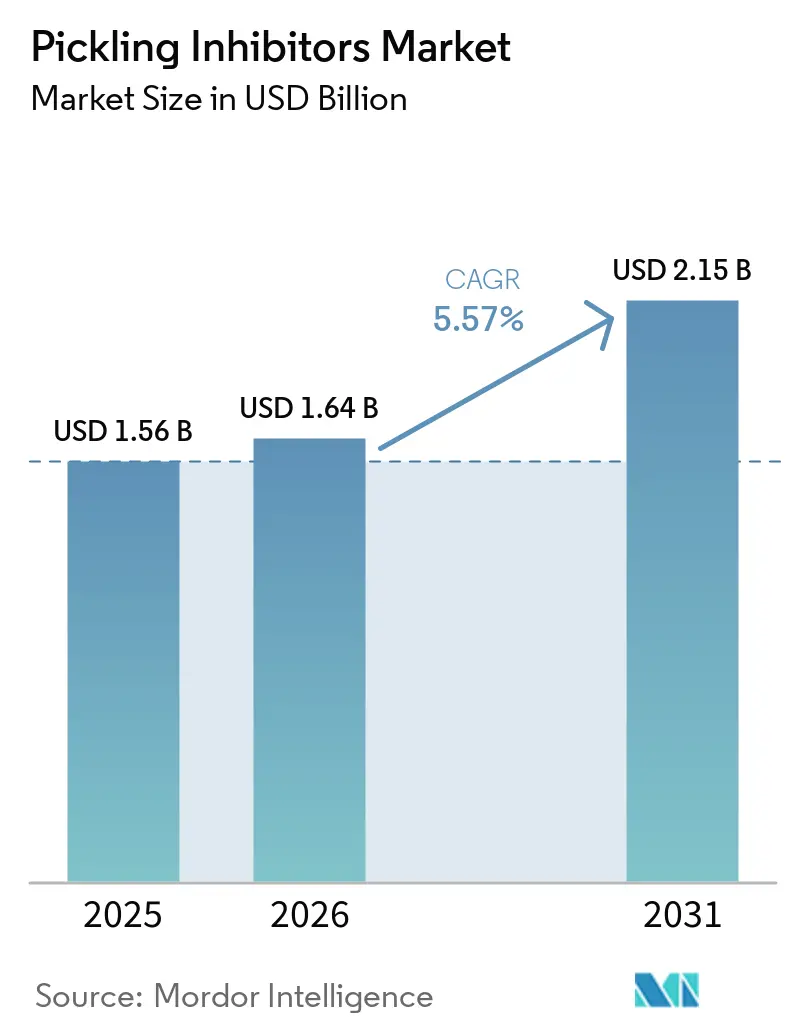
The Pickling Inhibitors Market size is projected to be USD 335.85 million in 2025, USD 352.64 million in 2026, and reach USD 462.42 million by 2031, at a CAGR of 5.57% from 2026 to 2031. Rising surface-quality requirements in automotive, appliance, and steel processing applications are driving demand for controlled acid pickling. Inhibitors protect the base metal during oxide scale removal, supporting consistent results in downstream coating and forming operations. New pickling lines in Asia-Pacific are creating opportunities for suppliers that can tailor formulations to acid chemistry, line speed, and regeneration systems. Suppliers are also shifting toward dosing support and digital bath management, making product performance and technical service more important than chemical price alone. The pickling inhibitors market is also influenced by the ability to provide reliable operational support.
Key Report Takeaways
- By type, organic pickling inhibitors accounted for 60.13% of revenue in 2025 and are forecast to grow at a CAGR of 5.92% through 2031.
- By product form, liquid concentrate held 57.36% of revenue in 2025, while liquid ready-to-use formulations are forecast to expand at a CAGR of 6.21% through 2031.
- By application, carbon steel pickling accounted for 50.17% of revenue in 2025, while stainless steel pickling and passivation are forecast to expand at a CAGR of 6.38% through 2031.
- By end-user industry, steel and metallurgy held 54.90% of revenue in 2025, while automotive is forecast to expand at a CAGR of 6.46% through 2031.
- By geography, Asia-Pacific held 44.28% of revenue in 2025 and is forecast to expand at a CAGR of 6.24% through 2031.
Note: Market size and forecast figures in this report are generated using Mordor Intelligence’s proprietary estimation framework, updated with the latest available data and insights as of January 2026.
Market Trends and Insights
Drivers Impact Analysis of Pickling Inhibitors Market*
| Drivers | (~) % Impact on CAGR Forecast | Geographic Relevance | Impact Timeline |
|---|---|---|---|
| Growth in High-Quality Coated Steel Demand | +1.4% | Global, with the highest intensity in Asia-Pacific and Europe | Medium term (2-4 years) |
| Acid Consumption and Fume Reduction Economics | +0.8% | Global | Short term (≤ 2 years) |
| Acid Regeneration-Compatible Formulations | +0.6% | APAC core, spillover to Europe | Medium term (2-4 years) |
| Expansion of Steel Pickling Capacity in Asia-Pacific | +1.2% | APAC core, spillover to MEA | Medium term (2-4 years) |
| Sensor-Enabled Bath Monitoring and Automated Dosing | +0.5% | North America and the EU, expanding to APAC | Medium term (2-4 years) |
| Low-Hazard Inhibitors for Hydrogen-Embrittlement Control | +0.7% | Global | Medium term (2-4 years) |
| Source: Mordor Intelligence | |||
Growth in High-Quality Coated Steel Demand
Tighter requirements for galvanized and electrogalvanized steel are pushing producers toward inhibited acid baths to deliver clean, uniform surfaces. Capacity investments in automotive steel processing are increasing the need for controlled pickling before downstream coating and forming. Advanced high-strength steel grades require careful process control, as hydrogen uptake can affect material performance. A 2025 journal study found that novel N-heterocyclic compounds achieved 42.80% hydrogen permeation inhibition and 91.45% corrosion inhibition at the reported optimum concentration. Automotive surface requirements make inhibitor selection a process-control decision in the pickling inhibitors market. Suppliers with validated hydrogen-control performance are better positioned to serve demanding steel grades.
Expansion of Steel Pickling Capacity in Asia-Pacific
New steel processing investments across Asia-Pacific are increasing demand for inhibitor quantities linked to plant commissioning. In September 2025, Tata Steel awarded John Cockerill India a contract for a 350,000-TPA (tons per annum) push-pull pickling line and a closed-loop acid regeneration plant at Jamshedpur. The facility was designed to achieve more than 99.5% acid regeneration efficiency. New lines require formulations matched to specific acid types, temperatures, strip speeds, and regeneration conditions. This qualification work gives suppliers an opportunity to establish a presence before routine production begins. The pickling inhibitors market benefits when these commissioning relationships develop into multiyear supply arrangements.
Sensor-Enabled Bath Monitoring and Automated Dosing
Continuous measurement of acid concentration, free iron, and inhibitor loading is changing how steel processors manage pickling baths. SensoTech states that its LiquiSonic system measures sonic velocity and conductivity to monitor acid concentration and iron loading in pickling baths. This data supports replenishment when bath conditions move outside the required range. In December 2025, Quaker Houghton introduced additions to its QH FLUID INTELLIGENCE platform, including the spectroscopy-based QH FLUIDCONTROL XMS 200 for fluid health monitoring[1]. Automated dosing can reduce unnecessary inhibitor use and limit avoidable bath disposal. It also favors suppliers that can support plant data systems and control chemical replenishment within the pickling inhibitors market.
Low-Hazard Inhibitors for Hydrogen-Embrittlement Control
Automotive use of advanced and ultra-high-strength steels is increasing the need to limit hydrogen uptake during pickling. A 2025 study reported that imidazoline-type inhibitors combined with thiourea derivatives performed better than single-compound systems in sulfuric acid at elevated temperatures. Such blends are relevant to high-speed, continuous pickling lines operating under demanding conditions. Suppliers must also account for restrictions affecting some legacy compounds under European chemical regulations. This supports the development of lower-hazard organic packages that address both corrosion control and material quality. The pickling inhibitors market can therefore reward formulations that combine hydrogen control, process performance, and regulatory compatibility.
Restraints Impact Analysis of Pickling Inhibitors Market*
| Restraints | (~) % Impact on CAGR Forecast | Geographic Relevance | Impact Timeline |
|---|---|---|---|
| Qualification Cycles for New Inhibitor Packages | -0.4% | Global | Medium term (2-4 years) |
| Variability in Acid Baths and Scale Loads | -0.3% | APAC and industrial emerging markets | Short term (≤ 2 years) |
| Volatility in Amine, Surfactant, and Solvent Inputs | -0.5% | Global | Medium term (2-4 years) |
| Substitution by Mechanical and Alternative Descaling | -0.3% | North America and the EU | Long term (≥ 4 years) |
| Source: Mordor Intelligence | |||
Qualification Cycles for New Inhibitor Packages
Steel producers and metal fabricators typically take 12 to 18 months to approve a new inhibitor chemistry. Each package must be assessed against the site's acid type, concentration, temperature, steel grades, scale load, and regeneration process. Integrated mills face a greater burden because changes in surface quality can require downstream review with automotive customers. The approval process favors incumbent suppliers with established performance records and delays the point at which a new entrant can convert trials into revenue. This timing gap can slow growth in the Pickling Inhibitors Market, even when new plant capacity is being added rapidly.
Substitution by Mechanical and Alternative Descaling
Laser descaling, high-pressure abrasive blasting, and dry-ice blasting are gaining use in selected precision applications. Verein Deutscher Ingenieure (VDI)'s resource-efficiency review identifies dry-ice blasting as suitable for sensitive surfaces and notes that laser cleaning avoids the generation of wastewater and spent cleaning liquor[2]. These methods can be appealing where effluent treatment and waste disposal increase the cost of wet pickling. However, their use remains limited because they do not provide the combined descaling, surface activation, and inhibitor protection that a managed acid bath offers. Throughput can also be constrained at the speeds used in modern continuous steel lines. The effect on the Pickling Inhibitors Market is therefore likely to remain concentrated in specialty pipe, precision tube, and fabricated component applications.
*Our forecasts treat driver/restraint impacts as directional, not additive. The impact forecasts reflect baseline growth, mix effects, and variable interactions.
Pickling Inhibitors Market Segment Analysis
By Type:
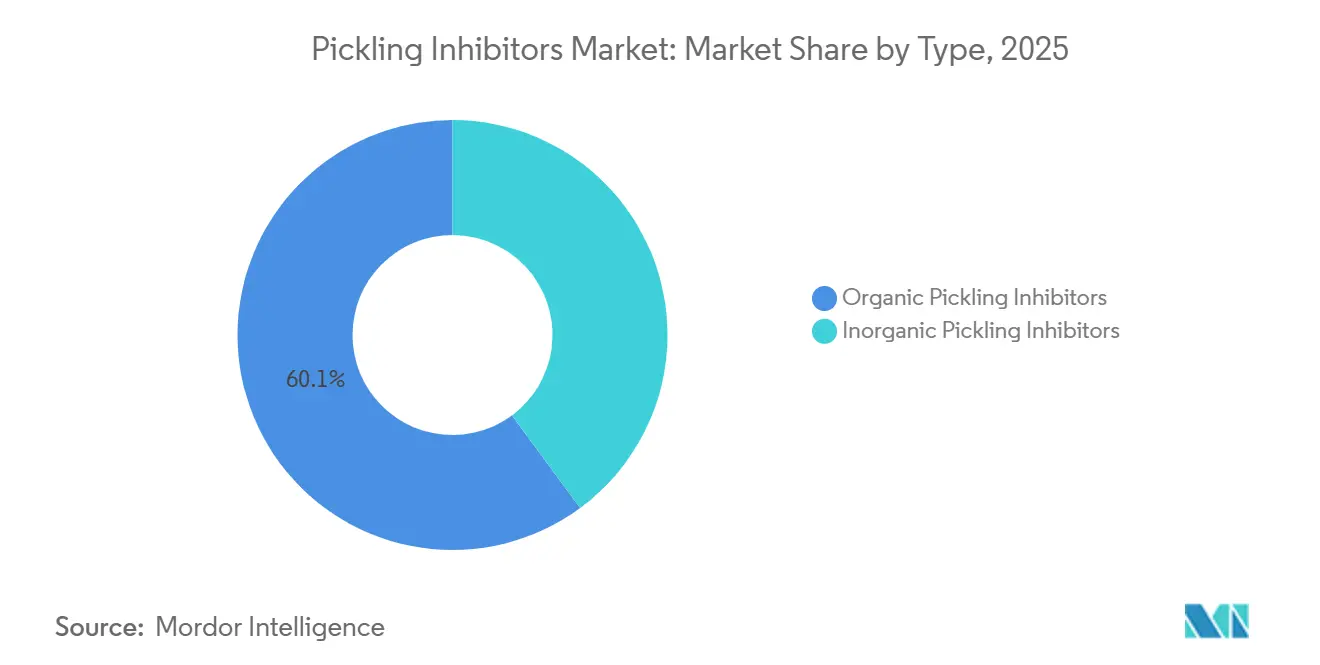
Organic Formulations Support Process PerformanceOrganic pickling inhibitors held a 60.13% revenue share in 2025, and their 5.92% CAGR through 2031 makes them both the largest and fastest-growing type. Organic formulations create protective films on freshly exposed steel through nitrogen, sulfur, and oxygen-containing compounds. These films preserve the scale removal process while limiting attack on the base metal. A 2025 study reported corrosion inhibition above 93% for imidazole-based compounds in mixed hydrochloric and sulfuric acid pickling environments. This finding supports the use of these compounds as a basis for product differentiation. The pickling inhibitors market size for organic formulations is supported by their ability to address both pickling efficiency and metal protection. Their role is further strengthened where processors require reliable results across different steel grades.
Plant-derived organic inhibitors are also receiving research attention as mills respond to chemical hazard requirements and procurement standards. A 2025 study reported that cinnamon leaf extract performed effectively as an inhibitor for mild steel in pickling bath environments. The same source identified Ocimum americanum extract as a candidate in academic research. These options could create a distinct product tier for sites seeking lower-hazard chemistry. Inorganic inhibitors still play a role in high-acid and high-temperature applications, particularly in wire and rod mills operating at sulfuric acid temperatures above 60°C. However, their limited control over hydrogen embrittlement and more difficult waste handling reduce their appeal as high-strength steel processing grows. This leaves organic suppliers competing on performance, certification, and technical service, while inorganic products serve established price-sensitive and thermally demanding applications.

By Product Form:
Ready-to-Use Liquids Gain Operational RelevanceLiquid concentrate retained 57.36% of revenue in 2025 because large integrated mills can manage dilution and control bath strength internally. The format provides unit-cost advantages where output is high, and operators have chemistry laboratories. It also allows plants to adjust dosing in response to inline bath measurements. This flexibility suits multi-tank pickling lines that process varied steel grades and scale conditions. The segment remains important to the pickling inhibitors market because continuous mills require a dependable supply in bulk quantities. It is particularly relevant where sensor arrays and automated replenishment are already integrated into line controls. Concentrates also allow technical teams to optimize inhibitor addition as bath conditions change. These characteristics keep the format central to high-throughput steel processing.
Liquid ready-to-use formulations recorded the highest forecast CAGR of 6.21% through 2031. Smaller job shops and contract metal processors often lack dedicated bath-chemistry expertise but still face strict surface-quality requirements. Pre-diluted solutions can reduce dosing errors and improve repeatability at the point of use. They allow suppliers to price based on surface quality, metal-loss reduction, and acid-use savings rather than on chemical content alone. Powder and granular products remain relevant in locations where liquid distribution is difficult or expensive. Gel and paste products are used to remove localized scale from fabricated steel and welded assemblies before hot-dip galvanizing. The International Zinc Association's regional technical guidance states that acid pickling must produce a chemically active surface prior to flux treatment. AD Chemicals markets Corrosion Inhibitor 04C for continuous hydrochloric acid picklers used in hot-dip galvanizing preparation.
By Application:
Stainless Steel Pickling Advances Alongside Carbon Steel DemandCarbon steel pickling accounted for 50.17% of revenue in 2025, reflecting the output of hot-rolled coil prepared for cold rolling, galvanizing, and tinplate production. This application uses large batches and high-throughput continuous lines. Its purchasing approach is generally cost-sensitive, which supports the use of proven liquid concentrate formulations. Suppliers need to maintain performance across varying acid concentrations, temperatures, and scale loads. Wire and tube pickling also generates demand, especially in oil-country tubular goods and seamless pipe production. These applications can involve heavier scale and elevated-temperature sulfuric acid baths. Hot-dip galvanizing pretreatment and other uses, including electroplating preparation and industrial descaling, have more varied requirements. The pickling inhibitors market size in carbon steel remains anchored by the operating scale of global flat-steel processing.
Stainless steel pickling and passivation is forecast to grow at a 6.38% CAGR through 2031, making it the fastest-growing application. This growth is driven by demand for stainless steel in power generation, food processing, and automotive exhaust and trim. In March 2026, Jindal Stainless commissioned a 1.2-MTPA stainless steel melt shop in Indonesia. These lines will require pickling chemistries compatible with hydrofluoric and nitric acid systems as they come online through FY27 and FY28. ISO 8074:2025 establishes requirements for the surface treatment of austenitic stainless steel aerospace parts, covering pickling chemistry, rinsing quality, and chloride limits, supporting a higher specification tier for stainless steel applications.
By End-User Industry:
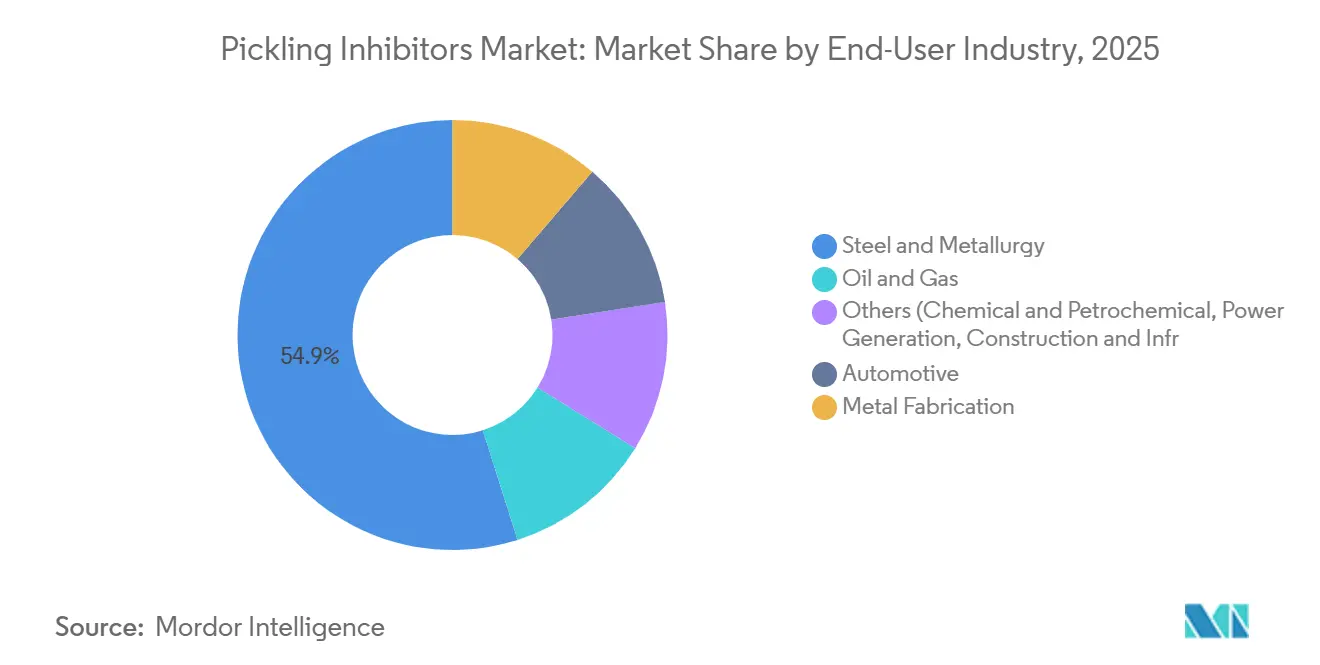
Automotive Raises Specification RequirementsSteel and metallurgy retained 54.90% of revenue in 2025 because integrated producers operate the largest and most continuous pickling capacity. These customers buy in quantities that exceed demand from other end users. They often use long-term supply agreements and have strong leverage over bulk pricing. Their preferred products extend bath life and reduce the frequency of disposal of spent pickle liquor. This can lower operating costs per ton of steel processed. Metal fabrication, oil and gas, and other industrial users form a long tail of demand. Their individual quantities are smaller, but they can accept premium pricing for specialized formulations. The pickling inhibitors market share held by steel and metallurgy reflects the concentration of continuous-process capacity.
Automotive is forecast to grow at a 6.46% CAGR through 2031, the highest rate among end-user industries. Rising use of advanced high-strength steel in body-in-white structures increases the need for controlled pickling. Thinner and stronger steels can also increase the pickling intensity per vehicle compared with conventional mild steel. A 2025 review discusses the role of organic corrosion inhibitors in high-performance metal alloy applications. Automotive supply contracts require demanding surface-quality performance and longer qualification cycles. High-strength steel processing raises the importance of documented pickling controls. These factors support pricing for suppliers that can meet material-quality and process-control requirements, and make application expertise an important factor in supplier selection.
Geography Analysis
APAC Pickling Inhibitors Market
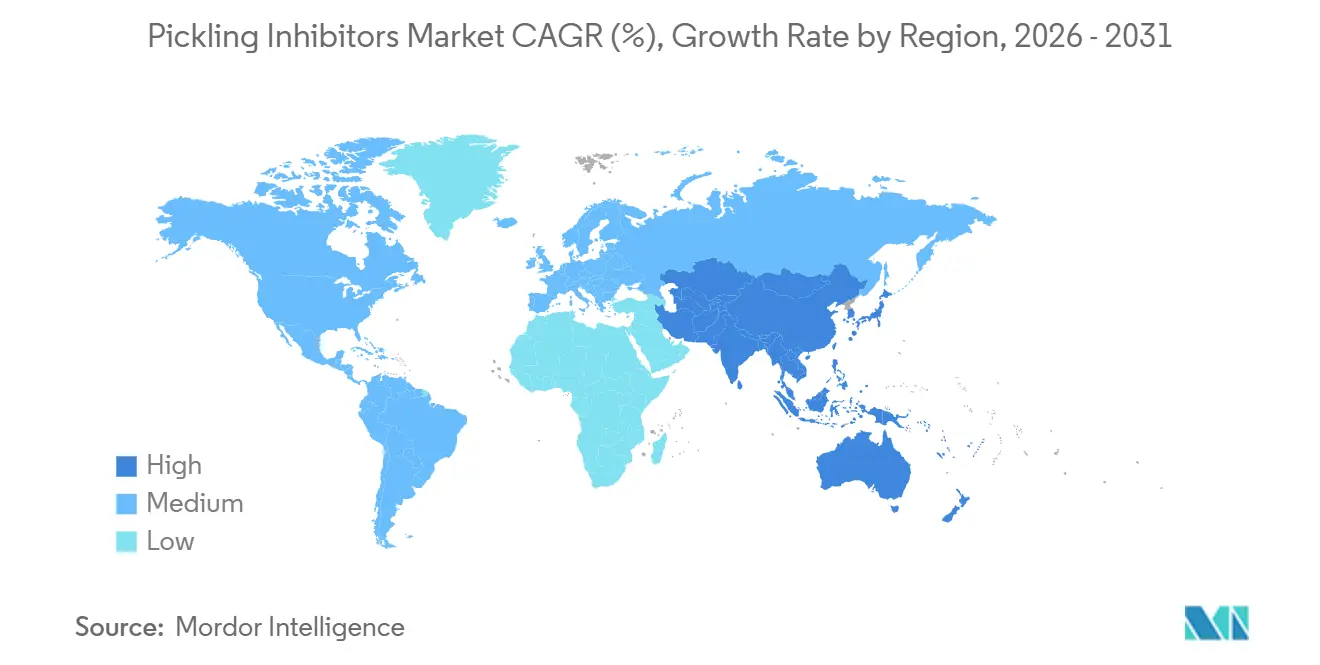
Asia-Pacific accounted for 44.28% of revenue in 2025 and is forecast to grow at a CAGR of 6.24% through 2031. The region combines new steel capacity with existing demand from automotive, appliance, and infrastructure supply chains. India is a major source of new investment in integrated pickling capacity. Tata Steel's Jamshedpur project adds a push-pull pickling line with closed-loop regeneration. These projects increase demand for formulations adapted to line design and acid recovery processes. New capacity also increases demand for suppliers capable of supporting qualification during commissioning. The pickling inhibitors market size in the region is therefore linked to both capacity additions and higher process-control requirements.
East Asia and ASEAN Pickling Inhibitors Market
China remains important in the Asia-Pacific region, as large flat-steel producers are investing in throughput and control systems. A large push-pull pickling line at HBIS Tangsteel's Laoting site was commissioned in 2026. Japan and South Korea are mature markets with high inhibitor specifications shaped by automotive export standards. South Korea's early 2025 trade measures on certain imported hot-rolled products may affect regional steel sourcing and line utilization. ASEAN markets are attracting stainless steel investment, including Jindal Stainless's 1.2-Million Tonnes Per Annum (MTPA) melt shop in Indonesia. This investment adds demand in markets that had previously relied more heavily on imported finished steel. Asia-Pacific's position in the pickling inhibitors market is supported by its combination of scale, new processing assets, and broad end-user demand.
EMEA and the Americas Pickling Inhibitors Market
North America and Europe are mature regions where output growth is lower but product value is higher. Automotive and aerospace quality requirements support demand for higher-specification, lower-toxicity formulations. Germany, France, and Italy remain important European end markets due to their automotive manufacturing bases. In North America, the nearshoring of automotive manufacturing to Mexico is increasing activity along the Midwest-Mexico supply corridor. The United States applied 25% tariffs on steel imports in 2025, which supported domestic mill utilization. South America, the Middle-East, and Africa are smaller but growing markets for pickling inhibitors. Brazil has the largest steel pickling capacity in South America, while the Middle-East has specialized demand for oil and gas pipeline descaling. South Africa serves as an entry point for sub-Saharan demand, although infrastructure constraints limit growth in the region.
Competitive Landscape
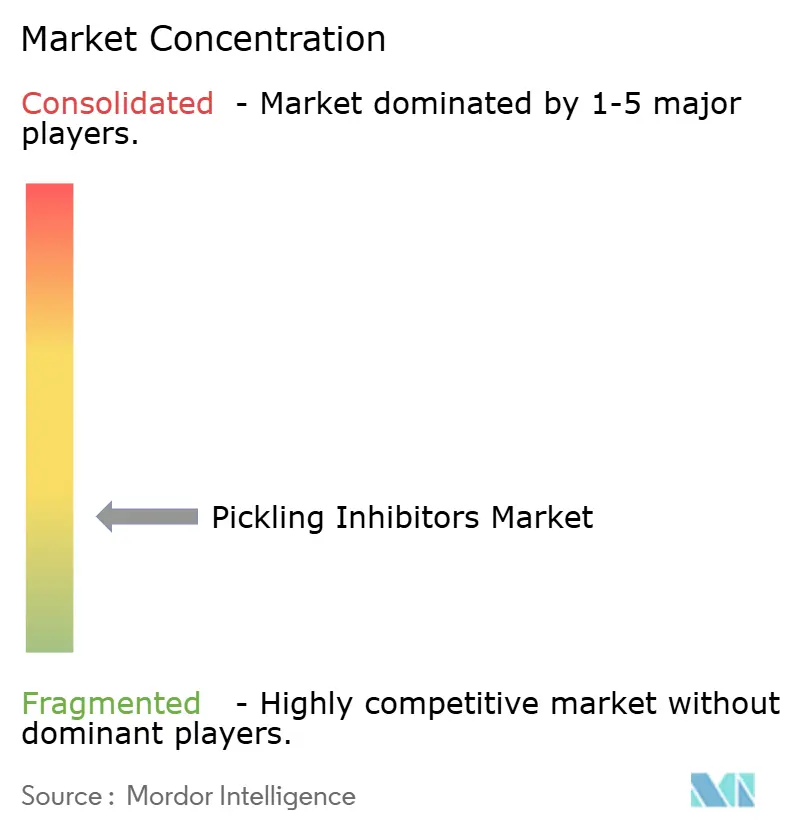
The pickling inhibitors market is fragmented. BASF, Quaker Houghton, Henkel, Chemetall, and European specialty chemical suppliers hold strong positions where customers require technical performance and process support. Regional formulators in China, India, and South Korea compete more aggressively on price in high-volume carbon steel applications. Quaker Houghton launched new automation technologies for its QH FLUID INTELLIGENCE platform in December 2025, including the QH FLUIDCONTROL XMS 200, which uses spectroscopy to monitor fluid condition. This approach positions the supplier closer to plant control and fluid management decisions and can increase switching costs where chemistry and monitoring systems are used together. Henkel introduced Bonderite C-AD 2002 in February 2026 for low-temperature dip degreasing. The product operates at 35-40°C, compared with 60-65°C for conventional dip-degreasing processes, reducing energy use during surface preparation before pickling. Chemetall's Gardo Control platform monitors pH, conductivity, temperature, and chemical consumption, and automates replenishment. These examples indicate that suppliers are combining chemistry with process hardware and data. Acid-regeneration-compatible packages, bio-derived inhibitors for sensitive processing environments, and formulations designed for automated dosing remain active areas of product development. Suppliers that contribute during new-line commissioning may secure longer operating relationships.
Intellectual property also affects competition, as specialty suppliers are developing N-heterocyclic and synergistic inhibitor systems. This work can provide protection for suppliers with validated chemistry and field-service capability. Regional competitors are improving electrochemical testing and can license established formulation approaches, which sustains price pressure in standard applications. Technical field support is becoming as important as laboratory development during new-line commissioning. The market is therefore divided between suppliers competing on process reliability and those competing primarily on price. Premium customers are more likely to value documented bath performance, hydrogen control, and integration with dosing systems, while commodity buyers tend to prioritize dependable supply and cost per kilogram. This distinction explains why global suppliers and regional formulators can operate in the same market with different commercial approaches.
The market depends on routine operating performance after a formulation is approved. Reliable results help mills avoid unnecessary metal loss and unplanned bath replacement, making technical support a commercial requirement rather than an added service. Suppliers that can respond to changes in acid concentration and scale conditions, which vary by line design, steel grade, and operating practice, are better positioned to influence renewal decisions. The market includes both long-term supply relationships and price-driven purchases, creating different requirements for global specialty suppliers and regional formulators. Integrated offerings that combine monitoring, replenishment, and chemistry can be advantageous, though simpler formulations retain a place in established operations with stable conditions. Across steel, automotive, and fabrication customers, suppliers must balance chemistry performance with practical application at the plant level, supported by field testing, operator training, and consistent product supply.
Pickling Inhibitors Industry Leaders
-
Henkel AG & Co. KGaA
-
Quaker Houghton
-
BASF
-
Atotech
-
TIB Chemicals AG
- *Disclaimer: Major Players sorted in no particular order
Pickling Inhibitors Market Companies Covered in this Report
- AFCL
- Atotech
- BASF
- Chemetall GmbH
- Columbia Chemical
- Crown Technology, Inc.
- DFE Chemie GmbH
- Henkel AG & Co. KGaA
- Hong Kong Honor & Honest International Co., Limited
- Hubbard-Hall Inc.
- Keller & Bohacek GmbH & Co. KG
- PEISUN CHEMICAL CO., LTD.
- Quaker Houghton
- Schloetter Company Limited
- SurTec International GmbH
- TIB Chemicals AG
Recent Industry Developments in Pickling Inhibitors Market
- February 2026: Henkel launched Bonderite C-AD 20202, a low-temperature dip degreasing surfactant operating at 35-40°C, up to 35°C lower than conventional dip-degreasing processes, reducing energy consumption and CO₂ emissions in pre-pickling surface preparation without additional capital investment. It addressed a gap in Henkel's Bonderite portfolio previously covered only by spray-degreasing chemistry at low temperatures.
- December 2025: Quaker Houghton launched three hardware additions to its QH FLUID INTELLIGENCE platform: the QH FLUIDCONTROL XMS 200, a spectroscopy-based carbon-content sensor and fluid health predictor; the QH FLUIDCONTROL XMS 100, for automated fluid monitoring through traditional sensors; and the QH FLUIDMONITOR GQ, for precision grinding fluid monitoring. The platform supports automated management of metal surface treatment fluids, including pickling-line chemistries, across the automotive, aerospace, and metals industries.
Global Pickling Inhibitors Market Report Scope
Pickling inhibitors are chemical additives mixed into acid baths used to clean metals. They prevent the acid from corroding the underlying metal once rust and scale are removed, while also preventing hydrogen damage and reducing harmful fumes.
The pickling inhibitors market is segmented by type, product form, application, end-user industry, and geography. By type, the market is segmented into organic pickling inhibitors and inorganic pickling inhibitors. By product form, the market is segmented into liquid concentrate, liquid ready-to-use, powder and granular, and others (gel and paste). By application, the market is segmented into carbon steel pickling, stainless steel pickling and passivation, wire and tube pickling, hot-dip galvanizing pretreatment, and others (electroplating pretreatment, industrial descaling and other metal surface preparation). By end-user industry, the market is segmented into steel and metallurgy, automotive, metal fabrication, oil and gas, and others (chemical and petrochemical, power generation, construction and infrastructure, general industrial manufacturing). The report also covers market size and forecasts for pickling inhibitors across 17 countries in major regions. The market sizes and forecasts are provided in terms of value (USD).
Segmentation Overview
| Organic Pickling Inhibitors |
| Inorganic Pickling Inhibitors |
| Liquid Concentrate |
| Liquid Ready-to-Use |
| Powder and Granular |
| Others (Gel and Paste) |
| Carbon Steel Pickling |
| Stainless Steel Pickling and Passivation |
| Wire and Tube Pickling |
| Hot-Dip Galvanizing Pretreatment |
| Others (Electroplating Pretreatment, Industrial Descaling and Other Metal Surface Preparation) |
| Steel and Metallurgy |
| Automotive |
| Metal Fabrication |
| Oil and Gas |
| Others (Chemical and Petrochemical, Power Generation, Construction and Infrastructure, General Industrial Manufacturing) |
| Asia-Pacific | China |
| India | |
| Japan | |
| South Korea | |
| ASEAN Countries | |
| Rest of Asia-Pacific | |
| North America | United States |
| Canada | |
| Mexico | |
| Europe | Germany |
| United Kingdom | |
| France | |
| Italy | |
| Spain | |
| NORDIC Countries | |
| Russia | |
| Rest of Europe | |
| South America | Brazil |
| Argentina | |
| Rest of South America | |
| Middle-East and Africa | Saudi Arabia |
| South Africa | |
| Rest of Middle-East and Africa |
| By Type | Organic Pickling Inhibitors | |
| Inorganic Pickling Inhibitors | ||
| By Product Form | Liquid Concentrate | |
| Liquid Ready-to-Use | ||
| Powder and Granular | ||
| Others (Gel and Paste) | ||
| By Application | Carbon Steel Pickling | |
| Stainless Steel Pickling and Passivation | ||
| Wire and Tube Pickling | ||
| Hot-Dip Galvanizing Pretreatment | ||
| Others (Electroplating Pretreatment, Industrial Descaling and Other Metal Surface Preparation) | ||
| By End-User Industry | Steel and Metallurgy | |
| Automotive | ||
| Metal Fabrication | ||
| Oil and Gas | ||
| Others (Chemical and Petrochemical, Power Generation, Construction and Infrastructure, General Industrial Manufacturing) | ||
| By Geography | Asia-Pacific | China |
| India | ||
| Japan | ||
| South Korea | ||
| ASEAN Countries | ||
| Rest of Asia-Pacific | ||
| North America | United States | |
| Canada | ||
| Mexico | ||
| Europe | Germany | |
| United Kingdom | ||
| France | ||
| Italy | ||
| Spain | ||
| NORDIC Countries | ||
| Russia | ||
| Rest of Europe | ||
| South America | Brazil | |
| Argentina | ||
| Rest of South America | ||
| Middle-East and Africa | Saudi Arabia | |
| South Africa | ||
| Rest of Middle-East and Africa | ||
Key Questions Answered in the Report
What is current market size of Pickling Inhibitors Market?
The Pickling Inhibitors Market size is projected to be USD 335.85 million in 2025, USD 352.64 million in 2026, and reach USD 462.42 million by 2031, at a CAGR of 5.57% from 2026 to 2031.
Which type drives demand for pickling inhibitors?
Organic formulations led with a 60.13% share in 2025 and are forecast to grow at a 5.92% CAGR through 2031.
Which product form is growing fastest?
Liquid ready-to-use formulations are forecast to grow at a 6.21% CAGR through 2031, supported by smaller processors seeking simpler dosing.
Which application is expanding most rapidly?
Stainless steel pickling and passivation is projected to grow at a 6.38% CAGR through 2031.