
Pickling Chemicals Market Size and Share
Market Overview
| Study Period | 2021 - 2031 |
|---|---|
| Market Size (2026) | USD 1.61 Billion |
| Market Size (2031) | USD 2.07 Billion |
| Growth Rate (2026 - 2031) | 5.23 % |
| Fastest Growing Market | Asia-Pacific |
| Largest Market | Asia-Pacific |
| Market Concentration | Medium |
Major Players *Disclaimer: Major Players sorted in no particular order Image © Mordor Intelligence. Reuse requires attribution under CC BY 4.0. | |
Pickling Chemicals Market Analysis by Mordor Intelligence
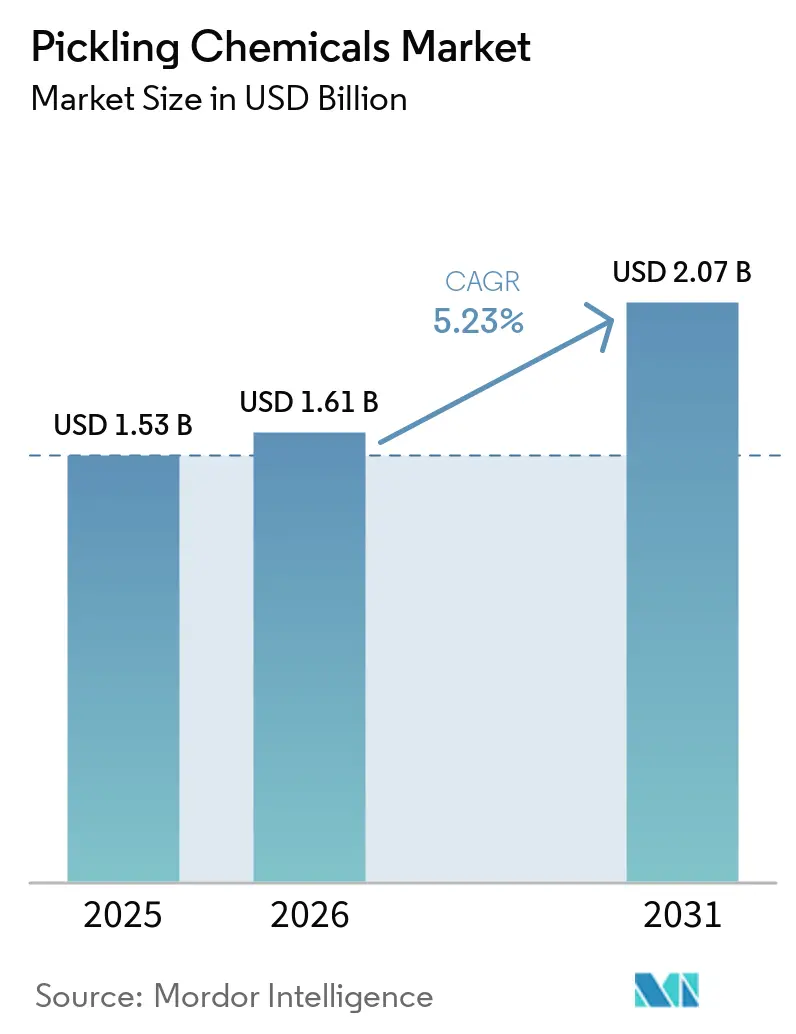
The Pickling chemicals market size was estimated at USD 1.53 billion in 2025 and is estimated to grow from USD 1.61 billion in 2026 to USD 2.07 billion by 2031, at a CAGR of 5.23% during the forecast period (2026-2031). The pickling chemicals market is more closely tied to steel processing activity than to crude steel output alone, as each processing line requires controlled oxide removal before rolling, coating, or finishing. New capacity for electrical steel, coated steel, and advanced high-strength steel is supporting demand for more specialized formulations. Global steel demand is growing. Higher specifications also increase the need for closer control of acid concentration, temperature, and treatment time. The pickling chemicals market, therefore, has opportunities in both large-scale steel lines and smaller, higher-value electronics and precision applications.
Key Report Takeaways
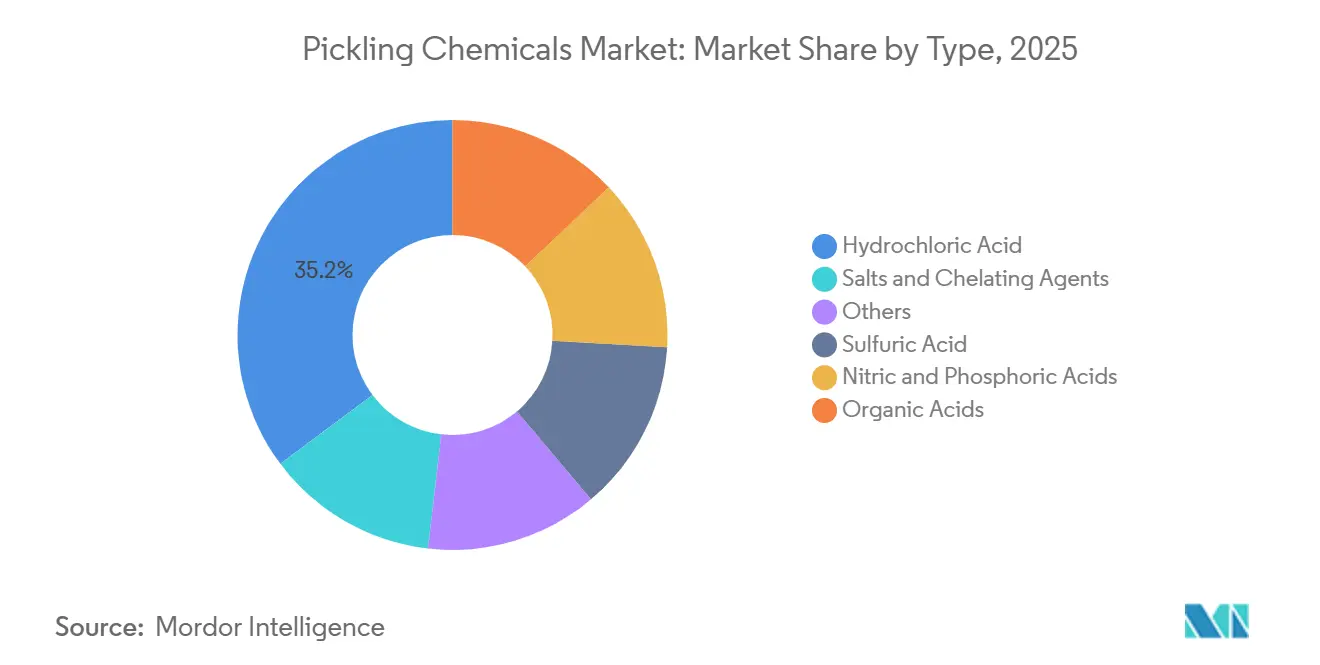
- By type, hydrochloric acid held 35.23% of the pickling chemicals market share in 2025, while organic acids are forecast to expand at a 6.14% CAGR through 2031.
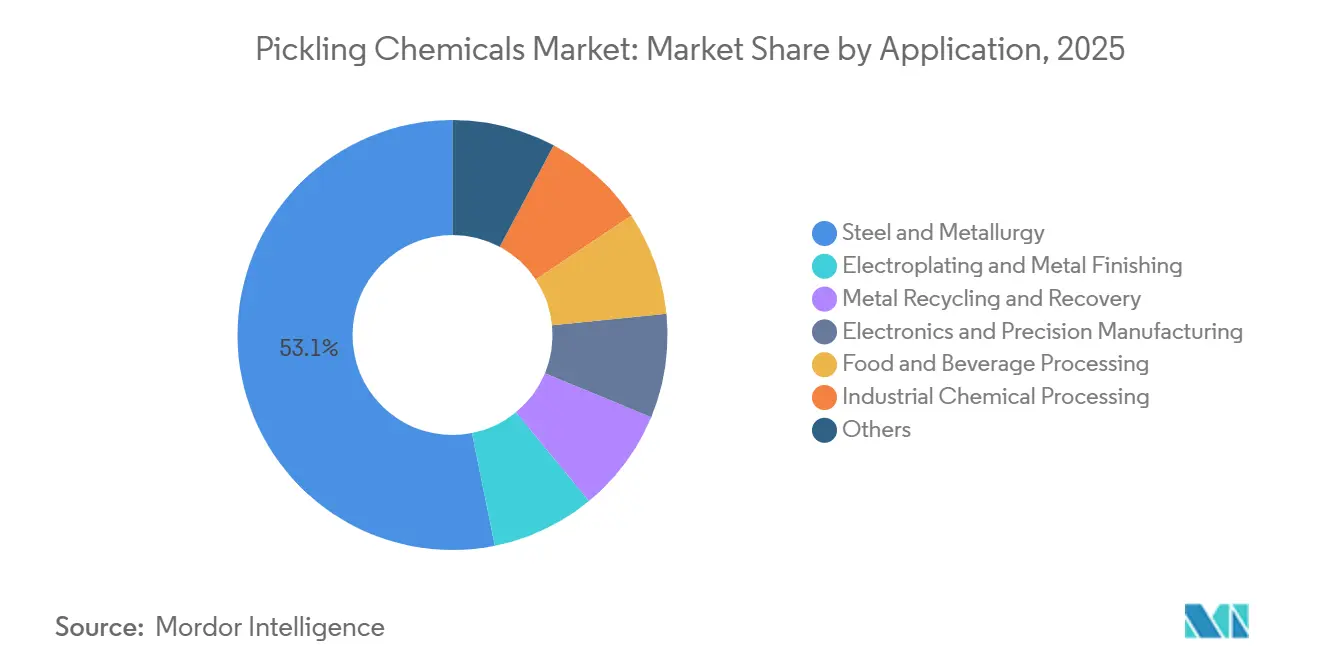
- By application, steel and metallurgy accounted for 53.14% of the pickling chemicals market share in 2025, while electronics and precision manufacturing recorded the highest projected CAGR at 6.32% through 2031.
- By geography, Asia-Pacific captured 46.47% of the pickling chemicals market share in 2025 and is forecast to grow at a 5.87% CAGR through 2031.
Note: Market size and forecast figures in this report are generated using Mordor Intelligence’s proprietary estimation framework, updated with the latest available data and insights as of January 2026.
Market Trends and Insights
Drivers Impact Analysis of Pickling Chemicals Market*
| Drivers | (~) % Impact on CAGR Forecast | Geographic Relevance | Impact Timeline |
|---|---|---|---|
| Expansion of Steel Pickling and Surface-Treatment Capacity | + 1.8% | Asia-Pacific core, spillover to South America and Middle East and Africa (MEA) | Short term (≤ 2 years) |
| Demand for Higher-Quality Coated and Advanced-Strength Steels | + 1.2% | Global | Medium term (2-4 years) |
| Growth of Automotive, Construction, Aerospace, and Electronics Manufacturing | + 1.4% | Global | Medium term (2-4 years) |
| Adoption of Acid Regeneration and Closed-Loop Pickling Systems | + 0.7% | Europe, Asia-Pacific | Medium term (2-4 years) |
| Real-Time Bath Monitoring and Automated Chemical Dosing | + 0.5% | North America and Europe | Long term (≥ 4 years) |
| Application-Specific Low-Fume and Nitric-Acid-Free Formulations | + 0.6% | Global | Medium term (2-4 years) |
| Source: Mordor Intelligence | |||
Expansion of Steel Pickling and Surface-Treatment Capacity
Capital investment in steel processing lines is creating near-term demand for pickling chemicals. In December 2025, John Cockerill reported the successful operation of an acid regeneration project for silicon steel pickling waste acid. Acid regeneration allows high-throughput lines to manage waste streams while maintaining the conditions required for consistent surface treatment. Electrical steel and advanced grades require narrower operating ranges for dwell time, acid strength, and bath temperature than commodity grades. Such lines require reliable oxide removal before rolling, coating, and other downstream processes. This gives the pickling chemicals market greater exposure to specialty formulations as processors add higher-specification capacity.
Demand for Higher-Quality Coated and Advanced-Strength Steels
The use of advanced high-strength steel in automotive structures changes the requirements placed on pickling baths. In November 2025, WorldAutoSteel updated its Advanced High-Strength Steel Application Guidelines, emphasizing validated approaches for coated high-strength steel applications. Silicon-alloyed grades can form silica-rich scale during hot rolling, which is more difficult to remove than conventional iron oxide. Processors may need acid accelerators or longer treatment periods to meet surface-quality requirements. In 2025, Tata Steel Nederland and Volkswagen Group reported progress on third-generation advanced high-strength steel with zinc coating for automotive crash structures[1]. The pickling chemicals market benefits when higher-grade steel increases the value of consistent, qualified surface treatment.
Growth of Automotive, Construction, Aerospace, and Electronics Manufacturing
Several manufacturing sectors draw on pickling chemistry, although their technical requirements differ. In 2025, the United Kingdom government reviewed UK REACH authorization for pretreatment operations in aerospace and defense supply chains, covering pickling, etching, and desmutting processes. Aerospace qualifications can take 18 to 24 months, which supports established supplier relationships once a formulation is approved. Electronics fabrication requires controlled microetch chemistry to prepare copper surfaces for adhesion in multilayer boards. Copper foil passivation for electric vehicle batteries also requires formulation choices that meet evolving regulatory and technical requirements. These specialized uses account for a smaller share than steel processing but can generate higher revenue per unit for the pickling chemicals market.
Adoption of Acid Regeneration and Closed-Loop Pickling Systems
Acid regeneration is becoming an operational and compliance priority for high-throughput pickling sites. In December 2025, ANDRITZ received an order from Tata Steel for an acid regeneration plant at Port Talbot capable of processing 6,340 liters per hour of waste hydrochloric acid. The project supports an expansion in pickling-line capacity from 1.2 million to 1.8 million tons per year, with commissioning planned for late 2027. The European Commission's REGMAX project documented acid regeneration rates above 97% and operating cost reductions of up to 91%. Higher recovery can reduce fresh-acid purchases at individual sites, while also supporting longer operating campaigns and higher line utilization. New processing capacity in Asia-Pacific can offset lower fresh-acid intensity at established European sites. The pickling chemicals market continues to benefit from the equipment, service, and specialty chemistry requirements associated with closed-loop systems.
Restraints Impact Analysis of Pickling Chemicals Market*
| Restraints | (~) % Impact on CAGR Forecast | Geographic Relevance | Impact Timeline |
|---|---|---|---|
| Hazardous-Acid Handling, Wastewater, and Emission Compliance Costs | - 1.2% | Europe, North America | Short term (≤ 2 years) |
| Volatility in Mineral-Acid and Specialty-Additive Costs | - 0.9% | Global | Short term (≤ 2 years) |
| Substitution by Mechanical, Abrasive, Laser, and Dry-Cleaning Technologies | - 0.5% | Aerospace and automotive sectors globally | Long term (≥ 4 years) |
| Qualification Bottlenecks for Advanced Alloys and Regenerated-Acid Chemistries | - 0.3% | North America and Europe | Medium term (2-4 years) |
| Source: Mordor Intelligence | |||
Hazardous-Acid Handling, Wastewater, and Emission Compliance Costs
Managing hazardous acids incurs operating and capital costs, particularly in more regulated regions. The consolidated September 2025 edition of the EU Registration, Evaluation, Authorization and Restriction of Chemicals (REACH) Regulation requires chemical safety assessments for registrants handling 10 or more tons of covered substances per year. This threshold applies to many industrial pickling operations. Northern Ireland's 2026 chemical compliance report for metal production and processing recorded 33 minor non-conformances and identified outdated UK REACH documentation at 9 sites[2]. Hydrofluoric and nitric acid systems used in stainless steel processing require careful neutralization, metal recovery, and wastewater permitting. These obligations can reduce the economic viability of small-scale chemical pickling. The pickling chemicals market may, therefore, become more dependent on larger processors capable of supporting dedicated treatment systems.
Volatility in Mineral-Acid and Specialty-Additive Costs
Volatile acid and additive costs present a direct profitability risk for chemical blenders. Sulfuric acid prices rose from USD 175 per ton in late December 2025 to USD 270 per ton by mid-April 2026, with spot prices exceeding USD 500 per ton in late May 2026. Hydrochloric acid, the largest product type in the pickling chemicals market, also faced tight supply conditions during the first half of 2026 due to constrained co-product availability and demand from steel and fertilizer users. Fixed-price supply arrangements can expose blenders when feedstock costs rise faster than contract prices allow. Larger suppliers can respond through longer-term sourcing, feedstock hedging, vertical integration, and more efficient batch planning. These capabilities strengthen the position of better-capitalized suppliers when input costs remain unstable.
*Our forecasts treat driver/restraint impacts as directional, not additive. The impact forecasts reflect baseline growth, mix effects, and variable interactions.
Pickling Chemicals Market Segment Analysis
By Type:
Hydrochloric Acid Anchors Market Share While Organic Alternatives Grow FasterHydrochloric acid held 35.23% of the pickling chemicals market share in the type segment in 2025. Its position reflects widespread use in continuous lines for carbon steel, galvanized steel, and silicon steel. Fast rinsing, pickling speed, and established regeneration equipment support its use at scale. Sulfuric acid remains important for stainless steel strip pickling and aluminum anodizing, particularly where spent-acid handling systems are already in place. Nitric and phosphoric acid formulations are used in aerospace and stainless steel passivation, where original equipment manufacturer qualification requirements can matter more than input cost. Salts and chelating agents support bath stability, inhibition, and passivation across mineral-acid and organic systems. The pickling chemicals industry is shifting toward formulations that deliver higher value per unit while retaining substantial quantities of hydrochloric acid.
Organic acids are forecast to expand at a 6.14% CAGR from 2026 to 2031, the fastest rate among chemical types. Regulatory pressure to reduce hazardous mineral-acid use and evidence of technical performance support this growth. A 2025 study in the Journal of The Electrochemical Society compared seven organic acid electrolytes for AA2024-T3 aerospace alloy anodization and found that malic acid produced the highest barrier-film properties among the candidates tested. This result is relevant to aerospace surface treatment, where chromium-free chemistry is receiving greater attention. Organic acids can also offer simpler spent-liquor disposal than strong mineral acids. Their lower closed-loop investment requirement can make them more accessible to smaller precision finishers and specialty coating operations. This supports a gradual shift in the pickling chemicals market toward more specialized chemistry, even as high-quantity hydrochloric acid lines remain established.

By Application:
Steel Processing Dominates While Electronics Momentum IntensifiesSteel and metallurgy accounted for 53.14% of the pickling chemicals market share in 2025. Continuous pickling lines, push-pull systems, and batch operations consume substantial quantities of acid across global steel processing. Global crude steel production reached 1,849.4 Mt in 2025. The product mix is shifting toward advanced high-strength, coated, and electrical grades, which require tighter control of surface treatment than commodity steel. Electroplating and metal finishing constitute the next major demand segment, as pretreatment quality affects plating adhesion and corrosion performance. Metal recycling and recovery add demand as scrap-based production increases and recycled feedstock requires surface conditioning. Food, beverage, and industrial processing use phosphoric and citric acid formulations to clean stainless steel equipment.
Electronics and precision manufacturing are forecast to grow at a 6.32% CAGR through 2031, the highest rate among application categories. Printed circuit board production requires controlled microetching and desmearing for copper adhesion in multilayer designs. Chemetall introduced Gardolene D in October 2025 as a chromium-free and fluoride-free passivation solution for copper foil. The formulation supports battery copper foil processing ahead of the European Union Battery Regulation's 2027 enforcement milestone. Electric motor stators, power-electronics substrates, and advanced packaging interconnects create further demand for precise descaling. Commodity acid suppliers may be unable to meet all purity, performance, and validation requirements for these applications. Higher formulation complexity supports premium pricing within the pickling chemicals market for precision applications.
Geography Analysis
APAC Pickling Chemicals Market
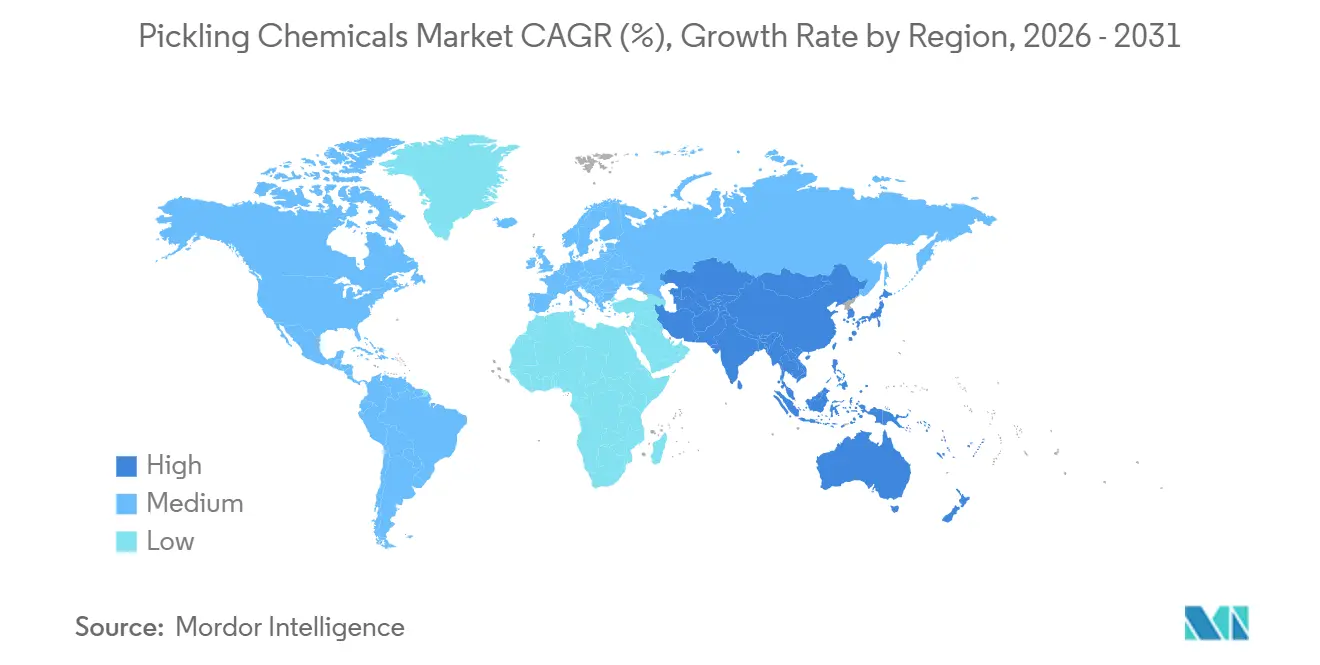
Asia-Pacific held 46.47% of the pickling chemicals market share in 2025 and is forecast to grow at a 5.87% CAGR through 2031. The region benefits from the expansion of steel processing, electronics manufacturing, and automotive production. China, India, Japan, South Korea, and the Association of Southeast Asian Nations all contribute to demand. Infrastructure construction, rail expansion, and automotive investment support demand above the global average. Japan and South Korea remain important sources of high-specification chemistries used in the automotive and electronics export industries. The pickling chemicals market in Asia-Pacific also benefits from new downstream capacity and related investments in equipment.
North America and Europe Pickling Chemicals Market
North America and Europe form the second and third demand pillars, although both are more regulated and less output-driven than the Asia-Pacific. In North America, mixed-metal vehicle platforms create demand for titanium, zirconium, and organo-functional silane pretreatments alongside conventional acid pickling. Electric vehicle production is also increasing the requirements for battery copper foil treatment and electric motor component preparation. In Europe, investment is focused more on regeneration systems and environmental improvement than on greenfield processing capacity. The Port Talbot regeneration order demonstrates how European operators can upgrade existing lines while increasing throughput. EU emissions and chemical regulations favor suppliers that can provide documented low-hazard formulations and compliance support.
MEA and South America Pickling Chemicals Market
South America, the Middle East, and Africa are smaller but relevant demand areas for the pickling chemicals market. Brazil and Argentina have established flat-steel producers and automotive supply chains that use hydrochloric and sulfuric acid systems. Middle East steel demand contracted in 2026 amid shipping disruption linked to Strait of Hormuz tensions, according to the World Steel Association. Saudi Arabian industrial diversification and Gulf infrastructure programs can support recovery when logistics stabilize. Jindal Stainless commissioned 1.1 million tons per annum (MTPA) of hot-rolled annealed and pickled capacity and 0.17 MTPA of cold-rolled annealed and pickled capacity for FY27. African construction activity supports demand for steel processing, but the region depends on imported specialty formulations. This reliance exposes local buyers to global acid prices and logistics conditions.
Competitive Landscape
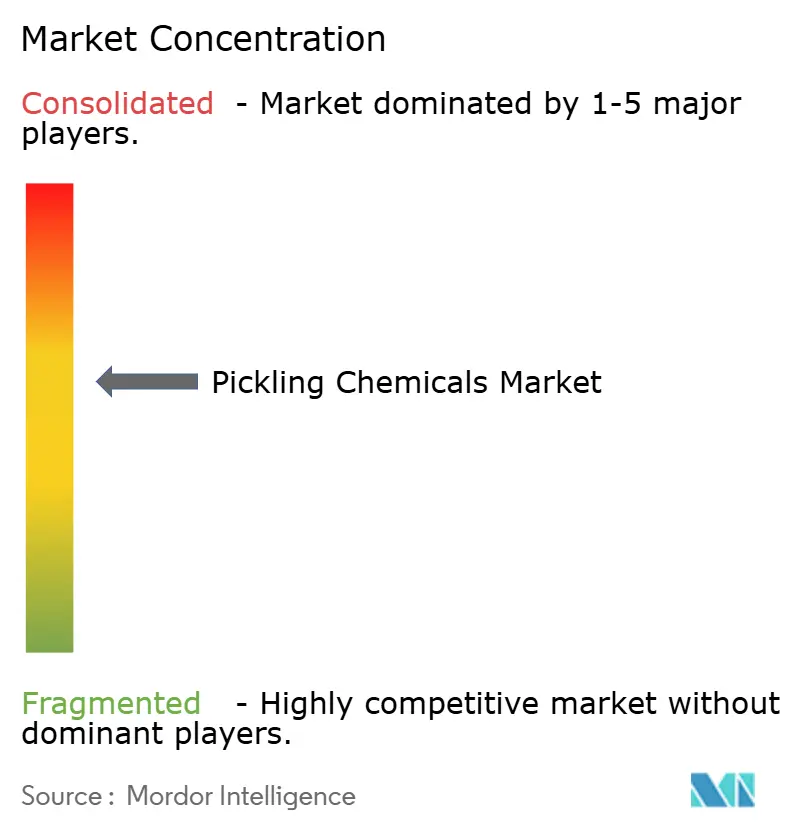
The pickling chemicals market is moderately consolidated. BASF (through Chemetall), Henkel, and Quaker Houghton maintain broad portfolios across high-quantity steel treatment and high-specification applications. Nihon Parkerizing, TIB Chemicals AG, Surtec Suisse GmbH, and Hubbard-Hall compete in application-specific or regional niches. These suppliers differentiate through local formulation knowledge, proximity to customer sites, and responsive technical service. Large suppliers tend to have the resources for global qualification programs, regulatory documentation, and multiregional supply. Regional specialists can compete where minimum order sizes and site-specific support are important. The market, therefore, contains both scale-led and service-led competitive positions.
Chemetall's October 2025 launch of Gardolene D demonstrates a product-led strategy focused on chromium-free and fluoride-free copper foil passivation. The formulation reduces requalification pressure for battery manufacturers preparing for the European Union Battery Regulation. Product validation, regulatory fit, and regional application support remain important competitive factors, allowing specialized suppliers to compete even where larger companies have broader portfolios.
Opportunities remain in lower-hazard acid systems for aerospace and medical alloy preparation, integrated bath management services, and organic acid or chelating agent formulations for precision electronics cleaning. Digital bath monitoring uses conductivity, acid concentration, and iron-load sensors to support controlled dosing and longer bath life. It reduces spent-liquor generation and provides data for site-level service agreements. Suppliers that document lower chemical cost per ton of processed steel can compete on operating outcomes rather than product supply alone. Solvay announced a EUR 25 million (~USD 28.96 million) investment in 2026 to restructure its specialized inorganic chemistry production at Bad Wimpfen and phase out higher-hazard lines. This portfolio shift may open opportunities for focused suppliers in selected formulations. The market is likely to reward companies that combine technically qualified products with reliable operational and compliance support.
Pickling Chemicals Industry Leaders
-
BASF
-
Henkel AG & Co. KGaA
-
Quaker Houghton
-
Solvay
-
Nihon Parkerizing Co., Ltd.
- *Disclaimer: Major Players sorted in no particular order
Pickling Chemicals Market Companies Covered in this Report
- BASF
- Callington Group
- Chemtex Speciality Limited
- Columbia Chemical
- Crown Technology, Inc.
- Henkel AG & Co. KGaA
- Hubbard-Hall Inc.
- Nihon Parkerizing Co., Ltd.
- Novel Surface Treatments
- Quaker Houghton
- Solvay
- Surface Innovators LLP
- Surtec Suisse GmbH
- TIB Chemicals AG
- voestalpine Böhler Welding Group GmbH
Recent Industry Developments in Pickling Chemicals Market
- June 2026: India's JSW Vijayanagar Metallics Limited (JVML) awarded John Cockerill India a USD 136.41 million contract to design, engineer, supply, and commission two annealing and coating lines and one annealing and pickling line for its Cold-Rolled Non-Oriented (CRNO) electrical steel mill. This contract is a step in India's domestic development of high-value electrical steel processing capacity for power and electric vehicle (EV) motor applications.
- December 2025: Tata Steel awarded ANDRITZ an order to design and supply an acid regeneration plant at Port Talbot Works, Wales, UK. The plant processes up to 6,340 liters per hour of waste hydrochloric acid, supporting a planned pickling line capacity expansion from 1.2 million to 1.8 million tons per annum, with commissioning scheduled for late 2027.
Global Pickling Chemicals Market Report Scope
Pickling chemicals are specialized acid-based solutions used to clean, descale, and remove impurities from metal surfaces. They dissolve surface rust, welding scale, oxides, and unwanted residues before the metal is painted, galvanized, or coated.
The pickling chemicals market is segmented by type, application, and geography. By type, the market is segmented into hydrochloric acid, sulfuric acid, nitric and phosphoric acids, organic acids, salts and chelating agents, and others. By application, the market is segmented into steel and metallurgy, electroplating and metal finishing, metal recycling and recovery, electronics and precision manufacturing, food and beverage processing, industrial chemical processing, and others. The report also covers market size and forecasts for pickling chemicals across 15 countries in major regions. The market sizes and forecasts are provided in terms of value (USD).
Segmentation Overview
| Hydrochloric Acid |
| Sulfuric Acid |
| Nitric and Phosphoric Acids |
| Organic Acids |
| Salts and Chelating Agents |
| Others |
| Steel and Metallurgy |
| Electroplating and Metal Finishing |
| Metal Recycling and Recovery |
| Electronics and Precision Manufacturing |
| Food and Beverage Processing |
| Industrial Chemical Processing |
| Others |
| Asia-Pacific | China |
| India | |
| Japan | |
| South Korea | |
| ASEAN Countries | |
| Rest of Asia-Pacific | |
| North America | United States |
| Canada | |
| Mexico | |
| Europe | Germany |
| United Kingdom | |
| France | |
| Italy | |
| NORDIC Countries | |
| Rest of Europe | |
| South America | Brazil |
| Argentina | |
| Rest of South America | |
| Middle East and Africa | Saudi Arabia |
| South Africa | |
| Rest of Middle East and Africa |
| By Type | Hydrochloric Acid | |
| Sulfuric Acid | ||
| Nitric and Phosphoric Acids | ||
| Organic Acids | ||
| Salts and Chelating Agents | ||
| Others | ||
| By Application | Steel and Metallurgy | |
| Electroplating and Metal Finishing | ||
| Metal Recycling and Recovery | ||
| Electronics and Precision Manufacturing | ||
| Food and Beverage Processing | ||
| Industrial Chemical Processing | ||
| Others | ||
| By Geography | Asia-Pacific | China |
| India | ||
| Japan | ||
| South Korea | ||
| ASEAN Countries | ||
| Rest of Asia-Pacific | ||
| North America | United States | |
| Canada | ||
| Mexico | ||
| Europe | Germany | |
| United Kingdom | ||
| France | ||
| Italy | ||
| NORDIC Countries | ||
| Rest of Europe | ||
| South America | Brazil | |
| Argentina | ||
| Rest of South America | ||
| Middle East and Africa | Saudi Arabia | |
| South Africa | ||
| Rest of Middle East and Africa | ||
Key Questions Answered in the Report
What is current market size of Pickling Chemicals Market?
The Pickling chemicals market size was estimated at USD 1.53 billion in 2025 and is estimated to grow from USD 1.61 billion in 2026 to USD 2.07 billion by 2031, at a CAGR of 5.23% during the forecast period (2026-2031).
Which type of chemical led to demand in 2025?
Hydrochloric acid led the segment with a 35.23% share in 2025, owing to its widespread use in continuous steel pickling lines.
Which application is growing fastest?
Electronics and precision manufacturing are forecast to expand at a 6.32% CAGR by 2031, supported by printed circuit board and battery copper foil treatment.
Why is the Asia-Pacific important for pickling chemicals?
Asia-Pacific held a 46.47% share in 2025 and is forecast to grow at a 5.87% CAGR, supported by steel, electronics, and automotive activity.