
Pesticide Residue Testing Market Size and Share
Market Overview
| Study Period | 2021 - 2031 |
|---|---|
| Market Size (2026) | USD 2.03 Billion |
| Market Size (2031) | USD 2.76 Billion |
| Growth Rate (2026 - 2031) | 6.34 % |
| Fastest Growing Market | Asia-Pacific |
| Largest Market | Europe |
| Market Concentration | Medium |
Major Players *Disclaimer: Major Players sorted in no particular order Image © Mordor Intelligence. Reuse requires attribution under CC BY 4.0. | |
Pesticide Residue Testing Market Analysis by Mordor Intelligence
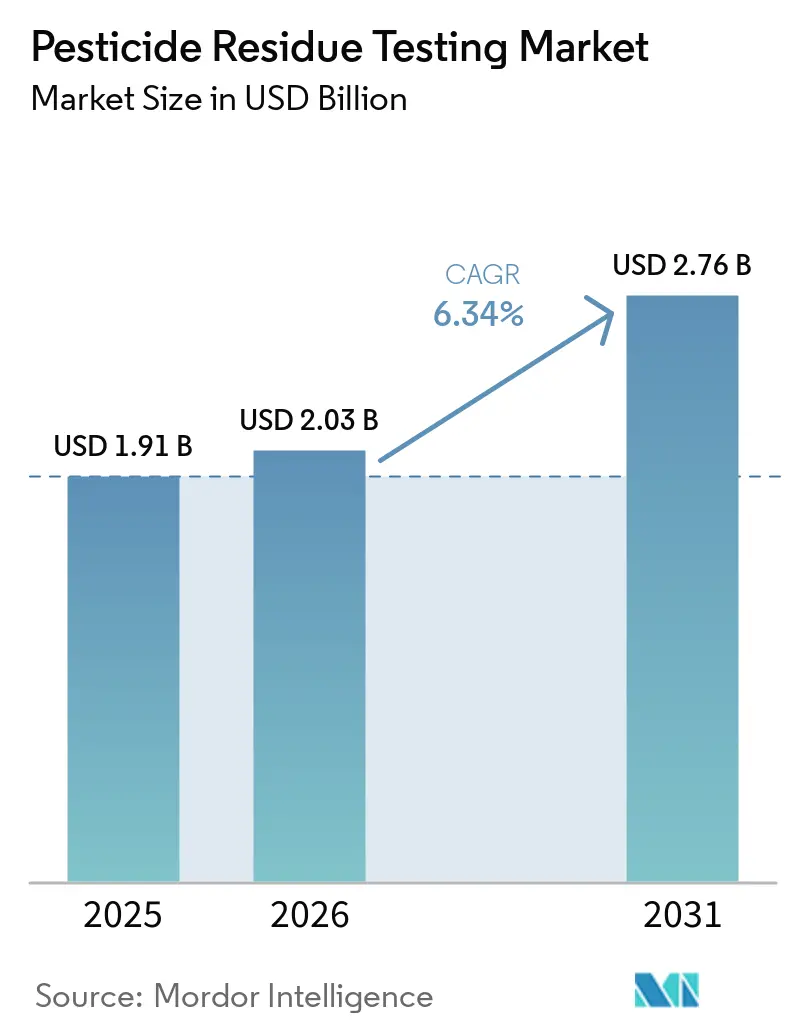
The pesticide residue testing market was valued at USD 1.91 billion in 2025 and is projected to grow from USD 2.03 billion in 2026 to USD 2.76 billion by 2031, registering a CAGR of 6.34% during the forecast period. The market is supported by the continued use of pesticides in agricultural production and increasing emphasis on verifying residue levels in food and agricultural commodities. Regulatory oversight, food safety requirements, and differences in permissible residue limits across destination markets encourage producers, processors, importers, and exporters to use specialized laboratory testing services. Demand for multi-residue analysis, validated analytical methods, and reliable compliance documentation also contributes to the need for advanced testing capabilities. In addition, laboratories are investing in analytical instrumentation, digital reporting systems, and service networks to support customers across agricultural supply chains, particularly in major production, processing, and export regions.
Key Report Takeaways
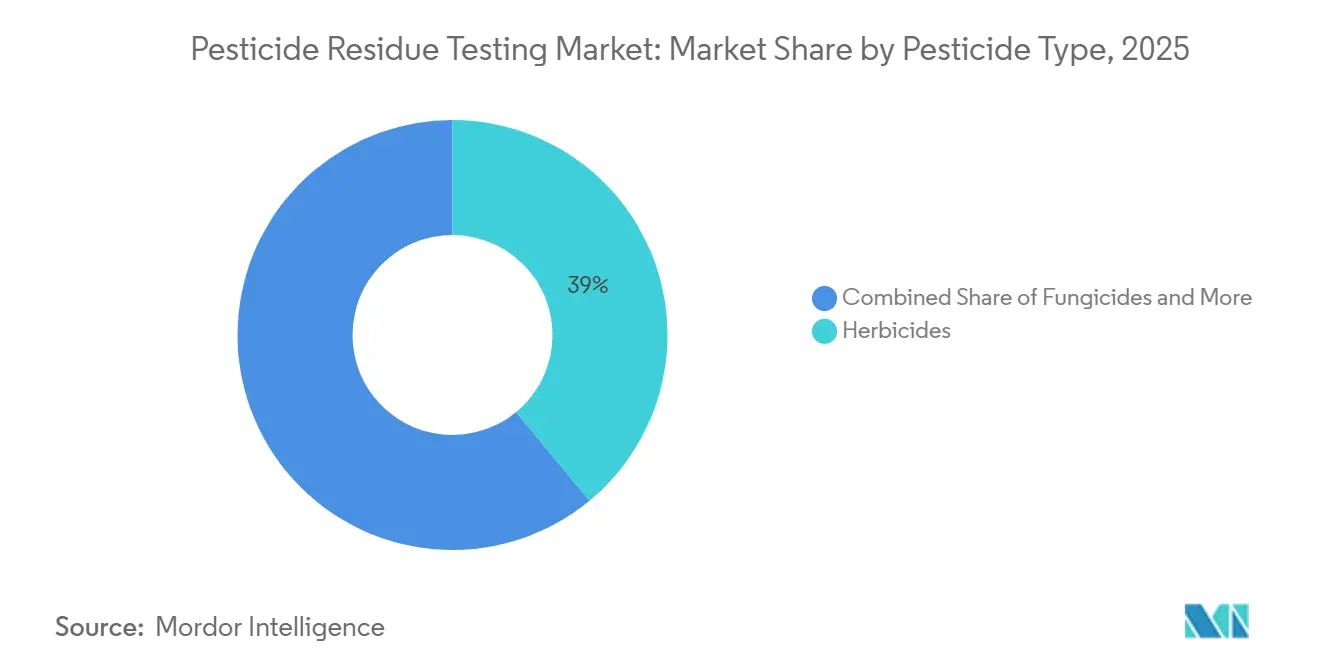
- By pesticide type, herbicides accounted for the largest 39.0% of the pesticide residue testing market share in 2025, while fungicides are projected to grow at the fastest CAGR of 7.9% from 2026 to 2031.
- By technology, liquid chromatography–mass spectrometry (LC-MS) accounted for the largest share at 47.4% in 2025, while the pesticide residue testing market size for high-performance liquid chromatography is projected to grow at the fastest CAGR of 9.0% from 2026 to 2031.
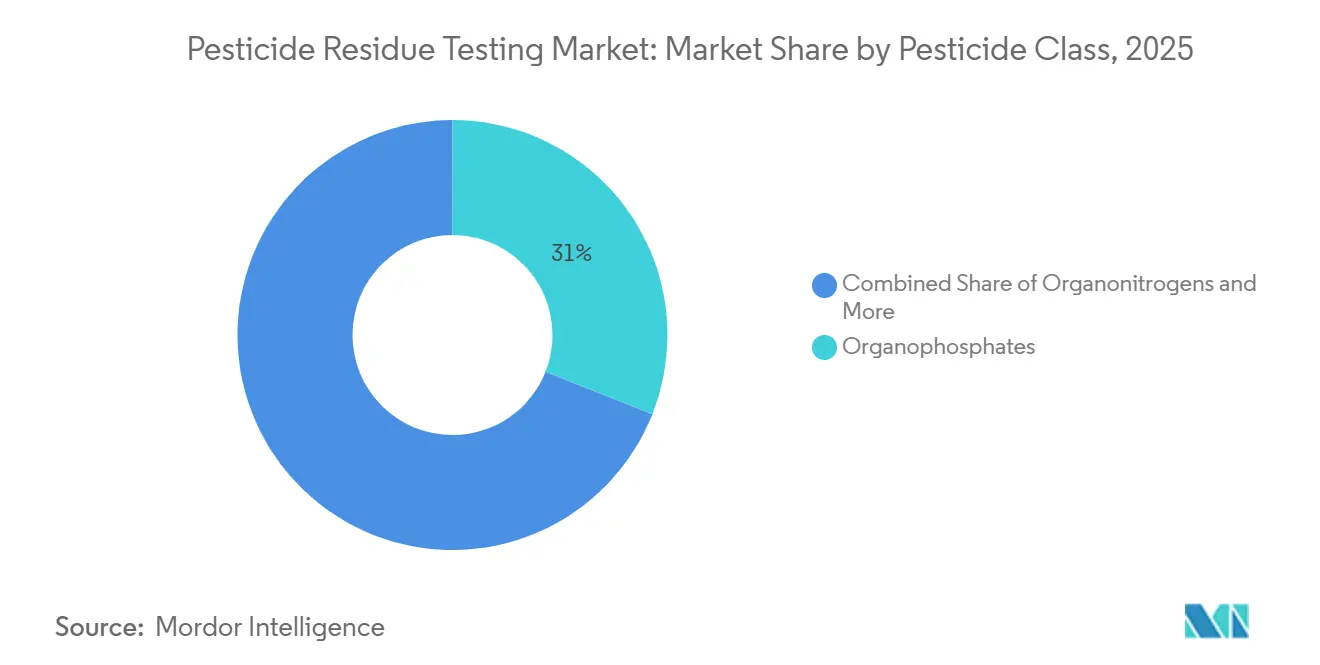
- By pesticide class, organophosphates accounted for the largest share at 31.0% in 2025, while the pesticide residue testing market size for organonitrogens is projected to grow at the fastest CAGR of 7.5% from 2026 to 2031.
- By food type, fruits and vegetables accounted for the largest share at 41.4% in 2025, while processed foods are projected to grow at the fastest CAGR of 7.6% from 2026 to 2031.
- By geography, Europe accounted for the largest share at 34.8% in 2025, while Asia-Pacific is projected to grow at the fastest CAGR of 8.5% from 2026 to 2031.
Note: Market size and forecast figures in this report are generated using Mordor Intelligence’s proprietary estimation framework, updated with the latest available data and insights as of January 2026.
Market Trends and Insights
Drivers Impact Analysis of Pesticide Residue Testing Market*
| Driver | (~) % Impact on CAGR Forecast | Geographic Relevance | Impact Timeline |
|---|---|---|---|
| Stricter Maximum Residue Limit Enforcement | 1.5% | Global, strongest in Europe, China, and Japan | Short term (≤ 2 years) |
| Expansion of Cross-Border Food Trade | 1.2% | Global, particularly Asia-Pacific exporters and European importers | Medium term (2-4 years) |
| Rising Consumer Demand for Low-Residue Food | 0.9% | North America, Europe, Japan, and South Korea | Medium term (2-4 years) |
| Growth in Multi-Residue Testing Requirements | 0.8% | Global, with high relevance in Asia-Pacific and South America | Short term (≤ 2 years) |
| Digitization of Traceability and Compliance Records | 0.7% | Asia-Pacific, Middle East and Africa, and South America | Long term (≥ 4 years) |
| Expansion of Accredited Testing Capacity in Emerging Agricultural Hubs | 0.6% | North America and Europe, with spillover to Asia-Pacific | Long term (≥ 4 years) |
| Source: Mordor Intelligence | |||
Stricter Maximum Residue Limit Enforcement
Stricter enforcement of maximum residue limits (MRLs) is driving growth in the pesticide residue testing market by increasing the need for compliance testing. In 2026, China's National Health Commission (NHC), Ministry of Agriculture and Rural Affairs, and State Administration for Market Regulation introduced updated pesticide residue standards, including analytical methods for 352 pesticides and their metabolites in plant-derived foods[1]. These requirements encourage food producers and exporters to use validated laboratory testing to demonstrate compliance with destination-market limits. As a result, regulatory enforcement is driving demand for specialized residue analysis, expanded testing capabilities, and reliable laboratory services.
Rising Consumer Demand for Low-Residue Food
Growing consumer concern about pesticide residues is prompting food retailers and suppliers to strengthen residue assurance programs and demonstrate compliance with statutory and private requirements. In 2025, the European Food Safety Authority (EFSA) reported that 39% of European Union citizens identified pesticide residues in food as a food safety concern. This highlights the importance of residue verification in fresh-food supply chains, where buyer-specific standards may require additional screening and documentation. As a result, demand for reliable pesticide analysis and compliance testing is supporting growth in the pesticide residue testing market.
Growth in Multi-Residue Testing Requirements
Multi-residue testing requirements support growth in the pesticide residue testing market by increasing demand for methods capable of detecting multiple pesticide compounds in food samples. In 2025, the European Food Safety Authority (EFSA) reported that official laboratories test food for more than 740 pesticides[2]. This broad analytical scope encourages laboratories to expand screening panels, validate methods, and maintain advanced instrumentation and technical expertise. As regulatory monitoring and food-trade compliance require broader residue coverage, demand for comprehensive multi-residue testing and laboratory services is increasing.
Expansion of Accredited Testing Capacity in Emerging Agricultural Hubs
The expansion of accredited testing infrastructure supports growth in the pesticide residue testing market by improving access to reliable analytical services across agricultural production and export hubs. In 2024, the United States Department of Agriculture's Agricultural Marketing Service (USDA AMS) conducted over 2.8 million individual tests on 9,832 food samples through cooperative agreements with nine states[3]. This testing activity highlights the need for accessible laboratory resources, while recognized accreditation helps establish confidence in analytical results. A stronger testing infrastructure supports compliance with pesticide residue regulations and contributes to market growth.
Restraints Impact Analysis of Pesticide Residue Testing Market*
| Restraint | (~) % Impact on CAGR Forecast | Geographic Relevance | Impact Timeline |
|---|---|---|---|
| High Capital and Operating Costs of Advanced Instrumentation | -1.0% | Global, most acute in South America, Middle East and Africa, and South and Southeast Asia | Short term (≤ 2 years) |
| Shortage of Qualified Analytical Personnel | -0.6% | Global, most severe in emerging Asia-Pacific and Middle East and Africa markets | Long term (≥ 4 years) |
| Fragmented Global Maximum Residue Limit Requirements | -0.5% | Global, with high burden for export-oriented agricultural economies | Medium term (2-4 years) |
| Matrix Effects and Method-Validation Complexity | -0.4% | Global | Long term (≥ 4 years) |
| Source: Mordor Intelligence | |||
High Capital and Operating Costs of Advanced Instrumentation
High capital and operating costs can constrain growth in the Pesticide Residue Testing Market by making advanced analytical capabilities expensive to establish and maintain. In 2025, GenTech Scientific listed a refurbished Agilent 6430 triple-quadrupole liquid chromatography mass spectrometry (LC/MS) system with an Agilent 1260 high-performance liquid chromatography (HPLC) at USD 58,500. Laboratories must also fund maintenance, reference materials, columns, proficiency testing, and accreditation-related quality systems. These expenses can limit smaller laboratories' ability to build comprehensive multi-residue capabilities, restricting market entry and capacity expansion, particularly in emerging export regions.
Shortage of Qualified Analytical Personnel
Shortages of qualified analytical personnel can constrain growth in the pesticide residue testing market by limiting laboratories' ability to validate methods, expand analytical panels, and maintain reliable testing operations. Advanced pesticide analysis requires experienced analytical chemists and food scientists who can conduct accuracy and precision studies, interpret results, and meet accreditation requirements. Recruiting and training specialized staff can delay accreditation and the introduction of new services, particularly in regions where technical education and laboratory workforce development lag behind export-sector needs. As a result, staffing constraints can slow the expansion of accredited testing capacity.
*Our forecasts treat driver/restraint impacts as directional, not additive. The impact forecasts reflect baseline growth, mix effects, and variable interactions.
Pesticide Residue Testing Market Segment Analysis
By Pesticide Type:
Herbicides Lead While Fungicides Segment GrowsHerbicides accounted for the largest share of the pesticide residue testing market at 39.0% in 2025, driven by their widespread use across major agricultural crops. This use creates a sustained need for residue monitoring to verify compliance with food safety standards and destination-market requirements. Laboratories analyze herbicide residues in agricultural commodities using methods appropriate to the target compounds and food matrices. Testing needs vary by crop, pesticide application practices, and regulatory limits. Fungicide testing is also significant for crops vulnerable to fungal diseases, including fruits, vegetables, and grains, that move through domestic and export supply chains.
Fungicides are projected to grow at the fastest CAGR of 7.9% from 2026 to 2031. Demand is influenced by the range of fungicidal compounds used in crop protection and the need to monitor residues against applicable limits. Laboratories may need to adjust sample preparation, analytical methods, and testing panels to accommodate different fungicide-commodity combinations. Multi-residue approaches can support the simultaneous analysis of several compounds when validated for the relevant application. Insecticides and other pesticide classes also drive demand for testing, reflecting agricultural practices, regulatory scrutiny, and food industry compliance requirements.

By Technology:
Liquid Chromatography–Mass Spectrometry (LC–MS) Leads While High-Performance Liquid Chromatography AdvancesLiquid chromatography–mass spectrometry (LC-MS) accounted for the largest technology share at 47.4% in 2025, reflecting its use in sensitive pesticide residue analysis and multi-residue testing. Laboratories use LC-MS workflows to identify and measure compounds across diverse food matrices, subject to method validation and performance requirements. Gas chromatography–mass spectrometry (GC-MS) supports the analysis of pesticides suited to gas chromatographic separation. Technology selection depends on analyte properties, matrix effects, detection limits, throughput, and regulatory or customer specifications. These factors influence instrumentation, sample preparation, quality control, and laboratory accreditation procedures.
High-performance liquid chromatography is projected to grow at the fastest CAGR of 9.0% from 2026 to 2031. Its suitability depends on the pesticide compounds being analyzed, detector configuration, and required analytical performance. HPLC-based methods can support targeted residue analysis where the selected method is appropriate for the analytes and food matrix. Laboratories also consider operating costs, staff expertise, throughput, and validation requirements when selecting or upgrading equipment. Advances in chromatographic separation and detection may inform investment decisions, while LC-MS, GC-MS, and screening technologies continue to serve complementary purposes across pesticide residue testing workflows.
By Pesticide Class:
Organophosphates Remain Important While Organonitrogens GrowOrganophosphates accounted for the largest share at 31.0% in 2025. Their continued inclusion in residue testing reflects their agricultural use and the need to verify compliance of food products with applicable residue limits. Laboratories analyze organophosphates through multi-residue panels or targeted methods, depending on the compound, commodity, and customer or regulatory requirements. Organochlorines, carbamates, and other pesticide classes also remain relevant in monitoring programs. Their inclusion depends on current pesticide use, historical contamination concerns, and destination-market rules. Analytical coverage is therefore shaped by crop characteristics, residue regulations, and the scope of testing requested.
The pesticide residue testing market size for organonitrogens is projected to grow at the fastest CAGR of 7.5% from 2026 to 2031. Testing demand for this class is influenced by the compounds included in monitoring programs, their authorized uses, and residue requirements across markets. Laboratories must select suitable extraction and instrumental methods for the relevant pesticides and food matrices. Differences in chemical properties can affect method performance and validation requirements. Providers may offer targeted testing or broader multi-residue panels to support growers, processors, importers, and exporters. Other pesticide classes continue to require analysis where regulatory controls, customer specifications, or risk-based monitoring programs call for their inclusion.
By Food Type:
Fruits and Vegetables Lead While Processed Foods RiseFruits and vegetables accounted for the largest share at 41.4% in 2025. Testing demand is driven by pesticide use during cultivation, residue compliance requirements, and the movement of fresh produce through retail and export channels. The varied composition of different commodities can require specific sample preparation and analytical considerations. Laboratories help producers, processors, and exporters verify residues against applicable maximum residue limits and customer specifications. Cereals, grains, and pulses also require monitoring, while animal-derived foods and beverages may need analytical procedures adapted to their distinct matrices.
Processed foods are projected to grow at the fastest CAGR of 7.6% from 2026 to 2031. Their testing requirements reflect ingredient sourcing, processing conditions, and the composition of finished products. Products containing ingredients from multiple agricultural origins may require appropriate sampling and traceability procedures to support compliance checks. Laboratories need methods that account for the food matrix and the pesticide residues under investigation. Testing helps manufacturers, importers, and retailers verify product specifications and meet regulatory requirements. Herbs, spices, nuts, oils, and beverages also contribute to testing demand where their characteristics and intended markets require residue analysis.
Geography Analysis
Europe accounted for the largest share at 34.8% in 2025. The region's testing demand is driven by established pesticide residue controls, food import requirements, and the need to demonstrate compliance with maximum residue limits. The European Food Safety Authority (EFSA) coordinates scientific assessments and publishes monitoring findings that inform food safety oversight. These activities sustain demand for laboratory analysis across domestic and imported food products. Testing providers must maintain appropriate methods and documentation for relevant commodities, pesticide combinations, and regulatory requirements, while food businesses use the results to support supply chain compliance and market access.
Asia-Pacific is projected to grow at the fastest CAGR of 8.5% from 2026 to 2031. Regional demand is influenced by agricultural production, food exports, domestic food safety controls, and requirements imposed by importing markets. Testing needs vary among countries due to differences in pesticide authorization, residue limits, monitoring programs, and food consumption patterns. Laboratories support growers, processors, exporters, and regulators by analyzing commodities against relevant requirements. As supply chains connect farms with domestic and overseas buyers, residue testing helps businesses document compliance and investigate potential non-conformities. These conditions create demand across public and commercial testing services.
North America, South America, the Middle East, and Africa contribute to pesticide residue testing through food production, imports, and export compliance requirements. Government monitoring programs provide direct evidence of ongoing analytical activity. The United States Food and Drug Administration (FDA) reported that its Fiscal Year 2023 monitoring program tested 3,577 human food samples, comprising 1,003 domestic and 2,574 imported samples from 84 countries and economies. This demonstrates the practical role of residue analysis in regulatory oversight and cross-border food trade, supporting continued demand for testing services across agricultural supply chains. Source.
Competitive Landscape
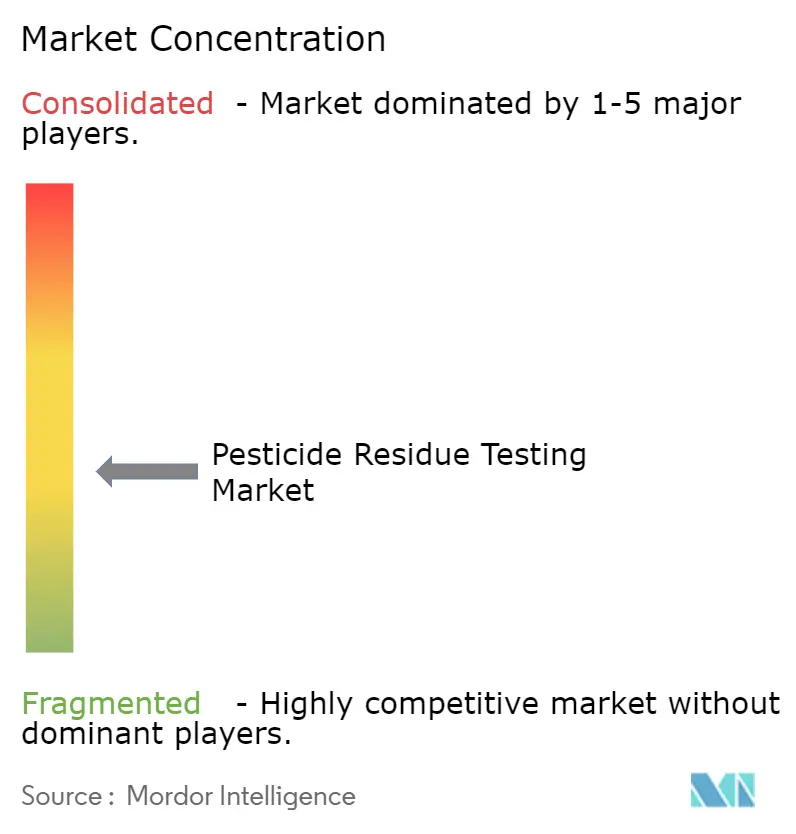
The pesticide residue testing market is moderately fragmented in 2025, with multinational testing, inspection, and certification companies competing alongside specialized food and agricultural laboratories. Major players include SGS SA, Eurofins Scientific SE, Bureau Veritas SA, Intertek Group plc, and ALS Limited. These companies and regional providers compete on pesticide panel coverage, validated analytical methods, accreditation, turnaround time, reporting quality, and proximity to agricultural production and export centers. Customers select testing providers based on commodity requirements, destination-market regulations, analytical capabilities, and regional service availability.
Laboratory capabilities and service breadth remain important competitive factors as food businesses seek reliable residue results for compliance and supplier assurance. Testing providers invest in analytical instruments, sample preparation systems, digital reporting, and technical personnel to handle different pesticide compounds and food matrices. Accreditation and documented quality procedures demonstrate that testing methods meet relevant requirements. Multinational networks can support customers operating across multiple markets, while regional laboratories may offer local expertise and closer proximity to agricultural producers and exporters.
Strategic acquisitions and laboratory network expansion can reshape competitive positioning by broadening analytical capabilities and customer reach. In March 2026, SGS SA announced its acquisition of Murray-Brown Laboratories, a United States food-testing laboratory with pesticide detection capabilities. SGS SA described the transaction as an expansion of its food safety and analytical chemistry services in North America. This acquisition illustrates how testing companies can strengthen their service portfolios and regional presence through consolidation. Providers continue to differentiate themselves through validated methods, specialized expertise, reliable turnaround times, accreditation, and the ability to meet customer and regulatory testing requirements.
Pesticide Residue Testing Industry Leaders
-
SGS SA
-
Eurofins Scientific SE
-
Bureau Veritas SA
-
Intertek Group plc
-
ALS Limited
- *Disclaimer: Major Players sorted in no particular order
Pesticide Residue Testing Market Companies Covered in this Report
- SGS SA
- Eurofins Scientific SE
- Bureau Veritas SA
- Intertek Group plc
- ALS Limited
- Mérieux NutriSciences (Institut Mérieux)
- AsureQuality Limited
- TÜV SÜD AG
- Microbac Laboratories, Inc.
- TÜV NORD AG
- SCS Global Services
- Symbio Laboratories Pty Ltd
- AGQ Labs
- IEH Laboratories and Consulting Group
- Thermo Fisher Scientific Inc.
Recent Industry Developments in Pesticide Residue Testing Market
- July 2026: ALS Limited completed the acquisition of Audentes Laboratories, a Mumbai-based food and consumer products testing laboratory, expanding its food analytical testing capabilities and presence in Western India. ALS's food testing portfolio includes pesticide residue analysis across multiple food categories.
- February 2026: SGS SA acquired Murray-Brown Laboratories, adding food testing capabilities that include pesticide and mycotoxin detection. The acquisition strengthens SGS SA's analytical chemistry services and food safety testing network in North America, supporting pesticide residue analysis for food and related products.
- July 2024: Eurofins Scientific SE launched a mobile pesticide residue testing laboratory for tea leaves in Dibrugarh, Assam, India. The laboratory uses Liquid Chromatography–Tandem Mass Spectrometry (LC-MS/MS) and Gas Chromatography–Tandem Mass Spectrometry (GC-MS/MS) for residue testing.
Global Pesticide Residue Testing Market Report Scope
Pesticide residue testing is the laboratory analysis of food, agricultural products, soil, and water to detect and measure pesticide residues. It helps assess compliance with food safety regulations, maximum residue limits (MRLs), and requirements for consumer and environmental protection.
The pesticide residue testing market report is segmented by pesticide type (herbicides, fungicides, insecticides, acaricides, nematicides, rodenticides, and disinfectants), by technology (liquid chromatography–mass spectrometry (LC–MS), gas chromatography–mass spectrometry (GC–MS), high-performance liquid chromatography, immunoassay, biosensor, and other technologies), by pesticide class (organophosphates, organochlorines, carbamates, organonitrogens, and other pesticide classes), by food tested (fruits and vegetables, cereals, grains, and pulses, meat and poultry, dairy products, processed foods, beverages, tea, coffee, and cocoa, herbs, spices, nuts, seeds, and oils), and by geography (North America, South America, Europe, Asia-Pacific, Middle East, and Africa). The market forecasts are provided in terms of value (USD).
Segmentation Overview
| Herbicides |
| Fungicides |
| Insecticides |
| Acaricides, Nematicides, Rodenticides, and Disinfectants |
| Liquid Chromatography–Mass Spectrometry (LC–MS) |
| Gas Chromatography–Mass Spectrometry (GC–MS) |
| High-Performance Liquid Chromatography |
| Immunoassay |
| Biosensor and Other Technologies |
| Organophosphates |
| Organochlorines |
| Carbamates |
| Organonitrogens |
| Other Pesticide Classes |
| Fruits and Vegetables |
| Cereals, Grains, and Pulses |
| Meat and Poultry |
| Dairy Products |
| Processed Foods |
| Beverages, Tea, Coffee, and Cocoa |
| Herbs, Spices, Nuts, Seeds, and Oils |
| North America | United States |
| Canada | |
| Mexico | |
| Rest of North America | |
| South America | Brazil |
| Argentina | |
| Rest of South America | |
| Europe | Germany |
| United Kingdom | |
| France | |
| Italy | |
| Spain | |
| Russia | |
| Rest of Europe | |
| Asia-Pacific | China |
| India | |
| Japan | |
| South Korea | |
| Australia | |
| Rest of Asia-Pacific | |
| Middle East | Saudi Arabia |
| United Arab Emirates | |
| Turkey | |
| Rest of Middle East | |
| Africa | South Africa |
| Egypt | |
| Nigeria | |
| Rest of Africa |
| By Pesticide Type | Herbicides | |
| Fungicides | ||
| Insecticides | ||
| Acaricides, Nematicides, Rodenticides, and Disinfectants | ||
| By Technology | Liquid Chromatography–Mass Spectrometry (LC–MS) | |
| Gas Chromatography–Mass Spectrometry (GC–MS) | ||
| High-Performance Liquid Chromatography | ||
| Immunoassay | ||
| Biosensor and Other Technologies | ||
| By Pesticide Class | Organophosphates | |
| Organochlorines | ||
| Carbamates | ||
| Organonitrogens | ||
| Other Pesticide Classes | ||
| By Food Type | Fruits and Vegetables | |
| Cereals, Grains, and Pulses | ||
| Meat and Poultry | ||
| Dairy Products | ||
| Processed Foods | ||
| Beverages, Tea, Coffee, and Cocoa | ||
| Herbs, Spices, Nuts, Seeds, and Oils | ||
| By Geography | North America | United States |
| Canada | ||
| Mexico | ||
| Rest of North America | ||
| South America | Brazil | |
| Argentina | ||
| Rest of South America | ||
| Europe | Germany | |
| United Kingdom | ||
| France | ||
| Italy | ||
| Spain | ||
| Russia | ||
| Rest of Europe | ||
| Asia-Pacific | China | |
| India | ||
| Japan | ||
| South Korea | ||
| Australia | ||
| Rest of Asia-Pacific | ||
| Middle East | Saudi Arabia | |
| United Arab Emirates | ||
| Turkey | ||
| Rest of Middle East | ||
| Africa | South Africa | |
| Egypt | ||
| Nigeria | ||
| Rest of Africa | ||
Key Questions Answered in the Report
What was the pesticide residue testing market size in 2025?
The pesticide residue testing market was valued at USD 1.91 billion in 2025.
Which pesticide type generates the largest testing demand?
Herbicides accounted for the largest 39.0% share in 2025, reflecting their broad use in row-crop agriculture.
Which region will grow fastest through 2031?
Asia-Pacific is forecast to grow at the fastest CAGR of 8.5% from 2026 to 2031 as exports increase and domestic food safety rules become more stringent.
Which analytical technology is most widely used for pesticide screening?
Liquid chromatography–mass spectrometry (LC–MS) accounted for the largest share at 47.4% in 2025.