
Performance-Enhancing Drugs Market Size and Share
Market Overview
| Study Period | 2020 - 2031 |
|---|---|
| Market Size (2026) | USD 513.23 Million |
| Market Size (2031) | USD 733.58 Million |
| Growth Rate (2026 - 2031) | 7.41 % |
| Fastest Growing Market | Asia-Pacific |
| Largest Market | North America |
| Market Concentration | Medium |
Major Players *Disclaimer: Major Players sorted in no particular order Image © Mordor Intelligence. Reuse requires attribution under CC BY 4.0. | |
Performance-Enhancing Drugs Market Analysis by Mordor Intelligence
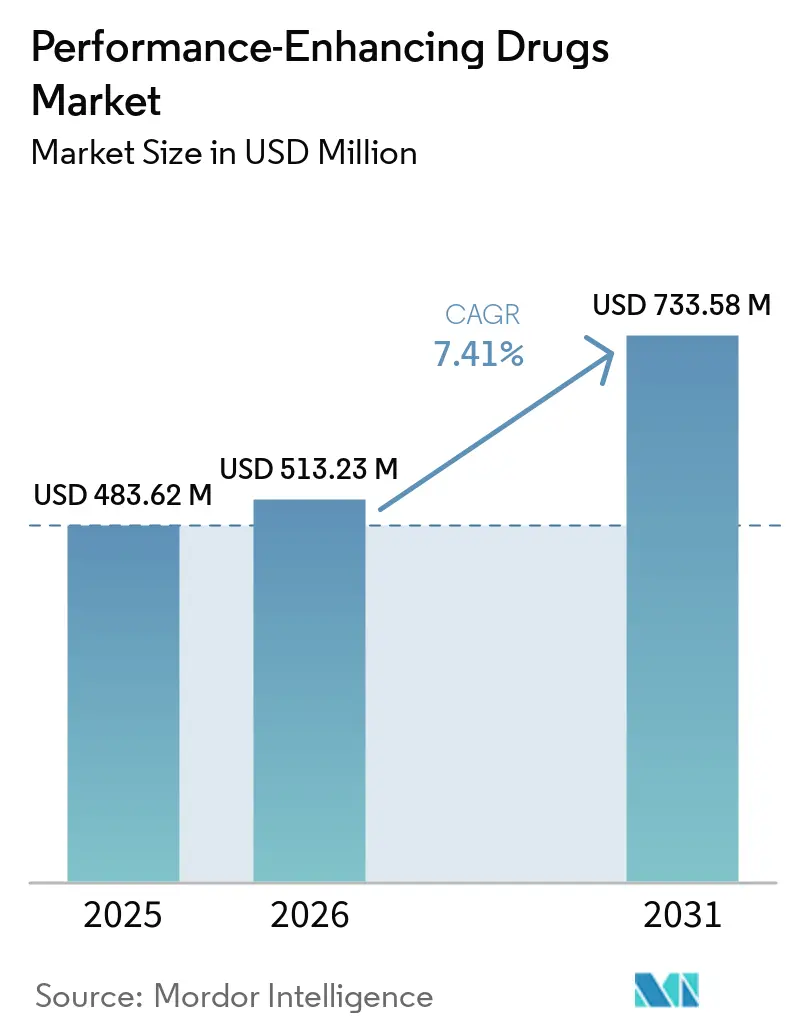
The performance-enhancing drugs market is projected to expand from USD 483.62 million in 2025 and USD 513.23 million in 2026 to USD 733.58 million by 2031, registering a CAGR of 7.41% between 2026 and 2031. The performance-enhancing drugs market is no longer driven only by conventional sports use, because clinical hormone therapy, cognitive enhancement, and wellness-focused demand are widening the addressable user base. This shift is making regulated medical channels more important to overall stability, even as less-controlled online and cross-border pathways continue to add volume in several regions. The performance-enhancing drugs market is also being shaped by formulation upgrades, especially in long-acting hormone products that improve adherence and expand legitimate treatment use. At the same time, counterfeit supply, expanding anti-doping enforcement, and wider prohibited-substance coverage are raising compliance burdens for companies that operate across borders. The result is a performance-enhancing drugs market where growth is coming from both broader participation and higher recurring spending, while competition is increasingly defined by channel control, product legitimacy, and regulatory resilience.
Key Report Takeaways
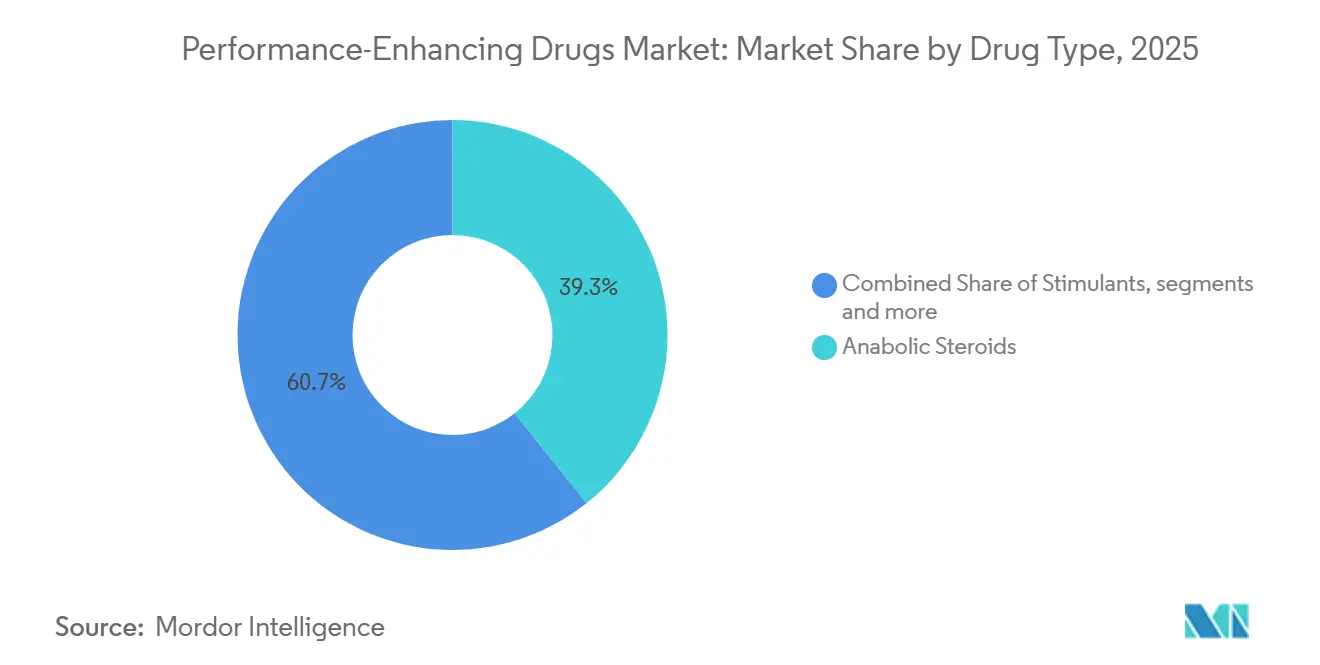
- By drug type, anabolic steroids led with a 39.34% share in 2025, while human growth hormone and peptides are projected to record the highest CAGR at 9.55% through 2031.
- By route of administration, oral products held a 38.52% share in 2025, while parenteral products are projected to grow fastest at an 8.17% CAGR through 2031.
- By dosage form, pills and supplements accounted for a 40.33% share in 2025, while injections are projected to expand at the highest CAGR of 7.76% through 2031.
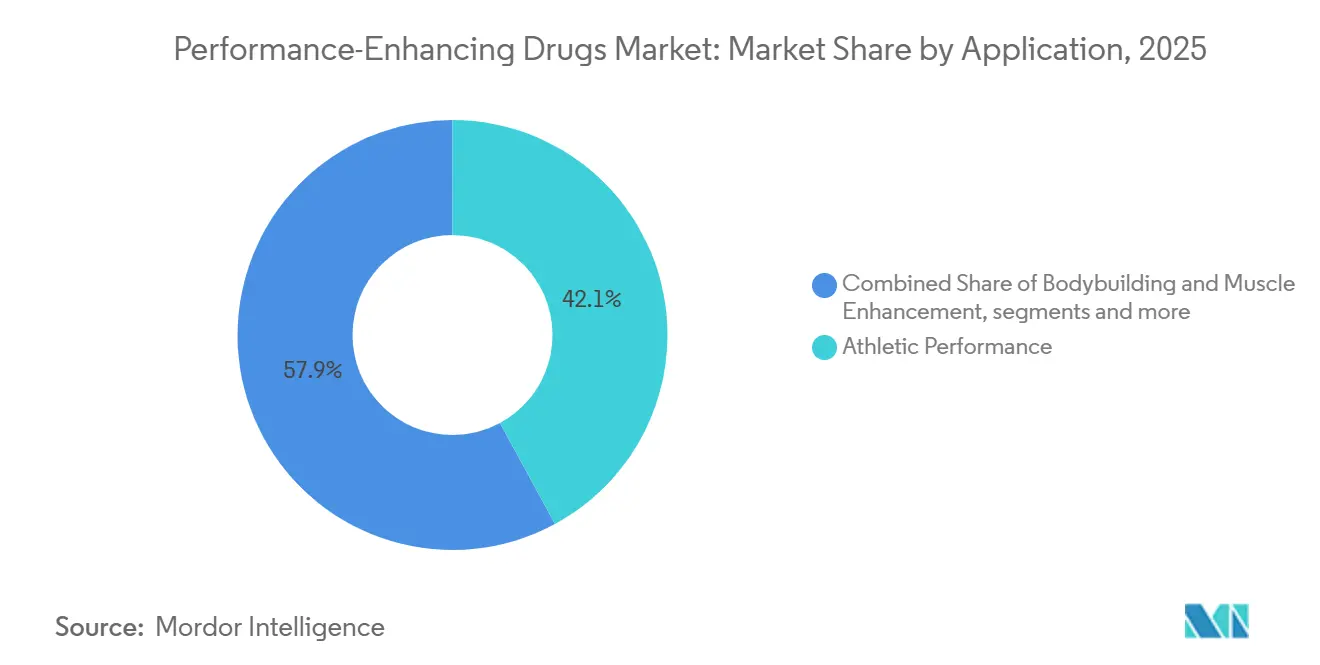
- By application, athletic performance captured a 42.10% share in 2025, while anti-aging and wellness are projected to grow fastest at a 9.12% CAGR through 2031.
- By distribution channel, hospital pharmacies held a 44.41% share in 2025, while online pharmacies are projected to expand at the highest CAGR of 8.52% through 2031.
- By geography, North America captured a 46.23% share in 2025, while the Asia-Pacific is expected to grow fastest at a 10.13% CAGR through 2031.
Note: Market size and forecast figures in this report are generated using Mordor Intelligence’s proprietary estimation framework, updated with the latest available data and insights as of January 2026.
Market Trends and Insights
Drivers Impact Analysis of Performance-Enhancing Drugs Market*
| Driver | (~) % Impact on CAGR Forecast | Geographic Relevance | Impact Timeline |
|---|---|---|---|
| Rising Demand for Performance Optimization in Competitive Sports and Fitness | +2.1% | Global, concentrated in North America, Europe, and APAC urban centers | Short term (≤ 2 years) |
| Expansion of Online and Cross-Border Supply Networks | +1.2% | North America, Europe, Australia, spill-over to Middle East | Medium term (2-4 years) |
| Better Targeting Through Long-Acting, Safer, and More Selective Formulations | +1.0% | North America and EU, with early rollout in Asia-Pacific | Medium term (2-4 years) |
| Rising Clinical Use in Hormonal and Muscle-Wasting Indications | +1.3% | Global, highest impact in markets with lower brick-and-mortar pharmacy density | Short term (≤ 2 years) |
| Micro-Dosing and Cycle-Management Practices Increasing Product Turnover | +0.5% | North America, Western Europe | Medium term (2-4 years) |
| Biometric Screening and Recovery-Optimization Demand in Elite Training Environments | +0.4% | North America, GCC, Australia | Long term (≥ 4 years) |
| Source: Mordor Intelligence | |||
Rising Demand for Performance Optimization in Competitive Sports and Fitness
The mainstream spread of testosterone replacement therapy is one of the clearest structural changes in the performance-enhancing drugs market. In July 2026, the US Department of Defense announced annual testosterone deficiency screening for all service members aged 30 and above, with optional access for younger personnel and treatment where deficiency is confirmed.[1]That move shows that testosterone optimization is being treated more like a broader health protocol and less like a narrow edge-case intervention. In September 2025, Hims & Hers launched a dedicated men’s TRT category with exclusive access to KYZATREX, an FDA-approved oral testosterone product that restored testosterone levels in 96% of patients while avoiding injections.[2] As telehealth lowers prescription friction, the performance-enhancing drugs market is seeing more clinical-grade anabolic steroid demand move through licensed channels instead of informal supply routes.
Expansion of Online and Cross-Border Supply Networks
Digital dispensing is becoming a stronger distribution backbone in the performance-enhancing drugs market, especially for products that are sold OTC or under lighter prescription controls. Redcare Pharmacy reported that its prescription drug revenue in Germany nearly doubled to EUR 503 million in 2025, while group Rx revenue rose 42.6% year over year to EUR 1.1 billion.[3] These figures show how quickly consumers are shifting from physical pharmacies to digital channels in regulated settings. The same convenience also supports cross-border gray-market activity, which remains a major force in the performance-enhancing drugs market. INTERPOL said Operation Pangea XVII dismantled 123 criminal groups operating across 90 countries and shut down around 13,000 criminal-linked websites, social media pages, and channels that marketed illicit products. This combination shows that legal online pharmacies and illicit digital sellers are competing for the same demand base.
Better Targeting Through Long-Acting, Safer, and More Selective Formulations
Formulation improvement is raising adherence and expanding legitimate use in the performance-enhancing drugs market. In July 2025, Ascendis Pharma received FDA approval for SKYTROFA for adults with growth hormone deficiency, introducing a once-weekly option that reduced the burden of daily injections. In February 2026, Novo Nordisk’s Sogroya became the first once-weekly long-acting growth hormone to gain 3 additional pediatric indications, which broadened the treated population further. These developments are strengthening the clinical footprint of HGH products inside the performance-enhancing drugs market. They also create spillover demand because easier dosing and more selective treatment profiles make these products more attractive outside of strictly medical use.
Rising Clinical Use in Hormonal and Muscle-Wasting Indications
The performance-enhancing drugs market is also drawing support from broader non-elite demand tied to physique goals, recovery, and mental performance. France’s Inserm reported in 2026 that anabolic steroid use among regular gym users in Western countries ranged from 10% to 35%, and the prevalence had been rising since 2022. Germany’s University of Erfurt found that 3.7% of adults were currently taking prescription drugs for cognitive performance without a medical indication, which equated to around 2.5 million users. These demand pools extend the performance-enhancing drugs market beyond conventional athletic use and create more repeat purchasing across hormone, stimulant, and peptide categories. They also feed both compliant and non-compliant channels at the same time, which makes demand expansion easier to see than channel quality.
Restraints Impact Analysis of Performance-Enhancing Drugs Market*
| Restraint | (~) % Impact on CAGR Forecast | Geographic Relevance | Impact Timeline |
|---|---|---|---|
| Stringent Anti-Doping Enforcement and Prescription Controls | -1.2% | Global, highest impact in high-income professional sports markets | Short term (≤ 2 years) |
| Adverse Event Risk, Abuse Liability, and Litigation Exposure | -0.8% | Global, primarily North America and Europe where reporting standards are highest | Medium term (2-4 years) |
| Counterfeit and Substandard Product Penetration | -0.7% | Asia-Pacific, MEA, South America, and cross-border online channels globally | Short term (≤ 2 years) |
| Compliance Friction Across Customs, Payments, and Platform Policies | -0.5% | Cross-border e-commerce corridors including EU-UK, ASEAN, and GCC imports | Medium term (2-4 years) |
| Source: Mordor Intelligence | |||
Stringent Anti-Doping Enforcement and Prescription Controls
Anti-doping enforcement is scaling up in ways that directly affect the performance-enhancing drugs market. The International Testing Agency said it collected more than 44,400 samples from over 17,200 athletes across 216 countries in 2024, which was a 10% increase from 2023, and it managed 532 potential rule violations, with 232 leading to sanctions. India also remained a major testing market, with 7,113 tests and 260 adverse analytical findings in 2024 before the positivity rate fell to 1.5% across 7,068 tests in 2025 after stronger education and monitoring efforts. The bigger commercial issue is that newer peptides and SARMs are being added or reclassified on prohibited lists, which narrows the gray area where many compounds have been marketed. That trend raises legal risk, limits open distribution, and forces the performance-enhancing drugs market to favor approved therapies over loosely positioned products.
Counterfeit and Substandard Product Penetration
Counterfeit supply remains one of the most disruptive restraints in the performance-enhancing drugs market. US Customs and Border Protection intercepted 71 shipments of counterfeit HGH during a 6-day operation across 5 ports of entry in March 2025, and the agency also noted a sharp rise in precursor chemical interceptions in mail, express consignment, and air cargo environments. In Europe, SHIELD VI coordinated enforcement across 30 countries and seized 4.6 million performance-enhancing substance tablets and 1.2 million vials and ampoules valued at EUR 33.2 million, or USD 36.3 million. These volumes show that illicit sellers are not a side issue but a parallel supply structure inside the performance-enhancing drugs market. Counterfeit products pressure legitimate pricing, increase health risks, and trigger tighter scrutiny that raises operating costs for compliant manufacturers and distributors.
*Our forecasts treat driver/restraint impacts as directional, not additive. The impact forecasts reflect baseline growth, mix effects, and variable interactions.
Performance-Enhancing Drugs Market Segment Analysis
By Drug Type:
Anabolic Steroid Dominance Challenged by Long-Acting Peptide PipelineAnabolic steroids held 39.34% of the performance-enhancing drugs market share in 2025. Their lead reflected decades of established use in testosterone replacement therapy and muscle-wasting conditions. The category also benefited from a broad generic manufacturing base, which supported supply across both prescription and gray-market channels. In the performance-enhancing drugs industry, stimulants remained the second-largest segment, while beta-blockers and diuretics served narrower use cases linked to cognitive performance, weight control, and precision or weight-class sports.
The performance-enhancing drugs market for human growth hormone and peptides is projected to expand at a 9.55% CAGR through 2031. Once-weekly HGH products are widening legitimate clinical access, which strengthens the reference demand that supports this category. The July 2025 FDA approval of SKYTROFA for adults with growth hormone deficiency widened adult treatment access.

By Route of Administration:
Parenteral Growth Driven by Clinical Protocol ShiftsThe oral route commanded a 38.52% share in 2025, which reflected enduring consumer preference for convenience. Oral formats fit both prescription and OTC demand in the performance-enhancing drugs market and remain easier to distribute across retail and digital settings. Topical and transdermal routes also remain relevant where users want needle-free administration and steady hormone delivery. These formats help preserve adherence in long-cycle therapy and broaden access for users who avoid injections.
The performance-enhancing drugs market for parenteral administration is projected to grow at an 8.17% CAGR through 2031. Injectable formats are gaining relevance because they offer precise dosing, strong bioavailability, and easier integration into medically supervised micro-dosing protocols. The performance-enhancing drugs market is also seeing more regulatory support for injectable testosterone formats, which strengthens the clinical role of parenteral use. In the United States, Schedule III controls create a barrier that keeps a large share of compliant injectable demand inside hospital and licensed retail pharmacy channels.
By Dosage Form:
Injections Overtake Pills in Growth TrajectoryPills and supplements retained a 40.33% share in 2025, which kept them as the most accessible dosage form in the performance-enhancing drugs market. They remained the default entry point for both supervised use and self-directed use because they are widely available and easier to consume. Oral liquids and topical creams formed smaller categories, but they still served patients and users who preferred easier administration. Customized hormone creams also stayed relevant through specialty dispensing and compounding channels.
The performance-enhancing drugs market for injections is expected to advance at a 7.76% CAGR through 2031. Therapeutic users and performance-oriented users are both moving toward injectable formats when they want higher bioavailability and more controlled delivery. Clinical guidance also supports this pattern, because testosterone replacement criteria continue to caution against certain oral forms and support use in clinically appropriate dosing frameworks. Patches remain a niche option, but formulation-specific detection windows and practical use patterns still influence demand across the performance-enhancing drugs market.
By Application:
Anti-Aging and Wellness Structurally Outpacing SportsAthletic performance accounted for 42.10% of demand in 2025, which kept it as the largest application in the performance-enhancing drugs market. That position reflected the long historical link between performance enhancement and both competitive and recreational sport. Bodybuilding and muscle enhancement remained another large use case, supported by persistent physique-oriented demand across gym culture.
The performance-enhancing drugs market for anti-aging and wellness is anticipated to expand at a 9.12% CAGR through 2031. Aging consumers are increasingly engaging with HGH, testosterone, and peptide therapies through telehealth platforms and longevity-focused clinics. Cognitive enhancement is also emerging as a meaningful adjacent use case in the performance-enhancing drugs market.
By Distribution Channel:
Online Pharmacy Growth Reshaping AccessHospital pharmacies held 44.41% in 2025 and remained the anchor channel for the performance-enhancing drugs market. Their lead came from clinically supervised testosterone replacement, HGH treatment, and other physician-managed hormonal therapies. Prescription controls for anabolic steroids in the United States continue to funnel compliant volume through institutional dispensing. Retail pharmacies also remain important where chronic therapy users rely on generic preparations and regular refill behavior.
Online pharmacies are expected to record the fastest growth at an 8.52% CAGR through 2031. Redcare’s German prescription revenue nearly doubled to EUR 503 million in 2025, which shows how digital dispensing is gaining traction in regulated environments. At the same time, illicit websites remain a major threat, and that keeps channel trust and verification central to competition in the performance-enhancing drugs market.
Geography Analysis
North America Performance-Enhancing Drugs Market
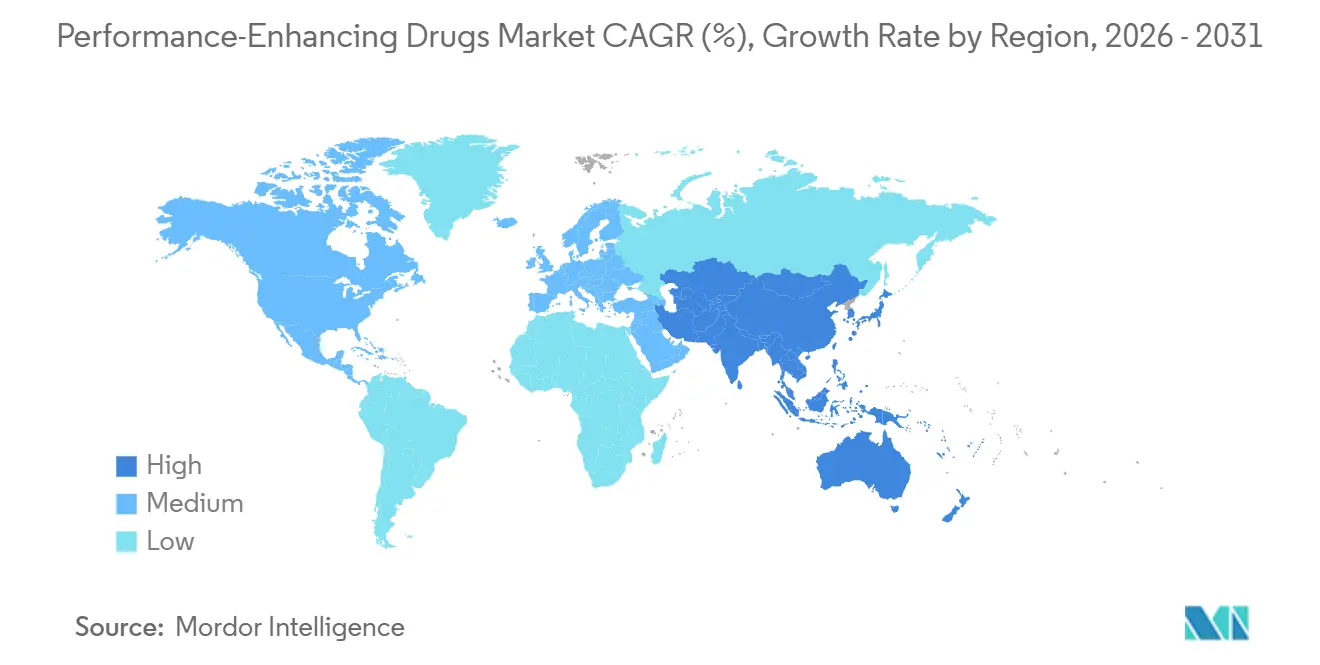
North America accounted for 46.23% of the performance-enhancing drugs market share in 2025. The region leads because the United States has an established testosterone replacement therapy base, a large number of licensed dispensing channels, and stronger telehealth participation. The July 2026 Department of Defense screening initiative adds another layer of institutional demand by treating testosterone deficiency as a broader health issue. Canada is also gaining importance in the performance-enhancing drugs market, and Hikma’s May 2026 licensing agreement for KYZATREX shows that multinational companies view it as a structured extension of the North American therapy base.
Europe Performance-Enhancing Drugs Market
Europe remained the second-largest regional footprint in the performance-enhancing drugs market. The region combines deep prescription infrastructure with stronger cross-border oversight, which makes it both commercially attractive and operationally demanding. OLAF’s SHIELD V operation in January 2025 seized more than 3.4 million pills, including anabolic steroids and doping substances, across EU member states. France’s 2026 Inserm review also pointed to rising anabolic steroid use among gym populations, which suggests that non-elite demand remains active even under tighter surveillance.
APAC, MEA and South America Performance-Enhancing Drugs Market
Asia-Pacific is projected to grow fastest at a 10.13% CAGR through 2031, making it the performance-enhancing drugs market size leader in growth terms. The region benefits from rising disposable income, stronger supplement acceptance, and a younger consumer base that is heavily influenced by social media and appearance-led fitness behavior. India shows both the demand side and the enforcement side of the performance-enhancing drugs market, with 260 adverse analytical findings from 7,113 tests in 2024, before the positivity rate fell sharply in 2025. Japan and South Korea remain more compliance-led markets, while parts of Southeast Asia are emerging as broader volume channels. In the Middle East and Africa, wealthy GCC consumers and South Africa’s sports base support demand, while Brazil remains the key South American market because bodybuilding culture and local pharmaceutical capacity continue to support the wider performance-enhancing drugs market.
Competitive Landscape
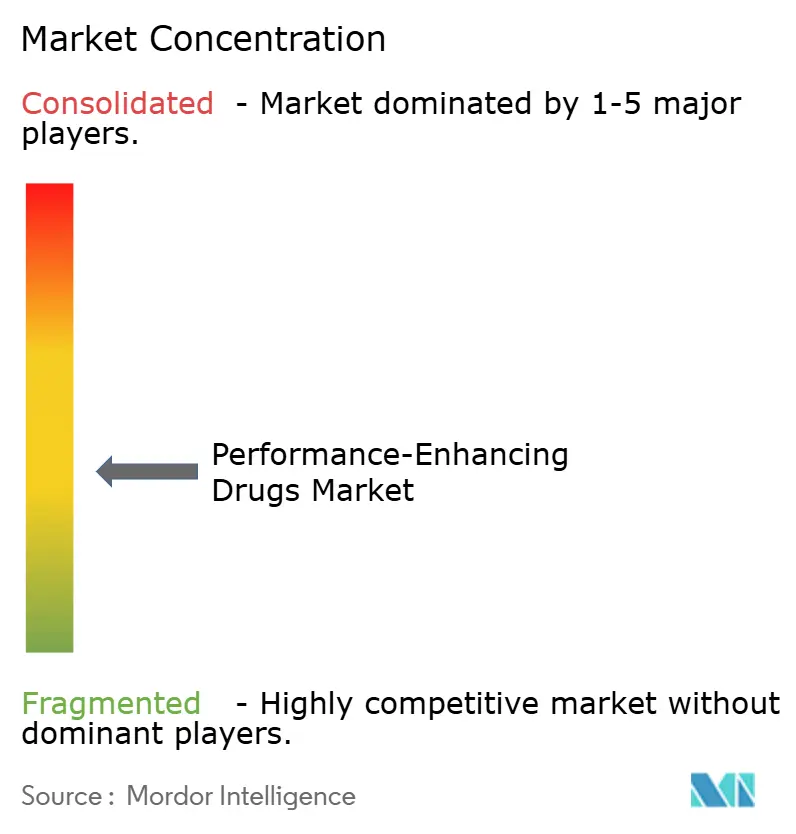
The performance-enhancing drugs market is moderately fragmented. Large pharmaceutical companies compete strongly in regulated hormone and HGH categories, while regional generic manufacturers, specialty supplement brands, and underground suppliers remain active across other layers of demand. AbbVie, Novo Nordisk, Eli Lilly, and Pfizer are better positioned where physician oversight, manufacturing quality, and formal distribution matter most. AbbVie’s April 2026 announcement of a USD 1.4 billion manufacturing campus in North Carolina and a USD 380 million investment in API facilities in North Chicago shows how scale players are protecting supply control and cost efficiency.
Product innovation is becoming one of the clearest points of differentiation in the performance-enhancing drugs market. Ascendis strengthened the HGH category in July 2025 with FDA approval for adult use of once-weekly SKYTROFA. Novo Nordisk then widened its position in February 2026 when Sogroya gained 3 additional pediatric indications. These moves show that formulation design, brand access, and digital prescribing links are gaining importance besides manufacturing scale in the performance-enhancing drugs market.
Channel integrity is another major competitive variable in the performance-enhancing drugs market because counterfeit sellers distort pricing and weaken confidence in legitimate brands. INTERPOL’s 2025 global crackdown and the FDA’s December 2025 warning letters to SARMs vendors both favored compliant players by raising legal and operational risk for unapproved sellers. In the adjacent performance nutrition space, Nutrabolt expanded its logistics network in April 2026 through a new Wisconsin site and scaled Utah operations, which shows that companies near the performance-enhancement category are still investing to capture demand around training and recovery. Even with visible strategic moves from larger names, the performance-enhancing drugs market remains dispersed because regulated therapies, generic supply, retail supplements, and illicit cross-border trade all continue to coexist.
Performance-Enhancing Drugs Industry Leaders
-
Pfizer Inc.
-
Teva Pharmaceutical Industries Ltd.
-
Novartis AG
-
Bayer AG
-
Eli Lilly and Company
- *Disclaimer: Major Players sorted in no particular order
Performance-Enhancing Drugs Market Companies Covered in this Report
- Abbvie
- Aurobindo Pharma
- Balkan Pharmaceuticals
- Bayer
- Cipla
- Dr. Reddy’s Laboratories
- Eli Lilly and Company
- Hikma Pharmaceuticals
- Lupin
- Mankind Pharma Ltd.
- Merck
- Novartis
- Novo Nordisk
- Nutrabolt
- Pfizer
- Roche
- Sanofi
- Sun Pharmaceuticals Industries
- Taj Pharmaceuticals
- Teva Pharmaceutical Industries
- Viatris
Recent Industry Developments in Performance-Enhancing Drugs Market
- July 2026: Defense Secretary Pete Hegseth announced mandatory annual testosterone deficiency screening for all US service members aged 30 and older, with optional TRT access where deficiency is confirmed. This institutional policy represents one of the largest single expansions of clinical testosterone demand in a regulated environment and validates KYZATREX, oral testosterone undecanoate, as a strategically positioned product for the DoD health ecosystem.
- May 2026: Hikma Pharmaceuticals signed a licensing agreement with Marius Pharmaceuticals to commercialize KYZATREX, testosterone undecanoate CIII capsules, in Canada, covering regulatory filings, commercialization, and distribution. The deal signals a structured push into the Canadian testosterone replacement therapy space and mirrors the broader North American commercial strategy.
- February 2026: The FDA approved Sogroya, a once-weekly long-acting growth hormone, for children aged 2.5 years and older with idiopathic short stature, small-for-gestational-age with no catch-up growth, and Noonan Syndrome. This label expansion broadened the clinical pipeline for long-acting HGH and strengthened Novo Nordisk’s position in legitimate GH therapy.
Global Performance-Enhancing Drugs Market Report Scope
According to the report’s scope, the performance-enhancing drugs market comprises the manufacturing, distribution, and sale of substances, such as anabolic steroids, hormones, and stimulants, designed to improve human physical strength, endurance, and recovery. Driven by sports culture and bodybuilding, this market operates through both legitimate pharmaceutical channels and a highly restricted underground sector heavily monitored by anti-doping regulations.
The performance-enhancing drugs market is segmented into drug type, route of administration, dosage form, application, distribution channel, and geography. By drug type, the market is segmented into anabolic steroids, stimulants, human growth hormone and peptides, selective androgen receptor modulators, beta-blockers, diuretics, and other drug types. By route of administration, the market is segmented into oral, parenteral, topical, transdermal, and other routes of administration. By dosage form, the market is segmented into pills and supplements, injections, patches, oral liquids, and topical creams. By application, the market is segmented into athletic performance, bodybuilding and muscle enhancement, cognitive enhancement, anti-aging and wellness, weight loss and management, and other applications. By distribution channel, the market is segmented into hospital pharmacies, retail pharmacies, and online pharmacies. By geography, the market is segmented into North America, Europe, Asia-Pacific, the Middle East and Africa, and South America. The report also covers the estimated market sizes and trends for 17 countries across major regions globally. The report offers values (USD) for all the above segments.
Segmentation Overview
| Anabolic Steroids |
| Stimulants |
| Human Growth Hormone and Peptides |
| Selective Androgen Receptor Modulators |
| Beta-Blockers |
| Diuretics |
| Other Drug Types |
| Oral |
| Parenteral |
| Topical |
| Transdermal |
| Other Routes of Administration |
| Pills and Supplements |
| Injections |
| Patches |
| Oral Liquids |
| Topical Creams |
| Athletic Performance |
| Bodybuilding and Muscle Enhancement |
| Cognitive Enhancement |
| Anti-Aging and Wellness |
| Weight Loss and Management |
| Other Applications |
| Hospital Pharmacies |
| Retail Pharmacies |
| Online Pharmacies |
| North America | United States |
| Canada | |
| Mexico | |
| Europe | Germany |
| United Kingdom | |
| France | |
| Italy | |
| Spain | |
| Rest of Europe | |
| Asia-Pacific | China |
| Japan | |
| India | |
| Australia | |
| South Korea | |
| Rest of Asia-Pacific | |
| Middle East and Africa | GCC |
| South Africa | |
| Rest of Middle East and Africa | |
| South America | Brazil |
| Argentina | |
| Rest of South America |
| By Drug Type | Anabolic Steroids | |
| Stimulants | ||
| Human Growth Hormone and Peptides | ||
| Selective Androgen Receptor Modulators | ||
| Beta-Blockers | ||
| Diuretics | ||
| Other Drug Types | ||
| By Route of Administration | Oral | |
| Parenteral | ||
| Topical | ||
| Transdermal | ||
| Other Routes of Administration | ||
| By Dosage Form | Pills and Supplements | |
| Injections | ||
| Patches | ||
| Oral Liquids | ||
| Topical Creams | ||
| By Application | Athletic Performance | |
| Bodybuilding and Muscle Enhancement | ||
| Cognitive Enhancement | ||
| Anti-Aging and Wellness | ||
| Weight Loss and Management | ||
| Other Applications | ||
| By Distribution Channel | Hospital Pharmacies | |
| Retail Pharmacies | ||
| Online Pharmacies | ||
| By Geography | North America | United States |
| Canada | ||
| Mexico | ||
| Europe | Germany | |
| United Kingdom | ||
| France | ||
| Italy | ||
| Spain | ||
| Rest of Europe | ||
| Asia-Pacific | China | |
| Japan | ||
| India | ||
| Australia | ||
| South Korea | ||
| Rest of Asia-Pacific | ||
| Middle East and Africa | GCC | |
| South Africa | ||
| Rest of Middle East and Africa | ||
| South America | Brazil | |
| Argentina | ||
| Rest of South America | ||
Key Questions Answered in the Report
What is the 2031 outlook for the performance-enhancing drugs market?
The performance-enhancing drugs market is projected to reach USD 733.58 million by 2031 from USD 483.61 million in 2025 to USD 513.23 million in 2026, at a 7.41% CAGR over 2026 to 2031.
Which drug category leads current demand?
Anabolic steroids led in 2025 with a 39.34% share, supported by long-standing use in testosterone replacement therapy and muscle-wasting treatment.
Which application is growing the fastest through 2031?
Anti-aging and wellness is projected to record the fastest growth at a 9.12% CAGR, driven by stronger use of testosterone, HGH, and peptides in longevity-focused care.
Which region is expanding the fastest?
Asia-Pacific is projected to grow at a 10.13% CAGR through 2031, supported by rising disposable income, wider supplement acceptance, and strong social media influence.