
Oxtail Market Size and Share
Market Overview
| Study Period | 2022 - 2032 |
|---|---|
| Market Size (2027) | USD 1.7 Billion |
| Market Size (2032) | USD 2.09 Billion |
| Growth Rate (2027 - 2032) | 4.23 % |
| Fastest Growing Market | Asia-Pacific |
| Largest Market | Asia-Pacific |
| Market Concentration | Low |
Major Players *Disclaimer: Major Players sorted in no particular order Image © Mordor Intelligence. Reuse requires attribution under CC BY 4.0. | |
Oxtail Market Analysis by Mordor Intelligence
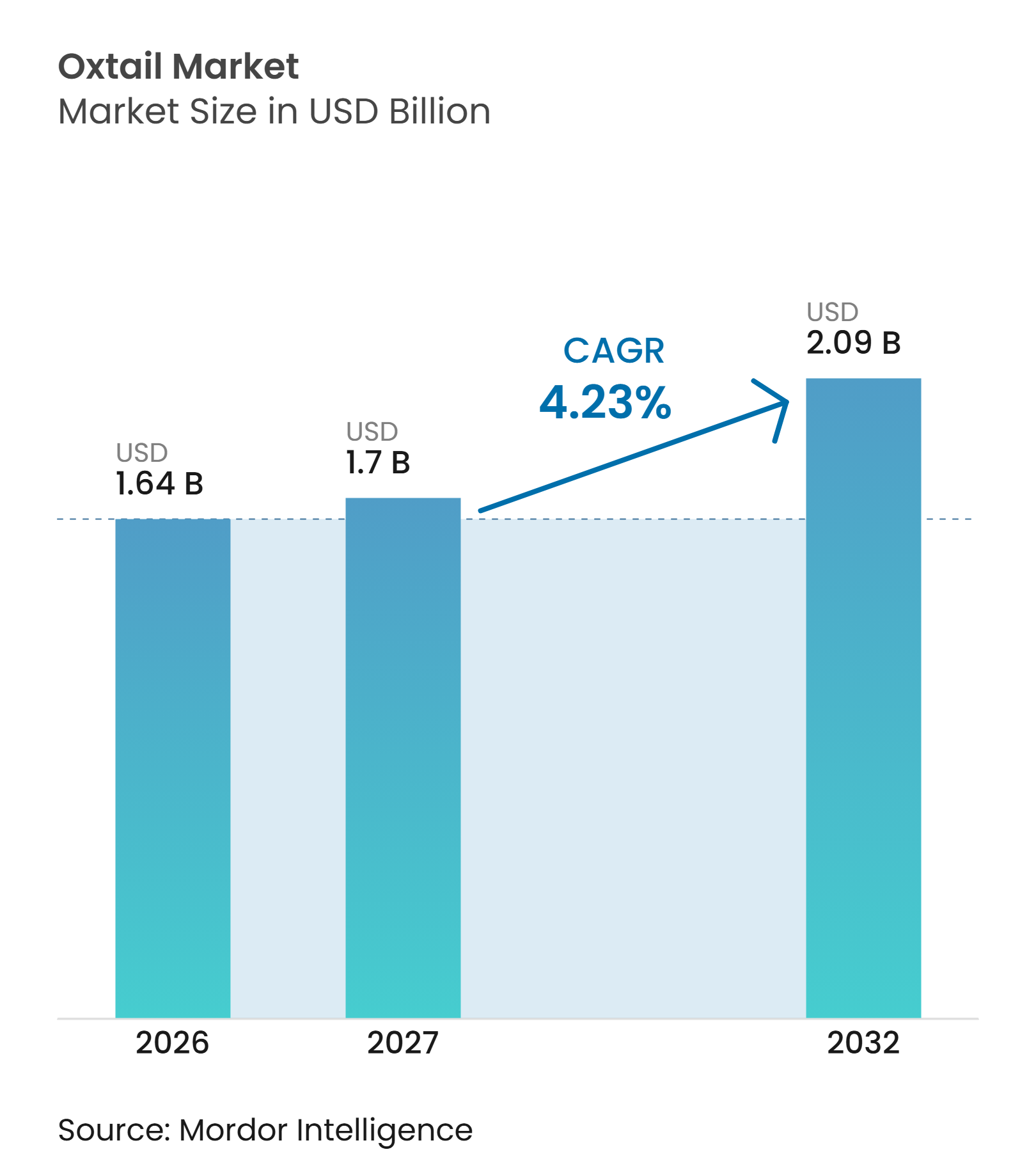
The oxtail market size was valued at USD 1.64 billion in 2026 and is estimated to grow from USD 1.70 billion in 2027 to reach USD 2.09 billion by 2032, at a CAGR of 4.23% during the forecast period (2027-2032). Rising demand is repositioning oxtail from a lower-value beef co-product to a specialty cut that appeals to foodservice buyers and retail consumers. Caribbean, West African, East Asian, and Spanish culinary traditions drive demand in established urban centers and emerging consumer markets. Oxtail’s collagen-rich composition also aligns with growing interest in slow-cooked meals and whole-food preparation. Consequently, processors and distributors can enhance value through reliable sourcing, frozen distribution, and ready-to-cook or fully cooked product formats.
Key Report Takeaways
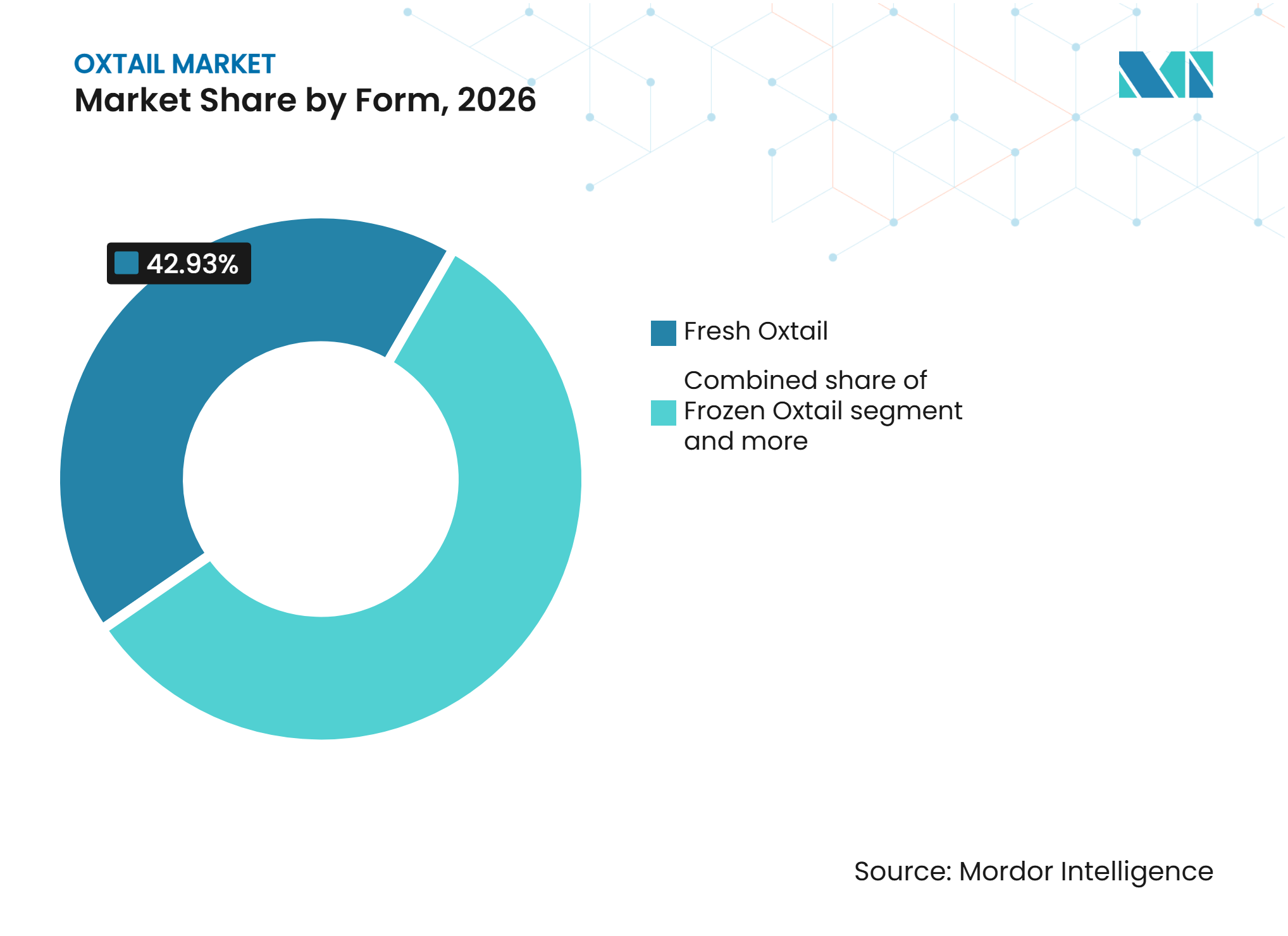
- By form, fresh oxtail held 42.93% of the oxtail market share in 2026, while frozen oxtail is forecast to expand at a CAGR of 5.33% through 2032.
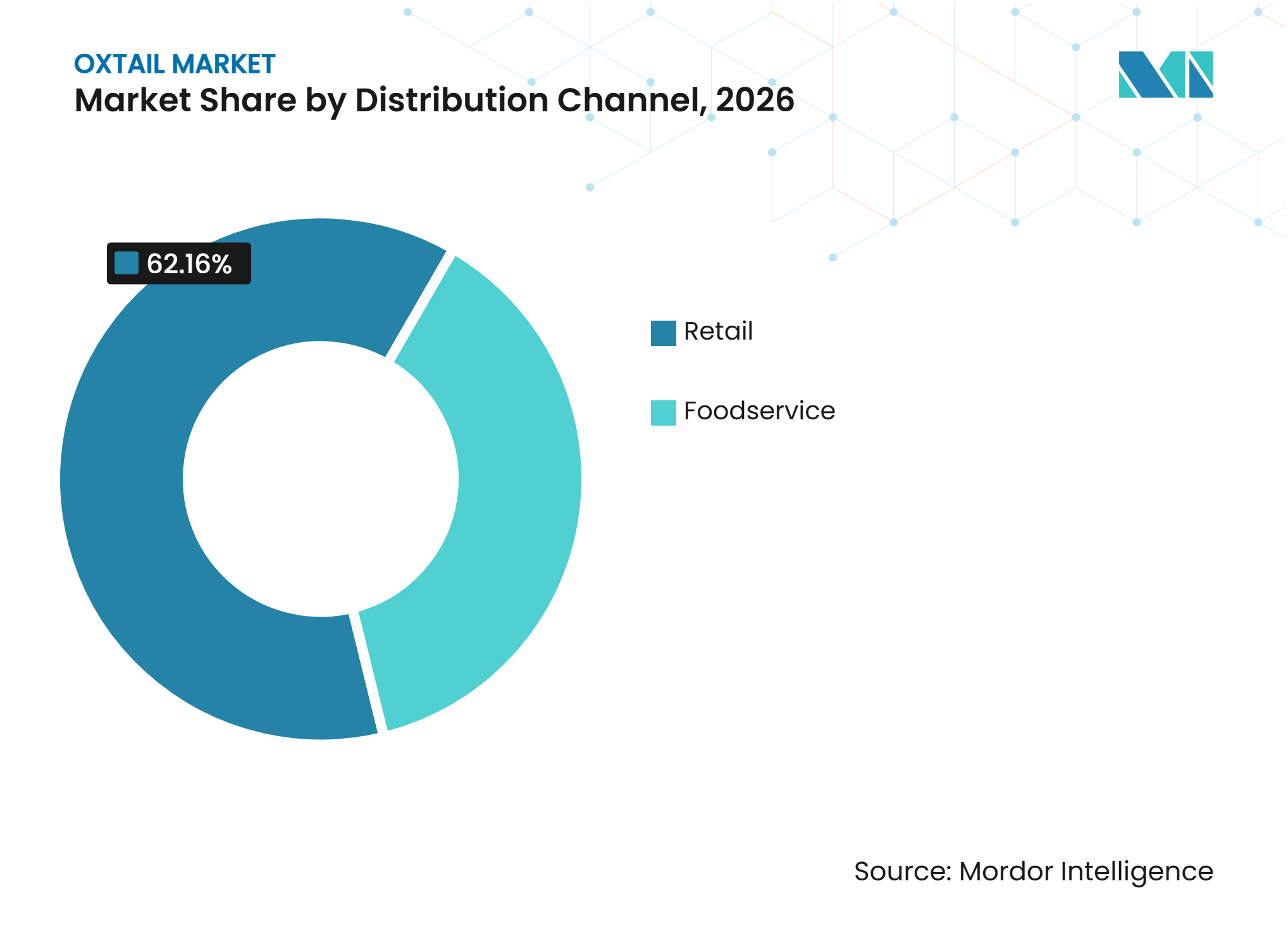
- By distribution channel, retail held 62.16% of market share in 2026, while foodservice is forecast to expand at a CAGR of 5.47% through 2032.
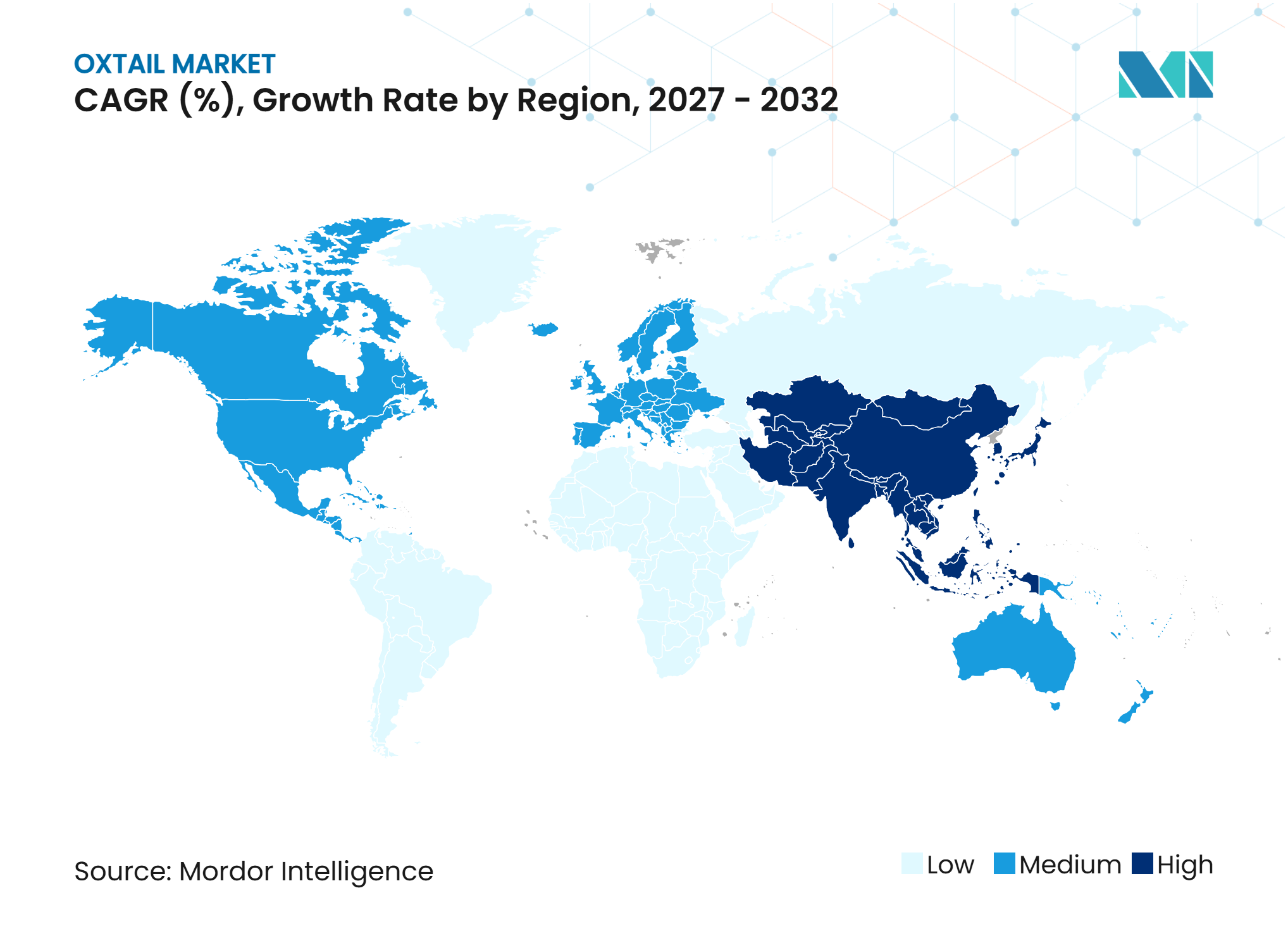
- By geography, Asia-Pacific held 43.82% of the oxtail market share in 2026 and is also forecast to be the fastest-growing region, expanding at a CAGR of 5.35% through 2032.
Note: Market numbers in this report are based on Mordor Intelligence's proprietary estimation framework, which combines nine months of actuals with Q4 projections for base year 2026.
Market Trends and Insights
Drivers Impact Analysis of Oxtail Market*
| Driver | (~) % Impact on CAGR Forecast | Geographic Relevance | Impact Timeline |
|---|---|---|---|
| Rising popularity of caribbean and ethnic cuisines | +1.1% | North America, Europe, Asia-Pacific diaspora hubs | Short term (≤ 2 years) |
| Expansion of specialty meat restaurants and foodservice outlets | +0.8% | North America, United Kingdom, Australia | Medium term (2-4 years) |
| Rising utilization of underused animal parts | +0.7% | Global, with early traction in Europe and Asia-Pacific | Medium term (2-4 years) |
| Expansion of international meat distribution networks | +0.9% | North America, Europe, Asia-Pacific | Short term (≤ 2 years) |
| Growing demand for collagen-rich meat preparations | +0.6% | North America, Europe, Asia-Pacific, Middle East | Medium term (2–4 years) |
| Rising demand for affordable alternative beef cuts | +0.5% | North America, Europe, Asia-Pacific, South America | Short term (≤ 2 years) |
| Source: Mordor Intelligence | |||
Rising Popularity of Caribbean and ethnic cuisines
The expansion of the Caribbean foodservice industry is creating opportunities for oxtail suppliers, as restaurants continue to serve traditional regional dishes and a range of international cuisines. According to a December 2025 report by the United States Foreign Agricultural Service, the Caribbean Basin has more than 3,000 full-service restaurants, reflecting an established commercial foodservice network[1]. These restaurants provide an important customer base for meat wholesalers, distributors, and beef processors that supply ingredients for traditional preparations. Oxtail, which is widely used in Jamaican oxtail stew and other Caribbean slow-cooked dishes, benefits from its established culinary role in the region. The extensive restaurant network supports recurring oxtail procurement by foodservice operators and strengthens demand through the B2B distribution channel.
Expansion of Specialty Meat Restaurants and Foodservice Outlets
The expansion of specialty meat restaurants, hotels, and foodservice establishments is increasing demand for oxtail as commercial kitchens diversify their menus with distinctive meat-based preparations. Restaurants specializing in Caribbean, African, and Asian cuisines use oxtail in traditional stews, soups, braised dishes, and slow-cooked meals, strengthening its commercial relevance beyond conventional household consumption. Its rich flavor, gelatinous texture, and suitability for prolonged cooking make oxtail an appealing ingredient for specialty dining establishments. Moreover, restaurants and catering operators require consistent bulk supplies of specific meat cuts to ensure menu availability and standardize food preparation. This requirement creates procurement opportunities for meat processors, wholesalers, and distributors, supporting oxtail demand through the B2B foodservice channel.
Rising Utilization of Underused Animal Parts
The growing focus on whole-animal utilization is creating commercial opportunities for oxtail suppliers. Meat processors and slaughterhouses increasingly seek to maximize value from all portions of cattle carcasses rather than relying solely on conventional meat cuts. Oxtail represents an additional marketable product from cattle processing, enabling meat producers to diversify their portfolios beyond commonly consumed beef cuts. Oxtail’s suitability for soups, broths, stews, and slow-cooked dishes also drives demand from restaurants, catering businesses, and specialty meat retailers. Moreover, commercializing traditionally underutilized animal parts helps processors maximize carcass value, reduce economic losses associated with underutilized cuts, and generate additional revenue from existing slaughter volumes. These factors support the commercial availability of oxtail and strengthen its position within the broader beef processing and distribution industry.
Growing Demand for Collagen-Rich Meat Preparations
Growing commercial interest in collagen-rich meat preparations is creating opportunities for oxtail suppliers, owing to oxtail’s high connective tissue content and suitability for soups, broths, stews, and slow-cooked dishes. During prolonged cooking, oxtail releases gelatin, enhancing the consistency and texture of meat-based preparations. In January 2026, Northern Ireland’s Department of Agriculture, Environment and Rural Affairs (DAERA) highlighted an innovative project at Clarkhill Farm that converts beef-processing bones into concentrated, protein- and collagen-rich bone broth[2]. The initiative demonstrates the commercial potential of converting beef-processing materials into premium culinary and nutritional products. Such developments support the utilization of collagen-rich beef components and create opportunities for meat processors and foodservice operators to expand their broth-based product offerings. This trend creates a favorable commercial environment for oxtail, which is widely used in collagen-rich soups, broths, and traditional slow-cooked preparations.
Restraints Impact Analysis of Oxtail Market*
| Restraint | (~) % Impact on CAGR Forecast | Geographic Relevance | Impact Timeline |
|---|---|---|---|
| Limited availability due to restricted carcass yield | -0.4% | Global | Long term (≥ 4 years) |
| High price volatility and premium pricing | -0.3% | North America, South Africa, Europe | Short term (≤ 2 years) |
| Stringent food safety and meat inspection requirements | -0.2% | North America, Europe, Asia-Pacific | Medium term (2–4 years) |
| Short shelf life and cold-chain dependency | -0.3% | Asia-Pacific, Africa, Latin America | Short term (≤ 2 years) |
| Source: Mordor Intelligence | |||
Limited Availability Due to Restricted Carcass Yield
The limited availability of oxtail represents a structural restraint for the global market, as each slaughtered animal yields only one tail. This limits the volume that meat processors can supply, independent of other beef cuts. Unlike conventional beef products, oxtail production cannot be expanded separately in response to rising demand, as its availability remains directly dependent on cattle slaughter volumes. According to the United States National Agricultural Statistics Service's Livestock Slaughter 2025 Summary, commercial cattle slaughter in the United States totaled 29.8 million head in 2025, representing a 6% decline from 2024[3]. This reduction in slaughter activity directly constrains the potential availability of cattle-derived cuts, including oxtail. Furthermore, competition among restaurants, wholesalers, specialty butcher shops, and retail buyers for this limited cut can lead to supply shortages and procurement challenges.
High Price Volatility and Premium Pricing
Restricted supply, rising demand, and logistics costs can cause rapid fluctuations in oxtail prices. These factors may limit purchases among households that have historically viewed oxtail as an affordable option. They can also complicate menu planning for mid-priced restaurants that cannot absorb sudden input-cost increases. Premium operators may be better positioned to recover higher costs through menu price adjustments. Frozen products can enable distributors and restaurants to purchase inventory in advance and reduce immediate exposure to spot-market volatility. Food safety and inspection regulations impose additional operational requirements on prepared formats, particularly for products traded across national borders.
*Our forecasts treat driver/restraint impacts as directional, not additive. The impact forecasts reflect baseline growth, mix effects, and variable interactions.
Oxtail Market Segment Analysis
By Form:
Fresh Oxtail Leads While Frozen Formats ExpandFresh oxtail accounted for 42.93% of the oxtail market in 2026. This position reflects the flavor and texture consumers expect from slow-cooked, bone-in preparations. Caribbean, West African, and East Asian consumers often purchase fresh oxtail through butcher shops, hypermarkets, and other urban food retailers. These channels serve customers who recognize the cut and are comfortable with longer preparation times. Chilled oxtail caters to premium foodservice buyers that prioritize stringent temperature control and shorter distribution routes. Its availability through traditional meat retailers and established local supply networks further supports its leading position across regions with strong oxtail consumption traditions.
Frozen oxtail is forecast to grow at a CAGR of 5.33% through 2032, the fastest growth rate among all forms. The frozen oxtail segment benefits from its longer shelf life and practical role in exports. Frozen products can reach inland destinations across Asia-Pacific, the Middle East, and Africa, where chilled distribution is less suitable. Ready-to-cook, marinated, portioned, and deboned products can reduce labor requirements for caterers and home cooks. These factors encourage suppliers to maintain traceability, temperature control, and documented process management. Additionally, frozen formats allow wholesalers and foodservice operators to maintain inventory for longer periods, manage procurement schedules more efficiently, and reduce dependence on frequent fresh-product deliveries.



By Distribution Channel:
Retail Retains Scale While Foodservice AdvancesRetail accounted for 62.16% of the oxtail market in 2026, as oxtail remains closely associated with home cooking. Supermarkets and hypermarkets enable consumers to compare fresh and frozen products in a single location. These outlets can also source products from multiple producing regions, helping maintain availability amid supply fluctuations. Convenience stores and grocery stores cater to frequent, smaller purchases in densely populated areas. Online retail is emerging as a channel for specialty beef cuts, particularly in markets where digital food discovery is expanding.
The foodservice channel is forecast to grow at a CAGR of 5.47% through 2032. Restaurant operators use oxtail as a recognizable menu item that differentiates Caribbean, Jamaican, and Afro-Caribbean cuisines. This channel supports recurring purchasing cycles, as restaurants can place regular orders rather than relying on event-driven household demand. Foodservice distributors can support these buyers through specialized sourcing and reliable delivery schedules. The channel may continue to outpace retail growth as ethnic dining concepts expand into new metropolitan and secondary-city locations.

Geography Analysis
Asia-Pacific
Asia-Pacific accounted for 43.82% of the oxtail market share in 2026 and is projected to grow at a CAGR of 5.35% through 2032. Chinese consumption is supported by regional dishes featuring braised and slow-cooked oxtail, while Korean, Thai, Indonesian, and Australian-Chinese communities also contribute to demand. The region combines high-volume traditional consumption with higher-value restaurant demand. Investments in cold-chain infrastructure support distribution to secondary cities, where chilled products are less practical and frozen products are better suited to longer distribution routes. Digital food retail also improves product discovery and expands access beyond wet-market channels. Australia remains an established supplier of offal to the region, while Brazil is increasing its capacity to serve Indonesia and other Asian import markets.
North America
Demand is driven by Caribbean and Afro-Caribbean restaurants in urban areas, where oxtail is a high-demand menu item. Established diaspora communities also purchase oxtail for household preparation. Product innovation is shifting some demand toward fully cooked and frozen formats that reduce preparation time. These products can make oxtail more accessible to consumers who value the dish but prefer to avoid lengthy cooking processes. Retail and foodservice demand therefore reinforce each other across the region. Smaller value-added businesses require robust food safety systems and shelf-life controls to compete effectively. Canada and Mexico further contribute to demand through regional food traditions and cross-border supply relationships.
Europe, South America, and the Middle East and Africa
Europe combines heritage dishes with diaspora-driven consumption. The United Kingdom records demand linked to Caribbean communities, while Spain maintains a long-established rabo de toro tradition. Germany, the Netherlands, and France represent smaller, import-oriented markets that European processing networks can serve. In October 2025, Dawn Meats secured a 65% stake in New Zealand’s Alliance Group, following shareholder approval of a NZD 270 million strategic partnership. The transaction connected Dawn Meats’ European operations with Alliance Group’s export channels in Asia and North America, improving year-round red meat supply options across the Northern and Southern Hemispheres.
Competitive Landscape
Market Concentration
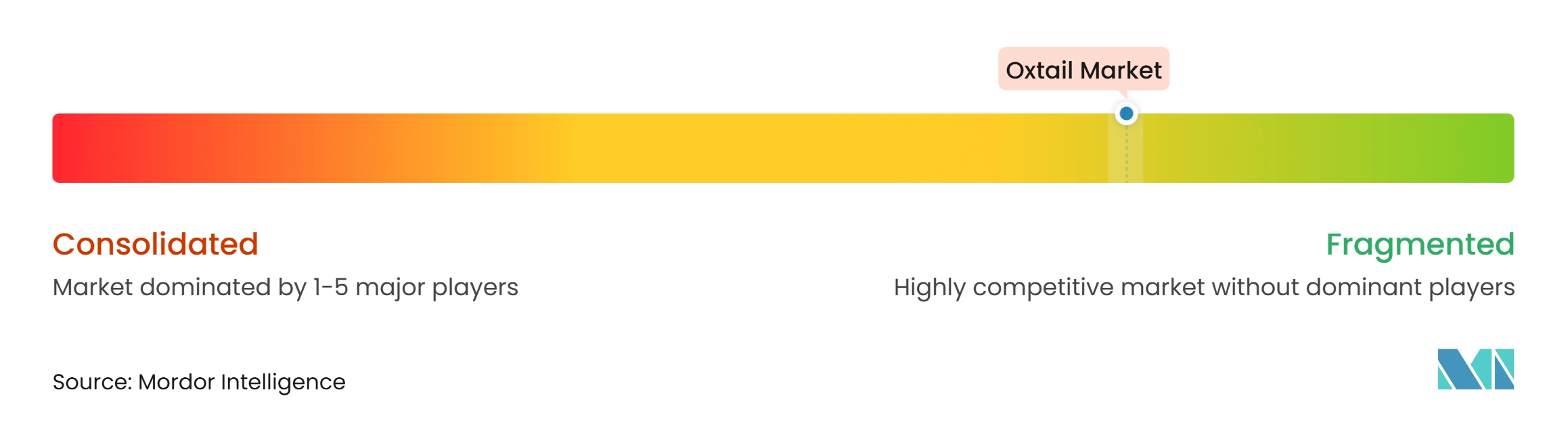
The oxtail market is fragmented, as large meat processors typically sell oxtail as one of several cattle co-products. JBS S.A., Cargill, Incorporated, Tyson Foods, Inc., and Silver Fern Farms operate broad beef businesses rather than dedicated oxtail franchises. Their scale supports animal procurement, inspection, cutting, freezing, and export operations. However, none of the companies covered in the supplied research has established a clearly differentiated, large-scale branded oxtail position. This creates opportunities for regional processors and specialty distributors that can provide reliable supply and practical packaging. Consequently, competition depends on supply access, food safety performance, cold-chain capabilities, and buyer relationships.
JBS has developed businesses that convert bovine co-products into food, collagen, pharmaceutical, biodiesel, and other higher-value products. This strategy supports greater carcass utilization and can improve the economics of collagen-bearing products. Dawn Meats’ investment in Alliance Group provides access to a cross-hemisphere supply network, which can help serve buyers seeking continuity across seasonal production cycles. Fully cooked and frozen oxtail products offer a separate avenue for differentiation by addressing preparation time and skill barriers. These formats enable brands to compete on convenience rather than solely on raw-cut availability.
Foodservice buyers favor suppliers that provide uniform cuts and reliable order fulfillment. Retailers similarly prioritize product integrity, labeling, and cold-chain control. Traceability based food safety systems are increasingly important for participation in prepared and export-oriented product categories. Smaller processors can still compete by building direct relationships with ethnic retailers, restaurants, and specialty distributors. The competitive structure is therefore likely to remain dispersed, while demand continues to reward specialized execution.
Oxtail Industry Leaders
-
Cargill, Incorporated
-
Tyson Foods, Inc.
-
Sysco Corporation
-
National Beef Packing Company, LLC
-
Vion Food Group N.V.
- *Disclaimer: Major Players sorted in no particular order
Oxtail Market Companies Covered in this Report
- JBS S.A.
- Marfrig Global Foods S.A.
- Minerva Foods S.A.
- Cargill, Incorporated
- Tyson Foods, Inc.
- National Beef Packing Company, LLC
- Sysco Corporation
- US Foods Holding Corp.
- Performance Food Group Company
- Vion Food Group N.V.
- NH Foods Ltd.
- Itoham Yonekyu Holdings Inc.
- Silver Fern Farms Limited
- Thomas Foods International
- Teys Australia
- ABP Food Group
- Dawn Meats
- Creekstone Farms Premium Beef, LLC
- Kepak Group
- American Foods Group, LLC
Recent Industry Developments in Oxtail Market
- January 2026: Meat the Veggies relocated its production operations to Lakeland, Florida, to scale the manufacturing of The Original Pulled Oxtail Meat.
- July 2025: de Braga by ARTOTEL in Bandung, Indonesia, introduced a new oxtail-themed menu, Obrolan Berbuntut Makan, featuring four dishes: Buntut Bakar Balado, Nasi Goreng Buntut Cabe Hijau, Buntut Bakar Kecap, and Buntut Goreng.
- January 2025: Miami-based Meat the Veggies announced the development and promotion of The Original Pulled Oxtail Meat™, a fully cooked, deboned, frozen oxtail product.
Global Oxtail Market Report Scope
Oxtail refers to the culinary cut of beef obtained from the tail of cattle, typically sold whole or sliced into segments.
The oxtail market is segmented by form and distribution channel. By form, the market is segmented into fresh oxtail, frozen oxtail, chilled oxtail, and other form types. By distribution channel, the market is segmented into foodservice and retail (hypermarkets and supermarkets, convenience/grocery stores, online retail, and other retail channels). Based on geography, the market is classified into North America, Europe, Asia-Pacific, South America, and the Middle East and Africa. The market forecasts are provided in terms of value (USD).
Segmentation Overview
| Fresh Oxtail |
| Frozen Oxtail |
| Chilled Oxtail |
| Other Form Types |
| Foodservice | |
| Retail | Hypermarkets and Supermarkets |
| Convenience/Grocery Stores | |
| Online Retail | |
| Other Retail Channels |
| North America | United States |
| Canada | |
| Mexico | |
| Rest of North America | |
| Europe | Germany |
| United Kingdom | |
| Italy | |
| France | |
| Spain | |
| Netherlands | |
| Rest of Europe | |
| Asia-Pacific | China |
| India | |
| Japan | |
| Australia | |
| Thailand | |
| Indonesia | |
| Rest of Asia-Pacific | |
| South America | Brazil |
| Argentina | |
| Peru | |
| Rest of South America | |
| Middle East and Africa | South Africa |
| United Arab Emirates | |
| Saudi Arabia | |
| Turkey | |
| Egypt | |
| Rest of Middle East and Africa |
| By Form | Fresh Oxtail | |
| Frozen Oxtail | ||
| Chilled Oxtail | ||
| Other Form Types | ||
| By Distribution Channel | Foodservice | |
| Retail | Hypermarkets and Supermarkets | |
| Convenience/Grocery Stores | ||
| Online Retail | ||
| Other Retail Channels | ||
| By Geography | North America | United States |
| Canada | ||
| Mexico | ||
| Rest of North America | ||
| Europe | Germany | |
| United Kingdom | ||
| Italy | ||
| France | ||
| Spain | ||
| Netherlands | ||
| Rest of Europe | ||
| Asia-Pacific | China | |
| India | ||
| Japan | ||
| Australia | ||
| Thailand | ||
| Indonesia | ||
| Rest of Asia-Pacific | ||
| South America | Brazil | |
| Argentina | ||
| Peru | ||
| Rest of South America | ||
| Middle East and Africa | South Africa | |
| United Arab Emirates | ||
| Saudi Arabia | ||
| Turkey | ||
| Egypt | ||
| Rest of Middle East and Africa | ||
Key Questions Answered in the Report
What is the current size and future growth outlook of the oxtail market?
The oxtail market was valued at USD 1.64 billion in 2026 and is estimated to reach USD 1.70 billion in 2027. The market is projected to grow to USD 2.09 billion by 2032, registering a CAGR of 4.23% during 2027-2032.
Which form held the largest share of the oxtail market in 2026?
Fresh oxtail was the largest form segment in 2026, accounting for 42.93% of the oxtail market.
Which distribution channel held the largest share of the oxtail market in 2026?
Retail was the largest distribution channel in 2026, accounting for 62.16% of the oxtail market.
Which region held the largest share of the oxtail market in 2026?
Asia-Pacific was the largest regional market in 2026, accounting for 43.82% of the oxtail market.