
Organic Honey Market Size and Share
Market Overview
| Study Period | 2022 - 2032 |
|---|---|
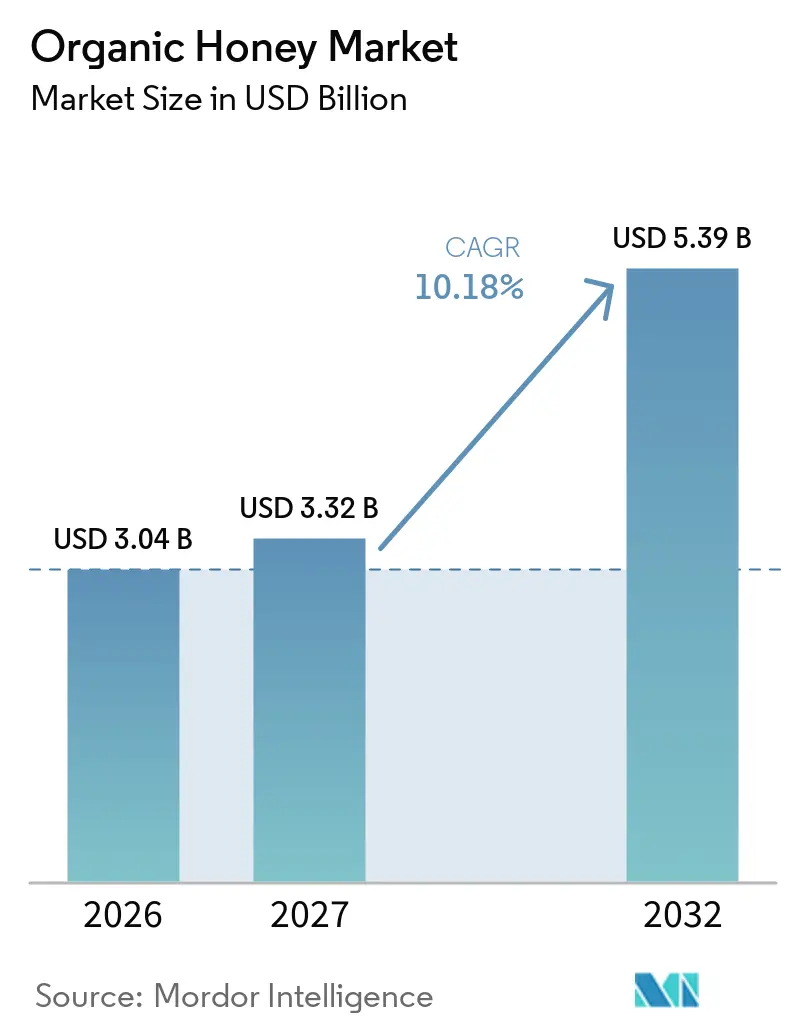
| Market Size (2027) | USD 3.32 Billion |
| Market Size (2032) | USD 5.39 Billion |
| Growth Rate (2027 - 2032) | 10.18 % |
| Fastest Growing Market | Asia-Pacific |
| Largest Market | North America |
| Market Concentration | Medium |
Major Players *Disclaimer: Major Players sorted in no particular order Image © Mordor Intelligence. Reuse requires attribution under CC BY 4.0. | |
Organic Honey Market Analysis by Mordor Intelligence
The Organic honey market size is USD 3.04 billion in 2026 and is forecast to reach USD 5.39 billion by 2032 at a CAGR of 10.1% over 2027-2032. Demand is moving toward certified, residue-free sweeteners as buyers seek clearer information on ingredients, production practices, and origin. In the United States, organic honey retail dollar sales grew 13.8% and volume increased 15.7% during the 52-week period reviewed in 2025, ahead of non-organic honey. Honey-containing products were preferred over comparable alternatives by 65% of 2,457 surveyed U.S. consumers, supporting continued interest in natural sweetening options. The Organic honey market also depends on reliable certification, auditable import records, and credible product testing because premium pricing can weaken quickly when authenticity is questioned. Competition is increasingly shaped by supply control, compliance capabilities, and direct customer access, while producers also use digital tools to improve traceability and manage harvest variability.
Key Report Takeaways
- By type, Multifloral Organic Honey held 51.2% of global value in 2026, while Monofloral Organic Honey is forecast to grow at an 11.2% CAGR through 2032.
- By packaging, Bottles accounted for 62.3% of global packaging value in 2026, while Tubes are projected to advance at an 11.5% CAGR through 2032.
- By end-use, Retail captured 58.5% of global value in 2026, while Foodservice/HORECA is projected to expand at a 12.3% CAGR through 2032.
- By geography, North America held 36.1% of the Organic honey market share in 2026, while Asia-Pacific is expected to record a 12.6% CAGR through 2032.
Note: Market numbers in this report are based on Mordor Intelligence's proprietary estimation framework, which combines nine months of actuals with Q4 projections for base year 2026.
Market Trends and Insights
Drivers Impact Analysis of Organic Honey Market*
| Driver | (~) % Impact on CAGR Forecast | Geographic Relevance | Impact Timeline |
|---|---|---|---|
| Increasing consumer trust through organic certification and product traceability | +2.0% | Global; most intensive compliance activity in North America and the EU | Medium term (2–4 years) |
| Clean-label and minimal processing trends | +1.5% | North America and EU core; expanding to urban APAC premium segments | Medium term (2–4 years) |
| Rising health consciousness and demand for natural sweeteners | +2.0% | Global; highest premium intensity in Japan, Germany, and the United States | Long term (≥ 4 years) |
| Growth of e-commerce and direct-to-consumer channels | +1.6% | Global; strongest acceleration in APAC (India, China) and North America | Short term (≤ 2 years) |
| Technological advancements in beekeeping and supply chain | +0.8% | Global; IoT and precision apiculture deepest in EU and North America | Long term (≥ 4 years) |
| Premiumization and demand for specialty varieties | +1.4% | North America, EU, Japan, and Middle East and Africa | Medium term (2–4 years) |
| Source: Mordor Intelligence | |||
Increasing Consumer Trust Through Organic Certification and Product Traceability
The USDA Strengthening Organic Enforcement rule requires National Organic Program import certificates for organic honey entering the United States, creating a documented chain of custody from exporter to port of entry. This requirement gives buyers in the organic honey market a clearer basis for verifying the movement of imported product. A 2025 peer-reviewed study found a USD 7.13 per-unit premium for USDA organic-labeled honey over unlabeled product. The same study found that willingness to pay declined by USD 1.32 when buyers were informed that USDA organic honey is imported under the regulatory definition, highlighting the need for product claims to be supported by traceable evidence[1]. Europe's import framework also raises the compliance threshold for exporters serving Germany, France, and Italy, as certified buyers require stronger documentation and compliance processes.
Rising Health Consciousness and Demand for Natural Sweeteners
The organic honey market benefits when households replace refined sugar with products perceived as more natural and less processed. The National Honey Board's 2025 consumer survey found that honey had become the most preferred sweetener among surveyed U.S. consumers. U.S. honey retail sales reached USD 1.2 billion in 2025, while organic honey dollar sales grew 13.8%, indicating that premium choices contributed to category value[2]. Japan represents another source of premium demand, as its organic food market was valued at JPY 224 billion (equivalent to USD 1.5 billion), and 32.6% of consumers ate organic food at least weekly, according to the Ministry of Agriculture, Forestry and Fisheries. This demand favors food products that can demonstrate product integrity and a clearly documented supply chain. Honey appeared on 58.5% of U.S. menus by mid-2026, with beverages, sauces, and condiments leading use among operators.
Growth of E-Commerce and Direct-to-Consumer Channels
Digital selling allows smaller producers and cooperatives in the Organic honey market to reach customers beyond their local retail base. Branded honey represented 63.2% of U.S. honey retail dollar sales in 2025, exceeding private-label value sales. Digital product pages can display certificates, origin information, and variety details that are harder to communicate on a crowded physical shelf. Nate’s Honey introduced USDA-certified Organic Honey Minis in March 2026, extending organic honey into single-serve, gifting, travel, and direct-to-consumer occasions. The National Honey Board reported a 12.9% increase in honey product introductions in the first half of 2026. Subscription formats support repeat purchase and can reduce brand exposure to short retail promotion cycles, while clean-label positioning remains important to customers comparing products online.
Premiumization and Demand for Specialty Varieties
Specialty products in the organic honey market command higher prices when botanical origin and certification can be verified. Nate's Honey reported a 105% increase in Manuka honey dollar sales in US food retail for the 52-week period ending April 2026, based on Circana data cited by the company. In June 2026, the company launched a USDA-certified, UMF-certified organic Manuka honey with 300+ MGO strength. New Zealand Trade and Enterprise found that organic status and health-related properties were the primary Manuka purchase factors among consumers in the United Arab Emirates. A 2025 study of more than 3,000 US and UK consumers identified Kānuka, Rewarewa, and Rātā as commercially underused single-floral varieties from New Zealand. These varieties provide suppliers with an opportunity to develop certified offerings beyond Manuka, provided they can demonstrate provenance and maintain consistent quality.
Restraints Impact Analysis of Organic Honey Market*
| Restraint | (~) % Impact on CAGR Forecast | Geographic Relevance | Impact Timeline |
|---|---|---|---|
| Honey adulteration and product authenticity concerns | -1.2% | Global; most critical in import-dependent markets — United States, Germany, Japan | Medium term (2–4 years) |
| Price competition from conventional honey | -1.0% | Global; most intense in price-sensitive APAC emerging markets and industrial segment | Long term (≥ 4 years) |
| High organic certification and regulatory compliance costs | -0.7% | Global; burden highest for smallholder beekeepers in Brazil, India, and sub-Saharan Africa | Long term (≥ 4 years) |
| Supply inconsistency and distribution challenges | -0.6% | Global; acute in 2025 for Uruguay and India origin honey | Short term (≤ 2 years) |
| Source: Mordor Intelligence | |||
Honey Adulteration and Product Authenticity Concerns
Adulteration undermines the price premium of the organic honey market, as customers expect certification to reflect a genuine product difference. The U.S. Food and Drug Administration tested 54 domestic and 48 imported samples under its fiscal year 2025 honey sampling assignment and found a 4% violation rate in both groups, taking action through import alerts and domestic recalls where appropriate. UK authorities issued revised guidance in February 2025 recommending a weight-of-evidence approach using multiple methods, including EA/LC-IRMS and DNA barcoding. This approach acknowledges that no single test can confirm honey authenticity in all circumstances. The requirements for testing, certificates, and records increase compliance costs, particularly for smaller certified suppliers, and make reliable supply from Brazil, India, and Uruguay more important during periods of strong demand.
Price Competition From Conventional Honey
The organic honey market faces a volume constraint when buyers compare its premium price with conventional alternatives. U.S. retail honey averaged USD 7.60 per pound in 2025, while a supplier report indicated that organic honey prices were higher than the prior year. Private label products accounted for 36.8% of U.S. retail honey unit volume in 2025, offering price-conscious buyers a lower-cost option in mass retail. Conventional honey from China and Argentina also competes on cost per kilogram in industrial food production. Certification costs and regulatory requirements add to the burden on smallholder beekeepers in Brazil, India, and sub-Saharan Africa. Supply disruptions in Uruguay and India during 2025 further highlight the need for distributors to maintain dependable origin relationships as they balance availability, price, and verified compliance.
*Our forecasts treat driver/restraint impacts as directional, not additive. The impact forecasts reflect baseline growth, mix effects, and variable interactions.
Organic Honey Market Segment Analysis
By Type:
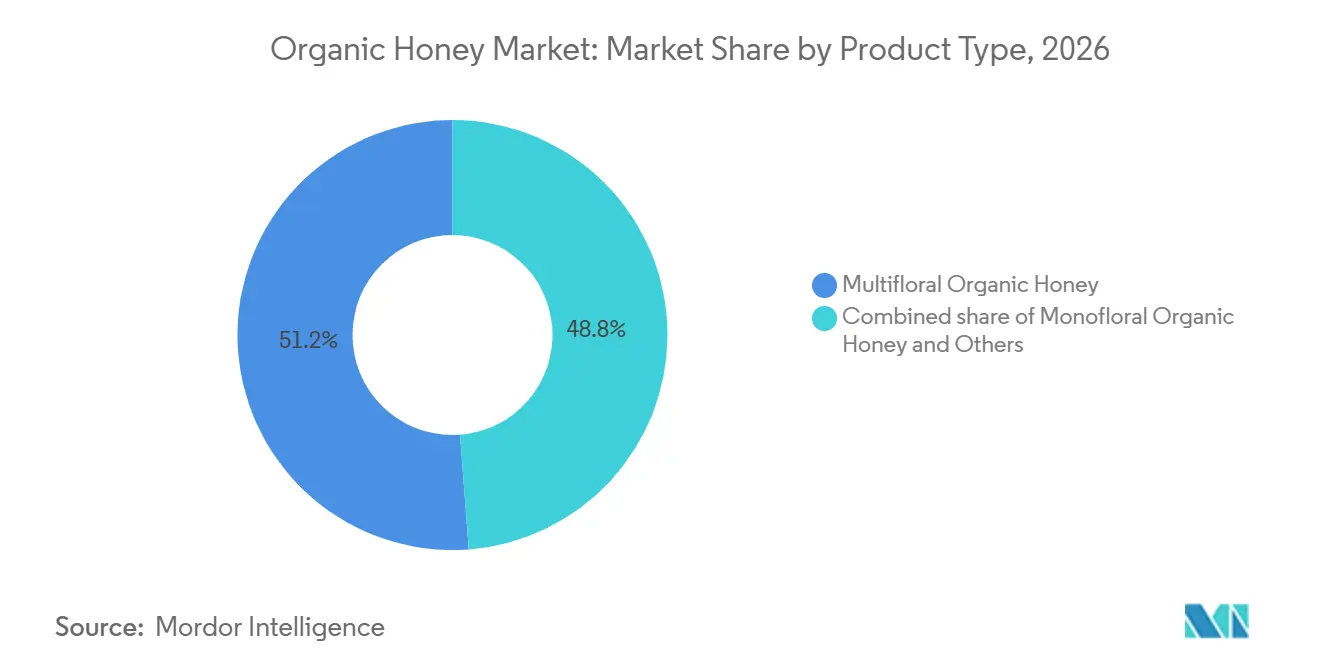
Multifloral Leads, While Monofloral Commands a Growing PremiumMultifloral Organic Honey accounted for 51.2% of the Organic honey market size in 2026. Its broad floral base supports production across certified source countries and suits a wide range of retail formats. Producers in Brazil, India, and Mexico can maintain organic production without the geographic concentration required by a single floral source. This helps multifloral products serve as an accessible certified option for shoppers entering the category. Its familiar profile also works in baked goods, cereals, and beverages where manufacturers want a stable ingredient and lower reformulation risk.
Monofloral Organic Honey is forecast to grow at an 11.2% CAGR from 2027 to 2032, making it the fastest-growing type in the Organic honey market. The segment relies on verified origin and functional positioning to justify prices that conventional honey cannot easily match. Nate’s 2026 organic Manuka launch combined USDA organic status, UMF certification, and 300+ MGO strength. The company’s reported 105% increase in Manuka dollar sales shows the commercial relevance of this positioning in U.S. food retail. Kānuka, Rewarewa, and Rātā could widen the premium offer where suppliers can provide credible botanical authentication and clear consumer education.

By Packaging:
Bottles Lead While Tubes Gain HORECA TractionBottles represented 62.3% of the Organic honey market size in 2026. The format works across grocery, specialty retail, and direct sales, while giving brands enough label space to present certification, origin, and variety details. In 2025, 34.8% of U.S. honey units were sold in 12 oz packages and 24.4% were sold in 16 oz packages. Branded honey held 63.2% of retail dollar sales, which supports investment in packaging that can carry a differentiated product story. Bottled formats also support premium display requirements and can extend into larger food-grade containers for industrial distribution.
Tubes are projected to grow at an 11.5% CAGR between 2027 and 2032 within the Organic honey market. Their appeal in professional kitchens comes from controlled dispensing, hygiene, and lower product waste. Foodservice operators can use this format to standardize portions and reduce handling during routine preparation. The format also gives brands a route to offer organic honey in flavors designed for beverage and menu applications. U.S. foodservice honey volumes grew 7.7% through November 2025, giving context for the commercial setting in which this packaging could gain adoption.
By End-Use:
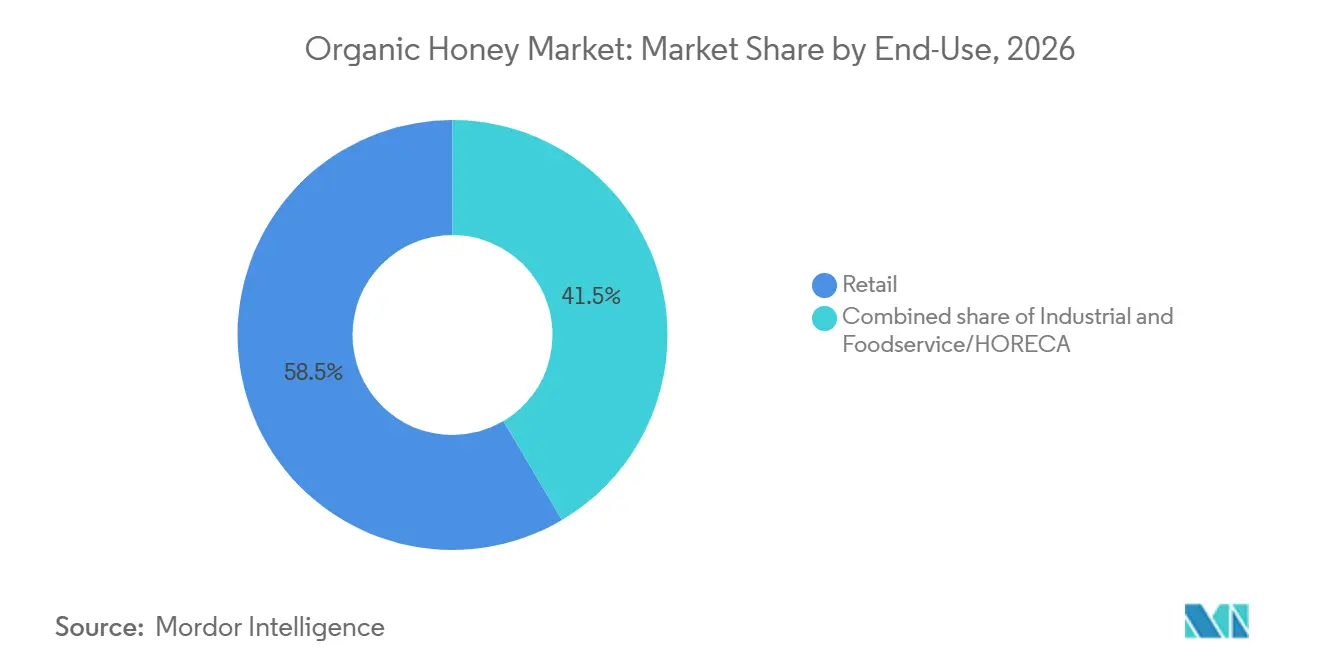
Retail Anchors Volume While HORECA Outpaces Category GrowthRetail held 58.5% of the Organic honey market size in 2026. Supermarkets, organic food stores, and online retailers give certified products multiple routes to shoppers. Organic honey posted 13.8% dollar growth and 15.7% volume growth in U.S. retail during 2025, outperforming non-organic alternatives. Premium brands are expanding specialty-retail distribution as they seek broader access to shoppers who value certified products. Supermarkets support scale, specialty stores support variety-led products, and direct subscription formats support recurring branded sales.
Foodservice/HORECA is forecast to grow at a 12.3% CAGR from 2027 to 2032 in the Organic honey market. Professional kitchens use honey as both a sweetener and a flavor ingredient in beverages, sauces, and condiments. Honey was present on 58.5% of U.S. menus by mid-2026, after a 10% year-over-year increase in menu penetration. The first half of 2026 also recorded a 12.9% rise in honey product introductions. Hotel and premium restaurant procurement policies can create steadier demand for organically sourced ingredients when these requirements are written into supplier contracts.
Geography Analysis
North America Organic Honey Market
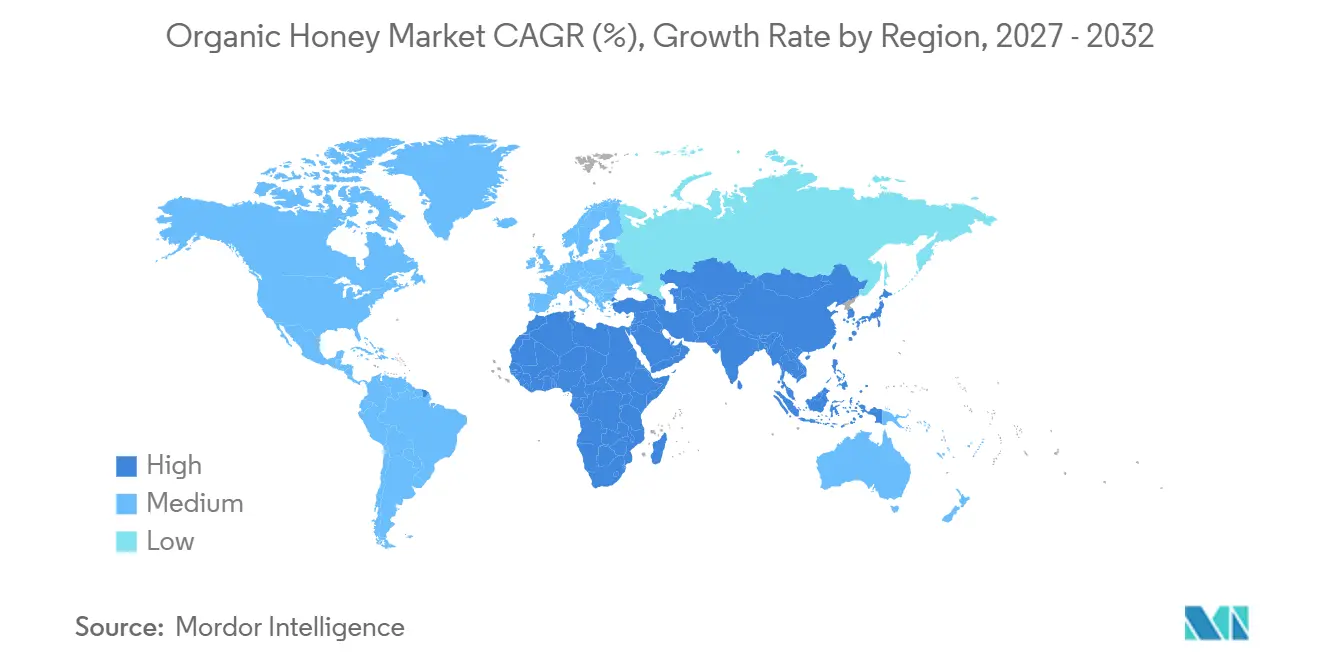
North America held 36.1% of the Organic honey market share in 2026. The United States has a mature organic retail system and uses USDA import documentation to strengthen the traceability of certified organic honey. U.S. retail honey sales grew to a record USD 1.5 billion in 2025, based on Circana data cited by a producer. Canada produced 84.1 million pounds of honey in 2025, with 854,653 colonies and a harvest value of CAD 241 million, equivalent to USD 170 million. The United States received 56.1% of Canadian export volume, underlining the links between regional supply and demand.
Europe Organic Honey Market
Germany’s organic food market reached EUR 18.23 billion, equivalent to USD 19.8 billion, in 2025, and large retail organic sales rose 8.8%. France recorded 4,500 tonnes of organic honey production in 2025 from 1,392 certified or conversion-stage farms. Italy’s retail honey category reached EUR 256.5 million, equivalent to USD 277.5 million, across 20,500 tonnes in 2025. Germany, the United Kingdom, France, Poland, Belgium, and Spain remain key destinations for certified honey, and compliance requirements favor exporters with auditable systems.
The Americas, APAC and MEA Organic Honey Market
Asia-Pacific is projected to grow at a 12.6% CAGR through 2032, the fastest pace among the geographic segments of the Organic honey market. Japan’s organic food demand, import reliance, and interest in functional foods support demand for certified premium honey. India is increasing its role in certified export supply, while middle-class consumers in Southeast Asia are showing stronger interest in health-oriented food choices. Brazil, India, and Uruguay supply more than 95% of U.S. organic honey imports, linking South America closely to North American availability. In the Middle East and Africa, the United Arab Emirates provides a premium outlet for certified Manuka honey, while early Africa-to-Asia-Pacific supply routes are broadening certified export participation.
Competitive Landscape
The Organic honey market includes mid-sized branded suppliers, regional specialists, and producer cooperatives. Competitive priorities center on vertically integrated supply, regulatory compliance, and ownership of direct customer relationships. Sweet Harvest Foods operates Nate’s Hives with more than 120,000 bee colonies and opened an extraction facility in LaBelle, Florida, in October 2025. The facility adds extraction capacity and supports the company’s effort to strengthen domestic supply control. The company also established an in-house team for pollinator science, linking agricultural operations and product innovation.
The Organic honey market is also seeing more attention to scale as compliance and digital selling costs rise. Larger supply networks can improve buyers’ confidence in documentation, product availability, and supplier response times. Direct-to-consumer distribution is increasingly relevant because it lets brands present certificates, origin, and variety information in greater detail. Regional specialists and cooperatives continue to compete alongside larger brands by using their local supply relationships and product knowledge.
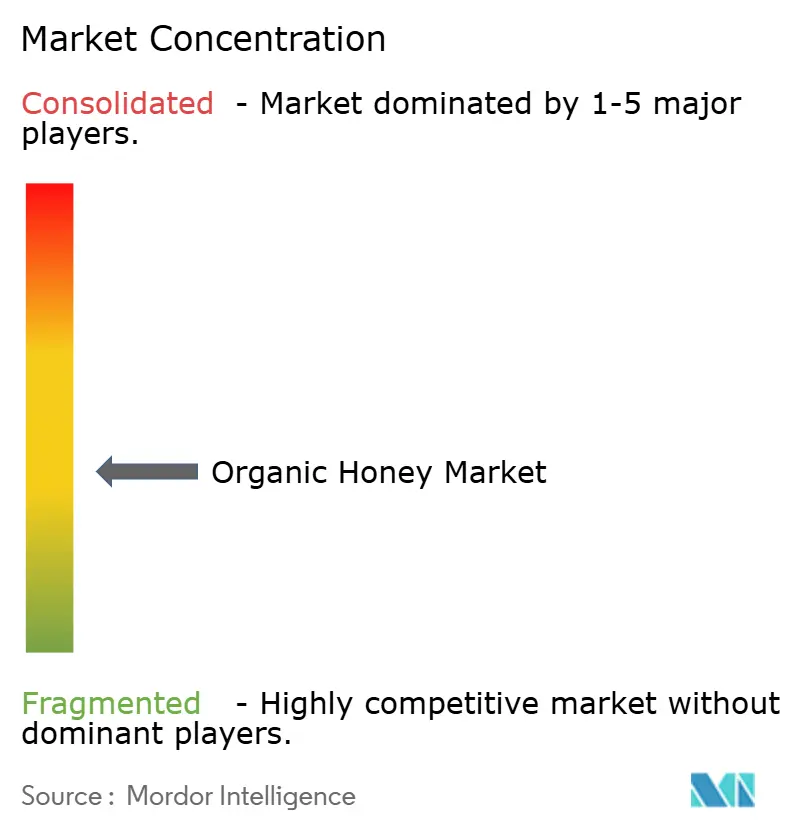
Technology adds another competitive dimension to the Organic honey market. A 2025 study based on interviews with 30 beekeeping experts identified 21 data points needed for smart honey traceability, including beekeeper identity, apiary location, composition data, and management records. IoT hive monitoring, drone mapping, and data-led colony management can reduce manual compliance work and improve responses to buyer audits. Affordable certified monofloral products, including acacia, linden, and regional varieties, remain an opening where awareness is building faster than verified supply. The sector remains fragmented because no single participant has a dominant global position, despite the growing importance of scale and traceability.
Organic Honey Industry Leaders
-
Comvita Limited
-
Nature Nate’s Honey Co.
-
Manuka Health New Zealand Limited
-
Dutch Gold Honey, Inc.
-
Barkman Honey LLC
- *Disclaimer: Major Players sorted in no particular order
Organic Honey Market Companies Covered in this Report
- Comvita Limited
- Manuka Health New Zealand Limited
- Nature Nate’s Honey Co.
- Dutch Gold Honey, Inc.
- Barkman Honey LLC
- Capilano Honey Limited
- Dabur India Limited
- Rowse Honey Limited
- Bee Maid Honey Limited
- Little Bee Impex Private Limited
- GloryBee, Inc.
- Madhava Natural Sweeteners, LLC
- Y.S. Eco Bee Farms, Inc.
- Heavenly Organics, LLC
- Wedderspoon Enterprises, Inc.
- Langnese Honig GmbH & Co. KG
- Conscious Food Private Limited
- Patanjali Ayurved Limited
- Balqees Honey
- Rigoni di Asiago S.r.l.
Recent Industry Developments in Organic Honey Market
- June 2026: Nate's Honey launched Nate's Organic Manuka Honey with 300+ MGO strength, UMF certification, and USDA organic status in 13.2 oz bottles on Amazon. In February 2026, Nate's became the number-one Manuka brand in U.S. food retail with dollar sales up 105% year over year per Circana.
- March 2026: Nate's Honey launched Organic Honey Minis, USDA-certified single-serve organic honey pouches for on-the-go and direct-to-consumer consumption, extending the addressable market into impulse, gifting, and travel retail verticals.
- October 2025: Sweet Harvest Foods opened a honey extraction facility in LaBelle, Florida, for Nate's Hives, which manages more than 120,000 bee colonies.
Global Organic Honey Market Report Scope
The Organic Honey Market refers to the market for honey produced by honeybees from floral nectar under organic production standards, including requirements related to beekeeping practices, hive management, and the use of approved substances, subject to applicable certification regulations. By type, the market is segmented into monofloral organic honey, multifloral organic honey, and other types. By packaging, the market is divided into bottles, tubs, tubes, and other packaging formats. By end-use, the market is segmented into retail, industrial, and foodservice/HoReCa. Geographically, the market covers North America, Europe, Asia-Pacific, South America, and the Middle East and Africa, with country-level coverage across major markets within each region. Market size and growth forecasts are presented in terms of value (USD) and volume (Liters).
Segmentation Overview
| Monofloral Organic Honey |
| Multifloral Organic Honey |
| Others |
| Bottles |
| Tubs |
| Tubes |
| Others |
| Retail | Supermarkets and Hypermarkets |
| Specialty Stores | |
| Convenience Stores | |
| Online Retail | |
| Industrial | |
| Foodservice/HORECA |
| North America | United States |
| Canada | |
| Mexico | |
| Rest of North America | |
| Europe | Germany |
| United Kingdom | |
| Italy | |
| France | |
| Spain | |
| Netherlands | |
| Poland | |
| Belgium | |
| Sweden | |
| Rest of Europe | |
| Asia-Pacific | China |
| India | |
| Japan | |
| Australia | |
| Indonesia | |
| South Korea | |
| Thailand | |
| Singapore | |
| Rest of Asia-Pacific | |
| South America | Brazil |
| Argentina | |
| Colombia | |
| Chile | |
| Peru | |
| Rest of South America | |
| Middle East and Africa | South Africa |
| Saudi Arabia | |
| United Arab Emirates | |
| Nigeria | |
| Egypt | |
| Morocco | |
| Turkey | |
| Rest of Middle East and Africa |
| By Type | Monofloral Organic Honey | |
| Multifloral Organic Honey | ||
| Others | ||
| By Packaging | Bottles | |
| Tubs | ||
| Tubes | ||
| Others | ||
| By End-Use | Retail | Supermarkets and Hypermarkets |
| Specialty Stores | ||
| Convenience Stores | ||
| Online Retail | ||
| Industrial | ||
| Foodservice/HORECA | ||
| By Geography | North America | United States |
| Canada | ||
| Mexico | ||
| Rest of North America | ||
| Europe | Germany | |
| United Kingdom | ||
| Italy | ||
| France | ||
| Spain | ||
| Netherlands | ||
| Poland | ||
| Belgium | ||
| Sweden | ||
| Rest of Europe | ||
| Asia-Pacific | China | |
| India | ||
| Japan | ||
| Australia | ||
| Indonesia | ||
| South Korea | ||
| Thailand | ||
| Singapore | ||
| Rest of Asia-Pacific | ||
| South America | Brazil | |
| Argentina | ||
| Colombia | ||
| Chile | ||
| Peru | ||
| Rest of South America | ||
| Middle East and Africa | South Africa | |
| Saudi Arabia | ||
| United Arab Emirates | ||
| Nigeria | ||
| Egypt | ||
| Morocco | ||
| Turkey | ||
| Rest of Middle East and Africa | ||
Key Questions Answered in the Report
What is the projected value of the Organic honey market by 2032?
The Organic honey market is forecast to reach USD 5.39 billion by 2032, growing at a 10.1% CAGR from 2027 to 2032. Growth is supported by demand for certified, traceable natural sweeteners.
Which Organic honey type holds the largest share?
Multifloral Organic Honey leads with a 51.2% share in 2026. Its scalable production and broad retail relevance support its position.
Which Organic honey segment is growing the fastest?
Foodservice/HORECA is projected to grow at a 12.3% CAGR through 2032. Operators use honey in beverages, sauces, condiments, and other menu applications.
Which region leads global demand?
North America leads with a 36.1% share in 2026. Established organic retail distribution and U.S. import documentation support demand.