
Oral Cancer Rapid Test Kit Market Size and Share
Market Overview
| Study Period | 2020 - 2031 |
|---|---|
| Market Size (2026) | USD 2.01 Billion |
| Market Size (2031) | USD 2.58 Billion |
| Growth Rate (2026 - 2031) | 5.12 % |
| Fastest Growing Market | Asia-Pacific |
| Largest Market | North America |
| Market Concentration | Medium |
Major Players *Disclaimer: Major Players sorted in no particular order Image © Mordor Intelligence. Reuse requires attribution under CC BY 4.0. | |
Oral Cancer Rapid Test Kit Market Analysis by Mordor Intelligence
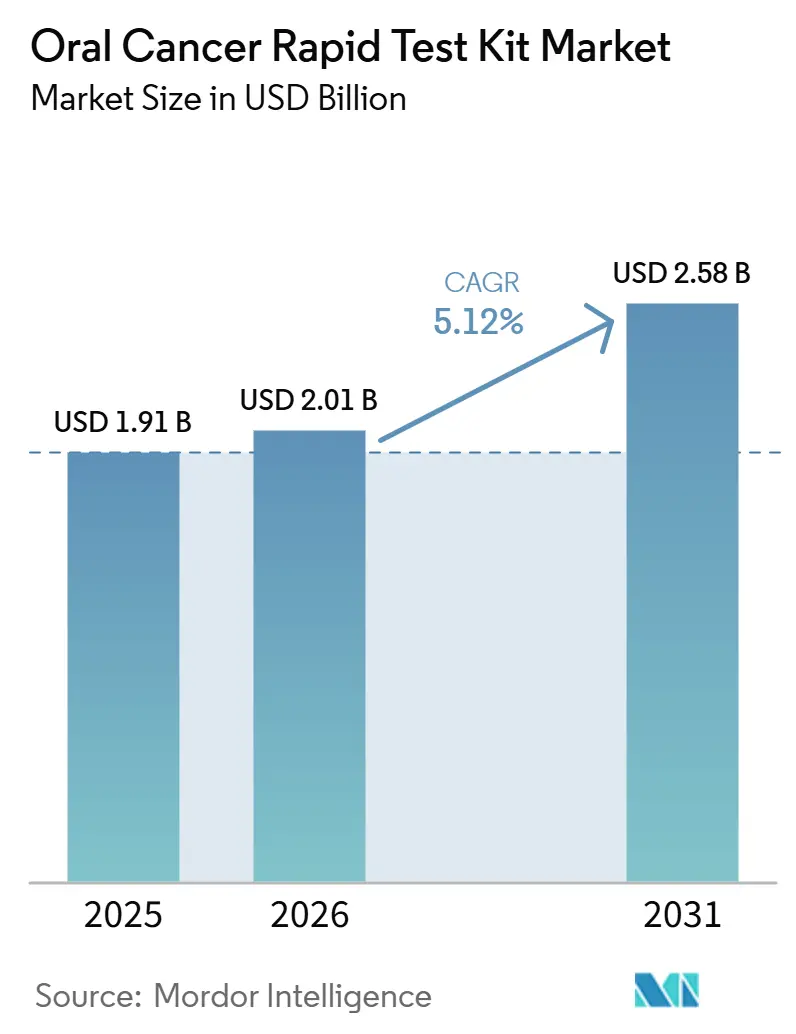
The Oral Cancer Rapid Test Kit Market size was valued at USD 1.91 billion in 2025 and is estimated to grow from USD 2.01 billion in 2026 to reach USD 2.58 billion by 2031, at a CAGR of 5.12% during the forecast period (2026-2031).
The market is supported by the need to identify the disease before it reaches advanced stages, when treatment becomes more difficult. Saliva-based testing is moving screening beyond pathology laboratories into dental practices, diagnostic centers, and selected home-collection pathways. This changes the route to diagnosis by making a rapid result available before a referral for tissue biopsy. The oral cancer rapid test kit market also faces a practical gap between clinical evidence and payer coverage, particularly where insurers continue to exclude salivary biomarker testing. Companies, therefore, need clinical evidence, workable collection methods, and distribution channels that can support use before reimbursement becomes broader.
Key Report Takeaways
- By product type, OncAlert Oral Cancer LAB led with 35.31% revenue share in 2025, while Lab-on-Chip Platforms are forecast to grow at a 6.65% CAGR through 2031.
- By detection principle, Immunoassay Tests held 41.24% revenue share in 2025, while Sensor-Based Tests recorded the highest projected CAGR at 7.42% through 2031.
- By sample type, Saliva-Based Testing held 46.24% revenue share in 2025 and is also forecast to grow at a 6.52% CAGR through 2031.
- By turnaround time, the 15-60 Minutes category accounted for 47.14% revenue share in 2025, while the Under 15 Minutes formats are forecast to expand at a 6.42% CAGR through 2031.
- By end user, Hospitals and Clinics held 45.84% revenue share in 2025, while Consumer and Home-Use Settings are forecast to grow at a 7.22% CAGR through 2031.
- By geography, North America held 41.41% revenue share in 2025, while Asia-Pacific is forecast to grow at a 6.25% CAGR through 2031.
Note: Market size and forecast figures in this report are generated using Mordor Intelligence’s proprietary estimation framework, updated with the latest available data and insights as of January 2026.
Global Oral Cancer Rapid Test Kit Market Trends and Insights
Drivers Impact Analysis*
| Driver | (~) % Impact on CAGR Forecast | Geographic Relevance | Impact Timeline |
|---|---|---|---|
| Rising Oral Cancer Incidence and High-Risk Exposure | +0.9% | Global, concentrated in South Asia, East Asia, and Sub-Saharan Africa | Long term (≥ 4 years) |
| Earlier Non-Invasive Detection Demand | +0.8% | North America and Europe, with adoption spillover to APAC | Medium term (2-4 years) |
| Decentralized Saliva Screening and Home Use | +0.8% | North America, Western Europe, early-stage uptake in APAC and MEA | Medium term (2-4 years) |
| Dental and Diagnostic Center Network Expansion | +0.7% | North America, EU, GCC, India | Short term (≤ 2 years) |
| Salivaomics and Multimarker Interpretation | +0.6% | North America, Japan, South Korea, Germany | Long term (≥ 4 years) |
| Portable Lab-on-Chip Adoption | +0.6% | Global, especially APAC and MEA in low-resource settings | Medium term (2-4 years) |
| Source: Mordor Intelligence | |||
Rising Oral Cancer Incidence and High-Risk Exposure
Tobacco use, betel-quid chewing, and HPV infection are increasing the need for earlier oral cancer screening across several regions. South Asia has the highest age-standardized incidence rate at 9.8 per 100,000 population, and the region accounts for 18.7% of global lip and oral cavity cancer deaths. HPV-associated oropharyngeal cancers among men have also increased across 44 countries in Europe, North America, South America, Australia, and New Zealand. This creates demand in both lower-income settings with high exposure to tobacco and betel quid and higher-income settings with HPV-related risk. The oral cancer rapid test kit market needs lower-cost saliva formats for primary care in South Asia and more sensitive molecular approaches for Western dental offices. These distinct patient groups limit the usefulness of a single product format across every setting.
Growing Demand for Earlier and Non-Invasive Detection
Tissue biopsy with histopathological analysis remains the diagnostic reference method, but it is invasive and difficult to use for broad population screening. A 2025 meta-analysis of 25 studies involving 4,112 patients found a pooled sensitivity of 89%, a specificity of 91%, and an AUC of 0.93 for salivary biomarker liquid biopsy. MicroRNA panels in that analysis showed 90% sensitivity and 92% specificity. A 2025 multimodal model using 1,527 samples reached 93.2% diagnostic accuracy and an AUC of 0.96, while reducing false negatives by 43% against conventional histopathology. In the oral cancer rapid test kit market, a chairside test can support triage by identifying patients who should proceed to invasive workup. Clinical recommendations can give dental practices a clearer basis for procurement when evidence supports their use.
Decentralized Screening and Home-Use Testing
The oral cancer rapid test kit market is moving from specialist channels toward general dental practice, public-health programs, and selected home-use pathways. SimplyTest partnered with Smile Source in July 2025 to bring salivary HPV oral cancer screening to more than 800 independent dental practices in the United States. Distributed testing can generate repeat demand for consumables without requiring large capital equipment purchases. It also introduces more variation in sample collection when use occurs outside controlled clinical environments. Gujarat's government dental screening program identified 3,023 premalignant oral cases from 12,915 examinations in 2025. This result shows the potential volume available through organized public-health screening in emerging economies. Dental and diagnostic-center networks can make testing more accessible, but they need standardized referral and confirmation pathways.
Salivaomics and Multimarker Interpretation
Salivaomics combines salivary genomic, proteomic, transcriptomic, metabolomic, and microbiomic information for diagnostic use. Multimarker panels that combine IL-6, IL-8, microRNAs, MMP-9, and VEGF can perform better than individual markers for oral squamous cell carcinoma screening. A March 2026 study validated a photonic-crystal microchip that detects salivary miRNA-31 at the point of care through an autocycling primer extension reaction. The oral cancer rapid test kit market can benefit when compact formats bring molecular sensitivity closer to the dental chair. AI-assisted multimarker interpretation and portable lab-on-chip platforms may raise clinician expectations for sensitivity beyond single-marker lateral flow tests. These approaches need robust validation before they can be widely adopted in routine screening.
Restraints Impact Analysis*
| Restraint | (~) % Impact on CAGR Forecast | Geographic Relevance | Impact Timeline |
|---|---|---|---|
| Limited Clinical Validation and Regulatory Uncertainty | -0.7% | Global, most acute in North America and EU | Long term (≥ 4 years) |
| Nonuniform Screening and Reimbursement Pathways | -0.6% | North America, Western Europe, structural in APAC and MEA | Medium term (2-4 years) |
| Collection, Storage, and Biomarker Stability Variability | -0.4% | Global, most critical in home use and low-resource settings | Short term (≤ 2 years) |
| False-Positive Risk and Confirmatory Biopsy Dependence | -0.4% | North America and EU | Medium term (2-4 years) |
| Source: Mordor Intelligence | |||
Limited Clinical Validation and Regulatory Uncertainty
The oral cancer rapid test kit market remains constrained by the level of evidence required for regulatory clearance and routine clinical use. As of 2026, no FDA-approved saliva-based standalone oral cancer test exists. PMC Breakthrough Device Designation can accelerate review, but it does not constitute marketing approval. Developers must also show that a test improves downstream outcomes, a standard that can require long-duration clinical data. The FDA's November 2025 proposal on downclassifying nucleic acid-based cancer companion diagnostics adds uncertainty for platforms that could expand into oral cancer modules. In Europe, IVDR requirements raise the clinical evidence threshold compared with the earlier framework, making regulatory planning central to international expansion.
Absence of Uniform Screening and Reimbursement Pathways
Inconsistent screening protocols and reimbursement routes limit the oral cancer rapid test kit market. Blue Cross Blue Shield policies issued from 2024 through 2026 state that salivary biomarker testing does not meet coverage criteria for oral cancer screening, detection, or diagnosis. BCBSIL Medicare does not cover ADA code D0431 under routine dental benefits, although it covers biopsies performed during oncological workup[1]Centers for Medicare & Medicaid Services, “Medicare Dental Coverage,” CMS, cms.gov.. This leaves companies dependent on direct patient payments and procurement by hospitals and dental service organizations. Collection and storage also matter because salivary protein analytes can degrade, and microRNA levels vary with collection timing, oral hygiene, and recent food intake. A positive screening result still needs a confirmatory biopsy, which limits the use of a rapid kit as a standalone diagnostic result.
*Our forecasts treat driver/restraint impacts as directional, not additive. The impact forecasts reflect baseline growth, mix effects, and variable interactions.
Segment Analysis
By Product Type: Lab-on-Chip Platforms Challenge Lateral Flow Leadership
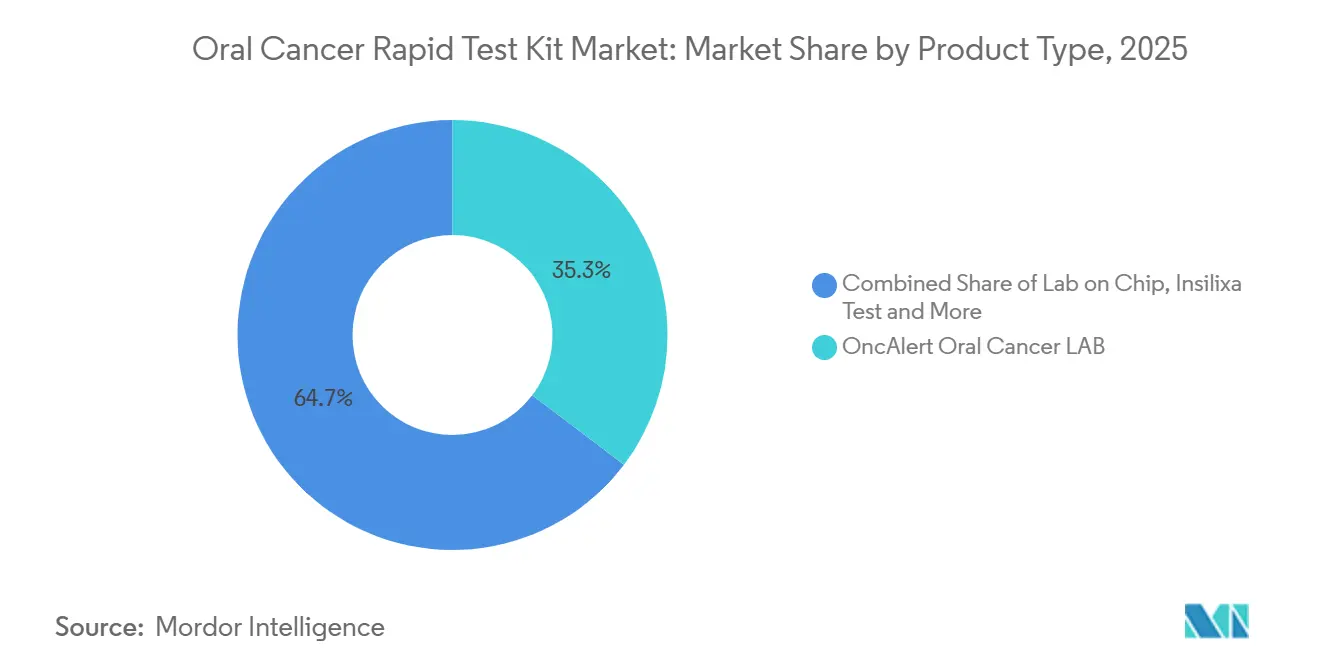
OncAlert Oral Cancer LAB held 35.31% of the oral cancer rapid test kit market share by product type in 2025. Its position reflects the earlier clinical development and chairside feasibility of established lateral flow immunoassay formats. A 2026 OncAlert RAPID study evaluates soluble CD44 and total protein in saliva to support decisions on evaluation or initial biopsy. Lab-on-Chip Platforms are forecast to grow at a 6.65% CAGR through 2031. Microfluidics and nucleic acid amplification can place laboratory-style analytical functions in compact cartridges. A 2026 review identified translational oncology value for point-of-care molecular diagnostics using microfluidic lab-on-chip formats.
The Insilixa Test and Prevo-Check retain positions in early-adopter clinical laboratory settings. The oral cancer rapid test kit market benefits when these laboratories can compare several biological signals in a single workflow. Their ability to assess multiple genetic and protein markers differentiates them from single-marker lateral flow formats. Other product types include AI-enabled brush-biopsy cytomics platforms such as OraLiva's Onc In-Cyt, which operate as CLIA-certified laboratory-developed tests while FDA clearance is pursued. The oral cancer rapid test kit industry is likely to favor platforms that can present stronger clinical validation evidence. This need becomes more important as dental guidance sets clearer expectations for early-detection evidence. Lateral flow and microfluidic developers both need evidence that supports institutional adoption at scale.



By Detection Principle: Immunoassay Leads While Sensor-Based Tests Gain Ground
Immunoassay Tests held 41.24% of the detection-principle segment in 2025. Mature lateral flow manufacturing, established antibody pairs for biomarkers such as IL-8 and CD44, and compatibility with chairside workflows support this position. Antibody recognition provides analyte specificity, which has supported clinical acceptance. However, single-analyte formats can face sensitivity limits as multiplex molecular data sets become more important in cancer detection. Sensor-Based Tests are forecast to grow at a 7.42% CAGR through 2031. Electrochemical and photonic biosensors can detect oral squamous cell carcinoma-related microRNAs, proteins, and exosomal markers in compact formats.
A 2026 study demonstrated sensitive detection of CD63 and CD44 exosomes in oral cancer cell lines using antibody-functionalized Janus particles. This work supports the development path from academic biosensing research toward clinical devices. Colorimetric tests remain relevant in high-incidence areas where instruments are limited and visual results are necessary. The oral cancer rapid test kit market also needs formats that can operate with limited supporting equipment. Molecular diagnostic and electrochemical formats are emerging alongside established immunoassays. ISO 15189 accreditation affects validation expectations for new detection principles in clinical use. Developers seeking international scale must address both FDA and IVDR compliance requirements.
By Sample Type: Saliva Supports Chairside and Home Collection
Saliva-Based Testing held 46.24% of the sample-type segment in 2025 and also led forecast growth through 2031. Saliva is noninvasive, can be self-collected, and contains biomarkers including miRNA-31, IL-8, MMP-9, circulating tumor DNA, and exosomes. These properties make it suitable for chairside testing and home collection. Machine learning models based on salivary microbial signatures have reported AUC values of up to 96.9% for oral squamous cell carcinoma in cross-cohort analysis. The oral cancer rapid test kit market needs collection processes that protect analytical quality across these settings.
Salivary proteases can degrade protein analytes during transport and storage. MicroRNA levels can also vary with collection time, oral hygiene, and recent food intake. These conditions can introduce variability that affects confidence in home-use results. The oral cancer rapid test kit market must account for this variability before home collection can become routine. Oral swabs are the second-largest sample type and remain useful for dental-chair collection where saliva devices are unavailable. Blood-based multi-cancer early detection platforms may provide a complementary screening tier, but they have lower organ-of-origin resolution for early oral lesions. Gingival crevicular fluid and exfoliative cytology washes remain in preclinical development and have limited commercial importance.
By Turnaround Time: Faster Results Support Same-Visit Decisions
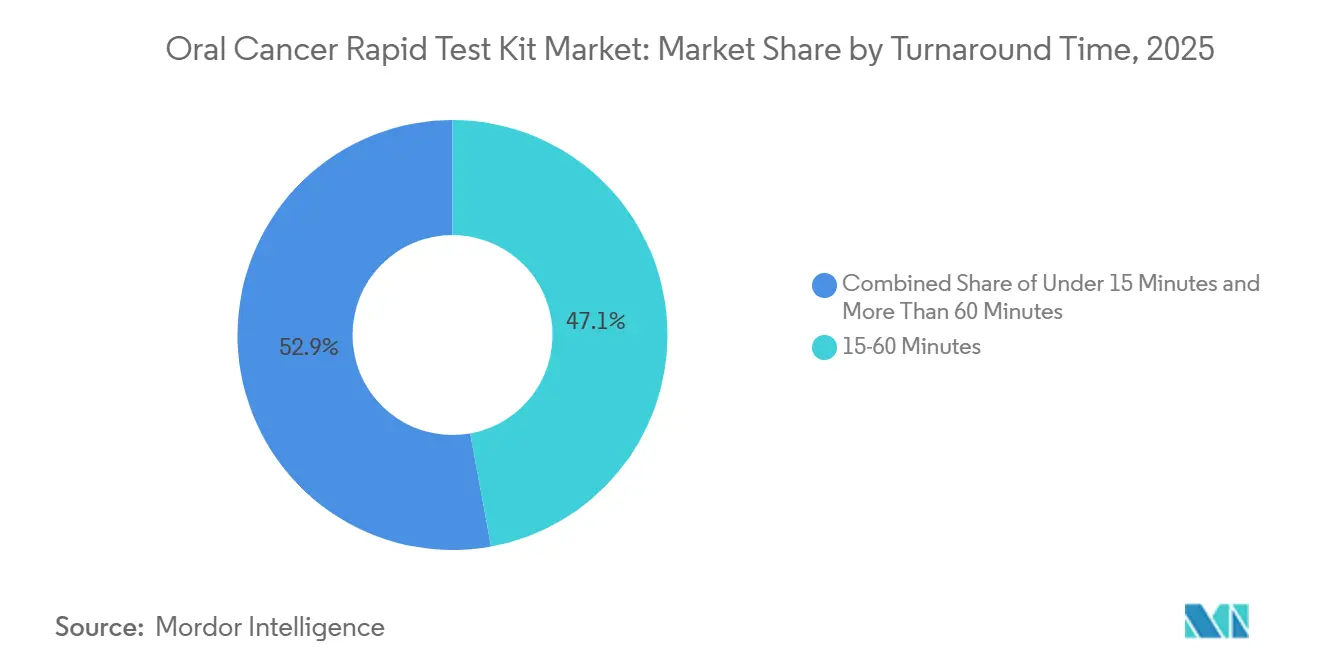
The 15-60 Minutes category held 47.14% of the turnaround-time segment in 2025. This reflects the time required by many clinically validated lateral flow and rapid immunoassay formats to provide a reliable chairside result. The category includes OncAlert RAPID and the BeVigilant OraFusion System. Vigilant Biosciences states that its system provides results in 10 minutes from saliva collection using machine-learning-assisted biomarker analysis. Under 15 Minutes formats are forecast to grow at a 6.42% CAGR through 2031. Paper-based microfluidic and gold-nanoparticle colorimetric platforms can support binary results without reagent preparation.
The More Than 60 Minutes category covers laboratory-processed molecular tests, including Insilixa Test, qMIDSV3, and CancerDetect. These tests offer greater multiplex capability but need sample shipment and laboratory infrastructure. A June 2026 qMIDSV3 study across 1,090 oral brush biopsy samples reported 95.7% sensitivity and 95.1% specificity for a 4-gene mRNA panel, with results in under 1 hour. This shows how molecular turnaround times are narrowing. Same-visit delivery affects clinical workflow and may affect eligibility for point-of-care billing categories. The oral cancer rapid test kit market is better aligned with dental visits when results arrive before the patient leaves. The oral cancer rapid test kit market will favor speed only where results remain dependable.
By End User: Consumer Use Grows Alongside Dental Networks
Hospitals and Clinics held 45.84% of the end-user segment in 2025. These settings are the primary location for oral cancer workup and confirmatory biopsy. Rapid kits are therefore used as pre-biopsy triage aids rather than independent diagnostic tools. A result that separates lower-risk and higher-risk patients can help oral and maxillofacial surgeons prioritize biopsy scheduling. Diagnostic Centers hold a meaningful secondary role because they receive referrals from general dental practitioners without in-office testing. Consumer and Home-Use Settings are forecast to grow at a 7.22% CAGR through 2031.
Self-collection saliva models can be linked with professional interpretation through secure digital portals. This structure can extend access for patients who cannot readily reach specialist care. Ambulatory Care Centers are expanding as dental service organizations standardize screening across multi-site networks. Bulk procurement can reduce the cost per test for these networks. The oral cancer rapid test kit market can use these organized networks to apply a consistent screening protocol. The oral cancer rapid test kit industry depends on coding and coverage progress before preventive dental care can absorb a much larger test volume. Until then, hospitals, diagnostic centers, and consumer channels will face different payment and workflow conditions. These differences require developers to tailor distribution and support to each end user.
Geography Analysis
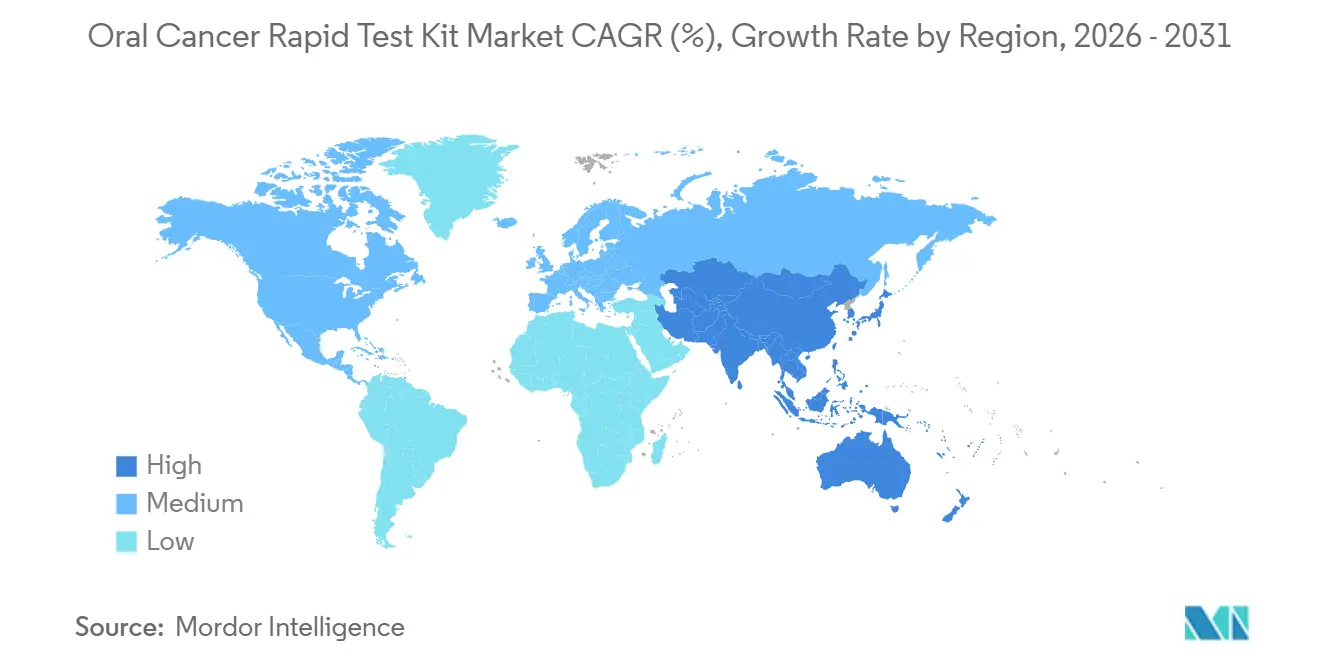
North America held 41.41% of the oral cancer rapid test kit market share in 2025. Dense dental networks, diagnostic-center channels, and FDA development pathways support the region's position. The United States has a substantial institutional base for research and hospital-based diagnostics. Canada and Mexico offer growth potential, but their reimbursement frameworks and diagnostic infrastructure differ from those in the United States. The oral cancer rapid test kit market requires localized payment and channel strategies in these countries. This makes the rapid transfer of a United States commercial model difficult. The oral cancer rapid test kit market in North America will remain shaped by the pace at which clinical validation reaches payer acceptance.
Europe held the second-largest regional position in 2025. IVDR conformity can be a demanding compliance requirement, but it can also support access to international markets. Vigilant Biosciences received IVDR approval for international expansion of its BeVigilant OraFusion System in 2025[2]Vigilant Biosciences, “Receives IVDR Approval for International Expansion of BeVigilant OraFusion System,” Vigilant Biosciences, vigilantbiosciences.com.. Germany, the United Kingdom, and France are the largest national markets in the region. Structured health systems and early-detection programs provide an institutional setting for oral screening tools. Compliance evidence can become a commercial advantage where purchasers prefer established documentation.
Asia-Pacific is forecast to grow at a 6.25% CAGR through 2031. India is a high-volume opportunity because tobacco and betel-quid chewing contribute to a large oral cancer burden, especially in rural populations with limited specialist access. South Korea and Australia add higher-income demand, while Southeast Asian populations with high betel-nut exposure remain underserved. The Middle East and Africa are early-stage markets linked to GCC health infrastructure investment. Brazil has the strongest South American position because of its oral cancer burden and expanding diagnostic center network.

Competitive Landscape
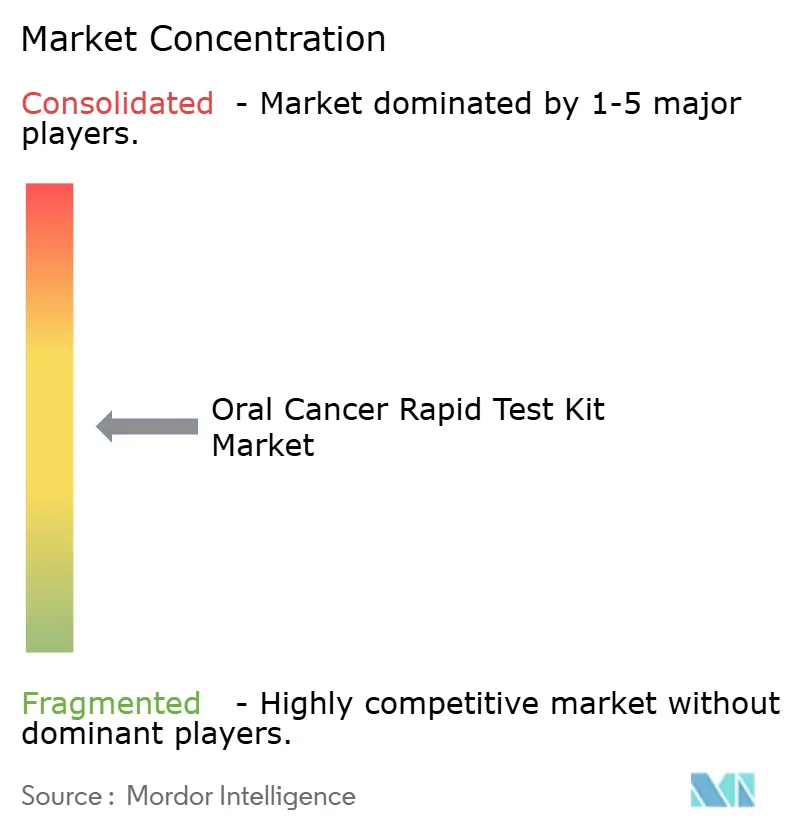
The oral cancer rapid test kit market overall is moderately fragmented. Vigilant Biosciences, OraLiva, and OrisDX focus more directly on oral cancer diagnostics. Their clinical evidence, regulatory progress, and channel access will affect which formats reach broad use. The oral cancer rapid test kit market does not provide a combined share for the leading companies, so a quantitative concentration ranking cannot be established from the available data.
Vigilant Biosciences partnered with AMP in January 2026 for United Kingdom distribution after its IVDR clearance[3]Vigilant Biosciences, “Partners with AMP as a Distributor in the UK,” Vigilant Biosciences, vigilantbiosciences.com.. Forward Science expanded the reach of its OralID screening product through a July 2025 partnership with Digital Doc's dental imaging network. SimplyTest launched a saliva-based oral HPV test in October 2025 that combined HPV detection with oral cancer-linked risk screening. These actions show that distribution relationships and integrated testing formats are central to commercial access. The oral cancer rapid test kit market offers room for low-cost sensor kits in high-incidence areas and multiplex platforms for dental service organizations. Firms need dependable collection workflows as well as analytical performance.
Potential competition also comes from blood-based multi-cancer detection tests that may complement oral-specific testing for high-risk patients. GRAIL submitted a Premarket Approval application for Galleri in January 2026, and an FDA advisory committee meeting was scheduled for September 23, 2026. Blood-based tests do not necessarily replace oral-specific rapid kits because early oral lesions need more specific local assessment. ISO 13485 quality management and IVDR or FDA compliance are becoming minimum requirements for large institutional procurement. These conditions can favor firms with stronger clinical validation programs and regulatory resources. The oral cancer rapid test kit market will remain open to specialist innovation while platform suppliers retain influence over scale and distribution.
Oral Cancer Rapid Test Kit Industry Leaders
Vigilant Biosciences
Viome Life Sciences
Abviris Deutschland GmbH
ErlySign
Supriya Lifescience Ltd.
- *Disclaimer: Major Players sorted in no particular order

Recent Industry Developments
- August 2026: A Case Western Reserve University-led research team started developing a noninvasive oral cancer test to help clinicians decide, chairside and within minutes, whether a suspicious lesion in the mouth needs a biopsy. The work is supported by a new five-year, USD 2.93 million grant from the National Cancer Institute (NCI), part of the National Institutes of Health (NIH).
- July 2026: A paper published in the Nature journal Biomarker Research by a cross-University team led by Queen Mary University of London researchers validated the use of a non-invasive brush biopsy test that can detect oral cancer within one hour.


Global Oral Cancer Rapid Test Kit Market Report Scope
As per the scope of the report, an oral cancer rapid test kit is a diagnostic tool designed to quickly detect the presence of markers or abnormal cells associated with oral cancer. It typically involves a simple, minimally invasive procedure such as a saliva or tissue sample collection, and provides results in a short period, aiding in early diagnosis and prompt treatment.
The oral cancer rapid test kit market is segmented by product type into OncAlert Oral Cancer LAB, Lab-on-a-Chip, Insilixa Test, Prevo-Check, and other product types. By detection principle, the market is segmented into sensor-based tests, colorimetric tests, immunoassay tests, molecular diagnostic tests, electrochemical tests, and other detection principles. By sample type, the market is segmented into saliva, oral swabs, blood, and other sample types. By turnaround time, the market is segmented into less than 15 minutes, 15–60 minutes, and more than 60 minutes. By end user, the market is segmented into hospitals and clinics, diagnostic centers, ambulatory care centers, consumer and home-use settings, and other end users. By geography, the market is segmented into North America, Europe, Asia-Pacific, the Middle East and Africa, and South America. The market report also covers the estimated market sizes and trends for 17 countries across major regions globally. For each segment, the market size and forecast are provided in terms of value (USD).
| OncAlert Oral Cancer LAB |
| Lab on Chip |
| Insilixa Test |
| Prevo-Check |
| Other Product Types |
| Sensor-Based Tests |
| Colorimetric Tests |
| Immunoassay Tests |
| Molecular Diagnostic Tests |
| Electrochemical Tests |
| Other Detection Principles |
| Saliva |
| Oral Swab |
| Blood |
| Other Sample Types |
| Under 15 Minutes |
| 15-60 Minutes |
| More Than 60 Minutes |
| Hospitals and Clinics |
| Diagnostic Centers |
| Ambulatory Care Centers |
| Consumer and Home-Use Settings |
| Other End Users |
| North America | United States |
| Canada | |
| Mexico | |
| Europe | Germany |
| United Kingdom | |
| France | |
| Italy | |
| Spain | |
| Rest of Europe | |
| Asia-Pacific | China |
| Japan | |
| India | |
| Australia | |
| South Korea | |
| Rest of Asia-Pacific | |
| Middle East and Africa | GCC |
| South Africa | |
| Rest of Middle East and Africa | |
| South America | Brazil |
| Argentina | |
| Rest of South America |
| By Product Type | OncAlert Oral Cancer LAB | |
| Lab on Chip | ||
| Insilixa Test | ||
| Prevo-Check | ||
| Other Product Types | ||
| By Detection Principle | Sensor-Based Tests | |
| Colorimetric Tests | ||
| Immunoassay Tests | ||
| Molecular Diagnostic Tests | ||
| Electrochemical Tests | ||
| Other Detection Principles | ||
| By Sample Type | Saliva | |
| Oral Swab | ||
| Blood | ||
| Other Sample Types | ||
| By Turnaround Time | Under 15 Minutes | |
| 15-60 Minutes | ||
| More Than 60 Minutes | ||
| By End User | Hospitals and Clinics | |
| Diagnostic Centers | ||
| Ambulatory Care Centers | ||
| Consumer and Home-Use Settings | ||
| Other End Users | ||
| By Geography | North America | United States |
| Canada | ||
| Mexico | ||
| Europe | Germany | |
| United Kingdom | ||
| France | ||
| Italy | ||
| Spain | ||
| Rest of Europe | ||
| Asia-Pacific | China | |
| Japan | ||
| India | ||
| Australia | ||
| South Korea | ||
| Rest of Asia-Pacific | ||
| Middle East and Africa | GCC | |
| South Africa | ||
| Rest of Middle East and Africa | ||
| South America | Brazil | |
| Argentina | ||
| Rest of South America | ||


Key Questions Answered in the Report
What is driving demand for oral cancer rapid test kits?
Earlier detection needs, saliva-based sampling, and screening expansion through dental and diagnostic channels are supporting adoption.
How large is the oral cancer rapid test kit market?
It is projected to grow from USD 2.01 billion in 2026 to USD 2.58 billion by 2031 at a 5.12% CAGR.
Which product type holds the largest position?
OncAlert Oral Cancer LAB held the leading product-type share at 35.31% in 2025.
Which testing method is growing fastest?
Sensor-Based Tests are projected to grow at a 7.42% CAGR through 2031.
Why is saliva used for oral cancer screening?
Saliva is noninvasive, can be self-collected, and contains several biomarkers associated with oral squamous cell carcinoma.
What is limiting the broader adoption of rapid kits?
Clinical validation requirements, inconsistent screening practices, reimbursement exclusions, and the need for confirmatory biopsy remain key constraints.
Page last updated on:





