
Open Network Testing and Certification Market Size and Share
Market Overview
| Study Period | 2020 - 2031 |
|---|---|
| Market Size (2026) | USD 2.91 Billion |
| Market Size (2031) | USD 6.76 Billion |
| Growth Rate (2026 - 2031) | 18.36 % |
| Fastest Growing Market | Middle East |
| Largest Market | North America |
| Market Concentration | Medium |
Major Players *Disclaimer: Major Players sorted in no particular order Image © Mordor Intelligence. Reuse requires attribution under CC BY 4.0. | |
Open Network Testing and Certification Market Analysis by Mordor Intelligence
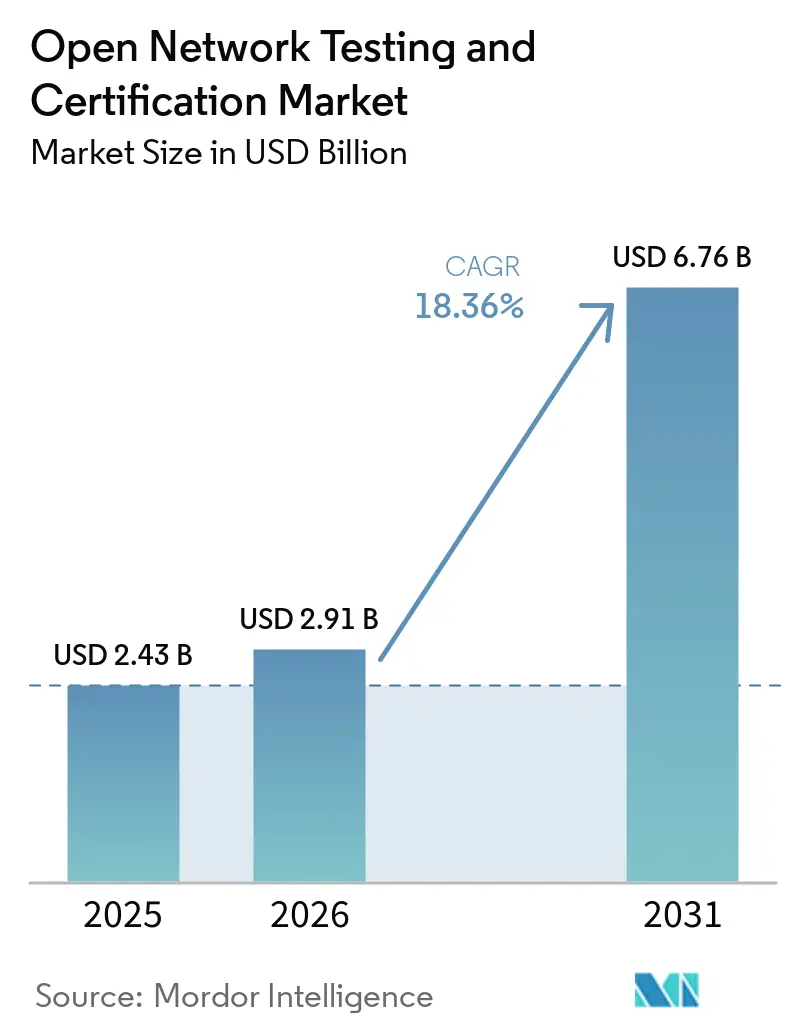
The open network testing and certification market size is projected to expand from USD 2.43 billion in 2025 to USD 2.91 billion in 2026, and to USD 6.76 billion by 2031, registering a CAGR of 18.36% between 2026 and 2031. Growth is tied to operator investment in Open RAN infrastructure across North America, Asia-Pacific, and the Gulf Cooperation Council. This investment is shifting testing from an internal engineering activity to a structured workflow that involves operators, vendors, laboratories, and systems integrators. The O-RAN Alliance completed Release 5 in June 2026, adding coverage for advanced massive MIMO beamforming and AI-native RAN functions and aligning future releases with 3GPP timelines. These additions broaden the scope of work available to qualified Open Testing and Integration Centers and require vendors to update their validation tools. AI-enabled radio functions also widen the testing scope because deterministic conformance procedures cannot fully assess variable model behavior. The open network testing and certification market, therefore, has opportunities in digital twin simulation, over-the-air behavioral validation, AI model benchmarking, and managed test services.
Key Report Takeaways
- By offering, Testing Hardware held 44.28% market share in the open network testing and certification market in 2025, while Professional Services is projected to expand at a 19.28% CAGR through 2031.
- By application, 5G Network Deployment accounted for 48.52% of the open network testing and certification market share in 2025, while Cloud RAN Testing is expected to grow at a 20.34% CAGR through 2031.
- By end user, Telecom Network Operators held 38.41% market share in the open network testing and certification market in 2025, while Certification Laboratories are forecast to grow at a 20.83% CAGR through 2031.
- By deployment model, On-Premises testing retained 42.39% share in 2026, while Cloud-Based testing is projected to expand at a 20.27% CAGR through 2031.
- By network architecture, Virtualized RAN held 40.36% share in 2025, while Disaggregated RAN testing is expected to advance at a 19.96% CAGR through 2031.
- By service type, Managed Testing accounted for 36.42% share in 2025, while Certification services are forecast to grow at a 20.36% CAGR through 2031.
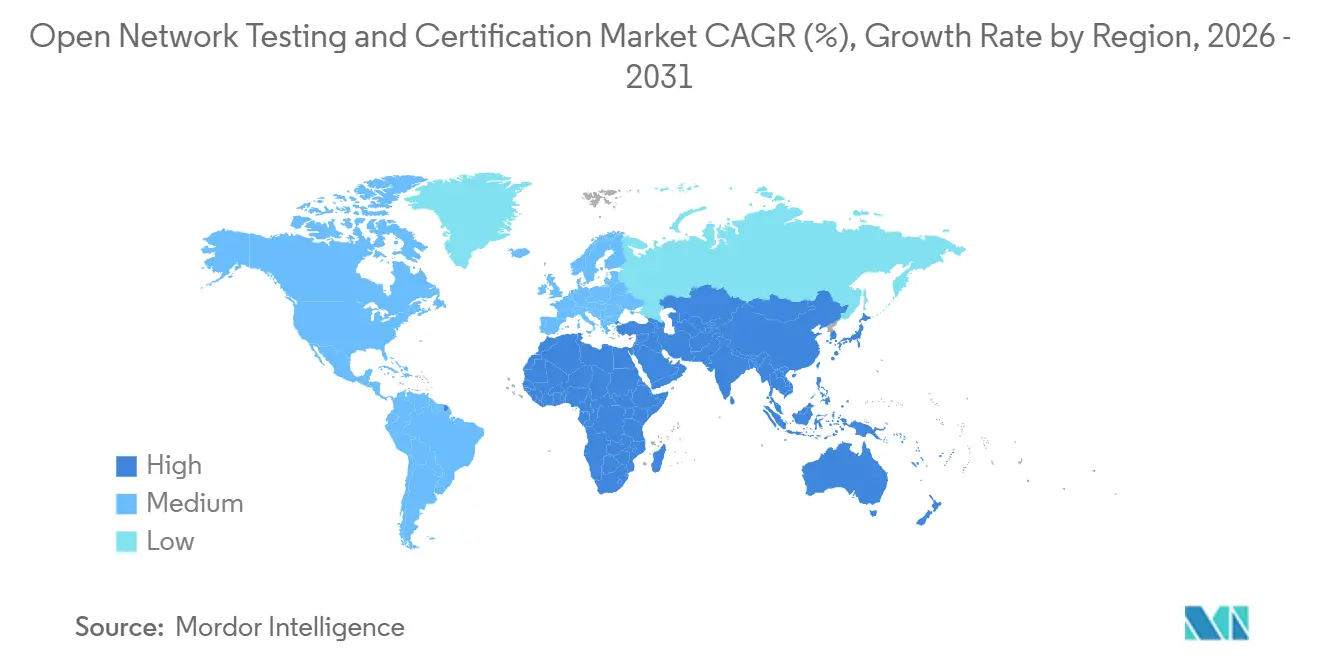
- By geography, North America held 37.24% market share in the open network testing and certification market in 2025, while Middle East is projected to expand at a 20.14% CAGR through 2031.
Note: Market size and forecast figures in this report are generated using Mordor Intelligence’s proprietary estimation framework, updated with the latest available data and insights as of January 2026.
Global Open Network Testing and Certification Market Trends and Insights
Drivers Impact Analysis*
| Driver | (~) % Impact on CAGR Forecast | Geographic Relevance | Impact Timeline |
|---|---|---|---|
| O-RAN Standardization and Certification Adoption | +4.2% | Global, concentrated in North America, Europe, and Asia-Pacific | Short term (≤ 2 years) |
| 5G and 5G Advanced Network Expansion | +3.8% | Global, strongest pull from Asia-Pacific and Middle East | Medium term (2-4 years) |
| Multi-Vendor Interoperability Risk | +3.2% | North America, Europe, and Asia-Pacific markets with advanced Open RAN deployments | Short term (≤ 2 years) |
| Cloud-Native and Virtualized RAN Validation Demand | +2.9% | Global, with early gains in North America and Southeast Asia | Medium term (2-4 years) |
| Operator Demand for Vendor-Neutral Test Once and Deploy Many Workflows | +2.4% | Global, with spillover to the Middle East and Africa | Medium term (2-4 years) |
| AI-Assisted Continuous Testing and Digital Twin Simulation | +1.8% | North America and Asia-Pacific, with spillover to Europe | Long term (≥ 4 years) |
| Source: Mordor Intelligence | |||
O-RAN Standardization and Certification Adoption
The O-RAN Certification and Badging Program uses conformance certificates, interoperability badges, and end-to-end badges to support test-once, deploy-many workflows. This structure is making formal credentials more important in multi-vendor procurement decisions. Japan OTIC awarded Rakuten Symphony conformance certification and an interoperability badge in January 2026, completing all 3 credential classes for the vendor. Repeated credentialing turns isolated lab activity into a repeatable service that laboratories can offer across vendor programs. ETSI formalized the O-RAN R1 interface test specification through its Publicly Available Specification process in February 2026. The open network testing and certification market gains a clearer basis for compliance as those test requirements enter European procurement and technical review processes.
5G and 5G Advanced Network Expansion
5G rollouts require validation from spectrum qualification through radio conformance, fronthaul timing, and feature testing. 5G Advanced adds carrier aggregation, massive MIMO beamforming, and AI-enabled RAN control to the validation workload. The O-RAN Alliance Spring 2026 Global PlugFest included multi-vendor massive MIMO integration and over-the-air testing. Digital Catapult reported that participants completed end-to-end massive MIMO testing at the United Kingdom's first. These activities show that beamforming validation has moved beyond laboratory research into formal interoperability programs. The open network testing and certification market benefits as operators require testing for both radio performance and AI-based network functions.
Multi-Vendor Interoperability Risk
Open RAN systems combine components from different suppliers, creating integration work before formal procedures can begin. Digital Catapult stated that system setup and multi-vendor integration accounted for 70-80% of the activity at the Spring 2026 PlugFest. NTT EAST released a March 2026 report on a private 5G RIC connectivity test involving 26 companies. The work also documented power reduction under specified conditions through RIC-driven radio control. The October 2025 xG-ALOE Plugfest tested components across timing-sensitive networking, localization, sensing, and security, in collaboration with 12 organizations. The open network testing and certification market thus needs services to assess interactions across the radio, transport, cloud, timing, and security layers.
Cloud-Native and Virtualized RAN Validation Demand
Containerized RAN software adds infrastructure benchmarking, orchestration checks, and container security testing to established RF procedures. Spirent introduced cloud-native infrastructure benchmarking in Landslide during October 2025 for CPU, memory, storage, and network readiness. Vodafone tested O-Cloud container platforms across more than 500 test cases in its 2025 benchmark. VIAVI expanded its VALOR Lab-as-a-Service facility in April 2025 with an RF-shielded anechoic chamber and 2 customer labs. The facility provides a means for vendors to integrate cloud-based preliminary checks with physical radio measurements. The open network testing and certification market can serve smaller suppliers that need carrier-grade validation without building a full laboratory.
Restraints Impact Analysis*
| Restraint | (~) % Impact on CAGR Forecast | Geographic Relevance | Impact Timeline |
|---|---|---|---|
| High Cost of Advanced Test and Measurement Infrastructure | -2.4% | Global, most acute in South America and Africa | Short term (≤ 2 years) |
| Multi-Domain Integration Complexity | -2.1% | Global, particularly in Europe and Asia-Pacific with legacy network layers | Medium term (2-4 years) |
| Evolving O-RAN Specifications and Test Case Volatility | -1.7% | Global, concentrated in North America and Europe where certification timelines are strictest | Short term (≤ 2 years) |
| Limited Availability of Specialized Open RAN Test Engineering Talent | -1.4% | Global, acute in the Middle East and Africa | Long term (≥ 4 years) |
| Source: Mordor Intelligence | |||
High Cost of Advanced Test and Measurement Infrastructure
Carrier-grade O-RU test rigs require signal generators, spectrum analyzers, emulators, and often RF-shielded over-the-air chambers. These assets can require several million dollars of investment for a single facility. The U.S. National Telecommunications and Information Administration integrated 3 commercial Open RAN systems into its CRAIN laboratory in 2025.[1]U.S. National Telecommunications and Information Administration, “Lessons Learned from ITS Open RAN System Integration,” Institute for Telecommunication Sciences, its.ntia.gov Its work showed the configuration and hardware dependencies involved in establishing a multi-vendor environment. This cost favors vendors with broad instrument portfolios and resources to keep pace with standards releases. It also limits local testing capacity in South America and Africa, where access to Lab-as-a-Service facilities remains constrained.
Multi-Domain Integration Complexity
Open RAN validation spans virtualized computing, PTP and SyncE timing, optical transport, RIC control loops, and cloud-native orchestration. The xG-ALOE Plugfest showed that testing extends beyond fronthaul interfaces to include timing-sensitive networking, localization, sensing, and security. This breadth makes it difficult to assemble teams with expertise in radio, cloud, and synchronization within a single program. Germany requires security evaluations for 5G operators, adding an independent compliance review to technical integration work. The open network testing and certification market faces longer project cycles, with limited local OTIC capacity. The complexity also supports demand for specialist integrators that can coordinate several testing disciplines.
*Our forecasts treat driver/restraint impacts as directional, not additive. The impact forecasts reflect baseline growth, mix effects, and variable interactions.
Segment Analysis
By Offering: Hardware Leads, but Services Reshape Revenue Mix
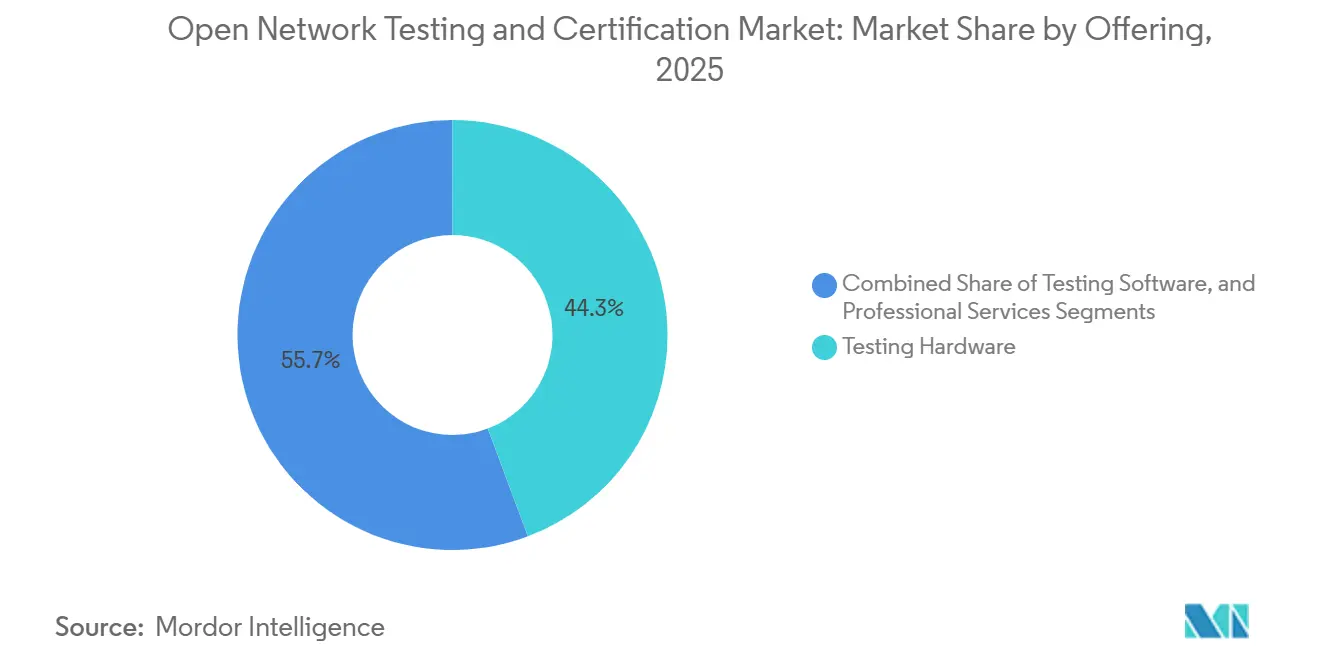
Testing Hardware held 44.28% of the offering segment in 2025. Physical RF validation still requires carrier-grade signal generators, O-RU conformance rigs, and spectrum analyzers. Software emulation cannot replace those tools for massive MIMO beam patterns or S-plane timing tolerance checks. Rohde and Schwarz and VIAVI supported the Berlin i14y Lab in its first European O-RAN conformance certification for an indoor O-RU from VVDN Technologies. Their approach paired the R and S SMW200A signal generator with the VIAVI TM500 O-RU Tester. This example shows why instrument quality and software integration remain central to the open network testing and certification market.
Professional Services is projected to grow at a 19.28% CAGR from 2026 to 2031. Operators increasingly use managed programs because experienced Open RAN test engineers are scarce. In the open network testing and certification market, Testing Software provides automation, orchestration, and analytics across the hardware layer. Each new O-RAN specification release adds test cases and requires continuing software updates. The Telecom Infra Project released the Small Cell End-to-End Test Plan Version 2 in 2025 to support validation of disaggregated 5G NR small cells. This standard expansion supports hardware, software, and the open network testing and certification industry services that connect them.



By Application: Deployment Testing Anchors, Cloud RAN Testing Surges
5G Network Deployment accounted for 48.52% of the application-level share in 2025. Operators must qualify radio units, validate fronthaul timing, and complete security assurance before site activation. These activities make deployment testing the core source of demand across the open network testing and certification market. Open RAN Integration testing is becoming a separate budget area as projects move from trials to commercial deployments. Digital twin platforms are being used to support behavioral analysis and identify potential failure conditions before production deployment. This work expands the need for coordinated testing across physical and virtual network components.
Cloud RAN Testing is forecast to grow at a 20.34% CAGR from 2026 to 2031. Carrier migration to containerized RAN creates requirements for Kubernetes validation, infrastructure benchmarking, and distributed-compute behavioral testing. This work differs from conventional radio conformance because performance depends on both software and the underlying compute environment. 4G Network Modernization remains relevant where operators refresh legacy systems using O-RAN-compliant O-eNB equipment. Within the open network testing and certification market, Telecom Equipment Validation also supports supply-chain qualification before equipment reaches field deployment.
By End User: Operators Anchor Spend, Certification Laboratories Scale Fastest
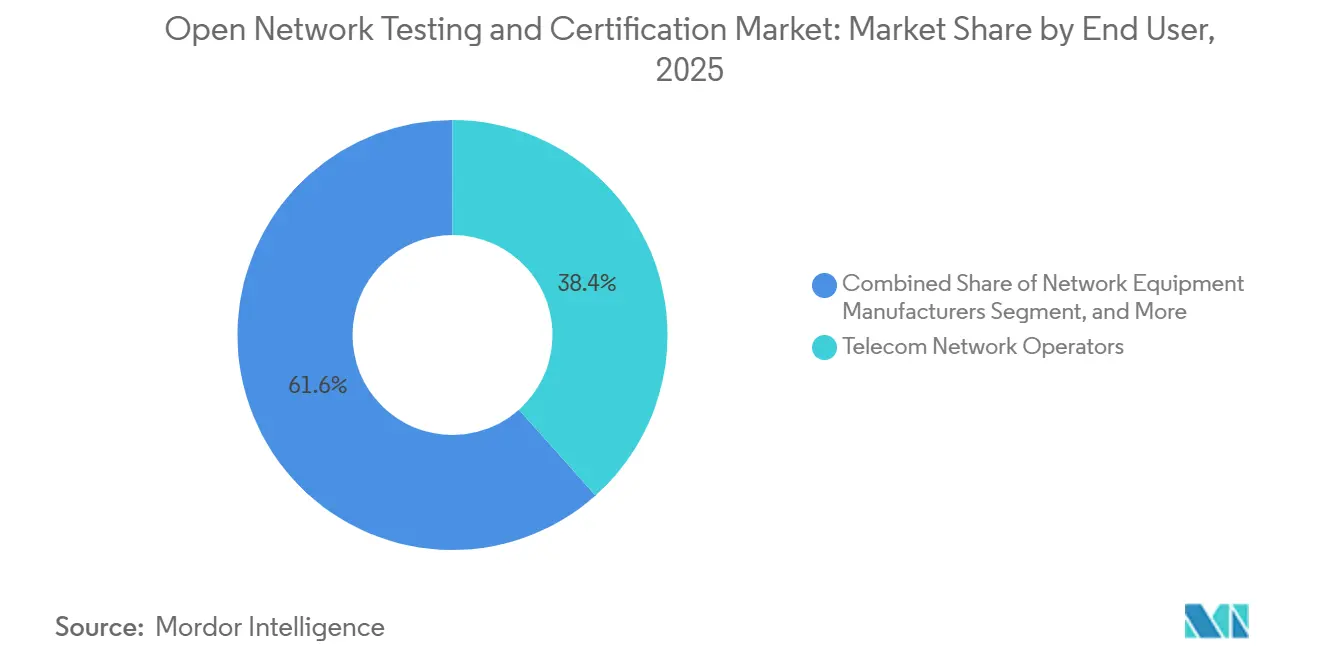
Telecom Network Operators held 38.41% of the end-user share in 2025. Operators purchase testing services and also make the final acceptance decision before commercial activation. They typically perform independent acceptance testing after formal OTIC certification. Japan OTIC issued an interoperability badge to NEC for the MB5420 radio unit in December 2025.[2]Japan OTIC, “Japan OTIC Issues O-RAN Interoperability Badges,” Japan OTIC, japan-otic.jp Rakuten Symphony then completed all 3 certification classes in January 2026. The pace of badge issuance increasingly informs operator requests for proposal across the Asia-Pacific.
Certification Laboratories are projected to expand at a 20.83% CAGR from 2026 to 2031. OTIC qualification is spreading across Asia-Pacific, Europe, and the Middle East, as governments support accredited test centers. Network Equipment Manufacturers are another major buyer group because operators are adding credential requirements to procurement contracts. In the open network testing and certification market, System Integrators consume testing services for assurance and may resell managed testing to their customers. This dual role can create additional revenue for integrators with multi-vendor lab capabilities. The open network testing and certification market gives laboratories and systems integrators a larger role in formal vendor qualification.
By Deployment Model: On-Premises Dominates, Cloud-Based Testing Grows Fastest
On-Premises testing retained 42.39% of the 2026 share. Massive MIMO over-the-air conformance depends on physical RF measurements in anechoic chamber environments. Cloud platforms cannot fully reproduce those measurements today. On-premises systems are still supported by operators and laboratories that require direct access to calibrated radio equipment. VIAVI expanded VALOR in April 2025 with an anechoic chamber and 2 additional customer labs. The expansion illustrates the continued need for physical laboratory capacity.
Cloud-Based testing is expected to expand at a 20.27% CAGR from 2026 to 2031. Lab-as-a-Service platforms support preliminary protocol checks, multi-cell load testing, and on-demand execution. They give smaller vendors access to test capabilities without a full on-premises build. The open network testing and certification market can benefit from hybrid approaches that combine cloud-based system validation with local RF and over-the-air measurements. This arrangement allows early compliance issues to be addressed before limited chamber time is booked. Hybrid models are likely to serve organizations that cannot justify either a complete local facility or a wholly cloud-based workflow.
By Network Architecture: Virtualized RAN Leads, Disaggregated RAN Expands Fastest
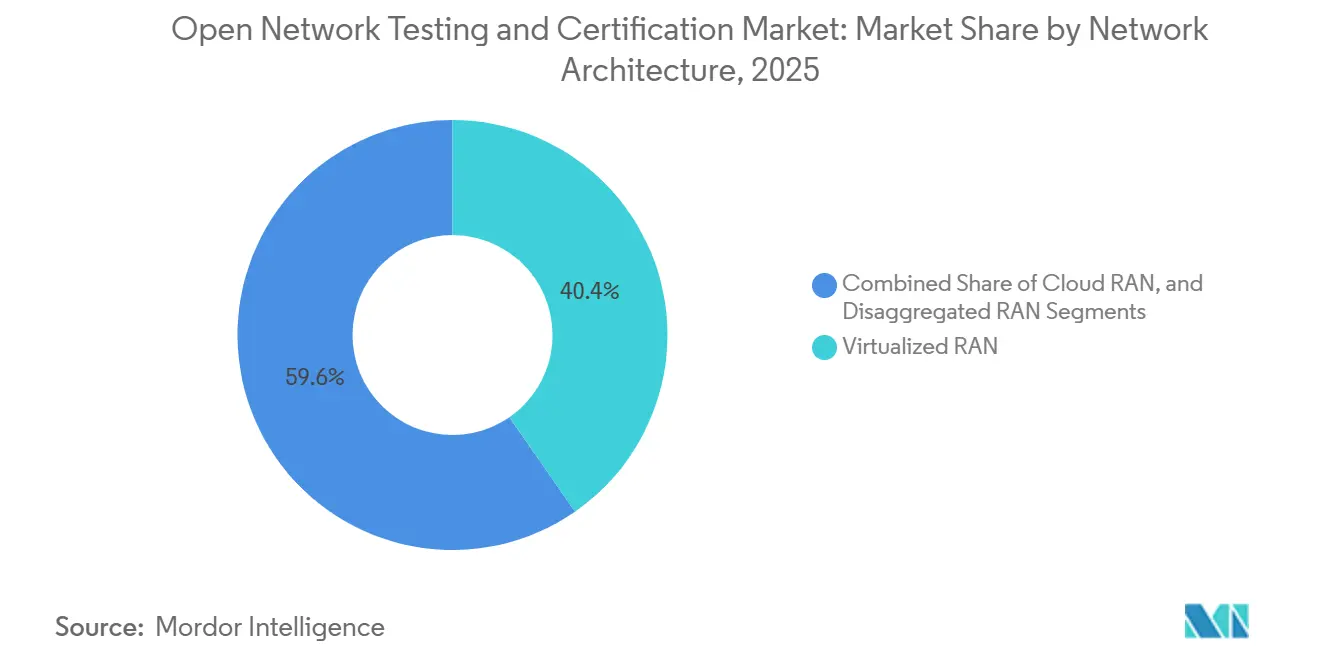
Virtualized RAN held 40.36% of the network architecture segment in 2025. Many operators chose vRAN as an initial migration step because it places RAN software on commercial off-the-shelf servers. This approach avoids the immediate complexity of a fully disaggregated architecture. The open network testing and certification market size tied to vRAN benefits from ongoing 4G and 5G modernization programs. Operators still need to validate software performance, server readiness, transport timing, and radio behavior together. These needs keep vRAN testing important as cloud-native architectures develop.
Disaggregated RAN testing is forecast to grow at a 19.96% CAGR from 2026 to 2031. Separate O-RU, O-DU, and O-CU components require validation across the interfaces of O-RAN WG4, WG5, and WG11. In the open network testing and certification market, static conformance lists alone do not identify all failure modes in a multi-vendor configuration. Digital twin methods can support predictive RAN validation before production deployment. The open network testing and certification market is therefore exposed to more test cases in which components and software functions are sourced separately. Cloud RAN testing is also gaining regional relevance after commercial cloud-native RAN activity in the Middle East.
By Service Type: Managed Testing Anchors Revenue, Certification Scales Fastest
Managed Testing held 36.42% of the service-type share in 2025. Tier-1 operators use long-term programs that cover research, pre-integration, and live-network assurance. This reduces the need to maintain large internal teams for every testing discipline. Spirent was selected by Vodafone in December 2025 to automate multi-vendor 5G software integration across pan-European core voice mobile networks. The program demonstrates the scale of managed testing in complex mobile networks. The open network testing and certification market remains supported by providers that can offer continuous testing rather than isolated engagements.
Certification services are projected to grow at a 20.36% CAGR from 2026 to 2031. The O-RAN Certification and Badging Program is extending geographically and broadening its security focus. Consulting demand is concentrated in new Open RAN programs, particularly where operators lack internal program management experience. Integration services support laboratory construction and multi-vendor hardware configuration. The open network testing and certification market also needs teams that can calibrate workflows across radio, cloud, timing, and security requirements. Certification growth reflects the need for externally recognized proof that equipment meets defined specifications.
Geography Analysis
North America held 37.24% regional share in 2025. The region has a dense concentration of OTIC-qualified laboratories, experienced test engineers, and federal support for open wireless systems. NTIA integrated 3 commercial Open RAN systems into its CRAIN laboratory during 2025. The work produced public multi-vendor integration results and showed the technical demands of carrier-grade configurations. Keysight completed its acquisition of Spirent in October 2025 for GBP 1.16 billion (USD 1.46 billion). The transaction combined design emulation, conformance testing, core-network simulation, live-network service assurance, and related automated workflow capabilities.
Asia-Pacific is a major volume center because of Japan's certification ecosystem, South Korea's 5G Advanced plans, and wider activity across India, China, and Southeast Asia. Japan OTIC issued 2 interoperability badges to NEC's MB5420 radio unit in 2025. NTT EAST published Japan's first disclosed multi-vendor RIC connectivity test in a private 5G setting in March 2026. Europe has 4 qualified OTICs in Berlin, Turin, Madrid, and Paris. The Berlin xG-ALOE Plugfest tested Open RAN components across timing-sensitive networking, sensing, and security domains.
The Middle East is projected to expand at a 20.14% CAGR from 2026 to 2031. GCC operators are moving into commercial Open RAN deployments, creating demand for conformance, timing, and security validation. Zain Kuwait and Parallel Wireless completed a 5G standalone Open RAN proof of concept in February 2025 with download speeds exceeding 1.3 Gbps.[3]Parallel Wireless, “Zain Kuwait and Parallel Wireless Successfully Complete Groundbreaking Trial,” Parallel Wireless, parallelwireless.com Saudi Arabia's TAWAL and Nokia demonstrated a live multi-tenant Open RAN edge-cloud platform in 2025. Limited local OTIC capacity creates an opening for specialized facilities in the region. South America and Africa remain earlier-stage markets because high infrastructure costs and limited engineering capacity constrain local testing.

Competitive Landscape
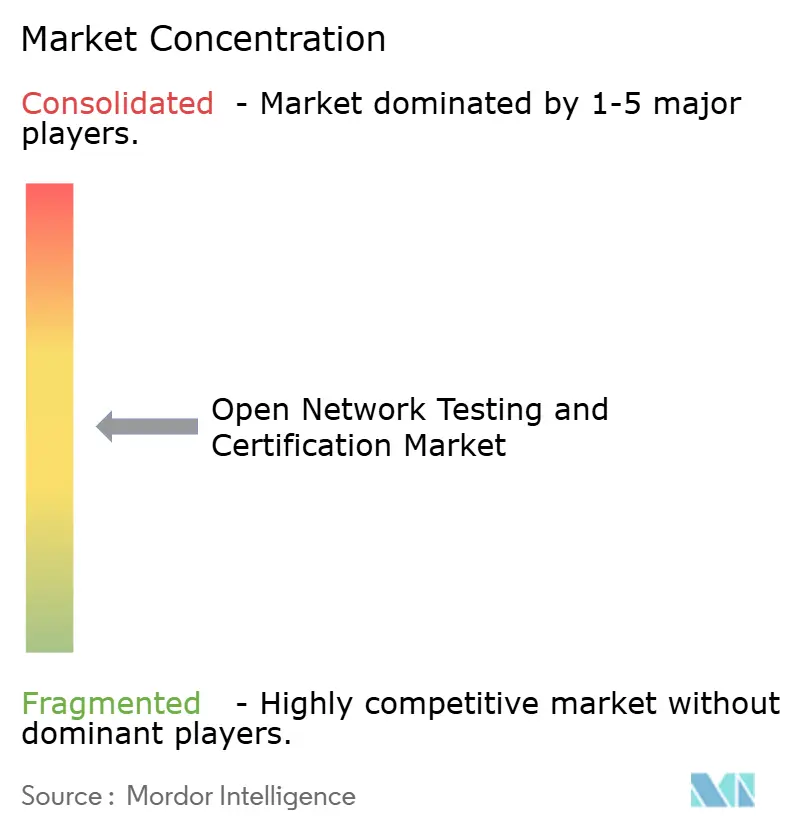
The open network testing and certification market is moderately concentrated among leading integrated vendors and fragmented across specialist providers. Keysight's October 2025 acquisition of Spirent for GBP 1.16 billion (USD 1.46 billion) was the major consolidation event. Under a U.S. Department of Justice consent decree, Keysight divested specified high-speed Ethernet, network security, and channel emulation assets while retaining 5G, cloud, and Open RAN testing activities. The combined company has coverage from design and simulation to service assurance. Rohde and Schwarz focuses on RF signal generation and analysis for O-RU conformance. VIAVI emphasizes Lab-as-a-Service delivery and OTIC laboratory infrastructure.
Anritsu provides solutions for O-RAN WG4 conformance through its O-RAN Radio Unit Test Solution. EXFO's Nova RAN platform supports vendor-neutral service assurance across the Open RAN software stack. Keysight demonstrated an AI-RAN validation workflow with Samsung and NVIDIA during MWC Barcelona 2026.[4] EXFO, “Open RAN Testing,” EXFO, exfo.com The workflow combined AI and ML model training, data generation, and performance benchmarking for Samsung's 5G-Advanced vRAN software. Within the open network testing and certification market, this strategic move extends testing beyond conventional pass-fail conformance procedures and traditional laboratory test scripts. It also positions AI-model behavior as a future area of product differentiation.
The open network testing and certification market has room for specialists in timing, security, behavioral validation, and digital twin simulation. Calnex demonstrated 3 live Open RAN and AI-RAN conformance bundles during MWC Barcelona 2026. Its focus on PTP timing accuracy and S-plane resilience shows why precision tools remain relevant beside broader software suites. VIAVI and Calnex announced pre-certification testbeds covering protocol, signal, and timing domains in November 2025. Partnerships such as this allow specialized providers to extend coverage without building every capability internally.
Open Network Testing and Certification Industry Leaders
Keysight Technologies, Inc.
Rohde & Schwarz GmbH & Co. KG
Anritsu Corporation
EXFO Inc.
LitePoint Corporation
- *Disclaimer: Major Players sorted in no particular order

Recent Industry Developments
- July 2026: EXFO published updated timing and synchronization test specification sheets in English, Japanese, Chinese, and French editions, expanding multilingual access to fronthaul synchronization tooling critical for O-RAN S-plane compliance across global operator markets.
- June 2026: O-RAN Alliance completed Release 5, extending test coverage to advanced massive MIMO beamforming and AI-native RAN functions while aligning future release timing with 3GPP to support efficient 6G standardization.
- March 2026: Keysight and Samsung demonstrated an end-to-end AI-RAN validation workflow with NVIDIA at MWC Barcelona 2026, integrating AI and ML model training, data generation, and performance benchmarking for Samsung's 5G-Advanced vRAN software on the NVIDIA Aerial platform powered by the NVIDIA GH200 Grace Hopper Superchip.
- February 2026: Keysight and Ericsson validated full-stack pre-6G interoperability between an Ericsson pre-6G base station and prototype pre-6G devices using Keysight's WaveJudge Wireless Analyzer Solutions, demonstrated live at MWC Barcelona 2026.


Global Open Network Testing and Certification Market Report Scope
The Open Network Testing and Certification Market encompasses solutions and services that evaluate, validate, and certify open networking hardware, software, and protocols for performance, interoperability, security, and compliance. This report analyzes market trends, growth drivers, challenges, competitive dynamics, and key developments across testing tools, certification services, end-user industries, and geographic regions.
The Open Network Testing and Certification Market Report is Segmented by Offering (Testing Hardware, Testing Software, and Professional Services), Application (5G Network Deployment, 4G Network Modernization, Open RAN Integration, Telecom Equipment Validation, Cloud RAN Testing, and Other Applications), End User (Telecom Network Operators, Network Equipment Manufacturers, System Integrators, and Certification Laboratories), Deployment Model (Cloud-Based, On-Premises, and Hybrid), Network Architecture (Virtualized RAN, Cloud RAN, and Disaggregated RAN), Service Type (Managed Testing, Consulting, Integration, and Certification), and Geography (North America, South America, Europe, Asia-Pacific, Middle East, and Africa). The Market Forecasts are Provided in Terms of Value (USD).
| Testing Hardware |
| Testing Software |
| Professional Services |
| 5G Network Deployment |
| 4G Network Modernization |
| Open RAN Integration |
| Telecom Equipment Validation |
| Cloud RAN Testing |
| Other Applications |
| Telecom Network Operators |
| Network Equipment Manufacturers |
| System Integrators |
| Certification Laboratories |
| Cloud-Based |
| On-Premises |
| Hybrid |
| Virtualized RAN |
| Cloud RAN |
| Disaggregated RAN |
| Managed Testing |
| Consulting |
| Integration |
| Certification |
| North America | United States |
| Canada | |
| Mexico | |
| South America | Brazil |
| Argentina | |
| Rest of South America | |
| Europe | Germany |
| United Kingdom | |
| France | |
| Italy | |
| Spain | |
| Russia | |
| Rest of Europe | |
| Asia-Pacific | China |
| Japan | |
| India | |
| South Korea | |
| Southeast Asia | |
| Rest of Asia-Pacific | |
| Middle East | Saudi Arabia |
| United Arab Emirates | |
| Turkey | |
| Rest of Middle East | |
| Africa | South Africa |
| Nigeria | |
| Rest of Africa |
| By Offering | Testing Hardware | |
| Testing Software | ||
| Professional Services | ||
| By Application | 5G Network Deployment | |
| 4G Network Modernization | ||
| Open RAN Integration | ||
| Telecom Equipment Validation | ||
| Cloud RAN Testing | ||
| Other Applications | ||
| By End User | Telecom Network Operators | |
| Network Equipment Manufacturers | ||
| System Integrators | ||
| Certification Laboratories | ||
| By Deployment Model | Cloud-Based | |
| On-Premises | ||
| Hybrid | ||
| By Network Architecture | Virtualized RAN | |
| Cloud RAN | ||
| Disaggregated RAN | ||
| By Service Type | Managed Testing | |
| Consulting | ||
| Integration | ||
| Certification | ||
| By Geography | North America | United States |
| Canada | ||
| Mexico | ||
| South America | Brazil | |
| Argentina | ||
| Rest of South America | ||
| Europe | Germany | |
| United Kingdom | ||
| France | ||
| Italy | ||
| Spain | ||
| Russia | ||
| Rest of Europe | ||
| Asia-Pacific | China | |
| Japan | ||
| India | ||
| South Korea | ||
| Southeast Asia | ||
| Rest of Asia-Pacific | ||
| Middle East | Saudi Arabia | |
| United Arab Emirates | ||
| Turkey | ||
| Rest of Middle East | ||
| Africa | South Africa | |
| Nigeria | ||
| Rest of Africa | ||


Key Questions Answered in the Report
What is the size of the open network testing and certification market?
The open network testing and certification market size is projected to expand from USD 2.43 billion in 2025 to USD 2.91 billion in 2026, and to USD 6.76 billion by 2031, registering a CAGR of 18.36% between 2026 and 2031.
What is driving demand for open network testing and certification?
Open RAN deployment, 5G Advanced features, multi-vendor interoperability needs, and cloud-native RAN validation are increasing testing requirements.
Which offering leads demand in this sector?
Testing Hardware led the offering segment with 44.28% share in 2025 because physical RF validation still depends on carrier-grade instruments.
Which application is growing fastest?
Cloud RAN Testing is projected to grow at a 20.34% CAGR through 2031 as operators validate containerized RAN software and supporting compute infrastructure.
Which region is expanding fastest for Open RAN testing?
The Middle East is projected to grow at a 20.14% CAGR through 2031 as Gulf operators move into commercial Open RAN deployment.
Page last updated on:





