
Oman Cartonboard Market Size and Share
Market Overview
| Study Period | 2020 - 2031 |
|---|---|
| Forecast Data Period | 2026 - 2031 |
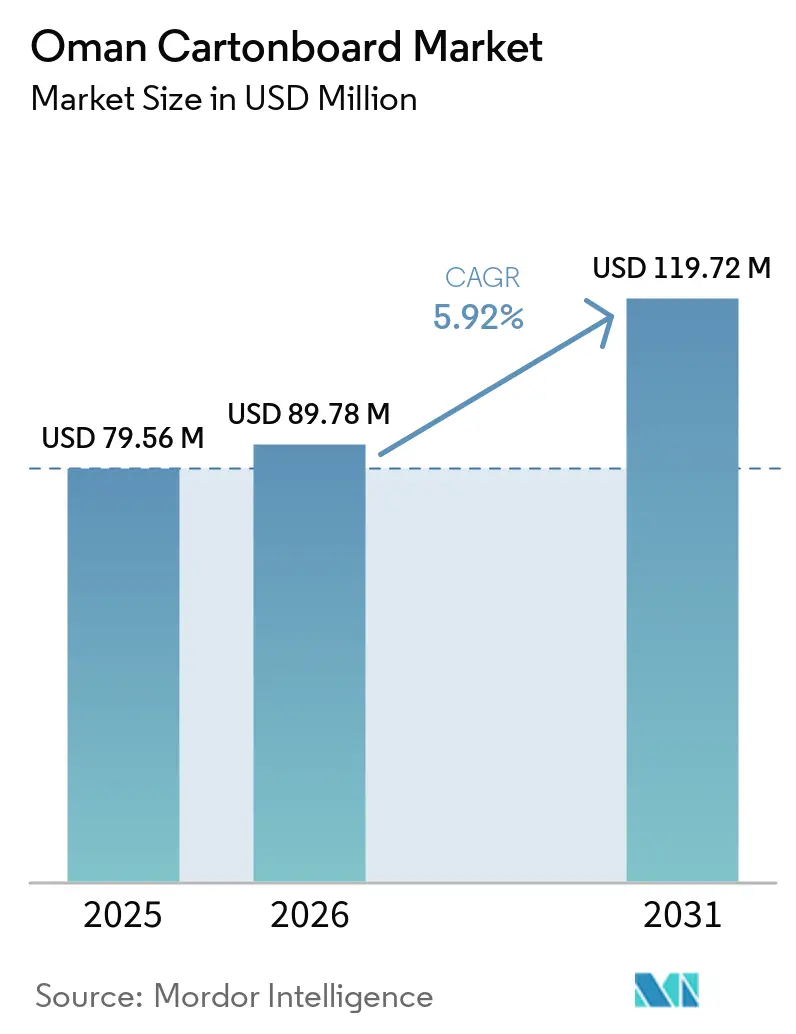
| Base Year Market Size (2025) | USD 79.56 Million |
| Market Size (2026) | USD 89.78 Million |
| Market Size (2031) | USD 119.72 Million |
| Growth Rate (2026 - 2031) | 5.92 % |
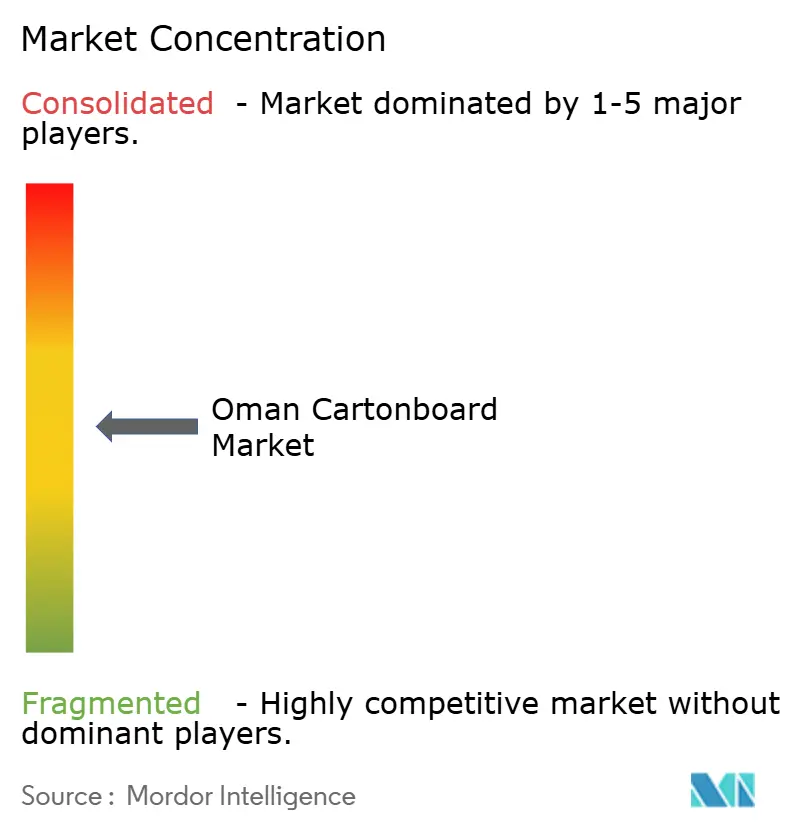
| Market Concentration | Medium |
Major Players *Disclaimer: Major Players sorted in no particular order Image © Mordor Intelligence. Reuse requires attribution under CC BY 4.0. | |
Oman Cartonboard Market Analysis by Mordor Intelligence
The Oman Cartonboard Market size is projected to be USD 79.56 million in 2025, USD 89.78 million in 2026, and reach USD 119.72 million by 2031, growing at a CAGR of 5.92% from 2026 to 2031.
Demand is supported by the phased ban on single-use plastic shopping bags, the expansion of food and fisheries processing, and stricter requirements for pharmaceutical packaging. These forces support demand across several packaging uses rather than relying on a single consumer category. Investment in free zones gives converters access to duty-free imports, long tax holidays, and simplified licensing, which can reduce operating barriers for new capacity. The Oman cartonboard market remains exposed to imported pulp, premium paperboard, freight costs, and supply disruptions. Its ability to serve food, healthcare, retail, and export packaging gives the sector a more stable base than markets linked to a narrow set of end uses.
Key Report Takeaways
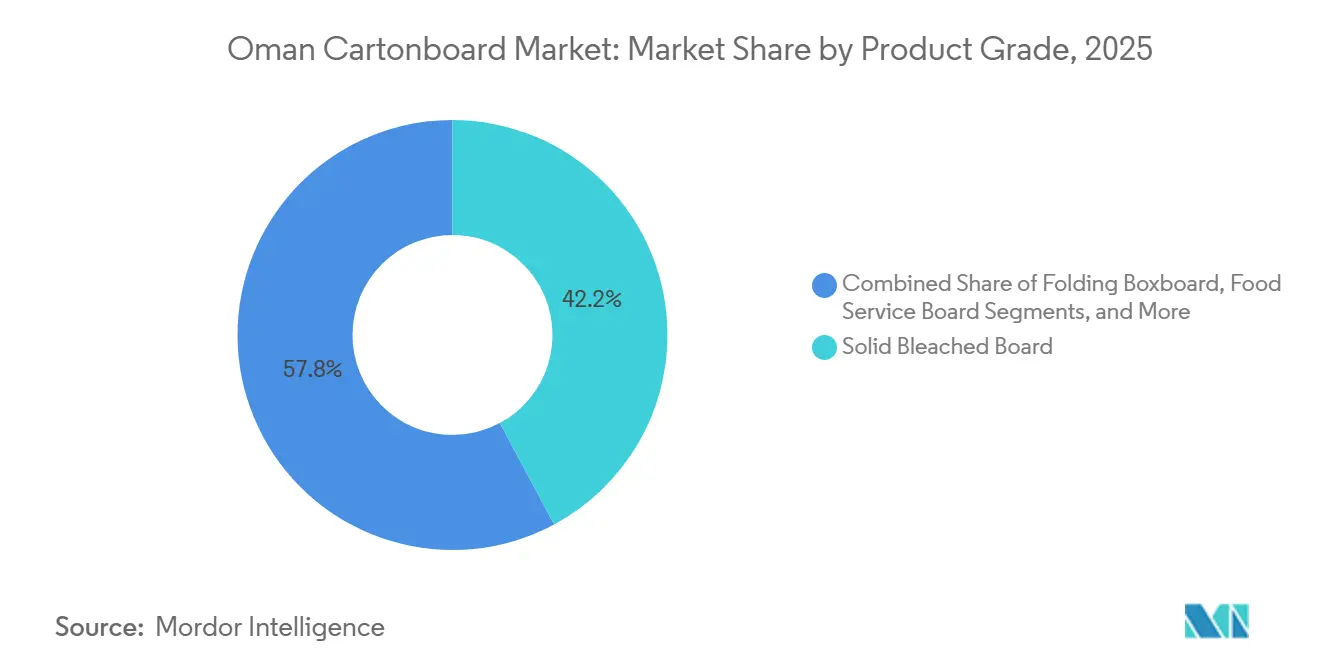
- By product grade, Solid Bleached Board held 42.16% of the Oman cartonboard market share in 2025, while Solid Unbleached Board is projected to expand at a 7.38% CAGR through 2031.
- By packaging format, Folding Cartons accounted for 58.23% of the Oman cartonboard market share in 2025, while Liquid Packaging is expected to expand at a 6.31% CAGR through 2031.
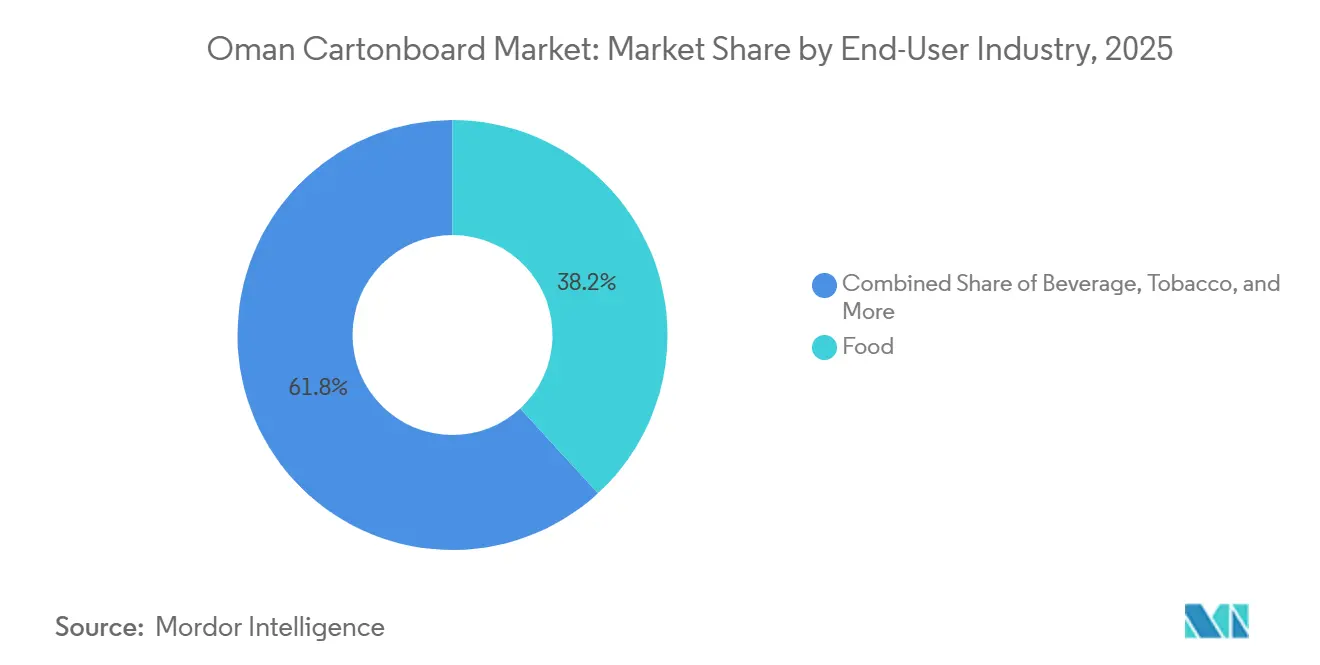
- By end-user industry, Food held 38.16% of the Oman cartonboard market size in 2025, while Pharmaceutical and Healthcare is projected to advance at a 6.21% CAGR through 2031.
Note: Market size and forecast figures in this report are generated using Mordor Intelligence’s proprietary estimation framework, updated with the latest available data and insights as of January 2026.
Oman Cartonboard Market Trends and Insights
Drivers Impact Analysis*
| Driver | (~) % Impact on CAGR Forecast | Geographic Relevance | Impact Timeline |
|---|---|---|---|
| Plastic Regulation Accelerating Paperboard Substitution | +1.5% | National, with early gains in pharmacies and clinics in Muscat and Sohar, and food retail across all governorates | Short term (≤ 2 years) |
| E-Commerce and Omnichannel Distribution Expansion | +1.2% | Greater Muscat, with spillover to Sohar and Salalah corridors | Medium term (2-4 years) |
| Food-Processing and Fisheries Capacity Expansion | +1.0% | Duqm Special Economic Zone, Salalah, and Al Wusta governorate | Medium term (2-4 years) |
| Healthcare Packaging Compliance and Serialization Requirements | +0.8% | National, concentrated in Muscat and Sohar pharmaceutical supply corridors | Medium term (2-4 years) |
| Export-Oriented Packaging Demand From Sohar, Duqm, and Salalah | +0.6% | Asia-Pacific, East Africa, and Middle East and Africa trade corridors | Long term (≥ 4 years) |
| Demand for Locally Converted Specialty Cartons in Underserved Applications | +0.4% | National | Long term (≥ 4 years) |
| Source: Mordor Intelligence | |||
Plastic Regulation Accelerating Paperboard Substitution
Oman’s Environment Authority issued Ministerial Decision No. 8/2024 in January 2024, setting a phased prohibition on single-use plastic shopping bags that leads to a national ban in January 2027.[1] Pharmacies, hospitals, and clinics entered the program in July 2024, while textile, retail, furniture, and mobile phone outlets followed in January 2025. Grocery stores, bakeries, sweet shops, and fruit and vegetable retailers entered the next phase in July 2025. Penalties for noncompliance range from OMR 50 to OMR 1,000, equal to USD 130 to USD 2,600, and repeat violations face doubled penalties. The food-retail phase has particular importance because grocery and bakery outlets handle larger daily volumes of shopping bags than the healthcare outlets covered earlier. The regulation makes compliance a stronger source of demand for paperboard alternatives than voluntary consumer preference in the Oman cartonboard market.
E-Commerce and Omnichannel Distribution Expansion
Oman’s digital retail environment is supported by the national transformation agenda and by the Central Bank of Oman framework for digital payment licensing. The country had delivered 2,277 online government services by late 2025, which supported broader digital adoption across households and merchants.[2] Higher parcel volumes increase demand for folding cartons and corrugated packaging. Smaller fulfillment locations in Al Mawaleh and Ghala are also changing the specifications required by retail customers. Same-day delivery favors smaller cartons with stronger graphics at several local stocking points instead of a single centralized distribution site. This pattern gives the Oman cartonboard market an added reason to invest in digital printing and rapid changeover capacity for short, personalized production runs.
Food-Processing and Fisheries Capacity Expansion
Oman’s aquaculture output reached 9,240 metric tons in 2025, an increase of 67.7% from 2024. Its value rose 63.7% to OMR 20.3 million, equal to USD 52.7 million.[3] The Duqm Fisheries Industrial Zone is expanding fish processing, cold storage, and canning operations. An Oman Investment Authority-backed tuna and sardine canning facility commenced operations with an investment of OMR 26 million, equal to USD 67.5 million, and annual capacity of 100 million cans. Secondary cartons are needed for dispatch from each canning operation, while the government targets aquaculture output of 252,000 tonnes by 2030. The integrated Duqm Fishery Port and industrial complex is expected to begin commercial operations in Q4 2026, creating a further source of food-grade cartonboard demand for the Oman cartonboard market.
Healthcare Packaging Compliance and Serialization Requirements
The Gulf Health Council requires GS1 DataMatrix barcodes on pharmaceutical packaging across GCC member states and promotes GS1 supply-chain standards for identification and traceability.[4] Oman’s Ministry of Health also required pharmaceutical companies to apply QR codes to registered products through the NashraTech platform before the end of 2025. These obligations raise requirements for print quality, dimensional consistency, and tamper-evident carton design. They favor suppliers that can handle clean digital printing and compliance documentation rather than basic printing-grade chipboard. Circular No. 194/2025 also made electronic license renewal mandatory through the Electronic Health Portal, which requires companies to keep approved packaging designs current. Recurring redesigns and reprints give the Oman cartonboard market a steadier healthcare demand base than product categories that are more sensitive to household spending.
Restraints Impact Analysis*
| Restraint | (~) % Impact on CAGR Forecast | Geographic Relevance | Impact Timeline |
|---|---|---|---|
| Virgin Pulp and Imported Paperboard Price Volatility | -1.2% | National, most acute in Sohar and Muscat converting hubs | Short term (≤ 2 years) |
| Competition From Flexible Pouches and Plastic Containers | -0.8% | National | Medium term (2-4 years) |
| Limited Local Availability of Pharmaceutical-Grade Cartonboard | -0.5% | Muscat and Sohar pharmaceutical supply corridors | Medium term (2-4 years) |
| Limited High-Color Carton Converting and Finishing Skills | -0.3% | National, most acute in non-Muscat governorates | Long term (≥ 4 years) |
| Source: Mordor Intelligence | |||
Virgin Pulp and Imported Paperboard Price Volatility
Oman imports most virgin pulp and high-specification paperboard from Northern Europe, North America, and Southeast Asia. This leaves local converters sensitive to international commodity prices and shipping conditions. Shipping disruptions in the Middle East raised container freight costs and marine insurance premiums in 2025 and the first half of 2026. Smaller converters face greater pressure because they may not have the volume or purchasing agreements needed to manage input-cost swings. Disruptions near the Red Sea and Strait of Hormuz affect both imported board and pulp delivered to GCC mills, so the two risks can occur at the same time. The exposure limits pricing visibility and can delay investments in higher-value cartonboard uses within the Oman cartonboard market.
Competition From Flexible Pouches and Plastic Containers
The plastic bag rules apply to thin single-use shopping bags and do not prohibit functional multilayer flexible packaging. Flexible pouches and rigid plastic containers therefore remain suitable for wet food, household chemicals, and personal care items where barrier performance and unit costs favor plastics. Switching to rigid cartonboard can require higher tooling and converting expenditure, especially for smaller orders. OQ commissioned the Ladayn Polymer Programme at Sohar Industrial City in October 2025, bringing 9 plants into commercial operation for food-grade containers, healthcare packaging, and specialized polymer packaging. Salalah Free Zone has also attracted polymer packaging investment, including the Turkish My Pack Plastic operation for dairy and food packaging. The Oman cartonboard market must therefore compete on performance and economics in uses where regulation does not require a move away from plastic.
*Our forecasts treat driver/restraint impacts as directional, not additive. The impact forecasts reflect baseline growth, mix effects, and variable interactions.
Segment Analysis
By Product Grade. Premium Substrate Demand Is Splitting the Grade Mix
Solid Bleached Board held 42.16% of the total sector value in 2025. Its position reflects demand from food retail, pharmaceutical, and cosmetics applications that need a white, print-receptive surface. The grade supports offset printing, digital printing, and UV-varnish finishes used for shelf-ready packs and display formats. Multinational consumer-goods brands operating in Oman often specify this grade for high-graphics packaging, while Folding Boxboard serves mid-tier packs and White-Lined Chipboard serves value-focused general retail applications. This mix keeps Solid Bleached Board important where visual quality and clear printing are central purchase requirements.
Solid Unbleached Board is projected to expand at a 7.38% CAGR through 2031, making it the fastest-growing product grade. Food processors and fisheries exporters in Duqm and Salalah use it for crush resistance and humidity tolerance in cold-chain movement. The expanding canning and fish-processing base requires secondary cartons that can withstand temperature and moisture changes during shipment to Asian and East African markets. Its lower technical production threshold compared with Solid Bleached Board makes it a more accessible option for domestic production and import substitution. Gulf Standardization Organization food-contact frameworks increase documentation requirements for imported grades and favor converters that maintain active compliance records.

By Packaging Format. Folding Cartons Anchor Volume While Liquid Packaging Holds the Growth Premium
Folding Cartons accounted for 58.23% of the Oman cartonboard market size by packaging format in 2025. Their use reflects compatibility with high-definition printing and finishing needed by pharmaceutical, food, cosmetics, and tobacco brands. Sleeve and tray formats serve narrower uses, including promotional multipacks and fresh-food displays, where their open-panel design gives products greater visibility. Cups and foodservice containers are also gaining attention as food retailers replace certain plastic-serving items. These uses make folding cartons an adaptable secondary packaging option during compliance reviews.
Liquid Packaging is projected to advance at a 6.31% CAGR through 2031, supported by UHT dairy and juice co-packing additions in Sohar and Salalah. Aseptic formats require multilayer lamination that combines foil, polyethylene, and paperboard, a capability that many Oman-based converters do not have. This leaves a larger share of demand to GCC suppliers that import finished laminated board. A free-zone converter with lamination equipment could serve local liquid-food customers and export through Salalah’s bonded shipping corridor. Obeikan Liquid Packaging Company operates capacity of 2 billion carton packs per year and holds ISO 9001:2015, ISO 14001:2015, ISO 45001:2018, and FSSC 22000 V5.1 certifications, providing a qualification benchmark for high-barrier packaging.
By End-User Industry. Food Leads Volume While Pharmaceutical and Healthcare Accelerate
Food accounted for 38.16% of the Oman cartonboard market size in 2025. Fisheries, dairy, confectionery, and processed meats make up the country’s diversified food-processing base. Farmed fish output reached 9,240 metric tons in 2025 and was 67.7% above the preceding year, adding a recent source of demand for secondary and tertiary packaging. Beverage demand is closely linked to liquid cartonboard formats, while cosmetics and toiletries use more premium shelf-display packaging. Tobacco has stable demand but a limited structural reason for volume expansion.
Pharmaceutical and Healthcare is projected to expand at a 6.21% CAGR through 2031. Serialization requirements, generic-drug dispensing, and private hospital expansion support this outlook. Electronic license renewal creates repeated carton updates because registered pharmaceutical packs must remain compliant through each renewal cycle. Toys, apparel, automotive, household, electrical, and foodservice uses form a wider group of smaller applications that broadly follow manufacturing diversification under Oman Vision 2040. Apparel and sportswear retailers are beginning to use premium folding cartons for store displays and e-commerce fulfillment, though their volumes remain below food and pharmaceutical demand.
Geography Analysis
Muscat is the primary consumption and converting center for the Oman cartonboard market. It contains the largest concentration of FMCG brand owners, pharmaceutical distributors, retailers, and supporting supply chains. Non-oil exports rose 10.5% to OMR 6.885 billion, equal to USD 17.9 billion, in 2025, while industrial employment reached 248,000. Sultan Qaboos Port and Muscat International Airport provide entry points for premium bleached grades sourced from Europe and Asia. Import-substitution priorities are guiding converting activity toward Al Mawaleh and Ghala, where e-commerce fulfillment and packaging operations are located together.
Sohar is the most industrially dense cartonboard location outside Muscat and provides an important supply-side base. Keryas Paper Industry operates a recycled paperboard mill in the Sohar industrial zone with capacity of 180,000 tonnes per year. Its proximity to Sohar Port can shorten supply lead times compared with Asian imports during normal freight conditions. Construction began in January 2026 on a USD 550 million PTA and PET facility at Sohar Port and Freezone, adding local packaging raw-material and polymer links. OQ also signed OMR 230 million, equal to USD 597.5 million, of downstream manufacturing agreements for Sohar and Salalah in January 2026, covering packaging among other product chains.
Duqm and Salalah are the highest-growth demand zones within the forecast period for the Oman cartonboard market. Salalah Free Zone had attracted manufacturers from more than 60 countries by 2026, with food processing and pharmaceutical repackaging among its active sectors. Arabian Packaging has established distribution infrastructure in Salalah to serve East African export routes. Duqm combines fisheries industries, aquaculture processing, and cold-chain logistics, while new aquaculture agreements signed through 2025 exceeded OMR 50 million, equal to USD 130 million, and add production of more than 15,000 tonnes annually.
Competitive Landscape
The Oman cartonboard market has a fragmented converting base that includes Keryas Paper Industry, Pride Packaging, Sun Packaging Company, Al Bahja Group, Power Carton, Silver Corner Packaging, and Safeer Luxury Pack. GCC scale operators also supply the country and compete for regional customer accounts. United Carton Industries Company, Napco National, and Obeikan Folding Carton have increasingly developed single-source relationships with multinational brand owners across the GCC. This can pressure the volume positions of domestic converters in food and beverage applications. United Carton Industries Company completed an initial public offering in April 2025, offering a 30% stake after reporting revenue above SAR 1 billion in 2024.
Pharmaceutical-grade carton converting and high-barrier liquid-board lamination remain the clearest capability gaps. Pharmaceutical formats require serialization-ready printing, dependable dimensional quality, and controlled documentation, while liquid packaging needs barrier lamination capabilities beyond the equipment base of many local converters. United Carton Industries Company approved a SAR 75.9 million, equal to USD 20.24 million, expansion at its Ras Al Khaimah subsidiary in April 2026. The project is expected to finish in Q3 2027 and will increase production capacity for the UAE and nearby GCC markets. This capacity could be more available to Oman with shorter lead times than some overseas suppliers.
Napco National completed its acquisition of Arabian Flexible Packaging in August 2025, adding polypropylene, polyester, nylon, polyethylene, foil, and paper packaging operations in the UAE. The transaction shows how regional suppliers are broadening their material portfolios rather than relying on a single packaging substrate. OPAZ rules provide long tax holidays, duty-free imports, simplified licensing, and 100% foreign ownership in eligible zones, creating entry routes for international converters. The competitive structure remains dispersed because the supplied evidence does not provide a combined market-share figure for leading suppliers.
Oman Cartonboard Industry Leaders
-
Keryas Paper Industry LLC
-
Pride Packaging LLC
-
TCPL Packaging Limited
-
United Carton Industries Company
-
Obeikan Folding Carton
- *Disclaimer: Major Players sorted in no particular order
Recent Industry Developments
- July 2026: United Carton Industries Company reported Q2-2026 revenues of SAR 384.09 million (USD 102.4 million), up 14.66% year-on-year, and net profit of SAR 28.79 million (USD 7.7 million), a 257.76% increase over Q2-2025. The company attributed the improvement to higher sales volumes across all packaging segments and easing raw material cost pressures, positioning UCIC as a well-capitalized GCC converter with stated intent to expand into additional GCC markets.
- June 2026: Salalah Free Zone recorded its highest annual export volumes to date, with pharmaceutical packaging and food processing among the sectors generating increased cartonboard converting activity. The zone’s zero-tax, zero-customs framework attracted companies from over 60 countries and reached record occupancy, prompting the expansion of industrial land allocation.
- April 2026: United Carton Industries’ Board of Directors approved a SAR 75.9 million (USD 20.24 million) capacity expansion at its UAE subsidiary, Ras Al Khaimah Packaging Ltd., with construction commencing in Q2 2026 and targeted completion in Q3 2027. The expansion is designed to increase production capacity and market share in UAE and adjacent GCC markets.
Oman Cartonboard Market Report Scope
The Oman Cartonboard Market encompasses the production, distribution, and application of cartonboard materials for packaging. Key product grades in the market include solid bleached board, solid unbleached board, folding boxboard, white-lined chipboard, liquid packaging board, and food service board. These grades are used across various packaging formats, including folding cartons, liquid packaging, sleeves, trays, cups, and foodservice containers. Due to their recyclability, printability, and sustainable packaging attributes, these cartonboard solutions are widely used across sectors such as food, beverage, pharmaceuticals, tobacco, cosmetics, and more.
The Oman Cartonboard Market Report is Segmented by Product Grade (Solid Bleached Board, Solid Unbleached Board, Folding Boxboard, White-Lined Chipboard, Liquid Packaging Board, and Food Service Board), Packaging Format (Folding Cartons, Liquid Packaging, Sleeve and Tray, and Other Packaging Formats), and End-User Industry (Food, Beverage, Pharma and Healthcare, Tobacco, Cosmetics and Toiletries, and Other End-User Industries). The Market Forecasts are Provided in Terms of Value (USD).
Source: https://www.mordorintelligence.com/industry-reports/india-cartonboard-market
| Solid Bleached Board |
| Solid Unbleached Board |
| Folding Boxboard |
| White-Lined Chipboard |
| Liquid Packaging Board |
| Food Service Board |
| Folding Cartons |
| Liquid Packaging |
| Sleeve and Tray |
| Other Packaging Formats (Cups, Foodservice Containers) |
| Food |
| Beverage |
| Pharmaceutical and Healthcare |
| Tobacco |
| Cosmetics and Toiletries |
| Other End-User Industries (Toy, Apparel, Automotive, Household, Electrical, Foodservice) |
| By Product Grade | Solid Bleached Board |
| Solid Unbleached Board | |
| Folding Boxboard | |
| White-Lined Chipboard | |
| Liquid Packaging Board | |
| Food Service Board | |
| By Packaging Format | Folding Cartons |
| Liquid Packaging | |
| Sleeve and Tray | |
| Other Packaging Formats (Cups, Foodservice Containers) | |
| By End-User Industry | Food |
| Beverage | |
| Pharmaceutical and Healthcare | |
| Tobacco | |
| Cosmetics and Toiletries | |
| Other End-User Industries (Toy, Apparel, Automotive, Household, Electrical, Foodservice) |
Key Questions Answered in the Report
What is the size of the Oman cartonboard market?
The sector is estimated at USD 89.78 million in 2026 and is projected to reach USD 119.72 million by 2031, at a CAGR of 5.92%. The forecast reflects demand from regulated retail packaging, food processing, healthcare compliance, and export-oriented activity in free zones.
Which product grade leads cartonboard demand in Oman?
Solid Bleached Board led with 42.16% share in 2025 because food, pharmaceutical, and cosmetics users require a white surface for high-quality printing. It remains suited to retail packs that need consistent graphics, shelf presentation, and controlled finishing quality.
Which cartonboard format is expanding fastest in Oman?
Liquid Packaging is projected to expand at a 6.31% CAGR through 2031, supported by dairy and juice co-packing capacity in Sohar and Salalah. Its progress depends on access to multilayer barrier lamination, which remains limited among local converters.
Why is pharmaceutical packaging demand increasing in Oman?
GS1 DataMatrix and QR-code requirements increase demand for compliant, accurately printed cartons, while license renewals lead to recurring packaging updates. Healthcare customers also need traceability, tight dimensional control, and packaging designs that remain current under applicable rules.
Which end-user sector has the highest cartonboard demand?
Food accounted for 38.16% in 2025, supported by fisheries, dairy, confectionery, processed meats, and secondary packaging needs. Expansion in aquaculture, canning, cold storage, and export distribution reinforces demand for food-grade cartons.
What limits local cartonboard converting capacity in Oman?
Import dependence for high-specification board, freight exposure, limited pharmaceutical-grade supply, and limited high-color finishing capability constrain local converters. These factors can reduce cost visibility and favor companies that hold larger supply agreements or specialized equipment. The limitations are most visible in premium healthcare cartons and high-barrier liquid packaging, where qualification requirements are more demanding.