
Octylphenol Ethoxylate Market Size and Share
Market Overview
| Study Period | 2021 - 2031 |
|---|---|
| Market Size (2026) | USD 1.11 Billion |
| Market Size (2031) | USD 1.37 Billion |
| Growth Rate (2026 - 2031) | 4.36 % |
| Fastest Growing Market | Asia-Pacific |
| Largest Market | Asia-Pacific |
| Market Concentration | Medium |
Major Players *Disclaimer: Major Players sorted in no particular order Image © Mordor Intelligence. Reuse requires attribution under CC BY 4.0. | |
Octylphenol Ethoxylate Market Analysis by Mordor Intelligence
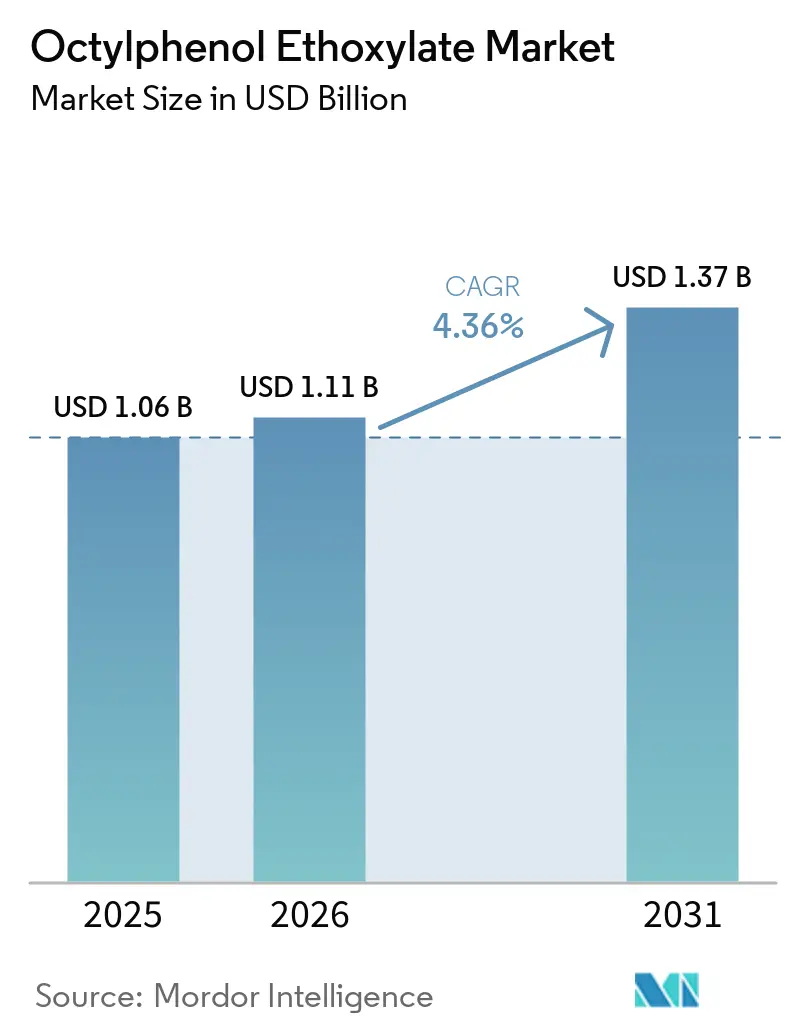
The Octylphenol Ethoxylate Market size was valued at USD 1.06 billion in 2025 and is estimated to grow from USD 1.11 billion in 2026 to reach USD 1.37 billion by 2031, at a CAGR of 4.36% during the forecast period (2026-2031). Octylphenol ethoxylate is a nonionic surfactant made by reacting octylphenol with ethylene oxide. Its hydrophilic-lipophilic balance can be adjusted for wetting, emulsification, and dispersion. The octylphenol ethoxylate market continues to depend on textile processing, agrochemical formulations, and coatings, even as restrictions tighten in Europe and selected North American jurisdictions. Demand is more durable where substitute chemistries have not completed technical qualification or cannot match the required process conditions. Suppliers are therefore balancing opportunities in Asia-Pacific with a greater focus on specialized grades and regulated applications within the octylphenol ethoxylate market, where qualification requirements can make validated supply relationships more durable.
Key Report Takeaways
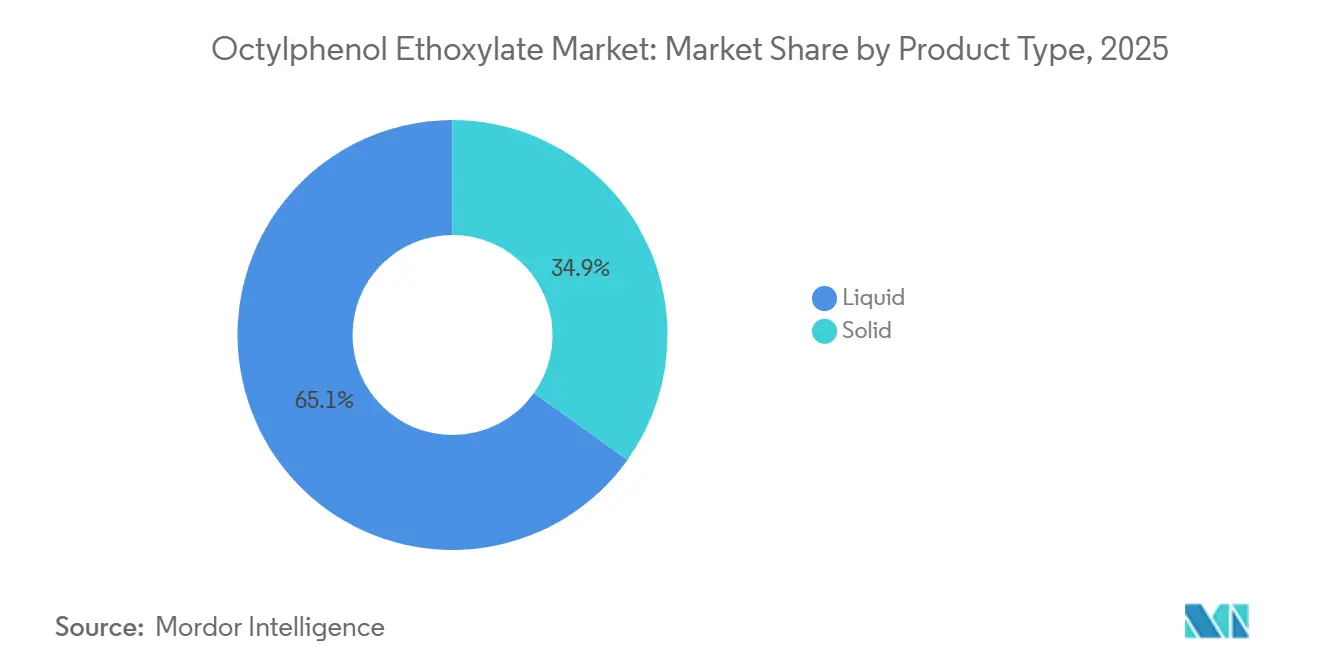
- By product type, liquid held 65.13% of the octylphenol ethoxylate market share in 2025, while solid is projected to advance at a 4.78% CAGR through 2031.
- By application, detergents held 42.56% of the octylphenol ethoxylate market share in 2025, while cleaners are projected to advance at a 5.11% CAGR through 2031.
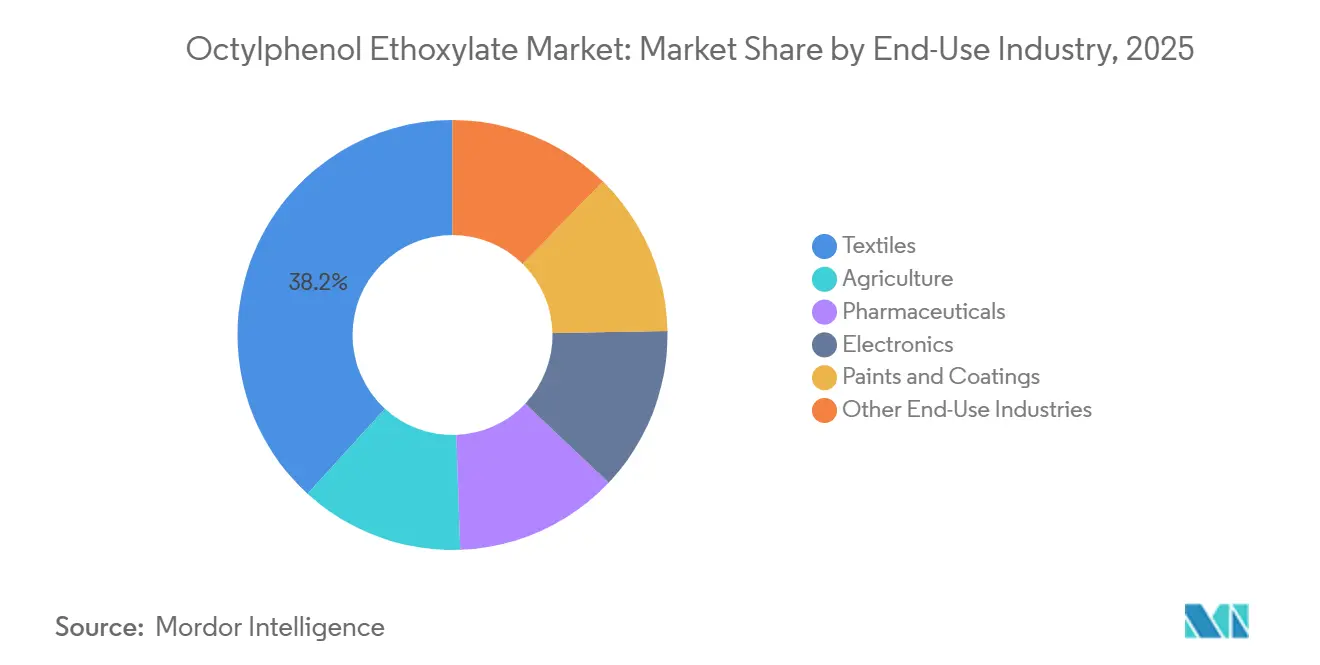
- By end-use industry, textiles held 38.22% of the octylphenol ethoxylate market share in 2025, while electronics is projected to advance at a 5.23% CAGR through 2031.
- By geography, Asia-Pacific held 41.61% of the octylphenol ethoxylate market share in 2025 and is projected to advance at a 4.82% CAGR through 2031.
Note: Market size and forecast figures in this report are generated using Mordor Intelligence’s proprietary estimation framework, updated with the latest available data and insights as of January 2026.
Global Octylphenol Ethoxylate Market Trends and Insights
Drivers Impact Analysis*
| Driver | (~) % Impact on CAGR Forecast | Geographic Relevance | Impact Timeline |
|---|---|---|---|
| Expansion of Textile Wet Processing in Asia-Pacific | +1.5% | APAC core (China, India, Bangladesh, Vietnam), spillover to South America (Brazil) | Medium term (2-4 years) |
| Agrochemical Formulation Demand in Emerging Markets | +1.1% | APAC (India, China), South America (Brazil, Argentina), MEA | Medium term (2-4 years) |
| Industrial Cleaning and Low-Foam Process Requirements | +0.8% | Global, concentrated in APAC manufacturing hubs and North America | Short term (≤ 2 years) |
| Emulsion Polymerization and Coatings Formulation Demand | +0.6% | Global, with concentration in APAC, Europe (Germany, Italy), and North America | Long term (≥ 4 years) |
| Grade-Level Performance Matching in APE-Free Reformulation | +0.3% | North America and Europe primarily, with spillover into export-oriented APAC markets | Medium term (2-4 years) |
| Source: Mordor Intelligence | |||
Expansion of Textile Wet Processing in Asia-Pacific
South and Southeast Asian textile export corridors remain an important foundation for the octylphenol ethoxylate market. In India, man-made yarn, fabrics, and made-ups grew 3.6% in fiscal year 2025–26, supporting wetting-agent demand in synthetic-fiber processing because those fibers can require greater wetting-agent activity[1]Press Information Bureau, Government of India, “India’s Textile Exports Register Growth of 2.1% in FY 2025-26,” Press Information Bureau, pib.gov.in. In jet dyeing and continuous preparation, octylphenol ethoxylate acts as a leveling and wetting agent under hard-water conditions and pH changes, while Vietnam and Bangladesh are increasing wet-processing capacity as apparel sourcing becomes less concentrated in one country. Export-oriented mills use surfactant systems that have already been qualified for production and customer compliance, so a change in octylphenol ethoxylate grade can require requalification even where an alternative is available. Restricted Substances List (RSL) requirements still pressure octylphenol ethoxylate use in branded textile supply chains, but validated products can remain in use where process continuity and performance outweigh a rapid chemistry change. This supports recurring wet-processing demand and helps regional producers with established textile relationships serve the octylphenol ethoxylate market.
Agrochemical Formulation Demand in Emerging Markets
Octylphenol ethoxylate serves as an emulsifier and wetting adjuvant in pesticide, herbicide, and fungicide concentrates, with a hydrophilic-lipophilic balance range of 8–16 that supports stable emulsifiable concentrate and suspension concentrate formulations for tropical field conditions. Brazil approved more than 100 new crop-protection product registrations in August 2024, which supported adjuvant demand in soybean and corn formulations where hard-water compatibility and rainfastness are important[2]Ministry of Agriculture and Livestock, “New Crop-Protection Registrations,” Government of Brazil, gov.br. Octylphenol ethoxylate also supports leaf adhesion and active-ingredient movement in post-emergence formulations, supporting the octylphenol ethoxylate market where these performance properties are required. In India, pesticide formulators have increased surfactant use where hard-water conditions require higher adjuvant loading for effective cuticle penetration, while China recorded higher herbicide sales in 2025 as labor shortages increased use in rice and wheat cultivation. New surfactant intermediates can take 18-36 months to complete agrochemical re-registration in many emerging markets, which encourages formulators to retain existing octylphenol ethoxylate-based concentrates while registration remains incomplete. Agricultural demand can therefore persist even as brand-led chemical restrictions become more common elsewhere.
Industrial Cleaning and Low-Foam Process Requirements
Octylphenol ethoxylate grades with ethylene oxide molar ratios from OP-4 to OP-20 can provide low-to-moderate foam performance in continuous-circulation and spray-wash systems, reducing the need for separate antifoam dosing in metal degreasing and flux-removal processes. In electronics manufacturing, grades with 9 moles of ethylene oxide are used in aqueous systems for post-etch substrate preparation and circuit-board flux removal. Malaysia, Vietnam, and Thailand are important locations for electronics and precision parts assembly, and their back-end operations offer demand while their transition to alkylphenol ethoxylate-free inputs remains less advanced than at leading-edge fabrication facilities. Octylphenol ethoxylate has greater stability above 50 °C than several alternative nonionic surfactants in certain processes, supporting use in pressurized spray-clean systems for metal components, automotive parts, and industrial machinery. These industrial uses are less directly affected by apparel and electronics RSL programs, creating a short-term opportunity where foam control and elevated-temperature stability affect line efficiency.
Emulsion Polymerization and Coatings Formulation Demand
Octylphenol ethoxylate is used as a steric stabilizer in waterborne acrylic and styrene-acrylic latex production, where it stabilizes growing polymer particles during free-radical polymerization and can improve finished-latex freeze-thaw stability. Patented formulations describe nonionic co-surfactants working with anionic sodium alkylbenzene sulfonates to provide electrostatic and steric stabilization, while Stepan Company lists POLYSTEP OP-9 PE as an emulsifier and post-additive for paints and coatings. The octylphenol ethoxylate market remains linked to waterborne coatings where pigment dispersion and electrolyte tolerance are required. Construction activity in Southeast Asia and Latin America supports demand for architectural and industrial coatings, and tighter volatile organic compound requirements favor water-based systems. In unrestricted industrial applications, octylphenol ethoxylate can retain a cost advantage over bio-based emulsifiers in high-shear polymerization, where active-surfactant cost affects formulation viability. This supports established grades where substitutes have not met the required process performance and makes coatings a long-term source of demand.
Restraints Impact Analysis*
| Restraint | (~) % Impact on CAGR Forecast | Geographic Relevance | Impact Timeline |
|---|---|---|---|
| REACH Authorization and Regional Use Restrictions | -0.7% | Europe (EU and UK), with compliance spillover into North America and export-oriented APAC | Long term (≥ 4 years) |
| APE-Free Substitution and Customer Restricted-Substance Lists | -0.5% | Global, strongest effect in branded textile, apparel, and electronics supply chains (EU, US, Japan) | Medium term (2-4 years) |
| Qualification Lead Times for HLB and Cloud-Point Matching | -0.3% | North America, Europe, and high-compliance APAC (Japan, South Korea) | Short term (≤ 2 years) |
| Source: Mordor Intelligence | |||
REACH Authorization and Regional Use Restrictions
Registration, Evaluation, Authorisation and Restriction of Chemicals (REACH) governs authorization and potential restrictions on octylphenol ethoxylate in the European Union, while the European Union Water Framework Directive sets aquatic-toxicity thresholds that influence industrial discharge management. 4-tert-octylphenol ethoxylate has a Substance of Very High Concern status because it can degrade into 4-octylphenol, a persistent aquatic toxicant. In December 2024, the European Chemicals Agency announced an investigation into potential European Union-wide restrictions on 4-OPnEO and 4-NPnEO in articles, indicating that controls could extend to imported consumer and industrial products. European formulators are reducing octylphenol ethoxylate specifications and evaluating alcohol ethoxylate alternatives, while a product-line reformulation can require 12-24 months of testing and qualification. This creates a compliance burden for European Union manufacturers and importers, whereas Chinese and Indian producers serving non-European markets do not face the same authorization timetable. The octylphenol ethoxylate market is increasingly separated between regulated European applications and non-European applications, requiring suppliers with dual exposure to manage different grade strategies.
APE-Free Substitution and Customer Restricted-Substance Lists
Customer RSL programs limit octylphenol ethoxylate use in textile, leather, electronics, and coatings supply chains, and the Apparel and Footwear International RSL Management (AFRIM Group)’s 2025 RSL version 10 maintained a combined 20 ppm limit for total nonylphenol ethoxylates and octylphenol ethoxylates in textile and leather substrates. The list identifies octylphenol ethoxylate-related Chemical Abstracts Service numbers, including 9002-93-1, 9036-19-5, and 68987-90-6, while bluesign revised its Chemical Reference Lists in July 2025 and added nonylphenol ethoxylates to restricted substance groups. These updates increased scrutiny of alkylphenol ethoxylate inputs used in textile wet processing, and procurement rules in Europe and North America favor alkylphenol ethoxylate-free chemistry for some industrial coatings customers. Octylphenol ethoxylate remains harder to replace than nonylphenol ethoxylate in selected uses because its hydrophilic-lipophilic balance range, hard-water tolerance, and emulsion-polymerization performance remain relevant. Fatty alcohol ethoxylates do not always provide the same performance at elevated temperatures or high electrolyte levels, leaving some applications less exposed to full substitution. The octylphenol ethoxylate market will remain shaped by the difference between commodity uses that can transition quickly and specialized uses that require more testing, even as compliance requirements reduce demand in branded consumer-facing supply chains.
*Our forecasts treat driver/restraint impacts as directional, not additive. The impact forecasts reflect baseline growth, mix effects, and variable interactions.
Segment Analysis
By Product Type: Liquid Leads Demand, While Solid Accelerates Growth
Liquid held 65.13% of the octylphenol ethoxylate market size in 2025, reflecting demand for pumpable grades used in automated textile processing and industrial cleaning lines. These grades commonly contain 7-15 moles of ethylene oxide, dissolve directly in water-based process baths, and allow hydrophilic-lipophilic balance selection for scouring and emulsification. Textile and agrochemical facilities in Asia-Pacific often store liquid octylphenol ethoxylate in International Organization for Standardization (ISO) tank containers, allowing direct transfer to reactors or mixing vessels and lowering handling labor and contamination risk. Installed dosing infrastructure makes a switch to solid grades less straightforward, even where solids offer a lower cost per kilogram. Liquid octylphenol ethoxylate remains aligned with the need for controlled dosing in established textile mills and formulation plants.
Solid is projected to advance at a 4.78% CAGR through 2031. High-ethylene-oxide grades with 20 or more moles are used in powder detergents and dry-mix coatings, where low water activity and carrier compatibility are important. Powder coatings in automotive and industrial uses offer an opportunity as construction and manufacturing grow in the Middle East and Southeast Asia. Some South Korean and Japanese formulators have substituted solid nonylphenol ethoxylate with solid octylphenol ethoxylate in selected waterborne systems, which supports solid producers without adding to total octylphenol ethoxylate volume. Demand for solid octylphenol ethoxylate will depend on specific formulation needs and the same compliance requirements that affect other octylphenol ethoxylate formats.


By Application: Detergents Dominant, Cleaners Fastest Growing
Detergents held 42.56% of the market share in 2025, supported by octylphenol ethoxylate’s role as a co-surfactant in heavy-duty industrial and institutional cleaning concentrates. Low critical micelle concentration can reduce active-ingredient loading, while established detergent bases use octylphenol ethoxylate for wetting and cleaning performance. Customer requalification can discourage rapid reformulation of products that have been used for several years. The European Union Detergents Regulation requires ready biodegradability for surfactants used in cleaning products, which creates continuing scrutiny for octylphenol ethoxylate-containing products sold in Europe. Industrial and institutional cleaners outside restricted consumer-facing uses remain an important demand base.
Cleaners are projected to advance at a 5.11% CAGR through 2031, driven by electronics manufacturing in Association of Southeast Asian Nations (ASEAN) countries and precision metal fabrication in India. These operations use aqueous cleaning systems where low foam at elevated temperatures is valuable, and octylphenol ethoxylate grades with 9-10 moles of ethylene oxide support flux removal and post-etch substrate preparation. Residue-free rinsing and foam control are important in recirculating spray-wash systems used in semiconductor packaging and printed circuit board cleaning. Emulsifiers and dispersants serve agrochemical concentrates and paints, while adhesives, oilfield chemicals, and paper sizing create more stable uses. The octylphenol ethoxylate market, therefore, serves applications with different technical requirements and regulatory exposure.
By End-Use Industry: Textile Leads Scale, While Electronics Gain Momentum
Textiles held 38.22% of the market share in 2025, with octylphenol ethoxylate used as a wetting, scouring, and leveling agent in dyeing and finishing across South and Southeast Asia. Cotton desizing, wool scouring, and synthetic-fiber dyeing need grades with defined cloud-point characteristics, making octylphenol ethoxylate harder to replace than in simpler cleaning applications. Agriculture, pharmaceuticals, and paints and coatings are further significant uses, with agriculture important in South America and South Asia, where octylphenol ethoxylate-based emulsifiable concentrates remain common. The broad end-use base offsets some pressure on consumer-facing applications, although each end-use differs in its ability to transition to an alternative surfactant.
Electronics is projected to advance at a 5.23% CAGR through 2031, supported by circuit-board flux cleaning, post-chemical mechanical planarization wafer rinsing, and precision-component degreasing in Asia-Pacific hubs. Mid-tier back-end assembly operations continue to use octylphenol ethoxylate-based cleaning formulations, where low foam, temperature stability, and residue control are required. Leading-edge operators in Taiwan and South Korea are progressively requiring alkylphenol ethoxylate-free declarations, confining much of the opportunity to component manufacturing and back-end assembly. Suppliers must align their grades with production stages that have less restrictive chemistry requirements.

Geography Analysis
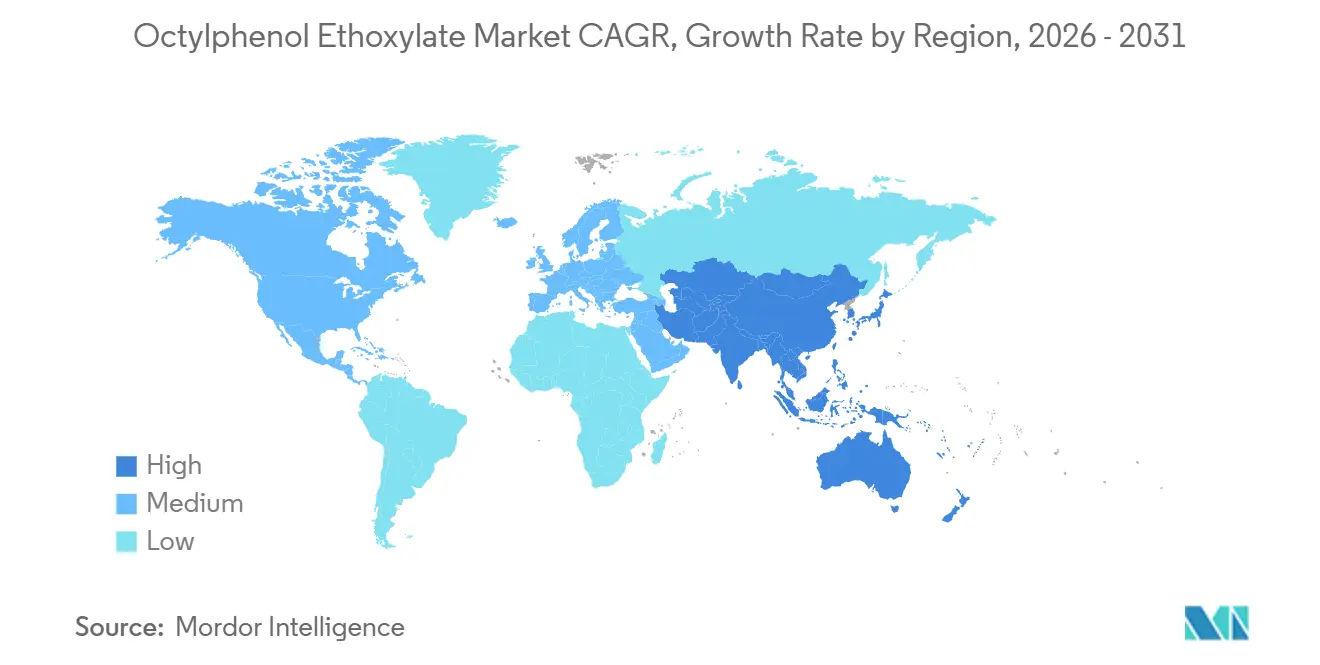
Asia-Pacific held 41.61% of the octylphenol ethoxylate market share in 2025 and is projected to advance at a 4.82% CAGR through 2031. India is expanding domestic ethoxylation for textile, agrochemical, and industrial cleaning customers, and India Glycols Limited expanded its New Specialties Unit in Kashipur, Uttarakhand, to 7,500 metric tons per year in 2024 while developing replacement products for restricted alkylphenol surfactants. Vietnam, Bangladesh, the Association of Southeast Asian Nations countries, and South Korea are additional demand centers, and South Korea’s electronics sector supports specialized precision-cleaning demand. In March 2026, BASF Hannong Chemicals Solutions Ltd., owned 51% by BASF and 49% by Hannong Chemicals, inaugurated a nonionic surfactant site in Seosan. The facility targets agricultural, polymer, and industrial chemical demand, reinforcing Asia-Pacific’s role as a producer and consumer despite export-customer restricted-substance requirements.
North America and Europe are mature, regulation-shaped regions, with the United States retaining octylphenol ethoxylate in industrial and institutional cleaners, agrochemical adjuvants, and emulsion polymerization, and Canada supporting industrial cleaning and paper-processing demand. Mexico offers an opportunity in agrochemical adjuvants tied to export agriculture, while Germany, France, and the United Kingdom use authorized grades in aerospace, diagnostics, and specialty coatings. In June 2025, the United Kingdom authorized PPG Industries (UK) Ltd. to use octylphenol ethoxylate in aerospace-grade polysulfide sealants for Airbus and its associated supply chain. Nordic countries are more constrained because national chemical rules can exceed the European Union REACH baseline, while Italy and France retain octylphenol ethoxylate demand in paints and coatings. These conditions leave North America and Europe with smaller but specialized uses of octylphenol ethoxylate.
South America and the Middle East and Africa have lower but growing demand bases. Brazil anchors South American use through soybean and corn agriculture, while Argentina uses octylphenol ethoxylate-containing agrochemical adjuvants for soybean cultivation. Saudi Arabia and the United Arab Emirates support industrial cleaning and coatings demand from refinery and construction activity, and South Africa has modest demand from mining chemicals and industrial cleaning.

Competitive Landscape
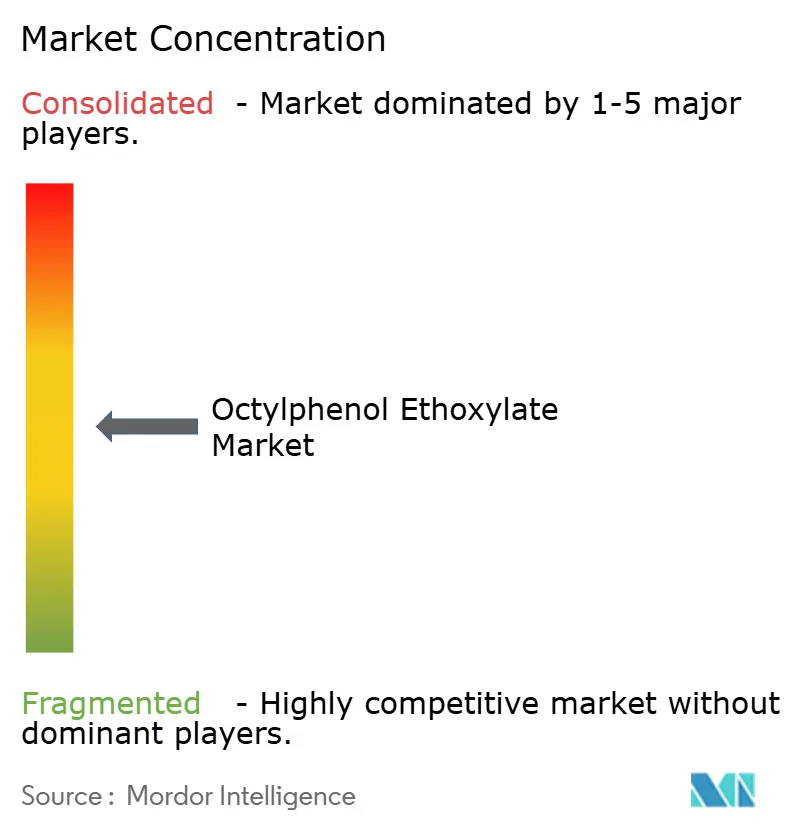
The octylphenol ethoxylate market is moderately concentrated, with the top five players including BASF, Dow, Syensqo, Stepan Company, and Huntsman International LLC. Producers in China, India, and Poland compete more directly on price and proximity to regional customers. BASF uses a vertically integrated model linking ethylene oxide production with downstream ethoxylation, and its Seosan joint-venture facility adds nonionic surfactant capacity for Asian supply chains. The facility supports agricultural, industrial cleaning, and personal-care customers in the region. This strategy shows the value of regional capacity for differentiated grades.
Stepan Company has focused on specialty alkoxylation while reducing selected commodity-surfactant activities, and its Pasadena, Texas facility supports 75,000 metric tons of annual output through ethoxylation and propoxylation for agricultural, oilfield, construction, and household end uses. PCC Exol SA completed a new production installation in Płock in 2025 and reported record group revenue of PLN 1.09 billion (approximately USD 280 million) for that year. The installation increased the availability of multiple product grades for European customers. Huntsman International LLC opened an expanded Performance Products manufacturing facility in Petfurdo, Hungary, in March 2026, providing manufacturing flexibility for polyurethane, coatings, metalworking, and electronics customers.
India Glycols Limited and Venus Ethoxyethers Pvt Ltd. compete with rapid technical support and just-in-time delivery to local textile and agrochemical customers, while Chinese producers with integrated octylphenol supply have a low-cost position in commodity octylphenol ethoxylate. Their pricing shapes competition in detergent and cleaning applications, although validated specialty grades give some suppliers more protection from price pressure. Aerospace and diagnostics need authorized supply chains and traceable handling, and low-heavy-metal agrochemical grades serve export markets with residue requirements. Narrow hydrophilic-lipophilic balance grades can address back-end electronics cleaning needs outside the strictest advanced-fabrication requirements. Competitive outcomes depend on technical performance, regulatory readiness, local supply, and customer qualification status.
Octylphenol Ethoxylate Industry Leaders
BASF
Dow
Syensqo
Stepan Company
Huntsman International LLC
- *Disclaimer: Major Players sorted in no particular order

Recent Industry Developments
- March 2026: BASF Hannong Chemicals Solutions Ltd., the BASF–Hannong Chemicals joint venture, inaugurated a new nonionic surfactant production site in Seosan, South Korea, to expand supply across the Asia-Pacific. The facility strengthens regional production of nonionic surfactants, including solutions serving chemical, agricultural, polymer, and polyurethane applications, supporting the broader surfactant supply base for octylphenol ethoxylate applications.
- March 2026: Huntsman International LLC inaugurated the expanded Performance Products manufacturing facility in Pétfürdő, Hungary, increasing global capacity for polyurethane catalysts and specialty amines. The expansion is relevant to the octylphenol ethoxylate market through its broader specialty-chemical production base serving coatings, metalworking, polyurethane, and industrial applications.


Global Octylphenol Ethoxylate Market Report Scope
Octylphenol ethoxylates are nonionic surfactants produced by adding ethylene oxide units to octylphenol. They provide surface-active properties that support wetting, emulsification, dispersion, and cleaning performance in formulated products.
The Octylphenol Ethoxylate Market is segmented by product type, application, end-use industry, and geography. By product type, the market is segmented into liquid and solid. By application, the market is segmented into detergents, emulsifiers, dispersants, adhesives, cleaners, and other applications. By end-use industry, the market is segmented into textiles, agriculture, pharmaceuticals, paints and coatings, electronics, and other end-use industries. The report also covers the market size and forecasts for octylphenol ethoxylates in 15 countries across major regions. For each segment, the market sizing and forecasts have been done on the basis of value (USD).
| Liquid |
| Solid |
| Detergents |
| Emulsifiers |
| Dispersants |
| Adhesives |
| Cleaners |
| Other Applications |
| Textiles |
| Agriculture |
| Pharmaceuticals |
| Paints and Coatings |
| Electronics |
| Other End-Use Industries |
| Asia-Pacific | China |
| India | |
| Japan | |
| South Korea | |
| ASEAN Countries | |
| Rest of Asia-Pacific | |
| North America | United States |
| Canada | |
| Mexico | |
| Europe | Germany |
| United Kingdom | |
| France | |
| Italy | |
| NORDIC Countries | |
| Rest of Europe | |
| South America | Brazil |
| Argentina | |
| Rest of South America | |
| Middle East and Africa | Saudi Arabia |
| South Africa | |
| Rest of Middle East and Africa |
| By Product Type | Liquid | |
| Solid | ||
| By Application | Detergents | |
| Emulsifiers | ||
| Dispersants | ||
| Adhesives | ||
| Cleaners | ||
| Other Applications | ||
| By End-Use Industry | Textiles | |
| Agriculture | ||
| Pharmaceuticals | ||
| Paints and Coatings | ||
| Electronics | ||
| Other End-Use Industries | ||
| By Geography | Asia-Pacific | China |
| India | ||
| Japan | ||
| South Korea | ||
| ASEAN Countries | ||
| Rest of Asia-Pacific | ||
| North America | United States | |
| Canada | ||
| Mexico | ||
| Europe | Germany | |
| United Kingdom | ||
| France | ||
| Italy | ||
| NORDIC Countries | ||
| Rest of Europe | ||
| South America | Brazil | |
| Argentina | ||
| Rest of South America | ||
| Middle East and Africa | Saudi Arabia | |
| South Africa | ||
| Rest of Middle East and Africa | ||


Key Questions Answered in the Report
What is the size of the octylphenol ethoxylate market?
The octylphenol ethoxylate market stands at USD 1.11 billion in 2026 and is projected to reach USD 1.37 billion by 2031.
What is driving demand for octylphenol ethoxylate?
Within the octylphenol ethoxylate market, textile wet processing, agrochemical formulations, industrial cleaning, and emulsion polymerization support the demand.
Which product type held the largest share in 2025?
Liquid held 65.13% of the market share in 2025.
Which application is expected to grow fastest through 2031?
Cleaners are projected to advance at a 5.11% CAGR through 2031, supported by electronics and precision metal cleaning requirements.
Page last updated on:


 Your data is secure and never sold or shared.


