
NVDIMM and Persistent Memory Module Market Size and Share
Market Overview
| Study Period | 2020 - 2031 |
|---|---|
| Market Size (2026) | USD 0.89 Billion |
| Market Size (2031) | USD 1.30 Billion |
| Growth Rate (2026 - 2031) | 7.92 % |
| Fastest Growing Market | Asia-Pacific |
| Largest Market | North America |
| Market Concentration | Low |
Major Players *Disclaimer: Major Players sorted in no particular order Image © Mordor Intelligence. Reuse requires attribution under CC BY 4.0. | |
NVDIMM and Persistent Memory Module Market Analysis by Mordor Intelligence
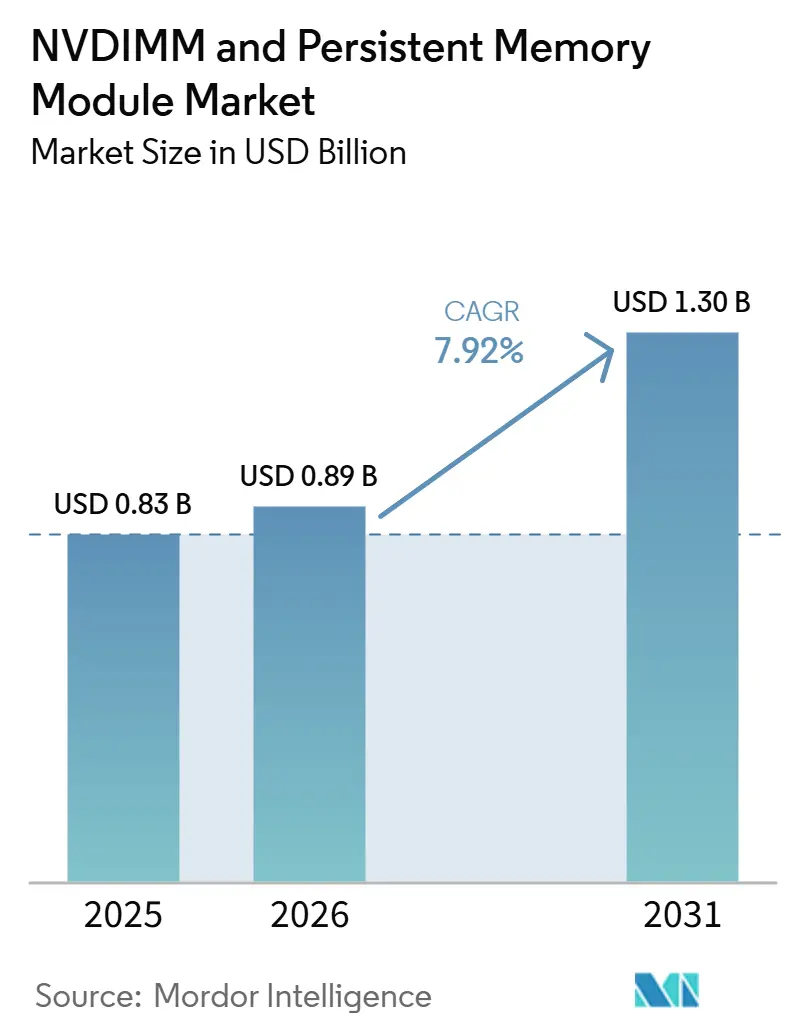
The NVDIMM and persistent memory module market size is projected to expand from USD 0.83 billion in 2025 and USD 0.89 billion in 2026 to USD 1.3 billion by 2031, registering a CAGR of 7.92% between 2026 to 2031. The category is gaining relevance because it protects working memory during power interruptions without forcing the slower recovery steps that follow storage-layer reloads. Demand is being supported by AI server deployments, where memory-state retention is moving closer to an uptime requirement instead of a niche hardware preference. The same build-out is also putting memory economics under sharper scrutiny, which makes persistent memory decisions more visible in enterprise and hyperscale capital planning. The DDR5 server transition is widening the commercial window for newer persistent memory designs, especially where buyers want byte-addressable persistence through standard server memory channels. At the same time, the NVDIMM and persistent memory module market still faces pressure from platform qualification timelines, software readiness gaps, and the slower but real rise of CXL-based memory expansion in large data center environments.
Key Report Takeaways
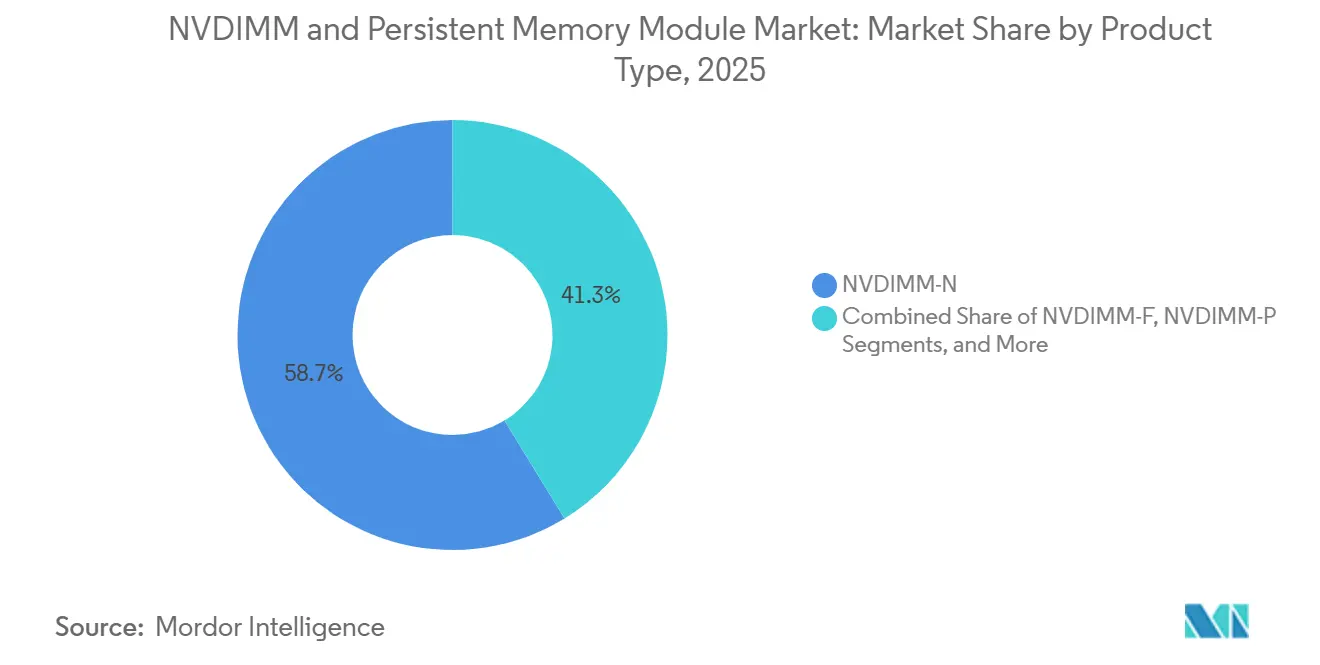
- By product type, NVDIMM-N held 58.71% of revenue of the NVDIMM and persistent memory module market in 2025, while NVDIMM-P is forecast to expand at a 9.11% CAGR through 2031.
- By end user, enterprise IT accounted for 43.88% of revenue in 2025, while telecom and edge infrastructure recorded the highest projected CAGR at 9.25% through 2031.
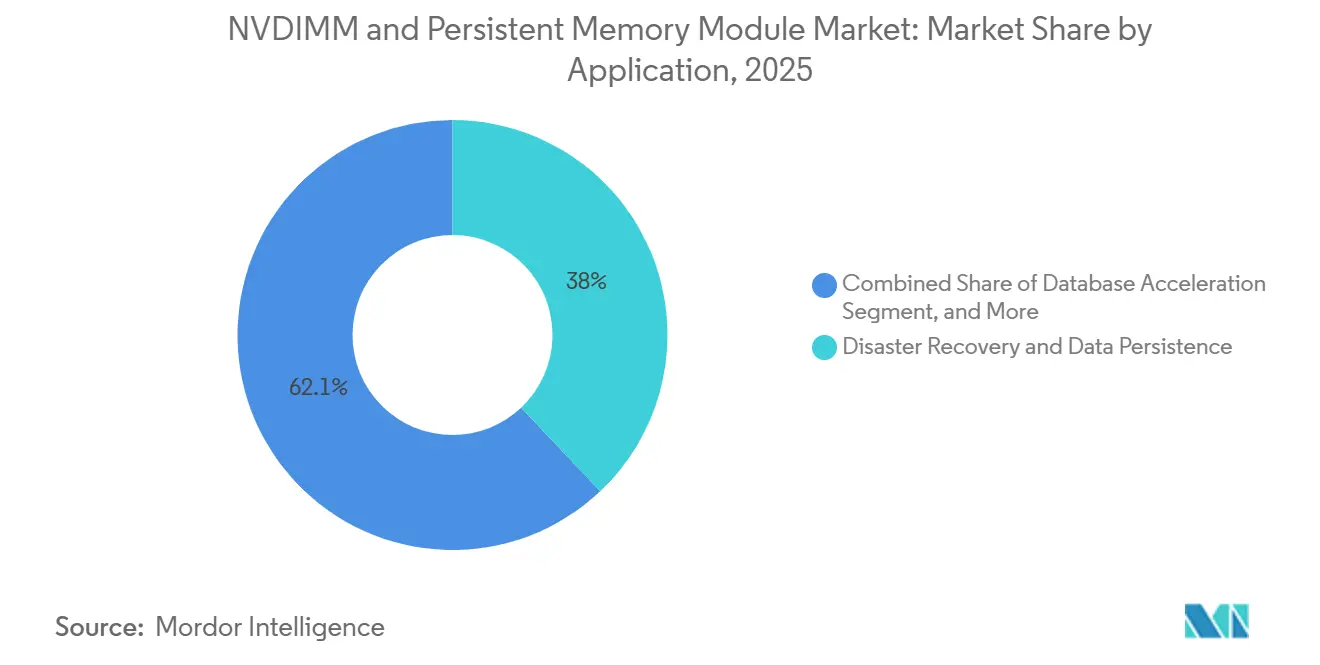
- By application, disaster recovery and data persistence accounted for a 37.95% share of the NVDIMM and persistent memory module market in 2025, while edge computing systems are advancing at a 9.63% CAGR through 2031.
- By technology, the DRAM and NAND hybrid accounted for 56.79% of revenue of the NVDIMM and persistent memory module market in 2025, while emerging SCM technologies are forecast to grow at a 9.47% CAGR through 2031.
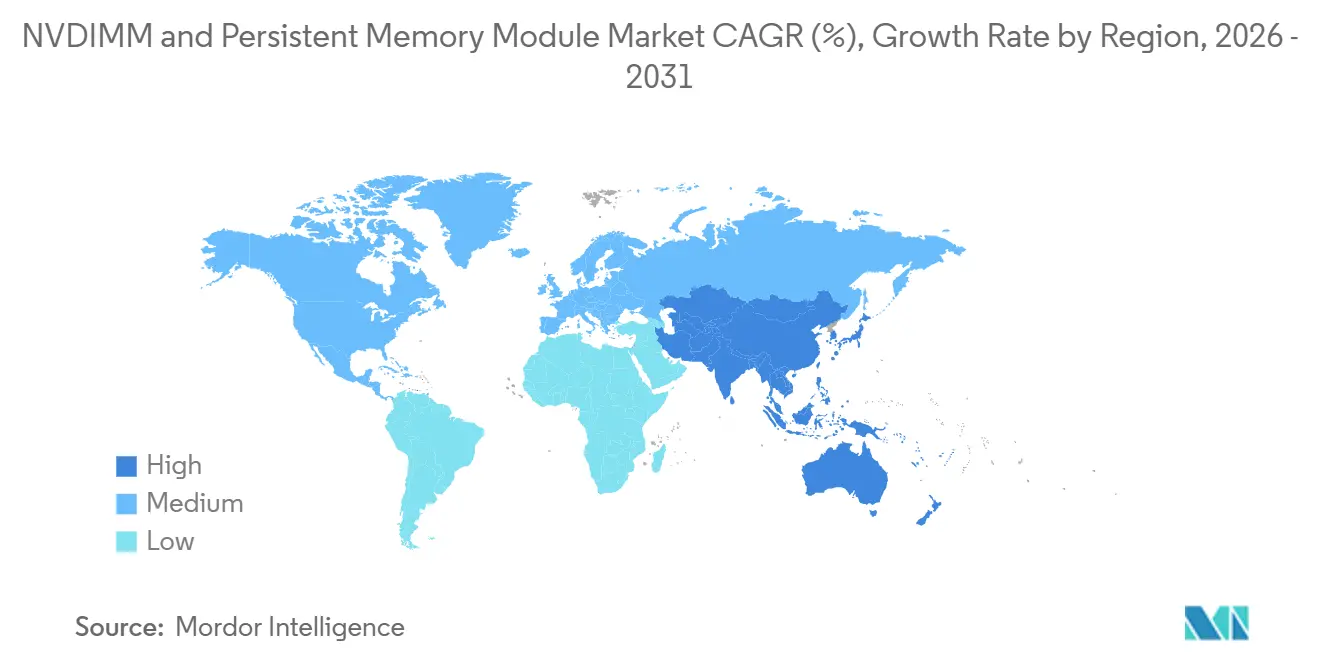
- By geography, North America held 45.43% of revenue in 2025, while the Asia Pacific is projected to record the highest CAGR at 8.96% through 2031
Note: Market size and forecast figures in this report are generated using Mordor Intelligence’s proprietary estimation framework, updated with the latest available data and insights as of January 2026.
Market Trends and Insights
Drivers Impact Analysis of NVDIMM and Persistent Memory Module Market*
| Driver | (~) % Impact on CAGR Forecast | Geographic Relevance | Impact Timeline |
|---|---|---|---|
| AI and High-Performance Computing Workloads Requiring Persistent Memory | +2.4% | Global, concentrated in North America and Asia Pacific | Short term (≤ 2 years) |
| Growth in Hyperscale and Enterprise Data Center Refresh Cycles | +1.7% | North America, Europe, Asia Pacific core | Short term (≤ 2 years) |
| Shift Toward In-Memory Databases and Real-Time Analytics Architecture | +1.2% | Global, with early adoption in Europe and North America | Medium term (2-4 years) |
| DDR5 Platform Transitions Supporting New Persistent Memory Designs | +0.9% | Global, with first-mover concentration in North America and East Asia | Short term (≤ 2 years) |
| Edge Computing and Industrial Resilience Requirements | +0.6% | Asia Pacific, EMEA industrial clusters | Medium term (2-4 years) |
| Server Downtime Avoidance and Power-Loss Protection Priorities | +0.4% | Global, with emphasis on financial services and healthcare verticals | Long term (≥ 4 years) |
| Source: Mordor Intelligence | |||
AI and High-Performance Computing Workloads Requiring Persistent Memory
Large language model inference clusters need feature stores, KV caches, and embedding vectors to survive context resets without repeated storage reloads, which makes persistence more relevant inside active memory footprints. That requirement is lifting the strategic value of the NVDIMM and persistent memory module market because volatile DRAM alone cannot preserve the working state across outages or planned interruptions. Microsoft stated in its Q3 FY2026 10-Q that USD 25 billion of its 2026 capital expenditure was linked to DRAM and HBM price inflation, showing that memory economics had become a board-level issue rather than only an infrastructure operations concern.[1]Microsoft Corporation, “10-Q Filing, Third Quarter Fiscal Year 2026,” U.S. Securities and Exchange Commission, sec.gov The NVDIMM and persistent memory module market also benefits, as AI inference clusters in telecom and financial services environments increasingly require session continuity and low-latency restart behavior after power events. That expands the addressable market for the NVDIMM and persistent memory module markets beyond traditional high-performance computing facilities into broader enterprise deployments. Rambus also framed its July 2026 DDR5 server chipset launch around agentic AI and HPC server infrastructure, which supports the view that persistent memory readiness is now being considered within mainstream AI server design cycles.[2]Rambus Inc., “Enabling Next-Generation Data Center Infrastructure for Agentic AI, Introducing the Rambus DDR5 9600 Server RDIMM Chipset,” Rambus Blog, rambus.com
Growth in Hyperscale and Enterprise Data Center Refresh Cycles
The NVDIMM and persistent memory module market is gaining support from server refresh activity, as many buyers are moving to DDR5-capable platforms in 2026. That timing matters because upgrades that were harder to justify on DDR4-only environments become more practical when enterprises are already changing core server boards and memory controllers. Micron said in its fiscal Q3 2026 earnings release filed with the SEC that fiscal 2026 capital expenditures would reach USD 27 billion, up from USD 13.8 billion in fiscal 2025, with spending centered on advanced DRAM and HBM capacity. In that environment, the NVDIMM and persistent memory module market stands out because specialized persistence layers can protect high-value workloads without imposing every resilience requirement on commodity DRAM. SK hynix completed Intel Data Center Certification for its 256GB DDR5 RDIMM in December 2025, which broadened the validated DDR5 ecosystem that module vendors depend on when pursuing OEM design wins.[3]SK hynix Inc., “SK hynix Begins Mass Production of SOCAMM2 192GB, Setting New Standard for AI Server Memory Performance,” SK hynix Newsroom, news.skhynix.co.kr The NVDIMM and persistent memory module market benefits from this, as each new qualified DDR5 platform creates a more credible insertion path for persistent memory modules during active server refresh cycles.
Shift Toward In-Memory Databases and Real-Time Analytics Architecture
The NVDIMM and persistent memory module market is also being pulled forward by in-memory databases and analytics systems that cannot tolerate long restart windows after outages. HPE introduced the HPE Compute Scale-up Server 3250 in May 2026 as the first scale-up server validated by the SAP BW Edition HANA benchmark with at least 48 TB of memory, directly addressing large in-memory workloads that depend on fast restart behavior and resilient data state retention.[4]Hewlett Packard Enterprise, “HPE Introduces Industry-First 64 TB Memory Server for SAP Cloud ERP and Business-Critical Workloads,” HPE Newsroom, hpe.com The NVDIMM and persistent memory module market benefits because these workloads place business continuity and transaction recovery alongside raw performance in infrastructure selection. Research published in the Proceedings of the VLDB Endowment in 2024 showed that SAP HANA on CXL-attached persistent memory could reuse data across restarts rather than reloading it, confirming that fast restart remains central to database uptime design even as architectures evolve.[5]Jihyun Ahn et al., “An Examination of CXL Memory Use Cases for In-Memory Database Management Systems using SAP HANA,” Proceedings of the VLDB Endowment, vldb.org Oracle AI Database 26ai was described in the source material as extending in-memory columnar capabilities and automatic memory management, which reflects how persistence is being absorbed into broader database infrastructure planning rather than treated as an isolated feature. As more operational analytics stacks combine transaction processing and analytics on shared infrastructure, the NVDIMM and persistent memory module market remains well positioned for buyers seeking low-latency memory with stronger restart resilience.
DDR5 Platform Transitions Supporting New Persistent Memory Designs
The DDR5 transition is one of the clearest structural supports for the NVDIMM and persistent memory module markets, as it opens a viable path for newer persistent memory formats on host platforms. JEDEC's 2026 publication of JESD400-5D.01 formally defined DDR5 SPD contents for NVDIMM-N and NVDIMM-P module types, which lowers the interoperability burden that had slowed validation and qualification work. Rambus launched its DDR5 9600 server RDIMM chipset in July 2026, featuring the RCD06 Registering Clock Driver, a PMIC, an SPD hub, and temperature sensor support, indicating that the chipset layer is being tuned for next-generation server memory integration. Netlist also said in its Q1 2026 results that its DDR5 product family had achieved significant qualification milestones with major server OEMs, pointing to commercial readiness across specialized memory modules. The NVDIMM and persistent memory module market benefits because DDR5 changes are not only about bandwidth; they also reduce the friction around bringing byte-addressable persistence into standard server memory configurations. That gives the NVDIMM and persistent memory module market more room to expand before newer fabric-attached alternatives reach full maturity at scale.
Restraints Impact Analysis of NVDIMM and Persistent Memory Module Market*
| Restraint | (~) % Impact on CAGR Forecast | Geographic Relevance | Impact Timeline |
|---|---|---|---|
| High Module and Platform Integration Cost | -1.5% | Global, with acute impact in cost-sensitive Asia Pacific emerging markets | Medium term (2-4 years) |
| Competition From CXL-Based Memory Expansion Architectures | -1.1% | North America, hyperscale cloud environments | Medium term (2-4 years) |
| Slow Software Ecosystem Optimization and Qualification Cycles | -0.8% | Global | Long term (≥ 4 years) |
| Limited Design Wins Outside High-Value Enterprise Use Cases | -0.5% | Global, except North America enterprise segment | Long term (≥ 4 years) |
| Source: Mordor Intelligence | |||
High Module and Platform Integration Cost
The NVDIMM and persistent memory module market still faces a meaningful pricing barrier because these modules carry more bill-of-materials complexity than standard DRAM. The architecture requires DRAM, NAND, an energy storage component, and controller logic for backup and restore behavior, which lifts the cost base before qualification work is even complete. That makes the NVDIMM and persistent memory module market harder to scale in mid-market environments where per-socket budgets stay tight and payback periods must fit normal IT spending cycles. Qualification adds another layer because firmware, BIOS, operating system support, and server board compatibility often need separate validation over 12-24 months before a design reaches production revenue. The SNIA NVM programming model also increases software adaptation work because application teams need to use direct access pathways rather than conventional buffered storage methods. Until component economics improve further and platform stacks become easier to certify, the NVDIMM and persistent memory module market will remain more attractive in higher-value deployments than in cost-sensitive rollouts.
Slow Software Ecosystem Optimization and Qualification Cycles
The NVDIMM and persistent memory module market is also constrained by the slower pace of software optimization around persistent memory behavior. Open-source and standards-led toolchains are available, but application teams still need specialized engineering to manage flush, fence, and crash-consistency logic without sacrificing the hardware's performance. Research published in the IEEE Transactions on Computers in 2026 showed that distributed persistence models based on CXL introduce fault patterns that older crash-consistency approaches do not fully address. That keeps the NVDIMM and persistent memory module markets dependent on customers with deeper systems programming expertise, especially in early production deployments. Qualification cycles at major OEMs also remain long, which means each new module generation and server platform pairing can require another round of validation before wide deployment. As a result, the NVDIMM and persistent memory module market does not always move at the same speed as underlying hardware innovation, even when the technical case for persistence is strong.
*Our forecasts treat driver/restraint impacts as directional, not additive. The impact forecasts reflect baseline growth, mix effects, and variable interactions.
NVDIMM and Persistent Memory Module Market Segment Analysis
By Product Type:
NVDIMM-P Positions as the Next Growth EngineNVDIMM-N held 58.71% of the NVDIMM and persistent memory module market share in 2025, which kept it as the leading product type because it already had broad OEM validation across major server lines. The NVDIMM and persistent memory module market still leans heavily on this format because it combines DRAM-like performance during operation with NAND-backed persistence only at power loss. That design reduces direct NAND wear during active workloads and keeps the installed base relevant in enterprise environments that prioritize stable qualification history. The NVDIMM and persistent memory module market also favors NVDIMM-N in accounts where buyers value known firmware behavior and proven interoperability over early adoption of newer formats. Unigen and Kingston remained important suppliers in this area because both companies operate inside the established compliance and validation framework described in the source material.
NVDIMM-P is the fastest-growing product type with a 9.11% CAGR through 2031, and that positioning matters because it aligns more directly with newer DDR5 platforms and byte-addressable persistence. The NVDIMM and persistent memory module market is opening more space for NVDIMM-P because buyers want persistence at lower latency than external memory expansion devices can usually provide. The CXL Consortium stated in 2025 that the move from NVDIMM-N concepts into CXL persistent memory preserves the logic of fast volatile media paired with non-volatile backup, which supports a coexistence phase instead of an immediate replacement cycle. JEDEC also set the standards direction for persistent memory protocol work, which remains central to OEM qualification on new server generations. The NVDIMM and persistent memory module market should therefore continue to rely on NVDIMM-N for current scale while using NVDIMM-P as the product path that captures more of the next platform cycle.



By End User:
Telecom and Edge Infrastructure Moves Ahead in GrowthEnterprise IT accounted for 43.88% of end-user revenue in 2025, which reflected the long-standing role of persistent memory in protecting database state, transaction logs, and checkpoint files. The NVDIMM and persistent memory module market has deep roots in this buyer group because deployments often sit inside tightly managed server stacks with vendor-specific firmware and battery or controller logic. That creates durable positions for incumbent suppliers once a design is qualified on a production server platform. The NVDIMM and persistent memory module market also remains strategically important for hyperscalers and cloud providers, even though these buyers are more willing than enterprises to evaluate CXL-based alternatives alongside traditional modules. Government and research organizations continue to support demand in specialized HPC environments where data integrity and restart behavior are tied to formal operating requirements.
Telecom and edge infrastructure is the fastest-growing end-user segment, with a 9.25% CAGR through 2031, making it the clearest new expansion lane for the NVDIMM and persistent memory module market. The NVDIMM and persistent memory module market is benefiting from 5G standalone networks, Open RAN, and multi-access edge computing, which push more latency-sensitive processing away from central facilities. SK hynix began mass production of its SOCAMM2 192GB module in 2026 for AI server environments, showing that advanced memory innovation is moving closer to distributed and edge-oriented deployment models. In these environments, buyers value power-fail protection because remote nodes cannot absorb long restart delays or repeated model-state reconstruction. The NVDIMM and persistent memory module market therefore gains not only from higher data volumes at the edge, but also from the higher operational penalty attached to lost memory state in distributed telecom infrastructure.
By Application:
Edge Computing Adds a New Demand LayerDisaster recovery and data persistence accounted for 37.95% of revenue in 2025, making it the largest application, as it reflects the oldest and most validated use case for persistent memory. The NVDIMM and persistent memory module market continues to depend on this application because the ability to retain working memory through power cycles directly addresses the cost of downtime. Uptime Institute's 2025 outage analysis found that power remained the leading cause of impactful data center outages, which supports the commercial case for memory-state protection in enterprise server environments. The NVDIMM and persistent memory module market also benefits because database acceleration and real-time analytics workloads can reduce checkpoint and restart overhead when persistence sits closer to the active memory layer. That keeps disaster recovery and data persistence at the core of current revenue, even as newer use cases begin to gain momentum.
Edge computing systems are the fastest-growing application segment, with a 9.63% CAGR through 2031, signaling a broader role for the NVDIMM and persistent memory module markets beyond centralized data centers. The NVDIMM and persistent memory module market for edge computing systems is growing as distributed AI inference, industrial controls, and autonomous infrastructure increasingly require local resilience when cloud connectivity is unstable or unavailable. Everspin launched the UNISYST MRAM family in March 2026 with read bandwidth up to 400 MB/s and AEC-Q100 Grade 1 qualification, which directly addressed industrial and automotive resilience requirements. Everspin also completed production qualification milestones in its PERSYST xSPI STT-MRAM portfolio in March 2026, expanding the density roadmap for aerospace, defense, and industrial automation use cases. The NVDIMM and persistent memory module market is therefore moving into applications where ruggedization, endurance, and certification matter as much as raw server performance.
By Technology:
Emerging SCM Technologies Build Pressure on Hybrid DesignsDRAM and NAND hybrid technology held 56.79% of revenue in 2025, which kept it as the dominant technology architecture across commercial NVDIMM-N and NVDIMM-F deployments. The NVDIMM and persistent memory module market relied on this design because active writes stay in DRAM during normal operation, while NAND is used mainly for backup during a power event. That separation helps extend module life in write-heavy enterprise workloads and fits current server expectations around performance and persistence behavior. The NVDIMM and persistent memory module market also continues to include NAND flash-based options where lower-cost persistent storage is acceptable, and latency demands are less strict. By contrast, legacy byte-addressable persistent memory tied to 3D XPoint is narrowing as the installed base shifts toward maintenance rather than fresh platform expansion.
Emerging SCM technologies, including MRAM, ReRAM, and PCM, are forecast to grow at a 9.47% CAGR through 2031, which makes them the fastest-growing technology segment in the NVDIMM and persistent memory module market. The NVDIMM and persistent memory module market is being challenged here because these technologies are improving on the density, endurance, and integration limits that historically favored NAND-backed designs. Research in ACM Transactions on Storage in 2025 described MRAM, ReRAM, PCM, and FeRAM as having distinct endurance, latency, and cost profiles suited to different persistent memory roles. Everspin said in its Q4 2025 discussion that its PERSYST and UNISYST families were targeting combined addressable demand above USD 700 million for high-reliability persistent memory applications, which shows supplier confidence in this direction. The NVDIMM and persistent memory module market will still rely on hybrid architectures for current scale, but the technology mix is clearly broadening as new media reach better commercial readiness.
Geography Analysis
North America NVDIMM and Persistent Memory Module Market
North America held 45.43% of the NVDIMM and persistent memory module market share in 2025, which reflected the region's heavy concentration of hyperscale capacity, large enterprise in-memory workloads, and active server OEM qualification programs. The NVDIMM and persistent memory module market is particularly strong in the region because buyers there tend to adopt new server architectures and memory-intensive AI infrastructure earlier. Microsoft's Q3 FY2026 10-Q showed that USD 25 billion of its 2026 capital expenditure was attributed to DRAM and HBM price inflation, which shows how strongly large North American operators are absorbing memory cost pressure to secure AI capacity. Micron also said in its fiscal Q3 2026 filing that capital expenditures would reach USD 27 billion in fiscal 2026, reinforcing the role of North America in advanced memory supply expansion and platform validation. The NVDIMM and persistent memory module market benefits from that environment because platform validation, component access, and demand for resilient memory all remain unusually concentrated in the region.
Europe NVDIMM and Persistent Memory Module Market
Europe ranked as the second-largest regional market and showed a different demand pattern from North America. The NVDIMM and persistent memory module market in Europe is shaped more by regulated enterprise sectors such as financial services, healthcare, and manufacturing, where resilience and restart integrity matter as much as AI performance. HPE's May 2026 launch of the Compute Scale-up Server 3250 for SAP HANA workloads fits this regional pattern because many of the largest in-memory database environments remain tied to enterprise continuity requirements rather than hyperscale experimentation. The NVDIMM and persistent memory module market also aligns with European deployment patterns because the software path is often governed by standards-led infrastructure planning and long qualification cycles rather than rapid pilot scaling.
APAC, MEA and South America NVDIMM and Persistent Memory Module Market
Asia Pacific is the fastest-growing region at an 8.96% CAGR through 2031, and this makes it the clearest geographic growth engine in the NVDIMM and persistent memory module market size. The NVDIMM and persistent memory module market is expanding in the region because semiconductor manufacturing strength in South Korea, Japan, and Taiwan is being matched by broader 5G rollout and industrial automation demand across China, India, and Southeast Asia. SK hynix said it had begun mass production of SOCAMM2 192GB in 2026, which supports the region's role as both a supply center and a proving ground for next-generation memory modules tied to AI infrastructure. The NVDIMM and persistent memory module market is also gaining from the edge side of regional growth because distributed telecom and industrial nodes need memory resilience closer to operations. The Rest of the World remained earlier in adoption, but sovereign AI data center activity in Gulf markets and gradual cloud infrastructure expansion in countries such as Brazil and South Africa are expected to create incremental opportunities over the forecast period.

Competitive Landscape
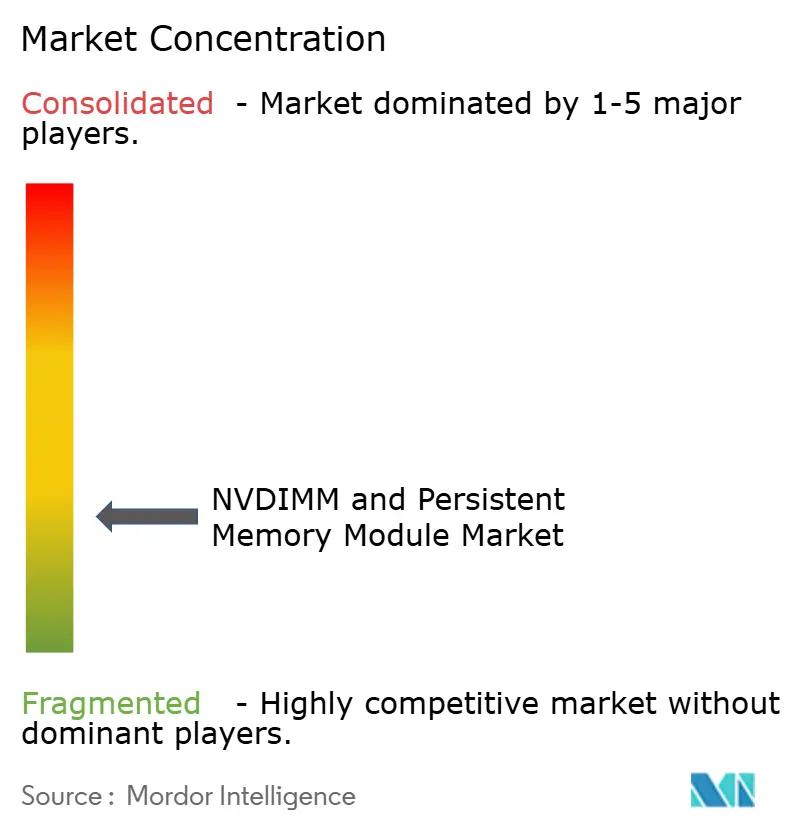
The NVDIMM and persistent memory module market shows a mixed structure, with tighter control at the silicon supply layer and broader fragmentation at the module level. Micron, SK hynix, and Samsung influence cost floors and performance boundaries through DRAM and NAND supply, while module specialists such as Netlist, Viking Technology, Unigen, Kingston Technology, and SMART Modular Technologies compete on qualification depth, backup architecture, and system integration. The NVDIMM and persistent memory module market, therefore, does not behave like a winner-take-all category, because module-level differentiation still matters once component supply is secured. JEDEC standards remain a central gatekeeper because suppliers need compliant products and then still face long OEM validation cycles before reaching material revenue. That process creates a moderate entry barrier for the NVDIMM and persistent memory module markets, even though the supplier list appears broad.
The competitive pattern is increasingly shaped by vertical alignment between component makers, module vendors, and AI infrastructure partners. Netlist received US Patent 12,646,537 B1 in June 2026 for a memory package with stacked DRAM array dies and a reduced driver-load architecture, demonstrating that intellectual property remains part of module-level differentiation. SMART Global Holdings also announced a USD 200 million strategic investment from SK Telecom in July 2024 to advance end-to-end AI infrastructure solutions, including advanced memory products and CXL standard memory expansion. The NVDIMM and persistent memory module market is therefore becoming more connected to broader AI system design, rather than operating only as a server memory subcategory.
White-space opportunity remains real, but it is concentrated in specific areas rather than spread evenly across the NVDIMM and persistent memory module market. One opening is ruggedized persistent memory for industrial, defense, and automotive use cases, where Everspin's 2026 launches and qualification milestones show early movement in certified high-reliability memory. Another is CXL-attached persistent memory, where Netlist said in Q1 2026 that it had begun sampling its CXL NVvault with major OEMs on next-generation server platforms. The NVDIMM and persistent memory module market still has time to build on socket-attached form factors because software and qualification work for distributed persistence models remains unfinished. That leaves room for established suppliers to defend current positions while also preparing for a more fabric-attached competitive environment over time.
NVDIMM and Persistent Memory Module Industry Leaders
Micron Technology, Inc.
SK hynix Inc.
Intel Corporation
Samsung Electronics Co., Ltd.
Hewlett Packard Enterprise Company
- *Disclaimer: Major Players sorted in no particular order
NVDIMM and Persistent Memory Module Market Companies Covered in this Report
- Micron Technology, Inc.
- SK hynix Inc.
- Intel Corporation
- Samsung Electronics Co., Ltd.
- SMART Global Holdings, Inc.
- Netlist, Inc.
- Viking Technology, Inc.
- AgigA Tech, Inc.
- Kingston Technology Company, Inc.
- Hewlett Packard Enterprise Company
- Dell Technologies Inc.
- Fujitsu Limited
- Huawei Technologies Co., Ltd.
- Super Micro Computer, Inc.
- Everspin Technologies, Inc.
- Rambus Inc.
- Unigen Corporation

Recent Industry Developments in NVDIMM and Persistent Memory Module Market
- July 2026: Rambus launched its DDR5 9600 Server RDIMM Chipset, featuring the sixth-generation Registering Clock Driver (RCD06) enabling RDIMM speeds up to 9,600 MT/s, 20% faster than the prior generation, alongside a PMIC5030 Power Management IC, SPD Hub, and temperature sensor ICs. The chipset is designed for agentic AI and HPC server platforms, directly reducing integration complexity for NVDIMM module manufacturers targeting next-generation persistent memory-capable servers.
- June 2026: Netlist received US Patent 12,646,537 B1 for a memory package featuring stacked DRAM array dies and reduced driver load architecture, adding to its foundational patent portfolio for advanced server DRAM packaging that underpins its NVDIMM and CXL product development pipeline.
- May 2026: HPE announced the availability of the HPE Compute Scale-up Server 3250, the first scale-up server validated by the SAP BW Edition HANA benchmark with at least 48 TB of memory, powered by Intel Xeon 6 processors. The system is purpose-built for in-memory databases and business-critical analytics workloads that depend on persistent memory for crash-state retention and real-time transaction processing.
- March 2026: Everspin Technologies launched the UNISYST MRAM family, a new class of unified memory combining code storage and data memory in a single high-density non-volatile architecture for edge AI, industrial, and mission-critical applications. Available in densities from 128Mb to 2Gb via xSPI interface, the family delivers read bandwidth up to 400 MB/s, more than 400 times faster than NOR flash, and includes AEC-Q100 Grade 1 qualification for automotive and industrial environments.


Global NVDIMM and Persistent Memory Module Market Report Scope
The NVDIMM and Persistent Memory Module market comprises server-grade memory modules that combine volatile memory performance with non-volatile data persistence to preserve critical data during power interruptions and accelerate memory-intensive workloads.
The NVDIMM and Persistent Memory Module Market Report is Segmented by Product Type (NVDIMM-N, NVDIMM-F, NVDIMM-P, and Persistent Memory DIMMs (PMem)), End User (Enterprise IT, Cloud Service Providers/Hyperscalers, Telecom and Edge Infrastructure, and Government and Research Organizations), Application (Database Acceleration, Real-Time Analytics, Disaster Recovery and Data Persistence, and Edge Computing Systems), Technology (DRAM + NAND Hybrid, NAND Flash-Based, Byte-Addressable Persistent Memory (3D XPoint), and Emerging Storage-Class Memory (SCM) Technologies (MRAM, ReRAM, and PCM)), and Geography (North America, Europe, Asia-Pacific, and Rest of the World). The Market Forecasts are Provided in Terms of Value (USD).
| NVDIMM-N |
| NVDIMM-F |
| NVDIMM-P |
| Persistent Memory DIMMs (PMem) |
| Enterprise IT |
| Cloud Service Providers / Hyperscalers |
| Telecom and Edge Infrastructure |
| Government and Research Organizations |
| Database Acceleration |
| Real-Time Analytics |
| Disaster Recovery and Data Persistence |
| Edge Computing Systems |
| DRAM + NAND Hybrid |
| NAND Flash-Based |
| Byte-Addressable Persistent Memory (3D XPoint) |
| Emerging SCM Technologies (MRAM, ReRAM, PCM) |
| North America | |
| Europe | |
| Asia Pacific | China |
| Japan | |
| South Korea | |
| Taiwan | |
| Rest of Asia Pacific | |
| Rest of the World |
| By Product Type | NVDIMM-N | |
| NVDIMM-F | ||
| NVDIMM-P | ||
| Persistent Memory DIMMs (PMem) | ||
| By End User | Enterprise IT | |
| Cloud Service Providers / Hyperscalers | ||
| Telecom and Edge Infrastructure | ||
| Government and Research Organizations | ||
| By Application | Database Acceleration | |
| Real-Time Analytics | ||
| Disaster Recovery and Data Persistence | ||
| Edge Computing Systems | ||
| By Technology | DRAM + NAND Hybrid | |
| NAND Flash-Based | ||
| Byte-Addressable Persistent Memory (3D XPoint) | ||
| Emerging SCM Technologies (MRAM, ReRAM, PCM) | ||
| By Geography | North America | |
| Europe | ||
| Asia Pacific | China | |
| Japan | ||
| South Korea | ||
| Taiwan | ||
| Rest of Asia Pacific | ||
| Rest of the World | ||


Key Questions Answered in the Report
What is driving the adoption of NVDIMM and persistent memory modules in 2026?
Adoption is being supported by AI server build-outs, DDR5 platform refresh cycles, and the need to retain working memory state during power events. The category is projected to grow from USD 0.89 billion in 2026 to USD 1.3 billion by 2031 at a 7.92% CAGR.
Which product type leads current revenue?
NVDIMM-N leads current revenue with a 58.71% share in 2025 because it has broad OEM validation and a long operating history in enterprise server environments.
Which end-user group is growing the fastest?
Telecom and edge infrastructure is the fastest-growing end-user segment, with a 9.25% CAGR through 2031, supported by 5G standalone, Open RAN, and edge inference deployments.
Why is disaster recovery still the largest application?
It held 37.95% of revenue in 2025 because buyers still place high value on preserving working memory during outages and reducing restart delays after power loss.
Which region offers the strongest near-term growth?
Asia Pacific is the fastest-growing region at an 8.96% CAGR through 2031, supported by semiconductor manufacturing strength, 5G rollout, and industrial automation investment.
What is the main risk to future expansion?
The main risk is not weak demand, but slower software optimization, long OEM qualification cycles, and eventual pressure from CXL-based memory expansion architectures in large data center environments.
Page last updated on:





