
North America Turf Protection Market Size and Share
Market Overview
| Study Period | 2021 - 2031 |
|---|---|
| Forecast Data Period | 2026 - 2031 |
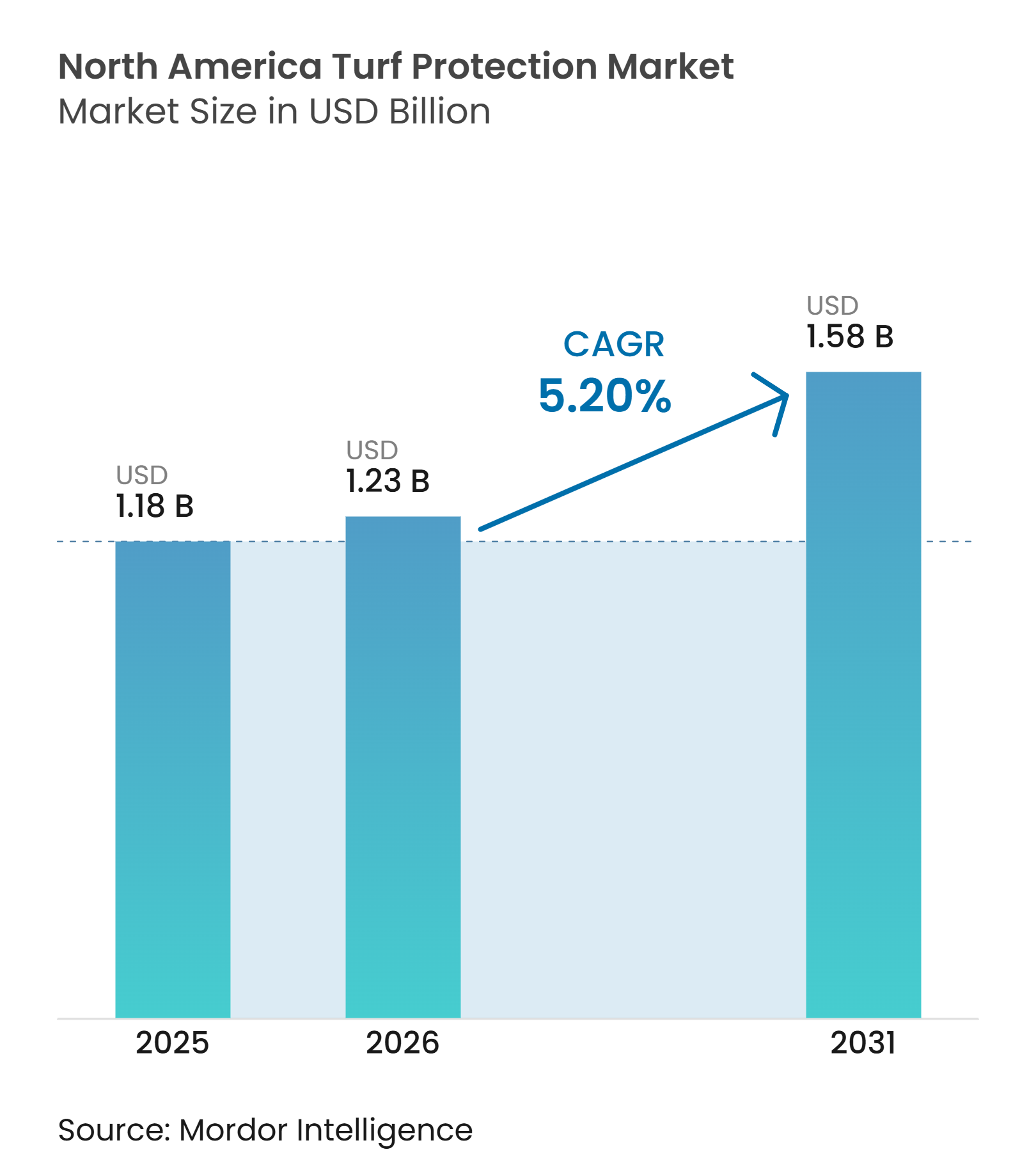
| Base Year Market Size (2025) | USD 1.18 Billion |
| Market Size (2026) | USD 1.23 Billion |
| Market Size (2031) | USD 1.58 Billion |
| Growth Rate (2026 - 2031) | 5.20 % |
| Market Concentration | Medium |
Major Players *Disclaimer: Major Players sorted in no particular order Image © Mordor Intelligence. Reuse requires attribution under CC BY 4.0. | |
North America Turf Protection Market Analysis by Mordor Intelligence
The North America turf protection market size is expected to grow from USD 1.18 billion in 2025 to USD 1.23 billion in 2026 and is forecast to reach USD 1.58 billion by 2031 at 5.2% CAGR over 2026-2031. The North America turf protection market covers commercial fungicides, herbicides, insecticides, plant growth regulators, biostimulants, and bio-fertilizers used on managed turfgrass. Professional buyers are moving from calendar-based spraying toward treatment programs based on disease risk, pest pressure, and turf condition. This change supports preventive applications and increases the importance of products that can be used in rotation. The United States remains the primary driver of regional demand, while Mexico is projected to expand faster as managed sports facilities and residential landscaping grow. Suppliers are responding through liquid formulations, biological options, and programs that combine chemical and biological products.
Key Report Takeaways
- By product type, fungicides held 34% of the North America turf protection market share in 2025, while biostimulants and bio-fertilizers are forecast to grow at 11.5% CAGR through 2031.
- By application, landscaping accounted for 39% of the North America turf protection market size in 2025, while sports fields are forecast to expand at 6.7% CAGR through 2031.
- By end-user, residential customers held 36% of the North America turf protection market share in 2025, while commercial landscape contractors are forecast to grow at 6.3% CAGR through 2031.
- By mode of action, chemical products held 82% share in 2025, while biological products are forecast to expand at 12.5% CAGR through 2031.
- By formulation, liquid concentrates held 44% share in 2025 and are forecast to grow at 6.2% CAGR through 2031.
- By geography, the United States held 88% share in 2025, while Mexico is forecast to grow at 7.8% CAGR through 2031.
Note: Market size and forecast figures in this report are generated using Mordor Intelligence’s proprietary estimation framework, updated with the latest available data and insights as of January 2026.
Market Trends and Insights
Drivers Impact Analysis of North America Turf Protection Market*
| Driver | (~) % Impact on CAGR Forecast | Geographic Relevance | Impact Timeline |
|---|---|---|---|
| Demand for disease, weed, and insect control in managed turf | +1.4% | North America, anchored in the United States | Short term (≤ 2 years) |
| Expansion of golf courses, sports fields, and commercial landscapes | +0.9% | United States, with spillover to Mexico | Medium term (2-4 years) |
| Adoption of integrated turf protection programs | +1.0% | United States and Canada | Medium term (2-4 years) |
| Increased use of lower-risk biological turf protection products | +0.7% | United States, with early gains in Canada | Medium term (2-4 years) |
| Greater use of biostimulants for turf stress management | +0.5% | United States and Mexico | Long term (≥ 4 years) |
| Adoption of preventive turf treatment supported by pest forecasting | +0.6% | United States, with early gains in Canada | Medium term (2-4 years) |
| Source: Mordor Intelligence | |||
Demand for Disease, Weed, and Insect Control in Managed Turf
Dollar spot, brown patch, Pythium diseases, grubs, billbugs, annual bluegrass, and broadleaf weeds require recurring treatment on maintained turf. Golf courses, athletic fields, sod farms, and landscape sites face different pest pressures throughout the growing season. The United States has nearly 16,000 golf courses and a large base of managed turfgrass, which creates repeat demand across several pest categories[1]. Dollar spot is a major economic concern because it can affect the appearance and playability of golf course turf. Disease pressure encourages buyers to use preventive programs that include products with longer residual activity. The North America turf protection market therefore benefits from the need to protect visible, high-value turf surfaces.
Expansion of Golf Courses, Sports Fields, and Commercial Landscapes
The existing golf and commercial landscape base supports recurring product use across the North America turf protection market. New sports fields and landscaped properties add treated acreage and can raise demand for professional application programs. Golf facilities use regular disease, weed, and insect control to maintain playing conditions and protect turf quality. The United States Golf Association Green Section invests USD 10 million each year in research, agronomy, and course consulting that informs resource and input management at golf facilities. New multi-use sports facilities also bring more natural turf into formal maintenance programs. This adds demand for preventive fungicides, selective herbicides, and insect management products over the life of a facility.
Adoption of Integrated Turf Protection Programs
Integrated turf protection programs combine cultural practices, pest monitoring, treatment thresholds, biological tools, and selective chemical applications. These programs help turf managers choose products based on observed conditions rather than fixed spray schedules. Penn State Extension describes pest monitoring and action thresholds as central parts of an integrated turfgrass pest management program. The approach creates space for both conventional and biological products within the same program. Since January 2025, the EPA has registered 15 new biopesticide active ingredients, adding options for biological rotations[2]. The North America turf protection market benefits when suppliers provide guidance that helps applicators use these products responsibly.
Increased Use of Lower-Risk Biological Turf Protection Products
Microbial and biochemical products are used for disease and pest control across golf, sports, landscape, and sod settings. Biological products can help applicators manage resistance and meet environmental requirements set by facility owners. The EPA provides a registration framework for biopesticides under the Federal Insecticide, Fungicide, and Rodenticide Act. This framework supports both smaller developers and established suppliers with biological product portfolios. Product performance and formulation stability are improving, thereby increasing the practical role of biological products in fine turf. The North America turf protection market is likely to see biological products used more often as rotation partners rather than direct replacements for all conventional chemistry.
Restraints Impact Analysis of North America Turf Protection Market*
| Restraint | (~) % Impact on CAGR Forecast | Geographic Relevance | Impact Timeline |
|---|---|---|---|
| North American product registration and active ingredient approval requirements | -0.80% | North America, strongest in the United States and Canada | Long term (≥ 4 years) |
| Resistance development in turfgrass pests, diseases, and weeds | -0.60% | United States and Canada | Medium term (2-4 years) |
| Variations in state and provincial turf product registrations and labels | -0.40% | United States and Canada | Medium term (2-4 years) |
| Variable field performance and storage stability of biological turf protection products | -0.30% | United States, with challenges in Canada | Long term (≥ 4 years) |
| Source: Mordor Intelligence | |||
North American Product Registration and Active Ingredient Approval Requirements
Commercial turf protection products must be registered before sale in the United States, Canada, and Mexico. The EPA regulates products under the Federal Insecticide, Fungicide, and Rodenticide Act, while Canada uses the Pest Control Products Act through the Pest Management Regulatory Agency of Canada (PMRA). Registration requirements, reevaluations, and label amendments add time and cost for suppliers. These requirements can be especially difficult for smaller companies without large regulatory teams. In November 2024, PMRA canceled all turf uses of tebuconazole because of drinking water exposure risks. Such decisions can redirect spending to other registered active ingredients and create pressure on remaining fungicide options.
Variable Field Performance and Storage Stability of Biological Turf Protection Products
Biological products can face performance variation across turf species, weather conditions, disease pressure, and application practices. Storage and handling requirements can also differ from those of established chemical products. These factors can make professional users cautious when they need predictable results on high-value turf. Biological products are therefore commonly used in rotation programs rather than as a complete replacement for conventional options. Biopesticide guidance provides the federal framework for these products, but field adoption still depends on practical results for turf managers. EPA Suppliers need clear technical support to help applicators use biological products within the right treatment program.
*Our forecasts treat driver/restraint impacts as directional, not additive. The impact forecasts reflect baseline growth, mix effects, and variable interactions.
North America Turf Protection Market Segment Analysis
By Product Type:
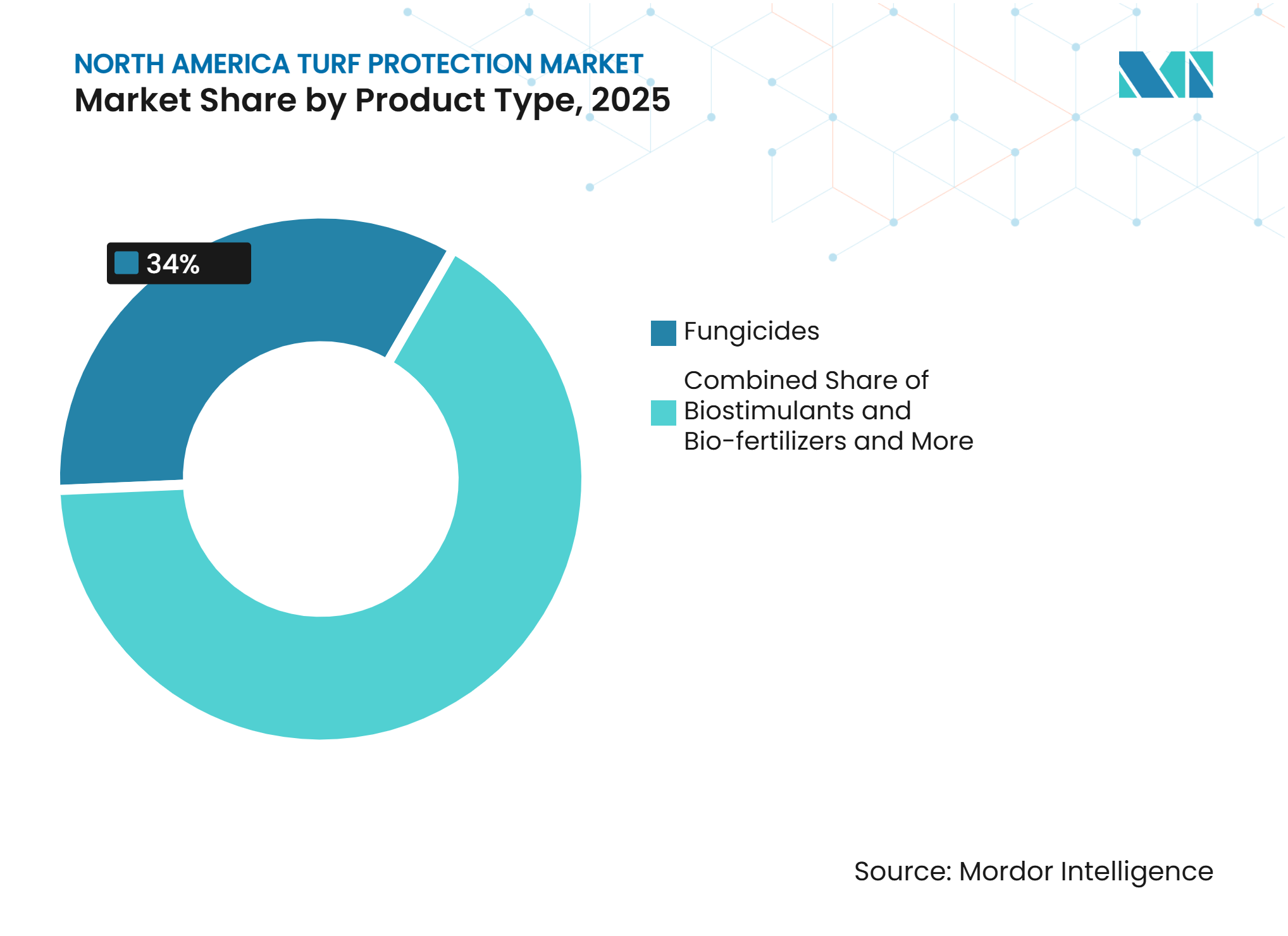
Fungicides Lead as Biological Products Gain GroundFungicides held 34% of the North America turf protection market size in 2025 because disease control is essential on golf courses, sports fields, and sod farms. Dollar spot, brown patch, Pythium, and snow mold can reduce turf density and surface quality. Fungicides are particularly important where visible turf damage affects play, customer experience, or the salable quality of sod. Herbicides address annual bluegrass, crabgrass, and broadleaf weeds across commercial, institutional, and residential sites. Insecticides remain necessary for grubs, billbugs, and other damaging insects. Plant growth regulators support mowing efficiency and turf management objectives on selected golf and landscape sites.
Biostimulants and bio-fertilizers are forecast to expand at 11.5% CAGR from 2026 to 2031, the fastest rate among product categories. Heat stress, drought, and heavy traffic underscore the need for products that support turf recovery. A 2026 peer-reviewed study found that multi-species microbial treatments improved turf quality, nutrient uptake, and stress resilience under temperate conditions. PMRA registered Paclobutrazol Technical and TRIMMIT for Canadian golf course turfgrass management in February 2024. This shows that product innovation includes both biological products and established plant growth management tools. Product selection depends on turf conditions, application practices, and the performance required by the site. The North America turf protection industry is therefore expanding through both conventional and lower-risk product categories.



By Application:
Landscaping Provides Volume While Sports Fields ExpandLandscaping accounted for 39% of the North America turf protection market share in 2025, as it encompasses commercial properties, housing developments, parks, campuses, and roadway landscapes. These sites require recurring weed, disease, and insect control across diverse turf conditions. Commercial landscapes are often managed through planned service schedules that support seasonal purchasing. Golf courses use products more intensively on high-value playing surfaces, even though their total acreage is lower than that of broad landscaping applications. Sod farms need clean, uniform turf during production and use fungicides and selective herbicides to meet quality standards. Each application has different product needs, which supports a broad portfolio approach among suppliers.
Sports fields are forecast to grow at 6.7% CAGR through 2031, making them the fastest-growing application segment. Natural turf fields require disease prevention, weed control, and recovery support under heavy use. Schools, municipalities, and private operators are formalizing maintenance practices at multiuse athletic sites. This can move facilities from reactive treatments to planned programs with defined product rotations. Turf managers also need products that help recover from traffic, heat, and seasonal weather pressure. Seasonal scheduling gives suppliers a clearer opportunity to support products used before visible damage develops. The North America turf protection market benefits when sports facilities treat field quality as an operational requirement rather than an occasional maintenance task.
By End-user:
Residential Demand Is Broad While Contractors ScaleResidential customers held 36% share in 2025, supported by the extensive base of private lawns in suburban areas across the United States. These customers purchase products through retail channels, lawn care operators, and direct treatment programs. Demand includes herbicides, insecticides, and fungicides used to manage visible lawn problems. Sports facility owners have different requirements because poor turf quality can affect field availability and the user experience. Municipalities and schools also purchase products for parks, school grounds, and recreation areas. Their purchasing decisions often balance budget limits, public use needs, and integrated pest management requirements.
Commercial landscape contractors are forecast to grow at 6.3% CAGR from 2026 to 2031. These contractors manage portfolios with multiple sites and can provide more consistent purchasing volumes than individual property owners. Larger contractors increasingly use weather monitoring, structured rotations, and planned ordering programs. Their scale gives suppliers an opportunity to provide technical support, bundled programs, and early-order arrangements. Contractors also help transfer professional application practices across offices, retail properties, residential communities, and institutional sites. Their purchasing patterns can provide more dependable demand than isolated retail transactions. The North America turf protection market has a clear channel opportunity in suppliers that can serve these repeat commercial buyers.
By Mode of Action:
Chemical Products Remain Central While Biological Options ExpandChemical products held 82% of the North America turf protection market size in 2025 because they have an established approval base and familiar field performance. Their broad control spectrum supports use across diseases, weeds, and insects in varied turf environments. Professional applicators understand how to use chemical products in accordance with the defined labels and seasonal programs. Integrated solutions combine chemical and biological options and provide a middle path for buyers seeking both reliable control and resistance management. Regulatory reevaluations can alter the set of available chemical products. PMRA’s 2024 tebuconazole decision showed how an active ingredient cancellation can redirect demand within the fungicide category.
Biological products are forecast to grow at 12.5% CAGR through 2031, the highest rate by mode of action. EPA registrations have expanded the range of microbial and biochemical active ingredients available to the U.S. market[3]. These products are increasingly used within integrated pest management programs and resistance rotations. They offer an additional tool for superintendents, sports turf managers, and commercial applicators. Their expansion depends on consistent performance, reliable storage, and practical application guidance. Integrated programs allow users to place each product type where it has the most practical value. The North America turf protection industry will continue to rely on chemical products while biological options gain a larger role in program design.
By Formulation:
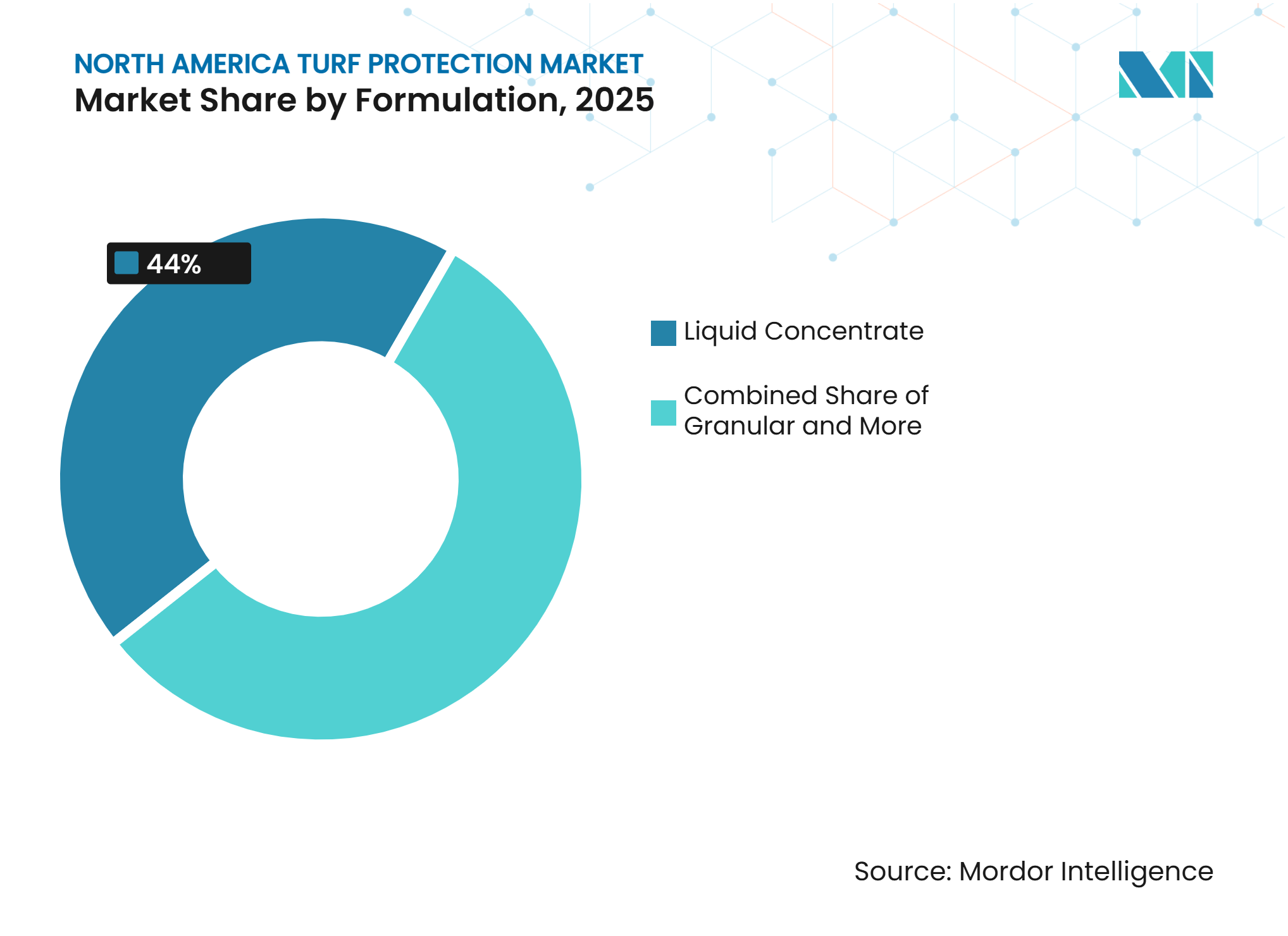
Liquid Concentrates Support Professional ApplicationLiquid concentrates held 44% of the North America turf protection market share in 2025 and are forecast to grow at 6.2% CAGR through 2031. They support precise dosing, tank mixing, and use with calibrated sprayer equipment. These benefits are important for golf courses, sports turf, and commercial landscape programs. Liquid products can help applicators combine approved active ingredients in a single treatment event. This can reduce the number of handling steps and improve program flexibility. Envu introduced Signature XTRA Stressgard Liquid fungicide in December 2025 for golf and fine turf use.
Granular products remain useful where spray equipment is unavailable or broadcast application is preferred. They are relevant for residential, institutional, and selected landscape uses. Wettable powders continue to serve as a means of delivering active ingredients that are not readily available as liquids. However, liquid formulations face lower operational friction for many professional users. Suppliers can expand a proven active ingredient’s reach by offering a liquid version without creating entirely new chemistry. This approach can improve user convenience while preserving access to established product chemistry. The North America turf protection market therefore gives formulation development a practical role in product differentiation and commercial adoption.

Geography Analysis
The United States held 88% of the North America turf protection market share in 2025, supported by its extensive golf, sports, residential lawn, and commercial landscape base. Nearly 16,000 golf courses create a substantial installed base for specialized turf treatment programs. The country also has a developed network of professional applicators and distributors. EPA registration activity supports access to conventional and biological products under FIFRA. The USGA’s 15/30/45 campaign aims to reduce golf course water use by 45% through a USD 30 million investment over 15 years. Water management and precision practices can influence how facilities plan product applications.
Canada is the second-largest regional market and operates under a distinct PMRA reevaluation environment. The PMRA’s November 2024 decision canceled turf uses of tebuconazole because of drinking water exposure risks. This changed the product options available for Canadian golf and sports turf managers. PMRA also approved Paclobutrazol Technical and TRIMMIT for Canadian golf course turfgrass management in February 2024. Canada has a shorter growing season than much of the United States, but its professional golf and sports turf users maintain demand for premium programs.
Mexico is forecast to grow at 7.8% CAGR from 2026 to 2031, the fastest rate in the regional analysis. Growth is supported by golf development, urban residential landscaping, and managed sports facilities in major metropolitan areas. Mexico participates with the EPA and PMRA in the North American Trilateral Technical Working Group on Pesticides. This framework supports regulatory cooperation for pesticides across North America. The Rest of North America contributes limited regional volume but offers niche potential for specialized fungicide and integrated pest management products. North America turf protection market suppliers can use distributor relationships to reach resort, golf, and landscape sites in these smaller markets.
Competitive Landscape
Market Concentration
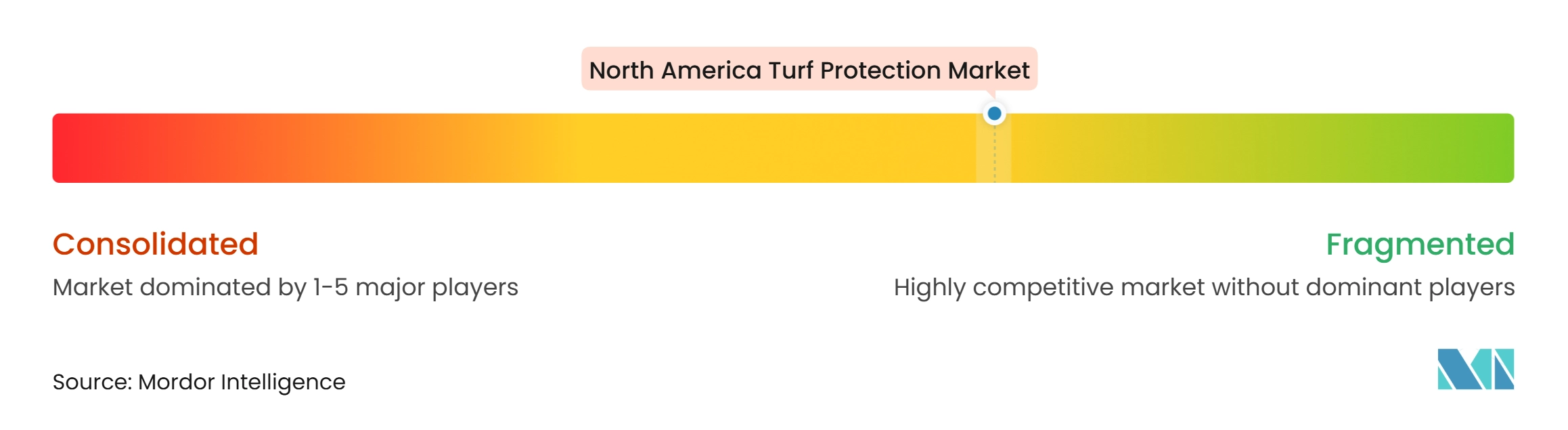
The North America turf protection market includes multinational manufacturers, specialist suppliers, generic formulators, biological product companies, and distributors. PBI-Gordon Companies, Lebanon Seaboard Corporation, SePRO Corporation, OHP, Inc., and BioWorks, Inc. compete through turf specialization, technical support, and channel coverage. Albaugh, LLC and Control Solutions, Inc. provide generic versions of established active ingredients for cost-focused buyers.
BASF introduced Aramax Intrinsic fungicide in May 2024 for golf course fairways in North America. The product combines pyraclostrobin and triticonazole and is labeled for the control of 26 turf diseases. This launch illustrates how suppliers use formulation and active ingredient combinations to address specific disease profiles. Envu unveiled Signature XTRA Stressgard Liquid in December 2025 for the golf and fine-turf segments. The product demonstrates commercial interest in liquid forms that balance mixing convenience with precise application. Companies are also expanding biological portfolios because users need rotation partners and lower-risk options.
Competition is strongest in fungicides, biological products, and products designed for professional application programs. Larger companies have broad portfolios and established distribution networks. Specialist companies can compete by providing field support, focused formulations, and service for specific turf needs. Generic suppliers add price pressure after patents expire for established active ingredients. Decision-support tools connected to weather and pest forecasting may strengthen supplier relationships with professional applicators. The North America turf protection market is likely to reward companies that combine reliable product performance with practical program advice.
North America Turf Protection Industry Leaders
-
BASF SE
-
Syngenta AG
-
Corteva, Inc.
-
Nufarm Limited
-
Envu, Inc.
- *Disclaimer: Major Players sorted in no particular order
North America Turf Protection Market Companies Covered in this Report
- BASF SE
- Envu, Inc.
- Syngenta AG
- Corteva, Inc.
- Nufarm Limited
- PBI-Gordon Companies, Inc.
- The Andersons, Inc.
- Lebanon Seaboard Corporation
- Albaugh, LLC
- Control Solutions, Inc.
- OHP, Inc.
- SePRO Corporation
- American Vanguard Corporation
- BioWorks, Inc.
- Koppert B.V.
Recent Industry Developments in North America Turf Protection Market
- December 2025: Envu unveiled Signature XTRA Stressgard Liquid fungicide at the 2026 Golf Course Superintendents Association of America Conference and Trade Show, positioning it as a cornerstone product in its greens health program, designed to control foliar and root Pythium diseases while boosting photosynthesis and improving turfgrass stress tolerance to heat, drought, shade, and traffic pressures.
- May 2024: BASF SE introduced Aramax Intrinsic brand fungicide for golf course fairways in North America, combining active ingredients pyraclostrobin and triticonazole to deliver broad-spectrum control of 26 cool- and warm-season turf diseases, including snow mold, large patch, brown patch, and dollar spot, with residual disease control up to 28 days and EPA-recognized plant health benefits.
- February 2024: Health Canada’s PMRA issued Registration Decision RD2024-02, granting registration for Paclobutrazol Technical and TRIMMIT for use on golf course turfgrass in Canada to slow turfgrass growth and suppress Poa annua, expanding the commercially available plant growth regulator toolset for Canadian golf course management under the Pest Control Products Act.
North America Turf Protection Market Report Scope
The turf protection market is the sale of chemical, biological, and mechanical inputs that safeguard living turf, lawns, sports fields, golf courses, and sod farms from pests, diseases, drought, wear, and nutrient stress while enhancing vigor and playability. The North America Turf Protection Market Report is Segmented by Product Type (Fungicides, Herbicides, Insecticides, Plant Growth Regulators, Biostimulants and Bio-fertilizers), Application (Landscaping, Golf Courses, Sports Fields, and Sod Farms), by End-User (Residential Customers, Commercial Landscape Contractors, Sports Facility Owners, and Municipalities and Schools), by Mode of Action (Chemical, Biological, and Integrated Solutions), by Formulation (Granular, Liquid Concentrate and Wettable Powder) and Geography (United States, Mexico and Rest of North America). The Report Offers Forecasts in Terms of Value (USD).
Segmentation Overview
| Fungicides |
| Herbicides |
| Insecticides |
| Plant Growth Regulators |
| Biostimulants and Bio-fertilizers |
| Landscaping |
| Golf Courses |
| Sports Fields |
| Sod Farms |
| Residential Customers |
| Commercial Landscape Contractors |
| Sports Facility Owners |
| Municipalities and Schools |
| Chemical |
| Biological |
| Integrated Solutions |
| Granular |
| Liquid Concentrate |
| Wettable Powder |
| United States |
| Canada |
| Mexico |
| Rest of North America |
| By Product Type | Fungicides |
| Herbicides | |
| Insecticides | |
| Plant Growth Regulators | |
| Biostimulants and Bio-fertilizers | |
| By Application | Landscaping |
| Golf Courses | |
| Sports Fields | |
| Sod Farms | |
| By End-user | Residential Customers |
| Commercial Landscape Contractors | |
| Sports Facility Owners | |
| Municipalities and Schools | |
| By Mode of Action | Chemical |
| Biological | |
| Integrated Solutions | |
| By Formulation | Granular |
| Liquid Concentrate | |
| Wettable Powder | |
| By Geography | United States |
| Canada | |
| Mexico | |
| Rest of North America |
Key Questions Answered in the Report
What is driving demand for turf protection products in North America?
Recurring disease, weed, and insect pressure on golf courses, sports fields, landscapes, and residential lawns supports demand. Preventive programs and integrated pest management also support product use. These needs recur during each growing season and across several turf applications.
How large is the North America turf protection market?
The sector is projected to increase from USD 1.23 million in 2026 to USD 1.58 million by 2031, at a 5.2% CAGR.
Which product category is growing fastest?
Biostimulants and bio-fertilizers are forecast to grow at 11.5% CAGR through 2031, supported by demand for stress recovery and biological tools. They are most relevant where heat, drought, and heavy use create sustained recovery needs.
Which application is projected to expand fastest?
Sports fields are forecast to grow at 6.7% CAGR through 2031 as more natural turf facilities move toward formal maintenance programs. Disease prevention, recovery support, and scheduled applications are important for these facilities.