
North America Seed Processing Machinery Market Size and Share
Market Overview
| Study Period | 2021 - 2031 |
|---|---|
| Forecast Data Period | 2026 - 2031 |
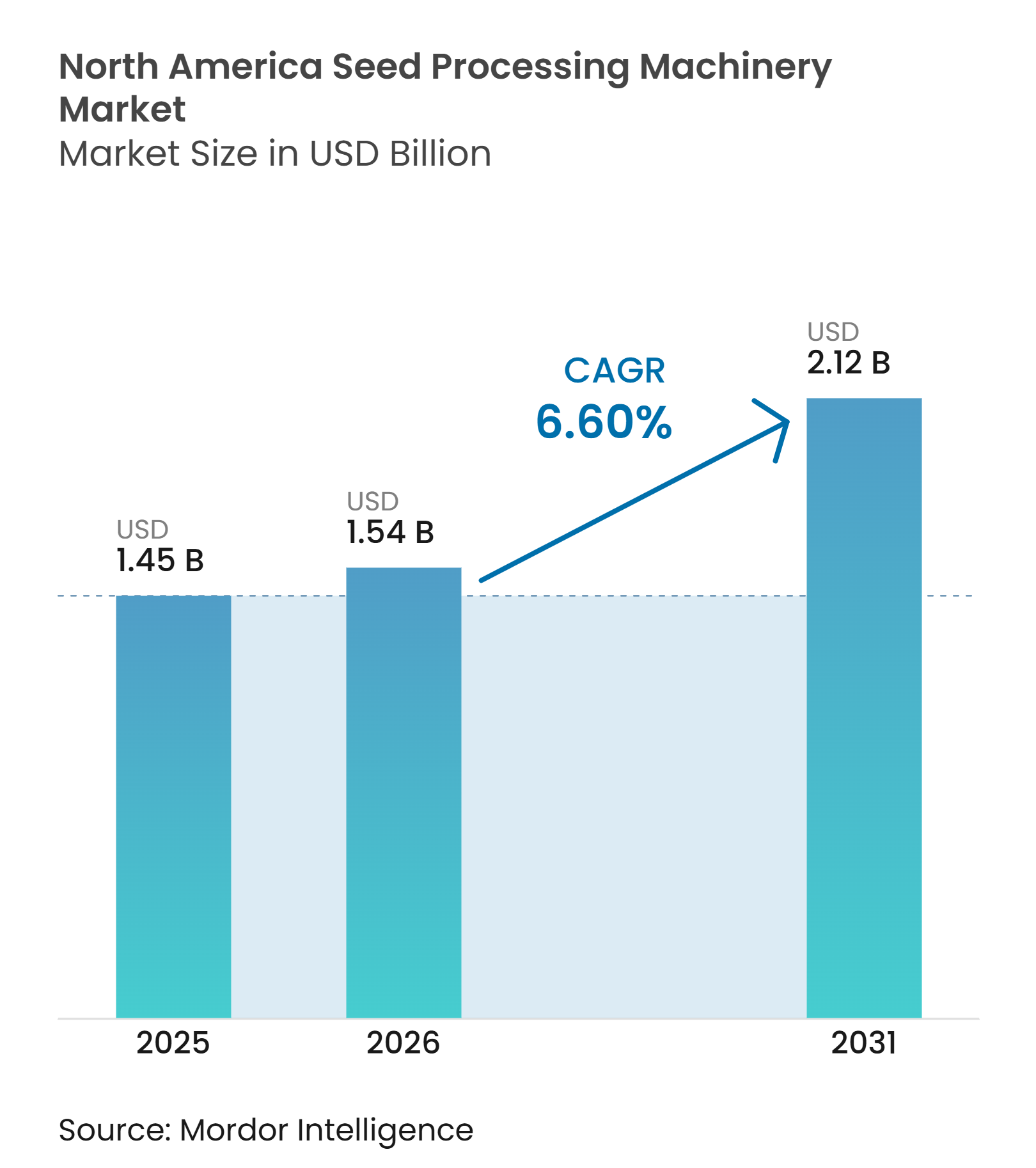
| Base Year Market Size (2025) | USD 1.45 Billion |
| Market Size (2026) | USD 1.54 Billion |
| Market Size (2031) | USD 2.12 Billion |
| Growth Rate (2026 - 2031) | 6.60 % |
| Market Concentration | Low |
Major Players *Disclaimer: Major Players sorted in no particular order Image © Mordor Intelligence. Reuse requires attribution under CC BY 4.0. | |
North America Seed Processing Machinery Market Analysis by Mordor Intelligence
The North America seed processing machinery market was valued at USD 1.45 billion in 2025, and its market size is estimated to grow from USD 1.54 billion in 2026 to reach USD 2.12 billion by 2031, at a CAGR of 6.6% during the forecast period from 2026 to 2031. The North America seed processing machinery market is supported by investment in optical sorting, automated cleaning, and integrated treatment lines at commercial seed plants. Certified, hybrid, treated, and specialty seed requires tighter grading, controlled coating, calibrated drying, and stronger documentation than commodity seed. This increases the amount of equipment required at each facility and favors suppliers capable of configuring complete lines. Labor constraints and compliance needs are also shifting demand toward automatic systems with process records. The North American seed processing machinery market remains fragmented because global systems suppliers and category specialists compete for distinct equipment needs.
Key Report Takeaways
- By machinery type, cleaners held 41.6% of the North America seed processing machinery market size in 2025, while optical sorters are forecast to grow at the fastest CAGR of 8.4% from 2026 to 2031.
- By operation mode, automatic systems held 71.3% of the North America processing machinery market share in 2025, while no separate forecast CAGR was available for semi-automatic systems.
- By end user, commercial seed processing plants held 56.6% of revenue in 2025, while on-farm facilities are forecast to grow at the fastest CAGR of 7.2% from 2026 to 2031.
- By country, the United States held 72.5% of revenue in 2025, while Mexico is forecast to grow at the fastest CAGR of 8.7% from 2026 to 2031.
Note: Market size and forecast figures in this report are generated using Mordor Intelligence’s proprietary estimation framework, updated with the latest available data and insights as of January 2026.
Market Trends and Insights
Drivers Impact Analysis of North America Seed Processing Machinery Market*
| Driver | (~) % Impact on CAGR Forecast | Geographic Relevance | Impact Timeline |
|---|---|---|---|
| Expansion of Certified and Export-Grade Seed Processing | +1.8% | United States: certified hybrid volumes require consistent conditioning. Canada: export-grade wheat, pulse, and canola processing raises quality requirements. Mexico, cross-border seed flows increase demand for compatible standards. | Medium term (2-4 years) |
| Automation to Offset Seasonal Labor Constraints | +1.5% | United States and Canada: seasonal labor gaps support automatic feeding, cleaning, and packing. Mexico, automation can reduce variability where trained labor is limited. | Short term (≤ 2 years) |
| Replacement of Aging Processing Lines | +1.2% | United States: the largest replacement pool is at mature commercial plants. Canada, established cooperative facilities face modernization needs. Mexico: new-line installations are more common than replacement-only projects. | Long term (≥ 4 years) |
| Adoption of Optical Sorting and Digital Quality Control | +1.0% | United States: the lead adopter for large commercial lines. Canada, canola, pulse, and cereal processors need quality control. Mexico: vegetable and maize applications create growth opportunities. | Medium term (2-4 years) |
| Higher Processing Intensity for Hybrid, Treated, and Specialty Seeds | +0.8% | United States: hybrid corn and soybean require precise handling. Canada, canola, cereal, and pulse seed need crop-specific processing. Mexico: maize and vegetable seed increase treatment and grading needs. | Medium term (2-4 years) |
| Regulatory Convergence Between the United States and Canada | +0.4% | United States and Canada, aligned traceability and certification expectations support systems that document lot-level processing. | Long term (≥ 4 years) |
| Source: Mordor Intelligence | |||
Expansion of Certified and Export-Grade Seed Processing
The North America seed processing machinery market benefits from certification requirements that place greater weight on lot purity, consistency, and documentation. The United States Department of Agriculture's Agricultural Marketing Service operates an Accredited Seed Conditioning Program that audits participating conditioning facilities using International Organization for Standardization methods [1]. These audits support demand for equipment that can clean, grade, separate, and record lot-specific results consistently. Canadian wheat exports rose 15% year over year to 29.3 million metric tons in the 2024-25 marketing year, which adds pressure on Prairie facilities to maintain export-grade conditioning standards. The commercial effect is a preference for integrated line upgrades instead of isolated equipment changes when processors need to meet a defined quality specification.
Automation to Offset Seasonal Labor Constraints
The North America seed processing machinery market is seeing more interest in automatic feeding, cleaning, sorting, treatment, and packing systems, where seasonal labor is difficult to secure. The United States H-2A program certified nearly 400,000 agricultural positions in fiscal year 2025, while the American Farm Bureau Federation reported that actual visas did not match all certified positions. This gap can compress processing windows when crops, labor, and transport capacity must align during the same period. Automatic systems reduce the number of manual interventions required between receiving seed and preparing finished lots. PETKUS Technologie GmbH stated in 2024 that its air-screen cleaner design can shorten screen changeover time, which matters to processors moving among crops and varieties. The business case is strongest where high-volume facilities need stable throughput during short conditioning seasons.
Replacement of Aging Processing Lines
Replacement demand remains relevant because much of the installed base in the United States and Canada includes mechanical cleaning and grading equipment that has operated through several consolidation cycles. Equipment can remain in service for many years if it still meets basic throughput needs. However, older lines often provide less flexibility for lot traceability, treatment control, or rapid crop changeovers. The North America seed processing machinery market therefore depends partly on upgrades triggered by compliance requirements, acquisitions, and plant expansions rather than regular replacement schedules. Ag Growth International Inc. reported in March 2026 that its order book had declined 26% year over year to CAD 543 million, which it linked to softer commercial order intake and longer customer review periods. This pattern shows why replacement-led revenue can be uneven even when the need to modernize persists.
Adoption of Optical Sorting and Digital Quality Control
Optical sorters are forecast to grow at the fastest CAGR of 8.4% from 2026 to 2031 within the North America seed processing machinery market. Multi-sensor systems can evaluate color, shape, and infrared characteristics in a single process step, giving processors a quality-control option beyond mechanical grading. These systems are suited to oilseed, pulse, cereal, and specialty seed operations where defect detection and lot consistency affect commercial value. Bühler AG opened an optical sorting research and training center in Stockton, California, with West-Link in March 2025, allowing processors to test material before making a capital decision. The facility gives prospective buyers a practical route to assess sorting performance for their own seed lots. Digital records from these platforms can also support traceability requirements at certified conditioning plants.
Restraints Impact Analysis of North America Seed Processing Machinery Market*
| Restraint | (~) % Impact on CAGR Forecast | Geographic Relevance | Impact Timeline |
|---|---|---|---|
| High Upfront Cost of Advanced Processing Lines | -1.80% | In the United States, smaller cooperatives can defer integrated upgrades. In Canada, local pulse, cereal, and forage facilities face lower volume economics. In Mexico, smaller operators can have limited capital for new automated lines. | Short term (≤ 2 years) |
| Long Replacement Cycles in a Mature Installed Base | -1.20% | In the United States and Canada, working mechanical equipment can delay capital decisions. In Mexico, the effect is lower because many projects involve first-time modernization. | Long term (≥ 4 years) |
| Shortage of Specialized Operators and Service Technicians | -0.80% | In the United States and Canada, staffing gaps affect peak-season commissioning and operation. In Mexico, limited specialist coverage can raise implementation and service requirements. | Medium term (2-4 years) |
| Crop Variability and Project-Specific Engineering Requirements | -0.50% | In the United States, corn and soybean lines need high throughput. In Canada, canola, pulse, cereal, and forage seed require flexible configurations. In Mexico, maize and vegetable lots require frequent changeovers. | Medium term (2-4 years) |
| Source: Mordor Intelligence | |||
High Upfront Cost of Advanced Processing Lines
Air-screen cleaners, gravity tables, and mechanical graders can remain useful if they meet minimum production needs. This delays purchases when operators do not face a compliance issue, a capacity constraint, or a new-crop requirement. Long decision-making periods can make supplier revenue difficult to forecast based on annual equipment demand alone. Ag Growth International Inc. noted in 2026 that commercial order intake softened as customers took longer to assess purchases. The statement illustrates how cautious procurement can affect suppliers that sell equipment to commercial agricultural customers. In a mature installed base, the commercial case for replacement must usually rest on lower labor needs, stronger traceability, higher accuracy, or a specific capacity requirement.
Crop Variability and Project-Specific Engineering Requirements
Seed characteristics differ by crop, variety, lot condition, moisture level, and intended end use. A system designed for high-volume corn may not suit smaller vegetable lots or pulse seed without changes to screens, airflow, settings, and treatment equipment. This makes complete lines more project-specific than standard machinery purchases. Custom design can lengthen quoting, testing, installation, and acceptance periods. Processors may also favor retaining familiar equipment when the expected gains from a new configuration are uncertain. These requirements can slow project approvals even when a facility recognizes the operational benefits of modernization.
*Our forecasts treat driver/restraint impacts as directional, not additive. The impact forecasts reflect baseline growth, mix effects, and variable interactions.
North America Seed Processing Machinery Market Segment Analysis
By Machinery Type, Cleaners Anchor Revenue While Optical Sorters Lead Growth
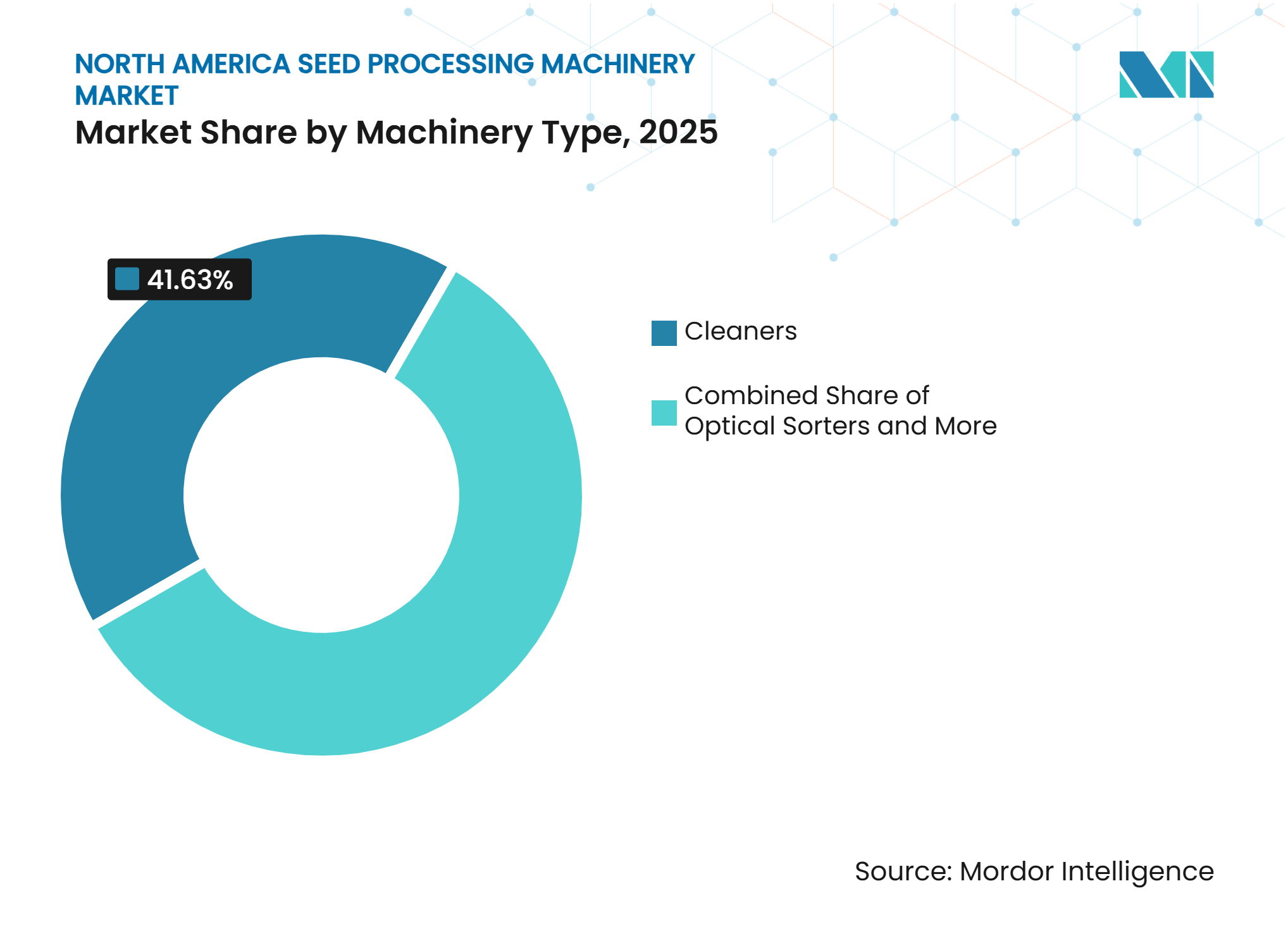
Cleaners held 41.6% of machinery-type revenue in 2025, making them the largest equipment category in the North America seed processing machinery market. They provide the core separation step used across corn, soybean, canola, cereal, pulse, and specialty seed lines. Pre-cleaners remove coarse material before finer separation stages and help protect downstream equipment. Separators and destoners remove materials that differ in size, shape, density, or weight from the intended seed lot. Graders support uniform size specifications, which matter for planting performance and certification. Coaters and treaters are used when processors need controlled application of treatment or coatings.
Optical sorters are forecast to grow at the fastest CAGR of 8.4% from 2026 to 2031. Their role is expanding, where visual and spectral inspection can identify damaged, discolored, or unwanted material that is difficult to remove mechanically. Bühler AG introduced the SORTEX AI700 in May 2025 and described deep-learning-based defect detection and improved reject concentration[2]. Dryers retain a necessary role in reaching moisture conditions appropriate for storage and certification. Seed packagers, polishers, and other specialized machines serve narrower functions but remain part of complete lines tailored to crop type and customer requirements.



By Operation Mode, Automatic Systems Hold the Largest Position
Automatic systems held 71.3% of revenue by operation mode in 2025, making them the largest segment. These systems integrate feeding, cleaning, sorting, treating, and packing with fewer manual handoffs. Their use is strongest at commercial facilities operating multiple shifts during peak conditioning periods. Labor availability increases the appeal of equipment that can maintain consistent operation with a smaller operating crew. Automatic controls can also support repeatable treatment rates and documented process settings. The North America seed processing machinery industry benefits when buyers connect these functions to labor planning and traceability needs.
Semi-automatic systems remain appropriate for smaller commercial plants, on-farm facilities, and research settings. They allow operators to retain direct control of screen selection, treatment settings, and crop changeovers. This can be useful when throughput is lower or when many varieties are handled in small batches. Westrup ApS operates a test center in Sioux Falls, South Dakota, where processors can run seed through smaller equipment using the same technology as larger models. Such testing helps users refine a process setup before choosing equipment. Semi-automatic configurations, therefore, retain demand where flexibility matters more than full-line automation.
By End User, Commercial Plants Lead While On-Farm Facilities Expand Fastest
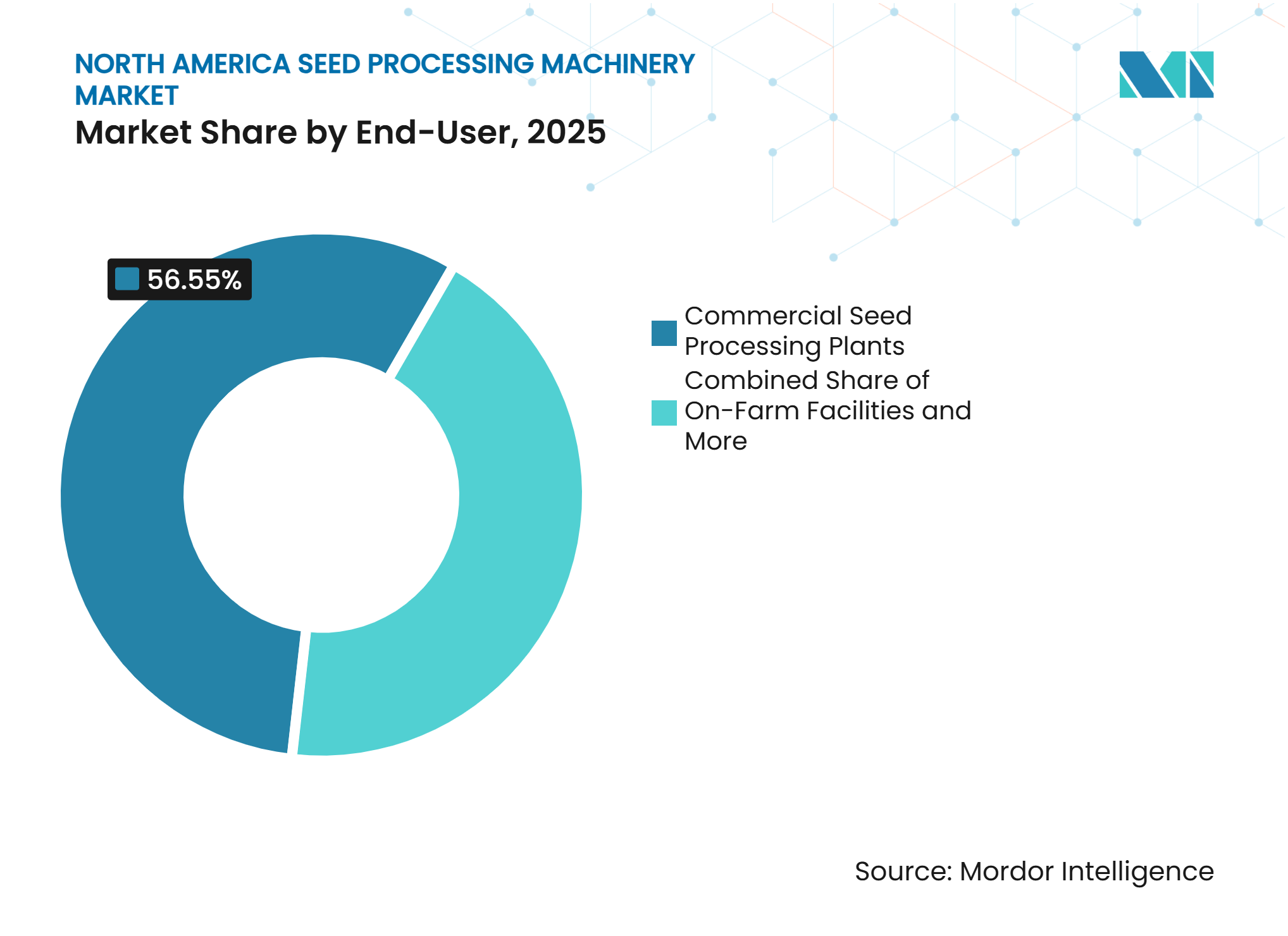
Commercial seed processing plants held 56.6% of end-user revenue in 2025, making them the largest end-user segment. These facilities process large volumes of hybrid, certified, treated, and specialty seed. Their requirements often span cleaning, grading, separation, treatment, and packing in a single, integrated process. High throughput and multiple product specifications can justify investment in automatic systems and optical sorting. Seed producers form another important customer group because they must bridge production volumes with conditioning standards. Grain handling facilities provide an adjacent source of demand where seed and grain handling infrastructure overlap within defined seed-processing applications.
On-farm facilities are forecast to grow at the fastest CAGR of 7.2% from 2026 to 2031. Larger farms can use basic pre-cleaning and sorting to reduce reliance on outside conditioning capacity during busy periods. The United States Department of Agriculture's Economic Research Service documented the continued use of precision technologies on farms in its 2024 report, supporting the broader shift toward data-led on-site management. Research institutions remain a stable market for small-lot cleaners, gravity tables, and laboratory-scale sorting systems. Iowa State University Seed Laboratory held a Satake color-sorting workshop in June 2026 for seed professionals working with corn and soybean sorting. These users prioritize repeatable test results and flexible handling over maximum throughput.

Geography Analysis
The United States held 72.5% of the North America seed processing machinery market share in 2025, making it the largest country segment. The country has a substantial base of commercial hybrid seed conditioning capacity in corn and soybean regions. Demand is supported by plants that handle high volumes and need equipment suited to cleaning, sizing, treatment, and packaging. Plant expansions and ownership changes can create demand for upgrades as operators align equipment with new operating standards. The scale of commercial seed production supports a broad range of requirements for cleaning, grading, treatment, and packaging capabilities.
Canada is the second-largest country segment, with established demand from canola, cereal, pulse, and forage seed conditioning. Processing activity is concentrated in Saskatchewan, Alberta, and Manitoba, where facilities handle crop-specific quality and certification requirements. The Canadian Food Inspection Agency is progressing amendments to the Seeds Regulations as part of its 2026 to 2028 forward plan. The regulations can increase attention to equipment that supports traceability and reliable documentation. Westrup ApS lists North American industry events in its 2026 exhibition calendar, indicating continued supplier engagement with regional processors[3].
Mexico is forecast to grow at the fastest CAGR of 8.7% from 2026 to 2031. Its smaller installed base means that modernization can involve new line installations rather than only incremental replacement. Maize and vegetable seed processing support demand for cleaning, grading, and treating equipment that can manage smaller lots and frequent variety changes, which can favor scalable systems. The Rest of North America segment remains a smaller contributor in 2026, although United States and Canadian supply standards can shape equipment needs at facilities serving regional seed flows.
Competitive Landscape
Market Concentration
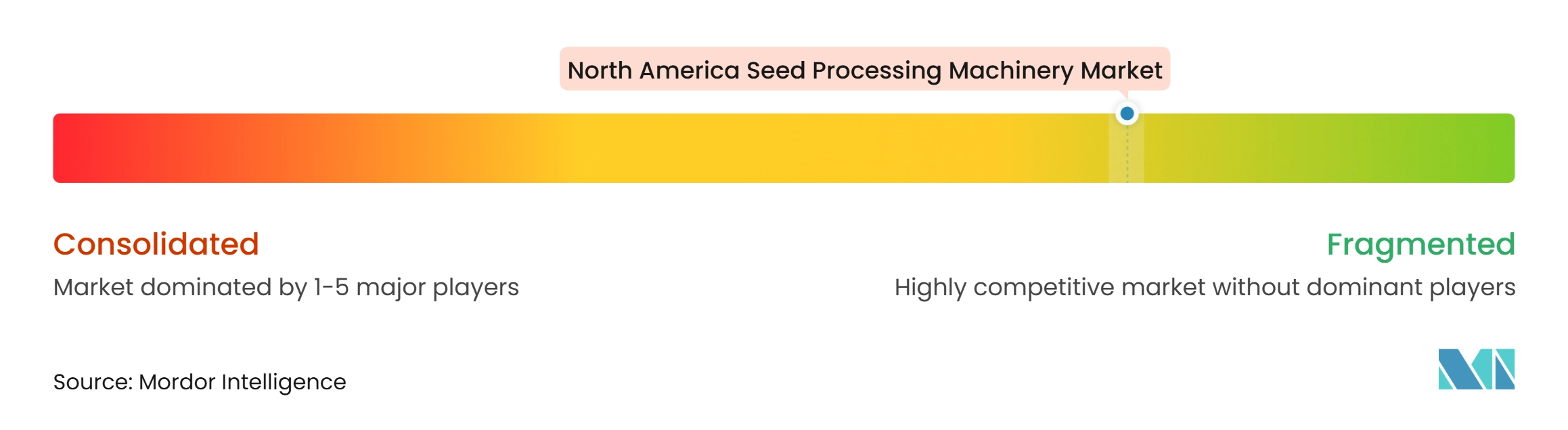
The North America seed processing machinery market is fragmented, and no supplier holds a commanding share across the complete machinery spectrum. Competition spans full-line suppliers, optical-sorting specialists, and manufacturers focused on cleaning, separation, drying, or treatment equipment. Buyers assess suppliers on crop fit, line integration, service coverage, commissioning ability, and the ability to support traceable processing. The fragmented structure means that a company can be strong in one machinery category without leading the full regional market. This also gives processors several options when assembling a line from compatible equipment categories.
Bühler AG, PETKUS Technologie GmbH, Westrup ApS, Grain and Protein Technologies, Alvan Blanch Development Company Ltd, and other approved suppliers compete through differentiated product configurations and technical support. Bühler AG expanded its optical sorting support in the western United States through the Stockton center, which opened with West-Link in 2025. Westrup ApS reported strong financial results for its 2025-26 financial year and continued international development in 2026. Technology demonstration and local support are therefore part of supplier strategy alongside product performance. These priorities help companies compete for plant upgrades and new processing projects.
Smaller operators represent a significant opening for suppliers that can offer modular upgrades rather than a complete new line. Cleaning, separation, treatment, and sorting equipment can be added in stages when capital budgets do not support an integrated project. Digital process monitoring connects machine settings with lot records and quality outcomes, creating a further point of differentiation. Suppliers must also help customers manage training and service needs, which keeps competition dispersed across equipment types, crop applications, and customer sizes.
North America Seed Processing Machinery Industry Leaders
-
Ag Growth International Inc.
-
Grain & Protein Technologies (Cimbria A/S)
-
Westrup ApS
-
PETKUS Technologie GmbH
-
Bühler AG
- *Disclaimer: Major Players sorted in no particular order
North America Seed Processing Machinery Market Companies Covered in this Report
- Ag Growth International Inc.
- Grain & Protein Technologies (Cimbria A/S)
- Westrup ApS
- PETKUS Technologie GmbH
- Bühler AG
- Satake Corporation
- Oliver Manufacturing CO, Inc.
- Seedburo Equipment
- A.T. Ferrell Company, Inc.
- LMC Manufacturing
- Kice Industries, Inc.
- Alvan Blanch Development Company Limited
- Bratney
- Carter Day International, Inc.
- Forsberg’s, Inc.
Recent Industry Developments in North America Seed Processing Machinery Market
- December 2025: Cimbria A/S, through its United States partner Bratney, completed an integrated sorghum seed processing line for Richardson Seeds. The installation included cleaning, gravity separation, indented-cylinder, color-sorting, and aspiration equipment.
- May 2025: Bühler AG launched the SORTEX AI700 optical sorter, applying deep learning to defect detection for grain and seed applications.
- March 2025: Satake Corporation released the EZER1251, the largest model in its EZER optical sorter range, with dual modules, a shared touchscreen controller, and quadruple-pass sorting capability.
North America Seed Processing Machinery Market Report Scope
North America Seed processing machinery encompasses equipment used in agriculture to clean, sort, grade, dry, treat, and package seeds, improving their quality and viability for planting. These machines play a critical role in removing impurities, ensuring uniformity, and safeguarding seeds from pests and diseases. The seed processing machinery market report is segmented by machinery type (pre-cleaners, cleaners, dryers, graders, coaters and treaters, separators and destoners, polishers, optical sorters, seed packagers, and other specialized equipment), by operation mode (automatic and semi-automatic), by end-user (commercial seed processing plants, seed producers, research institutions, on-farm facilities, and grain handling facilities), and by geography (United States, Canada, Mexico, and Rest of North America). The market forecasts are provided in terms of value (USD).
Segmentation Overview
| Pre-cleaners |
| Cleaners |
| Dryers |
| Graders |
| Coaters and Treaters |
| Separators and Destoners |
| Polishers |
| Optical Sorters |
| Seed Packagers |
| Other Specialized Equipment |
| Automatic |
| Semi-Automatic |
| Commercial Seed Processing Plants |
| Seed Producers |
| Research Institutions |
| On-Farm Facilities |
| Grain Handling Facilities |
| United States of America |
| Canada |
| Mexico |
| Rest of North America |
| By Machinery Type | Pre-cleaners |
| Cleaners | |
| Dryers | |
| Graders | |
| Coaters and Treaters | |
| Separators and Destoners | |
| Polishers | |
| Optical Sorters | |
| Seed Packagers | |
| Other Specialized Equipment | |
| By Operation Mode | Automatic |
| Semi-Automatic | |
| By End-User | Commercial Seed Processing Plants |
| Seed Producers | |
| Research Institutions | |
| On-Farm Facilities | |
| Grain Handling Facilities | |
| By Country | United States of America |
| Canada | |
| Mexico | |
| Rest of North America |
Key Questions Answered in the Report
What is the value of the North America seed processing machinery market in 2026?
The market is estimated at USD 1.54 billion in 2026 and is forecast to reach USD 2.12 billion by 2031.
Which equipment category leads sales in this sector?
Cleaners were the largest machinery category, holding 41.6% of revenue in 2025.
Which seed processing equipment is growing fastest?
Optical sorters are forecast to grow at the fastest CAGR of 8.4% from 2026 to 2031.
Which country is expected to grow fastest through 2031?
Mexico is forecast to grow at the fastest CAGR of 8.7% from 2026 to 2031.