
North America Perfume Market Size and Share
Market Overview
| Study Period | 2027 - 2032 |
|---|---|
| Forecast Data Period | 2027 - 2032 |
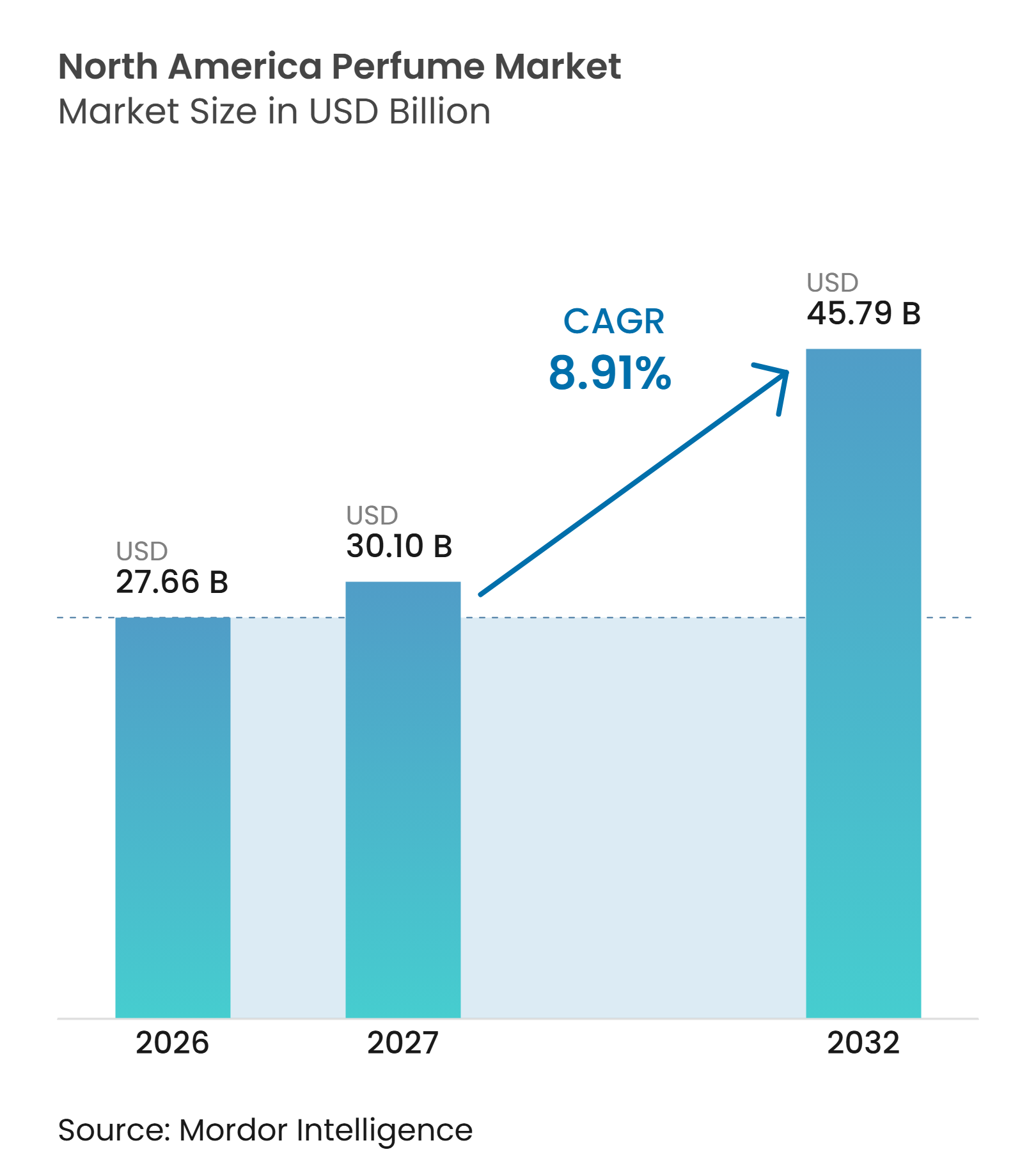
| Base Year Market Size (2026) | USD 27.66 Billion |
| Market Size (2027) | USD 30.10 Billion |
| Market Size (2032) | USD 45.79 Billion |
| Growth Rate (2027 - 2032) | 8.91 % |
| Market Concentration | Medium |
Major Players *Disclaimer: Major Players sorted in no particular order Image © Mordor Intelligence. Reuse requires attribution under CC BY 4.0. | |
North America Perfume Market Analysis by Mordor Intelligence
The North America perfume market size is expected to increase from USD 27.66 billion in 2026 to USD 30.10 billion in 2027 and reach USD 45.79 billion by 2032, growing at a CAGR of 8.91% over 2026–2032. Market growth is supported by rising demand for premium and luxury fragrances, increasing consumer interest in natural and sustainable ingredient formulations, and the growing popularity of niche, artisanal, and bespoke perfumes. Social media influence, celebrity-led brand collaborations, and fragrance-led self-expression are strengthening consumer engagement, while e-commerce and direct-to-consumer platforms are improving product accessibility. Premium perfumes and specialty stores remain important market segments, while online retail and natural ingredient formulations create opportunities for further expansion. However, counterfeit and grey-market products, concerns over synthetic and allergenic ingredients, supply chain volatility, and stricter ingredient safety and labeling requirements may constrain growth. Market expansion therefore favors companies that combine differentiated fragrance portfolios with reliable ingredient sourcing, product transparency, and effective omnichannel distribution strategies.
Key Report Takeaways
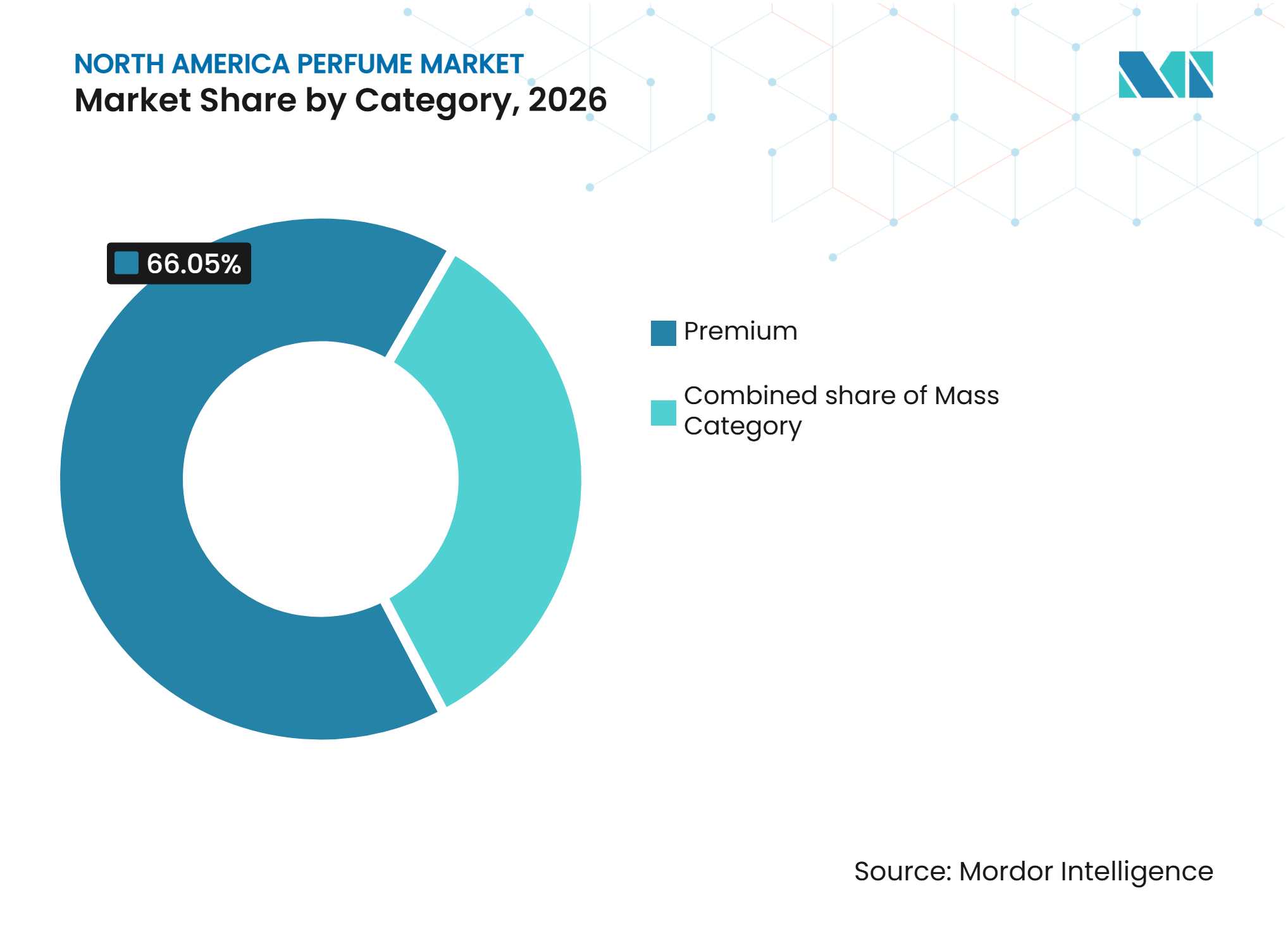
- By category, premium perfumes accounted for the largest share at 66.05% of the North America perfume market size in 2026 and are forecast to grow at a 9.61% CAGR over 2026–2031.
- By ingredient source, synthetic ingredients dominated with a 72.48% market share in 2026, while natural ingredients are projected to grow at the fastest rate, registering a 9.56% CAGR over 2026–2031.
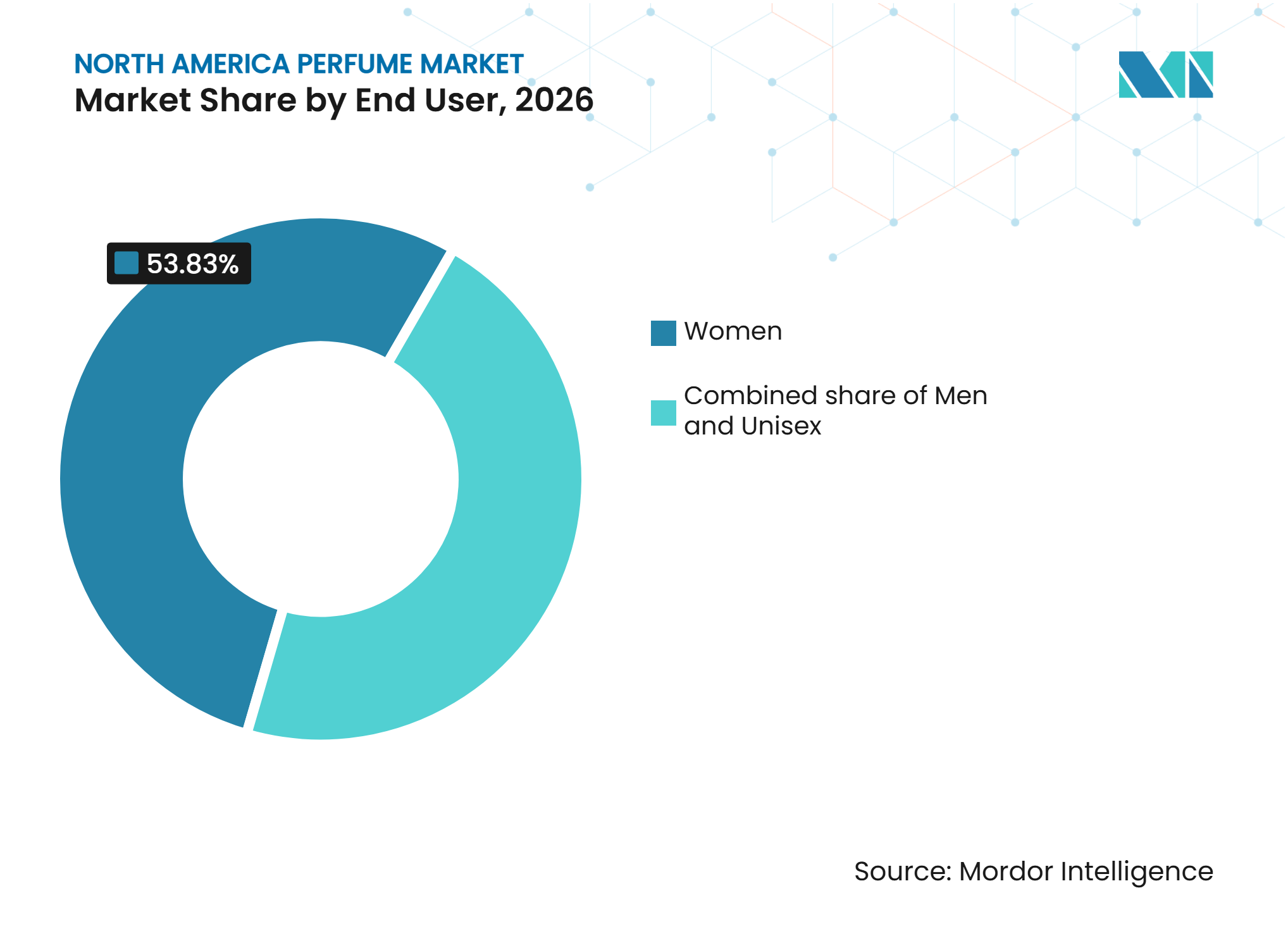
- By end user, women accounted for the largest share at 53.83% in 2026, while the unisex segment is forecast to grow fastest at a 9.37% CAGR over 2026–2031.
- By distribution channel, specialty stores held the largest share at 42.68% in 2026, while online retail stores are projected to record the fastest growth at a 9.76% CAGR over 2026–2031.
- Among countries, the United States accounted for the largest share at 45.83% in 2026, while Canada is projected to grow fastest at a 9.01% CAGR over 2026–2031.
Note: Market numbers in this report are based on Mordor Intelligence's proprietary estimation framework, which combines nine months of actuals with Q4 projections for base year 2026.
Market Trends and Insights
Drivers of North America Perfume Market*
| Driver | (~) % Impact on CAGR Forecast | Geographic Relevance | Impact Timeline |
|---|---|---|---|
| Shift toward natural, clean-label, and sustainable fragrance formulations | +0.9% | North America, particularly the United States and Canada, where consumer interest in ingredient transparency and sustainable beauty products is supporting demand | Medium term (2–4 years) |
| Growing demand for niche, artisanal, and bespoke fragrances | +0.8% | North America, particularly the United States, supported by demand for distinctive scents, personalized products, and premium fragrance experiences | Medium term (2–4 years) |
| Social media influence and celebrity-led brand collaborations | +0.7% | North America, particularly the United States, where digital platforms, influencers, and celebrity partnerships play an important role in fragrance discovery and brand engagement | Short term (Less than 2 years) |
| Premiumization and rising demand for luxury fragrance offerings | +0.8% | North America, particularly the United States and Canada, where premium beauty consumption and demand for luxury fragrance brands support market expansion | Medium term (2–4 years) |
| Expansion of e-commerce and direct-to-consumer fragrance platforms | +0.7% | Across North America, particularly the United States and Canada, where online beauty retail, brand-owned websites, and digital purchasing channels are expanding consumer access | Short term (Less than 2 years) |
| Increasing focus on personal grooming, self-expression, and experiential consumption | +0.6% | North America, particularly the United States and Canada, where fragrances are increasingly positioned as personal-care, lifestyle, and self-expression products | Long term (More than 4 years) |
| Source: Mordor Intelligence | |||
Shift Toward Natural, Clean-Label, and Sustainable Fragrance Formulations
Consumer interest in ingredient transparency and environmentally responsible product positioning is encouraging perfume manufacturers to review fragrance ingredients, sourcing practices, and product claims. Natural fragrance ingredients, including essential oils and botanical extracts, provide opportunities to develop differentiated scent profiles and appeal to consumers seeking plant-derived formulations. However, natural ingredients are not automatically safer or more sustainable than synthetic alternatives. Health Canada notes that natural and synthetic cosmetic ingredients can be equally suitable, while the US Federal Trade Commission (FTC) requires environmental marketing claims to be specific and adequately substantiated. These considerations encourage manufacturers to communicate ingredient origins and sustainability attributes accurately while maintaining fragrance quality and formulation stability. [1]
Growing Demand for Niche, Artisanal, and Bespoke Fragrances
Demand for distinctive fragrance experiences creates opportunities for niche and artisanal perfume brands to compete through specialized scent compositions, limited product collections, and personalized offerings. Unlike mass-market fragrances that generally target broad consumer preferences, niche brands can differentiate themselves through distinctive ingredient combinations, fragrance storytelling, and smaller product collections. Personalized fragrance development and bespoke scent consultations can also strengthen customer engagement and encourage brand loyalty. The US Bureau of Labor Statistics reported that average annual household expenditure on personal care products and services increased by 2.9% in 2024, indicating continued consumer spending in the broader personal-care category. This environment provides a commercial opportunity for specialist fragrance brands, particularly those targeting consumers seeking differentiated products and premium experiences. [2]
Social Media Influence and Celebrity-Led Brand Collaborations
Social media platforms have become important channels for fragrance discovery, product demonstrations, and brand engagement, allowing perfume companies to reach consumers through influencer content, celebrity partnerships, and user-generated reviews. Fragrance launches promoted through digital campaigns can build product awareness and encourage consumers to explore new brands, scent collections, and limited-edition collaborations. Celebrity endorsements can further strengthen brand visibility by associating fragrances with recognizable personalities and lifestyle positioning. The US Federal Trade Commission's endorsement guidance requires influencers to clearly disclose material relationships with brands, including paid partnerships and gifted products. This regulatory framework highlights the commercial importance of influencer marketing while emphasizing transparency in fragrance promotion. [3]
Premiumization and Rising Demand for Luxury Fragrance Offerings
Premiumization is supporting demand for perfumes positioned around distinctive fragrance compositions, brand heritage, high-quality ingredients, and luxury packaging. Established luxury houses and specialist fragrance brands use exclusive collections, limited editions, and higher-concentration formulations to differentiate their offerings and attract consumers seeking premium products. This positioning also allows manufacturers to target consumers purchasing fragrances for personal use, gifting, and special occasions. The US Bureau of Labor Statistics reported that average annual household expenditure on personal care products and services reached USD 978 in 2024, compared with USD 950 in 2023, reflecting a 2.9% increase. Although this category includes products beyond perfumes, the spending trend indicates continued expenditure across the broader personal-care market, providing a supportive environment for premium fragrance offerings. [4]
Restraints of North America Perfume Market*
| Restraint | (~) % Impact on CAGR Forecast | Geographic Relevance | Impact Timeline |
|---|---|---|---|
| Rising penetration of counterfeit and grey-market fragrances | −0.7% | North America, particularly the United States and Canada, where unauthorized online sellers and counterfeit distribution can affect brand trust, product authenticity, and legitimate sales channels | Medium term (2–4 years) |
| Heightened consumer concerns over synthetic and allergenic ingredients | −0.5% | Across North America, particularly the United States and Canada, where ingredient transparency and fragrance-allergy concerns influence product selection and formulation decisions | Medium term (2–4 years) |
| Supply chain volatility impacting availability of key aroma chemicals and natural ingredients | −0.6% | North America, particularly the United States, which relies on international sourcing networks for fragrance ingredients, essential oils, and aroma chemicals | Long term (More than 4 years) |
| Increasingly stringent ingredient safety, disclosure, and labeling regulations | −0.4% | Across North America, particularly the United States and Canada, where cosmetic ingredient safety, allergen disclosure, and product labeling requirements increase compliance responsibilities | Medium term (2–4 years) |
| Source: Mordor Intelligence | |||
Rising Penetration of Counterfeit and Grey-Market Fragrances
The availability of counterfeit and unauthorized fragrances through informal retail outlets and online marketplaces can undermine consumer confidence and affect legitimate perfume sales. Counterfeit products may imitate established fragrance brands through similar packaging, branding, and product descriptions, making authenticity difficult for consumers to assess before purchase. These products can also create concerns regarding ingredient quality, product safety, and consistency of fragrance performance. Grey-market distribution, involving genuine products sold outside authorized distribution networks, can further complicate pricing strategies and brand control. Such activities may weaken brand reputation, reduce the effectiveness of authorized retail partnerships, and discourage consumers from purchasing premium fragrances. Manufacturers therefore need to strengthen product authentication, monitor unauthorized distribution channels, and maintain reliable retail networks.
Heightened Consumer Concerns Over Synthetic and Allergenic Ingredient
Consumer concerns regarding synthetic fragrance compounds and potential allergenic ingredients can influence perfume purchasing decisions and increase pressure on manufacturers to improve ingredient transparency. Fragrances contain complex mixtures of aromatic substances, including synthetic aroma chemicals and natural extracts, some of which may cause sensitivity or allergic reactions among certain consumers. Growing attention to ingredient disclosure and fragrance-related skin reactions can encourage consumers to avoid specific formulations or seek products marketed around simpler ingredient compositions. These concerns also create formulation challenges, as manufacturers must balance fragrance performance, product stability, scent longevity, and consumer preferences while managing potential allergen exposure. Companies may need to reformulate products, improve ingredient communication, and strengthen product testing, increasing development and compliance requirements.
*Our forecasts treat driver/restraint impacts as directional, not additive. The impact forecasts reflect baseline growth, mix effects, and variable interactions.
North America Perfume Market Segment Analysis
By Category:
Premium Perfumes Lead While Maintaining Strong Growth MomentumIn 2026, the premium category accounted for an estimated 66.05% of the North America Perfume Market, making it the leading category. Its position reflects consumer demand for luxury fragrance offerings, distinctive scent compositions, established brand identities, and premium product experiences. Premium perfumes benefit from brand heritage, exclusive collections, sophisticated packaging, and positioning around personal grooming and self-expression. The segment is also supported by demand for fragrances purchased for gifting and special occasions.
The premium category is projected to record a CAGR of 9.61% through 2031, supported by continued premiumization and interest in differentiated fragrance products. Manufacturers are expanding luxury collections, niche offerings, and exclusive fragrance lines to attract consumers seeking distinctive scent experiences. However, brands need to balance product differentiation and premium positioning with pricing accessibility and consistent product quality.



By Ingredient Source:
Synthetic Ingredients Lead While Natural Ingredients Expand FasterIn 2026, synthetic ingredients accounted for an estimated 72.48% of the North America Perfume Market, making them the leading ingredient source. Their position reflects their broad application in fragrance formulations, consistent availability, formulation flexibility, and ability to deliver specific scent profiles. Synthetic aroma chemicals also allow manufacturers to maintain fragrance consistency across production batches and develop compositions that may be difficult to reproduce using natural materials alone.
Meanwhile, natural ingredients are projected to record the fastest growth, at a CAGR of 9.56% through 2031. Growing interest in botanical extracts, essential oils, and ingredient transparency is creating opportunities for fragrances featuring naturally derived components. Manufacturers are incorporating natural ingredients into differentiated fragrance collections while managing sourcing costs, raw-material availability, and formulation stability. The ability to balance natural ingredient positioning with fragrance performance and affordability will remain important.
By End User:
Women Lead While Unisex Fragrances Expand FasterIn 2026, the women's segment accounted for an estimated 53.83% of the North America Perfume Market, making it the leading end-user category. Its position reflects the established demand for women's fragrances across mass-market, premium, and luxury product ranges. Manufacturers offer diverse scent profiles, including floral, fruity, woody, and oriental compositions, supported by seasonal collections, celebrity collaborations, and gifting-oriented launches.
Meanwhile, the unisex segment is projected to record the fastest growth, at a CAGR of 9.37% through 2031. The expansion of gender-neutral fragrance collections creates opportunities for brands to target consumers based on scent preferences rather than conventional gender classifications. Woody, citrus, fresh, and aromatic compositions are commonly used in fragrances marketed toward broader consumer groups. This positioning also supports niche and artisanal brands seeking to differentiate their portfolios through distinctive scent profiles and inclusive product offerings.

By Distribution Channel:
Specialty Stores Lead While Online Retail Expands FasterIn 2026, specialty stores accounted for an estimated 42.68% of the North America Perfume Market, making them the leading distribution channel. Their position reflects the importance of in-store fragrance discovery, product sampling, personalized recommendations, and access to established premium and luxury brands. Specialty retailers also provide opportunities for consumers to compare fragrance profiles and receive assistance when selecting products, supporting their relevance in premium fragrance purchasing.
Meanwhile, online retail stores are projected to record the fastest growth, at a CAGR of 9.76% through 2031. E-commerce platforms and brand-owned websites are expanding access to niche fragrances, exclusive collections, and products that may have limited physical-store availability. Digital product descriptions, customer reviews, fragrance discovery sets, and personalized recommendations are also helping consumers evaluate fragrance options online. However, online retailers need to address the difficulty of assessing scent profiles without physical sampling through discovery kits, return policies, and detailed product information.
Geography Analysis
North America Perfume Market
North America is a significant regional market for perfumes, supported by established beauty and personal-care industries, strong demand for premium fragrances, and the presence of major global fragrance brands. The United States is the largest country-level market in the region, accounting for an estimated 45.83% of the North America Perfume Market in 2026. Demand is supported by premiumization, celebrity-led fragrance launches, niche and artisanal perfumes, and the growing influence of social media on product discovery. The expansion of online retail and direct-to-consumer platforms is also improving access to both established and emerging fragrance brands.
United States Perfume Market
The United States represents the largest country market in North America, supported by its extensive specialty beauty retail network, established luxury fragrance segment, and strong e-commerce ecosystem. Consumers are increasingly exposed to premium, niche, and celebrity-associated fragrance offerings through retailers, brand websites, and social media platforms. The presence of major companies such as Estée Lauder, Coty, L'Oréal, and Bath & Body Works further strengthens the country's competitive landscape. Online retail and demand for distinctive fragrance experiences provide opportunities for market participants.
Canada Perfume Market
Canada is projected to be the fastest-growing country-level market in the region, with an estimated CAGR of 9.01% over 2026–2031. Market opportunities are supported by demand for premium and niche fragrances, growing interest in unisex scent profiles, and the expansion of online beauty retail. Specialty stores remain important for fragrance sampling and product discovery, while e-commerce provides access to a broader range of international and independent brands. Companies can strengthen their presence by offering differentiated fragrance portfolios and adapting product positioning to local consumer preferences.
Competitive Landscape
Market Concentration
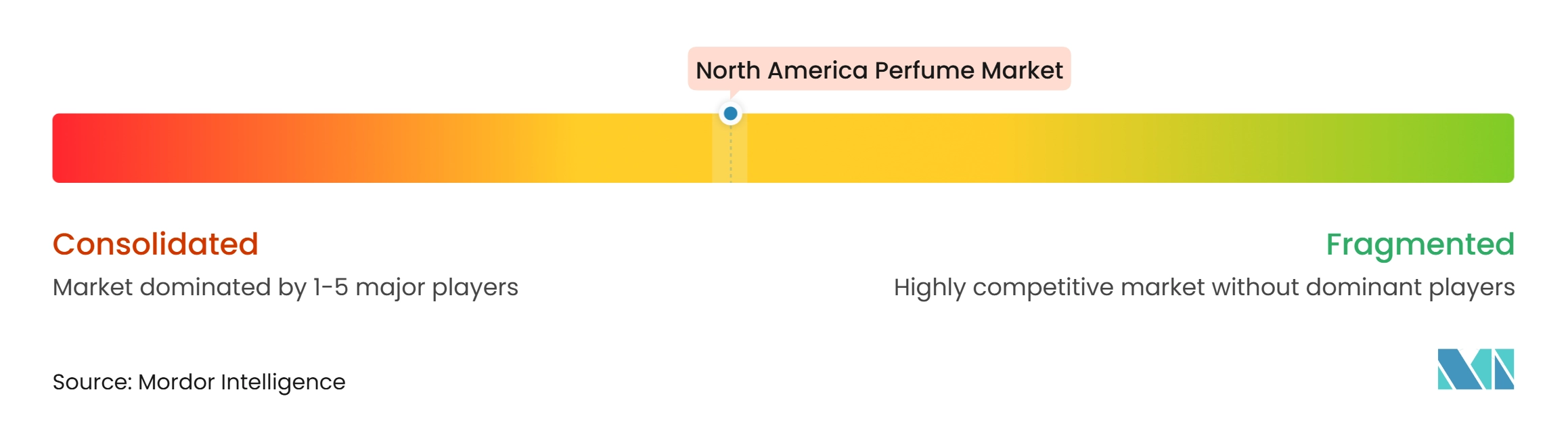
The North America Perfume Market includes multinational beauty and fragrance companies, luxury fashion houses, specialist perfume brands, and fragrance ingredient suppliers competing through brand positioning, product innovation, fragrance development, pricing strategies, and distribution reach. The competitive environment includes companies operating across mass-market, premium, and luxury fragrance categories, with different levels of exposure to finished perfume products. Established players benefit from recognized brand portfolios, product development capabilities, and relationships with specialty retailers, department stores, and online platforms. Niche and independent fragrance brands differentiate through distinctive scent compositions, artisanal positioning, and focused consumer segments.
Competitive strategies in the North America Perfume Market focus on expanding fragrance portfolios, introducing new scent collections, strengthening premium positioning, and using brand collaborations to improve consumer engagement. Companies such as The Estée Lauder Companies, Coty, L'Oréal, Chanel, and LVMH participate through established fragrance brands and luxury product portfolios. Interparfums develops and markets fragrances through licensing agreements with international fashion and luxury brands, while Bath & Body Works competes through personal fragrances, body mists, and related fragrance products. The 7 Virtues differentiates through a fragrance portfolio positioned around responsibly sourced ingredients and ingredient transparency. These approaches allow companies to target different consumer preferences across mass-market, premium, and luxury segments.
The market also includes companies with specialized roles in fragrance creation and ingredient supply. Givaudan SA and International Flavors & Fragrances Inc. (IFF) develop fragrance compositions and provide fragrance ingredients and related solutions to perfume manufacturers and brand owners, making them important upstream participants rather than direct sellers of finished perfumes. Alpha Aromatics similarly operates in fragrance development and compounding. Their capabilities support the development of new scent profiles and differentiated formulations. The competitive environment also includes companies such as Shiseido, Puig, Hermès, Natura, Revlon, and Procter & Gamble, although their exposure varies across fragrance brands, product categories, and geographic markets.
North America Perfume Industry Leaders
-
L'Oréal S.A.
-
The Estée Lauder Companies Inc.
-
Coty Inc.
-
Chanel Limited
-
LVMH Moët Hennessy Louis Vuitton SE
- *Disclaimer: Major Players sorted in no particular order
North America Perfume Market Companies Covered in this Report
- The Estée Lauder Companies Inc.
- Coty Inc.
- L'Oréal S.A.
- Chanel Limited
- LVMH Moët Hennessy Louis Vuitton SE
- Interparfums, Inc.
- Bath & Body Works, Inc.
- Revlon, Inc.
- Shiseido Company, Limited
- Puig Brands, S.A.
- Hermès International S.A.
- Kering S.A.
- Avon Products, Inc.
- Procter & Gamble Company
- Natura Cosméticos S.A.
- Givaudan SA
- International Flavors & Fragrances Inc.
- Alpha Aromatics
- Elizabeth Arden, Inc.
- The 7 Virtues Beauty Inc.
Recent Industry Developments in North America Perfume Market
- October 2026: Tate McRae launched TATE 01, her debut signature fragrance brand, in partnership with Scent Beauty. The fragrance was developed with Givaudan perfumers Adriana Medina and Antoine Maisondieu and features an ISO E Super-based composition designed to interact with individual skin chemistry. The launch expands celebrity-led fragrance offerings and strengthens the role of personalized scent positioning in the North American perfume market.
- September 2026: Interparfums, Inc. signed an exclusive worldwide license agreement with PUMA for the creation, development, production, and distribution of fragrances under the PUMA brand. The agreement expands Interparfums' licensed fragrance portfolio and provides an opportunity to develop products combining sportswear brand recognition with fragrance positioning.
- September 2026: Khloé Kardashian expanded her fragrance portfolio's retail distribution through a partnership with Luxe Brands and Sephora. The launch brought XO Khloé, Almost Always, and XO BLUE to Sephora stores across the United States, with Sephora serving as the exclusive retailer for the fragrance portfolio in Canada. The expansion strengthens access to celebrity-led fragrances through established specialty beauty retail channels.
- August 2026: Shiseido launched Max Mara Le Parfum, the first fragrance developed under its long-term partnership with Max Mara. The fragrance was introduced through selected retail partners in North America and Europe from August 24, ahead of a wider rollout across more than 50 markets from September 1. The launch expands Shiseido's prestige fragrance portfolio and demonstrates the role of licensing partnerships in bringing fashion brands into the perfume category.
North America Perfume Market Report Scope
For this study, the North America Perfume Market is defined as the sales value of commercially marketed perfumes and fragrances sold for personal use across the region. The market covers mass and premium perfume categories, segmented by ingredient source into synthetic and natural ingredients; by end user into men, women, and unisex; and by distribution channel into supermarkets/hypermarkets, specialty stores, online retail stores, and other distribution channels. The market is analyzed across the United States, Canada, Mexico, and the Rest of North America. The study considers competitive activities across finished-fragrance brands, luxury fragrance houses, specialist perfume companies, and relevant fragrance ingredient suppliers. Market sizing and forecasts are presented in value terms (USD) across the defined segments and geographies.
Segmentation Overview
| Mass | Premium |
| Synthetic Ingredients | Natural Ingredients |
| Men | Women |
| Unisex |
| Supermarkets/Hypermarkets | Specialty Stores |
| Online Retail Stores | |
| Other Distribution Channels |
| United States |
| Canada |
| Mexico |
| Rest of North America |
| By Category | Mass | Premium |
| By Ingredient Source | Synthetic Ingredients | Natural Ingredients |
| By End User | Men | Women |
| Unisex | ||
| By Distribution Channel | Supermarkets/Hypermarkets | Specialty Stores |
| Online Retail Stores | ||
| Other Distribution Channels | ||
| By Country | United States | |
| Canada | ||
| Mexico | ||
| Rest of North America | ||
Key Questions Answered in the Report
What is the size of the North America Perfume Market?
The North America Perfume Market is estimated at USD 27.66 billion in 2026 and is projected to reach USD 45.79 billion by 2032.
What is the expected growth rate of the North America Perfume Market?
The market is projected to grow at an estimated CAGR of 8.91% over 2026–2032.
Which category holds the largest share of the North America Perfume Market?
The premium category holds the largest share, accounting for an estimated 66.05% in 2026, supported by demand for luxury fragrances, differentiated scent profiles, and premium brand offerings.
Which country and distribution channel are expected to offer significant growth opportunities in the North America Perfume Market?
The United States holds the largest country share at 45.83% in 2026, while online retail stores represent the fastest-growing distribution channel, with an estimated CAGR of 9.76% through 2031.