
North America Low Smoke Zero Halogen (LSZH) Cables Market Size and Share
Market Overview
| Study Period | 2020 - 2031 |
|---|---|
| Forecast Data Period | 2026 - 2031 |
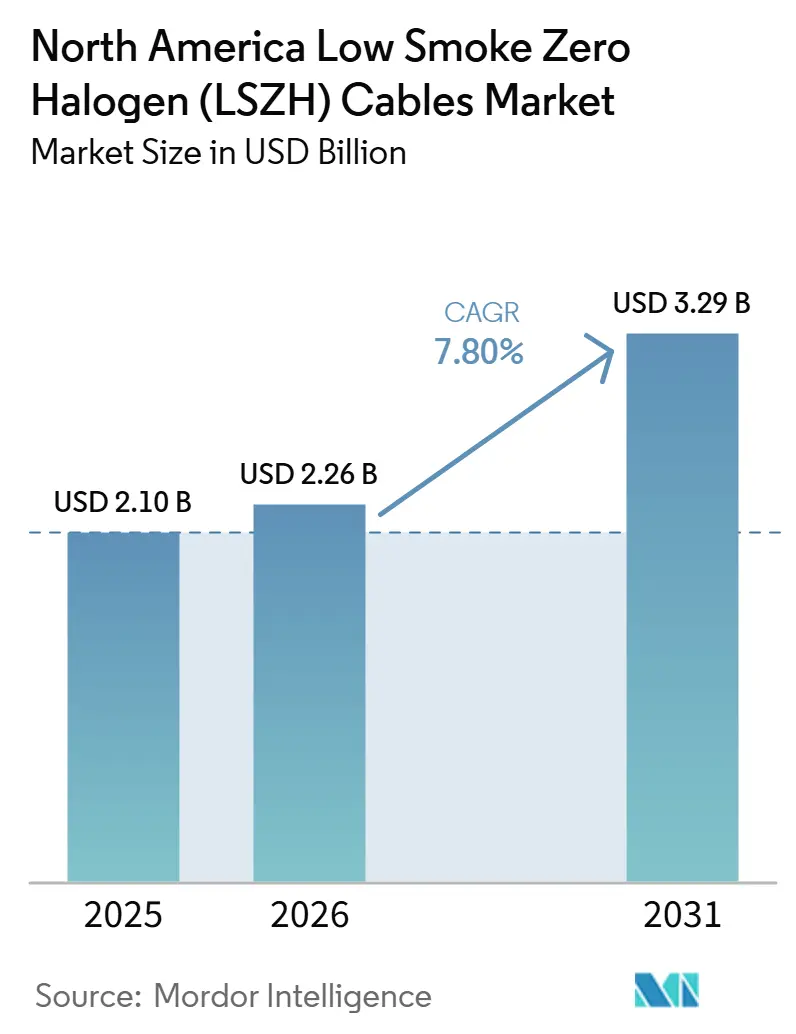
| Base Year Market Size (2025) | USD 2.10 Billion |
| Market Size (2026) | USD 2.26 Billion |
| Market Size (2031) | USD 3.29 Billion |
| Growth Rate (2026 - 2031) | 7.80 % |
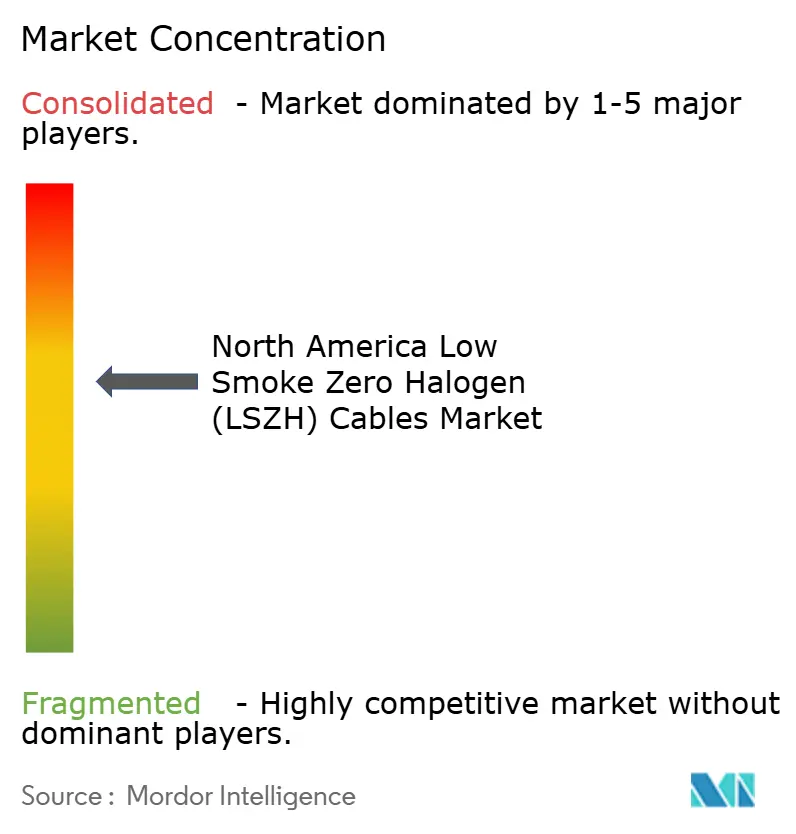
| Market Concentration | Medium |
Major Players *Disclaimer: Major Players sorted in no particular order Image © Mordor Intelligence. Reuse requires attribution under CC BY 4.0. | |
North America Low Smoke Zero Halogen (LSZH) Cables Market Analysis by Mordor Intelligence
The North America low smoke zero halogen (LSZH) cables market size was valued at USD 2.10 billion in 2025 and is estimated to grow from USD 2.26 billion in 2026 to reach USD 3.29 billion by 2031, at a CAGR of 7.80% during the forecast period (2026-2031). Growth is supported by new data center construction, stricter fire-safety requirements, and expanding renewable power and battery storage projects. These uses have broadened demand beyond rail and transit applications to include commercial buildings, industrial automation, and digital infrastructure. The North America LSZH cables market also benefits when project owners specify low-smoke, halogen-free products at the design stage, rather than treating them as a later upgrade. Manufacturers are responding through domestic capacity additions, acquisitions, and products designed for higher cable density and heat exposure. Pricing pressure, material availability, and lengthy product qualification requirements remain the main limits on adoption outside code-driven applications.
Key Report Takeaways
- By cable type, power cables accounted for 31.40% of the North America low-smoke zero-halogen (LSZH) cables market in 2025, while fiber-optic cables are projected to expand at a 9.60% CAGR through 2031.
- By voltage rating, the less-than-1-kV segment accounted for 68.40% of the North America low-smoke zero-halogen (LSZH) cables market in 2025, while the 1-35 kV segment is projected to grow at an 8.70% CAGR through 2031.
- By insulation material, cross-linked polyethylene (XLPE) held 46.70% of the North America low-smoke zero-halogen (LSZH) cables market in 2025, while other specialty insulation materials are projected to expand at a 9.10% CAGR through 2031.
- By end-user industry, commercial buildings held 21.80% of the North America low-smoke zero-halogen (LSZH) cables market in 2025, while data centers are projected to grow at a 10.80% CAGR through 2031.
- By country, the United States held 81.75% of the North America low-smoke zero-halogen (LSZH) cables market in 2025, while Mexico is projected to grow at a 9.30% CAGR through 2031.
Note: Market size and forecast figures in this report are generated using Mordor Intelligence’s proprietary estimation framework, updated with the latest available data and insights as of January 2026.
North America Low Smoke Zero Halogen (LSZH) Cables Market Trends and Insights
Drivers Impact Analysis*
| Driver | (~) % Impact on CAGR Forecast | Geographic Relevance | Impact Timeline |
|---|---|---|---|
| Hyperscale and AI Data Center Buildouts | +2.8% | Primarily the United States, including Northern Virginia, Texas, Arizona, and Georgia, with secondary concentration in Toronto, Canada | Short term (≤ 2 years) |
| Tightening Fire and Life-Safety Requirements in Enclosed Infrastructure | +1.9% | United States nationwide, with stronger enforcement under NEC 2026 Chapter 7 and NFPA 75 Chapter 6, plus NFPA 130 and NFPA 502 for transit and tunnels | Medium term (2-4 years) |
| Renewable Power and Battery Storage Expansion | +1.2% | United States, especially Texas, California, and Arizona, with growth in Ontario and British Columbia | Medium term (2-4 years) |
| Industrial Automation and Reshoring of Advanced Manufacturing | +0.8% | United States, particularly Arizona, Ohio, and Texas, with rising nearshoring demand in Mexico | Medium term (2-4 years) |
| Higher Compute Heat Density Driving High-Performance LSZH Compound Adoption | +0.5% | Primarily United States hyperscale corridors, with spillover from standardized hyperscaler specifications | Long term (≥ 4 years) |
| Traceable Low-Carbon and Domestic-Content Procurement Preferences | +0.3% | United States nationwide, supported by domestic-content incentives and federal infrastructure procurement requirements | Long term (≥ 4 years) |
| Source: Mordor Intelligence | |||
Hyperscale and AI Data Center Buildouts
Global AI data center capital expenditure is projected at USD 450 billion in 2026, with North American projects concentrated in Northern Virginia, Texas, Arizona, and Georgia. These projects require more power and data cabling in enclosed technical spaces than conventional server facilities. NFPA 75 Chapter 6 requires cables in IT equipment spaces to limit smoke and toxic gas hazards, while ANSI/BICSI 002 recommends LSZH products for intra-building power and data cabling in data centers. The North America LSZH cables market, therefore, gains from specifications that make fire performance part of the base design for new facilities. This demand favors manufacturers that can provide certified products, reliable deliveries, and documentation for large projects. It also allows cable suppliers to sell coordinated power, fiber, and structured cabling systems rather than isolated products, because campus operators need compatible cables across electrical distribution, equipment rooms, backbone networks, horizontal connections, and enclosed spaces where maintenance teams work. This coordinated approach also simplifies technical review and procurement for complex facilities.
Tightening Fire and Life-Safety Requirements in Enclosed Infrastructure
The 2026 National Electrical Code moved communications circuits from Chapter 8 into Chapter 7, placing them closer to the general wiring requirements in Chapters 1 through 4. This change strengthens the relationship between low-voltage communications work and broader electrical compliance. NFPA 130 requires low-smoke, halogen-free materials in passenger rail coaches, stations, and tunnels, while NFPA 502 applies similar requirements to life-safety systems in road tunnels and bridges.[1]Linde Cable, “Why Low Smoke Zero Halogen Cables Are Becoming the Global Standard,” Linde Cable, lindecable.com NEC Article 770 and NFPA 262 also influence cable selection in plenum spaces and vertical runs, particularly in large commercial and data center projects. The North America LSZH cables market benefits as owners include LSZH requirements in procurement documents, even when a single code does not explicitly require them. At the same time, the need to maintain qualification records can slow the introduction of revised compound formulations, particularly when a manufacturer must demonstrate consistent performance across flame, smoke, halogen, electrical, and installation requirements. The resulting review process also affects product availability during periods of changing construction and inspection practices.
Renewable Power and Battery Storage Expansion
The United States added 57.6 GWh of battery energy storage capacity in 2025, and total capacity is projected to reach 600 GWh by 2030.[2]Solar Energy Industries Association, “The Energy Storage Market Outlook Report,” Solar Energy Industries Association, seia.org Battery systems use high-current direct-current cable runs in enclosed inverter and battery-management areas where fire performance is important. Project contracts are increasingly specifying halogen-free, flame-retardant cable constructions for these uses. Domestic-content incentives can also encourage the procurement of cable made in the United States for projects in Texas, California, and Arizona. XLPE-insulated LSZH products are well-suited to medium-voltage renewable connections and battery systems because continuous high-current operation imposes stringent demands on thermal performance. This creates a durable source of demand for the North America LSZH cables market as solar-plus-storage projects expand, because cable selection affects power collection, inverter connections, battery-management equipment, control circuits, and enclosed operating areas, and developers need products that meet performance expectations over long operating cycles.
Industrial Automation and Reshoring of Advanced Manufacturing
New semiconductor facilities, electric-vehicle battery plants, and automated logistics sites are increasing demand for cables in industrial settings. These facilities often use enclosed trays, robotic equipment, control systems, and IT infrastructure that require careful fire-safety planning. A single factory project can specify LSZH products for building wiring, automation lines, and data networks simultaneously. This procurement pattern can raise cable volumes per project and reward suppliers with broad certified portfolios. Nearshoring is also expanding demand in Mexican industrial areas such as Nuevo León, Jalisco, and Coahuila, as multinational companies apply comparable procurement requirements across their sites. The North America LSZH cables market can therefore gain from manufacturing investments on both sides of the United States-Mexico border, as standardized procurement can extend from factory construction into process equipment, control networks, power distribution, and onsite digital systems, giving suppliers several routes to participate in the same industrial capital project.
Restraints Impact Analysis*
| Restraint | (~) % Impact on CAGR Forecast | Geographic Relevance | Impact Timeline |
|---|---|---|---|
| Premium Pricing Versus PVC-Based Cables | -1.6% | United States nationwide, with the highest resistance in residential construction and light commercial retrofits outside major metropolitan code-enforcement areas | Medium term (2-4 years) |
| Complex Qualification, Testing, and Certification Requirements | -0.9% | United States and Canada, where UL and IEC recertification after compound reformulation can take 18+ months | Medium term (2-4 years) |
| Volatility in Halogen-Free Compound and Additive Supply | -0.7% | Global supply-chain exposure concentrated in North America, including availability of aluminum trihydrate and magnesium dihydroxide compounds and certain additives | Short term (≤ 2 years) |
| Retrofit Disruption and Compatibility Constraints in Legacy Infrastructure | -0.5% | United States and Canada, especially pre-1990 commercial and industrial buildings with conduit and pulling constraints | Long term (≥ 4 years) |
| Source: Mordor Intelligence | |||
Premium Pricing Versus PVC-Based Cables
LSZH cables carry a 20-30% price premium over comparable PVC-based products because specialty halogen-free polyolefin compounds cost more than standard PVC compounds. This difference is most significant in residential construction and light commercial retrofit work, where buyers focus on initial material cost. Cable makers with captive compounding operations can reduce their exposure to purchased compound prices and compete more effectively. The cost calculation changes when a project is designed for a stricter code environment from the beginning. Installing compliant products during construction is less disruptive than replacing cables after a facility is complete. The restraint is therefore strongest where building-wire buyers compare LSZH products directly with standard THHN and THWN-2 alternatives, particularly when designs involve modest cable volumes, limited fire-risk assessment, and little scope to recover the initial material premium through a wider project budget.
Complex Qualification, Testing, and Certification Requirements
LSZH products must meet requirements for halogen content, smoke density, flame propagation, UL listings, and applicable NEC compliance marks. IEC 60754-2 addresses halogen-related testing, IEC 61034 addresses smoke density, and IEC 60332-1/3 addresses flame propagation. A change in compound formulation can trigger recertification cycles lasting 18 months or more. This requirement places a greater burden on mid-sized and specialty manufacturers with limited testing resources. Data center and industrial owners also increasingly require UL certificates, IEC documentation, and third-party fire-test records before approving a supplier.[3]Quabbin Wire and Cable, “The Nuts and Bolts of Low Smoke Zero Halogen Cabling,” Quabbin Wire and Cable, quabbin.com These checks protect product performance but can limit supply flexibility during periods of rising demand or changing code requirements, as suppliers need sufficient time to complete testing, update documentation, secure approvals, and add revised products to approved procurement lists.
*Our forecasts treat driver/restraint impacts as directional, not additive. The impact forecasts reflect baseline growth, mix effects, and variable interactions.
Segment Analysis
By Cable Type: Power Cables Lead While Fiber Optic Cables Grow Fastest
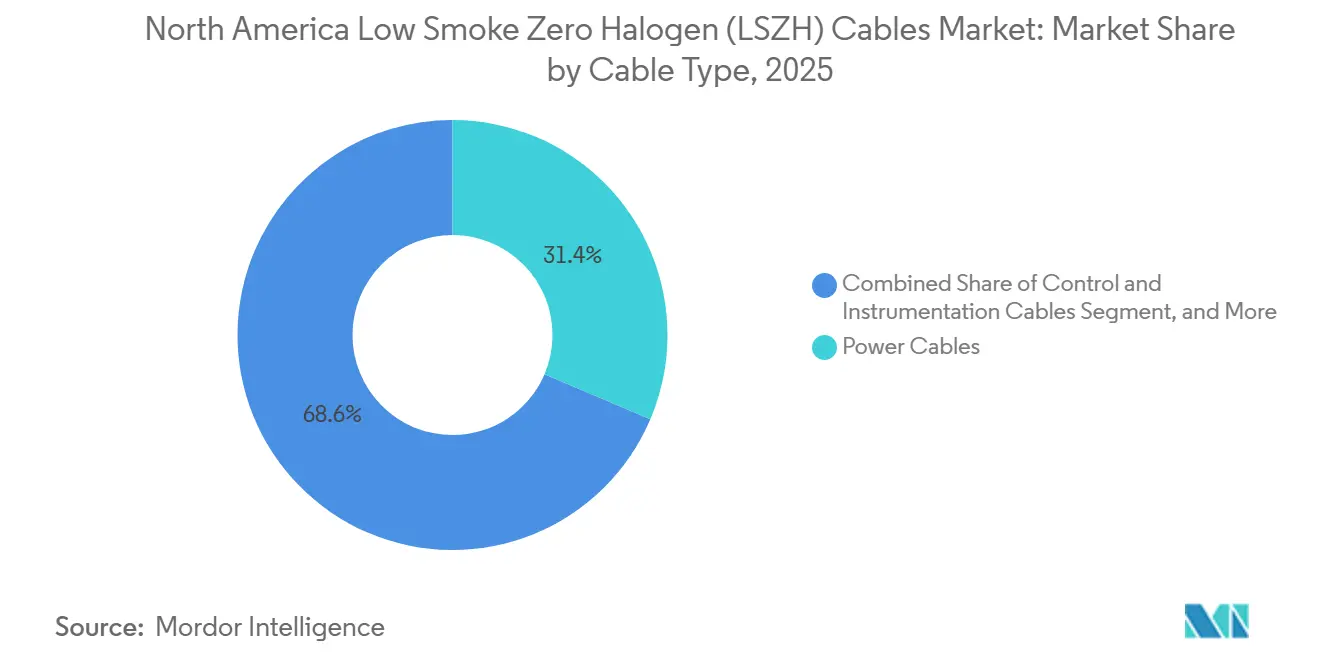
Power cables accounted for 31.40% of the North America low-smoke zero-halogen (LSZH) cables market share in 2025, supported by commercial construction, utility upgrades, and renewable power collection systems. Larger building and substation projects use substantial amounts of cable, and tighter smoke-control requirements are encouraging LSZH specifications in their designs. Control and instrumentation products support automated industrial systems, while data and communication cables benefit from enterprise IT upgrades and 5G backhaul work. Building wire remains linked to commercial construction activity, and specialty fire-circuit and transit products serve uses that require performance beyond standard LSZH grades. These demand sources provide the cable-type mix with a broad base across construction, utilities, transport, and digital infrastructure.
Fiber-optic cables are projected to grow at a 9.60% CAGR through 2031, making them the fastest-growing cable type. Hyperscale facilities are increasing the need for dense, fire-safe data infrastructure and for products supported by complete technical documentation. Suppliers with domestic LSZH-rated fiber capacity can respond more quickly to project schedules and qualification requirements. Pre-terminated and structured fiber systems also help installers manage dense connections in large facilities. Fiber, therefore, becomes a more important part of regional demand as operators expand digital infrastructure.



By Voltage Rating: Low Voltage Retains Volume Leadership as Medium Voltage Gains
Less-than-1-kV low-voltage products accounted for 68.40% of the North America low-smoke zero-halogen (LSZH) cables market in 2025. Commercial building wiring, IT power distribution, and structured cabling account for much of this volume. NEC, NFPA, and BICSI requirements increasingly shape selection toward low-smoke constructions. Above-65-kV products serve enclosed transmission projects, while the 36-65 kV range is gaining relevance at substations supporting large data center campuses. Both higher-voltage categories serve settings where confined cable corridors and enclosed switch rooms make fire performance especially important.
The 1-35 kV medium-voltage segment is projected to grow at an 8.70% CAGR through 2031. Renewable generation, battery storage, and large data center utility feeds are driving increased demand for medium-voltage products. XLPE-insulated LSZH designs are preferred where high-current operation requires sound thermal performance. Prysmian began a USD 500 million investment in a 650,000-square-foot medium-voltage production facility at its Encore Wire campus in McKinney, Texas, in June 2025, and the facility is expected to come online in 2027. UL-listed XLPE and LSZH constructions are becoming a contractual baseline for major utility and data center projects.
By Insulation Material: XLPE Holds the Largest Position and Specialty Materials Advance
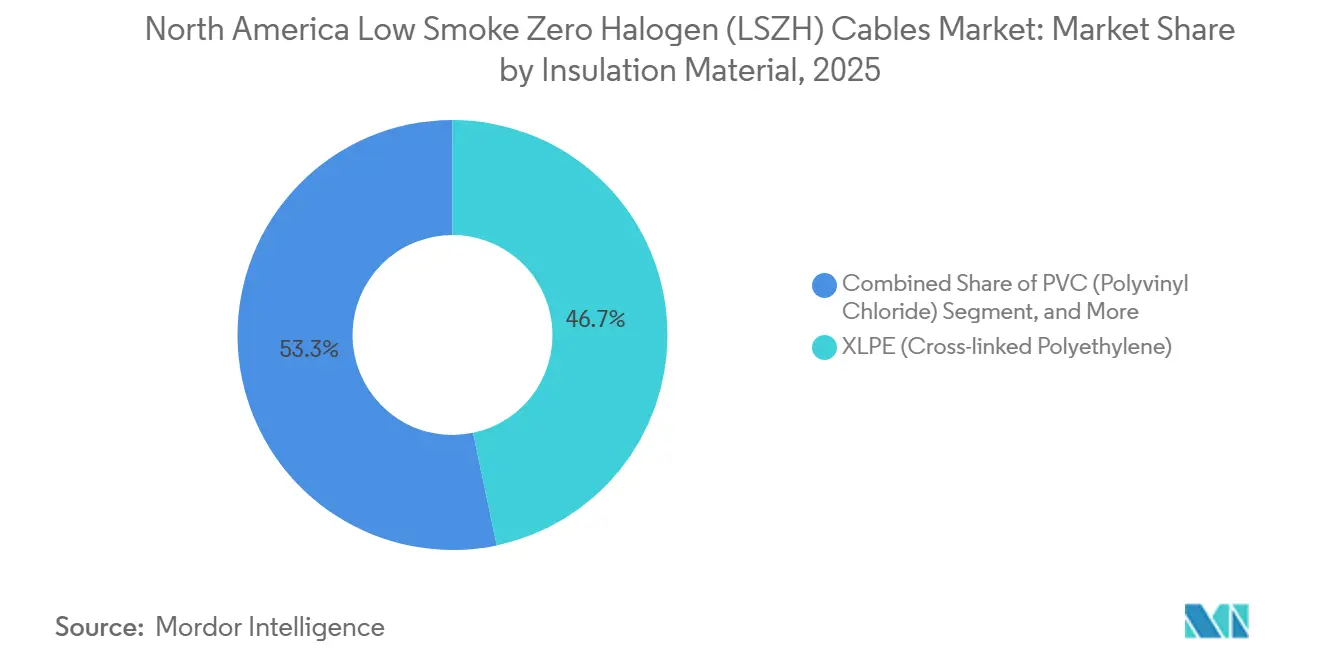
XLPE held 46.70% of the North America low-smoke zero-halogen (LSZH) cables market share in 2025. Its current-carrying capacity, thermal stability at 90°C during continuous operation, and compatibility with LSZH compounds support use in power distribution, data center main feeders, and renewable interconnection. PVC-insulated products retain a position in budget-constrained retrofit work, but new construction increasingly favors XLPE and polyethylene, or PE, formulations. PE-insulated LSZH cables are used mainly in outdoor and underground telecommunications and power-distribution applications. Their moisture and ultraviolet-resistance characteristics complement halogen-free construction requirements.
Other specialty insulation materials are projected to grow at a 9.10% CAGR through 2031. Silicone-polyolefin hybrids, nano-composite formulations, and specialty cross-linked compounds are used in cable environments with elevated thermal requirements. These materials can displace fluoropolymer alternatives in AI data centers and battery storage facilities. Borealis announced an expansion of XLPE insulation material capacity at its Stenungsund, Sweden, facility in October 2025 to support demand from grid modernization, offshore wind, and data center power infrastructure. In March 2026, Dow introduced its ENDURANCE XLPE 525 kV high-voltage direct-current insulation system, which combines cross-linked polyethylene insulation with a semiconductive compound designed to reduce charge injection.
By End-User Industry: Commercial Buildings Lead and Data Centers Outpace Other Uses
Commercial buildings accounted for 21.80% of the North America low-smoke zero-halogen (LSZH) cables market in 2025. New construction, office-complex retrofits, and healthcare upgrades support demand for low-smoke cabling in public corridors, HVAC plenum areas, and critical power circuits. Industrial manufacturing, energy and utilities, transportation infrastructure, and telecommunications also represent important demand bases. Telecommunications uses fiber-structured cabling for 5G backhaul, while transportation projects use LSZH products in metro rail, bus rapid transit, and airport connector systems. Offshore and marine, mining, and rail applications fall under the other end-user industries category and often require specialized cable constructions.
Data centers are projected to grow at a 10.80% CAGR through 2031, the highest rate among end-user industries. AI inference systems operate continuously at high rack power levels, increasing thermal stress on cable systems. This supports demand for products with stronger fire-safety characteristics in densely populated equipment spaces. Renewable energy is also expanding as battery storage and solar inverter rooms include LSZH cables in project contracts. The United States added 57.6 GWh of storage capacity in 2025, with Texas, California, and Arizona serving as important project locations.
Geography Analysis
The United States accounted for 81.75% of regional demand in 2025. Its position reflects large hyperscale data center capacity, extensive commercial building stock, and a substantial battery storage pipeline. Northern Virginia, Texas, Arizona, and Georgia are major data center corridors where campus projects require multi-year cable procurement. Meta’s campus expansion in Richland Parish, Louisiana, adds another important demand location. These projects favor suppliers that can meet delivery schedules and provide current qualification documentation.
Mexico is projected to grow at a 9.30% CAGR through 2031, making it the fastest-growing country within the North America LSZH cables market. Querétaro has become a major data center hub, attracting investments exceeding USD 12 billion. Televisa invested MXN 12.2 billion (USD 645 million) in 2025 to upgrade 4.5 million homes to fiber-to-the-home technology, and it plans to allocate 25% of sales to capital expenditure in 2026. The Tikva cross-border fiber corridor, a 2,500-km route linking Querétaro and Phoenix, Arizona, is expected to be completed in Q4 2026. This infrastructure supports interconnection between Mexico’s data center base and hyperscale campuses in the U.S. Southwest.
Canada is the second-largest country contributor and benefits from energy-transition investment in Ontario and British Columbia. Toronto’s data center activity drives demand for structured and power cabling, while grid projects require products suited to enclosed utility settings. Canada’s building-code approach aligns with NFPA principles, supporting adoption in new commercial and data center construction. All 3 countries refer to IEC material-performance standards, and consistent specifications by global hyperscalers reduce fragmentation across regional procurement.
Competitive Landscape
The North America low-smoke zero-halogen (LSZH) cables market is moderately concentrated, with Prysmian Group, Nexans, Southwire, and Belden holding meaningful positions in named-account and hyperscale projects. Regional and specialty suppliers, including HELUKABEL USA, SAB North America, Alpha Wire, and AFL Telecommunications, serve the automation, industrial, and telecommunications markets. Large suppliers are strengthening domestic manufacturing positions through acquisitions and capacity investment. Nexans completed its acquisition of Republic Wire Inc. in June 2026 for an enterprise value of EUR 680 million (USD 790 million). Republic Wire generated EUR 520 million (USD 605 million) in trailing 12-month revenue through February 2026, and the acquisition added United States manufacturing capacity that Nexans expects to expand by 30%.
AI data centers are a central area of competition because demand for fiber and structured cabling is rising quickly. Supplier selection depends on qualification records, pre-terminated system capabilities, delivery reliability, and price. Mid-sized competitors use UL and IEC dual-certification strategies and dedicated compound qualification programs to compete in project specifications. Specialty compound suppliers, including Dow, Borealis, and Teknor Apex, are developing halogen-free materials intended to improve performance and reduce costs. In March 2026, CommScope launched its Rapid Fiber Connect platform for high-density AI data center deployments with LSZH-rated single-mode and multimode configurations.
Prysmian signed a 10-year agreement with Molex in July 2026, valued at up to EUR 5.5 billion (USD 6.3 billion), to supply optical fiber cable to data centers. The agreement included an upfront payment of EUR 550 million (USD 620 million), and Prysmian committed EUR 1.25 billion (USD 1.4 billion) through 2031 to more than double U.S. optical fiber and cable capacity, creating more than 600 U.S. jobs. In June 2025, Prysmian also began its USD 500 million, 5-year investment at the Encore Wire campus to increase medium-voltage cable capacity. Compliance with NFPA 75 and NEC 2026 favors suppliers with current third-party test reports and ANSI/BICSI 002-aligned portfolios.
North America Low Smoke Zero Halogen (LSZH) Cables Industry Leaders
Prysmian Group
Nexans S.A.
Southwire Company, LLC
Belden Inc.
LS Cable & System U.S.A., Inc.
- *Disclaimer: Major Players sorted in no particular order

Recent Industry Developments
- July 2026: Prysmian signed a 10-year supply agreement with Molex, a Koch Inc. company, valued at up to EUR 5.5 billion (USD 6.3 billion), including a EUR 550 million (USD 620 million) upfront payment, for the supply of optical fiber cable to data centers globally. To support this agreement, Prysmian committed EUR 1.25 billion (USD 1.4 billion) through 2031 to more than double optical fiber and cable manufacturing capacity in the United States, creating over 600 U.S. jobs and reinforcing Prysmian’s position as 1 of only 3 domestic U.S. fiber manufacturers.
- June 2026: Nexans completed the acquisition of 100% of the share capital of Republic Wire Inc., a Cincinnati-based manufacturer of low-voltage copper and aluminum wire products, for a total enterprise value of EUR 680 million (USD 790 million). Republic Wire generated EUR 520 million (USD 605 million) in trailing 12-month revenue through February 2026 and was integrated into Nexans’ PWR-Connect business on June 1, 2026. The transaction added United States manufacturing capacity, which is being expanded by 30% to meet data center, commercial, and residential cable demand.
- March 2026: CommScope launched its Rapid Fiber Connect platform at the NVIDIA GTC 2026 conference in San Jose, California. The pre-configured, factory-terminated platform uses 96-fiber Mass Insert connectors and is available in LSZH-rated single-mode and multimode configurations for ultra-dense AI data center deployments.


North America Low Smoke Zero Halogen (LSZH) Cables Market Report Scope
The North America low-smoke zero-halogen (LSZH) cables market revenue is generated through the sale of LSZH power, control and instrumentation, data and communication, fiber optic, building wire, and specialty cables across multiple voltage ratings and insulation materials, as well as associated value-added cable solutions supplied to end-user industries including commercial buildings, industrial manufacturing, data centers, energy and utilities, transportation infrastructure, and telecommunications throughout the region.
The North America low-smoke zero-halogen (LSZH) cables market report is segmented by cable type (LSZH power cables, LSZH control and instrumentation cables, LSZH data and communication cables, LSZH fiber optic cables, LSZH building wires, and specialty LSZH cables), voltage rating (less than 1 kV, 1-35 kV, 36-65 kV, and above 65 kV), insulation material (PVC (polyvinyl chloride), XLPE (cross-linked polyethylene), PE (polyethylene), other specialty insulation materials), end-user industry (commercial buildings, industrial manufacturing, data centers, energy and utilities, transportation infrastructure, telecommunications, renewable energy, and other end-user industries), and country (United States, Canada, and Mexico). The market forecasts are provided in terms of value (USD).
| LSZH Power Cables |
| LSZH Control and Instrumentation Cables |
| LSZH Data and Communication Cables |
| LSZH Fiber Optic Cables |
| LSZH Building Wires |
| Specialty LSZH Cables |
| Less Than 1 kV |
| 1-35 kV |
| 36-65 kV |
| Above 65 kV |
| PVC (Polyvinyl Chloride) |
| XLPE (Cross-linked Polyethylene) |
| PE (Polyethylene) |
| Other Specialty Insulation Materials |
| Commercial Buildings |
| Industrial Manufacturing |
| Data Centers |
| Energy and Utilities |
| Transportation Infrastructure |
| Telecommunications |
| Renewable Energy |
| Other End-User Industries |
| United States |
| Canada |
| Mexico |
| By Cable Type | LSZH Power Cables |
| LSZH Control and Instrumentation Cables | |
| LSZH Data and Communication Cables | |
| LSZH Fiber Optic Cables | |
| LSZH Building Wires | |
| Specialty LSZH Cables | |
| By Voltage Rating | Less Than 1 kV |
| 1-35 kV | |
| 36-65 kV | |
| Above 65 kV | |
| By Insulation Material | PVC (Polyvinyl Chloride) |
| XLPE (Cross-linked Polyethylene) | |
| PE (Polyethylene) | |
| Other Specialty Insulation Materials | |
| By End-User Industry | Commercial Buildings |
| Industrial Manufacturing | |
| Data Centers | |
| Energy and Utilities | |
| Transportation Infrastructure | |
| Telecommunications | |
| Renewable Energy | |
| Other End-User Industries | |
| By Country | United States |
| Canada | |
| Mexico |


Key Questions Answered in the Report
What is the size of the North America LSZH cables market?
The North America LSZH cables market was valued at USD 2.1 billion in 2025. It is estimated to reach USD 3.29 billion by 2031, with a 7.80% CAGR from 2026 to 2031.
Which cable type is expected to grow fastest in North America?
Fiber optic cables are projected to expand at a 9.60% CAGR through 2031. Growth is tied to hyperscale construction, dense data connections, and the need for fire-safe infrastructure.
Why are LSZH cables used in data centers?
They help limit smoke and toxic-gas hazards in enclosed IT spaces. They also support cable specifications associated with NFPA 75 chapter 6 and ANSI/BICSI 002 guidance.
Which voltage rating holds the largest position?
Less-than-1-kV low-voltage products held 68.40% of regional demand in 2025. The segment serves commercial building wiring, IT power distribution, and structured cabling.
Which end-user group is growing fastest?
Data centers are projected to grow at a 10.80% CAGR through 2031. AI infrastructure requires dense power and data cabling with stronger fire-safety performance.
Why is Mexico important for LSZH cable demand?
Mexico is projected to grow at a 9.30% CAGR through 2031. Data center development, fiber deployment, and nearshoring activity are increasing demand across the North America LSZH cables market.
Page last updated on:





