
North America Induction Cooktops Market Size and Share
Market Overview
| Study Period | 2021 - 2031 |
|---|---|
| Forecast Data Period | 2026 - 2031 |
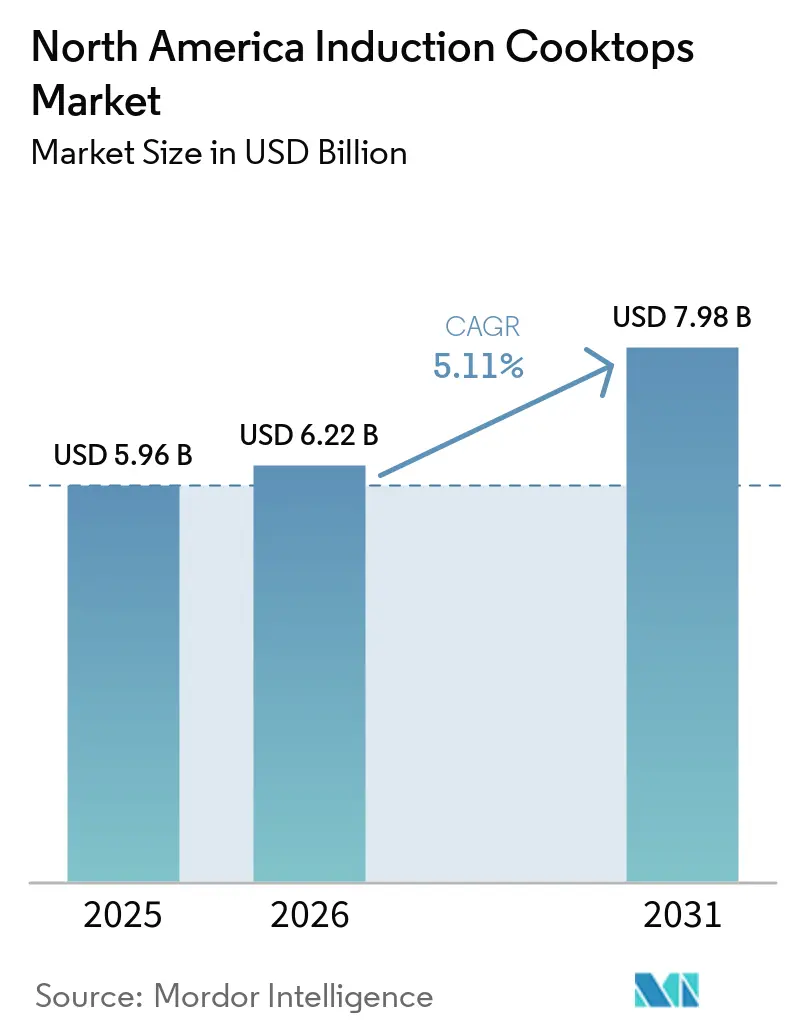
| Base Year Market Size (2025) | USD 5.96 Billion |
| Market Size (2026) | USD 6.22 Billion |
| Market Size (2031) | USD 7.98 Billion |
| Growth Rate (2026 - 2031) | 5.11 % |
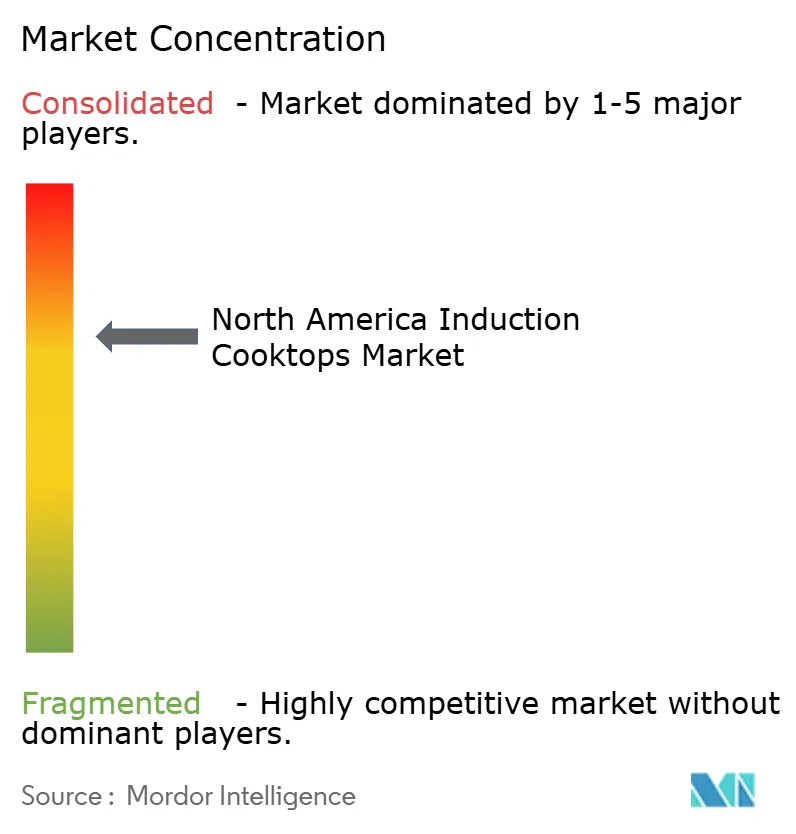
| Market Concentration | Medium |
Major Players *Disclaimer: Major Players sorted in no particular order Image © Mordor Intelligence. Reuse requires attribution under CC BY 4.0. | |
North America Induction Cooktops Market Analysis by Mordor Intelligence
The North American induction cooktops market size is projected to expand from USD 5.96 billion in 2025 to USD 6.22 billion in 2026, and to USD 7.98 billion by 2031, registering a CAGR of 5.11% between 2026 and 2031. Federal rebates, building codes, and limits on new gas connections are shifting induction from a discretionary kitchen upgrade toward a planned electrification purchase. Remodeling activity and wider use of all-electric building designs are also favoring built-in models and higher-value installations. Manufacturers are responding through connected products, flexible cooking zones, and designs that simplify replacement in existing kitchens. The North American induction cooktops market also faces practical adoption limits due to older electrical panels, installation costs, and the need for cookware replacement. These barriers are most visible in older homes and commercial kitchens with established gas equipment.
Key Report Takeaways
- By product type, built-in units held 63.36% of the North America induction cooktops market share in 2025, while free-standing and portable units are forecast to grow at a 6.14% CAGR through 2031.
- By burner configuration, 3-zone units accounted for 41.56% of the North America induction cooktops market size in 2025, while 4-zone units are projected to advance at a 6.62% CAGR through 2031.
- By end-user, residential users accounted for 71.86% of the North America induction cooktops market size in 2025 and are expected to record a 5.73% CAGR through 2031.
- By distribution channel, B2C retail held 76.62% of the North America induction cooktops market size in 2025 and is expected to grow at a 5.52% CAGR through 2031.
- By geography, the United States held 84.31% of the North America induction cooktops market size in 2025, while Mexico is forecast to expand at a 6.44% CAGR through 2031.
Note: Market size and forecast figures in this report are generated using Mordor Intelligence’s proprietary estimation framework, updated with the latest available data and insights as of January 2026.
Market Trends and Insights
Drivers Impact Analysis of North America Induction Cooktops Market*
| Driver | (~) % Impact on CAGR Forecast | Geographic Relevance | Impact Timeline |
|---|---|---|---|
| Premium Kitchen Remodeling and Built-In Appliance Replacement | +0.8% | United States Northeast and West Coast, with relevance across North America | Medium term (2-4 years) |
| Developer Savings from Eliminating Gas Risers and Flues | +0.5% | United States urban centers and multifamily corridors in the Northeast and the West Coast | Medium term (2-4 years) |
| Grid-Interactive Cooking and Residential Demand Flexibility | +0.4% | United States and Canada, especially utility demand-response hubs in California and Illinois | Long term (≥ 4 years) |
| Energy-Efficient Cooking and Lower Operating Energy Use | +0.9% | North America, with stronger relevance in the United States ENERGY STAR program states | Short term (≤ 2 years) |
| Electrification Codes, Rebates, and Gas-Connection Restrictions | +1.2% | United States, Canada, California, New York, and Massachusetts | Medium term (2-4 years) |
| Smart Kitchen Connectivity and Automated Cooking Controls | +0.6% | United States and Canada, with platform integration effects from Asia-Pacific suppliers | Long term (≥ 4 years) |
| Source: Mordor Intelligence | |||
Electrification Codes, Rebates, and Gas-Connection Restrictions Are Rewriting Demand Fundamentals
Federal policy is supporting the North America induction cooktops market by reducing the cost of qualifying installations. The High-Efficiency Electric Home Rebate Act provides up to USD 840 for eligible induction cooktops or ranges, and low- to moderate-income households can receive full coverage of project costs[1]. The requirement for permanent installation favors built-in products over portable units. California’s approved Induction Cooking Market Transformation Initiative supports retail incentives, manufacturer development work for 120 V products, and utility participation. New construction gas restrictions in the United States cities and counties are also increasing the number of projects designed around electric cooking. Canada’s National Energy Code for Buildings 2025 gives provinces a framework for lower-emission building requirements and can support all-electric cooking in new residential buildings.
Energy-Efficient Cooking and Lower Operating Energy Use
Energy performance remains a direct reason for households and developers to consider induction. The California technical reference database rated induction thermal efficiency at 84%, compared with 74% for electric resistance cooking and 40% for gas cooking[2]. The United States Department of Energy states that induction transfers nearly 85% of heating energy to cookware, while gas transfers close to one-third. Faster boil times can support the consumer case for replacement, especially where energy costs and kitchen use are high. A 2025 Lawrence Berkeley National Laboratory study found no measurable rise in indoor nitrogen oxides or carbon dioxide during induction cooking, unlike gas cooking. That difference in indoor air quality can strengthen procurement interest from healthcare, elder care, and institutional kitchens.
Premium Kitchen Remodeling and Built-In Appliance Replacement
Kitchen renovation is strengthening demand for built-in products in the North America induction cooktops market. Induction cooking appliances led the American Institute of Architects’ Q4 2025 home product trends, with a net popularity score of 58.5%[3]. The same survey showed that demand for smart appliances rose from a 6.8% to a 15% net popularity score. The National Kitchen and Bath Association projects USD 228 billion in kitchen and bath revenue in 2026, while repair and remodeling spending is expected to rise 2.9%. Professional renovation spending is expected to increase by 4.4%, supporting installations with higher unit values. These projects commonly favor flush-mounted surfaces, multiple zones, and coordinated appliance suites rather than stand-alone replacements.
Smart Kitchen Connectivity and Automated Cooking Controls
Connected features are becoming more common in the North America induction cooktops market as brands expand their home platforms. LG uses ThinQ, Samsung uses SmartThings, GE Appliances uses SmartHQ, and BSH uses Home Connect to link cooking appliances with other kitchen equipment. LG’s 36-inch smart induction cooktop can synchronize compatible hoods and over-the-range microwaves through ThinQ when burners are active[4]. LG also introduced its SKS Hidden Induction Island System at KBIS 2026, using sensor and zone technology beneath a flush glass surface. Connected cooking systems can encourage households to retain compatible appliance brands during later replacement cycles. Voice controls are also moving from premium products toward the middle of the category, supporting hands-free operation and accessible kitchen designs.
Restraints Impact Analysis of North America Induction Cooktops Market*
| Restraint | (~) % Impact on CAGR Forecast | Geographic Relevance | Impact Timeline |
|---|---|---|---|
| Electromagnetic-Field Safety Misconceptions | -0.3% | United States and Canadian consumer markets, with higher relevance among buyers skeptical of new technology | Medium term (2-4 years) |
| Electrical-Service Upgrades and Peak-Load Constraints in Older Housing | -0.6% | United States pre-1980 housing stock, particularly in the Northeast and Midwest urban cores | Medium term (2-4 years) |
| High Upfront Purchase and Installation Cost | -0.5% | United States low-to-moderate-income households, Canada, and cost-sensitive commercial buyers | Medium term (2-4 years) |
| Ferromagnetic Cookware Compatibility and Replacement Friction | -0.2% | North America, especially with established hospitality and institutional kitchens. | Short term (≤ 2 years) |
| Source: Mordor Intelligence | |||
Electrical-Service Upgrades and Peak-Load Constraints in Older Housing
Electrical capacity remains a common constraint on converting older homes from gas to induction cooking. An Electric Power Research Institute survey cited by CalMTA found that many households in the United States had limited open breaker space, especially in the western United States. The same source indicated that many existing panels in California would require a full upgrade to support the electrification of cooking. ComEd reported that customers switching from gas often required electrical work before installation, while customers already using electric cooking faced fewer electrical changes. A single-family panel upgrade can add a high upfront cost before any utility-side work. Battery-equipped 120 V induction products can reduce some panel work, but purchase prices and future battery replacement needs remain important cost factors.
High Upfront Purchase and Installation Cost
The upfront cost of induction conversion remains a barrier, even as product choices expand. GE Profile introduced a built-in induction model in March 2025 and a slide-in range in May 2025. The total cost of switching from gas in an older urban home can increase when the appliance, electrical work, labor, and compatible cookware are included. Federal support reduces this burden for eligible households but does not fully cover the large, moderate-income group, with limited reimbursement. A 2025 study found that moderate-income households can receive partial reimbursement for project costs. Portable 120 V units offer a lower-cost option, but permanent installation rules can prevent eligibility for some federal support. Cookware replacement can also add costs for households that use aluminum, ceramic, or copper cookware.
*Our forecasts treat driver/restraint impacts as directional, not additive. The impact forecasts reflect baseline growth, mix effects, and variable interactions.
North America Induction Cooktops Market Segment Analysis
By Product Type:
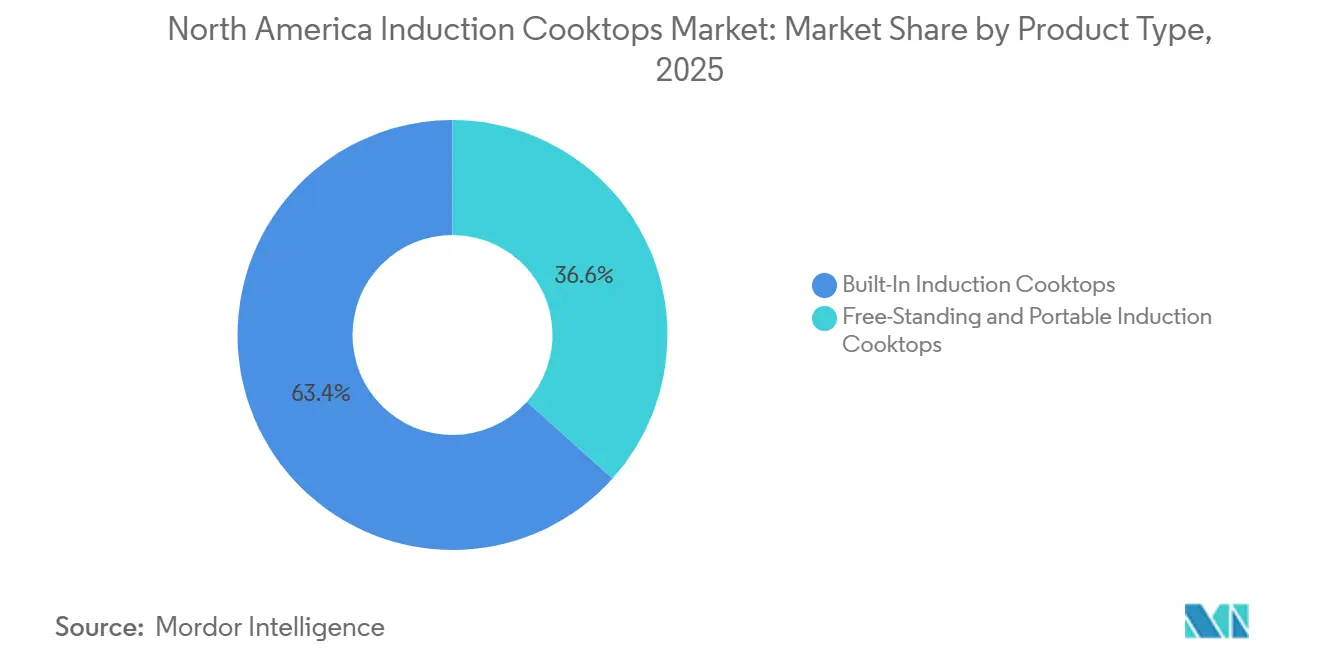
Built-In Units Lead as Free-Standing and Portable Products ExpandBuilt-in units accounted for 63.36% of the value in 2025, making them the dominant product group in the North American induction cooktops market. Their position reflects demand from renovation projects, in which fixed cooking surfaces are integrated into cabinetry and kitchen islands. Federal rebate rules for permanent installations further reinforce demand for built-in equipment. GE Appliances designed its 2025 30-inch built-in to fit existing cutouts, reducing the need for cabinet modifications when replacing units. This approach reduces a major installation concern for consumers replacing an established cooktop. Built-in products also align with the preference for coordinated, open-plan kitchen layouts.
Free-standing and portable models are forecast to grow at a 6.14% CAGR through 2031, the fastest pace within product types. The North America induction cooktops market size for this group is supported by plug-in products that can reach renters and homes where panel upgrades are difficult. A CalNEXT evaluation found that a stove with a 5-kWh battery could operate 4 induction burners at full power while limiting grid draw to 1,200 watts. Off-peak battery charging can also give utilities a tool for demand management. These models have lower average selling prices than installed units, but they make induction available to households outside the normal remodeling cycle. Their wider use can broaden the addressable customer base without requiring major kitchen construction.
By Burner Configuration:
Multi-Zone Products Reflect Demand for Greater Cooking Capacity3-zone configurations accounted for 41.56% of the value in 2025, reflecting their fit with standard 30-inch residential kitchen layouts. This format balances countertop space, price, and cooking flexibility for many mid-market households. The segment is well-suited to replacement installations where a standard-width cooktop is required. Buyers can use it as a practical alternative to conventional electric or gas equipment without having to move to a larger counter opening. This supports its leading position in the North America induction cooktops market. The configuration also matches the needs of households that want more capacity than portable units offer.
4-zone configurations are forecast to grow at a 6.62% CAGR through 2031, faster than other burner layouts. Buyers replacing 4-burner gas ranges may see this layout as the closest equivalent for everyday cooking. LG presented a 36-inch Full-Flex induction cooktop at KBIS 2026 with 2 extended zones for cookware up to 12.6 inches in diameter. One-zone and 2-zone products continue to serve smaller apartments, supplemental cooking needs, and budget-oriented buyers. Products with 5 zones or more remain concentrated in luxury residential kitchens and hospitality settings. The movement toward 4 zones shows that added cooking capacity is increasingly treated as a functional requirement rather than a luxury feature.
By End-User:
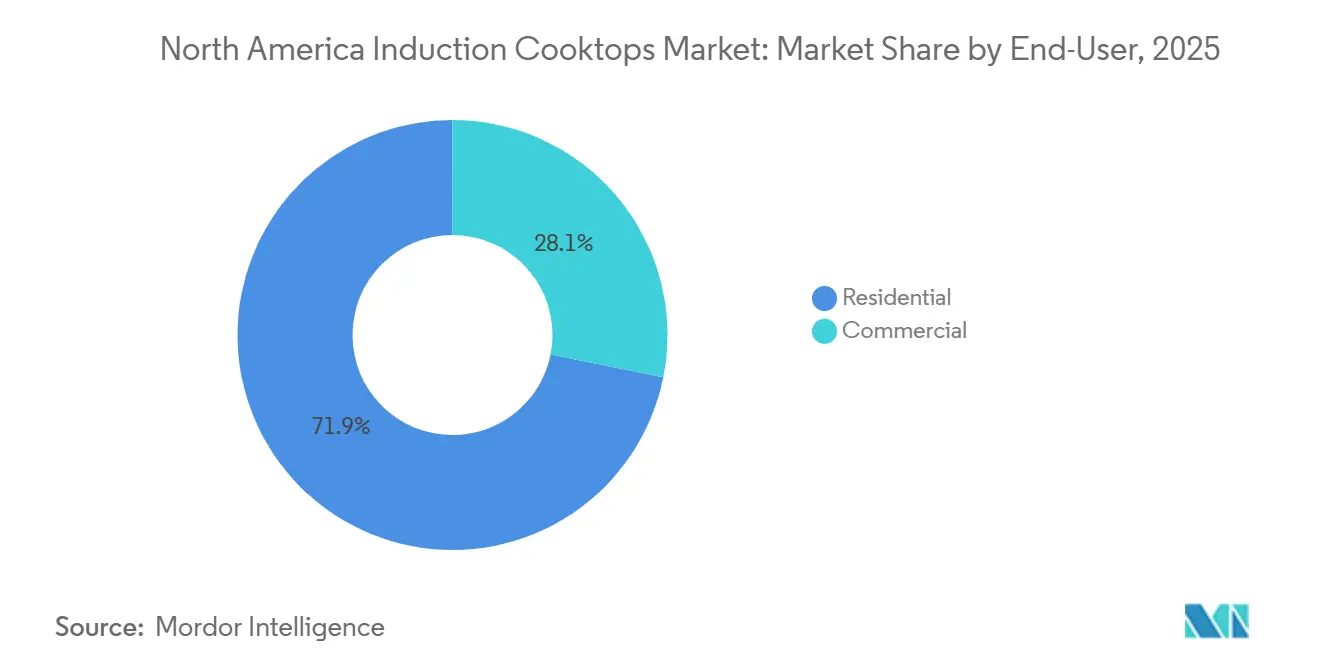
Residential Demand Leads While Commercial Buyers Address Conversion CostsResidential buyers accounted for 71.86% of the value in 2025 and are expected to grow at a 5.73% CAGR through 2031. This group benefits from remodeling activity, household rebates, and smart-home adoption. The American Institute of Architects reported a net popularity score of 58.5% for induction in Q4 2025, confirming strong interest among residential design professionals. Owner-occupiers are more likely to choose higher-wattage built-in products with several zones and connectivity features. Rental and multifamily demand is more likely to favor 120V solutions that avoid major electrical work. These separate purchasing patterns require distinct product and channel strategies.
Commercial demand includes hospitality, institutional kitchens, corporate cafeterias, transportation sites, retail, and healthcare facilities. The North America induction cooktops market is constrained in this group by existing cookware inventories and the capital required for commercial-grade equipment. Indoor air quality benefits can be important in healthcare and institutional procurement, where cooking conditions affect occupants. Electrolux Professional agreed to acquire the assets of Royal Range in November 2025, expanding its United States commercial cooking range and sales infrastructure. New all-electric commercial buildings can avoid much of the retrofit cost because induction can be specified at the design stage. Corporate cafeterias and newly built multifamily properties, therefore, provide opportunities where existing gas infrastructure does not determine the purchase decision.

By Distribution Channel:
B2C Retail Remains Central as Direct Procurement GrowsB2C retail held 76.62% of value in 2025 and is forecast to expand at a 5.52% CAGR through 2031. Consumers often research induction products online before purchasing through brand stores, appliance retailers, or kitchen showrooms. This pattern requires manufacturers to support both digital product comparison and physical demonstrations. Professional renovation work also affects retail sales because contractors often guide product selection. The National Kitchen and Bath Association expects professional-led renovation spending to rise 4.4% in 2026. The North America induction cooktops industry, therefore, relies on retailer training and installation support, not only shelf presence.
B2B and direct sales serve developers, commercial kitchens, institutions, and large construction projects. Developers can assess induction as part of a building-wide electric design rather than as a separate appliance decision. Removing gas plumbing, metering, and riser infrastructure can alter the project economics for all-electric multifamily buildings. Direct manufacturer agreements and kitchen design partners can benefit when equipment is specified early in a project. Con Edison’s Electric Advantage program creates an additional demand route for customers in selected gas-main corridors that switch gas use to electricity. This channel can grow even when normal retail replacement cycles are slow because its demand begins with infrastructure and building design decisions. For the North American induction cooktops market, this makes early engagement with contractors and developers important alongside traditional retail activity.
Geography Analysis
United States Induction Cooktops Market
The United States accounted for 84.31% of the value in 2025 and remains the leading country in the North American induction cooktops market. Its demand is centered on premium kitchen renovation, rather than first-time adoption across the full housing base. The American Institute of Architects reported that kitchen and bath remodeling billings improved to 44.8 in Q1 2026 from 37.3 in Q4 2024. Federal rebates of up to USD 840 and an electric panel tax credit worth 30% of the project cost, capped at USD 600, can reduce installation costs for qualified households. California’s Title 24 rules and the state-approved induction initiative make the West Coast the region’s most advanced demand center. New York and Massachusetts are also creating demand through local building policies and restrictions on gas connections.
Canada Induction Cooktops Market
Canada holds a meaningful secondary position in the regional market, supported by rules that are increasingly aligned with the United States electrification standards. Natural Resources Canada is advancing an energy-consumption requirement of 207 kWh per year for electric smooth-element cooktops, with proposed compliance aligned with the United States Department of Energy’s January 2028 date. Canada’s 2025 national building code provides tiered energy performance levels that provinces can use to inform lower-emission construction policies. LG Canada made its 36-inch UltraHeat 5.0kW Smart Induction Cooktop available in July 2026. British Columbia and Ontario are likely to remain the key provincial demand centers because of their relatively advanced building policies. National figures can therefore understate demand in these large provincial markets. The North America induction cooktops market in Canada is shaped by provincial code adoption and by established smart-home product ecosystems.
Mexico Induction Cooktops Market
Mexico is projected to grow at a 6.44% CAGR through 2031, the fastest rate among the countries covered. The North America induction cooktops market share in Mexico remains lower than in the United States because gas cooking is still embedded in much of the installed base. Urbanization and higher household incomes in northern manufacturing corridors are supporting interest in mid-premium and connected kitchen products. The Electrolux and Midea partnership includes a 65% Midea stake in a Juárez refrigeration plant, which expands the country’s appliance manufacturing infrastructure. Mexico City, Guadalajara, and Monterrey are forming a premium residential customer base, with demand patterns more closely aligned with established United States renovation markets. Product availability and competitive pricing can improve as regional manufacturing and distribution capacity develop.
Competitive Landscape
The North America induction cooktops market is moderately concentrated, with GE Appliances, BSH Home Appliances Group, Whirlpool Corporation, LG Electronics, and Samsung holding strong positions in premium and mid-market retail channels. These companies compete through brand reach, product breadth, connected features, and their ability to support retailers and installers. GE Appliances completed a USD 180 million expansion at its LaFayette, Georgia cooking-products plant in June 2025, adding robotic glass-cooktop assembly and high-volume induction production. In August 2025, it then announced a USD 3 billion manufacturing investment plan in the United States over 5 years. Local manufacturing gives GE Appliances a stronger basis for serving the USD 1,500-2,000 mass-premium price range. BSH reported more than 5% growth in North American revenue during 2025 and identified new Thermador induction products and the Gaggenau Expressive Series as contributors.
Product design is becoming an increasingly important competitive factor in the North American induction cooktop market. LG introduced the SKS Hidden Induction Island System at KBIS 2026, placing induction technology beneath a flush glass work surface. Whirlpool presented the JennAir NextGen Induction Downdraft Cooktop, co-developed with BORA, as well as a temperature-controlled 36-inch smart induction product. Samsung introduced its Bespoke AI Extractor Induction Hob in April 2026, combining a cooktop and extraction function for open-plan kitchens and islands. These products address installation limits that arise when an overhead hood is difficult to place. The premium category is therefore competing on kitchen integration and automated controls as much as core heating performance.
European luxury brands and specialists, including Miele, Smeg, Elica, Fisher & Paykel, True Induction, and Sub-Zero/Wolf, add competition in renovation, luxury, and commercial applications. Fisher & Paykel’s Series 9 SmartZone products use a touchscreen control hub and wireless temperature sensing to support more guided cooking. The sub-USD 1,000 range remains less well served by large brands and is more exposed to specialist suppliers and imported portable equipment. Electrolux and Midea announced a 15-year partnership in April 2026, including 3 joint ventures across refrigeration and laundry sales and manufacturing. The arrangement changes Electrolux’s North American manufacturing position while giving Midea access to assets and channel relationships. UL certification under ANSI/UL 858 and ENERGY STAR participation remain basic requirements for access to major United States sales channels. These requirements create a practical barrier for small suppliers without the resources for product development, testing, and channel support. The North America induction cooktops market, therefore, has room for differentiated specialists, even as large companies retain broad channel influence.
North America Induction Cooktops Industry Leaders
-
GE Appliances
-
Whirlpool Corporation
-
Samsung Electronics Co., Ltd.
-
LG Electronics Inc.
-
Robert Bosch GmbH
- *Disclaimer: Major Players sorted in no particular order
North America Induction Cooktops Market Companies Covered in this Report
- GE Appliances
- Whirlpool Corporation
- Samsung Electronics Co., Ltd.
- LG Electronics Inc.
- Robert Bosch GmbH
- AB Electrolux
- Midea Group
- Panasonic Holdings Corporation
- Koninklijke Philips N.V.
- Haier Smart Home Co., Ltd.
- Sub-Zero Group, Inc.
- Miele & Cie. KG
- Smeg S.p.A.
- Frigidaire
- True Induction
- Fisher & Paykel Appliances Holdings Ltd.
- KitchenAid
- Thermador
- JennAir
- Elica S.p.A.
Recent Industry Developments in North America Induction Cooktops Market
- April 2026: Electrolux Group and Midea Group announced a long-term 15-year strategic partnership structured as three joint ventures covering refrigeration product sales and manufacturing (including a Juárez, Mexico, refrigeration plant, in which Midea acquires a 65% stake) and laundry manufacturing in South Carolina. The deal, valued at approximately SEK 9 billion through rights issuance, is expected to begin operations in Q3 2026 and to restructure Electrolux's North American manufacturing footprint.
- April 2026: Samsung Electronics unveiled the Bespoke AI Extractor Induction Hob at a global launch event in Korea, integrating the cooktop and extractor hood into a single appliance unit. The product targets open-plan kitchens and island installations where conventional overhead hood installation is impractical, representing a structural design shift in induction product architecture.
- February 2026: LG Electronics unveiled the SKS Hidden Induction Island System — an invisible cooktop with embedded downdraft — and the 36-inch Full-Flex induction cooktop with extended zones for oversized cookware at KBIS 2026 in Orlando, Florida. The event also marked SKS's first-ever luxury laundry lineup, confirming LG's intent to compete as a full luxury-kitchen-suite brand in North America.
- February 2026: Whirlpool Corporation showcased the JennAir NextGen Induction Downdraft Cooktop (co-developed with BORA) and the JennAir 36-inch Oblivion Smart Induction Cooktop with Temperature-Controlled Cooking at KBIS 2026, reinforcing JennAir's positioning as Whirlpool's luxury induction vehicle in the North American premium channel.
North America Induction Cooktops Market Report Scope
Induction cooktops use electromagnetic energy to directly heat pots and pans, offering faster, safer, and more energy-efficient cooking compared to traditional gas or electric ranges. The North America induction cooktops market is segmented by product type, burner configuration, end-user, distribution channel, and geography. By product type, the market is segmented into built-in induction cooktops and free-standing and portable induction cooktops. By burner configuration, the market is segmented into 1 zone, 2 zones, 3 zones, 4 zones, and 5 or more zones. By end-user, the market is segmented into residential and commercial (including HoReCa [hotels, restaurants, and cafés/catering], institutional kitchens, corporate and office cafeterias, and other commercial applications such as transportation, retail, and healthcare). By distribution channel, the market is segmented into B2B / direct from manufacturers and B2C / retail (including multi-brand stores, exclusive brand outlets, online, and other distribution channels). By geography, the market is segmented into the United States, Canada, and Mexico. The report provides the market size in USD value for all the above-mentioned segments.
Segmentation Overview
| Built-In Induction Cooktops |
| Free-Standing and Portable Induction Cooktops |
| 1 Zone |
| 2 Zones |
| 3 Zones |
| 4 Zones |
| 5 Zones or Above |
| Residential | |
| Commercial | HoReCa (Hotels, Restaurants and Cafés/Catering) |
| Institutional Kitchens | |
| Corporate and Office Cafeterias | |
| Other Commercial Applications, including Transportation, Retail and Healthcare |
| B2B / Direct from Manufacturers | |
| B2C / Retail | Multi-Brand Stores |
| Exclusive Brand Outlets | |
| Online | |
| Other Distribution Channels |
| United States |
| Canada |
| Mexico |
| By Product Type | Built-In Induction Cooktops | |
| Free-Standing and Portable Induction Cooktops | ||
| By Burner Configuration | 1 Zone | |
| 2 Zones | ||
| 3 Zones | ||
| 4 Zones | ||
| 5 Zones or Above | ||
| By End-User | Residential | |
| Commercial | HoReCa (Hotels, Restaurants and Cafés/Catering) | |
| Institutional Kitchens | ||
| Corporate and Office Cafeterias | ||
| Other Commercial Applications, including Transportation, Retail and Healthcare | ||
| By Distribution Channel | B2B / Direct from Manufacturers | |
| B2C / Retail | Multi-Brand Stores | |
| Exclusive Brand Outlets | ||
| Online | ||
| Other Distribution Channels | ||
| By Geography | United States | |
| Canada | ||
| Mexico | ||
Key Questions Answered in the Report
What is driving demand for induction cooktops in North America?
Federal rebates, electric-building rules, energy efficiency, remodeling activity, and connected kitchen features are supporting demand.
How large is the North America induction cooktops market in 2026?
The category is projected to reach USD 6.22 billion in 2026 and USD 7.98 billion by 2031.
Which induction cooktop product type leads regional sales?
Built-in units led with 63.36% of value in 2025, supported by remodeling demand and permanent-installation rebate rules.
Why do older homes face difficulty adopting induction cooking?
Many homes require electrical work before installation, and panel upgrades can cost USD 2,500 to USD 5,000.
Which country is expected to grow fastest through 2031?
Mexico is expected to record a 6.44% CAGR through 2031, supported by urban premium demand and the development of appliance infrastructure.
What features are changing premium induction cooktops?
Flush surfaces, integrated ventilation, flexible zones, app connectivity, and temperature-guided cooking are becoming more important.