
North America Bathroom Furniture Market Size and Share
Market Overview
| Study Period | 2021 - 2031 |
|---|---|
| Forecast Data Period | 2026 - 2031 |
| Base Year Market Size (2025) | USD 7.94 Billion |
| Market Size (2026) | USD 8.20 Billion |
| Market Size (2031) | USD 10.65 Billion |
| Growth Rate (2026 - 2031) | 5.36 % |
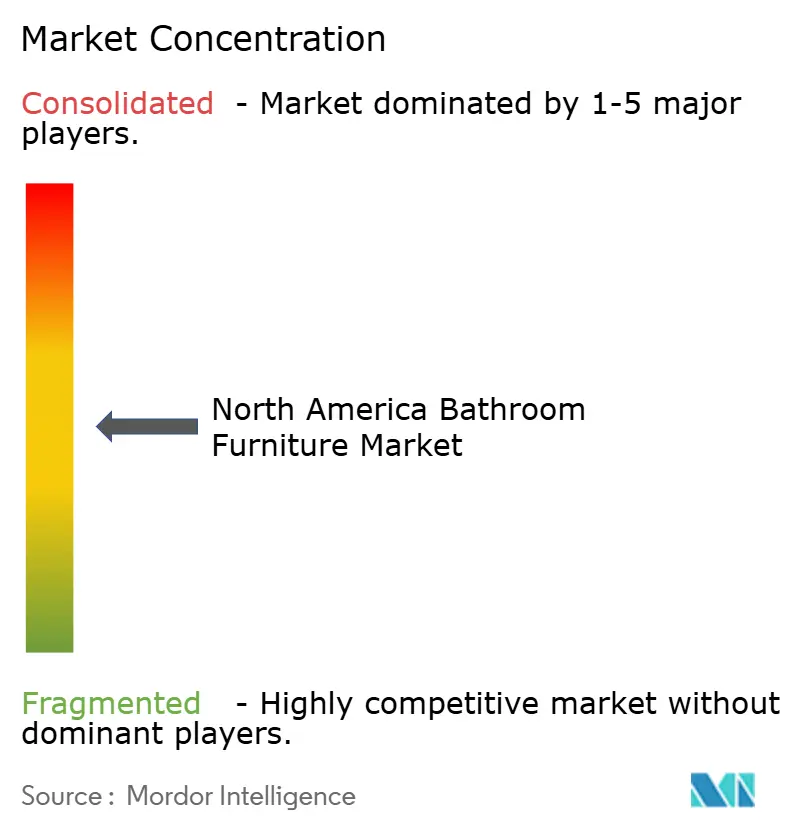
| Market Concentration | Medium |
Major Players *Disclaimer: Major Players sorted in no particular order Image © Mordor Intelligence. Reuse requires attribution under CC BY 4.0. | |
North America Bathroom Furniture Market Analysis by Mordor Intelligence
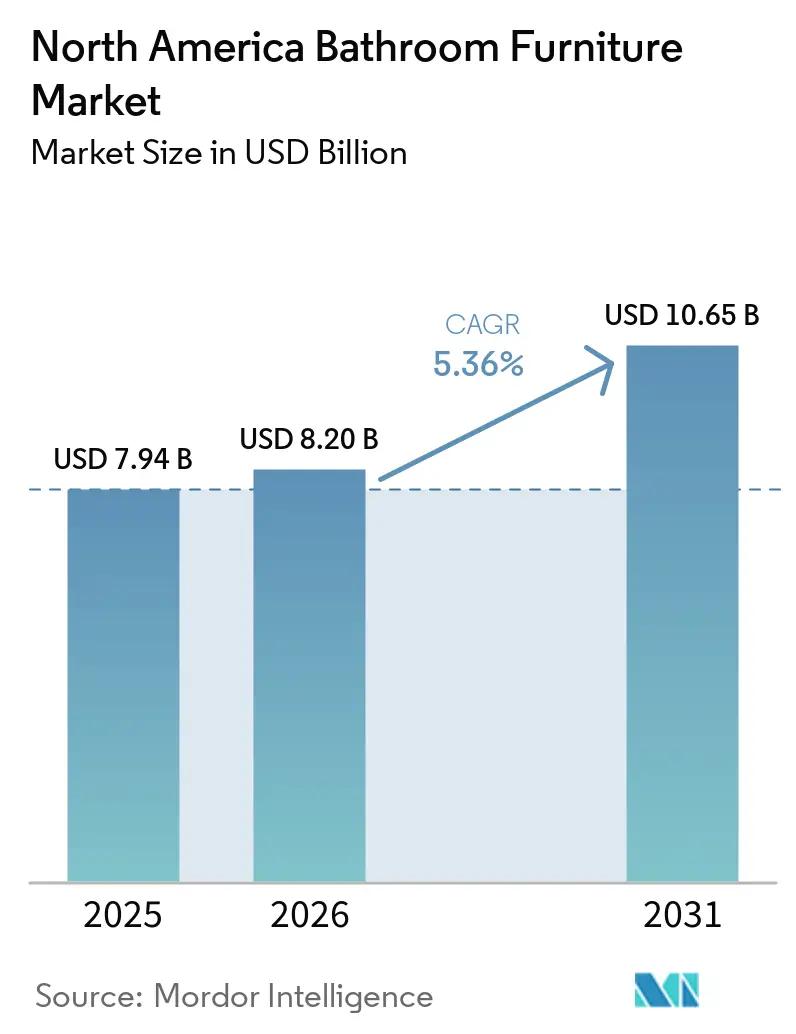
The North America bathroom furniture market is expected to grow from USD 7.94 billion in 2025 to USD 8.2 billion in 2026 and is forecast to reach USD 10.65 billion by 2031 at a 5.36% CAGR over 2026-2031. The North America bathroom furniture market is benefiting from sustained home improvement activity, as homeowners increasingly prioritize upgrading existing properties over relocating. Renovation projects are placing greater emphasis on integrated storage, accessibility, and durable materials, contributing to higher expenditure per project. Manufacturers are strengthening digital sales channels to improve customer reach, while contractors and property developers continue to prioritize suppliers offering reliable product availability and delivery schedules. Mexico is also gaining strategic importance as both a demand market and a regional manufacturing base. However, fluctuations in wood prices, hardware costs, and import expenses continue to exert pressure on procurement budgets and supplier margins, potentially constraining demand for higher-priced bathroom furniture solutions.
Key Report Takeaways
- By product type, bathroom cabinets accounted for 58.2% of the North America bathroom furniture market in 2025, while storage furniture and accessories are projected to register a CAGR of 6.95% through 2031.
- By material, wood accounted for 37.9% of the North America bathroom furniture market in 2025, while plastic and polymer are projected to register a CAGR of 6.51% through 2031.
- By price range, mid-range products accounted for 43.2% of the North America bathroom furniture market in 2025, while premium products are projected to register a CAGR of 6.67% through 2031.
- By end-user, residential users accounted for 71.6% of the North America bathroom furniture market in 2025, while commercial users are projected to register a CAGR of 6.21% through 2031.
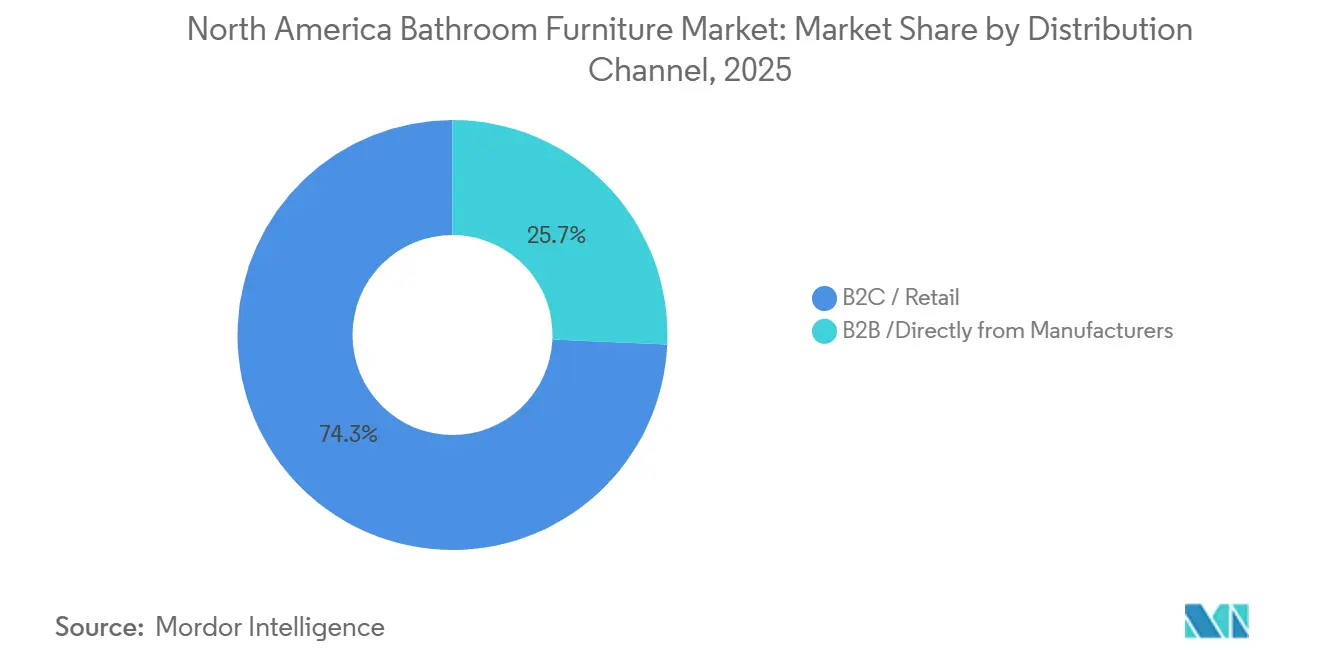
- By distribution channel, B2C retail accounted for 74.3% of the North America bathroom furniture market in 2025, while B2B direct sales are projected to register a CAGR of 6.15% through 2031.
- By geography, the United States accounted for 78.2% of the North America bathroom furniture market in 2025, while Mexico is projected to register a CAGR of 7.02% through 2031.
Note: Market size and forecast figures in this report are generated using Mordor Intelligence’s proprietary estimation framework, updated with the latest available data and insights as of January 2026.
Market Trends and Insights
Drivers Impact Analysis of North America Bathroom Furniture Market*
| Growing Residential Bathroom Remodeling and Repair Spending | +1.2% | United States, Canada | Short term (≤ 2 years) |
| Premium and customized bathroom design | +1.0% | United States, Canada | Medium term (2-4 years) |
| Hospitality and nonresidential construction | +0.8% | United States, Mexico | Medium term (2-4 years) |
| E-commerce and direct-to-consumer assortments | +0.7% | United States, Canada | Short term (≤ 2 years) |
| Retrofit-friendly formats for aging housing stock | +0.6% | United States, Canada | Long term (≥ 4 years) |
| Nearshoring of vanity and cabinet production in Mexico | +0.5% | Mexico and North America | Long term (≥ 4 years) |
| Source: Mordor Intelligence | |||
Growing Residential Bathroom Remodeling and Repair Spending
The preference for home improvement over relocation is sustaining renovation expenditure and supporting replacement demand for bathroom furniture across North America. Harvard University projected homeowner improvement and maintenance spending to reach USD 524 billion in early 2026, with 2.4% year-over-year growth[1]. This spending base supports vanities, cabinets, mirrors, and storage products even when home sales are limited. The National Kitchen and Bath Association revised its 2025 United States kitchen and bath revenue outlook to USD 228 billion, yet high-value renovation activity remained important to the sector[2]. Buyers with accumulated equity can fund larger projects, while homeowners with smaller budgets may focus on furniture replacements that improve function without a full rebuild. This pattern favors suppliers that offer products across price points and can meet installer requirements.
Premium and Customized Bathroom Design Demand
Premium projects are increasing the value of orders in the North American bathroom furniture market, especially where buyers prioritize fit, finishes, and integrated storage. According to Houzz data published in 2025, the 90th percentile of spending for large bathroom renovations reached USD 70,000 in 2024. More than 55% of renovating homeowners selected fully custom or semi-custom vanities, showing demand for products that match individual room dimensions and design preferences[3]. Villeroy & Boch presented fine solid wood furniture and textured bathroom materials at ISH 2025, reflecting demand for warmer finishes and coordinated spaces[4]. Flexible manufacturing and dependable lead times therefore matter more than high-volume standard designs alone. This demand also gives designers and specialty dealers a continuing role in product specification.
Hospitality and Nonresidential Construction Activity
Commercial demand adds a second source of growth for the North America bathroom furniture market. Commercial end users are forecast to grow at a 6.2% CAGR through 2031, led by hotel renovation activity. Supply House Times reported that more than 1,300 hotels were in conversion pipelines in 2024, while around 660 properties were undergoing major renovation work. Franchise property improvement plans create repeat purchasing needs as operators update guest bathrooms during renewal cycles. Hotel operators are increasingly replacing tubs with showers, which concentrates furniture demand on vanities, cabinets, mirrors, and storage products. Healthcare and education projects also require accessible layouts, moisture-resistant materials, and products that can withstand frequent use.
E-Commerce Expansion and Direct-to-Consumer Assortments
Digital sales are widening product access in the North American bathroom furniture market and changing the way buyers compare designs. According to ChannelEngine, more than 35% of United States homeware and furniture purchases were transacted online in 2025. Online tools help buyers compare dimensions, finishes, and room layouts before visiting a store or placing an order. Robern introduced Curated Cartesian Vanities through e-commerce in June 2025, bringing a luxury floating vanity line to digital shoppers. Direct digital access can give smaller design-focused suppliers visibility without the cost of a broad showroom network.
Restraints Impact Analysis of North America Bathroom Furniture Market*
| Restraint | (~) % Impact on CAGR Forecast | Geographic Relevance | Impact Timeline |
|---|---|---|---|
| Housing affordability and remodeling financing pressure | -0.7% | United States, Canada | Short term (≤ 2 years) |
| Wood, engineered stone, and hardware cost volatility | -0.6% | North America | Medium term (2-4 years) |
| Moisture, installation, and warranty risks for floating vanities | -0.3% | United States, Canada | Long term (≥ 4 years) |
| Cross-border compliance and product-liability complexity | -0.3% | United States and Mexico | Medium term (2-4 years) |
| Source: Mordor Intelligence | |||
Housing Affordability and Remodeling Financing Pressure
High ownership costs can limit renovation budgets, particularly for households that have not built substantial equity. In July 2025, the Federal Reserve stated that housing costs relative to median income were at their highest level since 1980. This reduces first-time buyer activity and removes some of the renovation work that often follows a home purchase. The NKBA lowered its 2025 revenue outlook to USD 228 billion and expected DIY activity to decline by 2.2%. Mid-range vanities priced from USD 800 to USD 1,500 face particular exposure when buyers rely on savings rather than home equity financing. Suppliers must therefore balance product upgrades with price points that remain accessible to routine remodelers.
Volatility in Wood, Engineered Stone, and Hardware Costs
Material costs remain a persistent constraint on margins and retail prices across the North America bathroom furniture market. New Section 232 tariffs on lumber and wood product imports took effect in September 2025, adding to existing pressure on imported inputs. Cabinetry suppliers reported price increases of 10% to 25% on imported bathroom goods during the first half of 2025, with metal hardware carrying particular exposure. Composite wood products also need to meet CARB II formaldehyde rules, which narrow available input choices for manufacturers using MDF cabinet structures. Many suppliers are responding with hybrid product designs that combine solid wood fronts with engineered-wood components. These products seek to preserve appearance and durability while controlling compliance and material costs.
*Our forecasts treat driver/restraint impacts as directional, not additive. The impact forecasts reflect baseline growth, mix effects, and variable interactions.
North America Bathroom Furniture Market Segment Analysis
By Product Type:
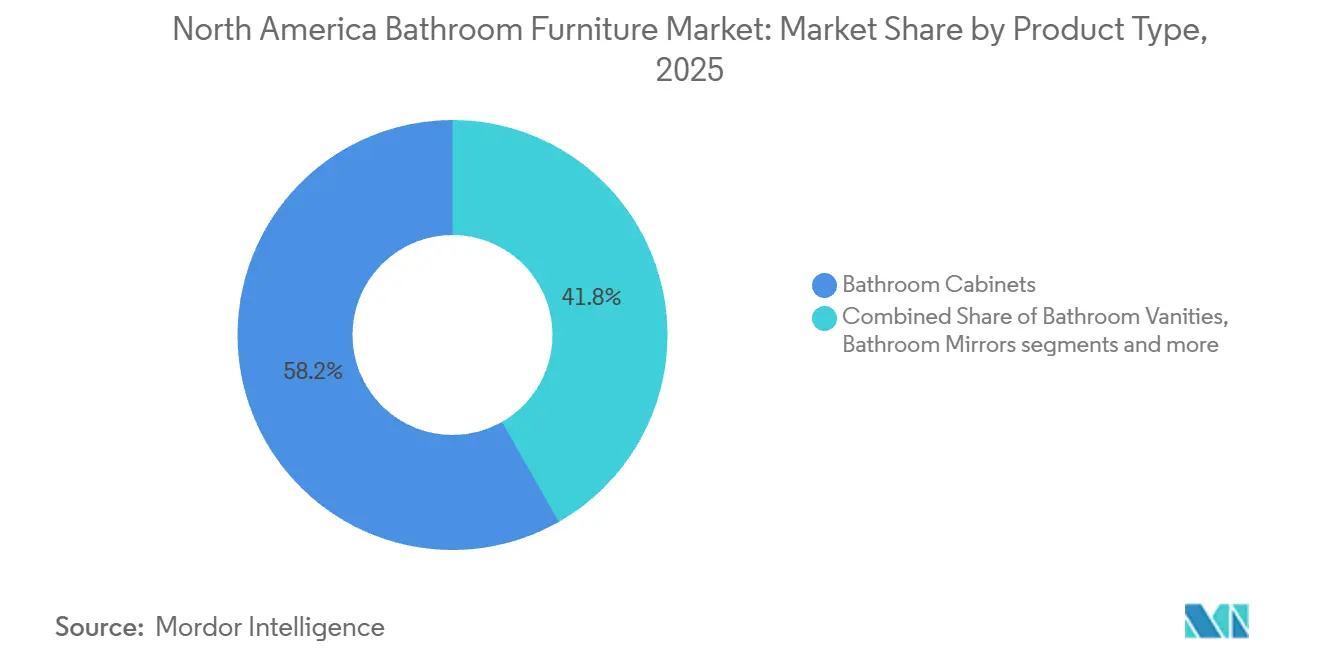
Cabinets Remain Central as Storage Demand BroadensBathroom cabinets accounted for 58.2% of the North American bathroom furniture market in 2025, supported by their essential storage function and suitability across a wide range of renovation budgets. Wall-mounted medicine cabinets and freestanding units serve diverse applications, including compact bathroom upgrades, full-scale remodels, primary and secondary bathrooms, and residential properties with varying storage requirements. The category also benefits from replacement opportunities that do not require extensive changes to existing bathroom layouts, plumbing configurations, or flooring. In April 2025, Robern introduced the Presence Cabinet, featuring integrated lighting, magnification, charging, and storage functions. Such product innovations reflect the growing emphasis on combining everyday utility with enhanced functionality and contemporary design, enabling manufacturers to target both value-conscious consumers and premium-oriented buyers.
Storage furniture and accessories are projected to register the fastest growth among product categories, with a CAGR of 6.95% through 2031. Increasing demand for space-efficient bathroom solutions is supporting the adoption of organizers, pull-out shelves, mirrored storage units, compact shelving, and modular furniture that improve storage capacity without requiring extensive renovation. These products are particularly relevant for smaller bathrooms and targeted refurbishment projects, where budget constraints and limited floor space favor practical, easy-to-integrate solutions. Lighted and smart mirrors further complement this trend by combining functional convenience with improved bathroom aesthetics, particularly in spaces with limited natural lighting. The growing preference for coordinated bathroom interiors also creates cross-selling opportunities across cabinets, storage accessories, mirrors, and vanities, allowing suppliers to increase product value per renovation project.

By Material:
Wood Retains Preference While Polymer Use ExpandsWood held 37.9% of the North American bathroom furniture market in 2025, supported by demand for natural-looking finishes, established consumer familiarity, and its close association with premium vanity designs. Houzz reported that nearly three-quarters of renovating homeowners selected solid wood for a primary vanity, with maple and white oak among the leading choices. Warm wood finishes remain prominent in wellness-oriented bathrooms, where homeowners seek a more residential setting with visual warmth and a coordinated relationship between cabinetry, flooring, and fixtures. Metal has a narrower but important role in commercial applications and open-shelf designs where water resistance, cleanability, and a more utilitarian appearance are essential. Wood products still require effective construction, coatings, installation practices, and attention to ventilation to manage long-term moisture exposure in rooms with frequent temperature changes.
Plastic and polymer products are forecast to grow at a 6.51% CAGR through 2031. WPC, high-density PVC, and engineered polymer surfaces can offer strong moisture resistance, straightforward maintenance, and lower prices than solid wood products. The materials are suited to rooms with high humidity, repeated cleaning, and a need for practical maintenance, including many hospitality, healthcare, and value-focused residential settings. Recycled PVC content also provides an option where hospitality and healthcare purchasers apply material sourcing standards alongside performance expectations. Polymer formats extend the available choice for cost-sensitive, commercial, and high-moisture projects, even as many residential buyers continue to prefer natural wood finishes for primary bathrooms and design-led renovations.
By Price Range:
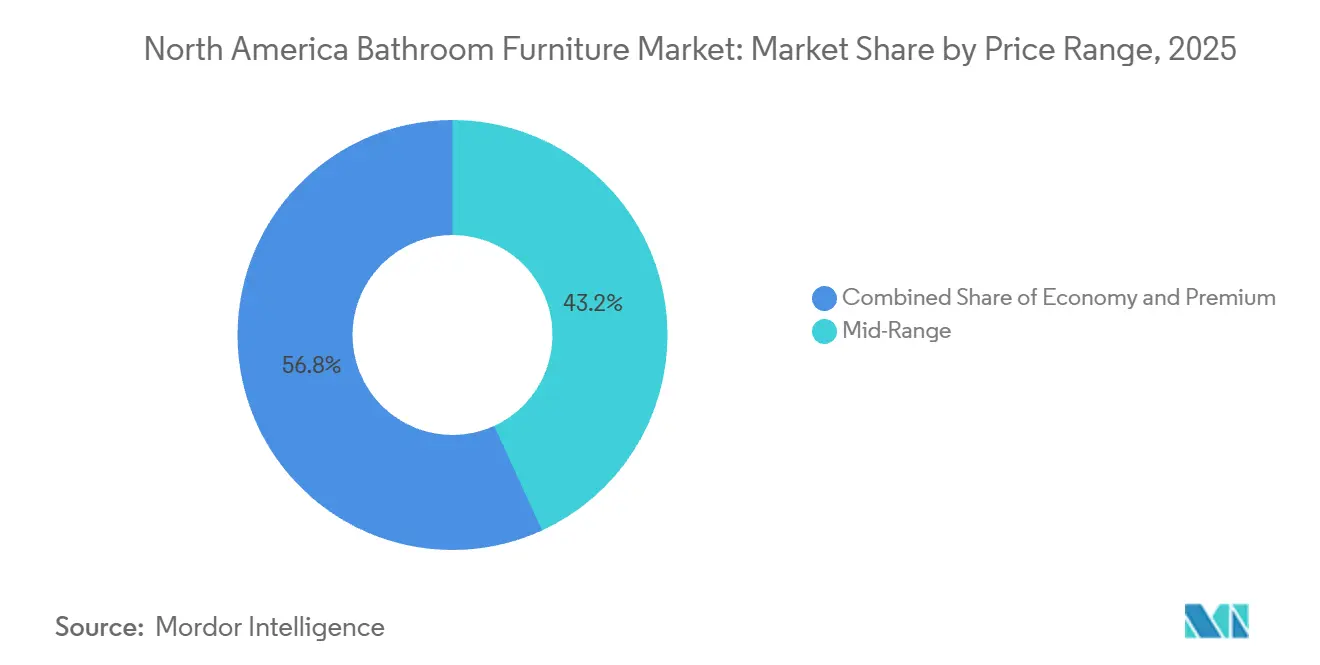
Mid-Range Products Lead Volume While Premium Grows FasterMid-range products held 43.2% of the North America bathroom furniture market in 2025, reflecting the budgets of homeowners completing partial or full bathroom renovations and seeking visible improvements without moving into bespoke pricing. Buyers in this category seek durable construction, current finishes, useful storage, and recognizable brands without the cost of fully custom cabinetry or premium imported collections. Houzz identified USD 12,000 to USD 22,000 as the median spending range for major bathroom renovations, placing many furniture decisions within a value-conscious overall project budget. Economy products face stronger pressure from input inflation because price-sensitive buyers can defer a purchase, choose lower-cost replacements, or limit the scope of a planned renovation. Mid-range suppliers therefore need to balance product quality, finish options, availability, delivery reliability, and retail pricing while avoiding unnecessary complexity in their core ranges.
Premium products are forecast to grow at a 6.67% CAGR through 2031, making this the fastest-growing price tier. Higher-end buyers are more willing to pay for custom dimensions, coordinated finishes, integrated storage, better materials, and branded design that supports a complete bathroom scheme. Duravit introduced the Aurena collection in North America in January 2025 with an aluminum console, open storage, cabinet options, LED mirrors, and hygienic ceramic surfaces. Made-to-order options help designers respond to unusual layouts, limited wall space, precise storage requirements, and the need to coordinate furniture with specified fixtures. This creates a stronger revenue opportunity for premium suppliers despite lower unit volume than the mid-range tier and a more selective customer base.
By End-User:
Residential Demand Leads While Commercial Projects Add MomentumResidential users held 71.6% of the North American bathroom furniture market in 2025, making homeowners the main source of demand for cabinets, vanities, mirrors, and storage furniture across the region. Demand is strongest where buyers are preparing homes for longer occupancy, updating dated layouts, addressing storage shortages, or adapting a bathroom to support aging in place. A 2025 Houzz study found that 61% of renovating homeowners added grab bars, 55% added non-slip flooring, and 52% installed low-curb showers. These improvements create linked demand for ADA-height vanities, accessible sinks, shallow storage, and furniture that allows users to move more easily around the room. The NAHB reported that universal design is increasingly specified for practical flexibility, longer-term usability, and potential resale value.
Commercial users are forecast to grow at a 6.21% CAGR through 2031. Hotels lead commercial demand because renovation programs regularly refresh guest bathrooms, while healthcare, education, retail, and offices also need durable products that meet operational requirements. Shower-centered hotel renovations concentrate purchases on vanities, cabinets, mirrors, and storage rather than freestanding tub surrounds, giving buyers a narrower but more frequently repeated furniture specification. Commercial purchasers also prioritize warranty support, replacement parts, maintenance needs, product consistency, and predictable delivery performance across projects with multiple rooms. Manufacturers with direct contractor and developer relationships are better positioned to serve recurring project needs and can coordinate more effectively on lead times, finishes, and installation requirements.
By Distribution Channel:
Retail Retains Reach While Direct Sales Gain GroundB2C retail held 74.3% of the North American bathroom furniture market in 2025, giving homeowners wide access to products through home centers, specialty stores, online retailers, and marketplace listings. The Home Depot and Lowe's have broadened bathroom furniture selections through marketplace models, increasing the range visible to consumers while giving brands access to established retail traffic. Many buyers research online before visiting stores, while others place an order online after checking physical displays, finishes, and storage features in person. This hybrid journey makes accurate images, dimensions, delivery information, compatibility details, and review management important for suppliers that want to reduce purchase uncertainty. Specialty stores continue to matter in premium projects where customers want guidance on designs, finishes, product compatibility, custom options, and coordination with a wider renovation plan.
B2B direct sales are forecast to grow at a 6.15% CAGR through 2031. Contractors, hotel operators, and multifamily developers seek direct access to manufacturers for volume pricing, delivery certainty, product consistency, and coordination on custom specifications. Direct arrangements can shorten the path from a project design to a product order and allow manufacturers to address warranty details, lead times, replacement needs, and installation conditions before work begins. This channel is particularly useful where many rooms use repeated layouts and need matching furniture supplied in planned phases. Strong direct-sales capabilities let manufacturers pursue commercial programs while retaining retail reach for individual homeowners and smaller renovation projects.
Geography Analysis
United States Bathroom Furniture Market
The United States held 78.2% of the North America bathroom furniture market in 2025 and remains the region's main source of demand. Its large housing stock, extensive home-improvement retail infrastructure, broad contractor base, and large population of homeowners with equity support ongoing replacement and renovation activity. Harvard University projected United States homeowner improvement and maintenance spending to reach USD 524 billion in early 2026, showing that renovation spending remains meaningful even when housing transactions are subdued. Aging homes also support demand for retrofit-friendly cabinets, floating vanities, and modular storage that can be fitted with limited plumbing changes and less disruptive construction work. The United States remains the largest destination for Mexican furniture exports, linking domestic renovation demand, retailer buying decisions, and regional manufacturing investment.
Canada Bathroom Furniture Market
Canada is the second-largest country market, with demand shaped by aging households, wellness-oriented design choices, higher construction costs, and building standards. Canadian buyers are showing interest in floating vanities, custom storage, warm wood tones, integrated bathroom organization, and designs that make efficient use of space. Mechanical Business reported in 2025 that aging-in-place products were among the fastest-growing bathroom categories in Canada, reflecting a wider focus on future usability rather than immediate accessibility needs alone. Suppliers that offer durable moisture-resistant products, accessible formats, practical storage, and finish choices suited to renovation work are well positioned as owners adapt current bathrooms instead of moving.
Mexico Bathroom Furniture Market
Mexico is forecast to grow at a 7.02% CAGR through 2031, the strongest pace in the North America bathroom furniture market. It serves both a growing domestic customer base and a production center for goods shipped to the United States, making domestic demand and export capacity important to supplier decisions. CEPAL stated that Mexico's furniture exports totaled USD 1.977 billion in 2024, with 96.7% sent to the United States, underscoring the close relationship between the two countries' furniture supply chains. ANFAD reported bathroom-sector exports above MXN 13.6 billion (~USD 0.76 billion) in 2024, supported by investments in quality controls, automated finishing, and materials that can improve consistency for cross-border buyers. Mexico's USMCA treatment gives qualifying furniture a cost advantage in the United States market, although tariff investigations could affect cross-border supply decisions and encourage manufacturers to preserve sourcing flexibility.
Competitive Landscape
The North America bathroom furniture market is moderately fragmented, with large cabinet manufacturers operating alongside premium European brands, home-center suppliers, regional specialists, and direct-to-consumer businesses. MasterBrand and American Woodmark announced an all-stock combination in August 2025, with a pro forma equity value of USD 2.4 billion and an enterprise value of USD 3.6 billion. The companies expect USD 90 million in cost synergies by the end of the third year after closing, based on greater scale in production, procurement, and operations. A combined distribution base through dealers, retailers, and builders can improve purchasing power and production efficiency, while also creating scope for competitors to pursue relationships during integration. Premium suppliers such as Duravit and Villeroy & Boch use designer and architect channels to protect their positions and support specification-led sales where design, finishes, and service have greater importance.
Competition is intensifying in the USD 500 to USD 2,500 vanity range as online sellers make design-led products accessible to a wider group of buyers. Wyndham Collection uses FSC-certified, zero-emission plywood and sells through The Home Depot and other large retailers, combining material claims with broad consumer distribution. In 2025, Water Creation introduced the Sequoia collection with quartz countertops and carved finger-groove handles, adding design details that appeal to buyers looking beyond standard cabinet formats. Robern's 2025 e-commerce launch for Curated Cartesian Vanities shows that high-end brands are also using digital channels to reach consumers, including buyers who do not live near an established dealer or showroom.
In April 2025, LIXIL and American Bath Group announced a strategic partnership that gave American Bath Group exclusive North American production and distribution rights for the American Standard, DXV, and Eljer bathing brands. The agreement reflects a focus on specialized manufacturing and distribution within established product portfolios while allowing individual businesses to concentrate on defined product and channel capabilities. Compliance costs are rising for importers as the CPSC moves to mandatory eFiling requirements for imported consumer products in July 2026. Manufacturers with established United States or USMCA-compliant production have an advantage when cost and compliance requirements rise, because they can reduce exposure to border delays and changing import requirements. This advantage can reinforce established regional supply relationships while maintaining room for specialized and design-led competitors.
North America Bathroom Furniture Industry Leaders
-
Kohler Co.
-
MasterBrand, Inc.
-
Masco Corporation
-
LIXIL Corporation
-
Roca Sanitario, S.A.
- *Disclaimer: Major Players sorted in no particular order
North America Bathroom Furniture Market Companies Covered in this Report
- MasterBrand, Inc.
- American Woodmark Corporation
- Robern, Inc.
- LIXIL Corporation
- Roca Sanitario, S.A.
- Duravit AG
- Villeroy & Boch AG
- James Martin Vanities
- Empire Industries Inc.
- Avanity Corporation
- Design Element Group, Inc.
- Water Creation, Inc.
- Wyndham Collection
- Strasser Woodenworks
- Bertch Cabinet, LLC
- LACAVA
- Virtu USA
- Vanderloc
- Revolution Vanities
- Native Trails
- Foremost Groups Ltd.
- MKE Cabinetry
Recent Industry Developments in North America Bathroom Furniture Market
- September 2025: The NAHB reported that the United States government imposed new Section 232 tariffs on lumber and wood product imports effective, adding another layer of input cost pressure for North American bathroom furniture and cabinetry manufacturers that rely on imported wood substrates. The tariffs are expected to compound existing cost headwinds and accelerate the search for domestic or USMCA-sourced alternatives.
- August 2025: MasterBrand, Inc. and American Woodmark Corporation signed a definitive all-stock merger agreement, unanimously approved by both boards. American Woodmark shareholders are to receive 5.15 MasterBrand shares per share owned. Both companies described the combination as creating the cabinet industry's most comprehensive brand portfolio, spanning stock, semi-custom, and premium categories.
- June 2025: Robern introduced Curated Cartesian Vanities, bringing its luxury Cartesian modular floating vanity line to e-commerce for the first time. The launch signals a structural shift in premium bathroom furniture distribution strategy, bypassing traditional showroom channels to reach specification-led renovation buyers through direct digital purchase.
North America Bathroom Furniture Market Report Scope
Segmentation Overview
| Bathroom Vanities |
| Bathroom Cabinets |
| Bathroom Mirrors |
| Storage Furniture & Accessories |
| Wood |
| Metal |
| Plastic and Polymer |
| Others |
| Economy |
| Mid-Range |
| Premium |
| Residential | |
| Commercial | Hospitality |
| Retail and Office | |
| Healthcare and Education | |
| Others Commercial End User |
| B2C / Retail | Home Centers |
| Specialty Furniture Stores | |
| Online | |
| Other Distribution Channels | |
| B2B /Directly from Manufacturers |
| Canada |
| United States |
| Mexico |
| By Product Type | Bathroom Vanities | |
| Bathroom Cabinets | ||
| Bathroom Mirrors | ||
| Storage Furniture & Accessories | ||
| By Material | Wood | |
| Metal | ||
| Plastic and Polymer | ||
| Others | ||
| By Price Range | Economy | |
| Mid-Range | ||
| Premium | ||
| By End User | Residential | |
| Commercial | Hospitality | |
| Retail and Office | ||
| Healthcare and Education | ||
| Others Commercial End User | ||
| By Distribution Channel | B2C / Retail | Home Centers |
| Specialty Furniture Stores | ||
| Online | ||
| Other Distribution Channels | ||
| B2B /Directly from Manufacturers | ||
| By Country | Canada | |
| United States | ||
| Mexico | ||
Key Questions Answered in the Report
What is the projected value of the North America bathroom furniture market by 2031?
The North America bathroom furniture market is projected to reach USD 10.7 billion by 2031, growing at a 5.36% CAGR from 2025 as renovation activity, accessible design needs, and digital product access support demand.
Which bathroom furniture product category leads regional demand?
Bathroom cabinets lead demand with 58.2% of regional revenue in 2025 because they are essential storage products in both limited refresh projects and complete bathroom renovations.
Which material is growing fastest for bathroom furniture in North America?
Plastic and polymer products are forecast to grow at a 6.51% CAGR through 2031, supported by moisture-resistant formats, practical maintenance needs, and lower price points than many solid wood alternatives.
What is supporting residential bathroom renovation demand?
Homeowners are investing in existing properties, while improvement and maintenance spending is projected to reach USD 524 billion in early 2026, supporting replacement purchases across cabinets, vanities, storage products, and mirrors.
Why is Mexico important to regional bathroom furniture suppliers?
Mexico is the fastest-growing country market at a 7.02% CAGR and serves as a major supply base for United States-bound furniture, supported by its production capacity and USMCA treatment.