
Nitrocellulose Market Size and Share
Market Overview
| Study Period | 2021 - 2031 |
|---|---|
| Market Size (2026) | USD 1.02 Billion |
| Market Size (2031) | USD 1.31 Billion |
| Growth Rate (2026 - 2031) | 5.13 % |
| Fastest Growing Market | Asia-Pacific |
| Largest Market | Asia-Pacific |
| Market Concentration | Medium |
Major Players *Disclaimer: Major Players sorted in no particular order Image © Mordor Intelligence. Reuse requires attribution under CC BY 4.0. | |
Nitrocellulose Market Analysis by Mordor Intelligence
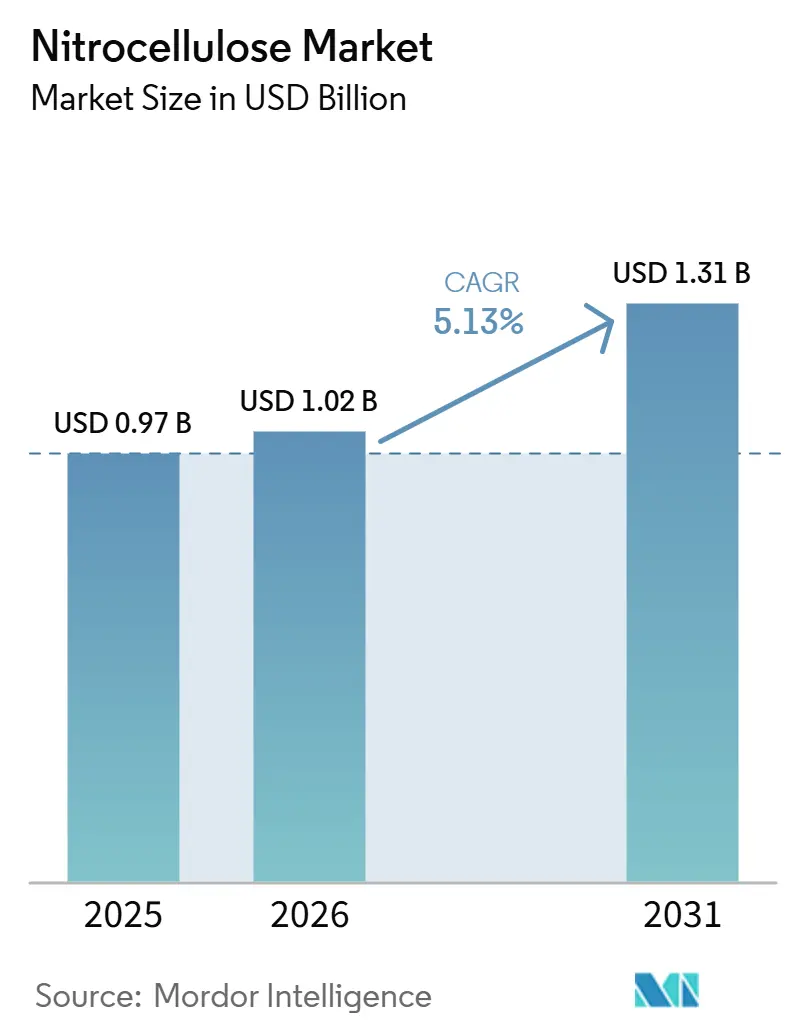
The Nitrocellulose Market was valued at USD 0.97 billion in 2025 and is estimated to grow from USD 1.02 billion in 2026 to reach USD 1.31 billion by 2031, at a CAGR of 5.13% during the forecast period (2026–2031). Nitrocellulose remains important in coatings, printing inks, wood finishes, and personal care products because it forms films that dry quickly. The nitrocellulose market is also linked to flexible packaging sector, especially in the Asia-Pacific region, where solvent-based flexographic and gravure inks use it as a binder. This connection supports demand even when broader chemical demand changes. European capacity is increasingly being directed toward energetic-grade material for defense uses, which can limit civilian supply. The nitrocellulose market, therefore, faces growth opportunities in specialty applications, alongside supply and compliance pressures in some end uses.
Key Report Takeaways
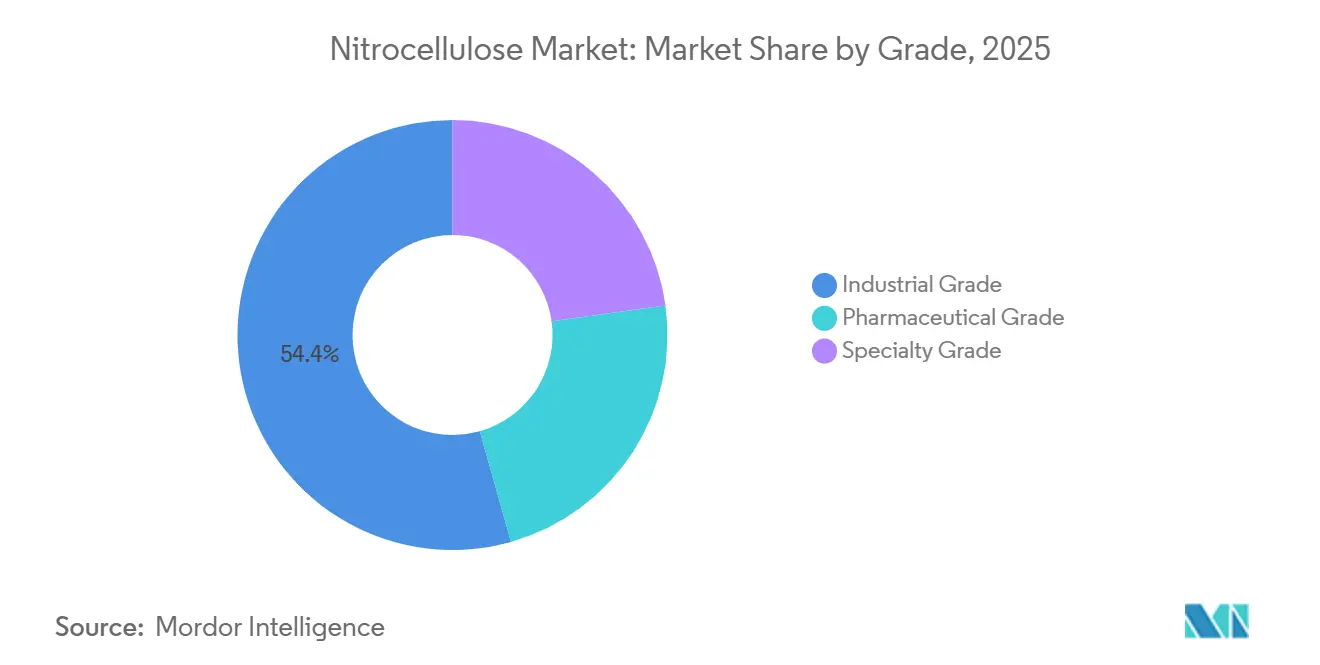
- By grade, industrial grade held 54.38% of the nitrocellulose market share in 2025, while specialty grade is forecast to grow at a 5.83% CAGR through 2031.
- By application, printing inks accounted for 31.62% of the nitrocellulose market share in 2025, while wood coatings is forecast to expand at a 5.95% CAGR through 2031.
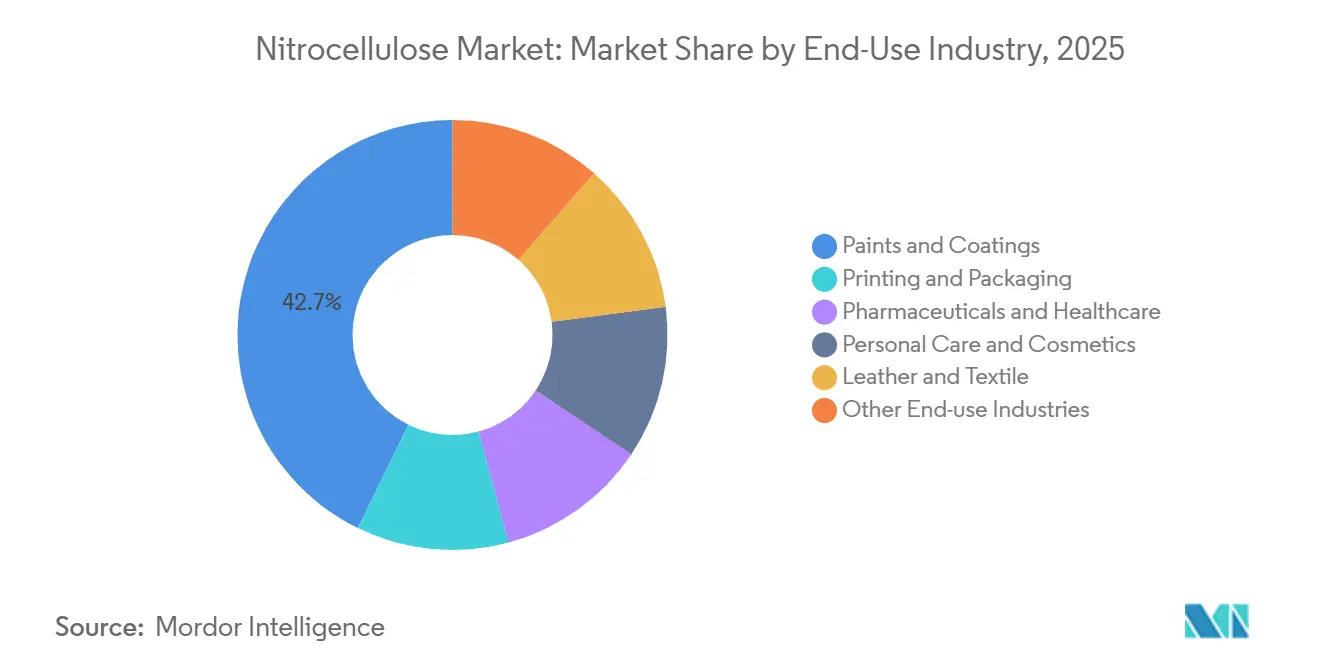
- By end-use industry, paints and coatings held 42.75% of the nitrocellulose market share in 2025, while personal care and cosmetics is forecast to grow at a 5.71% CAGR through 2031.
- By geography, Asia-Pacific held 43.81% of the nitrocellulose market share in 2025 and is forecast to grow at a 5.84% CAGR through 2031.
Note: Market size and forecast figures in this report are generated using Mordor Intelligence’s proprietary estimation framework, updated with the latest available data and insights as of January 2026.
Market Trends and Insights
Drivers Impact Analysis of Nitrocellulose Market*
| Driver | (~) % Impact on CAGR Forecast | Geographic Relevance | Impact Timeline |
|---|---|---|---|
| Growing Demand for High-Gloss and Fast-Drying Coatings Across Industrial Applications | +1.4% | Global, concentrated in Asia-Pacific and North America | Medium term (2–4 years) |
| Increasing Use of Nitrocellulose in Flexographic and Gravure Printing Inks | +1.2% | APAC core (China, India, Southeast Asia), spill-over to Europe | Medium term (2–4 years) |
| Rising Demand for Premium Wood Coatings and Furniture Finishes | +0.9% | Asia-Pacific (Vietnam, India), North America & EU | Long term (≥ 4 years) |
| Growing Preference for Fast-Curing Coating Systems to Improve Manufacturing Efficiency | +0.7% | Global, led by APAC and North America | Short term (≤ 2 years) |
| Increasing Product Innovation Toward Low-VOC and Environmentally Compliant Formulations | +0.6% | EU, North America, regulatory spill-over to APAC | Long term (≥ 4 years) |
| Source: Mordor Intelligence | |||
Growing Demand for High-Gloss and Fast-Drying Coatings Across Industrial Applications
Nitrocellulose provides fast solvent release, self-leveling film formation, and a high-gloss finish in industrial lacquer systems. Auto-refinish shops, furniture plants, and metal finishers use these properties to reduce the time between application, handling, and the next manufacturing step. Shorter drying cycles allow lines to complete more work within an existing shift without adding curing equipment or expanding floor space. Automotive refinish activity in India provides a demand base for industrial-grade material through 2031, particularly where repair work must be completed quickly. U.S. surface-coating requirements influence product specifications and have encouraged formulators to use compliant solvent blends[1]U.S. Environmental Protection Agency, “Surface Coating Operations National Emission Standards for Hazardous Air Pollutants,” EPA, epa.gov. The nitrocellulose market benefits when waterborne systems cannot deliver comparable throughput, finish quality, and practical drying speed in the same operation.
Increasing Use of Nitrocellulose in Flexographic and Gravure Printing Inks
Nitrocellulose is widely used as a film-forming binder in solvent-based gravure and flexographic inks because it supports adhesion, gloss, and rapid solvent evaporation. These characteristics are particularly useful on Biaxially Oriented Polypropylene (BOPP), Polyethylene Terephthalate (PET), and polyamide films, which are non-absorbent materials used in flexible food and consumer-goods packaging. High-speed print lines need stable film formation, and a change in binder can affect both print performance and production settings. China, India, and Southeast Asia have large packaging-film production bases, which gives regional ink demand a substantial revenue base. The nitrocellulose market also faces a different requirement in Europe, where water-based and Ultraviolet (UV)-cured alternatives are gaining use. Germany's Printing Ink Ordinance took effect in 2026 and restricts certain nitrocellulose-derived binders in food-contact inks, making separate regional formulations more necessary.
Rising Demand for Premium Wood Coatings and Furniture Finishes
Vietnam's furniture manufacturing base supports demand for high-gloss nitrocellulose lacquers on automated spray lines and large product ranges. The material can be re-dissolved and blended into a fresh coat during repair work, which helps finishers correct localized defects without stripping an entire surface. This repairability can reduce material use, labor time, and disruption on furniture production floors that handle many finishes and product designs. Premium interior finishes, cabinetry, flooring, and renovation work support continued demand for wood coatings. Renovation can remain active even when new housing construction slows, providing a broader demand base than new construction alone. The nitrocellulose market can retain a position in furniture production where fast application, repairability, and a smooth finish remain important.
Growing Preference for Fast-Curing Coating Systems to Improve Manufacturing Efficiency
Furniture and automotive refinish plants seek coatings that reduce flash-off time between coats and shorten the wait before handling. Nitrocellulose lacquers can reach handling strength within 10-20 minutes after application, which supports output capacity without new curing equipment. This advantage is especially relevant for smaller fabricators that need competitive throughput but cannot justify investment in UV-curing infrastructure. Many wood and leather finishing operations in India, Vietnam, and Indonesia, therefore, continue to use air-dry nitrocellulose systems. Product qualification also matters for exporters, because customers require reliable resistance and corrosion-protection performance from finished coated items. ISO 12944 and ISO 2812 remain relevant testing frameworks for manufacturers using coating systems.
Restraints Impact Analysis of Nitrocellulose Market*
| Restraint | (~) % Impact on CAGR Forecast | Geographic Relevance | Impact Timeline |
|---|---|---|---|
| Stringent Safety Requirements for the Handling, Storage, and Transportation of Nitrocellulose | -0.8% | Global; most acute in EU (ADR 2025), North America (DOT), and APAC ports | Short term (≤ 2 years) |
| Increasing Competition from Alternative Resins such as Acrylics and Polyurethanes | -0.6% | EU and North America core; gradual spill-over to APAC | Medium term (2–4 years) |
| High Compliance Costs Associated with Storage, Safety, and Regulatory Requirements | -0.5% | Global; disproportionate burden on small and mid-scale producers | Long term (≥ 4 years) |
| Source: Mordor Intelligence | |||
Stringent Safety Requirements for the Handling, Storage, and Transportation of Nitrocellulose
The European Agreement concerning the International Carriage of Dangerous Goods by Road (ADR) 2025 classifies nitrocellulose solution under UN 2059 as a Class 3 flammable liquid with strict transport conditions[2]United Nations Economic Commission for Europe, “ADR 2025 Agreement Concerning the International Carriage of Dangerous Goods by Road,” UNECE, unece.org. Dry solid nitrocellulose falls under UN 0340 or UN 0341 and is classified as a Class 1 explosive, requiring more demanding controls. Licensed transport, advance notification, route restrictions, and secure handling can increase delivered costs and limit viable transport distances. Large integrated producers can spread the cost of safety infrastructure across higher volumes, while smaller producers face higher compliance costs per ton. A 2024 incident at a nitrocellulose workshop in Laohekou, Hubei Province, highlighted continuing process-safety risks. The nitrocellulose market may see tighter industrial-grade availability when greater oversight adds operating requirements.
Increasing Competition from Alternative Resins such as Acrylics and Polyurethanes
Acrylic and polyurethane dispersions are gaining use in wood coatings and industrial finishes because they offer UV stability, water resistance, and a more favorable VOC profile. Polyurethane has replaced nitrocellulose in some outdoor furniture, flooring, and high-durability applications where weather resistance is a primary requirement. The competitive effect is not uniform, since nitrocellulose remains useful where rapid recoating, repairability, and cost-sensitive spraying are more important. Ink formulators are also developing nitrocellulose-free products where performance tolerances permit a change in binder technology. This places pressure on suppliers serving applications where alternatives have already reached an acceptable performance level. The nitrocellulose market must emphasize applications where substitutes do not offer the same combined balance of speed, finish, repairability, and cost.
*Our forecasts treat driver/restraint impacts as directional, not additive. The impact forecasts reflect baseline growth, mix effects, and variable interactions.
Nitrocellulose Market Segment Analysis
By Grade:
Industrial Grade Anchors Revenue While Specialty Grade Captures Margin GrowthIndustrial grade held 54.38% of revenue in 2025, supported by solvent-based coatings, printing inks, automotive refinish paints, and leather finishes. Industrial grade buyers in the nitrocellulose market seek delivered-price discipline, reliable viscosity, and consistent supply for established coating and ink lines. The nitrocellulose industry serves this demand through large-volume products that match existing production processes. Its wide application base keeps industrial grade central to revenue, but also links suppliers to changes in packaging, coating, and finishing output. Producers, therefore, need dependable industrial supply while managing shifts in regional demand and product specifications.
Specialty grade is forecast to grow at a 5.83% CAGR through 2031, led by pharmaceutical excipients and high-purity cosmetic applications. Buyers in these uses require purity certification, stable lot-to-lot viscosity, and controlled manufacturing practices. Nitrocellulose membranes support diagnostic lateral-flow assays, while selected controlled-release tablet coatings and nail lacquers require specialized grades. Pharmaceutical grade earns higher margins because sterility, purity, and regulatory requirements are demanding. Limited qualified supply can increase supply-concentration risk and encourage longer-term purchasing agreements.



By Application:
Printing Inks Leads Revenue While Wood Coatings Posts the Fastest GrowthPrinting inks accounted for 31.62% of the nitrocellulose market size in 2025, supported by gravure and flexographic printing on BOPP and PET films. The applications require adhesion, gloss, and fast solvent release on non-absorbent plastic surfaces used in flexible consumer-goods packaging. Packaging film output in China, India, and Southeast Asia provides a broad downstream demand base for these inks. Automotive paints are also important for small-scale touch-up and restoration work, where nitrocellulose can provide a cost-effective basecoat system. Food-contact rules in Europe may require some ink producers to reformulate, making regional product portfolios more complex.
Wood coatings is forecast to grow at a 5.95% CAGR through 2031, reflecting Southeast Asian furniture exports and renovation activity in North America. Furniture manufacturers value fast application on high-volume spray lines and the ability to repair surfaces without complete stripping, which supports the nitrocellulose market in demanding finishing operations. Cosmetic-grade material remains relevant where standard lacquer formulations need this combination of film performance and application speed. Other applications, including adhesives and celluloid products, represent residual demand with more limited growth prospects.
By End-Use Industry:
Paints and Coatings Dominate While Personal Care and Cosmetics Lead GrowthPaints and coatings held 42.75% of revenue in 2025, based on automotive refinish, industrial metal coating, and wood lacquer demand. High-throughput manufacturers use nitrocellulose as a film former, where rapid drying has a direct effect on line efficiency. Printing and packaging follow the demand pattern of flexible packaging and printing inks across the nitrocellulose market. Pharmaceuticals and healthcare differ from these uses because diagnostic membranes and related products require tightly controlled quality systems. Those requirements create entry barriers and reduce the scope for price-only competition among qualified suppliers.
Personal care and cosmetics is forecast to grow at a 5.71% CAGR through 2031, supported by nail-lacquer consumption in India, Brazil, and ASEAN countries. Premium beauty routines support demand for cosmetic-grade material that provides fast drying and durable film performance. Leather and textile manufacturers continue to use nitrocellulose in finishing lacquers across India, China, and Brazil, though polyurethane agents create gradual pressure. Defense and adhesives are included in other end-use industries and account for the remaining share.
Geography Analysis
APAC and LATAM Nitrocellulose Market
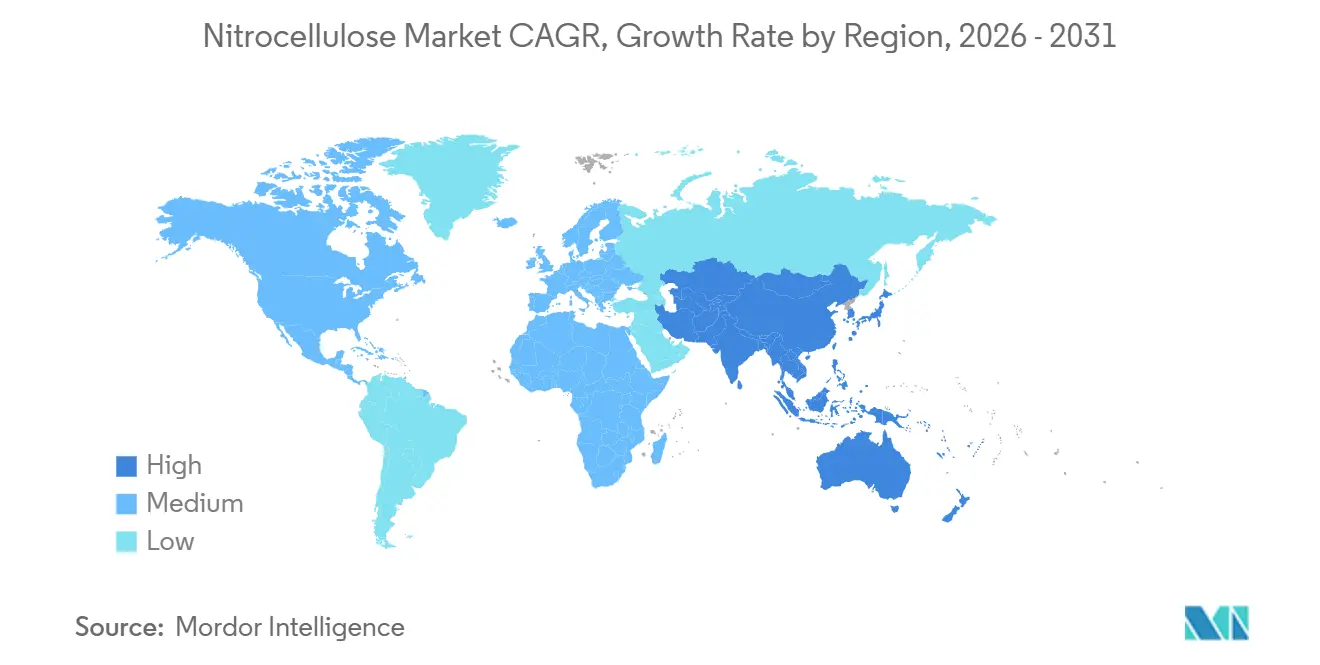
Asia-Pacific held 43.81% of revenue in 2025 and is forecast to grow at a 5.84% CAGR through 2031. China has a production base in Shandong, Jiangsu, and Zhejiang. This supply base serves domestic coatings and ink manufacturers and export customers across Southeast Asia and Latin America, reinforcing Asia-Pacific's position in the nitrocellulose market. India is an important demand center for packaging, printing, wood coatings, and leather processing, while Japan supports demand for precision coatings and high-quality furniture finishes. India has imposed anti-dumping duties on Chinese nitrocellulose imports, and Nitrex Chemicals India is expanding capacity at Jhagadia for domestic and export demand.
North America and Europe Nitrocellulose Market
North American demand is based on auto-refinish paints, cabinetry and flooring finishes, and flexible-packaging printing inks, while its residential renovation base supports cabinet-finishing lacquer demand. Europe faces tighter food-contact ink requirements while some production capacity shifts toward energetic-grade material. EU REACH requirements and Germany's Printing Ink Ordinance create reformulation and compliance work for suppliers and formulators.
South America and MEA Nitrocellulose Market
South America, and Middle-East, and Africa remain smaller but growing demand centers. The nitrocellulose market in these regions relies heavily on imports and the development of local coatings and ink manufacturing. Brazil and Mexico support South American demand through packaging, furniture production, and industrial coatings, with wood coatings providing the fastest application growth path in Latin America. Saudi Arabia and South Africa are the main Middle-East and Africa demand centers, where decorative coatings, printing inks, and leather finishes support imports. Limited local production and infrastructure constraints keep consumption per person below global averages.

Competitive Landscape
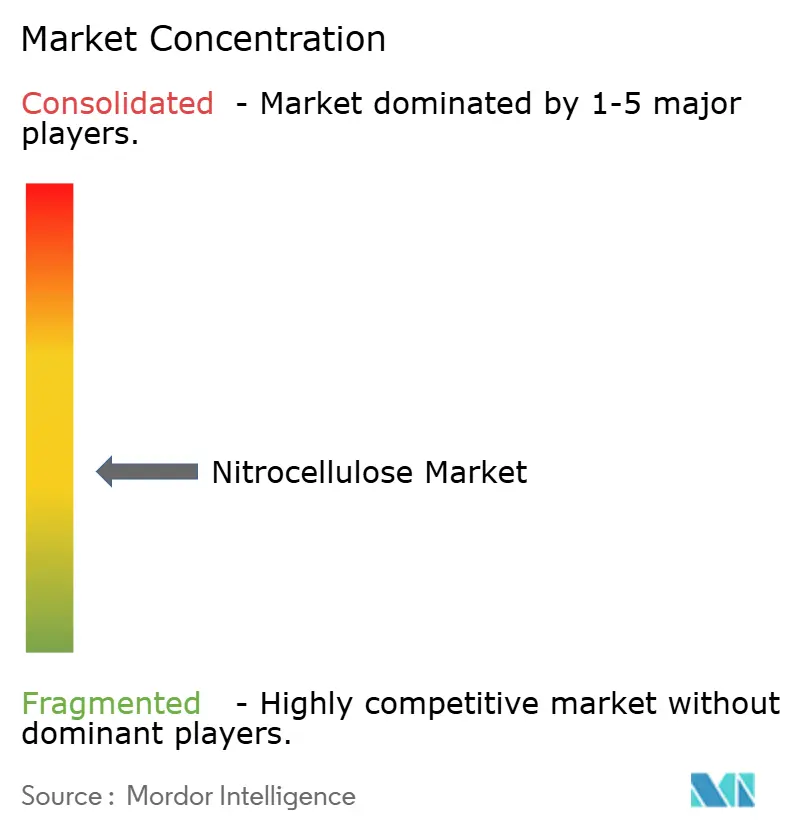
The nitrocellulose market is moderately concentrated. Safety requirements, capital needs, secure raw-material access, and established operating experience create barriers for new producers. European suppliers have traditionally served high-purity and specialty grades through established process capability. Synthesia Nitrocellulose joined Colt CZ Group's supply chain after Colt CZ acquired a 51% stake in 2025. MSM Group completed its acquisition of the Walsrode industrial park and its nitrocellulose plant in Germany in May 2025.
Asian suppliers compete strongly in industrial grades, with Chinese producers concentrated in Hubei, Shandong, and Jiangsu, and Indian suppliers including Nitrex Chemicals India and Unix Cellulose. The nitrocellulose market gives these suppliers an opportunity to support customers seeking alternatives to constrained European civilian supply. European defense demand changes the supply balance because energetic-grade projects can divert capacity from civilian applications. EURENCO secured EUR 300 million in February 2026 for European capacity expansion and announced a joint Slovakian project with ZVS Holding in March 2026. Rheinmetall also held a July 2026 foundation-laying ceremony for its Nitrochemie Aschau expansion.
Competitive differentiation in the nitrocellulose market increasingly depends on safety performance, sustainability credentials, certification, and the ability to serve several grades. ISO 16128 provides a reference point for natural and organic cosmetic ingredient claims relevant to premium cosmetic applications. Water-dispersible grades could help suppliers meet lower-solvent requirements while retaining use in wood coatings and printing inks. TNC Chemicals Philippines and T.N.C. Industrial serves Southeast Asian and Korean ink customers, while Taiwan's June 2024 export restrictions increased attention to supply diversification.
Nitrocellulose Industry Leaders
Nitrochemie
Nitrex Chemicals India Ltd
Nitrocellulose Group
Synthesia Nitrocellulose, a.s.
T.N.C. Industrial Co., Ltd.
- *Disclaimer: Major Players sorted in no particular order
Nitrocellulose Market Companies Covered in this Report
- ARDIN CHEMICAL COMPANY
- Eurenco
- GRN Cellulose Pvt. Ltd.
- Hubei Xuefei Chemical Co., Ltd
- IVM Chemicals srl
- MSM Walsrode GmbH and Co. KG
- Nitrex Chemicals India Ltd
- Nitrocellulose Group
- Nitrochemie
- Synthesia Nitrocellulose, a.s.
- T.N.C. Industrial Co., Ltd.
- TNC Chemicals Philippines Inc.
- Unix Cellulose

Recent Industry Developments in Nitrocellulose Market
- January 2026: Colt CZ Group SE completed the acquisition of a 51% stake in Synthesia Nitrocellulose, a.s. and Synthesia Power, a.s., strengthening its ammunition supply chain integration. At the time of the deal, operations were running at a capacity of 6,000 metric tons, with an expansion underway to 7,000 metric tons.
- April 2025: Rheinmetall AG acquired nitrocellulose producer Hagedorn-NC GmbH to address a significant shortage of raw materials. Hagedorn-NC GmbH had been producing industrial nitrocellulose for civilian applications in Lingen an der Ems.


Global Nitrocellulose Market Report Scope
Nitrocellulose is a highly flammable and energetic polymer produced by treating cellulose with a mixture of nitric and sulfuric acids. It dissolves readily in organic solvents such as acetone and ethyl acetate, forming a fast-drying, clear film upon evaporation.
The Nitrocellulose Market is segmented by grade, application, end-use industry, and geography. By grade, the market is segmented into industrial grade, pharmaceutical grade, and specialty grade. By application, the market is segmented into printing inks, automotive paints, wood coatings, leather finishes, nail varnishes, and other applications. By end-use industry, the market is segmented into paints and coatings, printing and packaging, pharmaceuticals and healthcare, personal care and cosmetics, leather and textile, and other end-use industries. The report also covers the market size and forecasts for nitrocellulose in 16 countries across major regions. For each segment, the market sizing and forecasts have been done on the basis of value (USD).
| Industrial Grade |
| Pharmaceutical Grade |
| Specialty Grade |
| Printing Inks |
| Automotive Paints |
| Wood Coatings |
| Leather Finishes |
| Nail Varnishes |
| Other Applications |
| Paints and Coatings |
| Printing and Packaging |
| Pharmaceuticals and Healthcare |
| Personal Care and Cosmetics |
| Leather and Textile |
| Other End-use Industries |
| Asia-Pacific | China |
| India | |
| Japan | |
| South Korea | |
| Rest of Asia-Pacific | |
| North America | United States |
| Canada | |
| Mexico | |
| Europe | Germany |
| United Kingdom | |
| France | |
| Italy | |
| Russia | |
| Rest of Europe | |
| South America | Brazil |
| Argentina | |
| Rest of South America | |
| Middle-East and Africa | Saudi Arabia |
| South Africa | |
| Rest of Middle-East and Africa |
| By Grade | Industrial Grade | |
| Pharmaceutical Grade | ||
| Specialty Grade | ||
| By Application | Printing Inks | |
| Automotive Paints | ||
| Wood Coatings | ||
| Leather Finishes | ||
| Nail Varnishes | ||
| Other Applications | ||
| By End-Use Industry | Paints and Coatings | |
| Printing and Packaging | ||
| Pharmaceuticals and Healthcare | ||
| Personal Care and Cosmetics | ||
| Leather and Textile | ||
| Other End-use Industries | ||
| By Geography | Asia-Pacific | China |
| India | ||
| Japan | ||
| South Korea | ||
| Rest of Asia-Pacific | ||
| North America | United States | |
| Canada | ||
| Mexico | ||
| Europe | Germany | |
| United Kingdom | ||
| France | ||
| Italy | ||
| Russia | ||
| Rest of Europe | ||
| South America | Brazil | |
| Argentina | ||
| Rest of South America | ||
| Middle-East and Africa | Saudi Arabia | |
| South Africa | ||
| Rest of Middle-East and Africa | ||


Key Questions Answered in the Report
What is the size of the nitrocellulose market?
The nitrocellulose market stands at USD 1.02 billion in 2026 and is projected to reach USD 1.31 billion by 2031, at a 5.13% CAGR.
Which region leads nitrocellulose demand?
Asia-Pacific held 43.81% of revenue in 2025 and is forecast to grow at a 5.84% CAGR through 2031.
Which grade led the market revenue share in 2025?
Industrial grade led with 54.38% of revenue share in 2025 because of its use in coatings, inks, automotive refinishing, and leather finishes.
What application is expected to grow fastest through 2031?
Wood coatings is forecast to grow at a 5.95% CAGR through 2031, supported by furniture production and renovation activity.
Page last updated on:





