
Netherlands Hydroponics Market Size and Share
Market Overview
| Study Period | 2021 - 2031 |
|---|---|
| Forecast Data Period | 2026 - 2031 |
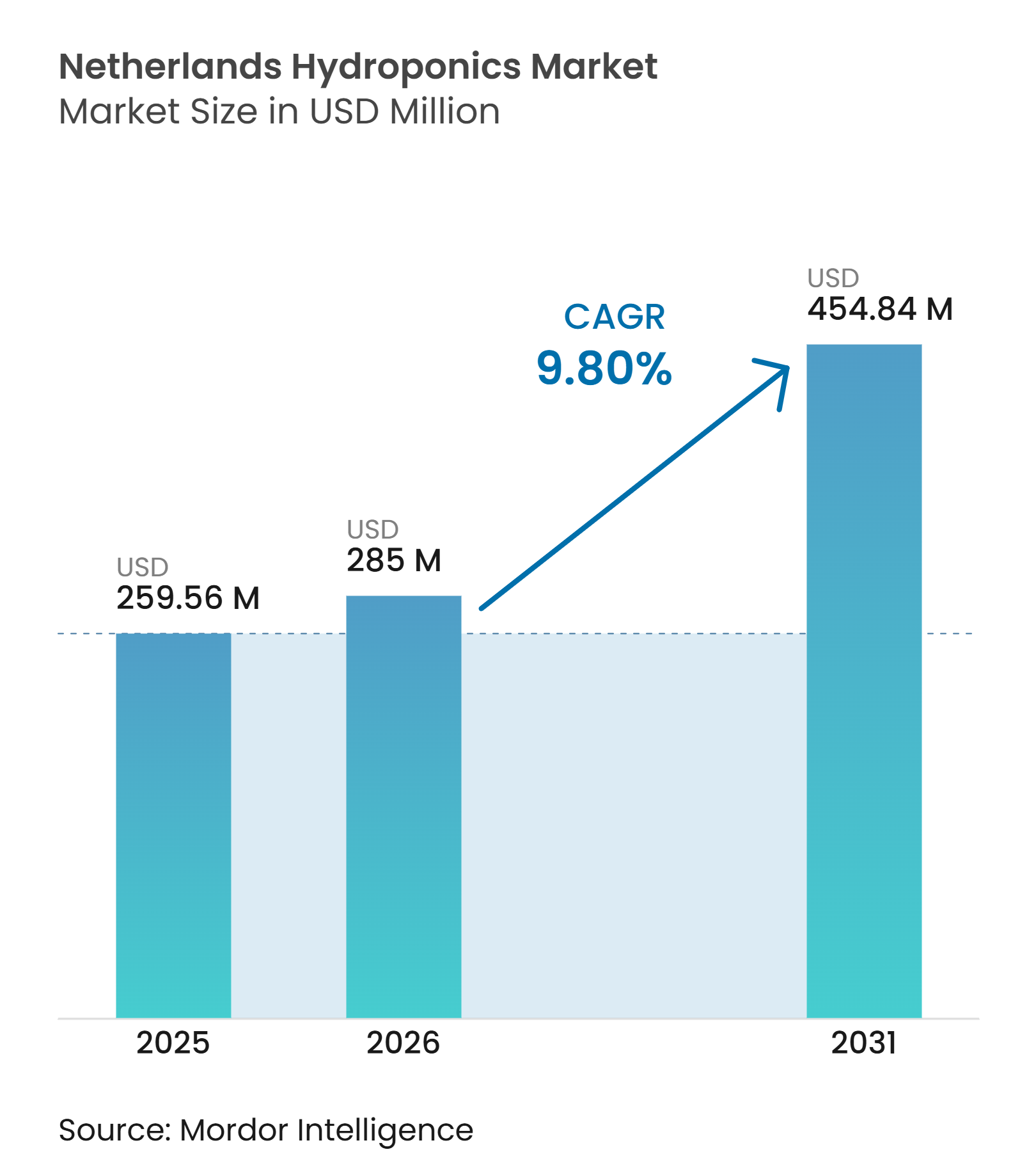
| Base Year Market Size (2025) | USD 259.56 Million |
| Market Size (2026) | USD 285 Million |
| Market Size (2031) | USD 454.84 Million |
| Growth Rate (2026 - 2031) | 9.80 % |
| Market Concentration | Medium |
Major Players *Disclaimer: Major Players sorted in no particular order Image © Mordor Intelligence. Reuse requires attribution under CC BY 4.0. | |
Netherlands Hydroponics Market Analysis by Mordor Intelligence
The Netherlands hydroponics market was valued at USD 259.56 million in 2025 and is projected to grow from USD 285 million in 2026 to USD 454.84 million by 2031, at a CAGR of 9.80% during the forecast period (2026 to 2031). The Netherlands' hydroponics market accounted for 4.19% of global hydroponics revenue, reflecting the country’s role in controlled-environment agriculture and related technologies. National food-security priorities support investment in systems that provide year-round output and efficient water use[1]. The Energietransitie Glastuinbouw 2022-2030 Covenant and related SDE++ support strengthen the case for energy-efficient greenhouse projects, while the 2025 SDE++ round made USD 8.7 billion (EUR 8 billion) available. Energy taxes, nutrient-discharge rules, and access to suitable crop genetics will shape the pace at which operators replace older systems. Technology suppliers can benefit from combining climate control, lighting, irrigation, energy management, and operational data in practical installations.
Key Report Takeaways
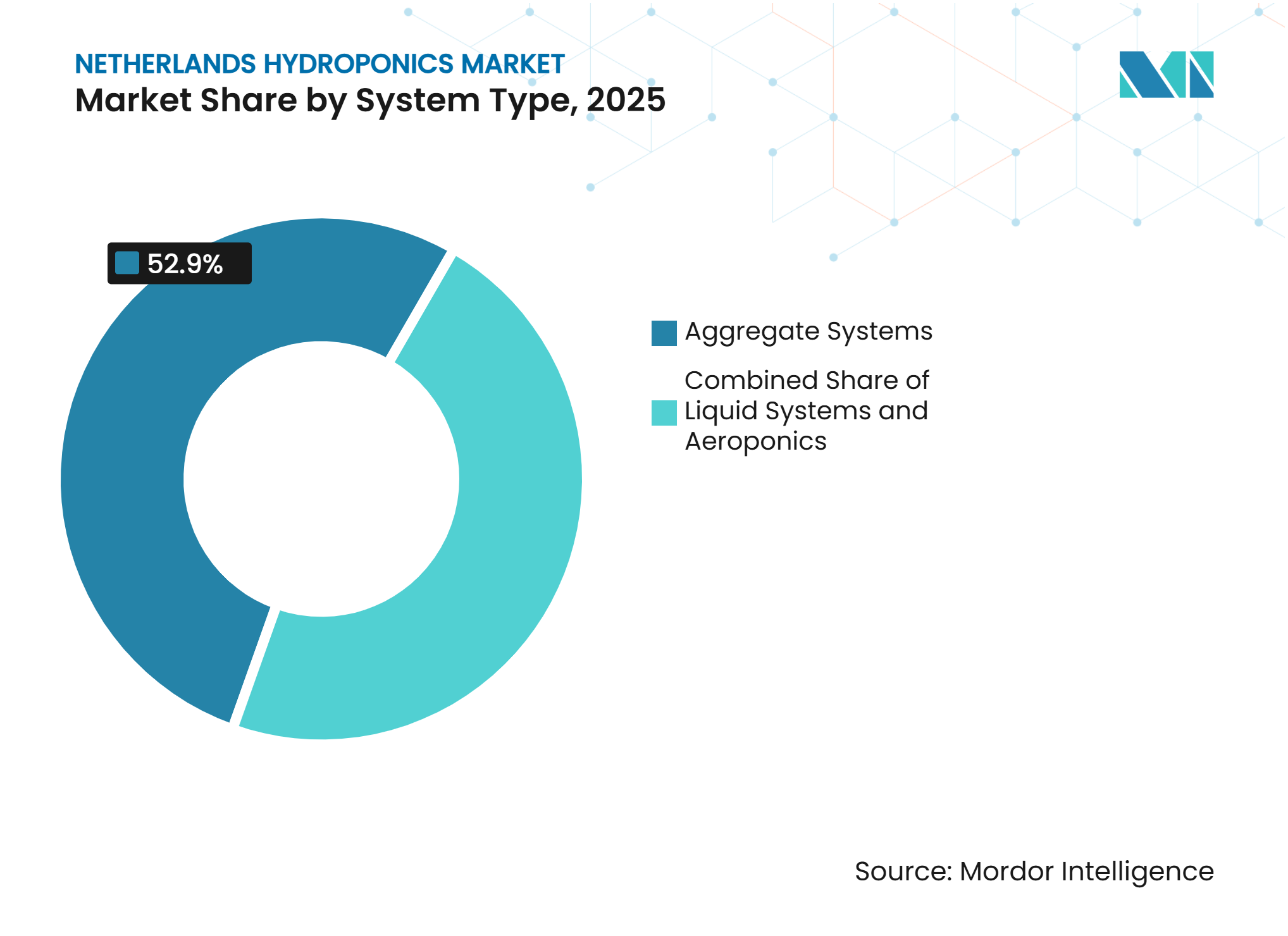
- By system type, aggregate systems accounted for the largest 52.9% of the Netherlands hydroponics market share in 2025, while aeroponics is projected to grow fastest at a 12.6% CAGR through 2026 to 2031.
- By farming type, commercial greenhouses accounted for the largest 64.6% of the Netherlands hydroponics market share in 2025, while vertical farms are projected to grow fastest at an 11.8% CAGR through 2026 to 2031.
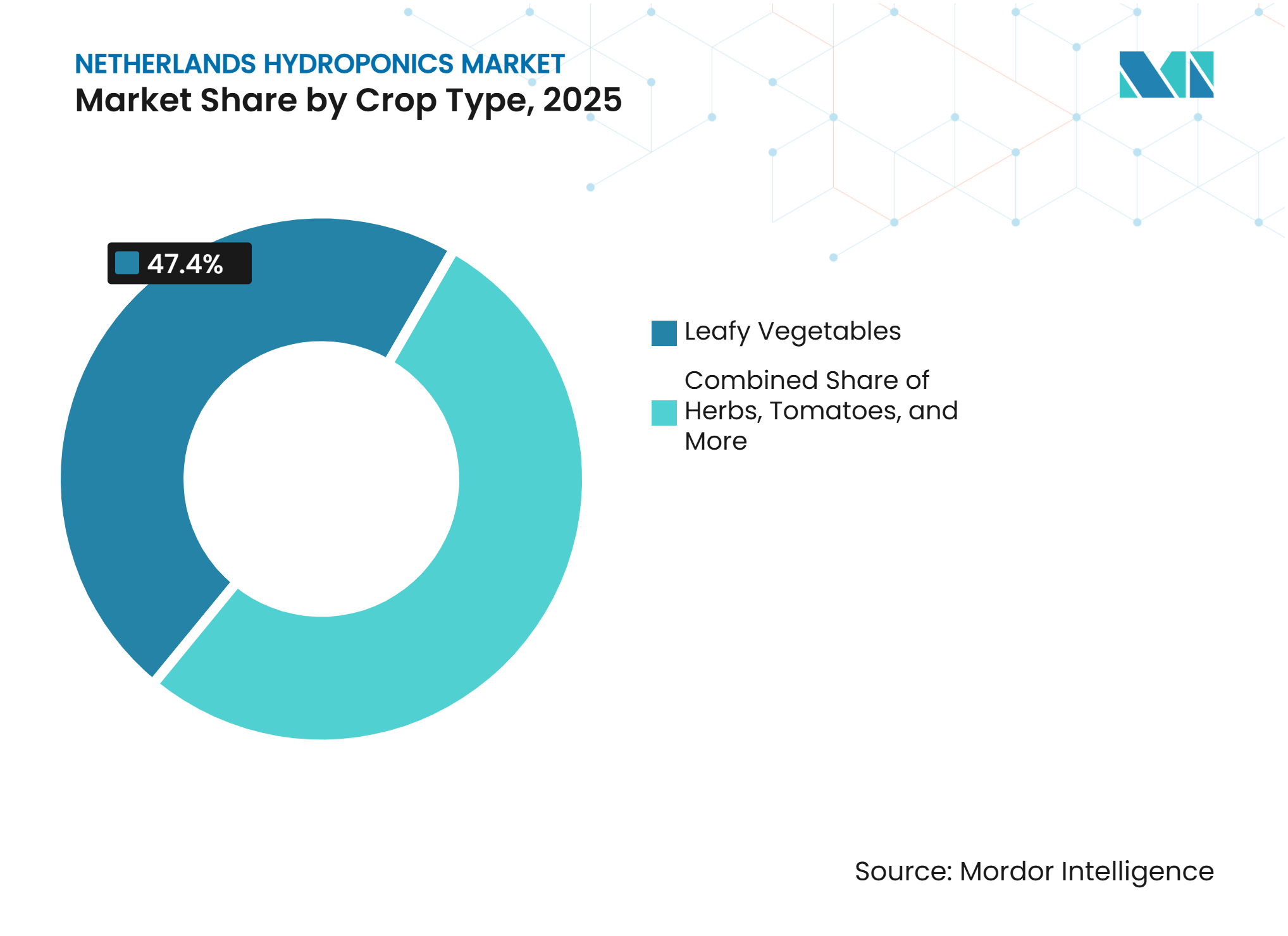
- By crop type, leafy vegetables accounted for the largest 47.4% of revenue in 2025, while strawberries are projected to grow fastest at a 12.8% CAGR through 2026 to 2031.
Note: Market size and forecast figures in this report are generated using Mordor Intelligence’s proprietary estimation framework, updated with the latest available data and insights as of January 2026.
Market Trends and Insights
Drivers Impact Analysis of Netherlands Hydroponics Market*
| Driver | (~) % Impact on CAGR Forecast | Geographic Relevance | Impact Timeline |
|---|---|---|---|
| Controlled-environment food security | +1.5% | National, with policy infrastructure concentrated in Greenport clusters | Long term (≥ 4 years) |
| Year-round local produce demand | +2.0% | National, with strongest demand around Amsterdam and Rotterdam | Short term (≤ 2 years) |
| Greenhouse productivity per square meter | +2.0% | South Holland, Limburg, and North Brabant greenhouse clusters | Medium term (2-4 years) |
| Recirculating water and nutrient efficiency | +1.5% | National, with compliance obligations across greenhouse regions | Medium term (2-4 years) |
| Circular phosphorus and fertilizer innovation | +0.8% | National, including Wageningen University and Research-linked trial sites | Long term (≥ 4 years) |
| Retail scaling of vertical-farm produce | +1.0% | National urban distribution corridors, with early activity in Amsterdam | Short term (≤ 2 years) |
| Source: Mordor Intelligence | |||
Controlled-Environment Food Security
The Ministry of Agriculture, Fisheries, Food Security, and Nature recognizes controlled-environment agriculture as important for food resilience and export capability. In June 2025, the Netherlands and Saudi Arabia signed a five-year memorandum during GreenTech Amsterdam covering agricultural cooperation and greenhouse technology[2]. The agreement supported the international deployment of Dutch greenhouse expertise and reinforced the domestic importance of the systems that underpin hydroponic production. The SDE++ 2025 program received applications exceeding the available funding budget, indicating strong demand for supported energy projects. Continued support for heat pumps and geothermal systems strengthens the investment case for hydroponic upgrades by reducing exposure to energy costs. This policy environment provides the Netherlands hydroponics market with a more stable foundation for equipment replacement and new project development.
Year-Round Local Produce Demand
Retailers increasingly value domestic, traceable hydroponic produce because it supports a consistent year-round supply. This demand reduces reliance on seasonal production and makes delivery planning more predictable for growers. Supply agreements with supermarkets, foodservice operators, restaurant groups, and food banks can create multiple sales channels for locally produced controlled-environment crops. Stable purchasing commitments can strengthen the financial case for expanding existing facilities. Demand is also shifting beyond sustainability-focused purchasing toward reliable availability and consistent retail-quality produce. For the Netherlands hydroponics market, this creates a stronger incentive to expand capacity near major population centers and distribution networks.
Greenhouse Productivity per Square Meter
Dutch controlled-environment growers produce 50 kilograms of tomatoes per square meter annually, demonstrating the output potential of intensive greenhouse systems[3]. This level of productivity helps operators justify investments in lighting, climate-control systems, water treatment, and regulatory compliance. In June 2025, Signify introduced its 4-channel Philips GreenPower LED toplighting force (TLF) system, enabling growers to independently adjust red, blue, white, and far-red light and develop crop-specific lighting strategies for different growth stages through the Philips GrowWise control system. The system supports more precise electricity use while maintaining crop-focused lighting programs. Signify and Grodan also began a low-energy tomato trial that tested full LED cultivation with 50% lower heat input than conventional requirements. Improved lighting efficiency can further strengthen the productivity advantage available to Dutch hydroponic growers within a fixed production footprint.
Retail Scaling of Vertical-Farm Produce
Vertical farms are attracting increasing attention as operators seek predictable crop production closer to consumers. Standardized operating platforms can help manage crop conditions, energy consumption, and labor requirements across multiple facilities. Retail distribution at conventional produce price points remains important because it demonstrates whether a facility can consistently supply mainstream grocery channels. The Netherlands hydroponics market can benefit when operators establish repeatable production models that align with supermarket procurement and delivery schedules. Expansion from an initial facility to additional sites depends on reliable demand, controlled operating costs, and consistent crop quality. These factors place greater emphasis on operational efficiency and scalability than on rapid capacity expansion.
Restraints Impact Analysis of Netherlands Hydroponics Market*
| Restraint | (~) % Impact on CAGR Forecast | Geographic Relevance | Impact Timeline |
|---|---|---|---|
| High capital requirements for controlled environments | -1.5% | National, with the strongest effect on new entrants | Long term (≥ 4 years) |
| Electricity and heating-cost exposure | -2.0% | National, with higher exposure in legacy gas-heated clusters | Medium term (2-4 years) |
| Nutrient-discharge and fertigation compliance | -1.0% | National, covering recirculating system operators | Medium term (2-4 years) |
| Limited crop-specific genetics and protocols | -0.5% | National, particularly specialty fruit diversification in North Brabant and Limburg | Long term (≥ 4 years) |
| Source: Mordor Intelligence | |||
High Capital Requirements for Controlled Environments
A commercial hydroponic greenhouse requires structural works, lighting, fertigation systems, climate controls, water treatment, and logistics infrastructure. This combination places initial project costs in the multimillion-euro range before production begins. PlantLab closed its Den Bosch research and development facility in 2025 after (EUR 120 million) USD 130.5 million in cumulative investment, highlighting the financial pressures that can affect even well-capitalized hydroponic projects. SDE++ support can help fund energy-related systems, but it does not cover all structural, lighting, and automation investments. As a result, new entrants face extended payback periods that remain sensitive to energy costs and produce pricing. This cost structure limits market entry and supports the adoption of phased or modular deployment models within the Netherlands hydroponics market.
Limited Crop-Specific Genetics and Protocols
Many commercial strawberry varieties are not specifically optimized for controlled-environment production, which limits yield predictability and makes it more difficult to standardize cultivation protocols for specialty fruit crops. Similar challenges affect peppers, herbs, and other crops where conventional genetics may not perform optimally under indoor or greenhouse conditions. Available land and logistics infrastructure can support diversification in regions such as North Brabant and Limburg, but do not address the underlying genetic limitations. Ongoing breeding, research, and propagation efforts can gradually improve the suitability of crop varieties for protected cultivation systems. Until these production protocols become more established, diversification within the Netherlands hydroponics market is likely to proceed more cautiously than expansion in mature leafy-vegetable segments.
*Our forecasts treat driver/restraint impacts as directional, not additive. The impact forecasts reflect baseline growth, mix effects, and variable interactions.
Netherlands Hydroponics Market Segment Analysis
By System Type:
Aeroponic Momentum Challenges Substrate DominanceAggregate systems accounted for 52.9% of revenue in 2025. Rockwool and perlite remain common across established tomato, cucumber, and pepper sites in South Holland and Limburg. These systems benefit from long-standing cultivation protocols and supply networks that reduce operational uncertainty. Growers also have extensive experience with substrate-based production, which makes rapid replacement less likely. Liquid systems are a close alternative to leafy vegetables and herbs. Nutrient film technique and deep-water culture can support fast crop cycles and precise nutrient management.
Aeroponics is forecast to grow at a 12.6% CAGR during 2026-2031. Its root-zone design can reduce water use and lower nutrient effluent generation. This is relevant as growers prepare for tighter discharge requirements. The European Union (EU) Fertilizing Products Regulation governs nutrient inputs used in aggregate, liquid, and aeroponic systems. Fieldlab Vertical Farming provides an environment for testing vertical-farming system designs before commercialization. Early adoption can simplify monitoring and water-treatment requirements because aeroponic systems do not generate substrate runoff.



By Farming Type:
Commercial Greenhouse Base Secures Market While Vertical Farms AccelerateCommercial greenhouses accounted for 64.6% of the Netherlands hydroponics market revenue in 2025. Their position rests on established glass infrastructure in Westland, Lansingerland, and Oostland. Existing operators often focus on LED lighting, climate computers, and recirculating fertigation rather than replacing greenhouse structures. These upgrades can extend the productive life of installed assets. Indoor farms sit between conventional greenhouses and vertical farms because they often use converted industrial buildings with supplemental lighting. Container farms remain a smaller format for urban-edge sites and operators seeking modular deployment.
Vertical farms are forecast to expand at an 11.8% CAGR during 2026-2031. Their growth depends on retail viability and technology that can be used across several facilities. Operators must consistently manage crop output, electricity use, and labor to achieve viable unit economics. Standardized operating platforms can reduce the operational complexity of multi-site expansion. A shift toward retail-scale production can shorten the time between a successful demonstration and later capacity decisions. The Netherlands hydroponics industry has room for vertical formats that prove dependable supply without relying on premium positioning.
By Crop Type:
Leafy Vegetable Base Deepens While Strawberries Signal High-Value ShiftLeafy vegetables accounted for 47.4% of the Netherlands' hydroponics market in 2025. Domestic lettuce, spinach, and mixed salad blends benefit from consistent demand from retailers. Mature protocols and rapid crop cycles support reliable production planning. Locally branded products also fit a retail structure that values traceability and supply continuity. Herbs remain an important crop category because protected systems can limit pesticide-management challenges. Tomatoes and cucumbers continue to support aggregate-system demand in the main greenhouse clusters.
Strawberries are forecast to grow at a 12.8% CAGR during 2026-2031. Their higher value proposition encourages growers to move beyond commodity leafy vegetables. However, suitable genetics and proven growing protocols remain limited. A controlled-environment propagation approach for hybrid strawberries is under development, reflecting the need for uniform plants and predictable output. North Brabant and Limburg can support trials by combining land availability with horticultural logistics. Wider adoption will depend on growers obtaining reliable evidence across varieties and protected production formats.

Geography Analysis
South Holland remains the center of the Netherlands hydroponics market due to its concentration of large-scale greenhouse operations in areas such as Westland, Lansingerland, and Oostland. The region has a well-developed controlled-environment agriculture ecosystem supported by advanced lighting, fertigation, climate control, and logistics infrastructure. Investment activity is increasingly focused on greenhouse modernization, including LED lighting upgrades, recirculating water systems, and climate-management technologies. Large-scale installations, such as the deployment of Philips LED lighting across multiple greenhouse sites in Westland and Bleiswijk in 2025, highlight the continued importance of efficiency improvements within this established production cluster.
Limburg, North Brabant, and Gelderland are emerging as key regions for hydroponic cultivation expansion due to their land availability, greenhouse infrastructure, and access to domestic and export markets. The Venlo horticultural cluster in Limburg provides strong connectivity to distribution networks in Germany and Belgium, supporting commercial greenhouse development. North Brabant benefits from infrastructure well-suited to vertical farming projects and specialty crop production, while Gelderland continues to attract investment in controlled-environment agriculture and greenhouse innovation. These regions offer opportunities for new facility development where expansion may be more practical than within the mature coastal greenhouse cluster.
North Holland and other regions across the Netherlands are supporting hydroponic cultivation through smaller-scale, decentralized production models. These areas are well-suited to modular greenhouse systems, container farms, and localized controlled-environment agriculture projects that can serve nearby population centers. While they do not possess the greenhouse density of South Holland, their proximity to consumers and regional distribution networks supports the development of flexible production formats. This geographic diversification is gradually broadening the footprint of the Netherlands hydroponics market beyond its traditional greenhouse centers.
Competitive Landscape
Market Concentration
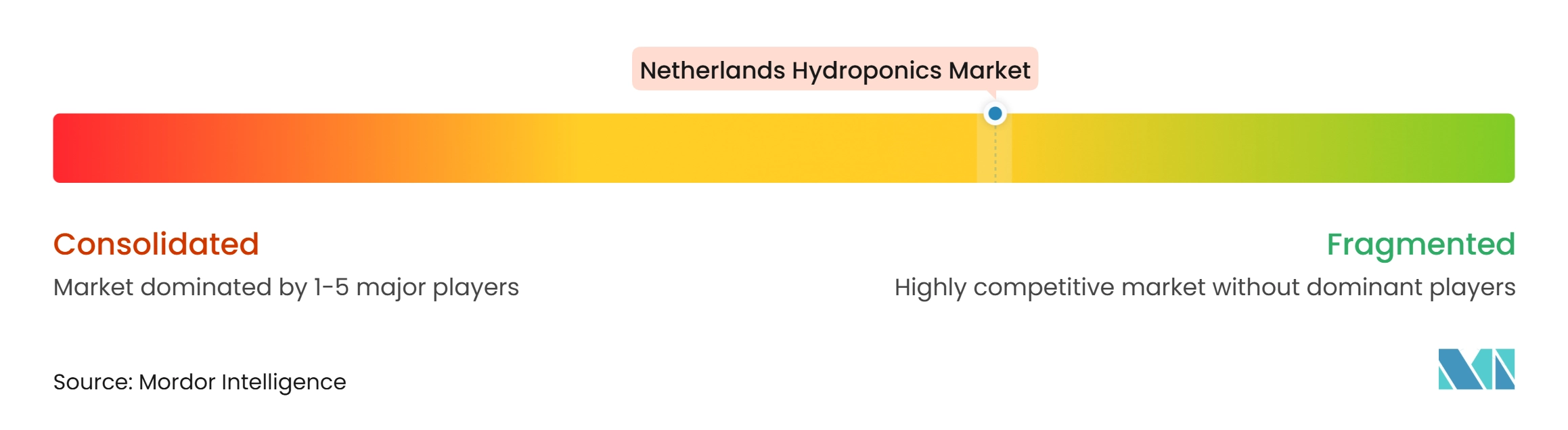
The Netherlands hydroponics market remains fragmented in 2025, with competition spread across greenhouse developers, automation specialists, cultivation system providers, lighting companies, and climate-control solution providers. Key participants include Priva Holding B.V., Certhon Group, KUBO Greenhouse Projects B.V., Signify N.V., and Hoogendoorn Growth Management B.V. Competition is driven by the ability to deliver integrated solutions covering climate control, lighting, fertigation, automation, cultivation systems, and greenhouse engineering. Market participants differentiate themselves through project execution capabilities, energy-efficiency solutions, and operational support services.
Technology integration is becoming an increasingly important competitive factor across the Netherlands hydroponics market. Companies are expanding beyond individual products and offering integrated platforms that connect climate management, irrigation, energy optimization, crop monitoring, labor management, and production planning. Greenhouse developers are also incorporating advanced automation, renewable energy integration, and resource-efficiency solutions into new projects to improve productivity and strengthen the long-term economics of hydroponic operations.
Data-driven cultivation, resource optimization, and circular production practices continue to create opportunities for market differentiation. Suppliers that can demonstrate reliable operational performance, scalability, and measurable economic benefits are better positioned to support greenhouse expansion and modernization projects. The fragmented structure of the market provides growers with multiple supplier options, encourages continuous innovation, and limits any single company's ability to exert significant influence over the sector.
Netherlands Hydroponics Industry Leaders
-
KUBO Greenhouse Projects B.V.
-
Certhon Group
-
Signify N.V.
-
Hoogendoorn Growth Management B.V.
-
Priva Holding B.V.
- *Disclaimer: Major Players sorted in no particular order
Netherlands Hydroponics Market Companies Covered in this Report
- Priva Holding B.V.
- Hoogendoorn Growth Management B.V.
- Ridder Group
- Bosman Van Zaal B.V.
- KUBO Greenhouse Projects B.V.
- Certhon Group
- LOGIQS B.V.
- Metazet B.V.
- Dalsem B.V.
- Gakon Netafim
- Artechno Growsystems B.V.
- Van der Hoeven Horticulture Projects B.V.
- Signify N.V.
- Grodan B.V.
- Urban Agrotech B.V.
Recent Industry Developments in Netherlands Hydroponics Market
- June 2026: Priva Holding B.V. showcased Priva One at GreenTech Amsterdam 2026, extending its integrated greenhouse management platform to vertical and indoor farms, strengthening automation and data-driven hydroponic operations.
- June 2026: Dalsem began developing a 2.5-hectare greenhouse for cucumbers for Kas. Ko in Den Hoorn, reflecting continued investment in Dutch hydroponic greenhouse capacity despite cost and energy pressures.
- May 2026: Infinite Acres commercially launched the GroLoop CEA operating system at GreenTech Amsterdam 2026, providing hydroponic and vertical farms with integrated operational, crop, and performance management capabilities.
Netherlands Hydroponics Market Report Scope
Hydroponics is a soilless cultivation method that grows plants using nutrient-rich water solutions, often supported by inert growing media. It enables efficient use of water and nutrients, supports year-round production, increases crop yields, and is widely used to cultivate vegetables, herbs, and fruits in controlled environments.
The Netherlands hydroponics market report is segmented by system type (aggregate systems, liquid systems, and drip systems), by farming type (commercial greenhouses, vertical farms, indoor farms, and container farms), and by crop type (leafy vegetables, herbs, tomatoes, cucumbers, strawberries, and other crop types). The market forecasts are provided in terms of value (USD).
Segmentation Overview
| Aggregate Systems |
| Liquid Systems |
| Aeroponics |
| Commercial Greenhouses |
| Vertical Farms |
| Indoor Farms |
| Container Farms |
| Leafy Vegetables |
| Herbs |
| Tomatoes |
| Cucumbers |
| Strawberries |
| Other Crop Types |
| By System Type | Aggregate Systems |
| Liquid Systems | |
| Aeroponics | |
| By Farming Type | Commercial Greenhouses |
| Vertical Farms | |
| Indoor Farms | |
| Container Farms | |
| By Crop Type | Leafy Vegetables |
| Herbs | |
| Tomatoes | |
| Cucumbers | |
| Strawberries | |
| Other Crop Types |
Key Questions Answered in the Report
What is the forecast for the Netherlands hydroponics market?
The Netherlands hydroponics market is projected to grow from USD 285 million in 2026 to USD 454.84 million by 2031, at a CAGR of 9.80% during the forecast period (2026 to 2031).
Which hydroponic system is growing fastest in the Netherlands?
Aeroponics is forecast to grow at a 12.6% CAGR through 2031, supported by its efficient water use and low effluent profile.
Which farming format holds the largest revenue share?
Commercial greenhouses held 64.6% of revenue in 2025, supported by the established glasshouse base in South Holland.
Which crop is expanding fastest in Dutch hydroponics?
Strawberries are forecast to grow at a 12.8% CAGR through 2031, although crop genetics and cultivation protocols remain constraints.