
Near Infrared Absorbing Materials Market Size and Share
Market Overview
| Study Period | 2022 - 2032 |
|---|---|
| Market Size (2027) | USD 408.84 Million |
| Market Size (2032) | USD 596.29 Million |
| Growth Rate (2027 - 2032) | 7.84 % |
| Fastest Growing Market | Asia-Pacific |
| Largest Market | North America |
| Market Concentration | Medium |
Major Players *Disclaimer: Major Players sorted in no particular order Image © Mordor Intelligence. Reuse requires attribution under CC BY 4.0. | |
Near Infrared Absorbing Materials Market Analysis by Mordor Intelligence
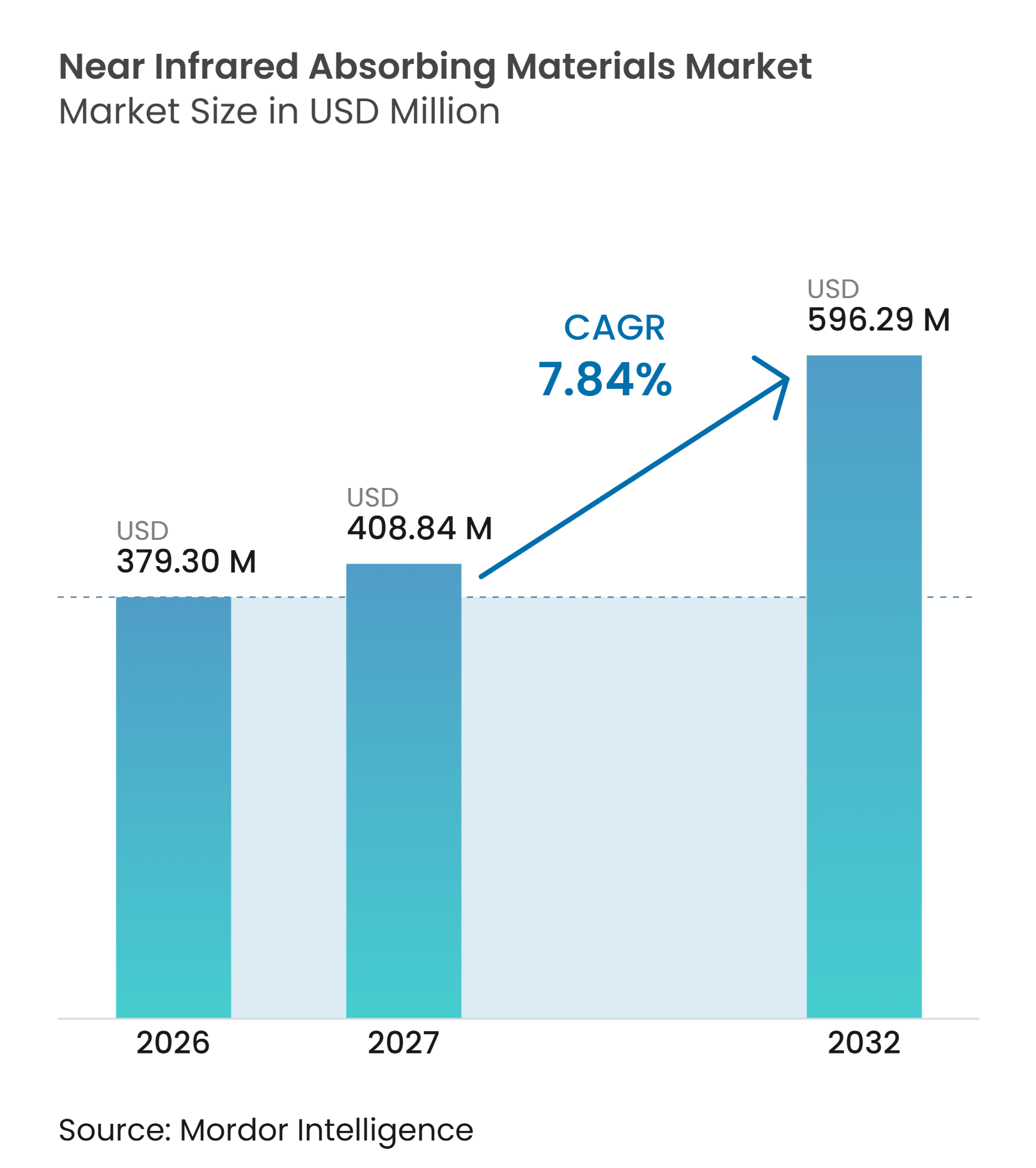
The Near Infrared Absorbing Materials Market size was valued at USD 379.30 million in 2026 and is estimated to grow from USD 408.84 million in 2027 to reach USD 596.29 million by 2032, at a CAGR of 7.84% during the forecast period (2027-2032). Demand is expanding as building owners, vehicle makers, and electronics suppliers seek materials that manage heat or control near infrared light without compromising visible-light performance. The near infrared absorbing materials market also benefits from the growing use of optical filters, imaging modules, LiDAR systems, and semiconductor packaging materials. Inorganic grades are gaining attention where heat resistance, weather stability, and optical durability matter, while organic dyes remain important for tunable absorption and processing flexibility. China’s 2025 export controls on tungsten and indium-related items have increased attention to lower-loading formulations and supply resilience.
Key Report Takeaways
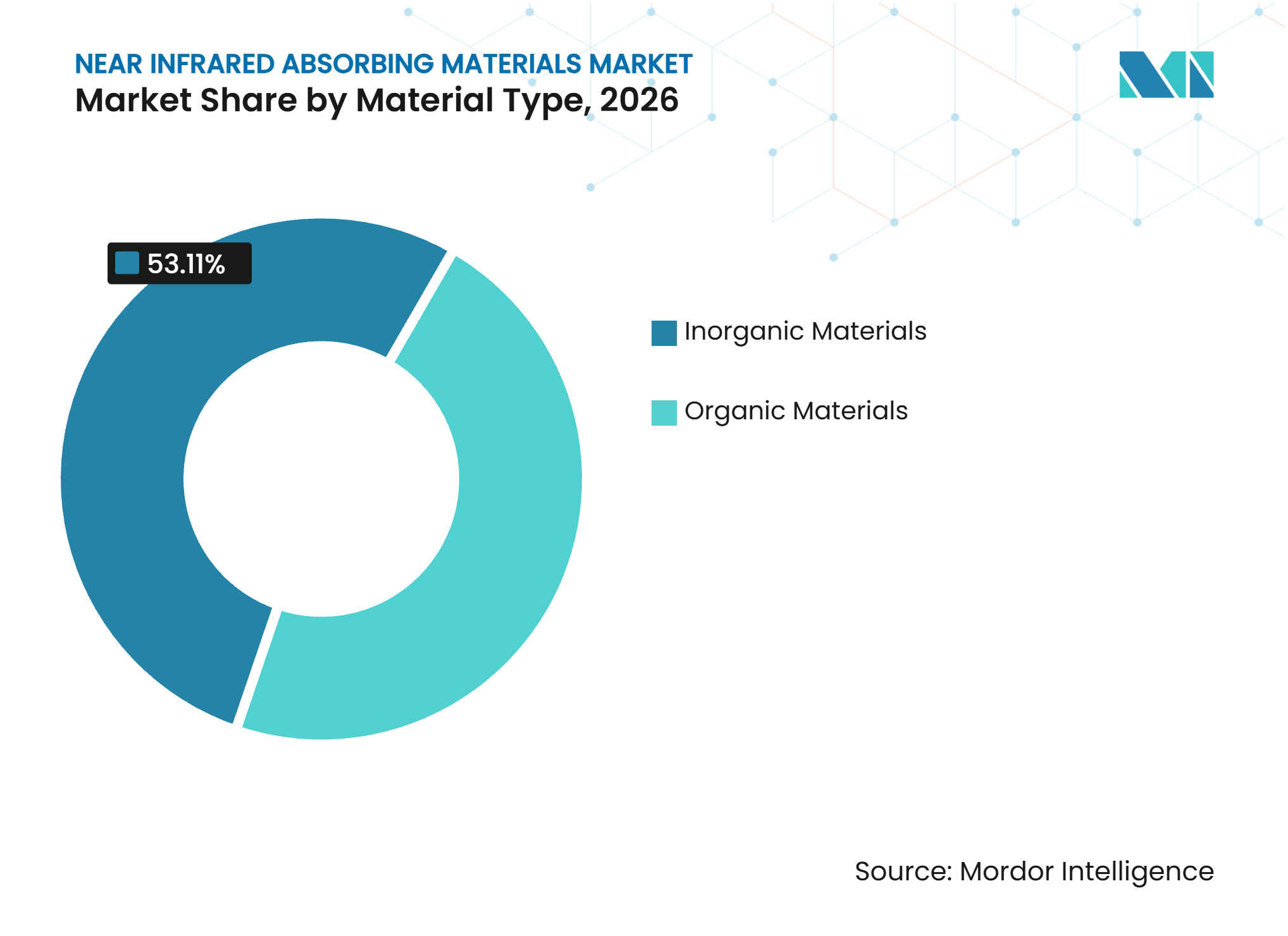
- By material type, organic materials held 46.89% of the near infrared absorbing materials market share in 2026, while inorganic materials are forecast to advance at an 8.12% CAGR through 2032.
- By function, absorption held 33.45% of the near infrared absorbing materials market share in 2026, while high transparency is forecast to advance at an 8.47% CAGR through 2032.
- By absorption range, 700–1,000 nm held 29.94% of the near infrared absorbing materials market share in 2026, while above 1,000 nm is forecast to advance at an 8.53% CAGR through 2032.
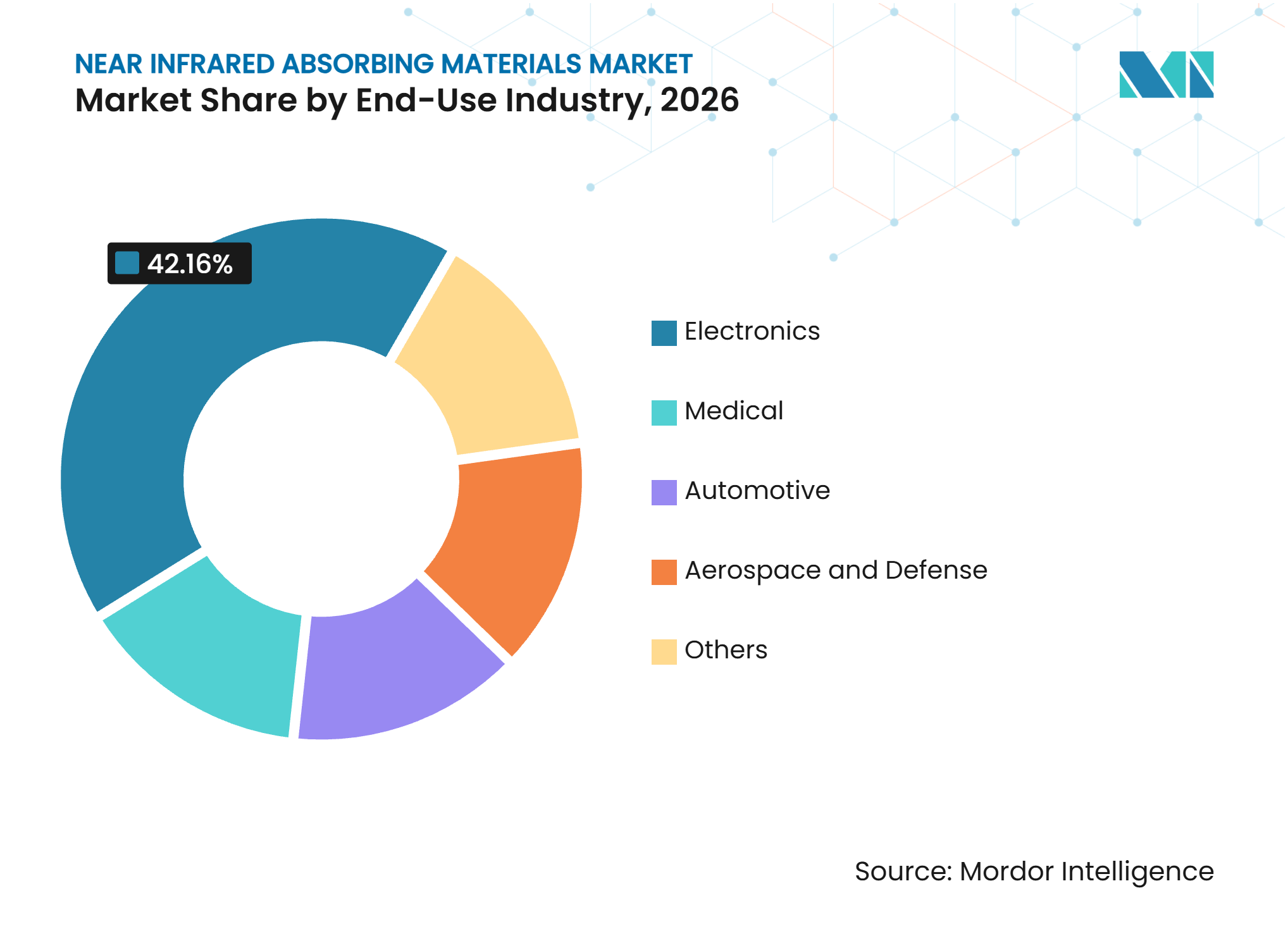
- By end-use industry, electronics held 42.16% of the near infrared absorbing materials market share in 2026 and is forecast to advance at an 8.81% CAGR through 2032.
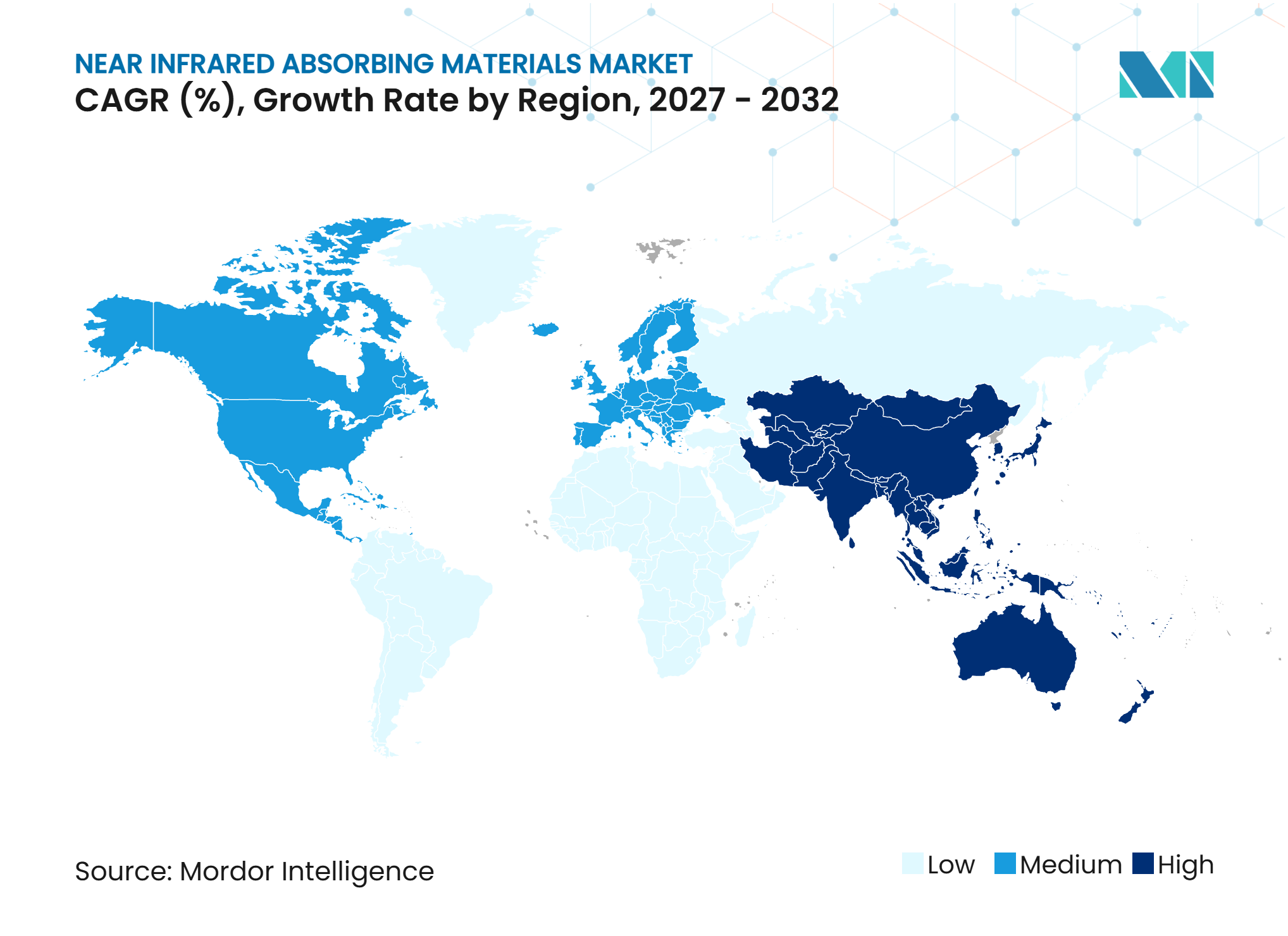
- By geography, North America held 35.71% of the near infrared absorbing materials market share in 2026, while Asia-Pacific is forecast to advance at an 8.66% CAGR through 2032.
Note: Market numbers in this report are based on Mordor Intelligence's proprietary estimation framework, which combines nine months of actuals with Q4 projections for base year 2026.
Market Trends and Insights
Drivers Impact Analysis of Near Infrared Absorbing Materials Market*
| Driver | (~) % Impact on CAGR Forecast | Geographic Relevance | Impact Timeline |
|---|---|---|---|
| Rising Demand for Energy-Efficient Solar Control Materials | +2.1% | Global; strongest pull in North America, EU, and East Asia | Medium term (2-4 years) |
| Growth in Optical Filters, Sensors and Imaging Systems | +1.8% | Global; core in Asia-Pacific and North America | Short term (≤ 2 years) |
| Expansion of LiDAR, ADAS and Machine-Vision Applications | +1.5% | North America, EU, China; spillover to South Korea, Japan | Short term (≤ 2 years) |
| Increasing Use in Photovoltaic and Photothermal Devices | +1.2% | APAC core, EU, Middle East | Medium term (2-4 years) |
| Low-Dosage Transparent NIR Absorber Formulations | +0.9% | Global | Long term (≥ 4 years) |
| Source: Mordor Intelligence | |||
Rising Demand for Energy-Efficient Solar Control Materials
Buildings account for 30% of global final energy consumption, and solar heat gain through glazing can increase cooling demand[1]. Near-infrared absorbers can reduce solar heat while preserving visible-light transmission in films and glazing systems. Sumitomo Metal Mining Co., Ltd. states that its cesium tungsten oxide material transmits 70% of visible light and blocks more than 94% of solar near infrared radiation. The recast Energy Performance of Buildings Directive requires European Union member states to transpose its provisions by May 2026, and related guidance addresses transparent building elements and solar performance. These requirements increase interest in coatings that support energy performance without visibly darkening windows. The near infrared absorbing materials market can therefore benefit where glazing specifications demand both solar control and visual clarity.
Growth in Optical Filters, Sensors and Imaging Systems
Optical filters for complementary metal-oxide-semiconductor image sensors use near infrared absorbing materials to manage unwanted wavelengths in depth-sensing and imaging systems. Tokyo Chemical Industry Co., Ltd. released benzobisthiadiazole building blocks for near infrared dye development in November 2025. Merck KGaA offers photonic and optical materials, including dyes for optical and bioimaging applications. The materials must also withstand the environmental tests applied to optical components under International Organization for Standardization (ISO) 9022. This requirement supports continued formulation work in both organic and inorganic systems. Wider use of camera modules in laptops, security devices, and edge artificial intelligence equipment gives the near infrared absorbing materials market a demand base beyond smartphones.
Expansion of LiDAR, ADAS and Machine-Vision Applications
LiDAR, Advanced Driver Assistance Systems (ADAS), and machine-vision equipment require surfaces that do not prevent near infrared signal transmission or reflection. Conventional carbon-black surfaces can absorb light at common 905 nm and 1,550 nm LiDAR wavelengths. BASF describes coating approaches that help dark automotive finishes remain detectable by LiDAR systems. DIC Corporation market Sicopal colorants for applications involving near infrared control, LiDAR response, and sorting. Automotive design teams can use these materials to retain dark visual finishes while meeting sensor-performance needs. The near infrared absorbing materials market is positioned to gain as higher vehicle automation levels increase demand for compatible coatings and molded parts.
Low-Dosage Transparent NIR Absorber Formulations
Low active-material loading helps maintain film clarity and can reduce material use in coatings and polymer parts. NIPPON SHOKUBAI CO., LTD. states that its EX-Color near infrared absorbing dyes cover peak absorption in the 800-1,000 nm range. Sumitomo Metal Mining Co., Ltd. states that its cesium tungsten oxide material can provide near infrared shielding at one-tenth of the indium tin oxide loading. Lower loading can help manufacturers control formulation cost and reduce exposure to constrained inputs. It can also simplify product design where transparency and thin-film processing are essential. The near infrared absorbing materials market is therefore seeing greater interest in organic-inorganic formulations that balance spectral performance with lower dosage.
Restraints Impact Analysis of Near Infrared Absorbing Materials Market*
| Restraint | (~) % Impact on CAGR Forecast | Geographic Relevance | Impact Timeline |
|---|---|---|---|
| High Synthesis and Raw-Material Costs | -0.8% | Global | Short to medium term (≤ 4 years) |
| Formulation Integration and Dispersion Complexity | -0.6% | Global; acute in Asia-Pacific for mass-production applications | Medium term (2-4 years) |
| Indium, Tungsten and Rare-Metal Supply Exposure | -0.5% | North America, EU, Japan | Long term (≥ 4 years) |
| Source: Mordor Intelligence | |||
High Synthesis and Raw-Material Costs
Multi-step synthesis for cyanine and phthalocyanine dyes can require expensive intermediates and careful process control. Specialty suppliers serve laser safety, aerospace, and precision optics applications where performance requirements can support premium pricing. H.W. Sands Corp. offers near infrared dyes for these specialized uses. Inorganic materials also require controlled production methods to achieve the needed particle size and optical response. Cesium and tungsten precursors can add cost compared with conventional pigment inputs. These economics can limit the near infrared absorbing materials market in price-sensitive products such as agricultural films and basic architectural coatings.
Indium, Tungsten and Rare-Metal Supply Exposure
Indium and tungsten are important inputs for indium tin oxide, cesium tungsten oxide, and related inorganic materials. China introduced export controls on tungsten, indium, and other materials on February 4, 2025[2]. The controls cover specified products, including ammonium paratungstate and tungsten oxide, and require export licensing. The European Union Critical Raw Materials Act identifies strategic and critical raw materials that require supply-chain attention. Supply concentration can increase price uncertainty for manufacturers in North America, Europe, and Japan. Material systems that need less active inorganic content can provide an important risk-management option in the near infrared absorbing materials market.
*Our forecasts treat driver/restraint impacts as directional, not additive. The impact forecasts reflect baseline growth, mix effects, and variable interactions.
Near Infrared Absorbing Materials Market Segment Analysis
By Material Type:
Organic Materials Lead, Inorganic Materials Gain on Organic IncumbentsOrganic materials held 46.89% of the market share in 2026, while inorganic materials are projected to advance at an 8.12% CAGR through 2032. The near infrared absorbing materials market size for inorganic grades is supported by their thermal stability, weather resistance, and performance in outdoor glazing and automotive films. Keeling & Walker’s 2025 investment in nanodispersion capacity reflects demand for scalable antimony tin oxide and doped-tungsten-oxide products. These materials are well suited to applications that require durable optical performance under heat and weather exposure. Inorganic grades can also support high-transparency coatings where visible-light clarity remains important.
Organic materials remain relevant because their structures can be tuned across a broad wavelength range. Cyanine, phthalocyanine, squarylium, and diimonium dyes can be adapted for different absorption needs without changing the underlying processing method. NIPPON SHOKUBAI CO., LTD. and Tokyo Chemical Industry Co., Ltd. provide products and intermediates that support this development work. Polymers and dyes account for much of the organic material demand, while medical imaging and security uses require more specialized grades. The near infrared absorbing materials industry is also testing hybrid systems that combine organic spectral tuning with inorganic durability. Such combinations can help expand absorption coverage while preserving optical quality.


By Function:
Absorption Leads, High Transparency AcceleratesAbsorption held 33.45% of the market share in 2026, while high transparency is projected to advance at an 8.47% CAGR through 2032. The near infrared absorbing materials market size for high-transparency products is growing as smart-glass and automotive-film systems require heat control without visible darkening. These materials selectively block or manage near infrared wavelengths while allowing useful visible light to pass through. European building-energy requirements reinforce the need for better glazing solar performance. Product design therefore centers on the balance between solar control, clarity, and long-term coating durability.
Absorption products serve photothermal collectors, laser-welding processes, and infrared heating applications. NIPPON SHOKUBAI CO., LTD. exhibited EX-Color products in coatings, pellets, and films at the New Functional Materials Exhibition 2025. Heat-resistant materials are used in engineering plastics and under-hood automotive components that encounter elevated processing temperatures. 3M provides light, sun, and heat-control films for automotive original equipment manufacturers and Tier 1 suppliers. Security and anti-counterfeiting applications form a smaller specialized use, where machine-readable spectral behavior is important. The near infrared absorbing materials industry serves these applications through carefully specified dyes and pigments rather than high-volume commodity products.
By Absorption Range:
700-1,000 nm Anchors, Above 1,000 nm ExpandsThe 700-1,000 nm range held 29.94% of the market share in 2026, while the above 1,000 nm range is projected to advance at an 8.53% CAGR through 2032. This established range is used in solar-control films, time-of-flight sensors, facial-recognition cameras, and many 905 nm LiDAR systems. Organic dyes are widely used here because they can be designed for specific wavelength windows. Crysta-Lyn Chemical Company and H.W. Sands Corp. offer near infrared dye portfolios for such applications. The near infrared absorbing materials market continues to rely on this range for established electronics and film applications.
Demand above 1,000 nm is associated with 1,550 nm LiDAR, short-wave infrared imaging, and fiber-optic filtering. These applications require materials with consistent optical behavior over longer wavelengths and under demanding environmental conditions. A 2025 Journal of Organic Chemistry study reported a hexarylene-bisimide absorber with a 921 nm peak and a molar absorptivity of 230,000 M⁻¹ cm⁻¹. The research demonstrates continued scope for colorless and narrow-band near infrared absorber development. Greater use of industrial inspection and agricultural sensing can broaden demand for short-wave infrared materials. The near infrared absorbing materials market will require new dye and oxide formulations as these applications become more precise.
By End-Use Industry:
Electronics Commands Both DimensionsElectronics held 42.16% of the market share in 2026 and is projected to advance at an 8.81% CAGR through 2032. The near infrared absorbing materials market size for electronics is supported by depth sensors, time-of-flight arrays, facial-recognition systems, and laser-absorbing coatings. These components are used in consumer devices, cameras, security equipment, and industrial electronics. Resonac Holdings Corporation provides an ultraviolet-cure optical adhesive for photonics applications. Its optical-material work reflects the need for transparent adhesives in silicon-photonics and optical-transceiver assembly.
Medical use includes surgical instruments, deep-tissue bioimaging agents, and photodynamic therapy materials. Merck KGaA’s optical materials portfolio illustrates the specialist chemistry needed in sensitive imaging applications. Automotive demand is expanding through LiDAR-compatible pigments and heat-rejection window films. Aerospace and defense systems require demanding optical precision for laser protection, sensor coatings, and calibration targets. These end uses have different qualification requirements, which reduces direct substitution between materials. The near infrared absorbing materials market remains anchored in electronics but is strengthened by high-value applications that require tailored optical properties.


Geography Analysis
North America
North America held 35.71% of the market share in 2026. The region’s position reflects defense demand, advanced driver-assistance programs, and a mature specialty-chemicals manufacturing base. The United States supports demand for laser-protection eyewear, hyperspectral sensor coatings, and LiDAR-compatible automotive materials. BASF and DIC Corporation have presented near infrared control products for automotive sensing applications. Chroma Color Corporation expanded its colorant and resin-compounding capabilities through its 2024 Spectra Color acquisition, although this transaction predates the reporting period and is not included as a recent development. The region’s suppliers are placing greater value on vertically integrated dye, masterbatch, and formulation capabilities. The near infrared absorbing materials market in North America can benefit from demand in vehicle sensors and optical electronics. Product qualification remains important because automotive and defense buyers require validated performance. This favors producers with application testing and formulation support.
Asia-Pacific
Asia-Pacific is projected to advance at an 8.66% CAGR through 2032. China’s smart-building construction, Japan’s photonics supply chain, South Korea’s semiconductor packaging activity, and India’s green-building adoption support demand across the region. Sumitomo Metal Mining Co., Ltd. received U.S. Patent 12,275,648 in April 2025 for near infrared absorbing particles based on cesium tungstate. Advanced Nano Products Co., Ltd. produces transparent infrared-blocking paste and indium tin oxide-related materials for functional-film and display applications. Japan remains important for proprietary materials and application-specific synthesis. Research on antimony-doped tin oxide nanoparticles also supports regional work on photothermal and solar-control coatings. The near infrared absorbing materials market in Asia-Pacific combines manufacturing scale with materials innovation. This combination supports both local demand and exports to global electronics, film, and coating supply chains.
Europe, South America, and the Middle East and Africa
Europe is shaped by compliance requirements that affect material selection, while South America and the Middle East and Africa have more application-led opportunities. The European Union’s Energy Performance of Buildings Directive and its guidance on transparent building elements increase attention on glazing energy performance. The European Union Critical Raw Materials Act also raises awareness of indium, antimony, and tungsten supply risks. Germany remains a key European center because it hosts BASF, Merck KGaA, and optical-material suppliers. Heraeus Group introduced photonics innovations at Laser World of Photonics in June 2025, including a synthetic fused silica solution for laser applications. Brazil offers early demand in construction films, agricultural films, and recycling-related pigment applications. High solar irradiance and green-building activity create a longer-term opening in the Middle East and Africa for heat-control glazing and window films. The near infrared absorbing materials market can expand in these regions where local rules, construction activity, and thermal-management needs align.
Competitive Landscape
Market Concentration
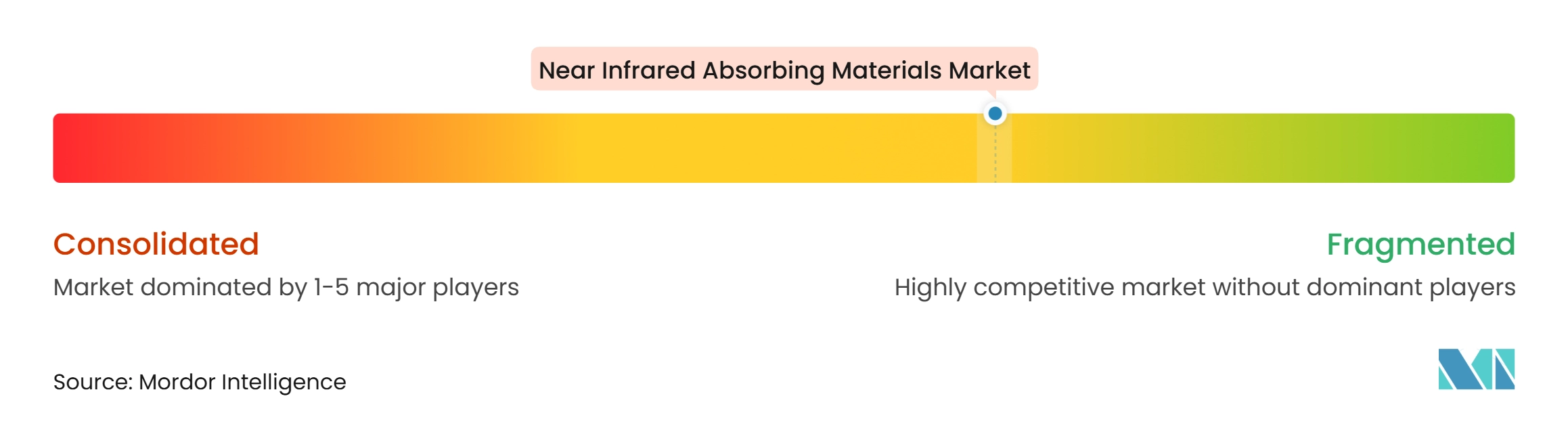
The near infrared absorbing materials market is moderately concentrated, with the top five players including Sumitomo Metal Mining Co., Ltd., Chroma Color Corporation, Keeling & Walker, NIPPON SHOKUBAI CO., LTD., and QCR Solutions Corp. Suppliers compete through powders, dispersions, masterbatches, coatings, dyes, and optical adhesives. This structure makes specialized formulation support important for customer retention. It also creates pricing pressure where products are technically similar.
Company strategy is centered on materials differentiation and application readiness. Keeling & Walker commissioned a research and development center and ATEX-rated nanodispersion manufacturing facility in 2025, expanding its ability to supply pre-dispersed inorganic materials. DIC Corporation highlighted its Spectrasense pigments for LiDAR-compatible dark finishes in 2025. Heraeus Group introduced photonics products for high-power laser applications in June 2025. These moves show how suppliers are pursuing higher-value applications with demanding specifications. The near infrared absorbing materials market rewards companies that can document performance in the customer’s chosen process and end-use environment.
The remaining opportunities are concentrated in pre-formulated dispersion systems, hybrid organic-inorganic absorbers, and sensor-compatible pigment engineering. Merck KGaA is applying materials intelligence tools to accelerate materials discovery and product development. Sumitomo Metal Mining Co., Ltd. continues to protect its cesium-tungstate platform through intellectual property and application development. Resonac Holdings Corporation is expanding semiconductor materials capacity to address artificial intelligence packaging demand. These actions can deepen supplier positions in technically demanding niches. Competition will remain shaped by supply reliability, optical performance, and process integration rather than by a single product standard.
Near Infrared Absorbing Materials Industry Leaders
-
Sumitomo Metal Mining Co., Ltd.
-
Chroma Color Corporation
-
Keeling & Walker
-
NIPPON SHOKUBAI CO., LTD.
-
QCR Solutions Corp
- *Disclaimer: Major Players sorted in no particular order
Near Infrared Absorbing Materials Market Companies Covered in this Report
- 3M
- Advanced Nano Products Co., Ltd.
- BASF
- Chroma Color Corporation
- Crysta-Lyn Chemical Company
- DIC Corporation
- H.W. Sands Corp.
- Heraeus Group
- Keeling & Walker
- Merck KGaA
- NIPPON SHOKUBAI CO., LTD.
- QCR Solutions Corp
- Resonac Holdings Corporation
- Sumitomo Metal Mining Co., Ltd.
- Tokyo Chemical Industry Co., Ltd.
Recent Industry Developments in Near Infrared Absorbing Materials Market
- October 2026: TANAKA PRECIOUS METAL GROUP Co., Ltd., in collaboration with Nagoya University, developed a lead-free precious-metal quantum dot material responsive to near infrared and short-wave infrared light. The silver-sulfur-tellurium quantum dots achieved an external quantum efficiency of 18.4% in the 1,200–1,700 nm wavelength range, supporting the near infrared absorbing materials market through advancements in infrared-responsive materials for sensing, biomedical applications, and consumer electronics.
- September 2026: ROWA Masterbatch introduced a near infrared reflective black masterbatch that combines deep-black color with high NIR reflectance to reduce heat accumulation in plastic surfaces. The product supports the near infrared absorbing materials market by expanding functional pigment and masterbatch solutions for automotive components, outdoor construction products, electrical housings, and consumer goods.
Global Near Infrared Absorbing Materials Market Report Scope
Near-infrared (NIR) absorbing materials are substances designed to selectively absorb light within the near infrared wavelength range. They are used to control optical and thermal properties in applications such as sensing, imaging, light management, and heat shielding.
The Near Infrared Absorbing Materials Market is segmented by material type, function, absorption range, end-use industry, and geography. By material type, the market is segmented into organic materials, including dyes, polymers, and others, and inorganic materials, including antimony tin oxide, indium tin oxide, doped tungsten oxide, and others. By function, the market is segmented into high transparency, absorption, heat resistance, and others. By absorption range, the market is segmented into 700–1,000 nm and above 1,000 nm. By end-use industry, the market is segmented into electronics, medical, automotive, aerospace and defense, and others. The report also covers the market size and forecasts for near infrared absorbing materials across 15 countries. For each segment, the market sizing and forecasts have been done on the basis of value (USD).
Segmentation Overview
| Organic Materials | Dyes |
| Polymers | |
| Others | |
| Inorganic Materials | Antimony Tin Oxide |
| Indium Tin Oxide | |
| Doped Tungsten Oxide | |
| Others |
| High Transparency |
| Absorption |
| Heat Resistance |
| Others |
| 700-1,000 nm |
| Above 1,000 nm |
| Electronics |
| Medical |
| Automotive |
| Aerospace and Defense |
| Others |
| Asia-Pacific | China |
| India | |
| Japan | |
| South Korea | |
| Rest of Asia-Pacific | |
| North America | United States |
| Canada | |
| Mexico | |
| Europe | Germany |
| United Kingdom | |
| France | |
| Italy | |
| Rest of Europe | |
| South America | Brazil |
| Argentina | |
| Rest of South America | |
| Middle East and Africa | Saudi Arabia |
| South Africa | |
| Rest of Middle East and Africa |
| By Material Type | Organic Materials | Dyes |
| Polymers | ||
| Others | ||
| Inorganic Materials | Antimony Tin Oxide | |
| Indium Tin Oxide | ||
| Doped Tungsten Oxide | ||
| Others | ||
| By Function | High Transparency | |
| Absorption | ||
| Heat Resistance | ||
| Others | ||
| By Absorption Range | 700-1,000 nm | |
| Above 1,000 nm | ||
| By End-Use Industry | Electronics | |
| Medical | ||
| Automotive | ||
| Aerospace and Defense | ||
| Others | ||
| By Geography | Asia-Pacific | China |
| India | ||
| Japan | ||
| South Korea | ||
| Rest of Asia-Pacific | ||
| North America | United States | |
| Canada | ||
| Mexico | ||
| Europe | Germany | |
| United Kingdom | ||
| France | ||
| Italy | ||
| Rest of Europe | ||
| South America | Brazil | |
| Argentina | ||
| Rest of South America | ||
| Middle East and Africa | Saudi Arabia | |
| South Africa | ||
| Rest of Middle East and Africa | ||
Key Questions Answered in the Report
What is the size of the near infrared absorbing materials market?
The near infrared absorbing materials market size was valued at USD 379.30 million in 2026 and is estimated to grow from USD 408.84 million in 2027 to reach USD 596.29 million by 2032, at a CAGR of 7.84% during the forecast period (2027-2032).
What is driving demand for near infrared absorbing materials?
Solar-control glazing, optical filters, vehicle sensors, imaging systems, and semiconductor packaging are key demand areas.
Which material type is projected to advance fastest through 2032?
Inorganic materials are projected to advance at an 8.12% CAGR through 2032, supported by durability and heat resistance.
Which end-use industry is projected to advance fastest through 2032?
Electronics is projected to advance at an 8.81% CAGR through 2032.