
Nanofiltration Membrane Market Size and Share
Market Overview
| Study Period | 2022 - 2032 |
|---|---|
| Market Size (2027) | USD 1.49 Billion |
| Market Size (2032) | USD 2.30 Billion |
| Growth Rate (2027 - 2032) | 9.14 % |
| Fastest Growing Market | Asia-Pacific |
| Largest Market | Asia-Pacific |
| Market Concentration | Medium |
Major Players *Disclaimer: Major Players sorted in no particular order Image © Mordor Intelligence. Reuse requires attribution under CC BY 4.0. | |
Nanofiltration Membrane Market Analysis by Mordor Intelligence
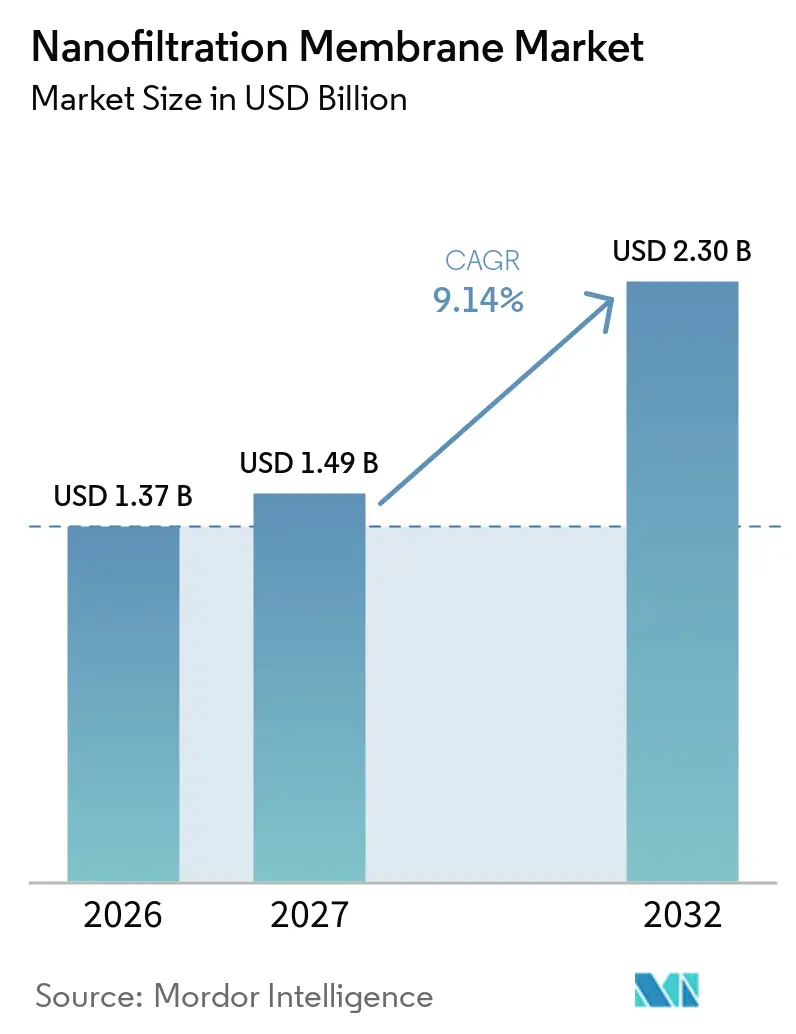
The Nanofiltration Membrane Market size was valued at USD 1.37 billion in 2026 and is estimated to grow from USD 1.49 billion in 2027 to reach USD 2.30 billion by 2032, at a CAGR of 9.14% during the forecast period (2027-2032). Municipal water upgrades, industrial process-water requirements, and drinking-water contaminant rules support this expansion. The U.S. Environmental Protection Agency retains enforceable maximum contaminant levels for perfluorooctanoic acid and perfluorooctane sulfonic acid, which keep advanced separation technologies under review by public water systems. The nanofiltration membrane market also benefits from applications that need selective rejection of divalent ions and larger organic compounds without the full pressure demand of reverse osmosis. Process water demand from semiconductor, battery, pharmaceutical, and chemical facilities broadens the buyer base beyond municipal treatment. Suppliers are responding through hollow-fiber platforms, specialty membranes for lithium processing, and service models that combine modules with process design.
Key Report Takeaways
- By type, polymeric held 68.43% of the nanofiltration membrane market share in 2026, while ceramic is forecast to advance at a 9.85% CAGR through 2032.
- By module, spiral-wound held 52.56% of the nanofiltration membrane market share in 2026, while hollow fiber is forecast to advance at a 10.07% CAGR through 2032.
- By application, water and wastewater treatment held 46.18% of the nanofiltration membrane market share in 2026 and is forecast to advance at a 10.45% CAGR through 2032.
- By geography, Asia-Pacific held 35.42% of the nanofiltration membrane market share in 2026 and is forecast to advance at a 10.32% CAGR through 2032.
Note: Market numbers in this report are based on Mordor Intelligence's proprietary estimation framework, which combines nine months of actuals with Q4 projections for base year 2026.
Market Trends and Insights
Drivers Impact Analysis of Nanofiltration Membrane Market*
| Driver | (~) % Impact on CAGR Forecast | Geographic Relevance | Impact Timeline |
|---|---|---|---|
| Water Scarcity and Reuse Mandates | +2.4% | Global, with concentrated gains in Asia-Pacific, Middle East, and Mediterranean Europe | Long term (≥ 4 years) |
| Stricter Micropollutant, PFAS, and Industrial Discharge Requirements | +2.0% | North America and Europe primary; spillover to APAC and Middle East | Medium term (2-4 years) |
| Industrial Demand for High-Purity Process Water | +1.8% | APAC core (semiconductor, battery); North America and Europe spillover | Medium term (2-4 years) |
| Selective Separation at Lower Pressure Than Reverse Osmosis | +1.5% | Global | Long term (≥ 4 years) |
| Direct Hollow-Fiber Nanofiltration for Chemical and Energy Savings | +1.2% | Europe and APAC early adopters; North America growing | Short term (≤ 2 years) |
| Source: Mordor Intelligence | |||
Water Scarcity and Reuse Mandates
The nanofiltration membrane market is being reshaped as water stress changes procurement plans for municipal utilities and industrial users across several regions. The nanofiltration membrane market benefits when reuse projects require the removal of organic compounds, pathogens, and selected dissolved constituents from municipal secondary effluent. NX Filtration BV received a repeat order in July 2025 to double the capacity of the SAPAL ERA plant in León, Mexico, taking drinking-quality water treatment capacity to 34 million liters per day. Such projects can reduce reliance on groundwater and defer new surface-water infrastructure. This creates continuing replacement demand for membrane modules after the initial installation. Reuse rules and water-security policies, therefore, support demand even where new water supply projects are delayed.
Selective Separation at Lower Pressure Than Reverse Osmosis
Nanofiltration provides a lower-pressure option where feedwater requires divalent-ion rejection or removal of larger organic compounds rather than deep monovalent-salt rejection. This operating profile makes energy use an important selection factor for brackish-water treatment and softening applications. The European Commission’s Blue Economy Observatory identifies desalination energy efficiency as a material operating issue for water treatment systems[1]. DuPont reported deployment of FilmTec nanofiltration elements at a large drinking-water facility in Jiaxing City, China, for dissolved organic compound removal. The nanofiltration membrane market gains when equipment is designed into greenfield facilities instead of being added only as a final polishing step. That design choice also establishes recurring module replacement cycles.
Stricter Micropollutant, PFAS, and Industrial Discharge Requirements
The nanofiltration membrane market is responding to drinking-water and wastewater rules that are increasing attention to advanced treatment technologies. The U.S. Environmental Protection Agency identifies nanofiltration among the treatment technologies that public water systems may assess for perfluorooctanoic acid and perfluorooctane sulfonic acid compliance. In Europe, the recast Urban Wastewater Treatment Directive entered into force in 2025 and established a framework for advanced treatment of micropollutants. NX Filtration BV and Eau d’Azur started a hollow-fiber nanofiltration and advanced oxidation pilot at the Haliotis wastewater plant in Nice during August 2025. A 2025 pilot study reported high rejection across tested perfluoroalkyl and polyfluoroalkyl substances in groundwater treatment. Japan also revised environmental quality standards related to water pollution in 2025, widening monitoring attention to additional Per- and Polyfluoroalkyl Substances (PFAS) compounds[2].
Industrial Demand for High-Purity Process Water
Semiconductor and battery plants require tightly controlled process water, which supports the use of selective membranes upstream of ultrapure-water polishing. The nanofiltration membrane market also has a separate demand stream in critical mineral processing. DuPont introduced FilmTec LiNE-XD elements for direct lithium extraction applications in April 2025 and collaborated with CleanTech Lithium on downstream purification in Chile. TORAY INDUSTRIES, INC. developed production technology for an acid-resistant nanofiltration element designed to recover lithium from battery black-mass leachate. The company reported lithium recovery above 95% in laboratory demonstrations. These programs extend membrane demand into mineral recovery, where feed conditions differ from conventional water treatment. They also increase the importance of acid resistance, selectivity, and stable performance under variable feed chemistry.
Restraints Impact Analysis of Nanofiltration Membrane Market*
| Restraint | (~) % Impact on CAGR Forecast | Geographic Relevance | Impact Timeline |
|---|---|---|---|
| Membrane Fouling and Cleaning-Related OPEX | -1.2% | Global; more severe in high-turbidity APAC surface water and high-organics North American groundwater | Long term (≥ 4 years) |
| High Initial System Cost and Alternative-Technologies Competition | -0.9% | Emerging markets in South America, South Asia, and Africa; price-competitive RO segments | Medium term (2-4 years) |
| Variable Feedwater Chemistry and Selectivity-Flux Trade-Offs | -0.5% | Global; most acute in industrial applications with wide feed-quality fluctuation | Medium term (2-4 years) |
| Source: Mordor Intelligence | |||
Membrane Fouling and Cleaning-Related OPEX
The nanofiltration membrane market faces operating constraints because organic matter, scaling salts, and biological activity can reduce flux and increase transmembrane pressure over time. Cleaning restores performance but adds chemical, water, labor, and downtime costs. GEA Group Aktiengesellschaft reported that its Smart Filtration clean-in-place approach reduced energy use by up to 46% and freshwater use by up to 52% at dairy membrane filtration plants. A 2025 review found that anti-fouling surface modifications can involve trade-offs in separation performance for polyamide membranes. The nanofiltration membrane market is therefore affected by each site’s raw-water quality and cleaning regime, not only by the initial module price. Buyers need to assess feedwater conditions and expected fouling before relying on supplier flux guarantees.
High Initial System Cost and Alternative-Technologies Competition
Initial system cost can slow adoption where conventional treatment solutions meet the required effluent standard. Ultrafiltration combined with activated carbon, enhanced coagulation, and established reverse osmosis systems may present lower entry costs in less demanding applications. The U.S. Government Accountability Office reviewed the Environmental Protection Agency’s cost analysis for its PFAS drinking-water regulation in 2025. The Environmental Protection Agency’s decision to retain requirements for perfluorooctanoic acid and perfluorooctane sulfonic acid, while reconsidering some other elements, can affect near-term procurement timing for public water systems. Financing constraints and limited membrane-operating experience remain relevant in South America, South Asia, and Africa. Product approvals for membranes used in drinking-water contact can also add time and administrative cost to procurement.
*Our forecasts treat driver/restraint impacts as directional, not additive. The impact forecasts reflect baseline growth, mix effects, and variable interactions.
Nanofiltration Membrane Market Segment Analysis
By Type:
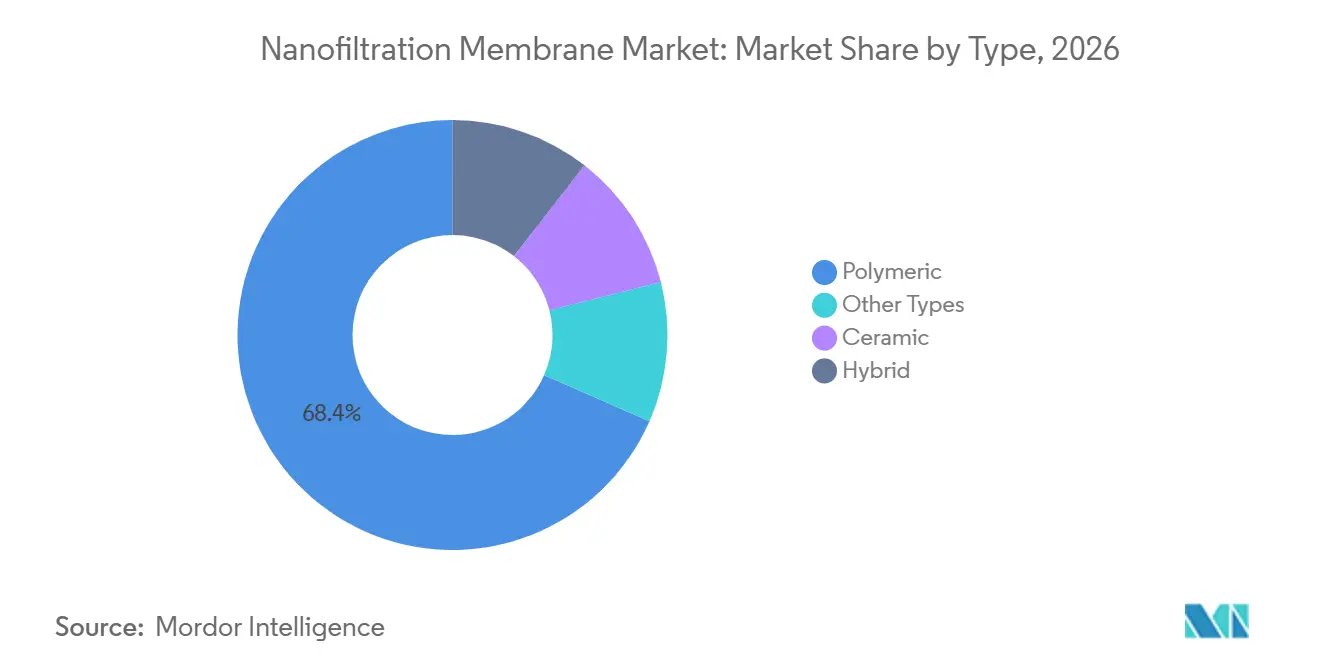
Polymeric Leads Demand, While Ceramic ExpandsIn the nanofiltration membrane market, polymeric membranes held 68.43% of the market share in 2026, supported by the installed base of thin-film composite polyamide elements. These membranes remain common in municipal and industrial systems because suppliers offer established configurations and pressure-vessel compatibility. Pall Corporation launched the Membralox GP-IC ceramic membrane system in September 2025 and stated that it can provide up to 45% more filtration capacity than comparable conventional ceramic elements.
Pall Corporation also stated that the system can recover up to 95% of value-added products from relevant processing side streams. A 2025 Nature Communications study reported that a lignin alkali additive improved water permeance and chloride-to-sulfate selectivity in a polyamide nanofiltration membrane. Hybrid membranes retain a smaller role where users seek chemical resistance closer to ceramic materials at a lower cost than fully ceramic structures. The nanofiltration membrane market size for ceramic membranes is projected to expand at a 9.85% CAGR through 2032. Material selection depends on the feed stream, cleaning conditions, required rejection profile, and expected service life.

By Module:
Spiral-Wound Leads While Hollow Fiber Redefines System ArchitectureIn the nanofiltration membrane market, spiral-wound membranes held 52.56% of the market share in 2026. Their leading position reflects high packing density, equipment familiarity, and use in standard pressure vessels. Hollow fiber membranes are projected to advance at a 10.07% CAGR through 2032 because direct filtration can reduce coagulation pretreatment in suitable applications. A 2025 Desalination study reported that spacer geometry can improve spiral-wound membrane performance through computational fluid dynamics-based design.
Hollow-fiber systems use short, straight flow channels and can be backwashed. NX Filtration BV increased capacity through a Netherlands facility designed for 60,000 modules per year, with room to exceed 120,000 modules per year. Tubular modules remain suitable for viscous dairy and fermentation streams, while flat-sheet modules are used in laboratory and pilot settings. The nanofiltration membrane market size for hollow fiber membranes is projected to advance at a 10.07% CAGR through 2032. Module choice depends on solids loading, cleaning needs, footprint limits, and the required treatment sequence.
By Application:
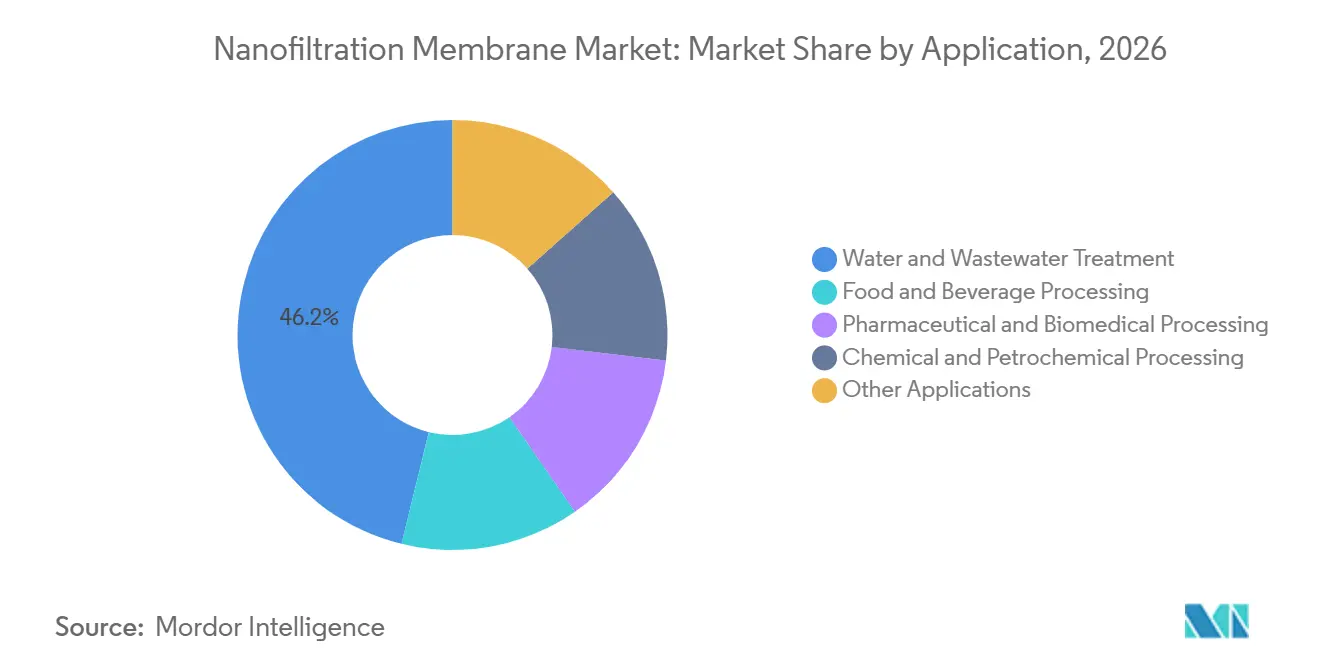
Water and Wastewater Treatment Anchors Both Revenue and GrowthWater and wastewater treatment held 46.18% of the market share in 2026 and is projected to advance at a 10.45% CAGR through 2032. Municipal reuse, contaminant removal, and industrial discharge requirements support this position. NX Filtration BV reported that a full-scale water recycling project in Bengaluru uses hollow-fiber modules for recovery from municipal secondary effluent. The project provides a commercial reference for reuse-oriented direct nanofiltration.
Food and beverage processing uses nanofiltration to concentrate lactose, separate whey components, demineralize fermentation broths, and refine fruit juices. DuPont reported that FilmTec Hypershell NF245XD elements can extend service time and improve productivity in dairy processing. Chemical, petrochemical, pharmaceutical, and biomedical users apply the technology to selective separation, purification, solvent recovery, and effluent reuse. The nanofiltration membrane market size for water and wastewater treatment is projected to advance at a 10.45% CAGR through 2032. Demand is supported by the need to reduce water consumption while meeting stricter discharge and reuse requirements.
Geography Analysis
Asia-Pacific
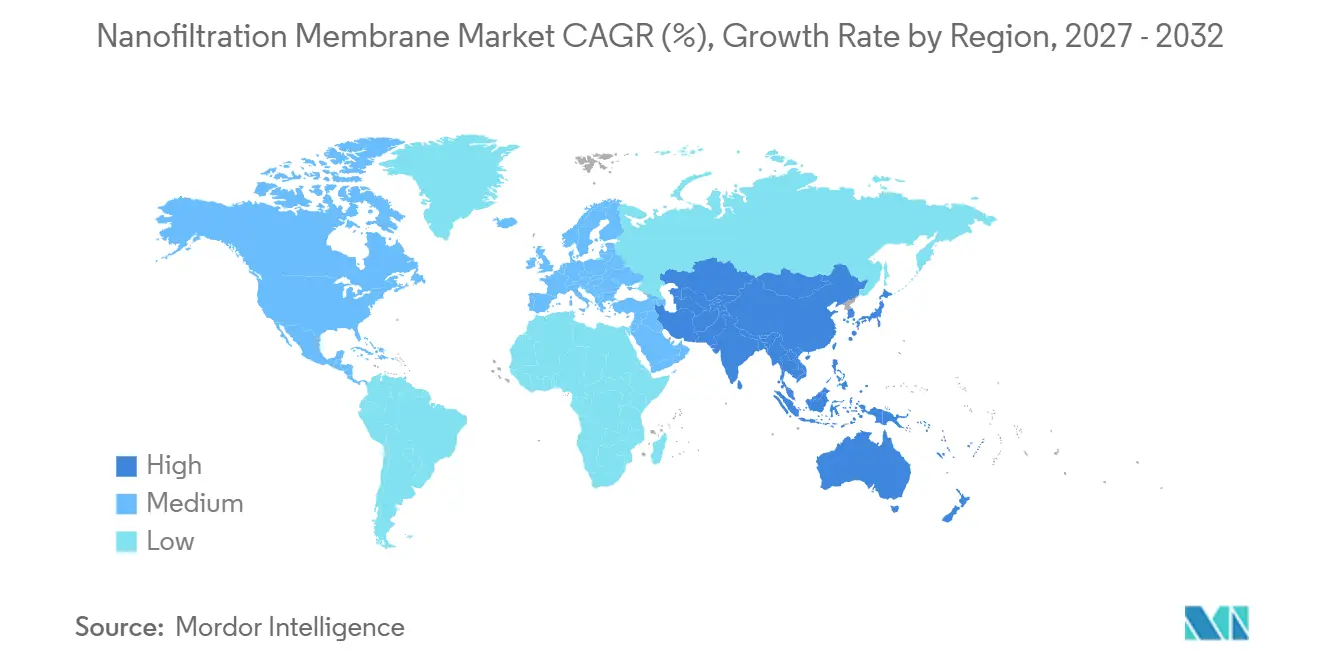
Within the nanofiltration membrane market, Asia-Pacific held 35.42% of the market share in 2026 and is forecast to advance at a 10.32% CAGR through 2032. China’s industrial membrane users and municipal utilities support replacement-module demand and new treatment capacity. The Ministry of Industry and Information Technology and the Ministry of Water Resources included nanofiltration in priority categories under the Water-Saving Equipment High-Quality Development Implementation Plan for 2025-2030. India’s reuse programs support municipal treatment deployment, while the Bengaluru project shows full-scale use of direct hollow-fiber nanofiltration. Semiconductor and battery manufacturing add high-purity process water demand.
North America
North America benefits from public water system reviews of advanced treatment options for PFAS compliance. The U.S. Environmental Protection Agency retained maximum contaminant levels for perfluorooctanoic acid and perfluorooctane sulfonic acid in 2025. This regulatory influence encourages water systems to assess technologies with strong contaminant rejection capabilities. Semiconductor manufacturing also increases demand for high-purity process water and wastewater reuse. Applied Membranes, Inc. and NX Filtration BV announced a February 2026 partnership for pharmaceutical wastewater reuse in the United States.
Europe, South America, and Middle East and Africa
Europe’s demand is shaped by the recast Urban Wastewater Treatment Directive, which entered into force in 2025 and increased attention to micropollutant removal. South America combines water reuse and lithium processing, while the León expansion establishes a major regional hollow-fiber reference site. The Middle East and Africa combine desalination, industrial water, and offshore sulfate-removal demand, illustrated by Veolia’s SATORP agreement and TORAY INDUSTRIES, INC.’s Dammam facility. These regions have different adoption patterns, but each relies on water security, industrial performance, or resource recovery needs.
Competitive Landscape
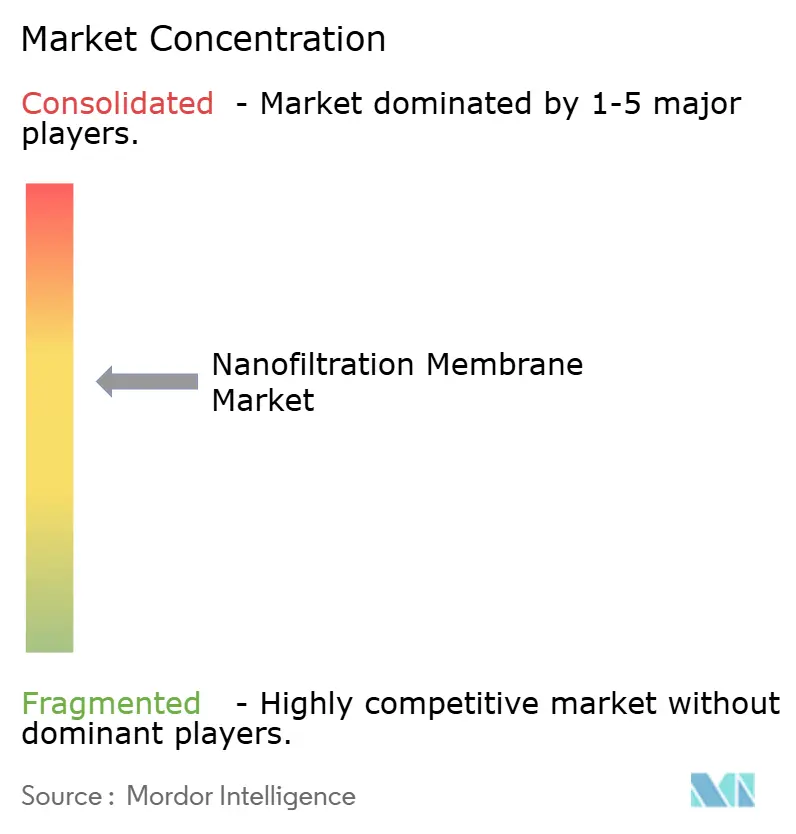
The nanofiltration membrane market is moderately concentrated, with the top five players including DuPont, TORAY INDUSTRIES, INC., Nitto Denko Corporation, Veolia, and ALFA LAVAL. DuPont, TORAY INDUSTRIES, INC., and Nitto Denko Corporation maintain broad membrane technology platforms and strong positions in spiral-wound applications. ALFA LAVAL, GEA Group Aktiengesellschaft, Veolia, Pentair, Pall Corporation, and Kovalus Separation Solutions compete through application engineering, systems integration, and service support. ALFA LAVAL won an order for an advanced nano- and ultrafiltration plant in Asia during March 2025. Kovalus Separation Solutions opened its Technology Centre in Aachen in June 2025 to support membrane screening and process validation.
NX Filtration BV focuses on hollow-fiber nanofiltration and reported 28% revenue growth in 2025. Applied Membranes, Inc., SPX FLOW, Inc., Synder Filtration, Inc., and Pentair serve specialized processing and water-treatment requirements. Pall Corporation extended its ceramic membrane offering, while Nitto Denko Corporation partnered with Syensqo on circular polysulfone membrane substrates in April 2025. These moves show that performance, system support, and substrate sourcing all shape supplier differentiation. The nanofiltration membrane market remains contested across material platforms and module designs.
NanoH2O, formerly LG Chem Water Solutions, operates as an independent membrane producer following the divestiture of the water solutions business. Vontron Technology Co., Ltd. is expanding membrane materials and module capacity in Nanjing. DuPont and TORAY INDUSTRIES, INC. have both advanced specialty nanofiltration for lithium processing. Veolia is expanding its role as an integrator of advanced membrane systems in industrial applications.
Nanofiltration Membrane Industry Leaders
-
DuPont
-
TORAY INDUSTRIES, INC.
-
Nitto Denko Corporation
-
ALFA LAVAL
-
Veolia
- *Disclaimer: Major Players sorted in no particular order
Nanofiltration Membrane Market Companies Covered in this Report
- ALFA LAVAL
- Applied Membranes, Inc.
- DuPont
- GEA Group Aktiengesellschaft
- Kovalus Separation Solutions
- LG Chem
- Nitto Denko Corporation
- NX Filtration BV
- Pall Corporation
- Pentair
- SPX FLOW, Inc.
- Synder Filtration, Inc.
- TORAY INDUSTRIES, INC.
- Veolia
- Vontron Technology Co., Ltd.
Recent Industry Developments in Nanofiltration Membrane Market
- August 2026: TORAY INDUSTRIES, INC., launched two nanofiltration membrane elements, NE8040-XDM and NE8040-90F, designed for impurity removal and chemical durability. The launch supports the nanofiltration membrane market by expanding membrane options for industrial wastewater reuse, resource recovery and advanced water purification.
- August 2026: NanoH2O introduced its NF7 next-generation nanofiltration membrane, designed to increase water production at the same operating pressure while improving multivalent-ion removal and resistance to fouling. The launch supports the nanofiltration membrane market by addressing demand for energy-efficient water softening, groundwater treatment, reverse-osmosis pretreatment and PFAS reduction.
Global Nanofiltration Membrane Market Report Scope
Nanofiltration membranes are semi-permeable membranes that selectively separate dissolved salts, organic compounds, and other particles based on their size and charge. They enable selective purification and concentration processes while supporting water treatment and industrial separation requirements.
The Nanofiltration Membrane Market is segmented by type, module, application, and geography. By type, the market is segmented into polymeric, ceramic, hybrid, and other types. By module, the market is segmented into spiral-wound, tubular, hollow fiber, flat sheet, and other modules. By application, the market is segmented into water and wastewater treatment, food and beverage processing, chemical and petrochemical processing, pharmaceutical and biomedical processing, and other applications. The report also covers the market size and forecasts for nanofiltration membranes across 15 countries. For each segment, the market sizing and forecasts have been done on the basis of value (USD).
Segmentation Overview
| Polymeric |
| Ceramic |
| Hybrid |
| Other Types |
| Spiral-Wound |
| Tubular |
| Hollow Fiber |
| Flat Sheet |
| Other Modules |
| Water and Wastewater Treatment |
| Food and Beverage Processing |
| Chemical and Petrochemical Processing |
| Pharmaceutical and Biomedical Processing |
| Other Applications |
| Asia-Pacific | China |
| India | |
| Japan | |
| South Korea | |
| ASEAN Countries | |
| Rest of Asia-Pacific | |
| North America | United States |
| Canada | |
| Mexico | |
| Europe | Germany |
| United Kingdom | |
| France | |
| Italy | |
| NORDIC Countries | |
| Rest of Europe | |
| South America | Brazil |
| Argentina | |
| Rest of South America | |
| Middle East and Africa | Saudi Arabia |
| South Africa | |
| Rest of Middle East and Africa |
| By Type | Polymeric | |
| Ceramic | ||
| Hybrid | ||
| Other Types | ||
| By Module | Spiral-Wound | |
| Tubular | ||
| Hollow Fiber | ||
| Flat Sheet | ||
| Other Modules | ||
| By Application | Water and Wastewater Treatment | |
| Food and Beverage Processing | ||
| Chemical and Petrochemical Processing | ||
| Pharmaceutical and Biomedical Processing | ||
| Other Applications | ||
| By Geography | Asia-Pacific | China |
| India | ||
| Japan | ||
| South Korea | ||
| ASEAN Countries | ||
| Rest of Asia-Pacific | ||
| North America | United States | |
| Canada | ||
| Mexico | ||
| Europe | Germany | |
| United Kingdom | ||
| France | ||
| Italy | ||
| NORDIC Countries | ||
| Rest of Europe | ||
| South America | Brazil | |
| Argentina | ||
| Rest of South America | ||
| Middle East and Africa | Saudi Arabia | |
| South Africa | ||
| Rest of Middle East and Africa | ||
Key Questions Answered in the Report
What is the size of the nanofiltration membrane market?
The Nanofiltration Membrane Market size was valued at USD 1.37 billion in 2026 and is estimated to grow from USD 1.49 billion in 2027 to reach USD 2.30 billion by 2032, at a CAGR of 9.14% during the forecast period (2027-2032).
What is driving demand for nanofiltration membranes?
Water reuse, PFAS and micropollutant compliance, high-purity industrial water, and selective separation for lithium processing support demand.
Which type held the largest share in 2026?
Polymeric membranes held 68.43% share in 2026, supported by their established use in municipal and industrial treatment systems.
Which module is projected to advance fastest through 2032?
Hollow fiber is projected to advance at a 10.07% CAGR through 2032 because it can support direct filtration and compact treatment designs.