
Nano Calcium Carbonate Market Size and Share
Market Overview
| Study Period | 2021 - 2031 |
|---|---|
| Market Size (2026) | USD 12.27 Billion |
| Market Size (2031) | USD 18.19 Billion |
| Growth Rate (2026 - 2031) | 8.19 % |
| Fastest Growing Market | Asia-Pacific |
| Largest Market | Asia-Pacific |
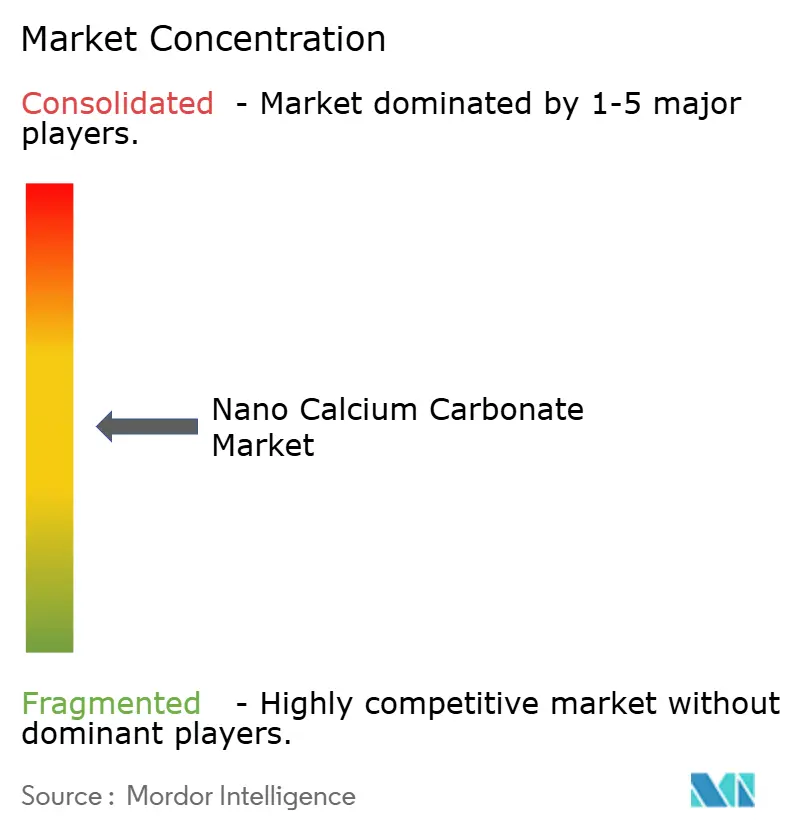
| Market Concentration | Medium |
Major Players *Disclaimer: Major Players sorted in no particular order Image © Mordor Intelligence. Reuse requires attribution under CC BY 4.0. | |
Nano Calcium Carbonate Market Analysis by Mordor Intelligence
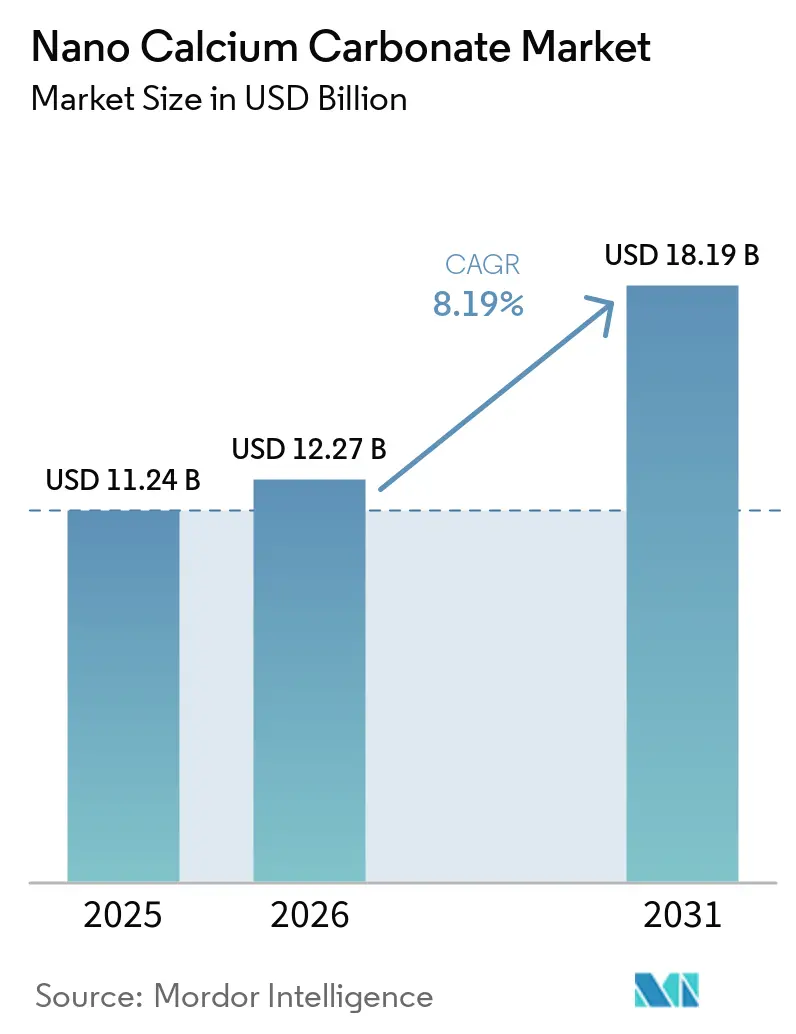
The nano calcium carbonate market size was valued at USD 11.24 billion in 2025 and is estimated to grow from USD 12.27 billion in 2026 to USD 18.19 billion by 2031, at a CAGR of 8.19% during the forecast period (2026-2031). China's integrated limestone-to-nano-Precipitated Calcium Carbonate (PCC) supply chains and India's expanding polymer and construction manufacturing base support market development. In 2024, demand for precipitated nano calcium carbonate increased, as its engineered particle design is compatible with a broader range of polar and nonpolar polymer matrices than ground alternatives. In paints and coatings, formulators use nano grades to reduce TiO₂ content while maintaining film opacity and hiding power. Performance requirements across polymer, construction, and packaging applications shape the nano calcium carbonate market. Surface-modified grades command premiums of 40-60% over unmodified materials, while production costs, batch variability, and an additional 12% U.S. tariff on China-origin products, which was introduced in November 2025, influence procurement and investment decisions. China's cost-efficient, vertically integrated limestone processing supports competitive pricing across export markets. India's growing domestic consumption in rubber compounding, adhesives, and sealants further expands the addressable market. Nano calcium carbonate's ability to enhance mechanical properties, including tensile strength, impact resistance, and surface finish, makes it a preferred additive in high-performance polymer applications. In construction, it is used in PVC profiles, pipes, and caulks, where particle size consistency directly affects product quality. Packaging manufacturers incorporate nano calcium carbonate to improve stiffness and reduce material usage in plastic films and rigid containers.
Key Report Takeaways
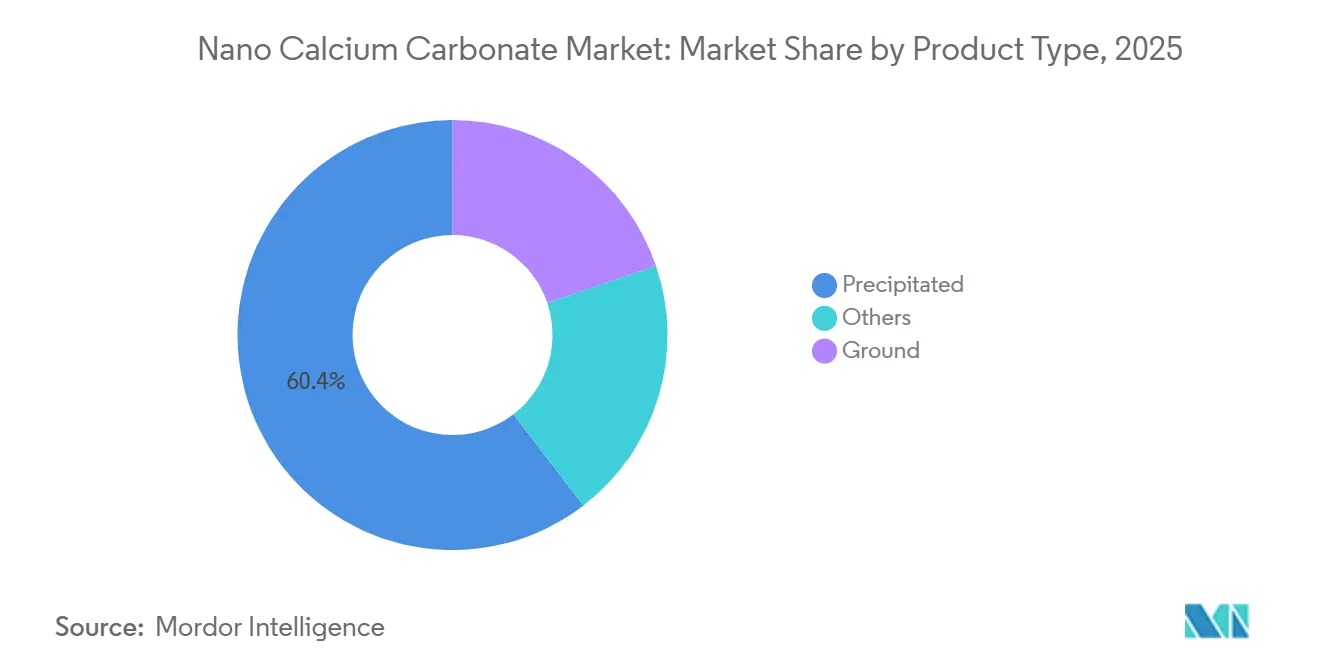
- By product type, precipitated nano calcium carbonate held 60.43% of the nano calcium carbonate market share in 2025, while ground nano calcium carbonate is forecast to grow at an 8.72% CAGR through 2031.
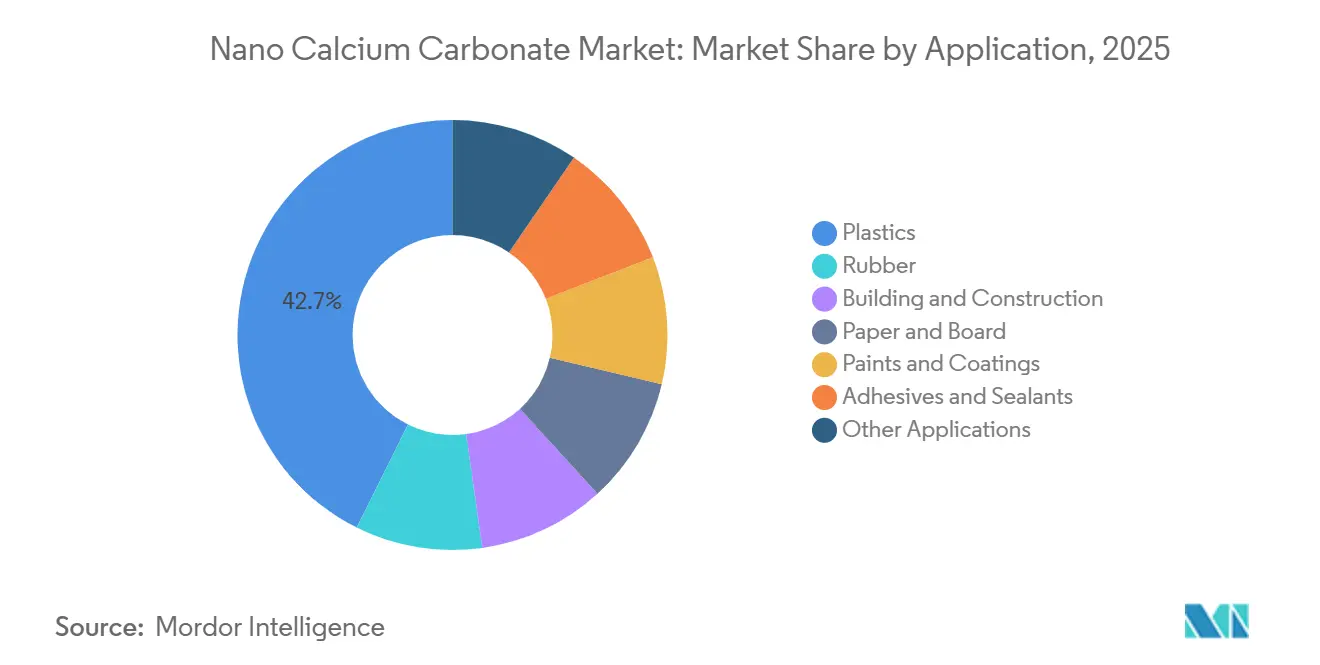
- By application, plastics held 42.65% of global demand in 2025, while paints and coatings are forecast to grow at a 9.13% CAGR through 2031.
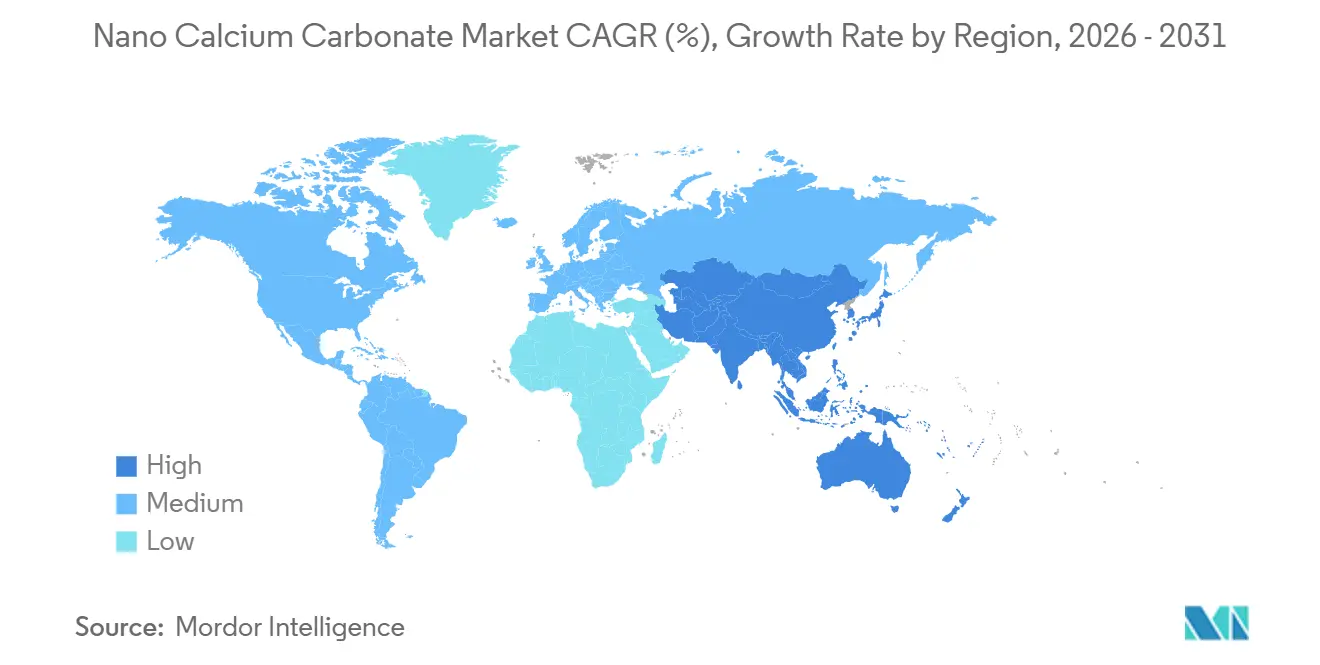
- By geography, Asia-Pacific accounted for 45.07% of global demand in 2025 and is forecast to expand at a 9.25% CAGR through 2031.
Note: Market size and forecast figures in this report are generated using Mordor Intelligence’s proprietary estimation framework, updated with the latest available data and insights as of January 2026.
Global Nano Calcium Carbonate Market Trends and Insights
Drivers Impact Analysis*
| Drivers | (~) % Impact on CAGR Forecast | Geographic Relevance | Impact Timeline |
|---|---|---|---|
| Plastics Lightweighting and Filler Optimization | +2.2% | Global, with Asia-Pacific and Europe leading in the automotive and packaging sectors | Medium term (2-4 years) |
| Construction Sealant and Composite Performance Requirements | +1.5% | APAC core, including China, India, and Southeast Asia, with spillover to the Middle East | Medium term (2-4 years) |
| High-Performance Packaging and Film Down-Gauging | +1.3% | Asia-Pacific and North America | Short term (≤ 2 years) |
| Expansion of Surface-Modified Nano Grades | +1.6% | Global, with Europe and Japan leading premium-grade applications | Long term (≥ 4 years) |
| On-Site and Just-in-Time Precipitated Calcium Carbonate (PCC) Supply Models | +0.8% | Global, particularly North America, Europe, and APAC | Medium term (2-4 years) |
| Source: Mordor Intelligence | |||
Plastics Lightweighting and Filler Optimization
Surface-modified nano CaCO₃ is a key functional filler in plastics, and its role is expanding as engineers replace metal and glass-fiber parts in automotive and consumer electronics products. Nano grades can enable filler loading that is 30-50% higher by weight than micro-grade alternatives while keeping the material processable. A 2025 study found that adding 4.0 wt% nanoparticulate CaCO₃ increased the polypropylene heat deflection temperature by 12°C relative to the neat polymer. The same study found that a 0.48 wt% loading reduced oxygen transmission by 52% in a nanocomposite.
Expansion of Surface-Modified Nano Grades
Stearic acid, silane coupling agents, and titanate esters can modify the surfaces of nano CaCO₃ for specific polymer and coating formulations. These modified grades cost 40-60% more than unmodified material, but they meet dispersion requirements in automotive coatings, pharmaceutical excipients, and electronics applications. A 2026 study showed that targeted surface modification allowed high-proportion filling of Acrylonitrile Butadiene Styrene (ABS) copolymer that unmodified nano CaCO₃ could not achieve. This distinction is relevant for manufacturers selecting filler grades for demanding processing conditions, where dispersion consistency directly affects end-product quality.
High-Performance Packaging and Film Down-Gauging
Breathable polyolefin films for hygiene, food packaging, and medical applications use nano CaCO₃ as a pore-forming filler. Loading levels of 30-60 wt% can create controlled microporosity when the film is stretched. Producers can reduce film thickness by 5-10% while retaining structural integrity and puncture resistance. This approach reduces material use and supports mono-material packaging designs with improved recyclability. Tight particle-size control remains necessary, as morphology variation can create pore defects, weaken barrier performance, and require reformulation. A 2026 study on surface modification also supported the use of nano CaCO₃ at high filling levels in rigid copolymer substrates, which is relevant for flexible and semi-rigid packaging formats. These findings indicate that nano CaCO₃ can support both performance and material efficiency objectives in packaging applications.
Construction Sealant and Composite Performance Requirements
Nano CaCO₃ functions as a thixotropic modifier and reinforcing agent in silicone, polyurethane, and Modified Silane (MS) polymer sealants. A specific surface area of 20-25 m²/g can provide slump resistance without reducing tensile strength or elongation at break. Construction activity in South and Southeast Asia is increasing demand for adhesives and sealants used in curtain walls, double-glazed windows, and prefabricated panels. Construction-adjacent composite uses, including copper-clad laminates and semiconductor packaging, reached 79,000 tons globally in the first half of 2026 (H1 2026). These uses expanded 21.3% year on year and drew on the same high-purity nano supply base. Building energy standards in Europe also favor sealants that maintain airtightness over a 25-year design life, supporting replacement demand in wall systems.
Restraints Impact Analysis*
| Restraints | (~) % Impact on CAGR Forecast | Geographic Relevance | Impact Timeline |
|---|---|---|---|
| Higher Production Costs Versus Conventional Calcium Carbonate | -0.9% | Global, most acute in price-sensitive South Asia and Southeast Asia | Medium term (2-4 years) |
| Nanomaterial Safety and Regulatory Compliance Burden | -0.7% | Europe and North America, with spillover to South Korea and Japan | Long term (≥ 4 years) |
| Batch-to-Batch Dispersion and Morphology Variability | -0.5% | Global, most acute in electronics and pharmaceutical precision segments | Short term (≤ 2 years) |
| Source: Mordor Intelligence | |||
Higher Production Costs Versus Conventional Calcium Carbonate
Nano CaCO₃ production involves controlled carbonation, surface modification, and energy-intensive drying or jet milling. These steps raise production costs by 40%-60% above conventional precipitated calcium carbonate at equivalent output levels. Electronics and pharmaceutical grades can cost 5-8 times more due to strict purity requirements, including iron content at 5 ppm or less and particle Coefficient of Variation (CV) of 3% or less. Low- and mid-range nano CaCO₃ prices fell 4.80% to USD 612 per ton in 2025-2026, while specialty-grade prices remained materially higher. This price difference limits substitution in cost-sensitive packaging and rubber applications, as specialty producers maintain margins through higher-value grades.
Nanomaterial Safety and Regulatory Compliance Burden
Nanomaterial regulations create varying compliance demands across major consuming regions. EU REACH requires registration dossiers that include particle morphology, specific surface area, and inhalation toxicology data; a new-grade registration package can exceed EUR 500,000. The U.S. EPA requires Premanufacture Notice reviews before the commercial launch of new nano-grade formulations. Proposed Significant New Use Rules published on July 23, 2026, reflected continued regulatory attention to chemical substances in regulated use categories[1]U.S. Environmental Protection Agency, “Significant New Use Rules on Certain Chemical Substances (26-3),” Federal Register, federalregister.gov. Japan and South Korea impose additional local notification requirements, increasing the compliance burden for smaller suppliers seeking to enter the pharmaceutical and food-contact markets. Collectively, these regional regulatory frameworks raise the cost and complexity of market entry, particularly for producers operating across multiple jurisdictions.
*Our forecasts treat driver/restraint impacts as directional, not additive. The impact forecasts reflect baseline growth, mix effects, and variable interactions.
Segment Analysis
By Product Type: Precipitated Grades Lead as Ground Nano Accelerates
Precipitated nano calcium carbonate held 60.43% of the nano calcium carbonate market share by product type in 2025. Its position reflects controlled particle size, engineered crystal morphology, and uniform surface area. Carbonation of calcium hydroxide under controlled CO₂ flow and temperature allows producers to create scalenohedral, acicular, and calcitic forms to meet specific rheological and mechanical requirements. This production route is difficult to match through ground methods at a similar cost. Minerals Technologies announced in January 2026 that it had launched three new satellite Precipitated Calcium Carbonate (PCC) plants in Asia during 2025, including two in China and one in India, and doubled the capacity at an existing satellite in India.
Ground nano calcium carbonate is forecast to register the fastest product-type CAGR of 8.72% through 2031. Process improvements are narrowing the morphology gap with precipitated material, particularly where customers need reliable particle distribution but do not require the highest pharmaceutical or electronics specifications. Omya received U.S. Patent 12668499 in June 2026 for a dry sandmill process to produce nano precipitated calcium carbonate, illustrating how dry processing and precipitation technologies are beginning to converge in their performance objectives. Ground grades can use existing limestone quarry infrastructure and established raw-material logistics, which support competitive pricing for construction compounds, rubber products, and standard packaging applications. The lower logistics burden is most relevant where material cost is central to purchasing decisions and precision requirements are less demanding. Other formats, including colloidal dispersions, aqueous slurries, and pre-dispersed masterbatches, are gaining use in films and textiles because dust-free handling and pre-dispersed delivery can reduce the agglomeration challenges associated with powder products.



By Application: Coatings Growth Challenges Plastics' Structural Lead
Plastics accounted for 42.65% of the nano calcium carbonate market by application in 2025. Demand came from PVC profiles, breathable polyolefin films, automotive components, and engineered plastic modification. Nano filler loading can reduce resin use while improving mechanical performance and surface finish. Rubber was the second-largest application, where the material improved elongation and tear strength in tire sidewalls, hoses, and automotive gaskets. Building and construction was the third-largest demand segment, and the replacement of conventional light calcium carbonate in construction formulations added 142,000 tons of annual incremental global output.
Paints and coatings are forecast to expand at a 9.13% CAGR through 2031, the fastest application growth rate in the nano calcium carbonate market. Formulators use nano CaCO₃ at 3-10 wt% loading to partly replace TiO₂ while improving scrub resistance, film hardness, UV stability, opacity, and particle packing in architectural and automotive refinish systems. The combination of lower TiO₂ use and stronger coating performance makes the material relevant where formulators need to manage both raw-material use and finished-film quality. Adhesives and sealants also use the material in Modified Silicone (MS) polymer and polyurethane formulations for construction, automotive assembly, and electronics encapsulation, where controlled flow and compressibility are important. These higher-value applications use surface-modified grades more frequently than commodity plastics applications do, which raises revenue per ton and improves product mix as they grow. Other applications include pharmaceutical excipients, cosmetic fillers, and food-contact additives, where the utility of calcium fortification and the Generally Recognized As Safe (GRAS) status of food-grade calcium carbonate variants support continued specialty product development.
Geography Analysis
Asia-Pacific accounted for 45.07% of the nano calcium carbonate market share in 2025 and is forecast to grow at a 9.25% CAGR through 2031. China held more than 62% of global production capacity and consumed more than 986,000 tons in 2026, equal to 41.2% of global consumption. India is seeing rising demand for sealants and construction-grade materials as urbanization advances and specialty chemical producers adopt client-integrated supply agreements. South Korea and Japan represent smaller markets but influence electronics and automotive specifications and pricing benchmarks.
North America is driven by demand for pharmaceutical-grade, food-contact-certified, and high-performance polymer materials. The additional 12% U.S. tariff on China-origin nano CaCO₃, effective November 2025, shifted procurement toward Indian, Southeast Asian, and European suppliers and continues to influence regional sourcing decisions. Omya and Domtar commissioned a PCC satellite plant in Nekoosa, Wisconsin, in September 2024, with an annual capacity of 27,500 dry tons. The plant reduced the risk of supply disruption, eliminated the need for long-haul transport, and addressed a regional supply gap following an earlier plant closure. Europe is centered on automotive coatings, construction sealants, and specialty paper, where EU REACH nanomaterial provisions act as a practical entry filter. These requirements favor suppliers that can provide complete registration dossiers, including particle morphology data, specific surface area measurements, and inhalation toxicology information[2]Domtar and Omya, “Domtar Announces Startup of New PCC Plant at Nekoosa Mill,” Domtar and Omya, tissueonlinenorthamerica.com.
South America remains an emerging demand area for coatings- and sealants-grade nano CaCO₃, supported by construction activity in Brazil, Argentina, and Chile. Imerys completed the acquisition of Brazilian ground calcium carbonate producer SB Mineração in July 2026, and the business generated USD 30 million in 2025 revenue. The Middle East and Africa primarily consume the material in construction coatings, polymer piping, and infrastructure sealants, with imports supplying much of the region's nano-grade demand. These regions continue to consume more total CaCO₃ than nano-specific products, but urbanization and industrial investment are expected to support longer-term adoption of higher-specification grades.

Competitive Landscape
The nano calcium carbonate market is moderately fragmented, with Omya International AG, Imerys SA, and Minerals Technologies Inc. collectively holding a significant share of global value. Their positions are supported by intellectual property related to surface modification, geographic service capabilities, and regulatory documentation. In June 2026, Omya patented a dry sandmill nano-PCC process that achieves more consistent particle morphology than conventional wet-milling routes. Imerys reported 8.1% adjusted EBITDA growth at constant exchange rates in its Performance Minerals division in H1 2026, partly driven by gains in polymer market share.
Minerals Technologies operates satellite Precipitated Calcium Carbonate (PCC) facilities that integrate supply at customer sites, reducing reliance on arm's-length distribution. Following its 2025 Asia expansion, the company operated or had under construction 56 satellite plants globally, increasing switching costs for paper and packaging customers. Chinese producers supplied a large share of global output, but commodity nano CaCO₃ prices declined 4.80% to USD 612 per ton in 2025-2026. This pricing pressure supported a shift toward electronics-grade and automotive-specification grades, where demand rose 21.3% year on year in H1 2026. In H1 2026, a group of 12 companies had stable mass-production capability for electronics-grade material with a particle-size coefficient of variation (CV) of 3% or less.
Smaller suppliers offer pre-dispersed nano-paste systems, which are high-solids CaCO₃ concentrates designed to reduce powder agglomeration during polymer compounding. This delivery format can narrow the practical performance gap between specialty and commodity grades for polymer producers lacking sophisticated in-house dispersion capabilities. Chinese companies are also pursuing electronics-grade qualification and selective patent activity in surface treatment and dry-milling morphology control as they seek to move beyond commodity output. Pharmaceutical-grade nano CaCO₃ for controlled-release tablet formulations requires biocompatibility, Good Manufacturing Practice (GMP) compliance, high purity, and extensive documentation, thereby limiting the number of qualified suppliers capable of serving this application. Battery-separator coatings for lithium-ion cells represent another high-specification application, in which Japanese and Korean suppliers hold active qualifications, and customers require extended qualification cycles. Suppliers entering these niches face qualification periods of 18 to 30 months, but successful qualification can support durable customer relationships and pricing premiums above commodity-grade levels.
Nano Calcium Carbonate Industry Leaders
Omya International AG
Minerals Technologies Inc.
Imerys S.A.
SHIRAISHI KOGYO KAISHA, LTD.
NanoMaterials Technology Co., Ltd.
- *Disclaimer: Major Players sorted in no particular order

Recent Industry Developments
- July 2026: Imerys finalized the acquisition of SB Mineração, a Brazilian nano calcium carbonate producer based in Cachoeiro de Itapemirim, Espírito Santo, serving the polymers, thermosets, and coatings markets. The business generated USD 30 million in revenue in 2025. The acquisition reinforces Imerys' presence in Latin America and aligns with its strategy to invest in polymer-adjacent end markets.
- January 2026: Minerals Technologies announced three new satellite nano calcium carbonate plants across Asia that launched in 2025, including two in China and one in India. The company also doubled capacity at an existing satellite plant in India and expected one additional satellite plant in China to enter service in early 2026. As of the announcement, the company operated or was constructing 56 satellite plants worldwide.


Global Nano Calcium Carbonate Market Report Scope
Nano calcium carbonate (CaCO₃) is an ultrafine form of calcium carbonate with particle sizes in the nanometer range, typically between 1 and 100 nanometers. It is produced by controlled precipitation or mechanical milling, resulting in particles with a high surface area-to-mass ratio.
The nano calcium carbonate market is segmented by product type, application, and geography. By product type, the market is segmented into precipitated, ground, and others. By application, the market is segmented into plastics, rubber, building and construction, paper and board, paints and coatings, adhesives and sealants, and other applications. The report also covers market size and forecasts for nano calcium carbonate across 15 countries in major regions. The market sizes and forecasts are provided in terms of value (USD).
| Precipitated |
| Ground |
| Others |
| Plastics |
| Rubber |
| Building and Construction |
| Paper and Board |
| Paints and Coatings |
| Adhesives and Sealants |
| Other Applications |
| Asia-Pacific | China |
| India | |
| Japan | |
| South Korea | |
| ASEAN Countries | |
| Rest of Asia-Pacific | |
| North America | United States |
| Canada | |
| Mexico | |
| Europe | Germany |
| United Kingdom | |
| France | |
| Italy | |
| NORDIC Countries | |
| Rest of Europe | |
| South America | Brazil |
| Argentina | |
| Rest of South America | |
| Middle East and Africa | Saudi Arabia |
| South Africa | |
| Rest of Middle East and Africa |
| By Product Type | Precipitated | |
| Ground | ||
| Others | ||
| By Application | Plastics | |
| Rubber | ||
| Building and Construction | ||
| Paper and Board | ||
| Paints and Coatings | ||
| Adhesives and Sealants | ||
| Other Applications | ||
| By Geography | Asia-Pacific | China |
| India | ||
| Japan | ||
| South Korea | ||
| ASEAN Countries | ||
| Rest of Asia-Pacific | ||
| North America | United States | |
| Canada | ||
| Mexico | ||
| Europe | Germany | |
| United Kingdom | ||
| France | ||
| Italy | ||
| NORDIC Countries | ||
| Rest of Europe | ||
| South America | Brazil | |
| Argentina | ||
| Rest of South America | ||
| Middle East and Africa | Saudi Arabia | |
| South Africa | ||
| Rest of Middle East and Africa | ||


Key Questions Answered in the Report
What is current market size of Nano Calcium Carbonate Market?
The nano calcium carbonate market size was valued at USD 11.24 billion in 2025 and is estimated to grow from USD 12.27 billion in 2026 to USD 18.19 billion by 2031, at a CAGR of 8.19% during the forecast period (2026-2031).
Which product type leads to global demand?
Precipitated nano calcium carbonate led product-type demand with 60.43% share in 2025 because it offers controlled particle size and engineered crystal morphology.
Which application is growing fastest through 2031?
Paints and coatings is projected to grow at a 9.13% CAGR through 2031 as formulators use nano grades to partly replace TiO₂ and improve coating performance.
Which region has the largest demand base?
Asia-Pacific accounted for 45.07% of global demand in 2025 and is forecast to grow at a 9.25% CAGR through 2031.
Page last updated on:





