
Nail Care Market Size and Share
Market Overview
| Study Period | 2022 - 2032 |
|---|---|
| Market Size (2027) | USD 7.40 Billion |
| Market Size (2032) | USD 10.67 Billion |
| Growth Rate (2027 - 2032) | 7.60 % |
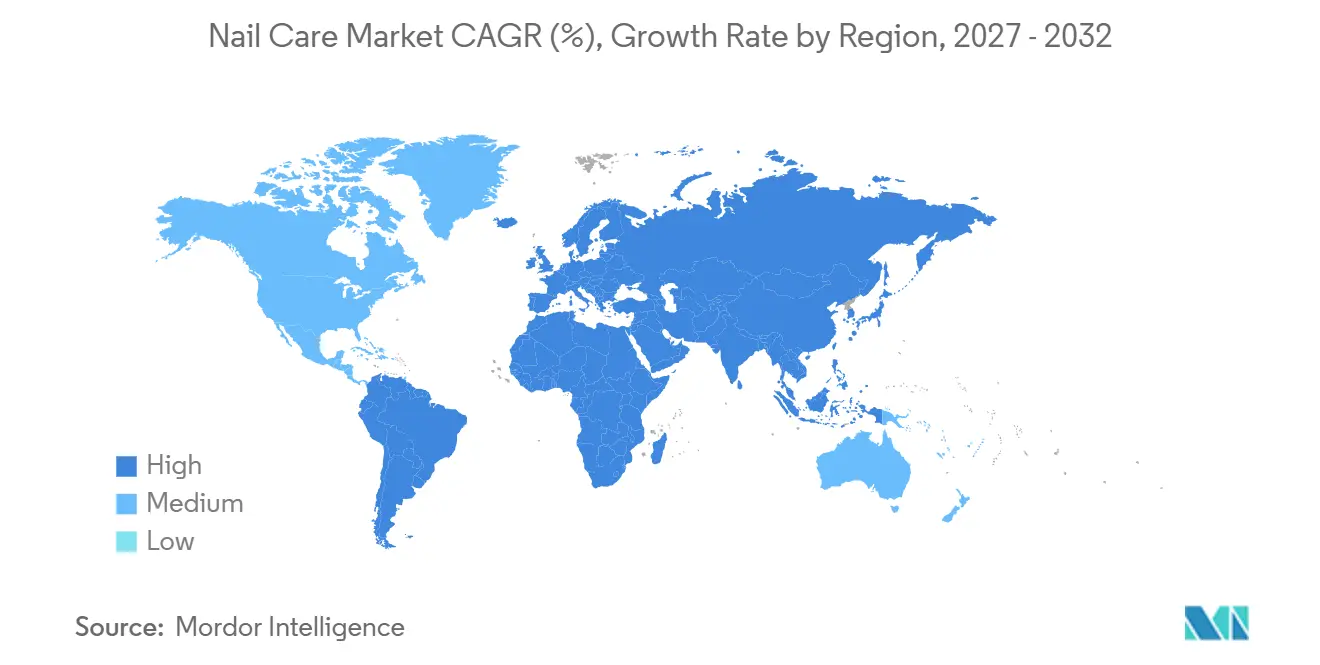
| Fastest Growing Market | Asia-Pacific |
| Largest Market | North America |
| Market Concentration | Low |
Major Players *Disclaimer: Major Players sorted in no particular order Image © Mordor Intelligence. Reuse requires attribution under CC BY 4.0. | |
Nail Care Market Analysis by Mordor Intelligence
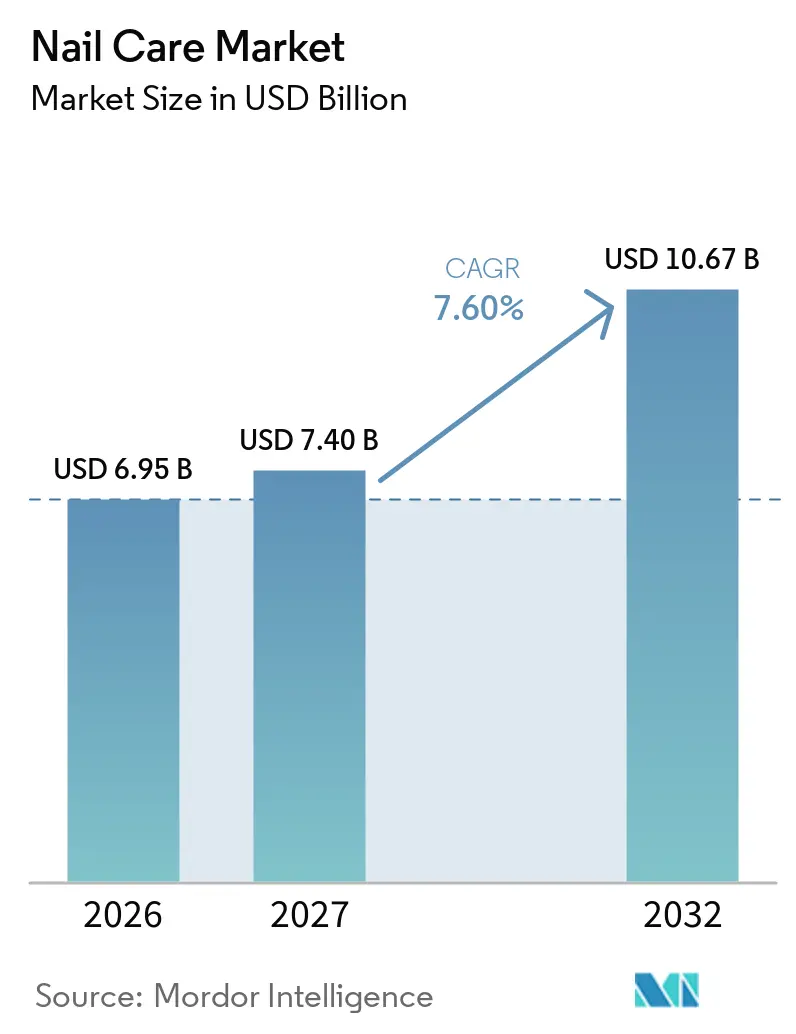
The Nail Care Market size was valued at USD 6.95 billion in 2026 and is projected to expand from USD 7.4 billion in 2027 to USD 10.67 billion by 2032, at a CAGR of 7.6% between 2027 to 2032. The nail care market is moving beyond occasional color purchases as consumers build regular routines around grooming, maintenance, and at-home treatment. Professional-quality gel systems, press-on sets, and hybrid lacquers are now available through mass retailers and e-commerce, which has widened access to formats that were once centered on salons. This wider availability can reduce the historic price premium for salon-only services, while also raising demand for products that offer visible performance at home. Safety, ingredient transparency, and long wear are becoming more important competitive factors as regulations evolve across major markets. Brands that can provide reliable claims, convenient application, and consistent distribution have room to reach both salon users and home users.
Key Report Takeaways
- By product type, nail polish held 38.4% of the nail care market share in 2026, while artificial nails and extensions are forecast to grow at an 8.3% CAGR through 2032.
- By category, mass products accounted for 66.2% of the nail care market share in 2026, while luxury and premium products are forecast to grow at a 9.2% CAGR through 2032.
- By ingredient type, conventional and synthetic formulations held 75.2% share in 2026, while natural and organic formulations are forecast to grow at an 8.5% CAGR through 2032.
- By distribution channel, health and beauty stores accounted for 37.1% share in 2026, while online retail stores are forecast to grow at a 9.3% CAGR through 2032.
- By geography, North America held 36.7% share in 2026, while Asia-Pacific is forecast to grow at an 8.7% CAGR through 2032.
Note: Market numbers in this report are based on Mordor Intelligence's proprietary estimation framework, which combines nine months of actuals with Q4 projections for base year 2026.
Market Trends and Insights
Drivers Impact Analysis of Nail Care Market*
| Driver | (~) % Impact on CAGR Forecast | Geographic Relevance | Impact Timeline |
|---|---|---|---|
| Rising focus on personal grooming and self-care | +2.3% | Global, with high intensity in North America and Asia-Pacific | Short term (≤ 2 years) |
| Product innovation in gel, hybrid, and long-wear formulations | +1.8% | North America, Europe, APAC core | Medium term (2–4 years) |
| Expansion of e-commerce and direct-to-consumer channels | +1.5% | Global; fastest adoption in APAC and North America | Short term (≤ 2 years) |
| Clean beauty and ingredient-conscious formulations | +1.0% | North America and EU, with spill-over to APAC | Medium term (2–4 years) |
| Expansion of nail salons and professional services | +0.9% | APAC core, Middle East, South America | Medium term (2–4 years) |
| Premiumization and demand for personalized nail treatments | +0.8% | North America, Europe, high-income APAC cities | Long term (≥ 4 years) |
| Source: Mordor Intelligence | |||
Rising Focus on Personal Grooming and Self-Care
The nail care market is benefiting as consumers treat nail maintenance as part of a broader personal care routine rather than a discretionary color purchase. This shift supports demand for base coats, cuticle products, strengthening treatments, and products designed for repeat use. The consumer survey reported that 97% of surveyed U.S. women maintained an active routine beyond polish, while 87% cited flexibility as the main reason for at-home treatments. The U.S. Bureau of Labor Statistics projects 12% employment growth for manicurists and pedicurists from 2023 to 2033, compared with 4% growth across all occupations, which supports continued demand for professional services[1]. As consumers use more steps in a routine, they can purchase more products on each occasion and reorder them more often. This behavior supports both salon-linked consumption and at-home maintenance across the nail care market.
Product Innovation in Gel, Hybrid, and Long-Wear Formulations
Gel-lacquer hybrids are central to product development because they offer extended wear in formats that consumers can remove without salon equipment. OPI’s updated Infinite Shine system uses pre-cured gel technology and is designed to provide up to 11 days of chip-resistant wear without UV curing. Research published International Journal of Cosmetic Science in 2025 found that a non-acrylate UV-LED system with more than 50% bio-renewable content could achieve a tack-free cure in under 60 seconds. This result addresses an earlier performance barrier for bio-based gels, especially the oxygen-inhibition issue during curing. The work also points to rising formulation demands as brands respond to safety rules and clean-label preferences. Larger suppliers can more readily fund laboratory work and validation, which may widen the product-development gap with smaller regional formulators.
Expansion of E-Commerce and Direct-to-Consumer Channels
Online retail is changing how consumers discover and purchase nail products, especially press-ons, treatments, and emerging formats. Olive & June entered 600 Ulta Beauty stores in January 2026 and later broadened its assortment through Amazon, showing how a digitally native brand can combine physical and online access. Ulta’s marketplace also added brands such as Manucurist, which gives specialist brands an additional digital route to discovery. Online channels reduce the need for an early national store footprint and give consumers more access to reviews, tutorials, and product comparisons. These features are well suited to at-home formats where a consumer wants to assess application steps before purchasing. Established suppliers therefore need strong digital conversion as well as existing health-and-beauty distribution to retain relevance in the nail care market.
Clean Beauty and Ingredient-Conscious Formulations
Ingredient awareness is changing product choices in both mass and prestige nail care. Brand claims have broadened from 3-Free formulas to 10-Free, 21-Free, and plant-based positioning as consumers pay closer attention to product composition. California and Washington restrictions on formaldehyde and formaldehyde-releasing chemicals took effect on January 1, 2025, increasing the importance of formulation review in the United States[2]. Brazilian Health Regulatory Agency (ANVISA) prohibited TPO and DMPT in Brazilian nail products in October 2026, bringing Brazilian requirements closer to EU restrictions. A 2025 scientific study also identified a mismatch between some nontoxic marketing claims and measured chemical content, which raises the value of reliable substantiation. Brands with verified claims and clearer disclosure can use this gap to build consumer confidence.
Restraints Impact Analysis of Nail Care Market*
| Restraint | (~) % Impact on CAGR Forecast | Geographic Relevance | Impact Timeline |
|---|---|---|---|
| Stringent regulatory compliance requirements | -0.9% | North America & EU, spill-over to Brazil and APAC | Medium term (2–4 years) |
| Health risks from toxic chemicals | -0.7% | Global | Short to medium term (≤ 4 years) |
| Counterfeit and low-quality products | -0.5% | APAC supply-chain origins; global consumer exposure | Short term (≤ 2 years) |
| Raw material price volatility | -0.4% | Global, acutely felt in North America and Europe | Short term (≤ 2 years) |
| Source: Mordor Intelligence | |||
Stringent Regulatory Compliance Requirements
The nail care market operates under an increasingly complex set of product and ingredient requirements. The U.S. Modernization of Cosmetics Regulation Act, known as MoCRA, requires manufacturers and processors to meet federal obligations that include product listing and facility registration. California has separately identified nail products containing Ministry of Environment and Climate Change (MMA) as an adopted priority product under its Safer Consumer Products program. The California Department of Toxic Substances Control has also assessed triphenyl phosphate in nail products, adding further scrutiny to ingredients used in coatings. These rules sit alongside EU Cosmetics Regulation No. 1223/2009 and ANVISA requirements in Brazil. The cost of reviewing formulas, retaining records, and managing different regional rules can weigh more heavily on smaller suppliers than on multinational companies with dedicated regulatory teams.
Health Risks from Toxic Chemicals
Health concerns remain a restraint because consumers and nail technicians need confidence that product labels accurately describe exposure risks. A 2025 study of formal and informal nail technicians in Johannesburg found cancer-risk estimates for benzene and formaldehyde that exceeded the U.S. EPA threshold used in the study. The same study reported health-related symptoms among 60% of informal technicians and 52% of formal technicians. The U.S. Food and Drug Administration warned consumers in April 2025 about methylene chloride in certain gel nail polish removers, although the source links to a secondary report rather than the FDA notice and is therefore not used here. In California’s product analysis, goods carrying 3-Free claims included measurable toluene and dibutyl phthalate, reinforcing concerns around label reliability. Such concerns can make retailers more cautious about brands with limited safety information and can weaken consumer willingness to pay for unsupported claims.
*Our forecasts treat driver/restraint impacts as directional, not additive. The impact forecasts reflect baseline growth, mix effects, and variable interactions.
Nail Care Market Segment Analysis
By Product Type:
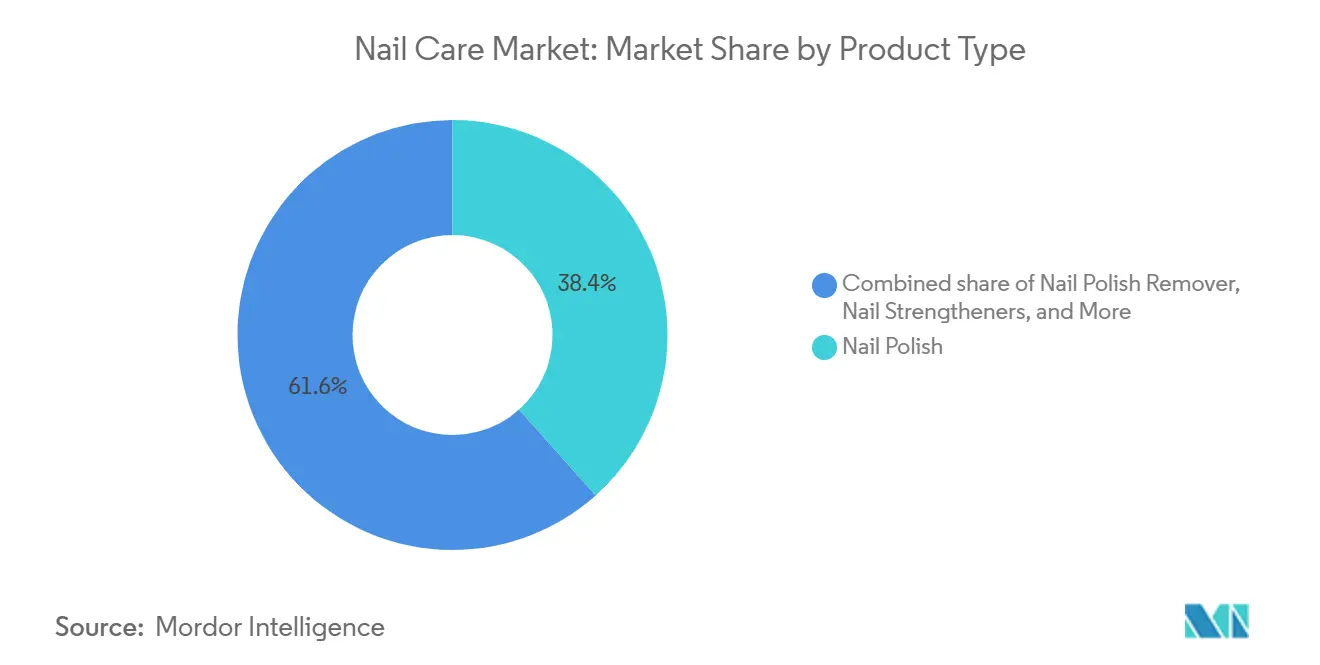
Nail Polish Provides Scale While Extensions Lead GrowthNail polish accounted for 38.4% of global category sales in 2026. It remains the category’s most widely recognized product and is often the first nail product purchased by new consumers. Its scale reflects widespread availability and continued format development across gel-lacquer hybrids, color-and-treatment combinations, and scented versions. Nail polish is also evolving through formulas that include keratin, peptides, hyaluronic acid, and botanical ingredients. These additions position some products as nail-health treatments as well as cosmetic color. Nail polish remover, strengtheners, tools, and accessories support the preparation and maintenance parts of a multistep routine.
Artificial nails and extensions are projected to expand at an 8.3% CAGR from 2027 to 2032. Press-on products are a major part of this growth because they can create a finished manicure without advanced skill or UV equipment. Their value proposition is based on convenience and a salon-like appearance for home use. The 2026 U.S. retail data indicated that press-on buyers spent more per purchase occasion than traditional polish buyers. Social platforms also support the segment because viewers see the finished design rather than the application method. This makes press-on sets particularly suitable for trend-driven designs, seasonal collections, and short-form visual content in the nail care market.



By Category:
Mass Products Support Volume While Premium Products Gain ValueThe mass category held 66.2% of global category sales in 2026. Mass products serve a broad consumer base through pharmacies, supermarkets, mass merchandisers, and other accessible outlets. Consumers frequently treat nail color as an impulse purchase, which supports high-volume distribution in this category. Beetles Gel Polish expanded from a primarily online presence into Walmart and Target locations, showing how retail access can help a newer brand reach value-focused consumers. The mass segment can provide broad scale, but its economics depend on disciplined assortments, reliable supply, and efficient distribution. It is less suited to premium pricing unless a brand can demonstrate a clear functional advantage.
Luxury and premium products are forecast to grow at a 9.2% CAGR through 2032. Consumers who are familiar with salon service quality increasingly seek comparable performance for home use. Chanel and Dior Beauty have maintained premium price points for nail lacquers through limited-color releases and packaging that signals prestige beyond the shade itself. Manucurist’s October 2026 minority investment from Inflexion focused on international expansion and clean nail care development, indicating investor interest in the overlap between premium positioning and ingredient-conscious formulas. Structured manicures using builder gels systems can also raise professional service spending. This dynamic allows premium brands to compete through service-like performance, specialized treatments, and more carefully managed brand presentation.
By Ingredient Type:
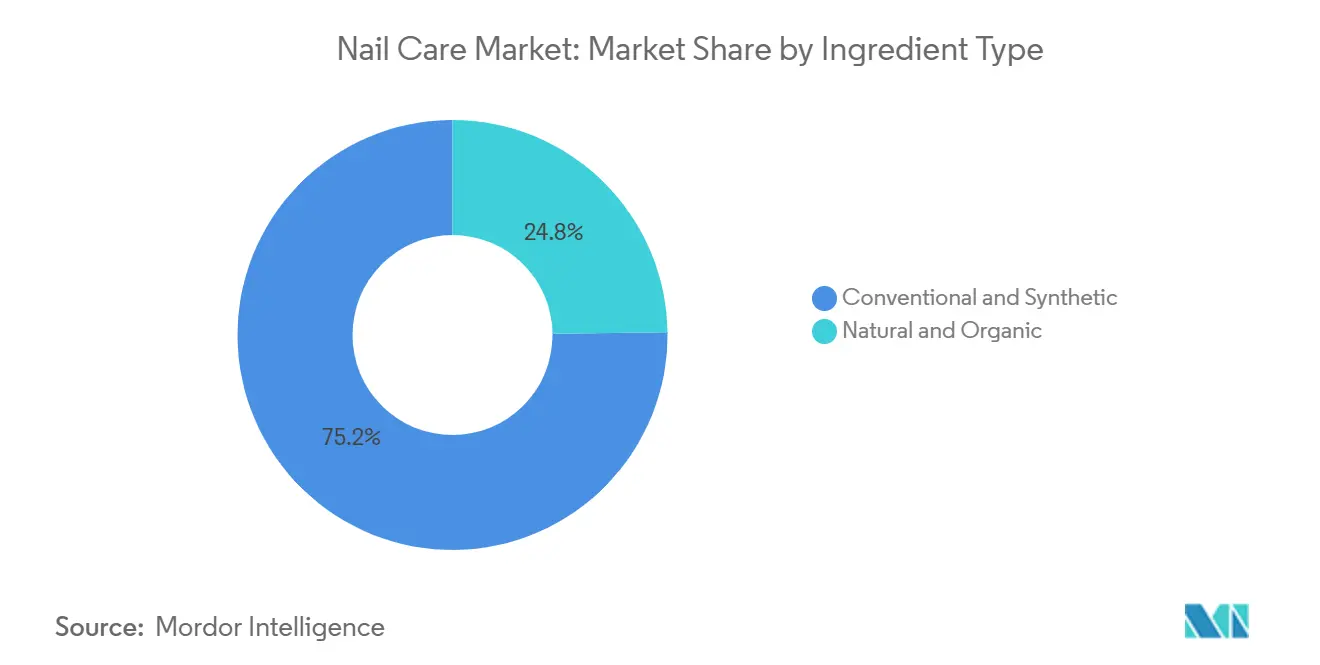
Synthetic Formulas Retain Scale While Natural Options Gain GroundConventional and synthetic formulas held 75.2% of global category sales in 2026. Their position rests on known performance, wide material availability, and lower cost in mass applications. Nitrocellulose-based film formers, plasticizers, and synthetic solvents remain part of the standard structure of many nail polish formulas. Removing all conventional ingredients may require costly technical changes and can create risks around wear, finish, and application. Many suppliers are instead removing the ingredients under greatest scrutiny while retaining the broader performance structure. This measured approach can support cleaner claims without requiring a complete formula redesign.
Natural and organic formulations are forecast to expand at an 8.5% CAGR through 2032, from a 24.8% share base in 2026. Consumer interest in sustainable and eco-conscious products is one factor supporting this shift. The 2025 consumer survey reported interest in eco-friendly nail polish among 79% of U.S. female nail consumers, but the survey publisher is not relied on as an authoritative source. The 2025 study of organic-inorganic hybrid gel systems showed that formulations with more than 50% bio-renewable content could meet performance requirements with 100% solids and zero Volatile Organic Compounds (VOC) output. Fiabila’s hybrid formula with marine extract is a commercial example of how product developers are incorporating treatment and protective attributes into nail products. These developments strengthen the technical case for natural and organic formats, even though conventional formulas continue to hold the larger base.

By Distribution Channel:
Health and Beauty Stores Lead While Online Retail Expands FasterHealth and beauty stores accounted for 37.1% of global category sales in 2026. These outlets remain important because they provide a curated environment for product discovery and often sit close to other beauty purchases or services. Specialty retailers such as Ulta Beauty and Sephora can combine branded assortments, trained staff, and selective service offerings. Olive & June’s 2026 entrance into 600 Ulta locations demonstrates how a direct-to-consumer brand can use specialty retail to build trust and encourage product trial. Supermarkets, hypermarkets, and other channels continue to serve routine replenishment needs, especially for removers and tools. Their role is especially relevant where consumers are more price sensitive and less likely to seek detailed product advice.
Online retail stores are forecast to grow at a 9.3% CAGR from 2027 to 2032. Nail content on TikTok, Instagram, and YouTube can support product discovery, while online platforms give smaller brands national reach without an early physical retail investment. This format is well suited to niche products because consumers can compare reviews, colors, and use instructions before choosing. Blank Beauty’s online customization model allows consumers to personalize polish through a three-step process and illustrates the potential for digital personalization. As online and omnichannel formats expand, physical beauty stores are likely to remain important for discovery while losing some share of repeat purchasing.
Geography Analysis
North America
North America held 36.7% of global category sales in 2026. The United States remains the largest national setting for nail products in the regional assessment, supported by a strong culture of salon visits and regular at-home maintenance. Gel manicures, dip powder, nail art, and related treatments have become recurring elements in many consumers’ grooming routines. The U.S. Bureau of Labor Statistics projects 12% employment growth for manicurists and pedicurists from 2023 to 2033, which supports continued demand at the professional-service level. This professional base can support sales of consumables, maintenance items, and at-home extensions. Regulatory influence is also significant, with MoCRA, California formaldehyde restrictions, and state-level PFAS and heavy-metal rules raising the value of credible safety practices. California’s designation of nail products containing MMA as a priority product shows that compliance issues can directly affect product choices and retailer standards. The region offers opportunities for brands that pair product performance with clearer ingredient communication and retail execution.
Asia-Pacific
Asia-Pacific is forecast to grow at an 8.7% CAGR from 2027 to 2032. China is the region’s manufacturing hub for manicure and pedicure preparations and is also developing as a consumer market in major cities. Premium salon chains and brand-led studios are gaining visibility in these urban areas, while lower-cost operators continue to serve a broad customer base. India is positioned in the analysis as a high-growth market due to rising disposable income among consumers aged 18 to 35 and increasing e-commerce use beyond major cities. South Korea has an important role in setting aesthetics through beauty creators and the K-beauty export ecosystem. Nail styles that gain visibility in South Korea can influence product launches and salon menus across Southeast Asia and other regions. This makes regional trend tracking, fast product adaptation, and social commerce capabilities important for brands seeking expansion. China’s manufacturing capacity also places greater focus on product safety controls and traceability when products are sold across regulated markets.
Europe, South America, and the Middle East and Africa
Europe is shaped by EU Cosmetics Regulation No. 1223/2009, which has encouraged early adoption of formulations designed around stricter ingredient standards. Brands selling across regions may need to comply with EU requirements or manage separate product formulas. Spain’s nail salon base and the expansion of premium salon concepts demonstrate continued demand for professional services, although the figures from an industry publication are not repeated because they do not meet the source standard. Townhouse had expanded its premium salon model across Europe and the United States, which shows the potential for consistent service quality and a recognizable brand experience. In South America, Brazil’s October 2026 ANVISA action on TPO and DMPT can speed formula upgrades and restrict weaker imports. The Middle East and Africa are shaped by urban beauty spending and, where relevant, halal certification expectations. The UAE and Saudi Arabia are positioned as important locations for professional services and premium retail, while certification and ingredient standards can influence product selection.
Competitive Landscape
Market Concentration
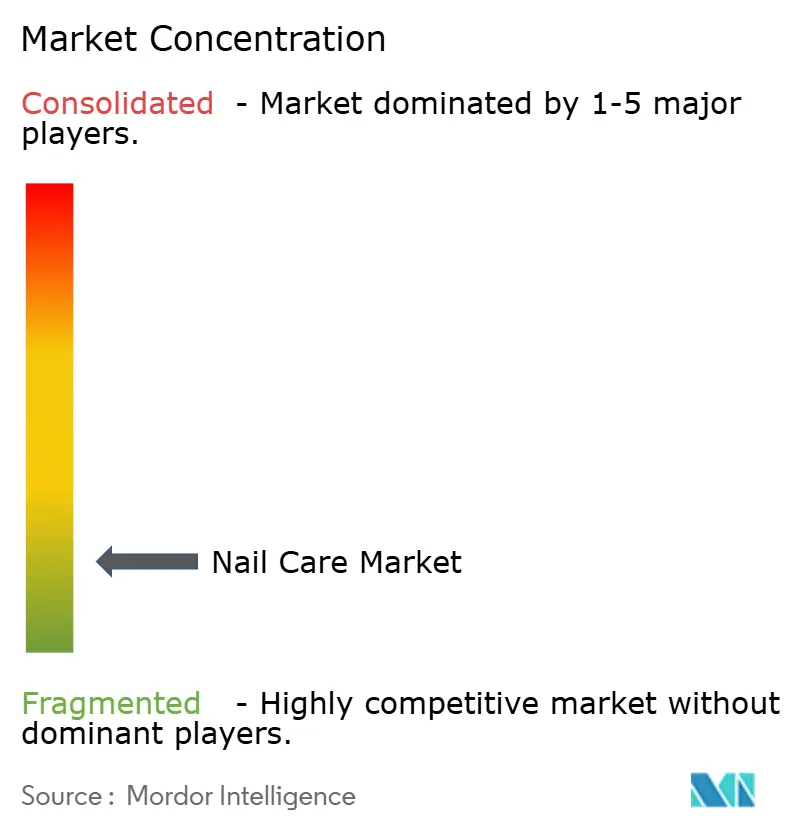
The nail care market is highly fragmented, with the top 10 players collectively holding less than 30% market share and no company in a dominant position. The competitive landscape includes global beauty groups, professional suppliers, direct-to-consumer brands, and emerging platform-based brands. L’Oréal Groupe, Creative Nail Design, ORLY International, Olive & June, Manucurist, Beetles Gel Polish, Cosnova, Colorbar Cosmetics, Chanel, and Dior Beauty operate across different parts of the market. Companies use mass-market, professional, prestige, and clean-label brands to meet varied consumer needs. Global groups benefit from broad distribution networks, while specialist brands can introduce formula updates and focused launches more quickly. Brand agility, product credibility, and retail access are therefore as important as scale.
The market also offers opportunities in men’s grooming, hypoallergenic gel systems, and digital personalization. Talons reported more than 10,000 orders in its first year on SHOPLINE after expanding its nail range for male consumers. However, the report was syndicated through a non-primary outlet and should not be treated as verified evidence. The content also references HONA’s November 2025 partnership with Ellisons for systems free from HEMA, HPMA, TPO, and IBOA, addressing allergy concerns. As this date is after the current year, the information requires verification. Online try-on tools, data-driven color planning, and made-to-order production can help smaller suppliers reduce inventory needs. Research on acrylate-free, bio-based UV-LED gels may also offer intellectual property benefits for early developers.
The content also cites company initiatives dated 2026, which require verification because they fall after the current year. Manucurist reportedly received minority investment from Inflexion in October 2026 to support international growth, US retail expansion, digital channels, and product development. The GelBottle Inc reportedly entered 487 CosmoProf stores in the United States in May 2026 with BIAB, gel polish, and extension lines. Sally Hansen reportedly launched Miracle Gel Super Charged Shades, gel-free Short’Ease Press-Ons, Gel Rehab Nail Repair Serum, and the Color Therapy Scented Collection in January 2026. These initiatives highlight retail expansion, hybrid-performance products, repair solutions, press-on nails, and treatment-led care. They also show the importance of clear product claims and accessible consumer education.
Nail Care Industry Leaders
-
L’Oréal Groupe
-
Coty Inc.
-
Shiseido Company, Limited
-
Unilever PLC
-
The Estée Lauder Companies Inc.
- *Disclaimer: Major Players sorted in no particular order
Nail Care Market Companies Covered in this Report
- L’Oréal Groupe
- Coty Inc.
- Shiseido Company, Limited
- Unilever PLC
- The Estée Lauder Companies Inc.
- Revlon, Inc.
- AMERICAN INTERNATIONAL INDUSTRIES
- ORLY International, Inc.
- Creative Nail Design, Inc.
- Cosnova GmbH
- Olive & June
- Art of Beauty, Inc.
- Nail Tek
- Nails Inc.
- Butter London
- Manucurist
- KIKO S.p.A.
- Chanel Limited
- LVMH Moët Hennessy Louis Vuitton SE
- Colorbar Cosmetics Pvt. Ltd.
Recent Industry Developments in Nail Care Market
- October 2026: Manucurist receives minority investment from Inflexion. European private equity firm Inflexion took a minority stake in French clean nail brand Manucurist. The partnership targets accelerated international growth, with a focus on U.S. retail and digital expansion, alongside new product development for clean nail care. The transaction places clean formulas, international distribution, and digital access at the center of the brand’s next stage in the nail care market.
- October 2026: Townhouse signs a franchise agreement with PRCNX Italia. Premium nail salon group Townhouse executed a 40-salon franchise agreement with PRCNX Italia to enter Italy, with the first location expected in Milan. The agreement extends Townhouse’s European footprint and supports franchise-led growth in premium salon services. It also moves the business beyond its existing United Kingdom and broader European base. The planned rollout indicates that a standardized premium salon model can be adapted through local franchise partners.
- May 2026: The GelBottle Inc launches across 487 CosmoProf stores in the United States. The GelBottle Inc partnered with Beauty Systems Group to enter 487 CosmoProf locations. The range includes BIAB, gel polish, and extension lines, with a larger fixture in 96 stores and an essential range in 391 stores. The rollout gives a United Kingdom professional brand a wider physical base in the United States. It also places builder gels and extensions beside core polish products in a professional retail setting.
- January 2026: Olive & June debuts at Ulta Beauty. Olive & June launched in 600 Ulta Beauty stores and on Ulta.com on January 18, 2026. The range includes polish, press-ons, treatments, tools, and an Ulta-exclusive Gel Mani System. The launch followed Helen of Troy’s late-2024 acquisition of Olive & June for USD 240 million. It marks a move from a digitally led model into prestige beauty retail and reinforces the importance of omnichannel access in the nail care market.
Global Nail Care Market Report Scope
The Nail Care Market refers to the market for products designed to maintain, protect, strengthen, groom, and enhance the appearance of fingernails and toenails, including nail cosmetics, treatment products, and grooming tools and accessories. By product type, the market is segmented into nail polish, nail polish remover, nail strengtheners, nail tools and accessories, and artificial nails and extensions. By category, the market is divided into mass and luxury/premium products. By ingredient type, the market is segmented into natural and organic, and conventional and synthetic products. By distribution channel, the market is divided into supermarkets/hypermarkets, health and beauty stores, online retail stores, and other channels. Geographically, the market covers North America, Europe, Asia-Pacific, South America, and the Middle East and Africa, with country-level coverage across major markets, including the United States, Canada, Mexico, Germany, the United Kingdom, Italy, France, Spain, the Netherlands, Poland, Belgium, Sweden, China, India, Japan, Australia, Indonesia, South Korea, Thailand, Singapore, Brazil, Argentina, Colombia, Chile, Peru, South Africa, Saudi Arabia, the United Arab Emirates, Nigeria, Egypt, Morocco, and Turkey, along with the respective regional rest-of-country categories. Market size and growth forecasts are presented in terms of value (USD).
Segmentation Overview
| Nail Polish |
| Nail Polish Remover |
| Nail Strengtheners |
| Nail Tools and Accessories |
| Artificial Nails and Extensions |
| Mass |
| Luxury/Premium |
| Natural and Organic |
| Conventional and Synthetic |
| Supermarkets/Hypermarkets |
| Health and Beauty Stores |
| Online Retail Stores |
| Other Channels |
| North America | United States |
| Canada | |
| Mexico | |
| Rest of North America | |
| Europe | Germany |
| United Kingdom | |
| Italy | |
| France | |
| Spain | |
| Netherlands | |
| Poland | |
| Belgium | |
| Sweden | |
| Rest of Europe | |
| Asia-Pacific | China |
| India | |
| Japan | |
| Australia | |
| Indonesia | |
| South Korea | |
| Thailand | |
| Singapore | |
| Rest of Asia-Pacific | |
| South America | Brazil |
| Argentina | |
| Colombia | |
| Chile | |
| Peru | |
| Rest of South America | |
| Middle East and Africa | South Africa |
| Saudi Arabia | |
| United Arab Emirates | |
| Nigeria | |
| Egypt | |
| Morocco | |
| Turkey | |
| Rest of Middle East and Africa |
| By Product Type | Nail Polish | |
| Nail Polish Remover | ||
| Nail Strengtheners | ||
| Nail Tools and Accessories | ||
| Artificial Nails and Extensions | ||
| By Category | Mass | |
| Luxury/Premium | ||
| By Ingredient Type | Natural and Organic | |
| Conventional and Synthetic | ||
| By Distribution Channel | Supermarkets/Hypermarkets | |
| Health and Beauty Stores | ||
| Online Retail Stores | ||
| Other Channels | ||
| By Geography | North America | United States |
| Canada | ||
| Mexico | ||
| Rest of North America | ||
| Europe | Germany | |
| United Kingdom | ||
| Italy | ||
| France | ||
| Spain | ||
| Netherlands | ||
| Poland | ||
| Belgium | ||
| Sweden | ||
| Rest of Europe | ||
| Asia-Pacific | China | |
| India | ||
| Japan | ||
| Australia | ||
| Indonesia | ||
| South Korea | ||
| Thailand | ||
| Singapore | ||
| Rest of Asia-Pacific | ||
| South America | Brazil | |
| Argentina | ||
| Colombia | ||
| Chile | ||
| Peru | ||
| Rest of South America | ||
| Middle East and Africa | South Africa | |
| Saudi Arabia | ||
| United Arab Emirates | ||
| Nigeria | ||
| Egypt | ||
| Morocco | ||
| Turkey | ||
| Rest of Middle East and Africa | ||
Key Questions Answered in the Report
What is the projected value of the nail care sector by 2032?
The nail care market is projected to reach USD 10.67 billion by 2032, growing at a 7.6% CAGR from 2027 to 2032. Its growth is supported by recurring home care routines and broader access to professional-style formats.
Which product category leads nail care sales?
In the nail care market, nail polish leads by product type with a 38.4% share in 2026. Its established role, broad availability, and ongoing formula updates support its position.
What is the fastest-growing nail product segment?
Artificial nails and extensions are projected to grow at an 8.3% CAGR through 2032 in the nail care market. Convenient press-on formats support the segment because they offer a salon-like appearance for home use.
Which sales channel is growing fastest for nail products?
Online retail stores are forecast to grow at a 9.3% CAGR through 2032 in the nail care market. Product reviews, tutorials, direct-to-consumer access, and easier discovery of niche brands support this expansion.
Why are clean nail formulas becoming more important?
California restrictions and ANVISA’s 2026 ban on TPO and DMPT increase the need for safer formulations, reliable claims, and clear ingredient disclosure. In the nail care market, these requirements can affect product development and retailer confidence. The nail care market must also balance verified safety communication with product performance and consumer ease of use.