
Mining Pumps Market Size and Share
Market Overview
| Study Period | 2022 - 2032 |
|---|---|
| Market Size (2027) | USD 3.01 Billion |
| Market Size (2032) | USD 3.65 Billion |
| Growth Rate (2027 - 2032) | 3.94 % |
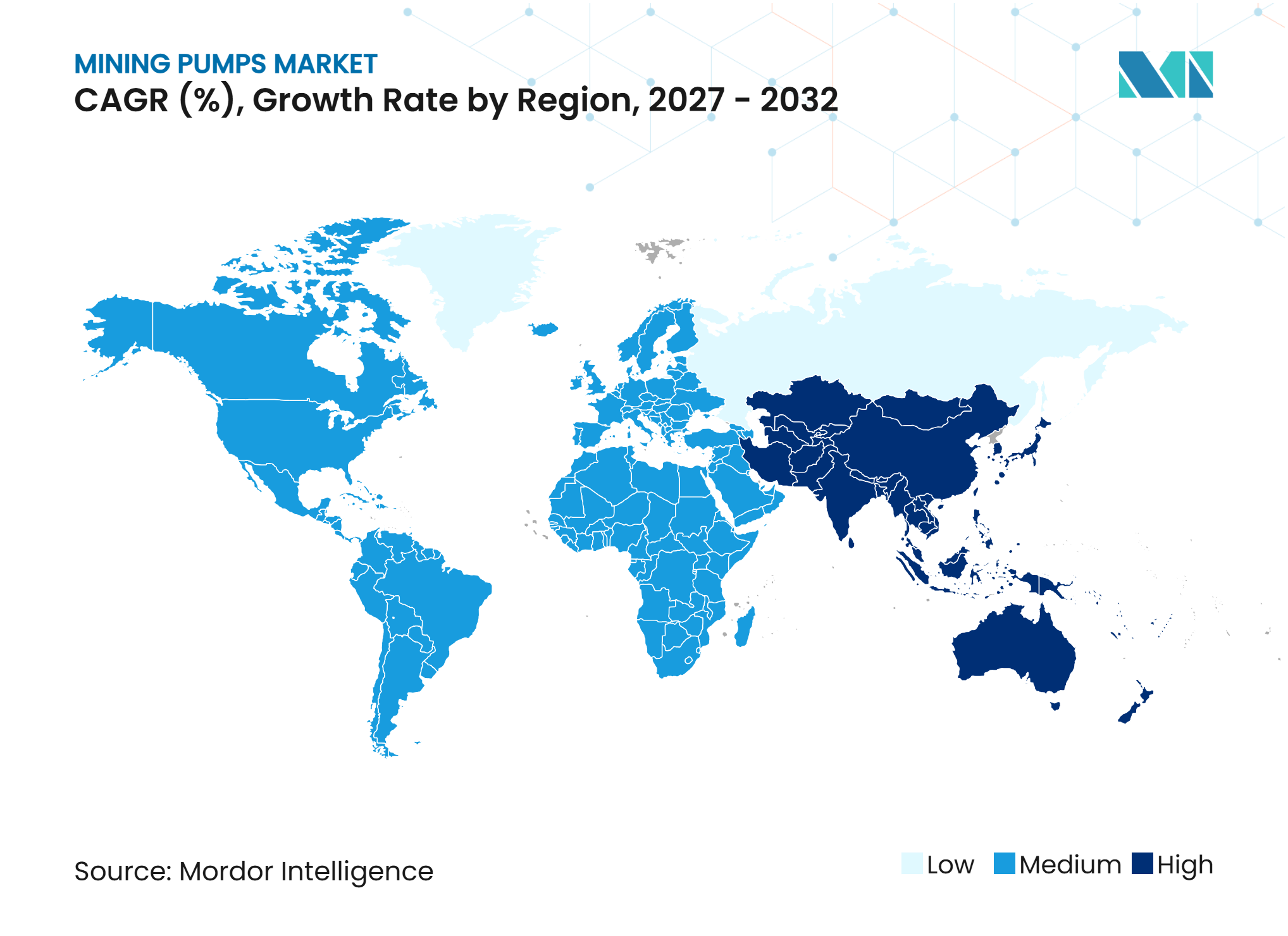
| Fastest Growing Market | Asia-Pacific |
| Largest Market | Asia-Pacific |
| Market Concentration | Low |
Major Players *Disclaimer: Major Players sorted in no particular order Image © Mordor Intelligence. Reuse requires attribution under CC BY 4.0. | |
Mining Pumps Market Analysis by Mordor Intelligence
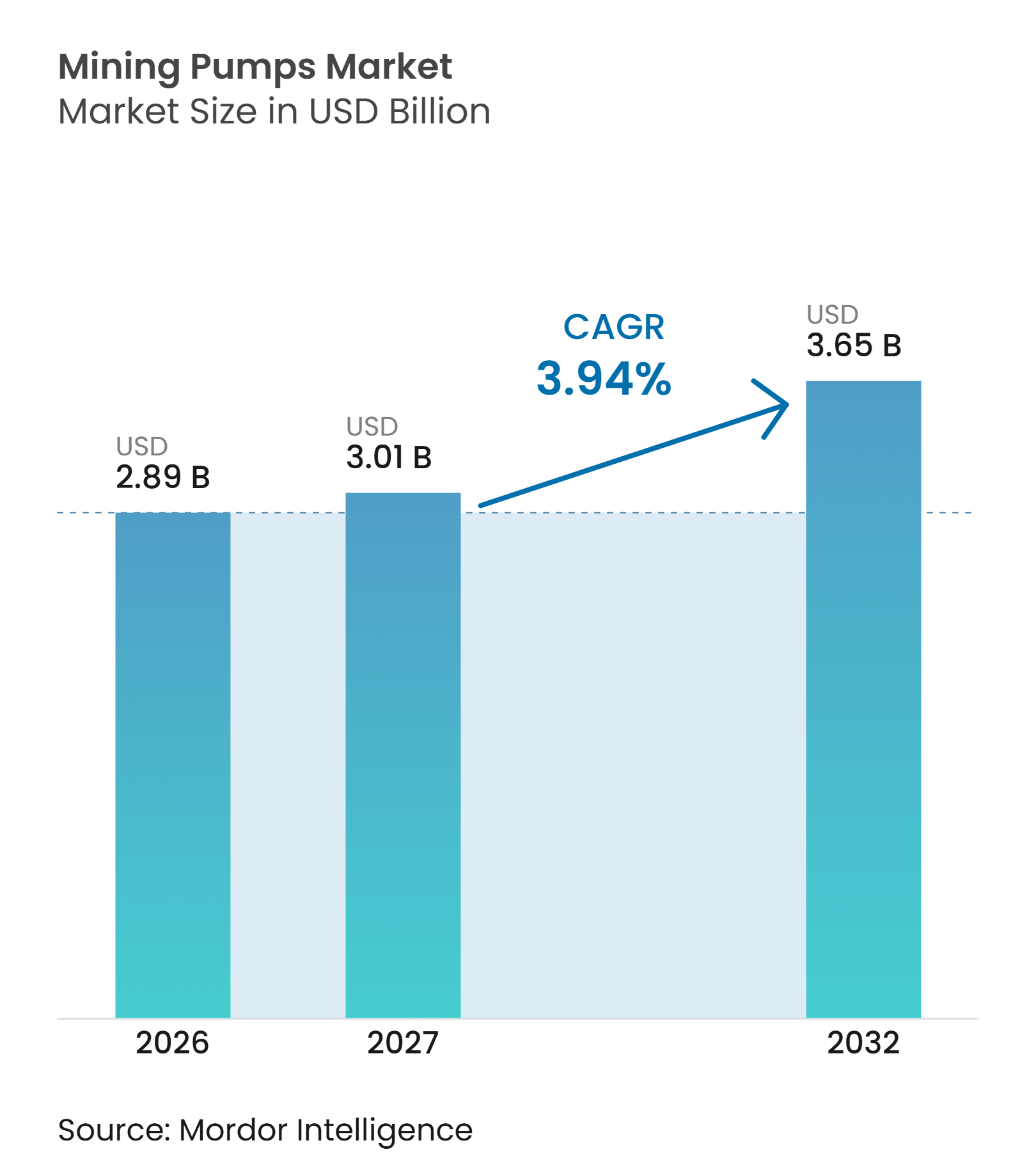
The Mining Pumps Market size was valued at USD 2.89 billion in 2026 and is estimated to grow from USD 3.01 billion in 2027 to reach USD 3.65 billion by 2032, at a CAGR of 3.94% during the forecast period (2027-2032). Growth is tied to higher capital spending on copper, lithium, cobalt, and other critical-mineral projects, which require dewatering, slurry movement, and process-water systems throughout mine life. Deeper workings and tighter water controls are raising the value placed on high-head, energy-efficient equipment. The Global mining pumps market is also moving toward systems that combine pumps with monitoring, wear components, and service support. This gives established suppliers an advantage because mine operators must balance up time, energy use, and discharge compliance. Environmental requirements can delay projects, but they also support demand for recirculation and seawater-transfer systems.
Key Report Takeaways
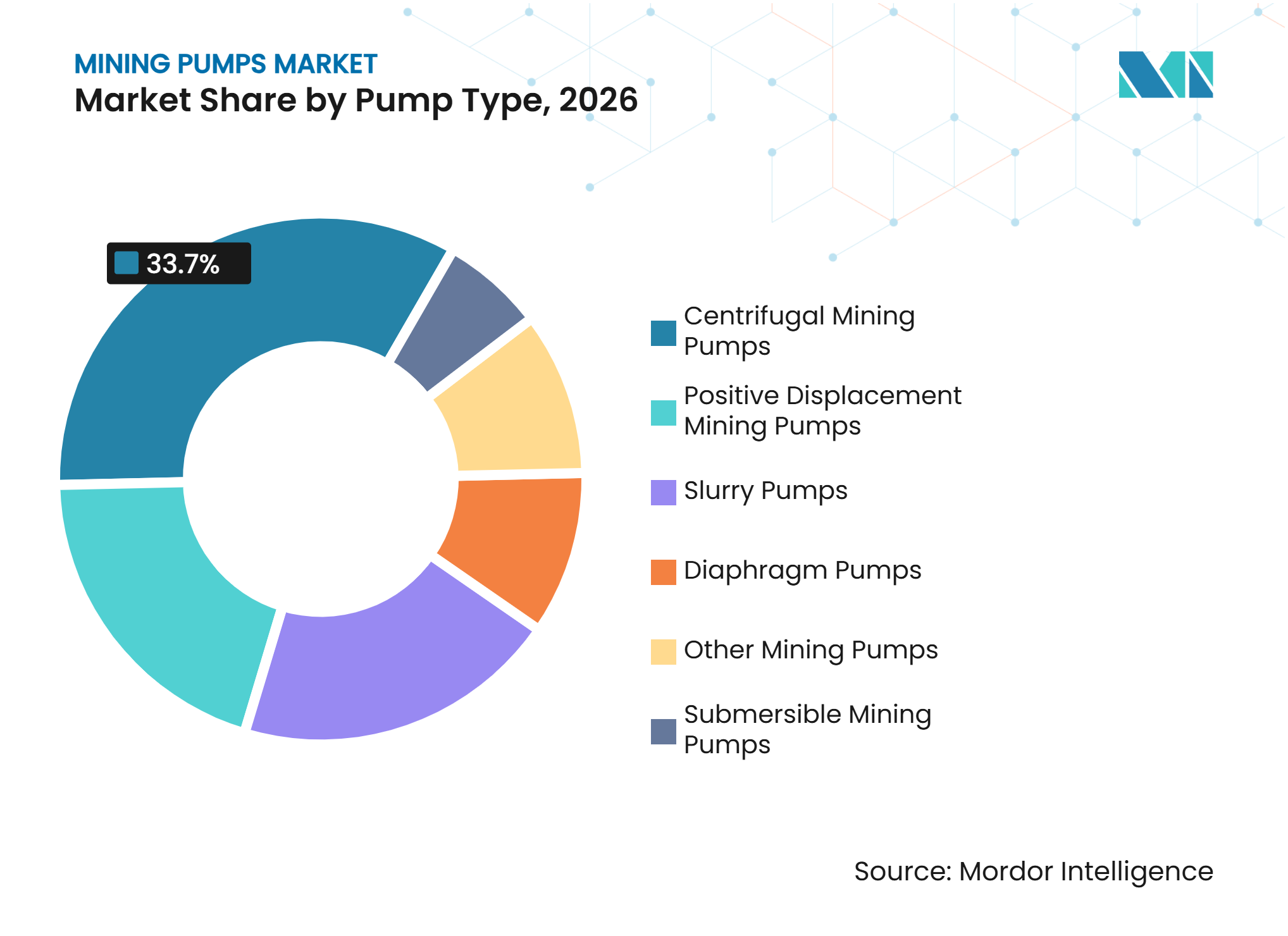
- By pump type, centrifugal pumps held 33.7% of the Global mining pumps market share in 2026, while slurry pumps are forecast to expand at a 4.5% CAGR through 2032.
- By pump design, horizontal pumps held 41.5% of total demand in 2026, while multistage pumps are forecast to expand at a 4.2% CAGR through 2032.
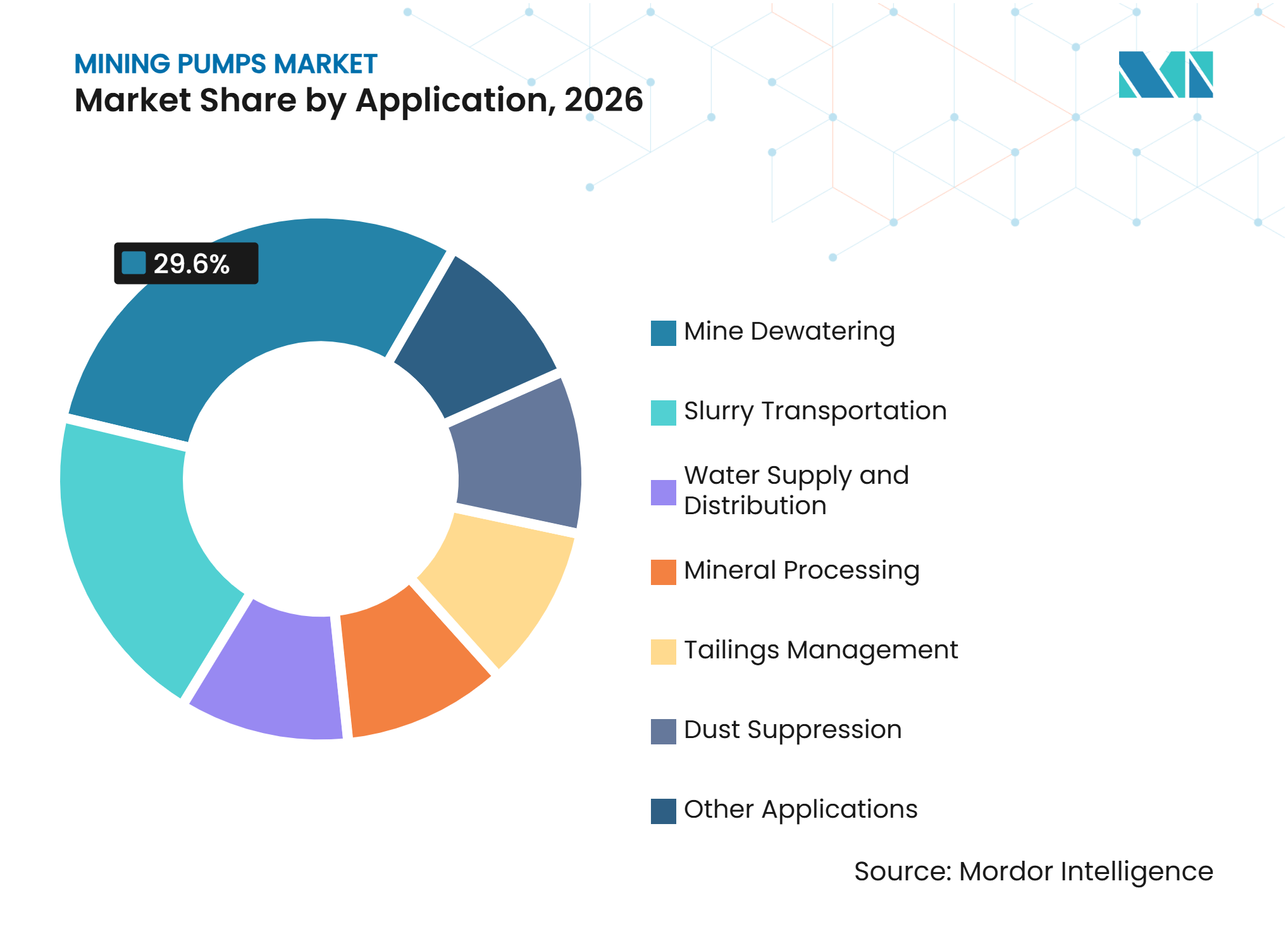
- By application, mine dewatering held 29.6% of the Global mining pumps market size in 2026, while slurry transportation is forecast to expand at a 4.6% CAGR through 2032.
- By geography, Asia-Pacific held 68.1% of total demand in 2026 and is forecast to expand at 4.4% CAGR through 2032.
Note: Market numbers in this report are based on Mordor Intelligence's proprietary estimation framework, which combines nine months of actuals with Q4 projections for base year 2026.
Market Trends and Insights
Drivers Impact Analysis of Mining Pumps Market*
| Driver | (~) % Impact on CAGR Forecast | Geographic Relevance | Impact Timeline |
|---|---|---|---|
| Critical-Mineral and Copper Mining Expansion | +1.1% | Global, with concentration in Asia-Pacific, South America, and Middle East and Africa | Medium term (2-4 years) |
| Increasing Mine Depth and Water Ingress | +0.8% | Asia-Pacific, South America | Long term (≥ 4 years) |
| Higher Slurry Throughput and Tailings-Handling Requirements | +0.6% | Global, with strongest relevance in Asia-Pacific and South America | Medium term (2-4 years) |
| Water Reuse and Closed-Loop Mine-Water Systems | +0.5% | Asia-Pacific, South America, and Middle East and Africa | Medium term (2-4 years) |
| Smart Pumping, Remote Monitoring, and Predictive Maintenance | +0.5% | Global, with early adoption in North America and Europe | Short term (≤ 2 years) |
| Replacement of Inefficient Pump Fleets | +0.4% | Global, with higher relevance in aging Asia-Pacific mine infrastructure | Short term (≤ 2 years) to Medium term (2-4 years) |
| Source: Mordor Intelligence | |||
Expansion of Critical-Mineral and Copper Mining Capacity
New copper and battery-mineral developments are creating equipment demand beyond the normal replacement cycle in the Global mining pumps market. New projects need complete dewatering, mill-discharge, froth, slurry, and sump systems before production begins. Metso received a 2025 order to supply a full pump package for South32’s Hermosa critical-minerals project in Arizona. The package covered vertical froth pumps, mill-discharge pumps, Orion slurry pumps, and sump pumps.[1] The Weir Group also reported a GBP 18 million order for GEHO positive-displacement pumps for an Indonesian nickel expansion during 2025.[2] These contracts create longer delivery cycles and can establish aftermarket relationships for the operating life of a mine.
Increasing Mine Depth and Water Ingress
Deeper mines increase the pumping head required to remove water from active workings in the Global mining pumps market. This favors high-head systems over standard arrangements that need multiple pumps in series. Atlas Copco introduced its PAC SH super high-head dewatering range in 2025 for demanding dewatering work, with a reported maximum head of 235 meters and flow of up to 1,980 m³/h.[3] ISO 22932-9:2025 provides standardized mining drainage terminology, which can make equipment specifications clearer for international projects.[4] Heavy rainfall can also increase unplanned dewatering requirements at operating mines. The Global mining pumps market therefore benefits when operators maintain high-capacity equipment for both planned drainage and sudden water ingress.
Water Reuse and Closed-Loop Mine-Water Systems
Water scarcity is changing pump selection in the Global mining pumps market, especially where operators must reuse processed water or move desalinated seawater inland. Chile’s mining policy has encouraged a shift from continental water to seawater sources for mining operations. This increases demand for corrosion-resistant, high-pressure transfer systems that can work across long distances and large elevation changes. The Chilean Copper Commission reported that seawater use in copper mining continued to increase as freshwater withdrawals fell. BHP has invested in desalination infrastructure that supports its Chilean operations. Australia’s water licensing requirements also make water management part of mine planning. Closed-loop systems can support steady demand in the Global mining pumps market because pump investment becomes linked to operating permissions rather than solely to output growth.
Smart Pumping, Remote Monitoring, and Predictive Maintenance
Digital monitoring is moving from an optional feature to a practical way to manage downtime and energy use. Xylem’s Flygt Bibo Alpha has been tested at Boliden’s Renström underground mine in Sweden. Xylem stated that the system achieved energy savings of up to 60% and wear reduction of up to 70% under the cited operating conditions. Tsurumi also demonstrated its Tsurumi Connect platform at Bauma 2025, showing how connected pump installations can coordinate multiple units. These systems help maintenance teams identify changes in vibration, temperature, and energy use before a failure disrupts production. The Global mining pumps market can gain from retrofits as well as from sales of new connected equipment.
Restraints Impact Analysis of Mining Pumps Market*
| Restraint | (~) % Impact on CAGR Forecast | Geographic Relevance | Impact Timeline |
|---|---|---|---|
| Commodity-Price Volatility and Deferred Mine Capital Expenditure | -0.7% | Global, particularly nickel- and lithium-exposed regions | Short term (≤ 2 years) |
| High Energy Intensity of Pumping Operations | -0.6% | Global, particularly energy-cost-sensitive Asia-Pacific and Africa | Medium term (2-4 years) |
| Abrasive and Corrosive Operating Conditions | -0.5% | Global, with greater relevance in deep and hard-rock Asia-Pacific mines | Long term (≥ 4 years) |
| Lengthy Environmental Permitting and Discharge Approvals | -0.4% | Asia-Pacific, South America, and North America | Medium term (2-4 years) |
| Source: Mordor Intelligence | |||
High Energy Intensity of Pumping Operations
Pumping is a major source of electricity consumption in the global mining pumps market, particularly where slurry moves over long distances or water must be lifted from deep workings. Pump fleets can account for 25% to 40% of a mine's total energy consumption. This makes electricity costs a direct consideration in decisions to expand, replace, or extend service intervals for pump fleets. Higher-efficiency motors and variable-speed drives can reduce energy consumption, but fleet-wide upgrades require capital that some operators may defer. The U.S. Department of Energy maintains efficiency standards for commercial and industrial pumps under 10 Code of Federal Regulations (CFR) Part 431. Australia applies guidance for assessing pump-system efficiency through AS ISO/ASME 14414, which places greater emphasis on system-level energy performance.
Commodity-Price Volatility and Deferred Mine Capital Expenditure
Pump demand is linked to mine construction, processing rates, and sustaining capital, all of which respond to commodity prices. Lower nickel and lithium prices during 2025 reduced activity in some operations and restrained demand for associated equipment. The Weir Group identified weaker activity in these commodities as a factor affecting its mining business during 2025. KSB SE & Co. KGaA reported a decline in mining sales during 2025, partly due to weaker demand for spare parts. Copper and gold projects can provide a more stable base for expansion, but large mine approvals remain uneven. A delay in one major project can shift equipment orders across several years and affect the Global mining pumps market.
*Our forecasts treat driver/restraint impacts as directional, not additive. The impact forecasts reflect baseline growth, mix effects, and variable interactions.
Mining Pumps Market Segment Analysis
By Pump Type:
Centrifugal Pumps Lead Installed Demand While Slurry Pumps Grow FasterCentrifugal pumps held 33.7% of total demand in 2026. They are used in dewatering, mineral processing, and water supply duties where solids levels are manageable and operators need continuous flow. Their broad installed base supports recurring revenue from replacement parts, seals, liners, and service. The equipment is widely understood by mine maintenance teams and is available across many common flow and pressure ranges. This makes centrifugal systems a practical choice for surface and underground operations.
Slurry pumps are forecast to grow at a 4.5% CAGR through 2032, the highest rate within pump types. Higher ore throughput and denser tailings require equipment that can withstand abrasion and continue operating under heavy solids loads. KSB GIW launched its LCC Gen2 slurry pump series in 2025 with a front pull-out shaft seal design and zinc-plated fasteners intended to improve serviceability. Submersible pumps serve deep dewatering duties where installation space is limited. Positive-displacement pumps are used where stable high pressure is needed for thickened tailings and backfill.



By Pump Design:
Horizontal Pumps Retain Scale While Multistage Pumps Address DepthHorizontal pumps accounted for 41.5% of total demand in 2026. Their wide use reflects straightforward access for inspection and maintenance, established supply chains, and proven performance in surface operations. Mine operators can often use standardized spare parts for common horizontal configurations. This can lower repair time at remote locations with limited technical resources. Horizontal systems remain relevant in dewatering sumps, process-water circuits, and lower-head slurry duties across the Global mining pumps market.
Multistage pumps are forecast to grow at 4.2% CAGR through 2032 as underground mines reach greater depths. Multiple impellers allow higher pressure within a compact unit, which can reduce the need for a larger staged arrangement. Atlas Copco’s PAC SH range reflects this need for high-head dewatering in difficult mine conditions. Vertical pumps continue to support sump and pit applications where suction conditions limit horizontal equipment. Single-stage pumps remain suitable for lower-head, high-flow applications such as process-water circulation.
By Application:
Mine Dewatering Provides a Stable Base While Slurry Transportation ExpandsMine dewatering held 29.6% of total demand in 2026. Water removal is necessary for mine safety and production continuity, so it remains a core application even when broader capital budgets tighten. Discharge requirements can increase the specification of dewatering equipment because operators must control both the volume and quality of released water. In the United States, the National Pollutant Discharge Elimination System sets permit requirements for point-source discharges to surface waters. This can increase demand for reliable pumps, monitoring systems, and water-treatment links across the Global mining pumps market.
Slurry transportation is projected to expand at 4.6% CAGR through 2032. Mine operators use slurry pipelines to move ore and tailings over distance while reducing reliance on truck haulage in selected applications. FLSmidth reported 12% organic revenue growth in its Pumps, Cyclones and Valves business during 2025, supported by mining activity and customer investment. Mineral processing also requires pumps for mills, flotation circuits, and thickeners. Metso states that its MD series mill-discharge pumps can reduce water use by up to 50% in specific applications.

Geography Analysis
Asia-Pacific
Asia-Pacific held 68.1% of total demand in 2026 and is forecast to grow at a 4.4% CAGR through 2032. China, Australia, Indonesia, and India support the Global mining pumps market through large coal, iron ore, base-metal, and critical-mineral operations. China adopted the MT/T 1289-2025 efficiency standard for explosion-proof submersible pumps used in coal mines, which adds weight to energy performance in procurement. Australia’s critical-minerals investment and Indonesia’s nickel projects create demand for dewatering, slurry, and tailings systems, as shown by Weir’s 2025 GEHO order for Indonesia.
North America
North America is seeing renewed interest in domestic critical-mineral supply, which supports brownfield expansions and selected new projects. The U.S. Department of Energy’s pump standards encourage higher energy performance and can influence equipment choice. Metso’s Hermosa order shows that new projects can require equipment across dewatering, processing, and water-handling duties. The Global mining pumps market in North America also favors systems that support energy control, remote supervision, and discharge compliance.
Europe, South America, and Middle East and Africa
Europe has demand from deep hard-rock mines, where high-head dewatering and remote monitoring can reduce intervention at depth. Xylem’s work with Boliden at Sweden’s Renström mine showed the potential of smart dewatering systems to reduce energy use and wear. South American demand is closely tied to Chilean and Peruvian copper production, while water scarcity increases the need for seawater transfer and recirculation. The Global mining pumps market in Middle East and Africa has room for project-led growth in gold mining and tailings retreatment. Schurco Slurry announced a 2025 supply of 146 complete pump sets for a South African tailings retreatment project. Water rules, tailings management, and deeper operations can favor specialized suppliers across these regions.
Competitive Landscape
Market Concentration
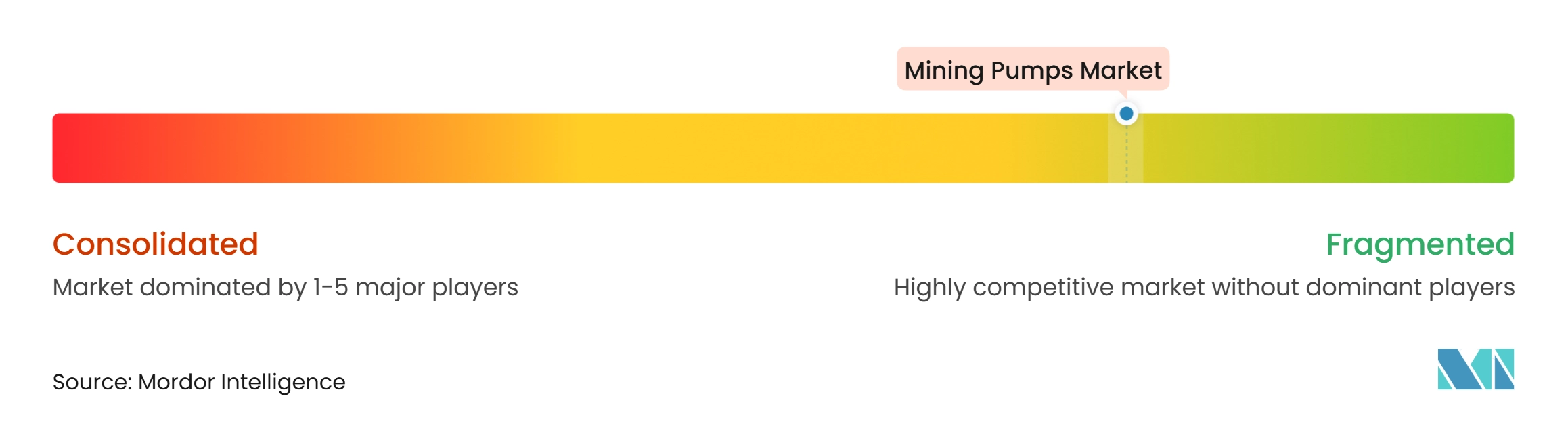
The Global mining pumps market is fragmented industry. Broadline manufacturers compete with specialists that have strong positions in slurry, dewatering, and high-pressure applications. Leading suppliers seek recurring revenue from replacement parts, wear components, field services, and service agreements. The Weir Group reported that it won more than 90% of its large mill-circuit pump field trials in 2025. This can strengthen its installed base and future parts and service demand.
Companies in the Global mining pumps market are expanding their packages through acquisitions and product development. Metso acquired Q&R Industrial Hoses in 2025, adding hose and pinch-valve-sleeve capability to its pumps, pipes, valves, and hydrocyclones offering. FLSmidth’s Pumps, Cyclones and Valves business reported 12% organic revenue growth in 2025. KSB introduced the GIW VMD vertical slurry pump in 2025, using a dual-suction configuration for demanding slurry duties. These moves place emphasis on uptime, wear performance, and broader circuit integration.
Smaller producers in the Global mining pumps market can compete in specialist applications by offering shorter lead times or site-specific customization. ISO 9906 provides an international framework for hydraulic performance acceptance testing of rotodynamic pumps. International Electrotechnical Commission (IEC) efficiency classes provide a common reference point for motor performance. The Global mining pumps market has space for specialists, but larger companies have an advantage when operators want equipment, service, and digital monitoring from a single supplier.
Mining Pumps Industry Leaders
-
Weir Group PLC
-
Sulzer Ltd.
-
Xylem Inc.
-
Atlas Copco AB
-
Flowserve Corporation
- *Disclaimer: Major Players sorted in no particular order
Mining Pumps Market Companies Covered in this Report
- Atlas Copco AB
- Dragflow S.r.l.
- Ebara Corporation
- Flowserve Corporation
- FLSmidth A/S
- Grundfos Holding A/S
- ITT Inc. (Goulds Pumps)
- Kirloskar Brothers Limited
- KSB SE & Co. KGaA
- Metso Corporation
- Multotec Group
- NETZSCH Group
- Pemo Pumps
- Schurco Slurry
- Sulzer Ltd.
- The Gorman-Rupp Company
- The Weir Group PLC
- Toyo Pumps
- Tsurumi Manufacturing Co., Ltd.
- Xylem Inc.
Recent Industry Developments in Mining Pumps Market
- March 2026: Weir successfully deployed its WARMAN MCU 450 mill pump at Vale's Salobo copper mining operation in Brazil. The pump delivered a 30% reduction in annual parts costs, an 81% improvement in impeller wear life, and zero unplanned maintenance interventions. Following the trial, the mine operator decided to replace eight existing cyclone feed pumps across two processing plants with WARMAN pumps. This outcome reflects demand for high-wear-resistant mill pumps that improve operational reliability and reduce maintenance costs.
- September 2025: Metso Corporation acquired Q&R Industrial Hoses, an Australian manufacturer of rubber hoses and pinch valve sleeves, to consolidate its end-to-end slurry handling supply chain following its 2024 acquisition of Jindex Pty Ltd. The move brings in-house the hose and sleeve manufacturing that completes Metso's integrated slurry handling offering of pumps, pipes, hoses, valves, and hydrocyclones.
- September 2025: The Weir Group PLC secured a large GEHO positive displacement pump order for Codelco's Talabre tailings project in Chile, valued at GBP 40 million, combined with Weir's NEXT AI-enabled asset monitoring technology. The contract represents a full technology-stack win combining hardware and digital services.
- July 2025: Dragflow S.r.l. launched the EL30 electric submersible pump, its highest-capacity model with a maximum flow rate of 300 m³/h and solid handling up to 60 mm in diameter. The EL30 is designed for high solids-concentration mining and dredging applications.
Global Mining Pumps Market Report Scope
A mining pump is a heavy-duty fluid-handling machine designed to move water, abrasive slurries, and chemical solutions in underground and open-pit mining operations. Unlike standard industrial or clean-water pumps, mining pumps are built to withstand extreme conditions, including high concentrations of suspended rock fragments, corrosive or low-pH mine waters, and continuous 24/7 operating cycles.
The mining pumps market is segmented into pump type, pump design, application, and geography. By pump type, the market is divided into centrifugal mining pumps, submersible mining pumps, positive displacement mining pumps, slurry pumps, diaphragm pumps, and other mining pumps. By pump design, the market is segmented into horizontal pumps, vertical pumps, multistage pumps, and single-stage pumps. By application, the market is segmented into mine dewatering, slurry transportation, mineral processing, tailings management, water supply and distribution, dust suppression, and other applications. The report also covers the market size and forecasts for the global mining pumps market across 26 countries in key regions. For each segment, the market sizing and forecasts have been provided on the basis of value (USD).
Segmentation Overview
| Centrifugal Mining Pumps |
| Submersible Mining Pumps |
| Positive Displacement Mining Pumps |
| Slurry Pumps |
| Diaphragm Pumps |
| Other Mining Pumps |
| Horizontal Pumps |
| Vertical Pumps |
| Multistage Pumps |
| Single-Stage Pumps |
| Mine Dewatering |
| Slurry Transportation |
| Mineral Processing |
| Tailings Management |
| Water Supply and Distribution |
| Dust Suppression |
| Other Applications |
| North America | United States |
| Canada | |
| Mexico | |
| Europe | Germany |
| France | |
| Italy | |
| Spain | |
| United Kingdom | |
| Poland | |
| Russia | |
| Rest of Europe | |
| Asia-Pacific | China |
| India | |
| Japan | |
| South Korea | |
| Australia | |
| Indonesia | |
| Vietnam | |
| Thailand | |
| Rest of Asia-Pacific | |
| South America | Brazil |
| Argentina | |
| Chile | |
| Rest of South America | |
| Middle East and Africa | Saudi Arabia |
| United Arab Emirates | |
| Egypt | |
| South Africa | |
| Morocco | |
| Rest of Middle East and Africa |
| By Pump Type | Centrifugal Mining Pumps | |
| Submersible Mining Pumps | ||
| Positive Displacement Mining Pumps | ||
| Slurry Pumps | ||
| Diaphragm Pumps | ||
| Other Mining Pumps | ||
| By Pump Design | Horizontal Pumps | |
| Vertical Pumps | ||
| Multistage Pumps | ||
| Single-Stage Pumps | ||
| By Application | Mine Dewatering | |
| Slurry Transportation | ||
| Mineral Processing | ||
| Tailings Management | ||
| Water Supply and Distribution | ||
| Dust Suppression | ||
| Other Applications | ||
| By Geography | North America | United States |
| Canada | ||
| Mexico | ||
| Europe | Germany | |
| France | ||
| Italy | ||
| Spain | ||
| United Kingdom | ||
| Poland | ||
| Russia | ||
| Rest of Europe | ||
| Asia-Pacific | China | |
| India | ||
| Japan | ||
| South Korea | ||
| Australia | ||
| Indonesia | ||
| Vietnam | ||
| Thailand | ||
| Rest of Asia-Pacific | ||
| South America | Brazil | |
| Argentina | ||
| Chile | ||
| Rest of South America | ||
| Middle East and Africa | Saudi Arabia | |
| United Arab Emirates | ||
| Egypt | ||
| South Africa | ||
| Morocco | ||
| Rest of Middle East and Africa | ||
Key Questions Answered in the Report
What is the projected value of the global mining pumps sector by 2032?
The Global mining pumps market is projected to reach USD 3.65 billion by 2032, from USD 3.01 billion in 2027, at a 3.94% CAGR.
Which pump type has the largest installed demand?
Centrifugal pumps led with 33.7% share in 2026 because they serve common dewatering, process-water, and mineral-processing duties across the Global mining pumps market.
Which application is growing most quickly through 2032?
Slurry transportation is forecast to grow at a 4.6% CAGR through 2032 as the Global mining pumps market supports higher slurry pipeline use and tailings-handling capacity.
Why is mine dewatering important for pump suppliers?
Mine dewatering held 29.6% share in 2026 and remains necessary for safety, production continuity, and discharge compliance.
Which region leads demand for mining pumps?
Asia-Pacific led with 68.1% share in 2026 and is forecast to grow at a 4.4% CAGR through 2032, supported by major mining activity and critical-mineral investment.
How are digital tools changing pump procurement?
Connected systems can help operators manage energy use, reduce wear, and plan maintenance. Xylem reported up to 60% energy savings in the cited dewatering application.