
Middle East and Africa Precision Agriculture Market Size and Share
Market Overview
| Study Period | 2021 - 2031 |
|---|---|
| Forecast Data Period | 2026 - 2031 |
| Base Year Market Size (2025) | USD 1.27 Billion |
| Market Size (2026) | USD 1.42 Billion |
| Market Size (2031) | USD 2.21 Billion |
| Growth Rate (2026 - 2031) | 9.25 % |
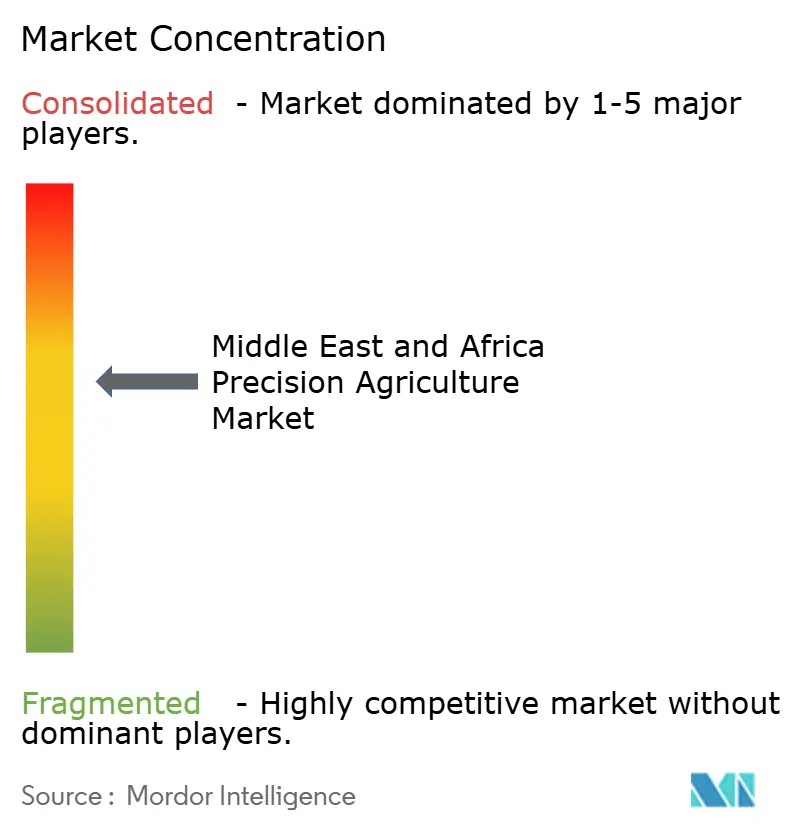
| Market Concentration | Medium |
Major Players *Disclaimer: Major Players sorted in no particular order Image © Mordor Intelligence. Reuse requires attribution under CC BY 4.0. | |
Middle East and Africa Precision Agriculture Market Analysis by Mordor Intelligence
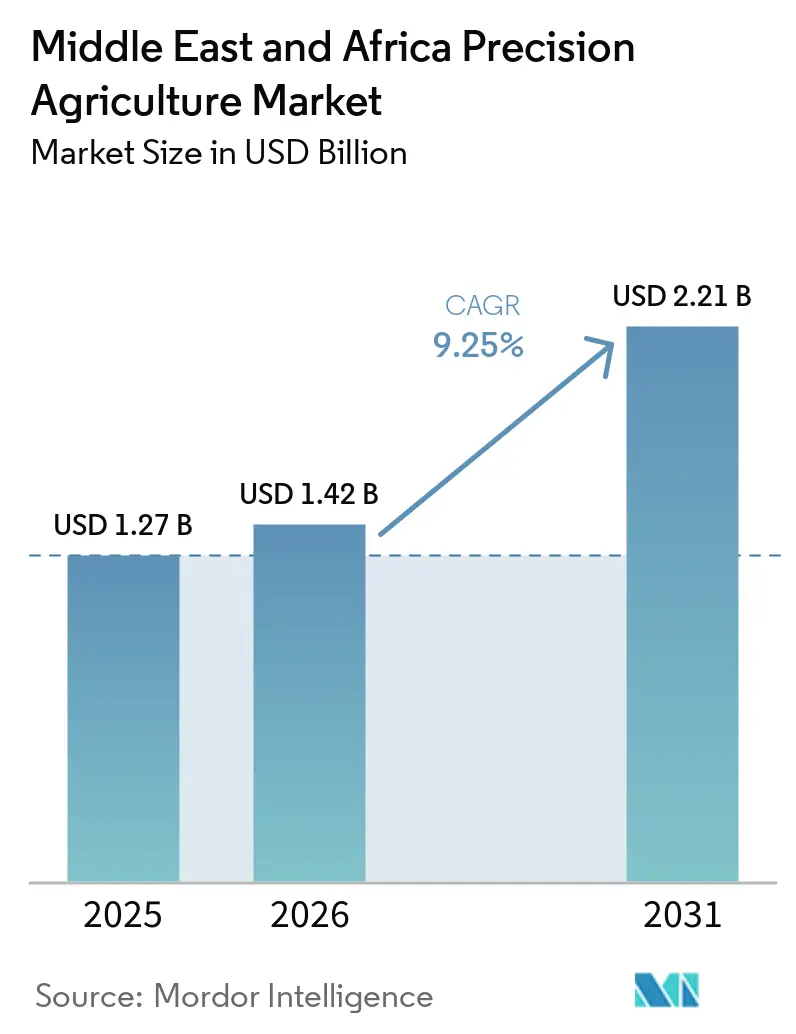
The Middle East and Africa precision agriculture market size is projected to expand from USD 1.27 billion in 2025 and USD 1.42 billion in 2026 to USD 2.21 billion by 2031, registering a CAGR of 9.25% between 2026 and 2031. Acute water scarcity, food security mandates in national policy agendas, and lower costs for remote sensing and IoT hardware continue to shape the Middle East and Africa precision agriculture market in 2026. Demand remains strongest where governments treat precision farming systems as core agricultural infrastructure rather than optional farm upgrades, which keeps commercial adoption linked to policy priorities as much as to farm economics. The competitive field includes global equipment suppliers, irrigation specialists, and software-led providers, and that mix keeps the Middle East and Africa precision agriculture market active across both large commercial farms and emerging service models for smaller growers. Faster growth in services and software is gradually shifting revenue away from one-time equipment sales toward subscriptions, remote management, and advisory support, changing how suppliers position themselves in the Middle East and Africa precision agriculture market. The long-term outlook for the Middle East and Africa precision agriculture market still depends on rural digital infrastructure catching up in Africa and on precision irrigation staying central to food and water policy in the Middle East.
Key Report Takeaways
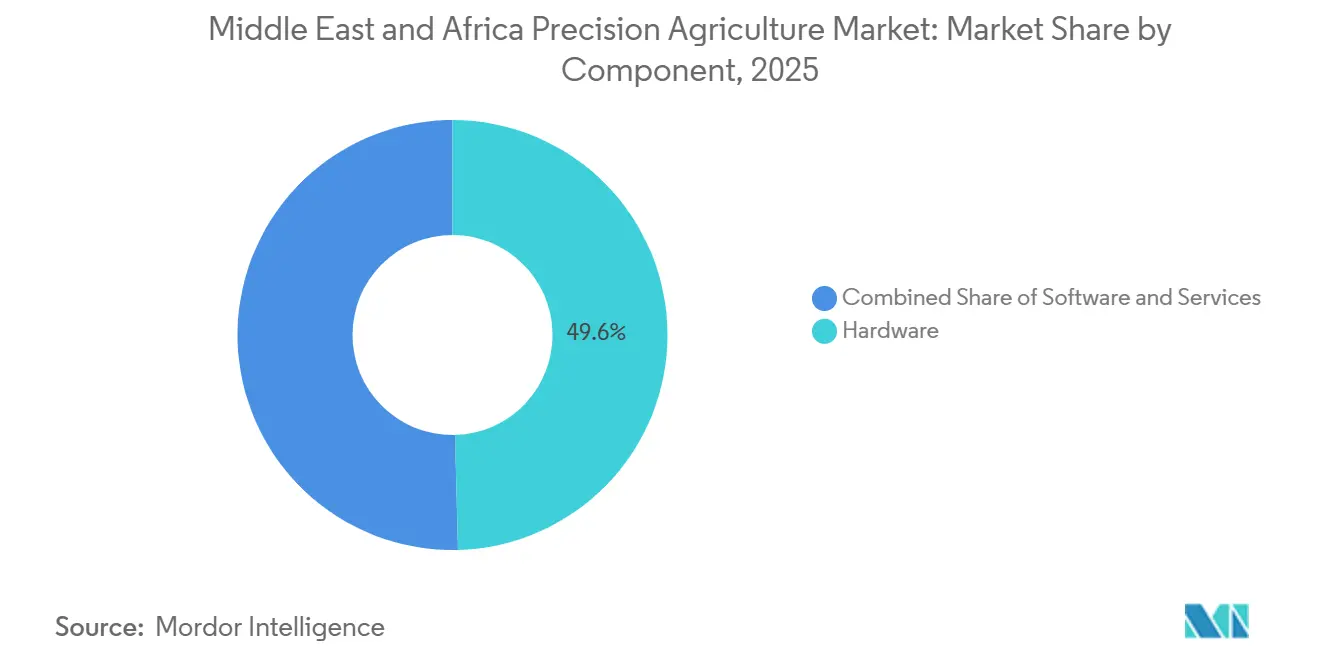
- By component, hardware accounted for the largest share at 49.6% in 2025, while services are projected to register the fastest CAGR of 14.2% through 2031.
- By technology, remote sensing held the largest Middle East and Africa precision agriculture market share at 41.4% in 2025 and is also projected to witness the fastest CAGR of 15.1% through 2031.
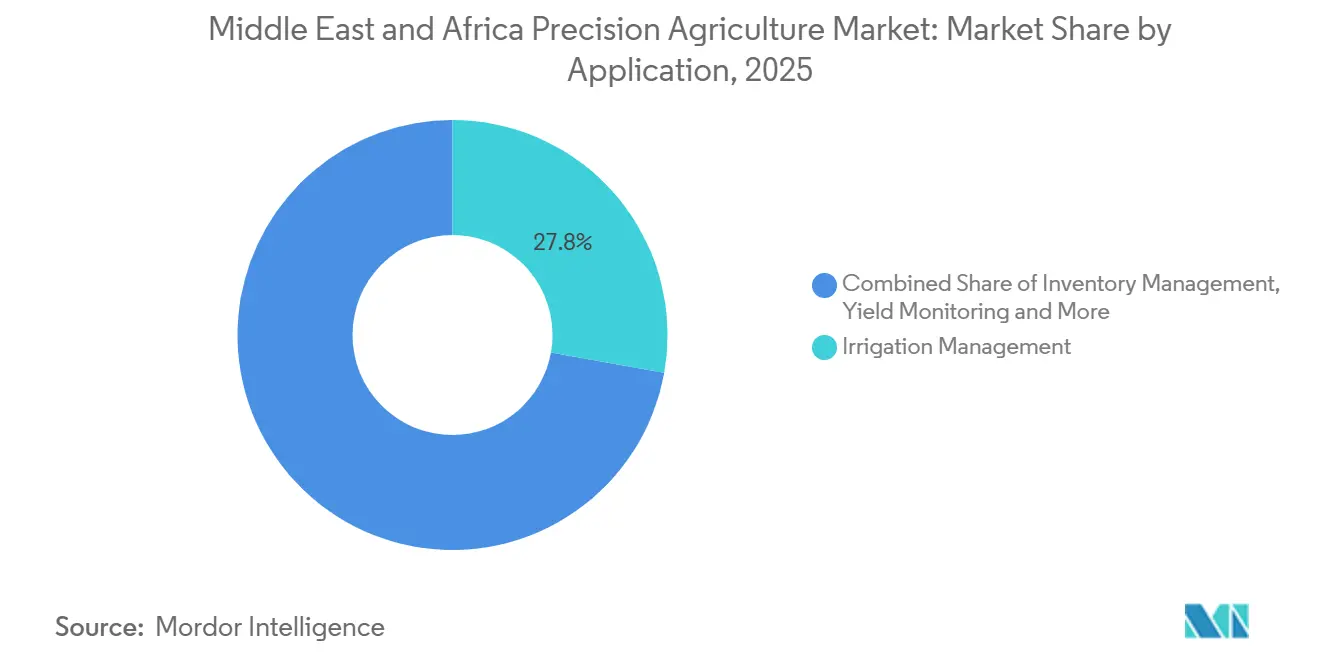
- By application, irrigation management accounted for the largest Middle East and Africa precision agriculture market size at 27.8% in 2025 and is projected to grow at the fastest CAGR of 16.0% through 2031.
- By geography, the Middle East accounted for 56.1% of the Middle East and Africa precision agriculture market share in 2025, while Africa is projected to register the fastest CAGR of 14.8% through 2031.
Note: Market size and forecast figures in this report are generated using Mordor Intelligence’s proprietary estimation framework, updated with the latest available data and insights as of January 2026.
Middle East and Africa Precision Agriculture Market Trends and Insights
Drivers Impact Analysis*
| Driver | (~) % Impact on CAGR Forecast | Geographic Relevance | Impact Timeline |
|---|---|---|---|
| Expanding Water Stress and Irrigation Efficiency Needs | +2.5% | Middle East and Africa (MEA)-wide, strongest in Saudi Arabia, United Arab Emirates (UAE), Egypt, and Morocco | Medium term (2-4 years) |
| Export Crop Yield Optimization Pressure | +1.5% | Gulf Cooperation Council (GCC) core, expanding to South Africa, Kenya, and Ethiopia | Medium term (2-4 years) |
| Labor Shortage and Mechanization Gap in Commercial Farms | +1.0% | Gulf Cooperation Council (GCC) and North Africa | Short term (≤ 2 years) |
| Government and Donor Support for Climate-Smart Agriculture | +2.0% | Early gains in Saudi Arabia, United Arab Emirates (UAE), Kenya, and Nigeria | Medium term (2-4 years) |
| Growth of Satellite-Based Farm Advisory and Remote Monitoring | +0.8% | Egypt, Kenya, South Africa, and Turkey | Long term (≥ 4 years) |
| Rising Adoption of Data-Driven Precision Irrigation in Horticulture | +1.2% | Middle East and North Africa (MENA) core with East Africa spillover | Medium term (2-4 years) |
| Source: Mordor Intelligence | |||
Expanding Water Stress and Irrigation Efficiency Needs
Water scarcity remains the clearest commercial trigger for the Middle East and Africa precision agriculture market because irrigation efficiency directly affects farm viability in arid and semi-arid production systems. The World Economic Forum reported in 2025 that 14 Middle East and North Africa (MENA) countries face extreme freshwater stress, highlighting the urgent need for more efficient agricultural water management. The Forum also noted that smart irrigation systems have the potential to reduce water usage by up to 50% compared with traditional irrigation methods, strengthening the business case for precision agriculture across the region[1]. In January 2026, National Agricultural Development Company (NADEC) and EF Polymer began large-scale field trials that targeted a 40% reduction in irrigation water use through artificial intelligence (AI)-driven irrigation systems and satellite-based crop monitoring. These conditions keep irrigation management at the center of the Middle East and Africa precision agriculture market because water savings can be measured quickly and tied to operating costs. As water allocation rules tighten, precision irrigation is moving closer to a requirement in some production zones, making the demand in the Middle East and Africa precision agriculture market more durable than a simple replacement cycle.
Government and Donor Support for Climate-Smart Agriculture
Public policy and sovereign-backed investment continue to accelerate adoption in the Middle East and Africa precision agriculture market as food security objectives are increasingly translated into long-term agricultural modernization initiatives. Saudi Agricultural and Livestock Investment Company (SALIC) signed a letter of intent with Syngenta in October 2025 to explore collaboration in digital agriculture, soil health, and crop protection, demonstrating how sovereign-backed organizations are expanding access to advanced agricultural technologies. This approach supports the simultaneous deployment of precision equipment, digital platforms, and agronomic services rather than investing in a single layer of the agricultural value chain. It also benefits technology providers capable of integrating hardware, software, and ongoing technical support with national food and water security priorities, making execution as important as product offerings. Government and donor-backed programs further reduce adoption risks for commercial growers while accelerating the integration of digital farming solutions into routine agricultural operations. As a result, policy support remains one of the strongest long-term growth drivers for the Middle East and Africa precision agriculture market throughout the forecast period.
Export Crop Yield Optimization Pressure
Yield improvement remains a key adoption driver as growers seek to protect margins, maintain quality consistency, and enhance traceability across export-oriented farming systems, keeping the Middle East and Africa precision agriculture market relevant beyond irrigation alone. The World Economic Forum reported in 2025 that precision agriculture has the potential to increase crop yields by 15% to 25% compared with conventional farming practices, providing a compelling economic incentive for high-value crop producers. Across Africa's export farming regions, these productivity gains encourage investment in remote sensing, field monitoring, and variable-rate input applications by improving return on investment. Commercial-scale farms also create demonstration effects that advisory networks and service providers can leverage to promote digital technologies among cooperatives and smallholder farmers, helping expand adoption beyond early users. As a result, yield optimization serves not only as a productivity benefit but also as a catalyst for broader technology adoption across neighboring farming communities.
Rising Adoption of Data-Driven Precision Irrigation in Horticulture
Irrigation management is becoming a major revenue driver in the Middle East and Africa precision agriculture market, supported by rising demand for connected irrigation equipment and remote management services. In December 2025, Lindsay Corporation signed a USD 80 million agreement to supply Zimmatic irrigation systems and FieldNET remote management technology across the Middle East and North Africa (MENA), highlighting the shift toward integrated hardware and digital service offerings. As growers face increasing water constraints, the commercial case for monitoring, analytics, and managed irrigation support continues to strengthen because these solutions enable more efficient water use, remote system management, and improved operational decision-making. As a result, the Middle East and Africa precision agriculture market is increasingly generating revenue not only from advanced irrigation equipment but also from the software and service ecosystems that support it.
Restraints Impact Analysis*
| Restraint | (~) % Impact on CAGR Forecast | Geographic Relevance | Impact Timeline |
|---|---|---|---|
| High Upfront Hardware and Integration Costs | -2.0% | Sub-Saharan Africa primarily, with Turkey and North Africa secondary | Short term (≤ 2 years) |
| Fragmented Farm Connectivity and Digital Infrastructure | -1.8% | Sub-Saharan Africa core, rural Middle East secondary | Medium term (2-4 years) |
| Fragmented Farm Sizes and Input Standardization Limits | -1.3% | Middle East and Africa (MEA), especially smallholder zones in Sub-Saharan Africa and North Africa | Long term (≥ 4 years) |
| Limited Local Technical Support and After-Sales Service | -1.0% | Rural Africa and interior Middle East | Medium term (2-4 years) |
| Source: Mordor Intelligence | |||
High Upfront Hardware and Integration Costs
Upfront equipment costs remain one of the strongest barriers to wider adoption in the Middle East and Africa precision agriculture market because many growers continue to face limited access to financing and constrained investment capacity[2]. The 2025 study, "Digitalization of Precision Fertilization in East Africa: Adoption, Benefits and Losses," highlighted that variable-rate application systems require significant purchase and calibration investments, making adoption challenging for many smallholder farmers[3]. Research published in the journal Drones in 2025 also found that although unmanned aerial vehicle (UAV)-based precision agriculture solutions deliver strong field performance, their ownership costs remain difficult for individual smallholders across much of Sub-Saharan Africa. Although the cost of sensors and digital technologies has declined over time, access to affordable financing continues to lag behind technological advancements, slowing commercial adoption. Service-based business models and cooperative ownership structures are helping improve accessibility, but their success still depends on reliable technical support networks and sustainable dealer ecosystems. Until financing mechanisms become more accessible, high hardware costs will continue to limit precision agriculture adoption among smaller farm operators across the Middle East and Africa.
Fragmented Farm Connectivity and Digital Infrastructure
Connectivity gaps continue to limit the precision agriculture market in the Middle East and Africa because many digital farming solutions depend on reliable data transmission, cloud connectivity, and consistent power availability at the field level. Where mobile network coverage is limited, the effectiveness of real-time decision-making declines because sensor data, drone imagery, and digital advisory services cannot be transferred efficiently between farms and management platforms. This challenge extends beyond internet access, as many off-grid agricultural areas also experience unreliable electricity, affecting sensor operation, equipment charging, and routine system maintenance. Although satellite-based connectivity solutions can improve coverage in remote locations, they often increase operating costs and reduce affordability for smallholder farmers and low-value crops. As a result, the growth of the Middle East and Africa precision agriculture market remains closely linked to continued investment in rural digital infrastructure, particularly across Sub-Saharan Africa, where adoption potential is significant, but infrastructure development remains uneven.
*Our forecasts treat driver/restraint impacts as directional, not additive. The impact forecasts reflect baseline growth, mix effects, and variable interactions.
Segment Analysis
By Component: Hardware Anchors the Base, Services Signal the Growth Vector
Hardware accounted for 49.6% of the Middle East and Africa precision agriculture market size in 2025, reflecting substantial investments in smart irrigation systems, Global Positioning System (GPS) guidance technologies, and field sensors across major agricultural markets such as Saudi Arabia, Egypt, and South Africa. This demonstrates that physical equipment remains the foundation of the region's precision agriculture ecosystem, particularly where governments and large commercial farms prioritize irrigation control, field positioning, and real-time data collection. Software sits in the middle layer of the component landscape and continues to expand as farm management platforms and satellite-based analytics move beyond pilot projects into routine commercial use. This keeps the Middle East and Africa precision agriculture industry anchored in equipment-led adoption while steadily building a broader digital ecosystem around installed hardware.
Services are projected to grow at a CAGR of 14.2% from 2026 to 2031, making them the strongest indicator of the market's evolving revenue mix. In December 2025, Lindsay Corporation signed an agreement to supply USD 80 million worth of Zimmatic irrigation systems integrated with FieldNET remote management technology across the Middle East and North Africa (MENA), illustrating the growing demand for bundled hardware and digital services. This trend reflects a broader shift toward integrated precision agriculture solutions, where software, remote monitoring, and advisory services are becoming increasingly important alongside physical equipment. As a result, the Middle East and Africa precision agriculture industry is projected to generate a growing share of revenue from software integration, advisory services, and managed support rather than equipment sales alone.

By Technology: Remote Sensing Holds the Widest Reach and Fastest Growth
Remote sensing captured 41.4% of technology revenue in 2025 and is projected to grow at a CAGR of 15.1% through 2031, making it both the largest and fastest-growing technology segment in the Middle East and Africa precision agriculture market. This combination is notable because the most widely adopted technology is also projected to experience the strongest future growth. The popularity of remote sensing is driven by its ability to monitor large, dispersed agricultural areas using satellite and drone imagery, enabling informed decisions on irrigation scheduling, crop health, and field management while reducing reliance on on-site labor. These capabilities make remote sensing a practical solution for both large commercial farms and service providers supporting smallholder farmers through shared digital platforms.
Guidance systems represent the next major technology segment, particularly across large-scale mechanized farming operations and precision irrigation systems that require accurate field positioning. Variable-rate technology continues to witness comparatively slower adoption because it requires compatible equipment and advanced operational management. However, its adoption is gradually increasing, where growers can translate precise input application into improved export quality and lower production costs. Over time, the value of these technologies will depend less on individual deployment and more on their integration across remote sensing, field operations, and farm management software. As a result, technology adoption in the Middle East and Africa precision agriculture market is steadily shifting toward connected digital workflows rather than standalone solutions.
By Application: Irrigation Management Leads on Scale and Urgency
Irrigation management accounted for 27.8% of application revenue in 2025 and is forecast to grow at a 16.0% CAGR through 2031, giving it both the largest current share and the fastest growth rate in the Middle East and Africa precision agriculture market. This position reflects the direct economic value of water optimization, as irrigation improvements can deliver measurable reductions in water use while improving crop productivity, lowering input costs, and supporting compliance with increasingly stringent water management policies. Precision irrigation technologies have demonstrated water savings of up to 50% under Middle Eastern conditions, while IoT-enabled irrigation management has improved irrigation water use efficiency, strengthening the business case for continued investment. Irrigation management remains the most mature application segment, where hardware, software, and service offerings work together to deliver integrated farm management solutions.
Field mapping and field monitoring are the next most established applications, enabling continuous crop observation and data-driven decision-making, particularly on commercial and export-oriented farms. Crop scouting is expanding through mobile-based advisory platforms that allow growers to monitor larger cultivation areas more efficiently and respond quickly to pest, disease, or nutrient issues. Weather tracking and forecasting are becoming increasingly important as digital decision-support tools, helping producers optimize irrigation schedules and field operations. Inventory management and farm labor management remain at relatively earlier stages of adoption across much of the region. As digital interoperability improves, the market is projected to increasingly favor integrated platforms that combine monitoring, irrigation, scouting, weather intelligence, and operational planning into a unified farm management workflow.
Geography Analysis
The Middle East accounted for 56.1% of the Middle East and Africa precision agriculture market in 2025, reflecting sustained investment in arid-land agriculture, irrigation modernization, and food security initiatives. Saudi Arabia remains the region's largest demand center, where improving irrigation efficiency and optimizing agricultural inputs are central to national farming strategies. The United Arab Emirates is also advancing adoption through climate-smart agriculture programs and water-efficient cultivation practices, supporting continued demand for monitoring and precision irrigation technologies. Turkey further strengthens the regional market with its diversified agricultural sector, creating demand for guidance systems, field monitoring, and variable-rate technologies across grain, vegetable, and commercial crop production. Regional adoption is further reinforced by demonstrated performance gains. Precision irrigation technologies in Jordan have achieved water savings of up to 44% compared with conventional irrigation methods, highlighting the strong economic and resource-efficiency benefits of digital irrigation.
Africa is projected to expand at a 14.8% CAGR between 2026 and 2031, making it the fastest-growing regional market despite its smaller current size. South Africa continues to lead adoption through its well-developed commercial farming sector, which is better positioned to invest in positioning systems, remote sensing technologies, and data-driven crop management solutions. Egypt also represents a significant growth opportunity, as rising pressure on water resources in the Nile Delta is accelerating demand for irrigation optimization and crop-monitoring technologies. Kenya and several other East African countries are gradually expanding adoption through government-supported digital agriculture initiatives and advisory platforms that improve farmer access to precision farming practices. However, adoption across many sub-Saharan African markets remains at an earlier stage because infrastructure limitations, financing constraints, and limited technical service networks continue to slow large-scale deployment.
The regional landscape illustrates two distinct growth trajectories within the Middle East and Africa precision agriculture market. The Middle East currently dominates because long-term public investment, water scarcity, and food security priorities have already established strong demand for precision irrigation and resource optimization technologies. Africa, meanwhile, is expanding more rapidly as improvements in remote sensing, digital advisory services, and institutional support make precision agriculture increasingly accessible to commercial and emerging farming operations. Across both regions, long-term competitive success will depend on delivering solutions that address local water availability, connectivity infrastructure, farm economics, and after-sales service requirements rather than applying a uniform regional strategy.
Competitive Landscape
The Middle East and Africa precision agriculture market has a moderately concentrated competitive landscape. Trimble Inc., Deere and Company, CNH Industrial N.V., AGCO Corporation, and Topcon Corporation form the main group of broad-based equipment and precision technology suppliers. These companies compete through dealer reach, installed equipment bases, positioning systems, and the ability to pair machinery with digital farm tools. Irrigation-focused vendors such as Lindsay Corporation, Valmont Industries, Inc., and Jain Irrigation Systems Ltd. also hold an important position, as water management is one of the most commercially urgent applications in the region. This combination keeps the market competitive across hardware, irrigation systems, and software support, rather than allowing one supplier type to dominate. As a result, customers often compare vendors on integration and service depth as much as on equipment specifications.
Several recent developments illustrate how competition is evolving in the Middle East and Africa precision agriculture market. Lindsay Corporation's USD 80 million Middle East and North Africa (MENA) agreement in December 2025 demonstrated how irrigation specialists are using bundled hardware and digital management platforms to win large regional contracts. SALIC's October 2025 letter of intent with Syngenta pointed to another approach, linking sovereign-backed agricultural investment with global digital agriculture and crop-solution capabilities. CropX's 2025 selection for a precision irrigation pilot at NEOM's Oxagon zone showed that specialist platforms can secure a position in high-visibility projects when they address clear irrigation needs. NADEC's January 2026 deployment with EF Polymer further demonstrated that field-level partnerships can strengthen the competitive position of technology providers that prove water savings in live operating conditions.
The market is also changing as irrigation and positioning specialists expand further into analytics, remote management, and advisory services. This narrows the distinction between hardware vendors and software providers and pushes more companies toward full-stack offerings. At the same time, sub-Saharan smallholder agriculture remains largely unaddressed, as no single global vendor has established a dominant model for low-cost distribution, local servicing, and recurring digital support across that base. Consequently, the companies most likely to succeed in the Middle East and Africa precision agriculture market are those that combine practical deployment, service continuity, and water-related performance, rather than those that rely solely on scale.
Middle East and Africa Precision Agriculture Industry Leaders
-
Deere and Company
-
Trimble Inc.
-
CNH Industrial N.V.
-
AGCO Corporation
-
Netafim Ltd.
- *Disclaimer: Major Players sorted in no particular order
Recent Industry Developments
- January 2026: Syngenta expanded its partnership with Planet Labs PBC to integrate near-daily, 3-meter satellite imagery into the Cropwise platform. The collaboration enhances remote sensing and AI-enabled crop-monitoring capabilities, strengthening Syngenta's global precision agriculture portfolio with technologies applicable to the Middle East and Africa markets.
- December 2025: Lindsay Corporation secured an approximately USD 80 million agreement to supply Zimmatic irrigation systems and FieldNET remote management technology across the Middle East and North Africa (MENA), strengthening precision irrigation adoption and supporting regional water efficiency and food security initiatives.
- October 2025: Saudi Agricultural and Livestock Investment Company (SALIC) and Syngenta signed a Letter of Intent to explore joint projects in Saudi Arabia covering digital agriculture, digital farm management platforms, climate-smart farming, and water conservation, supporting precision agriculture adoption and regional food security objectives.
Middle East and Africa Precision Agriculture Market Report Scope
Precision agriculture is a farming method that utilizes technologies such as GPS, sensors, and data analytics to monitor and manage variability in crop fields. This approach optimizes inputs like water, fertilizers, and pesticides, enhancing productivity, efficiency, and sustainability.
The Middle East and Africa Precision Agriculture Market Report is Segmented by Component (Hardware, Software, and Services), by Technology (Guidance Systems, Remote Sensing, and More), by Application (Field Monitoring, Crop Scouting, Irrigation Management, Farm Labor Management, Others), and by Geography (Saudi Arabia, UAE, Turkey, South Africa, Egypt, and More). The Market Forecasts are Provided in Terms of Value (USD).
| Hardware |
| Software |
| Services |
| Guidance Systems |
| Remote Sensing |
| Variable Rate Technology |
| Yield Monitoring |
| Field Mapping |
| Crop Scouting |
| Weather Tracking and Forecasting |
| Irrigation Management |
| Inventory Management |
| Farm Labor Management |
| Other Applications |
| Middle East | Saudi Arabia |
| United Arab Emirates | |
| Turkey | |
| Rest of Middle East | |
| Africa | South Africa |
| Egypt | |
| Rest of Africa |
| By Component | Hardware | |
| Software | ||
| Services | ||
| By Technology | Guidance Systems | |
| Remote Sensing | ||
| Variable Rate Technology | ||
| By Application | Yield Monitoring | |
| Field Mapping | ||
| Crop Scouting | ||
| Weather Tracking and Forecasting | ||
| Irrigation Management | ||
| Inventory Management | ||
| Farm Labor Management | ||
| Other Applications | ||
| By Geography | Middle East | Saudi Arabia |
| United Arab Emirates | ||
| Turkey | ||
| Rest of Middle East | ||
| Africa | South Africa | |
| Egypt | ||
| Rest of Africa | ||
Key Questions Answered in the Report
What is the projected value of the Middle East and Africa precision agriculture market by 2031?
The Middle East and Africa precision agriculture market is projected to reach USD 2.21 billion by 2031, rising from USD 1.42 billion in 2026 at a 9.25% CAGR .
Which application area is leading adoption across the region?
Irrigation management leads with a 27.8% revenue share in 2025 and is forecast to grow at a 16% CAGR through 2031 because water efficiency remains the most urgent need .
Why is water scarcity so important for precision farming in the Middle East and Africa?
The World Economic Forum reported that 14 MENA countries faced extreme freshwater stress in 2025, while precision irrigation reduced water consumption by 50% compared with conventional methods.
What is slowing wider adoption among smaller farms?
High upfront hardware costs, weak financing access, and uneven rural connectivity still limit adoption among many smallholders, even where the agronomic benefits are clear.