
Middle East and Africa Irrigation Pumps Market Size and Share
Market Overview
| Study Period | 2021 - 2031 |
|---|---|
| Forecast Data Period | 2026 - 2031 |
| Base Year Market Size (2025) | USD 8.03 Billion |
| Market Size (2026) | USD 8.61 Billion |
| Market Size (2031) | USD 12.14 Billion |
| Growth Rate (2026 - 2031) | 7.11 % |
| Market Concentration | Medium |
Major Players
*Disclaimer: Major Players sorted in no particular order Image © Mordor Intelligence. Reuse requires attribution under CC BY 4.0. |
|
Middle East and Africa Irrigation Pumps Market Analysis by Mordor Intelligence
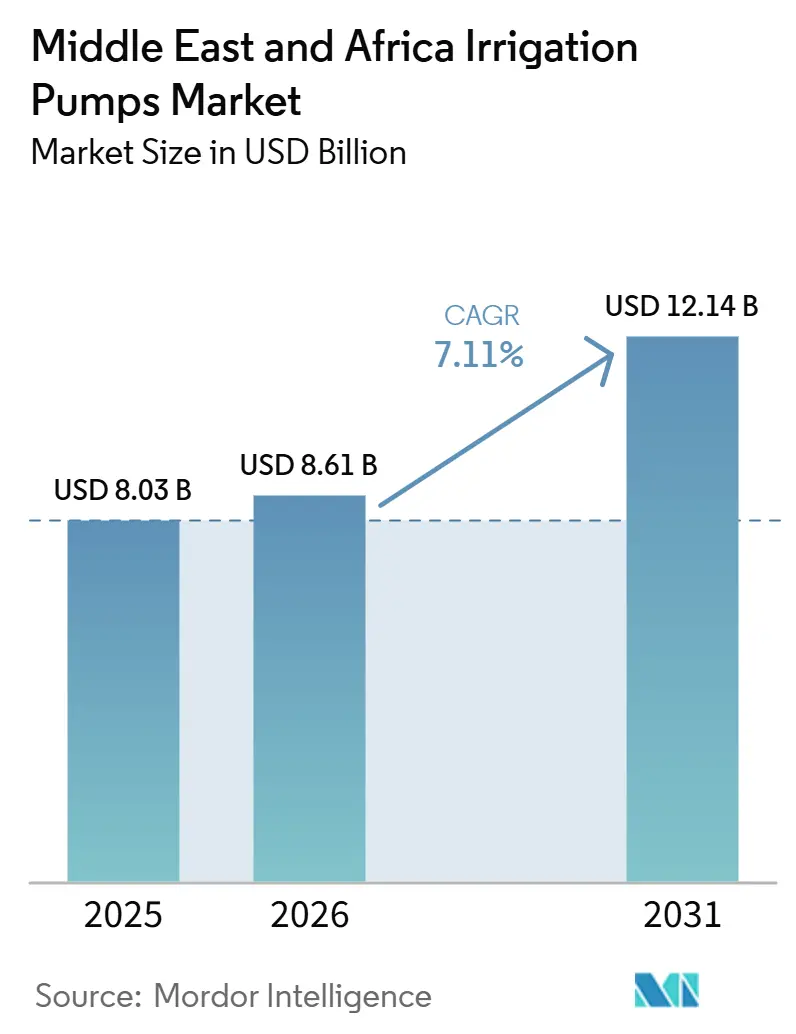
The Middle East and Africa irrigation pumps market size is projected to expand from USD 8.03 billion in 2025 and USD 8.61 billion in 2026 to USD 12.14 billion by 2031, registering a CAGR of 7.11% between 2026 and 2031. Farming demand across this region remains tied to irrigation needs rather than seasonal crop cycles, because Saudi Arabia still draws 88% to 90% of its water withdrawals for agriculture in 2025[1]Source: John Calabrese, “Saudi Arabia’s Water Future: Addressing Scarcity and Ensuring Sustainability,” AGSI, April 3, 2025, agsi.org. The demand mix is also shifting toward solar-powered systems, as limited grid access and high diesel costs are pushing growers to adopt lower-cost pumping systems across off-grid irrigation corridors. Public support remains an important accelerator, with Morocco subsidizing 30% to 70% of solar irrigation pump costs by farm size and Nigeria backing national solar irrigation pump rollout through domestic production in 2025. At the same time, falling water tables are pushing buyers toward deeper and higher-specification systems, which keeps replacement demand active even when farmer margins tighten. Competitive positions in the Middle East and Africa irrigation pumps market, therefore, depend on service coverage, borehole expertise, and the ability to supply solar, electric, and hybrid configurations that fit very different farm conditions across the region.
Key Report Takeaways
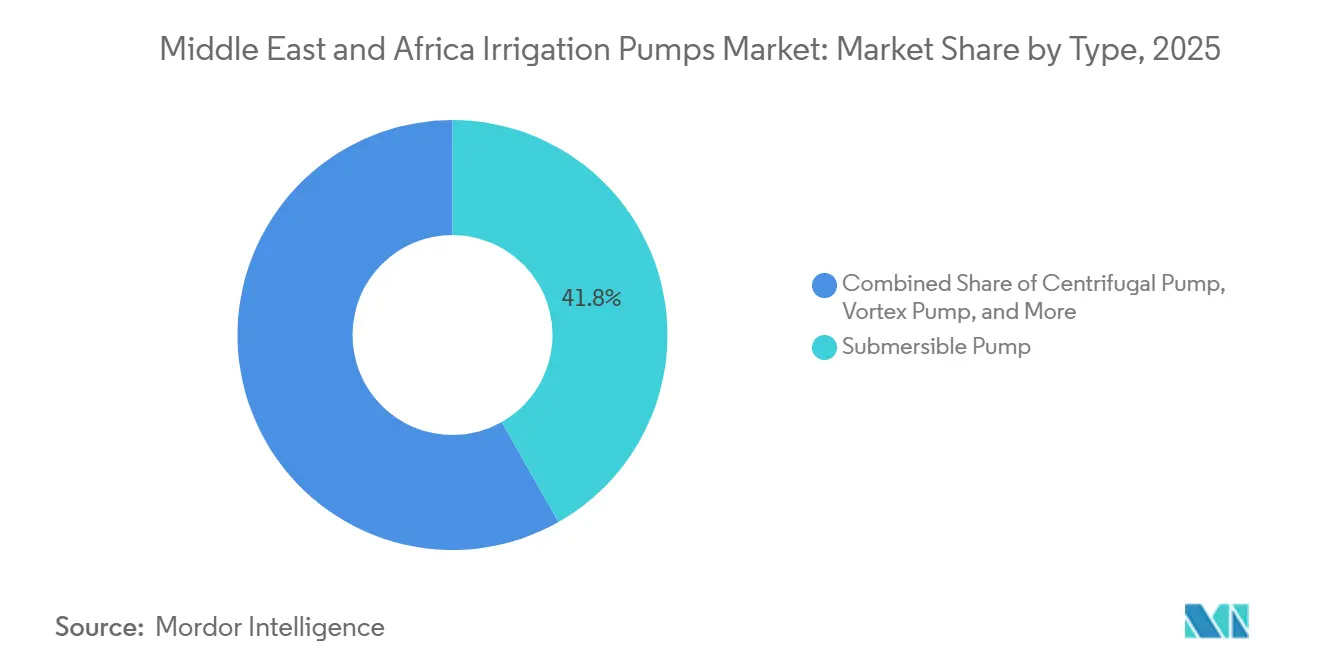
By type, submersible pumps accounted for 41.8% of the Middle East and Africa irrigation pumps market in 2025 and are forecast to grow at an 8.5% CAGR between 2026 and 2031.
By geography, the Middle East accounted for 58.4% of the Middle East and Africa irrigation pumps market share in 2025, while Africa recorded the highest projected CAGR of 8.3% between 2026 and 2031.
Note: Market size and forecast figures in this report are generated using Mordor Intelligence’s proprietary estimation framework, updated with the latest available data and insights as of January 2026.
Market Trends and Insights
Drivers Impact Analysis of Middle East and Africa Irrigation Pumps Market*
| Driver | (~) % Impact on CAGR Forecast | Geographic Relevance | Impact Timeline |
|---|---|---|---|
| Expansion of pressurized irrigation in water-stressed farms | +1.50% | Middle East and Africa, core markets | Short term (≤ 2 years) |
| Rising solar-powered pump adoption in off-grid irrigation clusters | +1.30% | Sub-Saharan Africa, Gulf Cooperation Council countries, and Egypt | Medium term (2-4 years) |
| Government subsidy support for irrigation modernization | +1.20% | Morocco, Algeria, Gulf Cooperation Council states, and Ethiopia | Medium term (2-4 years) |
| Replacement of diesel pumping with energy-efficient electric systems | +1.00% | Saudi Arabia, Egypt, and North Africa | Long term (≥ 4 years) |
| Groundwater dependence in arid and semi-arid farming belts | +0.80% | Middle East, and North Africa | Medium term (2-4 years) |
| Precision irrigation deployment on high-value crops | +0.70% | Saudi Arabia, United Arab Emirates, and Morocco | Short term (≤ 2 years) |
| Source: Mordor Intelligence | |||
Expansion of Pressurized Irrigation in Water-Stressed Farms
Flood irrigation is steadily losing ground to drip, sprinkler, and micro-irrigation systems across many farming zones in this region. That change matters because pressurized irrigation needs more reliable pumping performance and tighter pressure control than basic flood systems. The Saudi Irrigation Organization and the International Commission on Irrigation and Drainage (ICID) worked on an Integrated Irrigation Sector Management for Sustainable Development in 2024 to promote efficient irrigation and better water productivity among farmers in Saudi Arabia[2]Source: "International Commission on Irrigation and Drainage (ICID)", Newsletter: ICID News Update, 2024, icid-ciid.org. Morocco is also expanding distribution infrastructure through the Saïss irrigation project 3, initiated in 2025, to convey 125 million cubic meters of water each year from the M'Dez dam. These projects raise demand for booster systems, pressure-regulated pump sets, and distribution pumps rather than only standard centrifugal units. That shift improves the sales mix in the Middle East and Africa irrigation pumps market because more engineered systems usually carry a higher unit value. It also supports replacement demand, as older pumps often do not meet the pressure and flow stability requirements of modern irrigation layouts. The result is a market where water-saving irrigation methods are directly tied to stronger demand for pump systems and higher technical requirements at the farm level.
Rising Solar-Powered Pump Adoption in Off-Grid Irrigation Clusters
Solar pumping is becoming one of the clearest growth themes in the Middle East and Africa irrigation pumps market. This is because large agricultural areas still lack reliable grid electricity, and diesel costs remain a burden for irrigation operations in rural areas. Ethiopia is moving from scattered pilots to scale, with the International Water Management Institute coordinating a national platform to mobilize 1,750 solar pumps in 2026[3]Source: International Water Management Institute, “Ethiopia Plans to Scale Solar Irrigation with Public and Private Sector Momentum,” International Water Management Institute, iwmi.org. Morocco also shows a strong operating case, with solar irrigation pumping. In Saudi Arabia, a 4.58 MW solar water-pumping installation completed in Riyadh by Nuuko Power in October 2025 irrigated 2,560 acres while reducing annual operating costs. Solar adoption is also widening the supplier base, as lower-cost manufacturers can compete more effectively with buyers who focus on payback and fuel savings. As this spread continues, the Middle East and Africa irrigation pumps market is moving closer to a mixed competitive structure that includes global pump brands, local channel partners, and solar-focused entrants.
Government Subsidy Support for Irrigation Modernization
Government support is turning irrigation pump demand into funded procurement across several countries simultaneously. Algeria launched a USD 345 million program to electrify agricultural perimeters across 15 southern wilayas[4]Source: Algiers Brief Team, "Algeria Allocates DZD 46.6 Billion (~$345 Million) for Rural Electrification in Southern Farms," algiersbrief.com. Nigeria’s National Economic Council also endorsed the rollout of solar irrigation pumps produced by the National Agency for Science and Engineering Infrastructure, with 50,000 to 100,000 units planned for distribution to states based on need in 2025. These programs reduce the initial burden for growers and make pump purchases less dependent on private financing cycles. They also shape competition, because subsidy-backed schemes usually favor suppliers that meet formal technical standards and tender rules. That gives compliant companies a better path into the Middle East and Africa irrigation pumps market, especially where public procurement drives a large share of early adoption. The policy effect is not just higher unit volumes, but also a more formal buying process that benefits established vendors with strong service and documentation.
Groundwater Dependence in Arid and Semi-Arid Farming Belts
Groundwater dependence gives the Middle East and Africa irrigation pumps market a durable base of demand. Saudi Arabia’s agriculture sector still accounts for 88% to 90% of national water withdrawals, and the country relies heavily on non-renewable aquifers for irrigation in major farming areas. That means pump demand is closely tied to water access rather than only to crop prices or short seasonal conditions. In Egypt, a 2025 study in Minia Governorate found that deeper aquifer conditions were associated with higher extraction costs per cubic meter. As water tables drop, farms need stronger multistage submersible systems with higher head capacity and greater efficiency. This pushes buying toward higher-specification product categories and keeps replacement cycles active. It also makes service support more important, because pump failure in a deep irrigation borehole can disrupt an entire cropping cycle. For that reason, groundwater reliance continues to support steady demand across the Middle East and Africa irrigation pumps market even when farm budgets are under pressure.
Restraints Impact Analysis of Middle East and Africa Irrigation Pumps Market*
| Restraint | (~) % Impact on CAGR Forecast | Geographic Relevance | Impact Timeline |
|---|---|---|---|
| Limited grid reliability in rural irrigation corridors | -1.20% | Sub-Saharan Africa, and Yemen | Short term (≤ 2 years) |
| High upfront cost of solar and variable-speed pump systems | -0.90% | Sub-Saharan Africa, and North Africa smallholders | Medium term (2-4 years) |
| Borehole depletion increasing pump downtime and replacement burden | -0.70% | Saudi Arabia, Egypt, and North Africa | Long term (≥ 4 years) |
| Fragmented farm sizes slowing standardized equipment adoption | -0.50% | Sub-Saharan Africa, and North Africa | Medium term (2-4 years) |
| Source: Mordor Intelligence | |||
Limited Grid Reliability in Rural Irrigation Corridors
Unreliable electricity supply remains one of the clearest barriers to faster adoption of electric pumps in many irrigation zones. Voltage fluctuations and outages can damage motors and control components, increasing maintenance costs and eroding growers' confidence. Where supply is unstable, farmers often stay with diesel or delay upgrades to more advanced electric systems. This limits the spread of variable-speed drives and intelligent control systems that need stable voltage to perform well. It also slows adoption in the very corridors where irrigation expansion is most needed. As a result, the Middle East and Africa irrigation pumps market cannot fully benefit from premium electric technologies in many rural areas. The practical outcome is a split market in which modern equipment demand grows fastest only where power quality, financing, and technical support are available. In addition, unreliable grid access complicates irrigation scheduling, reduces operational efficiency during peak growing periods, and discourages investment in automated irrigation infrastructure, further constraining long-term modernization efforts across agricultural regions.
High Upfront Cost of Solar and Variable-Speed Pump Systems
Capital costs remain a real barrier for small- and mid-sized growers, even when long-term operating savings are attractive. In Morocco, the cost of installing solar irrigation pump systems remains substantial, making adoption challenging for many farmers without access to formal credit, financing mechanisms, or government subsidy support. The International Food Policy Research Institute noted that even under Uganda’s World Bank-backed subsidy structure, the required 25% co-financing contribution per system remained a hurdle for subsistence farmers in 2024. The result is uneven adoption, because commercial farms and cooperatives are better placed to finance upgrades than individual smallholders. This slows the breadth of demand in the Middle East and Africa irrigation pumps market, even while the technology case continues to strengthen. It also means suppliers often need financing partners or phased product offerings to reach the largest farmer base. Until those gaps narrow, affordability will continue to slow conversion from diesel or basic pumps into more advanced irrigation systems.
*Our forecasts treat driver/restraint impacts as directional, not additive. The impact forecasts reflect baseline growth, mix effects, and variable interactions.
Middle East and Africa Irrigation Pumps Market Segment Analysis
By Type:
Submersible Pumps Lead and Advance the Fastest Across Irrigation ApplicationsSubmersible pumps accounted for 41.8% of the Middle East and Africa irrigation pump market share in 2025, making them the leading type segment, as deep-borehole irrigation remains central across Saudi Arabia, Egypt, and several arid farming zones in North Africa. Their strong position reflects the region’s continued reliance on groundwater for irrigation, particularly in areas with limited or uneven access to surface water. Centrifugal pumps remained important in canal-fed agriculture and surface irrigation systems, while vortex pumps were used for sediment-laden water conditions. Other irrigation pump types continued to support specialized agricultural flow requirements.
Submersible pumps are anticipated to grow at the fastest rate, at a CAGR of 8.5% from 2026 to 2031, supported by deeper borehole use, rising solar integration, and continued irrigation demand across groundwater-dependent farming belts. Their growth is also tied to the need for reliable high-head pumping in desert agriculture and remote irrigation corridors. Centrifugal pumps are likely to see steady expansion where new distribution networks and surface-water irrigation projects are being developed, especially in organized schemes such as Morocco’s Saïss project. Vortex pumps should retain a smaller but stable role in applications with suspended solids, while other irrigation pump types will continue serving niche high-flow agricultural uses.



Geography Analysis
Middle East Irrigation Pumps Market
The Middle East accounted for 58.4% of the Middle East and Africa irrigation pumps market revenue in 2025, making it the dominant regional market. Its leadership is supported by extensive groundwater-based irrigation, large-scale agricultural infrastructure, and continued investments in water-use efficiency. Governments across the region are also accelerating the adoption of solar-powered irrigation through financing programs and precision agriculture initiatives, while investments in advanced pump testing and manufacturing infrastructure continue to strengthen the regional supply ecosystem.
Africa and Middle East Irrigation Pumps Market
Africa is projected to register the fastest growth in the Middle East and Africa irrigation pumps market, estimated to expand at a CAGR of 8.3% between 2026 and 2031. Growth is supported by increasing government investments in irrigation infrastructure, expanding deployment of solar-powered irrigation pumps, and rising commercialization of agriculture. Ethiopia’s 2026 target of mobilizing 1,750 solar pumps under a national platform marks a similar shift toward structured implementation. South Africa remains important for higher-specification irrigation systems in commercial farming. This spread means the Middle East and Africa irrigation pumps market is becoming broader geographically even though national market maturity still varies widely.
MEA Irrigation Pumps Market
The market is becoming increasingly balanced between the Middle East's established demand base and Africa's high-growth potential. While the Middle East continues to generate the majority of market revenue through replacement demand and advanced irrigation infrastructure, Africa is emerging as the primary growth engine, driven by expanding irrigated farmland, supportive government policies, and increasing investments in climate-resilient agricultural water management. This combination is expected to sustain strong regional market growth throughout the forecast period.
Competitive Landscape
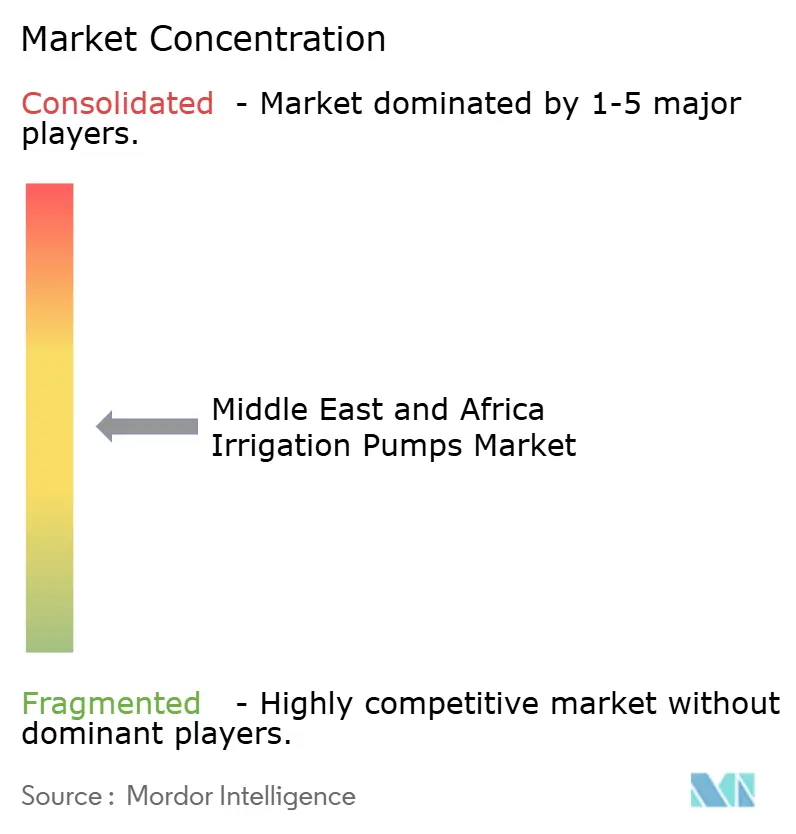
The Middle East and Africa irrigation pumps market remains moderately concentrated rather than highly fragmented. Grundfos Holding A/S, Xylem Inc., Franklin Electric Co., Inc., Ebara Corporation, and Wilo Group accounted for a significant share of the market in 2025. The leading companies hold their positions through broad pump portfolios, strong distributor relationships, and deeper service capability across irrigation and groundwater applications. That matters in this market because buyers often need installation support, borehole matching, and maintenance follow-up rather than only a basic equipment sale. The result is a competitive field where channel strength and technical support are meaningful barriers to entry.
Grundfos Holding A/S strengthened its position in 2026 by launching the GENIECON intelligent system controller across the Middle East and Africa, including agricultural and landscape irrigation applications. Franklin Electric Co., Inc. has also been expanding its presence in boreholes and water systems through agricultural pumping solutions that meet off-grid irrigation demand in African markets. Wilo Group reinforced its regional supply position in 2025 by expanding its Jebel Ali facility in the United Arab Emirates and adding the largest accredited pump test bench in the region. These moves show that leading suppliers are not competing only on pump hardware. They are also investing in controls, regional production, testing, and service access.
The next competitive tier is more mixed in strategy and price positioning. KSB SE and Co. KGaA, Sulzer Ltd, and The Gorman-Rupp Company compete where specification depth, certification, and project requirements matter more than upfront price alone. Kirloskar Brothers Limited and Shakti Pumps (India) Limited are more visible in solar and borehole irrigation offerings suited to markets where grid quality is weak and irrigation adoption is still expanding. Chinese manufacturers such as LEO Group Pump (Zhejiang) Co., Ltd. and Shimge Pump Industry Group Co., Ltd. continue to pressure lower-price categories in submersible and centrifugal pumps. The main competitive opening now lies in hybrid and solar-ready irrigation packages that bridge the gap between diesel dependence and fully electrified irrigation systems.
Middle East and Africa Irrigation Pumps Industry Leaders
-
Grundfos Holding A/S
-
Xylem Inc.
-
Franklin Electric Co., Inc.
-
Ebara Corporation
-
Wilo Group
- *Disclaimer: Major Players sorted in no particular order
Middle East and Africa Irrigation Pumps Market Companies Covered in this Report
- Grundfos Holding A/S
- Xylem Inc.
- Franklin Electric Co., Inc.
- Ebara Corporation
- Wilo Group
- KSB SE and Co. KGaA
- Sulzer Ltd
- The Gorman-Rupp Company
- Kirloskar Brothers Limited
- Shakti Pumps (India) Limited
- Jain Irrigation Systems Ltd.
- Davey Water
- Valmont Industries, Inc
- LEO Group Pump (Zhejiang) Co., Ltd.
- Shimge Pump Industry Group Co., Ltd.

Recent Industry Developments in Middle East and Africa Irrigation Pumps Market
- April 2026: Grundfos Holding A/S launched GENIECON, an intelligent system controller now available across the Middle East and Africa markets, addressing agricultural and landscape irrigation networks with cloud-based remote monitoring, enhanced cybersecurity, and firmware update capabilities.
- June 2026: Wilo Group expanded its partnership with DP World to advance sustainable water technologies and smart logistics solutions across the Middle East and Africa, strengthening regional water infrastructure capabilities and improving distribution networks for pumping and water management equipment.
- September 2025: Nigeria’s National Economic Council endorsed the national rollout of solar irrigation pumps produced by the National Agency for Science and Engineering Infrastructure, directing production of 50,000 to 100,000 pump units for state distribution ahead of the 2025 dry season.


Middle East and Africa Irrigation Pumps Market Report Scope
The irrigation pumps are used for various purposes, including watering agricultural lands, lawns, gardens, and turf. The Middle East and Africa Irrigation Pumps Market is Segmented by Type (Submersible Pump, Centrifugal Pump, Vortex Pump, and Other Irrigation Pump Types) and by Geography (Middle East and Africa). The report offers market size and forecasts in terms of value (USD).
| Submersible Pump |
| Centrifugal Pump |
| Vortex Pump |
| Other Irrigation Pump Types |
| Middle East | United Arab Emirates |
| Saudi Arabia | |
| Qatar | |
| Kuwait | |
| Oman | |
| Bahrain | |
| Israel | |
| Rest of Middle East | |
| Africa | Egypt |
| South Africa | |
| Nigeria | |
| Kenya | |
| Morocco | |
| Algeria | |
| Ethiopia | |
| Rest of Africa |
| By Type | Submersible Pump | |
| Centrifugal Pump | ||
| Vortex Pump | ||
| Other Irrigation Pump Types | ||
| By Geography | Middle East | United Arab Emirates |
| Saudi Arabia | ||
| Qatar | ||
| Kuwait | ||
| Oman | ||
| Bahrain | ||
| Israel | ||
| Rest of Middle East | ||
| Africa | Egypt | |
| South Africa | ||
| Nigeria | ||
| Kenya | ||
| Morocco | ||
| Algeria | ||
| Ethiopia | ||
| Rest of Africa | ||


Key Questions Answered in the Report
What is the 2026 value of the Middle East and Africa irrigation pumps market?
The market stands at USD 8.61 billion in 2026 and is projected to reach USD 12.14 billion by 2031 at a 7.11% CAGR.
Which pump type leads irrigation demand in the region?
Submersible pumps lead the region, accounting for 41.8% of revenue in 2025 because deep-borehole irrigation remains common across Saudi Arabia, Egypt, and parts of North Africa.
Which country is growing fastest in this regional space?
Africa is the fastest-growing national market, with an anticipated CAGR of 8.3% from 2026 to 2031.
What is the main challenge slowing wider adoption of modern irrigation pumps?
The biggest constraints are weak rural grid reliability, high upfront system costs, deeper boreholes, and fragmented farm structures that make standardization and financing more difficult.
Page last updated on:





