
Middle East and Africa Environmental Protection Technical Textiles Market Size and Share
Market Overview
| Study Period | 2021 - 2032 |
|---|---|
| Forecast Data Period | 2027 - 2032 |
| Base Year Market Size (2026) | USD 0.1 Billion |
| Market Size (2027) | USD 0.11 Billion |
| Market Size (2032) | USD 0.18 Billion |
| Growth Rate (2027 - 2032) | 9.86 % |
| Market Concentration | Medium |
Major Players *Disclaimer: Major Players sorted in no particular order Image © Mordor Intelligence. Reuse requires attribution under CC BY 4.0. | |
Middle East and Africa Environmental Protection Technical Textiles Market Analysis by Mordor Intelligence
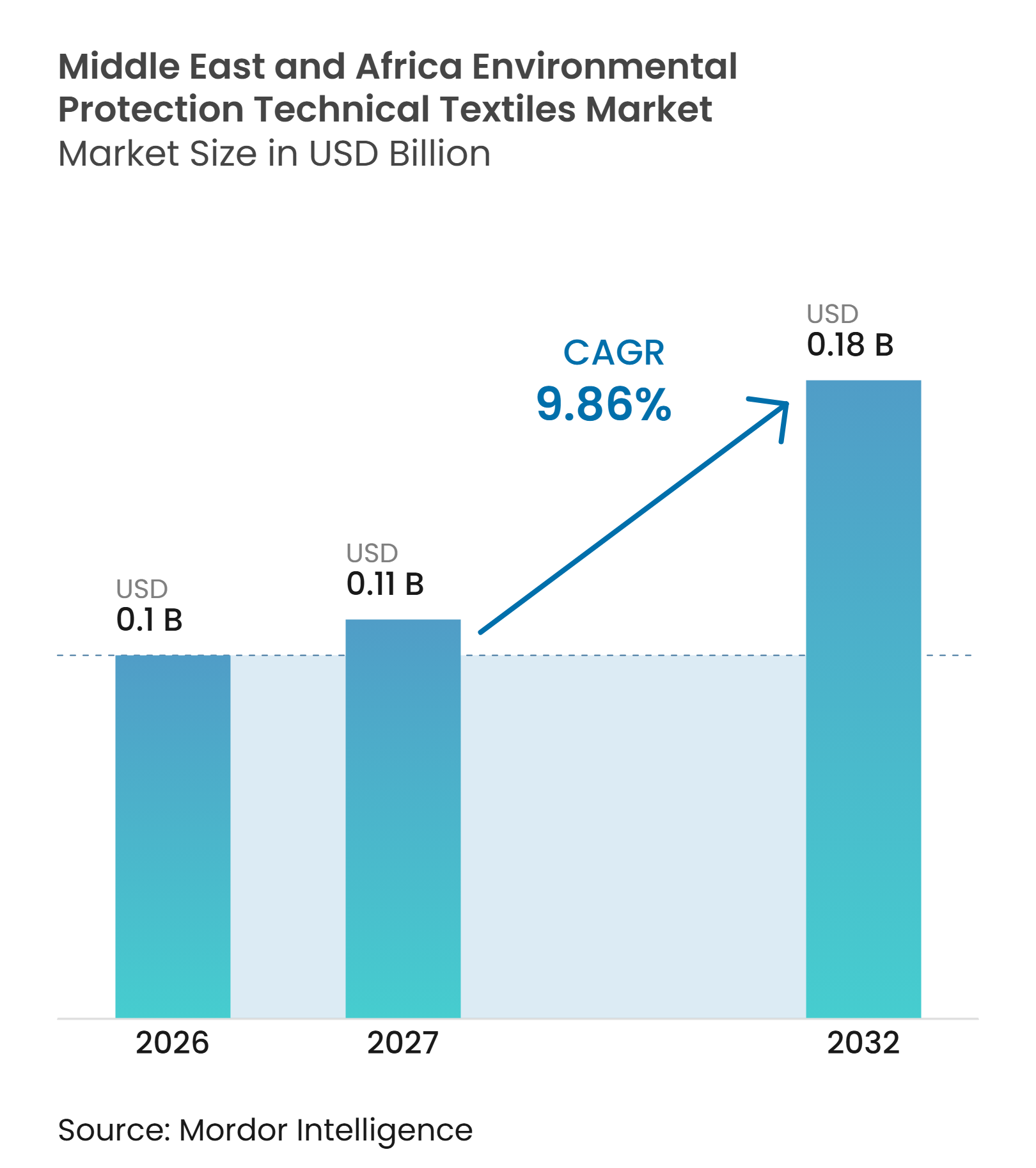
The Middle East And Africa Environmental Protection Technical Textiles Market size is projected to be USD 0.1 billion in 2026, USD 0.11 billion in 2027, and reach USD 0.18 billion by 2032, growing at a CAGR of 9.86% from 2027 to 2032.
Growth is supported by tighter industrial emission requirements, water and wastewater investment, and capacity additions in heavy industry across the GCC, Egypt, and South Africa. Procurement is frequently specified during greenfield infrastructure planning rather than added after construction, which can connect textile demand to long-lived treatment, industrial, and containment assets. The Middle East and Africa environmental protection technical textiles market faces clear limits from public-financing constraints, high equipment costs, import dependence for advanced inputs, and uneven technical-service capacity.
Key Report Takeaways
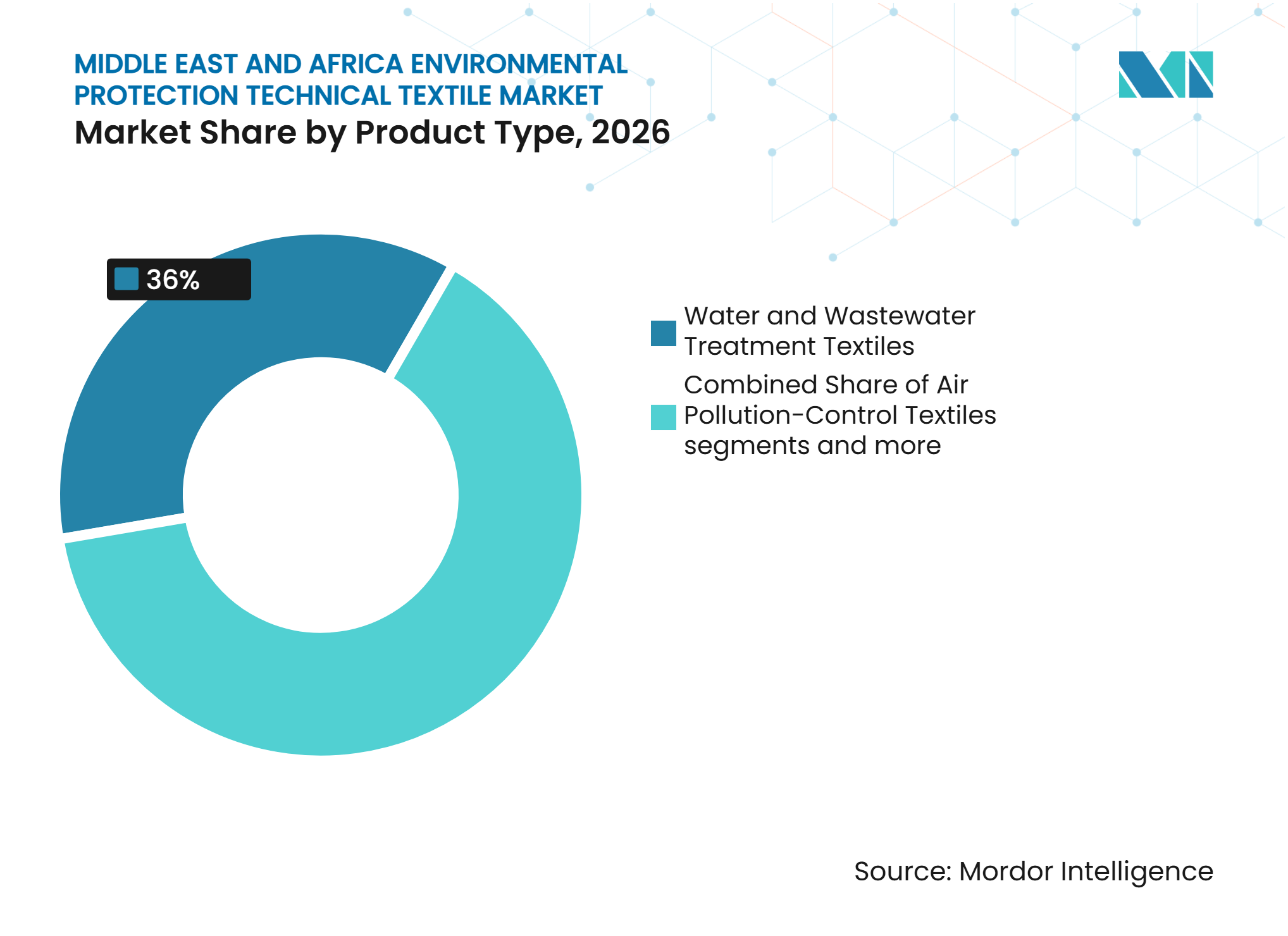
- By product type, water and wastewater treatment textiles held 36% of the Middle East and Africa environmental protection technical textiles market share in 2026 and are projected to grow at an 11.2% CAGR through 2032.
- By material type, polypropylene held 28% of the Middle East and Africa environmental protection technical textiles market size in 2026, while high-performance synthetic fibers are forecast to grow at an 11% CAGR through 2032.
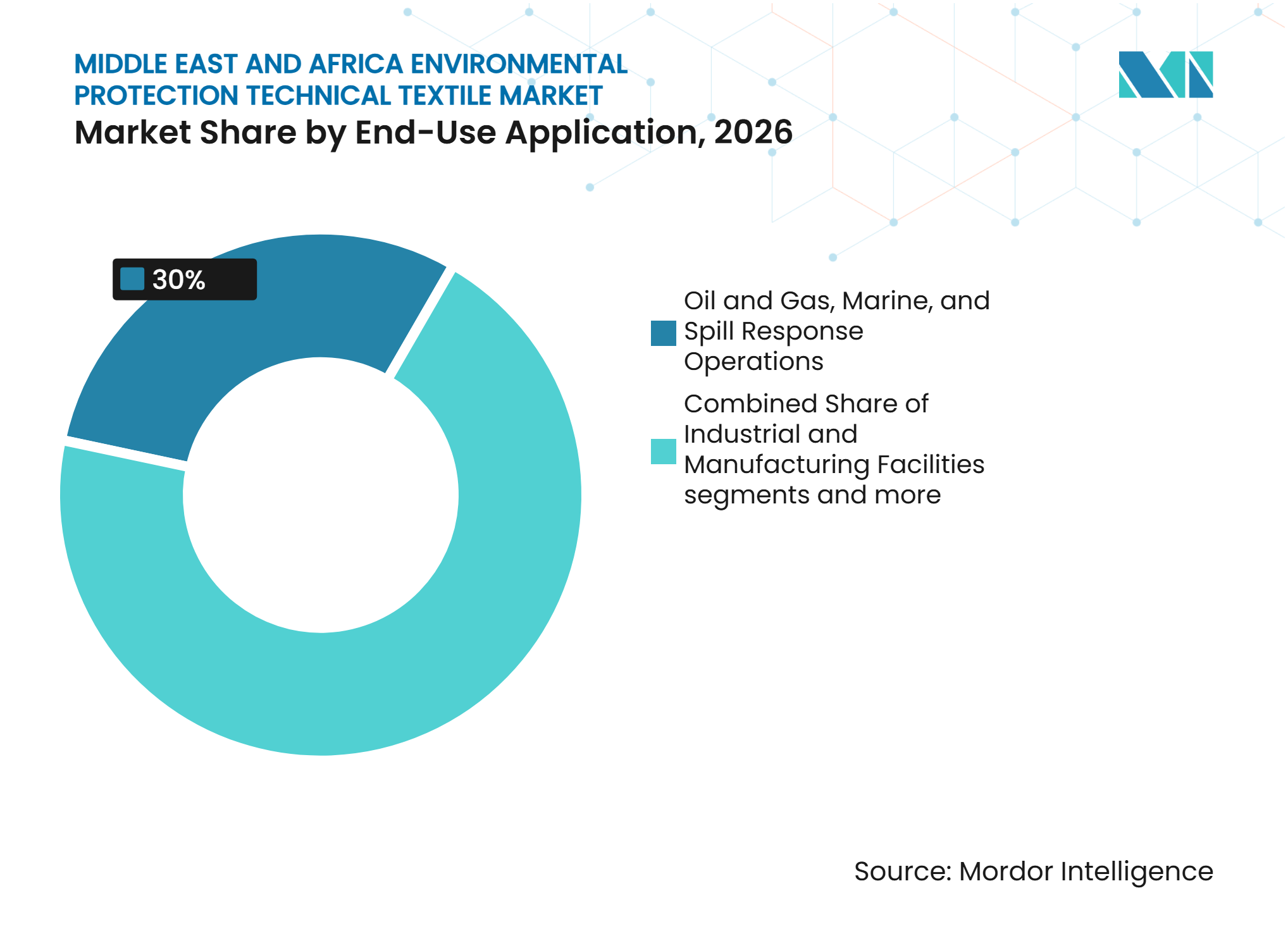
- By end-use application, oil and gas, marine, and spill response operations held 30% of the market in 2026, while municipal water and wastewater utilities are forecast to grow at an 11.5% CAGR through 2032.
- By geography, Saudi Arabia held 32% of the market in 2026, while Egypt is forecast to grow at an 11.8% CAGR through 2032.
Note: Market numbers in this report are based on Mordor Intelligence's proprietary estimation framework, which combines nine months of actuals with Q4 projections for base year 2026.
Market Trends and Insights
Drivers Impact Analysis of Middle East and Africa Environmental Protection Technical Textiles Market*
| Driver | (~) % Impact on CAGR Forecast | Geographic Relevance | Impact Timeline |
|---|---|---|---|
| Industrial Emission-Control Requirements | +3.5% | Saudi Arabia, UAE, South Africa, Qatar, Kuwait | Medium term (2-4 years) |
| Water Scarcity and Wastewater-Reuse Investment | +2.8% | GCC core, Egypt, North Africa | Long term (≥ 4 years) |
| Gulf Mega-Projects and Environmental Infrastructure Development | +1.5% | Saudi Arabia, UAE, Qatar | Medium term (2-4 years) |
| Expansion of Mining, Cement, Petrochemical, and Manufacturing Capacity | +1% | South Africa, Saudi Arabia, UAE | Medium term (2-4 years) |
| Local Manufacturing and Import-Substitution Programs | +0.5% | Saudi Arabia, UAE | Long term (≥ 4 years) |
| Climate-Resilient Coastal and Flood-Control Infrastructure | +0.3% | Egypt, Oman, UAE | Short term (≤ 2 years) |
| Source: Mordor Intelligence | |||
Industrial Emission-Control Requirements
Industrial emission rules are making filtration upgrades a compliance requirement in key Middle East and Africa markets, rather than discretionary spending that can be deferred when project budgets tighten. Abu Dhabi’s 2026 measurement, reporting, and verification framework applies to facilities emitting 25,000 tons of CO2e or more. The framework covers petrochemicals, cement, steel, and aluminum, and requires third-party verification from September 2026. These requirements increase demand for baghouse systems, PTFE membrane filter bags, and high-temperature flue-gas filtration fabrics designed to meet documented limits. Saudi Arabia is also updating stationary-source standards for industrial sectors, while South Africa’s National Dust Control Regulations extend dust-management requirements to mining operations and other controlled emitters.[1] Operators upgrading from conventional bags to surface-filtration PTFE laminates can raise product specifications, improve compliance margins, and support a higher-value sales mix across the Middle East and Africa environmental protection technical textiles market.
Water Scarcity and Wastewater-Reuse Investment
Water scarcity is creating a long-term need for desalination, treatment, and reuse infrastructure across the GCC and North Africa. GCC countries produce 120 cubic meters of natural freshwater per person each year, against a consumption of 800 cubic meters. The GCC produced 8.5 billion cubic meters of desalinated water in 2025, while governments committed USD 100 billion to expand desalination capacity by 37% over the following 5 years. Membrane pre-filtration nonwovens and sludge-dewatering textiles are used across desalination and reuse projects, making new capacity a direct procurement driver. Egypt’s water and sanitation program completed 65 treatment stations with a combined daily capacity of 6.3 million cubic meters during fiscal year 2025/2026.[2] The treatment gap remains material because the Middle East and North Africa generate 21.5 billion cubic meters of municipal wastewater annually, and more than 50% remains untreated.
Gulf Mega-Projects and Environmental Infrastructure Development
Large projects in Saudi Arabia are combining industrial construction, water investment, and environmental infrastructure in a single procurement environment. NEOM’s Oxagon industrial city includes a USD 8.5 billion green hydrogen plant developed by ACWA Power, Air Products, and NEOM. The project is expected to require filtration systems for production and waste-management operations as commissioning progresses through 2027. The National Water Company inaugurated 122 water and sanitation projects in Saudi Arabia’s Eastern Region, including treatment facilities designed to process 200,000 cubic meters per day. Saudi Arabia has also expanded water-technology manufacturing, including Toray Membrane Middle East’s Dammam facility. The facility has an annual capacity of 300,000 reverse-osmosis membranes, which brings membrane production closer to water-treatment projects.[3]
Expansion of Mining, Cement, Petrochemical, and Manufacturing Capacity
Heavy-industry expansion adds a steady source of demand for environmental filtration products that can continue beyond an individual infrastructure project’s construction phase. In November 2025, Ta’ziz awarded an EPC contract for a PVC plant in Ruwais with 1.9 million tons of annual capacity. The facility requires filtration systems for emissions control, effluent handling, and spill containment across its operating life. South African mining operators must meet particulate-control requirements under the National Water Act and the 2026 Dust Control Regulations. Cement, power, mining, and petrochemical projects also require media that can manage elevated temperatures, chemical exposure, and persistent particulate loads in the Middle East and Africa environmental protection technical textiles market.
Restraints Impact Analysis of Middle East and Africa Environmental Protection Technical Textiles Market*
| Restraint | (~) % Impact on CAGR Forecast | Geographic Relevance | Impact Timeline |
|---|---|---|---|
| High Capital and Operating Costs of Advanced Filtration Systems | -2% | Egypt, Rest of Africa, lower-income GCC | Short term (≤ 2 years) |
| Competition from Conventional Aggregates and Non-Textile Materials | -1.2% | Global, with early impact in lower-income Africa | Medium term (2-4 years) |
| Import Dependence for Advanced Fibers, Membranes, and Machinery | -0.8% | Saudi Arabia, UAE, Egypt, South Africa | Medium term (2-4 years) |
| Limited Application Engineering and Technical-Service Capacity Outside Major Industrial Clusters | -0.4% | Rest of Africa, Iraq, Oman | Long term (≥ 4 years) |
| Source: Mordor Intelligence | |||
High Capital and Operating Costs of Advanced Filtration Systems
High upfront and operating costs limit adoption of advanced filtration textiles outside high-income GCC markets. PTFE membrane bags, electrospun nanofiber media, and high-temperature PPS fabrics can cost 4 to 8 times more than standard polyester products. Municipal projects in Egypt and sub-Saharan Africa often depend on development-finance programs that prioritize the lowest compliant solution, even where a higher-performance system offers better service life. Dusty desert conditions can shorten replacement cycles for baghouse filters and increase total ownership costs beyond assumptions based on temperate operating environments. Buyers with limited budgets can choose entry-grade needlepunched polyester bags and reactive replacement practices rather than planned premium replacements. Import dependence for advanced fibers, membranes, machinery, and specialist application engineering compounds this cost barrier outside major industrial clusters in the Middle East and Africa environmental protection technical textiles market.
Competition from Conventional Aggregates and Non-Textile Materials
Non-textile materials and conventional construction methods compete with environmental protection technical textiles in selected applications. Granular activated carbon and ceramic filtration media serve as alternatives in certain water and wastewater treatment processes. At the same time, gravel drainage layers and concrete containment structures compete in specific civil-engineering and stormwater management applications. Contractors favor conventional gravel drainage systems and concrete structures where established engineering specifications, material availability, and procurement practices influence project selection. In coastal protection, lower-cost nature-based solutions also compete with engineered textile-based systems. For example, Egypt has implemented dunes and woven reed fences for coastal erosion protection in the Nile Delta, demonstrating the use of locally sourced alternatives to conventional hard coastal defences. These alternatives can limit textile adoption in price-sensitive projects, particularly where conventional materials or nature-based solutions meet the required engineering performance.
*Our forecasts treat driver/restraint impacts as directional, not additive. The impact forecasts reflect baseline growth, mix effects, and variable interactions.
Middle East and Africa Environmental Protection Technical Textiles Market Segment Analysis
By Product Type:
Water Treatment Leads, Stormwater Poised for AccelerationWater and wastewater treatment textiles held 36% of the Middle East and Africa environmental protection technical textiles market size in 2026 and are forecast to expand at an 11.2% CAGR through 2032. The category is supported by a large water-infrastructure gap, which keeps municipal utilities focused on treatment, desalination, reuse, and sludge-management capacity. Membrane bioreactor support fabrics and wastewater sludge-dewatering textiles are advancing with utility upgrades in Egypt, Saudi Arabia, and the United Arab Emirates. Toray Membrane Middle East opened a Dammam plant with an annual capacity of 300,000 reverse-osmosis membranes in 2025.
Air pollution-control textiles remain a major procurement category for cement, petrochemical, and power facilities operating under tighter permits. Particulate-control media lead this category, while catalytic and multifunctional textiles are used as operators add DeNOx and acid-gas treatment to existing flue-gas systems. Oil and Chemical Spill-Control Textiles remain necessary across hydrocarbon logistics in the Persian Gulf, where absorbents, filters, and booms are recurring operational purchases. Stormwater and Surface Runoff Pollution-Control Textiles are gaining use as GCC smart-city projects integrate drain-inlet filtration into urban drainage plans. Together, these applications extend technical-textile demand from conventional treatment plants to industrial sites, marine operations, and municipal infrastructure.



By Material Type:
Polypropylene Leads, High-Performance Fibers Accelerate MostPolypropylene held 28% of the Middle East and Africa environmental protection technical textiles market size in 2026. The material combines chemical resistance and cost competitiveness with compatibility across the region’s established spunbond and needlepunch manufacturing base. Alujain Corporation and Beaulieu International Group signed an MoU in March 2026 for a Saudi joint venture to produce polypropylene fibers and nonwovens in Yanbu. The planned venture is intended to localize supply for geotextile and environmental applications. Polyester remains important in filter bags and geotextiles where dimensional stability under sustained mechanical stress matters, while polyamide supports liquid filtration and polyolefins serve cost-sensitive drainage and containment uses.
High-performance synthetic fibers are projected to grow at an 11% CAGR through 2032 within the Middle East and Africa environmental protection technical textile industry. The group includes polyphenylene sulfide, aramid, and other materials specified for demanding industrial conditions. Cement and petrochemical facilities generate flue-gas temperatures that standard polyester filter bags cannot withstand, creating a technical requirement for PPS and aramid grades. DuPont’s announced intention to divest its Aramids business in 2025 creates supply-chain uncertainty for buyers relying on Nomex-grade filtration fabrics. Fluoropolymer Textile Media and Glass and Inorganic Fibers occupy narrower roles in PTFE lamination and high-temperature filtration, but these roles become more important as operators upgrade process controls.
By End-Use Application:
Oil and Gas Anchors Volume, Municipal Utilities Drive GrowthOil and gas, marine, and spill response operations held 30% of the market in 2026. The segment reflects the high concentration of hydrocarbon production, transport, and offshore activity across the Persian Gulf. Operators use spill-control absorbents, drum-top filters, and containment booms to manage routine handling risks and emergency response requirements. Spill-control textile kits are required inventory on offshore platforms and marine vessels in GCC territorial waters, creating recurring demand that is less dependent on short-term project cycles. Industrial and Manufacturing Facilities are the next major end-use group, supported by chemicals, petrochemicals, metals, mining, cement, and new industrial-zone development.
Municipal water and wastewater utilities are expected to grow at an 11.5% CAGR through 2032. Government capital programs and development-finance support are expanding treatment capacity in countries with large service gaps. Egypt’s Al-Jebel Al-Asfar Phase 3 expansion adds 1 million cubic meters per day of capacity under African Development Bank financing. Environmental Remediation and Emergency Response Services are also emerging as South African mining operators address acid mine drainage and tailings-management requirements. The mix of municipal, industrial, power, recycling, and urban-drainage applications gives the Middle East and Africa environmental protection technical textiles market several demand channels.

Geography Analysis
Saudi Arabia: Regional Demand Anchor
Saudi Arabia held 32% of the Middle East and Africa environmental protection technical textiles market size in 2026. Giga-project construction, desalination growth, and Vision 2030 industrial diversification support demand across utility and industrial applications. The National Water Company inaugurated 122 water and sanitation projects in the Eastern Region, with treatment capacity of 200,000 cubic meters per day and reservoir networks exceeding 1.5 million cubic meters. IKTVA and the National Industrial Development and Logistics Program favor domestic or approved regional suppliers on major projects. Toray’s Dammam facility integrates membrane fabrication and assembly, illustrating the country’s move toward local supply of critical water-filtration materials.
Egypt: Fastest-Growing Country Market
Egypt is projected to expand at an 11.8% CAGR through 2032. Coastal protection and wastewater investment drive procurement as water stress and urban growth raise demand for durable treatment and containment systems. The UNDP-supported North Coast and Nile Delta Climate Change Adaptation Project completed 69 kilometers of coastal protection works across 5 governorates by 2025. The government committed to operate and maintain 75 kilometers of these systems for 40 years. Egypt also completed 65 water treatment stations with a combined daily capacity of 6.3 million cubic meters in fiscal year 2025/2026.
Rest of Middle East and Africa : Industrial and Compliance-Led Demand
Qatar, Kuwait, and the UAE generate demand through industrial and utility procurement, with Qatar targeting a 70% reduction in groundwater extraction by 2030. Kuwait awarded the Doha SWRO Phase II project to the joint venture of VA Tech Wabag and HEISCO in April 2026, with the contract signed on August 25, 2026. The revised contract value is approximately USD 372 million, covering a 60 MIGD desalination facility, with 36 months allocated for construction, followed by five years of operation and maintenance. Oman, Iraq, and Bahrain are smaller but expanding markets, and Oman’s Vision 2040 objective to treat wastewater to reuse standards can sustain filtration-media demand. Africa’s annual water-infrastructure financing gap of USD 30 billion continues to shape project timelines across the wider region.
Competitive Landscape
Market Concentration
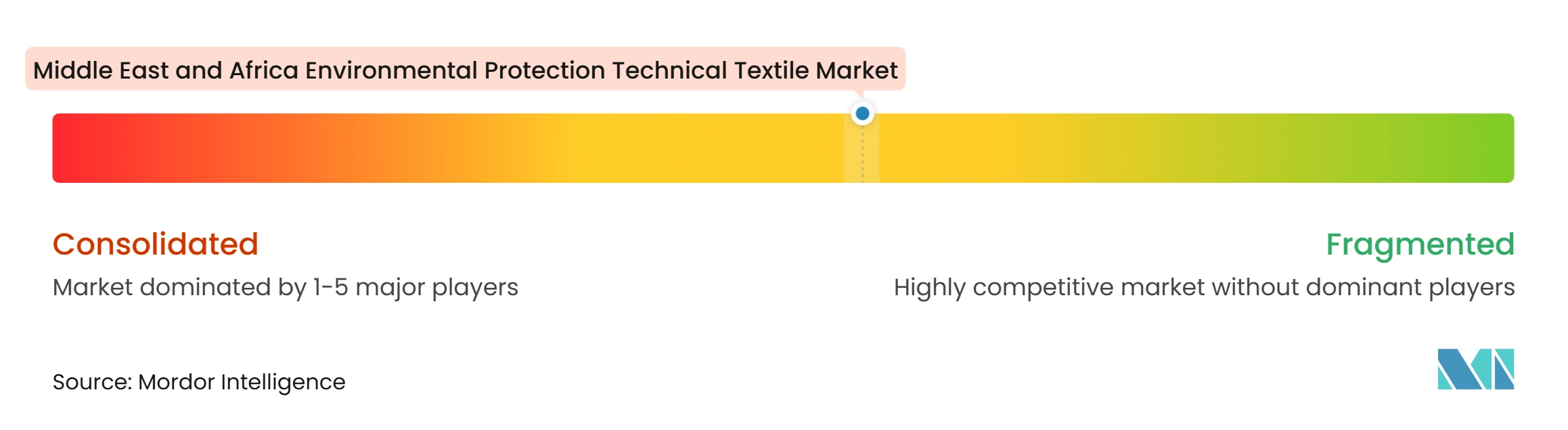
The Middle East and Africa environmental protection technical textiles market exhibits a medium level of market concentration. Mattex Group, ALYAF Industrial Company, Kaytech Engineered Fabrics, and Fibertex Nonwovens compete through cost, delivery speed, local project knowledge, and proximity to major procurement centers. Freudenberg Performance Materials, Donaldson Company, and Camfil AB serve higher-specification applications with proprietary fiber technologies and type-approval documentation. PPS filter bags, electrospun nanofiber composites, and PTFE membrane laminates are largely imported, exposing buyers to currency and logistics risk.
Product certification is a key route to market access in GCC procurement, especially where utilities and industrial operators maintain approved-vendor lists. SASO conformity approvals and ESMA product-control documentation can affect supplier inclusion, creating a practical barrier for suppliers without established compliance records. Alujain’s MoU with Beaulieu International Group supports local polypropylene fiber and nonwoven production for geotextile applications. Obeikan Technical Fabrics and Gulf Air Filters Factory Company are expanding filtration offerings, while digital specification tools and filter-condition monitoring are enabling more performance-based service relationships.
Global suppliers differentiate through application-specific products that local producers cannot easily reproduce at the same specification level. HUESKER launched Tektoseal Active PFAS in October 2025, combining ion-exchange resin and activated carbon between geotextile layers for containment and remediation uses. Ahlstrom completed an advanced molecular-filtration media line in Turin in June 2025. Freudenberg Performance Materials received an EcoVadis Silver Medal in January 2026.
Middle East and Africa Environmental Protection Technical Textiles Industry Leaders
-
Mattex Group
-
Alyaf Industrial Co. Ltd.
-
Exeed Geotextile
-
Fibertex Nonwovens (Pty) Ltd
-
Kaytech Engineered Fabrics
- *Disclaimer: Major Players sorted in no particular order
Middle East and Africa Environmental Protection Technical Textiles Market Companies Covered in this Report
- Mattex Group
- Alyaf Industrial Co. Ltd.
- Exeed Geotextile
- Fibertex Nonwovens (Pty) Ltd
- Kaytech Engineered Fabrics
- Spunchem International
- Obeikan Technical Fabrics
- Toray Membrane Middle East LLC
- Hanza Environment Technology Factory
- Gulf Air Filters Factory Company
- Ahlstrom
- Freudenberg Performance Materials
- Solmax
- HUESKER Group
- Officine Maccaferri S.p.A.
- NAUE GmbH and Co. KG
- Berry Global Group, Inc.
- DuPont de Nemours, Inc.
- Donaldson Company, Inc.
- Camfil AB
- MANN+HUMMEL International GmbH and Co. KG
Recent Industry Developments in Middle East and Africa Environmental Protection Technical Textiles Market
- August 2026: UAE’s Fujairah Natural Resources Corporation and JSW Cement signed a contract to establish a 1.65 MTPA Portland cement grinding unit in Al Tawyeen. The new cement capacity supports the Middle East and Africa environmental protection technical textile market by increasing demand for dust-control and flue-gas filtration media.
- March 2026: outh Africa’s Minister of Forestry, Fisheries and the Environment published the National Dust Control Regulations under the Air Quality Act, 2004, extending mandatory dust-management plans to mining operations and atmospheric-emission licensees, with fines of up to ZAR 5 million (USD 0.3 million) for first-time offenders. The regulations support the Middle East and Africa environmental protection technical textile market because mining operators need engineered particulate-control and filtration solutions to comply.
- November 2025: Toray Membrane Middle East LLC and Abunayyan Holding inaugurated the Middle East’s largest RO membrane manufacturing plant in Dammam’s Third Industrial City, an investment exceeding SAR 1 billion (USD 266.5 million) with an annual capacity of 300,000 membranes, also housing the Middle East Water Treatment Technical Center.
Middle East and Africa Environmental Protection Technical Textiles Market Report Scope
The Middle East and Africa Environmental Protection Technical Textiles Market is segmented by Product Type (Oil and Chemical Spill-Control Textiles, and More), by Material Type (Polypropylene, Polyester, and More), by End-Use Application (Municipal Water and Wastewater Utilities, Industrial and Manufacturing Facilities, and More), and by Geography (Qatar, Oman, and more). The Market Forecasts are Provided in Terms of Value (USD).
Segmentation Overview
| Air Pollution-Control Textiles | Particulate Emission-Control Filter Textiles |
| Catalytic and Multifunctional Emission-Control Textiles | |
| Other Specialized Air Pollution-Control Textiles | |
| Water and Wastewater Treatment Textiles | Water Purification and Fine-Filtration Textile Media |
| Wastewater and Effluent Filtration Textiles | |
| Wastewater Sludge Dewatering Textiles | |
| Oil and Chemical Spill-Control Textiles | Flat-Form Absorbent Textiles |
| Shaped Absorbent Textile Products | |
| Textile-Based Spill Containment Products | |
| Other Specialized Spill-Control Textiles | |
| Stormwater and Surface Runoff Pollution-Control Textiles | Drain-Inlet and Catch-Basin Textile Filter Bags |
| Stormwater Filter Mats and Textile Inserts | |
| Textile Media for Stormwater Filter Cartridges | |
| Other Dedicated Runoff Pollution-Removal Textiles | |
| Other Specialized Environmental Protection Textiles ( Contaminant Remediation Products, etc.) |
| Polypropylene |
| Polyester |
| Polyamide |
| Polyethylene and Other Polyolefins |
| High-Performance Synthetic Fibers (Polyphenylene Sulfide, Aramid, etc.) |
| Fluoropolymer Textile Media |
| Glass and Other Inorganic Fibers |
| Natural and Regenerated Cellulosic Fibers |
| Other Materials |
| Municipal Water and Wastewater Utilities | Drinking Water Treatment |
| Municipal Wastewater Treatment | |
| Industrial and Manufacturing Facilities | Chemicals and Petrochemicals |
| Metals, Mining, and Mineral Processing | |
| Cement and Building Materials Manufacturing | |
| Other Industrial Manufacturing | |
| Power Generation and Energy Facilities | |
| Municipal Solid Waste and Recycling Facilities | |
| Oil and Gas, Marine, and Spill Response Operations | |
| Urban Stormwater and Drainage Infrastructure | |
| Environmental Remediation and Emergency Response Services | |
| Other Environmental Protection End Users |
| Saudi Arabia |
| United Arab Emirates |
| Qatar |
| Kuwait |
| Oman |
| Bahrain |
| Iraq |
| South Africa |
| Egypt |
| Rest of Middle East and Africa |
| By Product Type | Air Pollution-Control Textiles | Particulate Emission-Control Filter Textiles |
| Catalytic and Multifunctional Emission-Control Textiles | ||
| Other Specialized Air Pollution-Control Textiles | ||
| Water and Wastewater Treatment Textiles | Water Purification and Fine-Filtration Textile Media | |
| Wastewater and Effluent Filtration Textiles | ||
| Wastewater Sludge Dewatering Textiles | ||
| Oil and Chemical Spill-Control Textiles | Flat-Form Absorbent Textiles | |
| Shaped Absorbent Textile Products | ||
| Textile-Based Spill Containment Products | ||
| Other Specialized Spill-Control Textiles | ||
| Stormwater and Surface Runoff Pollution-Control Textiles | Drain-Inlet and Catch-Basin Textile Filter Bags | |
| Stormwater Filter Mats and Textile Inserts | ||
| Textile Media for Stormwater Filter Cartridges | ||
| Other Dedicated Runoff Pollution-Removal Textiles | ||
| Other Specialized Environmental Protection Textiles ( Contaminant Remediation Products, etc.) | ||
| By Material Type | Polypropylene | |
| Polyester | ||
| Polyamide | ||
| Polyethylene and Other Polyolefins | ||
| High-Performance Synthetic Fibers (Polyphenylene Sulfide, Aramid, etc.) | ||
| Fluoropolymer Textile Media | ||
| Glass and Other Inorganic Fibers | ||
| Natural and Regenerated Cellulosic Fibers | ||
| Other Materials | ||
| By End-Use Application | Municipal Water and Wastewater Utilities | Drinking Water Treatment |
| Municipal Wastewater Treatment | ||
| Industrial and Manufacturing Facilities | Chemicals and Petrochemicals | |
| Metals, Mining, and Mineral Processing | ||
| Cement and Building Materials Manufacturing | ||
| Other Industrial Manufacturing | ||
| Power Generation and Energy Facilities | ||
| Municipal Solid Waste and Recycling Facilities | ||
| Oil and Gas, Marine, and Spill Response Operations | ||
| Urban Stormwater and Drainage Infrastructure | ||
| Environmental Remediation and Emergency Response Services | ||
| Other Environmental Protection End Users | ||
| By Geography | Saudi Arabia | |
| United Arab Emirates | ||
| Qatar | ||
| Kuwait | ||
| Oman | ||
| Bahrain | ||
| Iraq | ||
| South Africa | ||
| Egypt | ||
| Rest of Middle East and Africa | ||
Key Questions Answered in the Report
What is the projected value of environmental protection technical textiles in the Middle East and Africa?
The sector is projected to reach USD 0.18 billion by 2032, growing at a 9.86% CAGR from 2027 to 2032. Demand is linked to water treatment, industrial emissions control, spill response, drainage, and environmental remediation applications.
Which product category leads demand in the Middle East and Africa?
Water and wastewater treatment textiles lead with a 36% share in 2026 and are also the fastest-growing product category at an 11.2% CAGR. Desalination pre-filtration, municipal treatment, membrane support fabrics, and sludge dewatering support this position.
Why are water applications expanding across the region?
Desalination, wastewater reuse, and treatment infrastructure are expanding because of persistent water scarcity and untreated wastewater volumes. New utility assets require products used in intake, pre-filtration, wastewater treatment, sludge management, and replacement cycles.
Which material is growing fastest for environmental filtration applications?
High-Performance Synthetic Fibers are projected to grow at an 11% CAGR through 2032 because high-temperature industrial processes require materials such as PPS and aramid. These materials are relevant where polyester bags cannot withstand flue-gas temperatures or chemical conditions.
Which end-use application is growing fastest?
Municipal Water and Wastewater Utilities are forecast to grow at an 11.5% CAGR through 2032, supported by treatment investment and development-finance programs. Egypt’s large treatment expansion pipeline shows how utility upgrades can create procurement demand for filtration textiles.
Which country offers the fastest growth outlook?
Egypt is forecast to grow at an 11.8% CAGR through 2032, supported by wastewater, coastal-protection, and drainage-reuse projects. Climate-adaptation investment along the Nile Delta and service expansion in water treatment underpin this outlook.