
Middle East and Africa Data Center Climate Risk and Resilience Market Size and Share
Market Overview
| Study Period | 2021 - 2032 |
|---|---|
| Forecast Data Period | 2027 - 2032 |
| Base Year Market Size (2026) | USD 253.62 Million |
| Market Size (2027) | USD 291.27 Million |
| Market Size (2032) | USD 572.41 Million |
| Growth Rate (2027 - 2032) | 14.47 % |
| Market Concentration | Medium |
Major Players *Disclaimer: Major Players sorted in no particular order Image © Mordor Intelligence. Reuse requires attribution under CC BY 4.0. | |
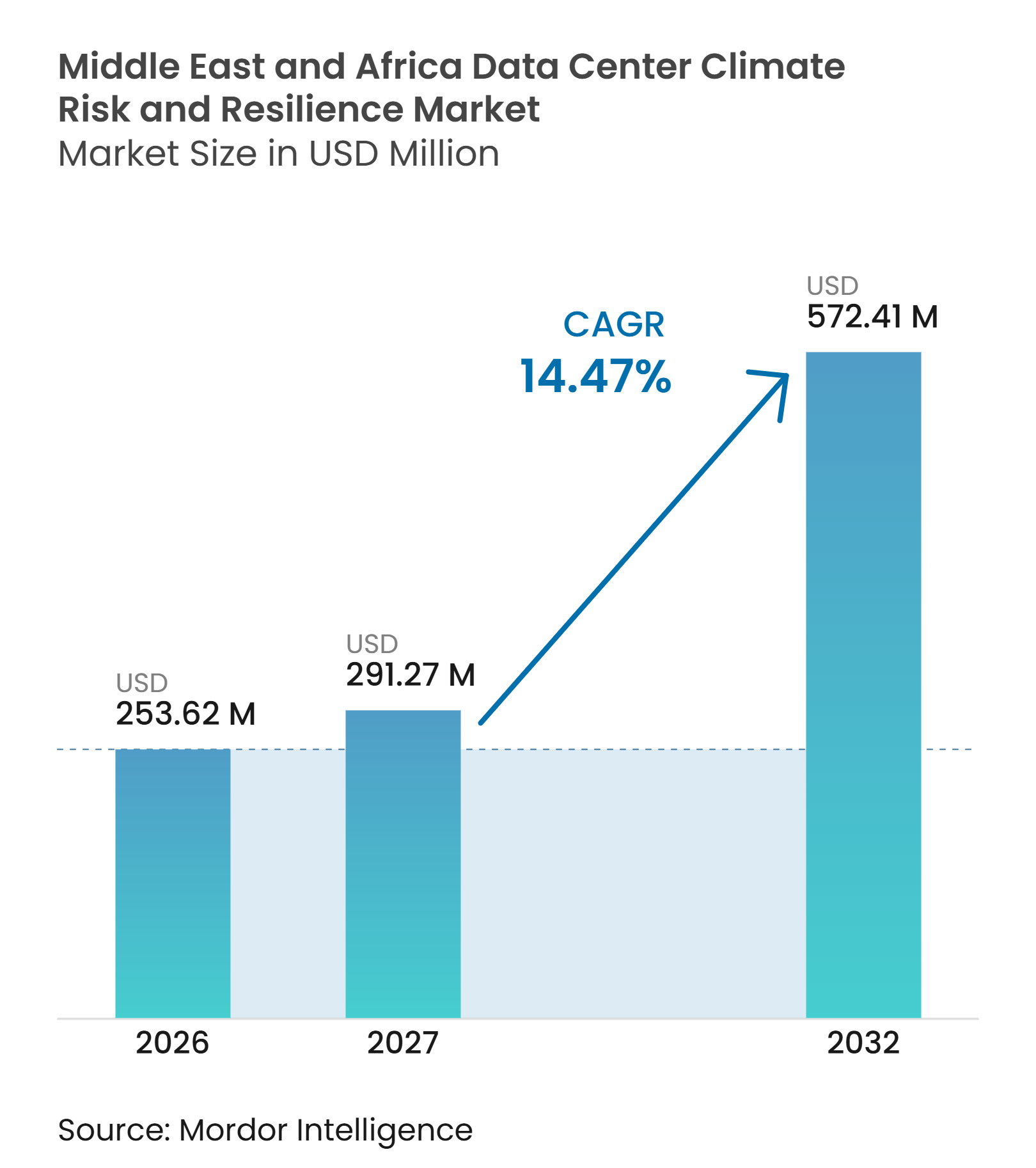
Middle East and Africa Data Center Climate Risk and Resilience Market Analysis by Mordor Intelligence
The Middle East and Africa Data Center Climate Risk and Resilience Market size is projected to be USD 253.62 million in 2026, USD 291.27 million in 2027, and reach USD 572.41 million by 2032, growing at a CAGR of 14.47% from 2027 to 2032. Investment in AI-ready capacity is making heat, water, and power reliability material operating concerns for facility owners. Higher rack densities reduce the thermal margin available during hot weather and increase the cost of cooling interruptions. Resilience spending is therefore moving into site design, financing, procurement, and operating procedures. The Middle East and Africa data center climate risk and resilience market also benefits from formal climate disclosures and customer resilience requirements, which place greater value on documented evidence of physical risk.
Key Report Takeaways
-
By solution type, Climate Risk Assessment and Analytics held 28.43% of the Middle East and Africa data center climate risk and resilience market share in 2026, while Climate Risk Monitoring and Early Warning is projected to expand at a 15.28% CAGR through 2032.
-
By climate hazard, Extreme Heat and Heatwaves accounted for 33.72% of the Middle East and Africa data center climate risk and resilience market share in 2026, while Compound and Multi-Hazard Events is expected to grow at a 15.19% CAGR through 2032.
-
By assessment method, Physical Risk and Vulnerability Assessment held a 27.94% share in 2026, while Forward-Looking Climate Scenario Analysis is projected to grow at a 15.32% CAGR through 2032.
-
By resilience strategy, Water Availability and Conservation Measures held a 26.38% share in 2026, while Cooling and Thermal Resilience is expected to expand at a 15.24% CAGR through 2032.
-
By service type, Climate Risk Consulting accounted for 35.69% of the market in 2026, while Monitoring and Early Warning Services is projected to grow at a 15.43% CAGR through 2032.
-
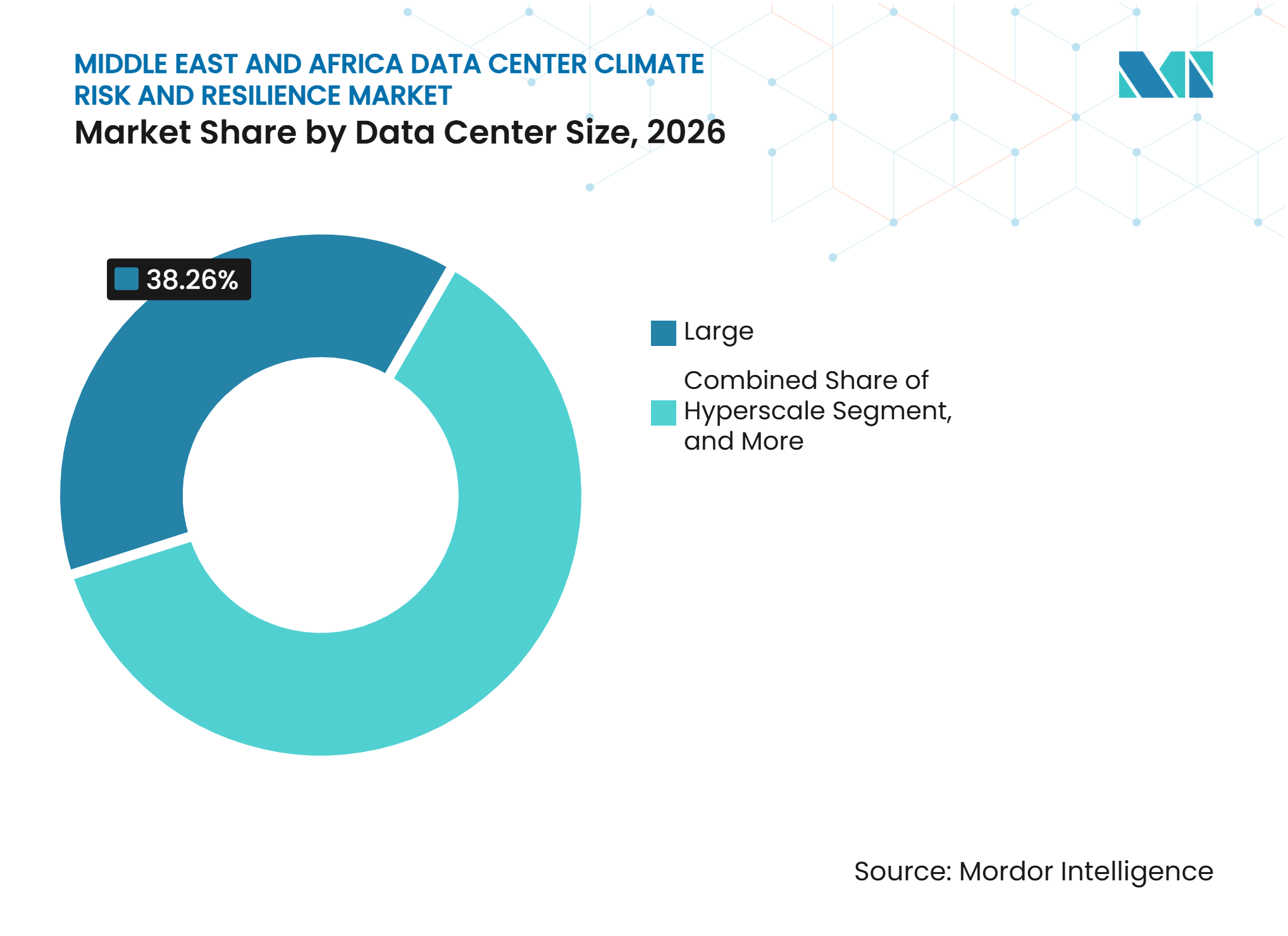
By data center size, Large Data Centers held a 38.26% share in 2026, while Hyperscale Data Centers are expected to expand at a 15.32% CAGR through 2032.
-
By data center type, Colocation Data Centers accounted for a 41.87% share in 2026, while Cloud Service Providers are projected to grow at a 15.17% CAGR through 2032.
-
By geography, Saudi Arabia held 22.58% of the Middle East and Africa data center climate risk and resilience market share in 2026, while the United Arab Emirates is projected to expand at a 15.26% CAGR through 2032.
Note: Market numbers in this report are based on Mordor Intelligence's proprietary estimation framework, which combines nine months of actuals with Q4 projections for base year 2026.
Market Trends and Insights
Drivers Impact Analysis of Middle East and Africa Data Center Climate Risk and Resilience Market*
| Driver | (~) % Impact on CAGR Forecast | Geographic Relevance | Impact Timeline |
|---|---|---|---|
| AI and High-Density Workloads Increasing Climate-Resilience Spend | +3.5% | Global, with MEA hyperscale corridors as primary concentration zones | Short term (≤ 2 years) |
| GCC Net-Zero Water Policies and Closed-Loop Cooling Adoption | +2.4% | GCC core, UAE and Saudi Arabia, spillover to North Africa | Medium term (2-4 years) |
| Climate-Adjusted Site Selection Becoming a Capital Allocation Requirement | +2.2% | Global, concentrated in MEA hyperscale investment corridors | Short term (≤ 2 years) |
| Grid Volatility and Renewable-Storage Integration in African Data Centers | +1.9% | Sub-Saharan Africa, South Africa, Nigeria, Kenya, and East Africa | Medium term (2-4 years) |
| Sustainability-Linked Financing and Customer Resilience Clauses | +1.6% | MENA, UAE and Saudi Arabia, with spillover to South Africa | Medium term (2-4 years) |
| Digital Twins, Geospatial Analytics and Continuous Risk Monitoring | +1.4% | Global, with North Africa and GCC as early adopters | Long term (≥ 4 years) |
| Source: Mordor Intelligence | |||
AI And High-Density Workloads Increasing Climate-Resilience Spend
AI inferencing workloads are changing the physical risk profile of regional data centers. Rack densities have increased from 40 kW to more than 130 kW per rack in advanced deployments. High-performance configurations could approach 250 kW per rack, tightening the tolerance for heat-related disruptions. Operators must manage cooling, backup power, and equipment performance as connected issues rather than separate engineering workstreams. The Middle East and Africa data center climate risk and resilience market is supported by this need for monitoring that can inform daily operational decisions.
GCC Net-Zero Water Policies And Closed-Loop Cooling Adoption
Water policy is influencing how new data centers are designed across the Gulf Cooperation Council. The UAE demand-side management program targets a 51% reduction in water use from business-as-usual levels by 2050.[1] Large water users must therefore demonstrate how their designs reduce demand and manage supply risk. Water conservation is especially relevant where municipal systems depend on desalination. The Middle East and Africa data center climate risk and resilience market gains from advisory work that links cooling choices with site approvals and operating requirements.
Climate-Adjusted Site Selection Becoming A Capital Allocation Requirement
Site selection is shifting beyond land cost, connectivity, and time to market. Operators increasingly need to evaluate heat, flood, water, and grid exposure over an asset's life. A peer-reviewed study found that geographic information system and AI-led methods can change site rankings when compound hazards are included. This approach gives investors a more complete view of avoided disruption and future retrofit costs. It also moves climate risk analysis to the earliest stage of the Middle East and Africa data center climate risk and resilience market.
Grid Volatility and Renewable-Storage Integration in African Data Centers
Grid reliability remains a major operational constraint in many African data centers. Some operators report as many as 33 power outages a month in relevant national markets. Tier III and Tier IV facilities cannot depend on a single grid connection to meet their availability commitments. Hybrid systems combine grid power, on-site renewables, batteries, and backup generation. This raises demand for resilience plans that assess energy security alongside physical climate risks. KenGen commissioned a 1.16-megawatt-hour battery energy storage system for its Nairobi modular data center in 2025.
Restraints Impact Analysis of Middle East and Africa Data Center Climate Risk and Resilience Market*
| Restraint | (~) % Impact on CAGR Forecast | Geographic Relevance | Impact Timeline |
|---|---|---|---|
| Water Rights, Abstraction Permits and Competing Municipal Demand | -0.8% | South Africa, Kenya, Egypt, Nigeria, and emerging GCC corridors | Short term (≤ 2 years) |
| High Capex and Maintenance Complexity of Advanced Treatment Systems | -0.7% | Global, most acute in GCC high-density AI corridors | Medium term (2-4 years) |
| Skilled-Workforce Shortage for Climate Engineering and Operations | -0.5% | Sub-Saharan Africa and MEA broadly | Medium term (2-4 years) |
| Intermittent Utility and Connectivity Infrastructure in Emerging Corridors | -0.4% | Sub-Saharan Africa and North Africa secondary markets | Long term (≥ 4 years) |
| Source: Mordor Intelligence | |||
Water Rights, Abstraction Permits And Competing Municipal Demand
Water rights are slowing some proposed data center developments across the region. In South Africa, more than 250 submissions to the South African Human Rights Commission in 2026 called for an independent assessment of the impacts on water, land, and electricity before further development. The Department of Water and Sanitation has stated that rising data center abstraction is subject to formal water-use licensing. These conditions give greater weight to domestic and agricultural demand in project approval decisions. The Middle East and Africa data center climate risk and resilience market must therefore account for permitting risks early in the site selection process.
High Capex And Maintenance Complexity Of Advanced Treatment Systems
Liquid cooling and advanced water treatment can reduce resource use, but their deployment requires substantial upfront investment. Operators must also invest in piping, chip interfaces, controls, and specialist maintenance. Equipment supply constraints add to the capital burden. These costs can be harder for mid-tier operators to absorb within short project cycles. Generator step-up transformers had lead times exceeding 160 weeks in the first quarter of 2026. High-voltage circuit breakers reached 125 weeks in 2025, compared with 77 weeks in 2023. Dry and hybrid cooling can also raise electricity use when they replace water-cooled systems.
*Our forecasts treat driver/restraint impacts as directional, not additive. The impact forecasts reflect baseline growth, mix effects, and variable interactions.
Middle East and Africa Data Center Climate Risk and Resilience Market Segment Analysis
By Solution Type:
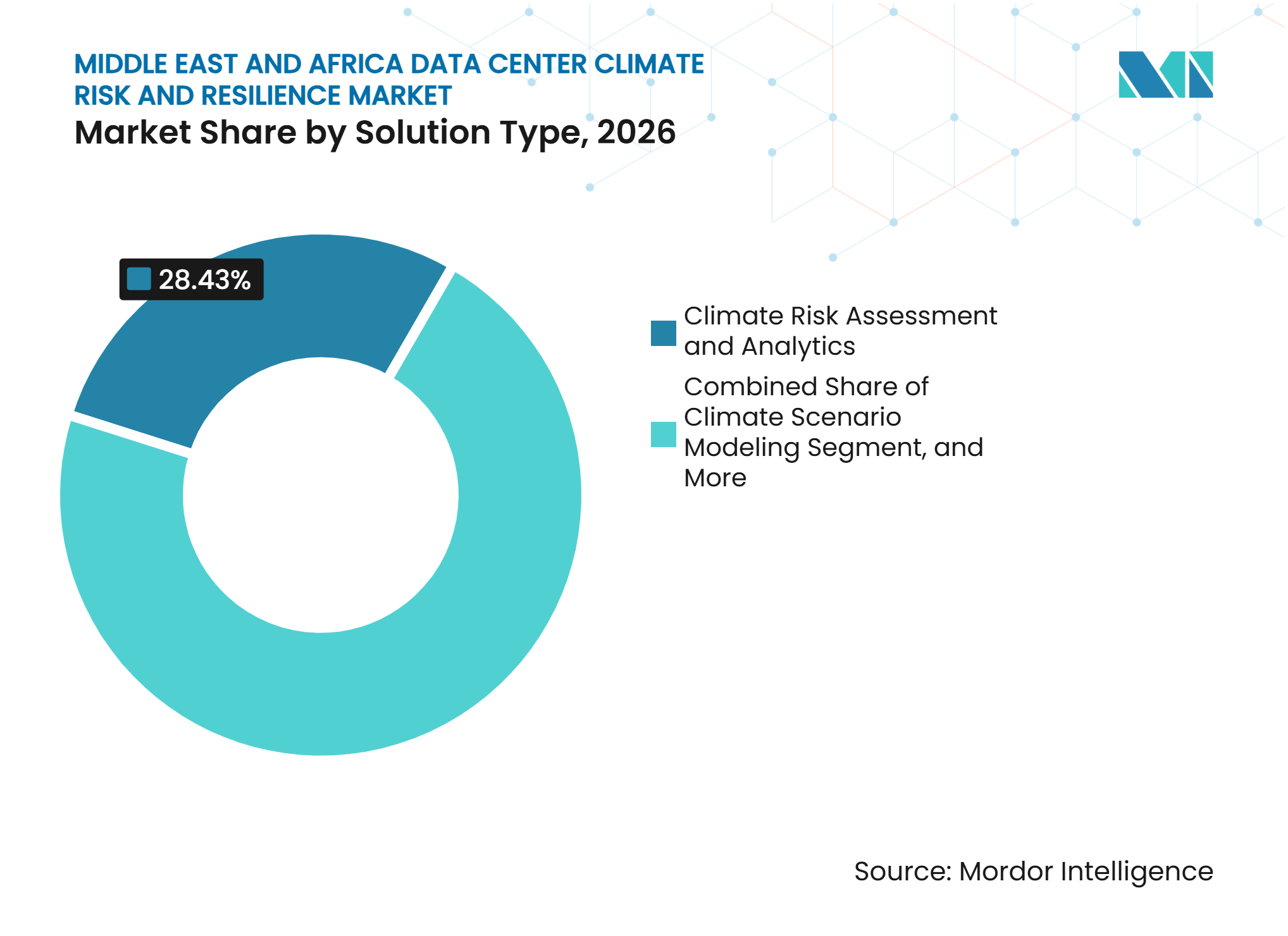
Risk Assessment Anchors Share as Monitoring ScalesClimate Risk Assessment and Analytics held 28.43% of the Middle East and Africa data center climate risk and resilience market share in 2026. It commonly serves as the first formal engagement for operators that need to understand exposure before choosing controls. Assessment work supports insurance discussions, financing documentation, and internal investment decisions. It also creates the base dataset for later monitoring, mapping, and adaptation planning. Climate Scenario Modeling is becoming increasingly relevant as operators need forward-looking financial risk information under the ISSB IFRS S2 requirements. Geographic and Geospatial Risk Mapping supplies the location data that supports those decisions.
Climate Risk Monitoring and Early Warning is projected to expand at a 15.28% CAGR through 2032. The service can track heat, flood, water, and air quality conditions across several sites. Platform delivery lowers the marginal cost of adding facilities after the initial setup. This creates an accessible path for mid-tier operators that cannot fund frequent bespoke assessments. Climate Adaptation and Resilience Planning converts risk findings into a program of projects and controls. Advisory and engineering services remain important because implementation choices depend on each facility’s equipment, location, and contractual commitments.



By Climate Hazard:
Extreme Heat Dominates, Compound Risks Set the PaceExtreme Heat and Heatwaves accounted for 33.72% of the Middle East and Africa data center climate risk and resilience market share in 2026. Cooling can account for 40% to 60% of data center energy use in hot regions. The UAE’s average power usage effectiveness was 1.79, compared with a global average of 1.56. This gap shows why cooling efficiency remains a central operating issue. High-density computing makes heat resilience more important because more equipment must be cooled in the same footprint. Cooling performance therefore affects both service availability and energy costs.
Compound and Multi-Hazard Events are expected to grow at a 15.19% CAGR through 2032. Operators increasingly recognize that severe disruption may involve simultaneous heat, power stress, water scarcity, and poor air quality. Single-peril assessments may miss how these conditions reinforce each other. Flooding and sea-level rise also matter for coastal facilities. A scientific study projects compound flooding exposure in Jeddah to reach 233.70 square kilometers by 2100 under high-emission pathways. Drought, wildfire smoke, extreme cold, and cyclones remain relevant to specific subregional locations.
By Assessment Method:
Physical Risk Assessment Leads, Scenario Analysis Gains GroundPhysical Risk and Vulnerability Assessment held 27.94% of the Middle East and Africa data center climate risk and resilience market share in 2026. Asset-level assessment identifies where a facility is exposed to heat, flood, water, and power-related hazards. It is usually the first method used when an operator establishes a climate risk program. Historical Hazard Analysis and Geographic and Geospatial Risk Mapping provide the underlying records and location information. These methods are widely used because they can be applied across large facility portfolios. They also support comparisons between candidate sites before construction begins.
Forward-Looking Climate Scenario Analysis is projected to grow at a 15.32% CAGR through 2032. Listed operators need more scenario-based disclosure as ISSB IFRS S2 practices gain relevance in the Gulf. The UAE launched its National MRV System in 2025 to monitor greenhouse gases and air pollutants. Climate Stress Testing is also becoming more important for projects seeking debt or green financing. Financial and Asset-Level Climate Risk Quantification can help lenders and insurers test key assumptions in the financial model.
By Resilience Strategy:
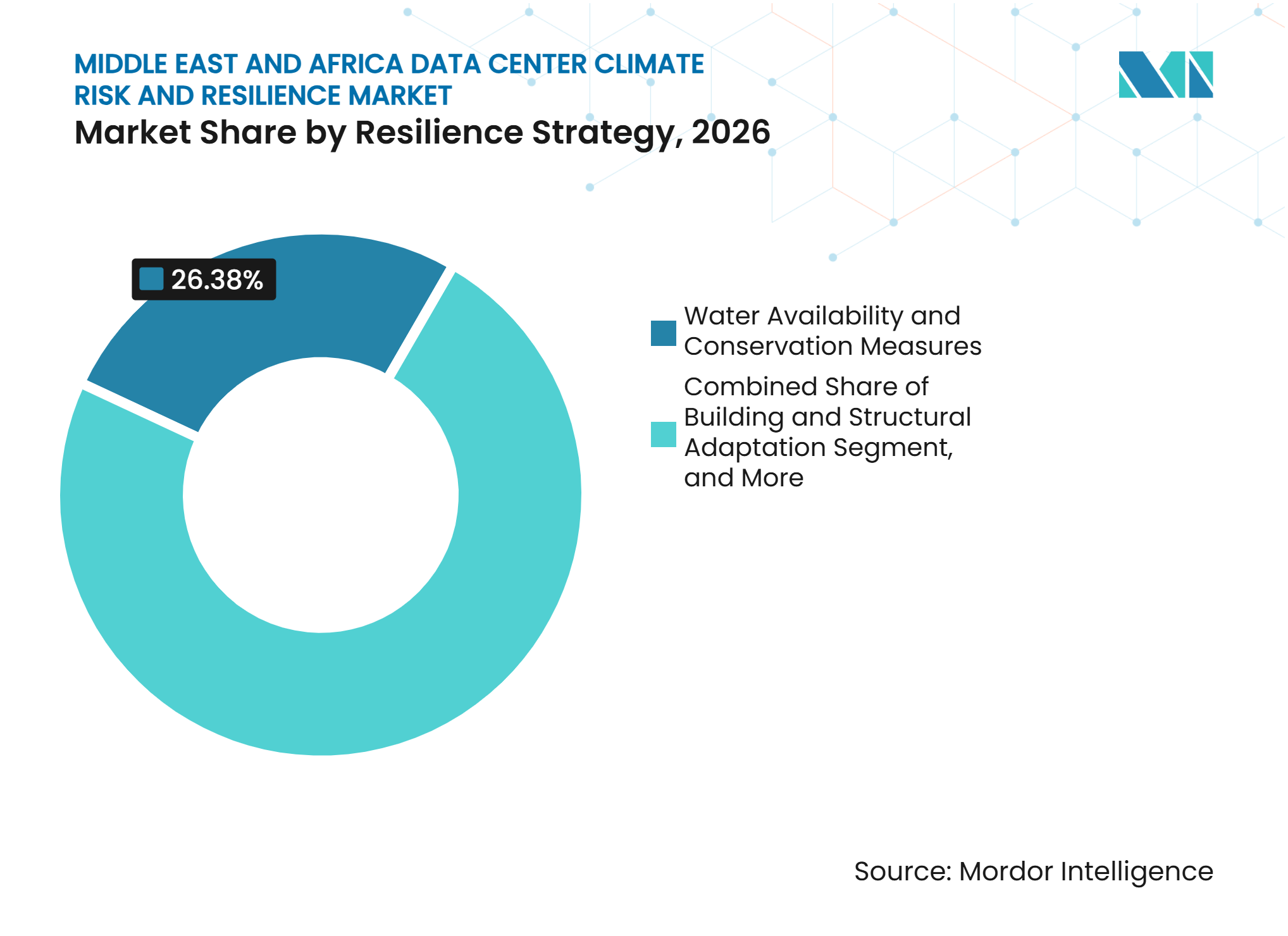
Water Conservation Leads, Thermal Resilience AcceleratesWater Availability and Conservation Measures accounted for 26.38% of the Middle East and Africa data center climate risk and resilience market share in 2026. Water access influences site selection, cooling design, operating licenses, and community acceptance. This strategy is particularly important in arid Gulf markets and drought-prone parts of Africa. It covers reuse, closed-loop systems, treated wastewater, and lower-water cooling designs. Khazna’s work with treated sewage effluent shows one way operators can diversify cooling-water sources. Better measurement of water use also supports transparent performance reporting.
Cooling and Thermal Resilience is expected to expand at a 15.24% CAGR through 2032. AI-oriented rack density increases the amount of heat that must be safely removed. Operators are using liquid cooling, adiabatic cooling, and stronger equipment specifications to manage this load. Khazna has reported an annualized power usage effectiveness of 1.5 or below under regional conditions.[2] Site Selection and Climate-Informed Planning remain important upstream strategies because location decisions shape exposure over decades. Power resilience, flood protection, structural adaptation, and multi-hazard planning complete the broader resilience program.

By Service Type:
Consulting Commands a Premium, Monitoring Expands the Market BaseClimate Risk Consulting held 35.69% of the Middle East and Africa data center climate risk and resilience market share in 2026. Consulting is often required because financial, regulatory, and engineering issues differ by customer and site. Operators use it to interpret local water rules, tenant requirements, and financing expectations. It also helps translate technical risk information into project specifications and board-level decisions. Climate Engineering and Design is a related high-value service because it turns risk findings into physical modifications. Locally adapted cooling equipment is becoming more important as operators address Saudi Arabia’s high ambient temperatures.
Monitoring and Early Warning Services is projected to grow at a 15.43% CAGR through 2032. Continuous services can support facilities that need current alerts rather than occasional reports. They can also be scaled across a portfolio without repeating the full cost of a consulting engagement. This model broadens access to structured climate risk management among medium-sized operators. Climate Adaptation Planning then converts alerts and assessments into prioritized investments. Risk Auditing and Disclosure Support is expected to gain relevance as investors seek independently supported climate reporting and financing documents.
By Data Center Size:
Large Facilities Lead, Hyperscale Sets the PaceLarge Data Centers held a 38.26% share of the Middle East and Africa data center climate risk and resilience market in 2026. These facilities are large enough to justify structured resilience programs but may not maintain fully developed in-house risk teams. They need external support for physical-risk assessments, engineering design, and disclosure preparation. Their project scale also creates material exposure to supply delays and utility constraints. Medium facilities form an important emerging customer group in African markets. Standardized digital assessments can make formal climate risk programs more affordable for this group.
Hyperscale Data Centers are expected to grow at a 15.32% CAGR through 2032. Large AI projects concentrate computing capacity, water demand, cooling needs, and power requirements in a small number of locations. This makes the impact of site-level disruption more significant. Regional capacity plans are increasing the need to assess climate exposure before construction schedules are fixed. Extended procurement periods for transformers and switchgear add another planning challenge. Hyperscale operators consequently require resilience planning before construction schedules are fixed.
By Data Center Type:
Colocation Leads, Cloud Operators Close the GapColocation Data Centers accounted for 41.87% of the Middle East and Africa data center climate risk and resilience market share in 2026. Colocation providers must meet the resilience expectations set forth in customer contracts. Hyperscale tenants may apply global due diligence requirements that exceed local regulatory thresholds. This encourages facilities to commission assessments and demonstrate the reliability of cooling, water, and power systems. It also makes third-party advice valuable in tenant discussions. The Middle East and Africa data center climate-risk industry is therefore closely linked to contractual resilience expectations in colocation portfolios.
Cloud Service Providers are projected to grow at a 15.17% CAGR through 2032. Global cloud providers bring established climate governance methods when they enter the Gulf. These methods encourage local partners to strengthen scenario analysis, disclosure practices, and operating controls. Digital Realty has reported that it evaluates and mitigates climate change risks across its global portfolio of 308 facilities, including 16 African assets. Enterprise and edge facilities remain less mature, but platform-based tools could extend risk assessment to this dispersed group. Cloud providers are more likely to favor forward-looking scenario work, while colocation providers often prioritize tenant-led site assessments.
Geography Analysis
Saudi Arabia
Saudi Arabia held 22.58% of the Middle East and Africa data center climate risk and resilience market share in 2026. Operational data center capacity reached 467 MW in the first quarter of 2026, after increasing sevenfold since 2021. The planned expansion increases the need for heat, water, and power, as well as for flood-related risk planning. A 1-gigawatt data center could use 1.5 million to 5 million cubic meters of water annually, depending on the cooling system. Green financing frameworks that recognize climate adaptation can support the documentation of resilience in financed projects. The National Center for Meteorology signed a climate cooperation agreement with ACWA Power in July 2025, strengthening the data environment for early-warning services. Coastal flood modeling for Jeddah also means operators in western corridors need to consider both pluvial and coastal flooding.
United Arab Emirates
The United Arab Emirates is projected to record a 15.26% CAGR in the Middle East and Africa data center climate risk and resilience market through 2032. Planned capacity expansion is concentrating climate exposure within a growing group of large facilities. The Ministry of Energy and Infrastructure established a National Team in 2025 to review the effects of data centers on the energy sector.[3] Regulatory influence is encouraging more consistent performance benchmarking and climate-aware planning. Khazna’s use of physical climate analytics illustrates how regional operators are integrating hazard scenarios, water access, and equipment selection. Moro Hub’s solar-powered facility also illustrates the move toward lower-carbon colocation capacity.
African and Other Regional Markets
South Africa has the region’s most mature African data center base, with large facilities in Johannesburg, Cape Town, and Durban. The country’s water licensing system and public scrutiny are increasing demand for documented water governance. Nigeria’s grid instability makes power supply resilience its most pressing service requirement. Kenya is seeing early demand for water-risk reviews where AI projects could affect freshwater users. Egypt faces a combination of rising digital demand, heat, and Nile-related water stress. Turkey combines European-style disclosure expectations with heat, water stress, and seismic exposure. Across these geographies, renewable power, storage, water permitting, and multi-hazard assessment are moving from specialist topics to basic development requirements.
Competitive Landscape
Market Concentration
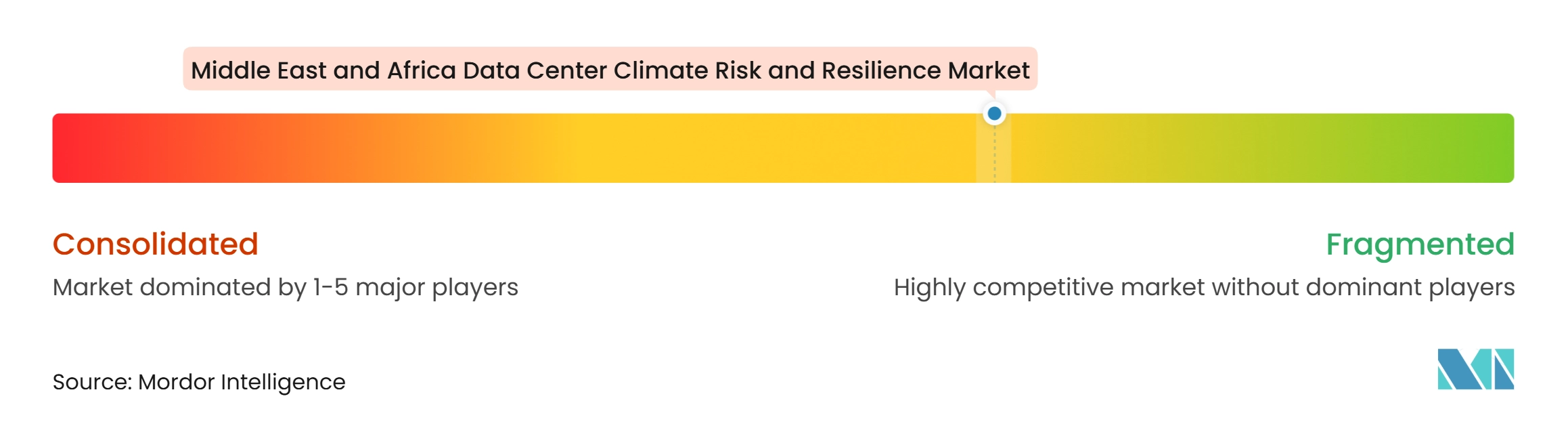
The Middle East and Africa data center climate risk and resilience market is moderately fragmented. Reinsurers, brokers, engineering suppliers, specialist analytics platforms, and regional operators address different parts of the customer need. No supplier has a dominant position across risk analytics, engineering, regulatory advice, and operating resilience. Global risk firms have strengths in catastrophe models and insurance-linked analysis.
Infrastructure companies are widening their role from equipment supply to resilience planning. Vertiv signed a technical cooperation agreement with Ezditek in October 2025 to develop AI-ready data center solutions in Saudi Arabia. Eaton and Siemens Energy partnered to provide modular gas turbine-powered data center capacity to improve power reliability and delivery speed.[4] Khazna’s AlphaGeo integration shows that operators are also treating climate analytics as part of enterprise governance. These moves favor partnerships that combine equipment knowledge, site analysis, and operational data.
Tier III and Tier IV standards and LEED certification can influence procurement by hyperscale tenants. Operators use these frameworks to demonstrate reliability and environmental performance. Integrated multi-hazard planning remains a gap in the regional offering. Customers often need engineering, permitting, scenario analysis, and disclosure support in the same engagement. The Middle East and Africa data center climate risk and resilience market creates an opportunity for providers that can coordinate these requirements without fragmenting accountability.
Middle East and Africa Data Center Climate Risk and Resilience Industry Leaders
-
Lockton Companies LLC
-
Schneider Electric SE
-
Vertiv Holdings Co
-
Johnson Controls International plc
-
Trane Technologies plc
- *Disclaimer: Major Players sorted in no particular order
Middle East and Africa Data Center Climate Risk and Resilience Market Companies Covered in this Report
- Lockton Companies LLC
- Schneider Electric SE
- Vertiv Holdings Co
- Johnson Controls International plc
- Trane Technologies plc
- Eaton Corporation plc
- ABB Ltd.
- Siemens AG
- Honeywell International Inc.
- STULZ GmbH
- Airedale International Air Conditioning Ltd
- Iceotope Technologies Limited
- CoolIT Systems, Inc.
- Alfa Laval AB
- Aquatech International LLC
- Khazna Data Centers LLC
- Digital Realty Trust, Inc.
- Equinix, Inc.
- Teraco Data Environments (Pty) Ltd.
- Africa Data Centres Ltd.
- Gulf Data Hub LLC
- Vantage Data Centers LLC
Recent Industry Developments in Middle East and Africa Data Center Climate Risk and Resilience Market
- August 2026: Al Jazeera reported that plans for a Microsoft-G42 AI data center complex near Kenya's Lake Naivasha drew regulatory scrutiny from the Water Resources Authority over potential water abstraction impacts on local communities and freshwater ecosystems. The case established a precedent for water-rights due diligence as a formal step in East African data center project development.
- July 2026: Saudi Arabia's Regional Climate Change Center released an El Niño risk analysis projecting an elevated probability of developing El Niño conditions through late 2026 and into 2027, with Niño 3.4 index values forecast to reach +2.8°C by October 2026, raising flood risks in western Saudi Arabia and intensifying heat wave severity across the region. The report directly informs risk planning for data centers across Jeddah, Riyadh, and the NEOM corridor.
- February 2026: Honeywell announced a strategic collaboration with Kortech, a subsidiary of Hassan Allam Holding, to automate and digitize critical infrastructure projects in Egypt, Saudi Arabia, and the UAE. The agreement targets resilience, energy efficiency, and climate adaptation for data centers and smart-city infrastructure across 3 major MEA markets simultaneously.
- January 2026: Sheikh Maktoum bin Mohammed inaugurated the second phase of Moro Hub's Green Data Center at the Mohammed Bin Rashid Al Maktoum Solar Park, the world's largest solar-powered data center, operating on 100% solar energy with a Tier III certification from the Uptime Institute and a total planned capacity of 100 MW across 10 phases. The facility sets the regional benchmark for climate-neutral colocation.
Middle East and Africa Data Center Climate Risk and Resilience Market Report Scope
The Middle East and Africa Data Center Climate Risk and Resilience Market refers to the market for solutions and services that help data center operators assess, manage, and mitigate climate-related risks, including extreme heat, flooding, water scarcity, and other environmental disruptions, while improving operational resilience across the region.
Middle East and Africa Data Center Climate Risk and Resilience Market Report is Segmented by Solution Type (Climate Risk Assessment and Analytics, Climate Scenario Modeling, Climate Risk Mapping and Geospatial Analysis, Climate Adaptation and Resilience Planning, Climate Risk Monitoring and Early Warning, and Climate Risk Advisory and Engineering Services), Climate Hazard (Extreme Heat and Heatwaves, Flooding and Sea-Level Rise, Hurricanes, Cyclones, and Severe Windstorms, Wildfires and Smoke Exposure, Drought and Water Scarcity, Extreme Cold, Ice, and Snow Events, and Compound and Multi-Hazard Events), Assessment Method (Historical Hazard Analysis, Forward-Looking Climate Scenario Analysis, Physical Risk and Vulnerability Assessment, Geographic and Geospatial Risk Mapping, Climate Stress Testing, and Financial and Asset-Level Climate Risk Quantification), Resilience Strategy (Site Selection and Climate-Informed Planning, Building and Structural Adaptation, Cooling and Thermal Resilience, Water Availability and Conservation Measures, Power Supply and Grid Resilience, Flood, Fire, and Severe Weather Protection, and Multi-Hazard Adaptation Planning), Service Type (Climate Risk Consulting, Climate Engineering and Design, Climate Adaptation Planning, Monitoring and Early Warning Services, and Risk Auditing and Disclosure Support), Data Center Size (Small, Medium, Large, and Hyperscale), Data Center Type (Colocation, Cloud Service Providers [CSPs], and Enterprise and Edge), and Geography (Saudi Arabia, United Arab Emirates, Turkey, Rest of Middle East, South Africa, Egypt, Nigeria, and Rest of Africa). The Market Forecasts are Provided in Terms of Value (USD).
Segmentation Overview
| Climate Risk Assessment and Analytics |
| Climate Scenario Modeling |
| Climate Risk Mapping and Geospatial Analysis |
| Climate Adaptation and Resilience Planning |
| Climate Risk Monitoring and Early Warning |
| Climate Risk Advisory and Engineering Services |
| Extreme Heat and Heatwaves |
| Flooding and Sea-Level Rise |
| Hurricanes, Cyclones, and Severe Windstorms |
| Wildfires and Smoke Exposure |
| Drought and Water Scarcity |
| Extreme Cold, Ice, and Snow Events |
| Compound and Multi-Hazard Events |
| Historical Hazard Analysis |
| Forward-Looking Climate Scenario Analysis |
| Physical Risk and Vulnerability Assessment |
| Geographic and Geospatial Risk Mapping |
| Climate Stress Testing |
| Financial and Asset-Level Climate Risk Quantification |
| Site Selection and Climate-Informed Planning |
| Building and Structural Adaptation |
| Cooling and Thermal Resilience |
| Water Availability and Conservation Measures |
| Power Supply and Grid Resilience |
| Flood, Fire, and Severe Weather Protection |
| Multi-Hazard Adaptation Planning |
| Climate Risk Consulting |
| Climate Engineering and Design |
| Climate Adaptation Planning |
| Monitoring and Early Warning Services |
| Risk Auditing and Disclosure Support |
| Small |
| Medium |
| Large |
| Hyperscale |
| Colocation |
| Cloud Service Providers (CSPs) |
| Enterprise and Edge |
| Middle East | Saudi Arabia |
| United Arab Emirates | |
| Turkey | |
| Rest of Middle East | |
| Africa | South Africa |
| Egypt | |
| Nigeria | |
| Rest of Africa |
| By Solution Type | Climate Risk Assessment and Analytics | |
| Climate Scenario Modeling | ||
| Climate Risk Mapping and Geospatial Analysis | ||
| Climate Adaptation and Resilience Planning | ||
| Climate Risk Monitoring and Early Warning | ||
| Climate Risk Advisory and Engineering Services | ||
| By Climate Hazard | Extreme Heat and Heatwaves | |
| Flooding and Sea-Level Rise | ||
| Hurricanes, Cyclones, and Severe Windstorms | ||
| Wildfires and Smoke Exposure | ||
| Drought and Water Scarcity | ||
| Extreme Cold, Ice, and Snow Events | ||
| Compound and Multi-Hazard Events | ||
| By Assessment Method | Historical Hazard Analysis | |
| Forward-Looking Climate Scenario Analysis | ||
| Physical Risk and Vulnerability Assessment | ||
| Geographic and Geospatial Risk Mapping | ||
| Climate Stress Testing | ||
| Financial and Asset-Level Climate Risk Quantification | ||
| By Resilience Strategy | Site Selection and Climate-Informed Planning | |
| Building and Structural Adaptation | ||
| Cooling and Thermal Resilience | ||
| Water Availability and Conservation Measures | ||
| Power Supply and Grid Resilience | ||
| Flood, Fire, and Severe Weather Protection | ||
| Multi-Hazard Adaptation Planning | ||
| By Service Type | Climate Risk Consulting | |
| Climate Engineering and Design | ||
| Climate Adaptation Planning | ||
| Monitoring and Early Warning Services | ||
| Risk Auditing and Disclosure Support | ||
| By Data Center Size | Small | |
| Medium | ||
| Large | ||
| Hyperscale | ||
| By Data Center Type | Colocation | |
| Cloud Service Providers (CSPs) | ||
| Enterprise and Edge | ||
| By Geography | Middle East | Saudi Arabia |
| United Arab Emirates | ||
| Turkey | ||
| Rest of Middle East | ||
| Africa | South Africa | |
| Egypt | ||
| Nigeria | ||
| Rest of Africa | ||
Key Questions Answered in the Report
What is the Middle East and Africa data center climate risk and resilience market size?
The market is valued at USD 253.62 million in 2026 and is projected to reach USD 572.41 million by 2032, at a 14.47% CAGR from 2027 to 2032.
What is driving demand for data center climate resilience services in the Middle East and Africa?
AI workloads, high rack density, water constraints, grid reliability concerns, and climate-aware financing are increasing demand for risk assessments and engineering support.
Which solution type leads the Middle East and Africa data center climate risk and resilience market?
Climate Risk Assessment and Analytics leads with 28.43% share in 2026, while monitoring and early-warning services are the fastest-growing solution type.
Why is water management important for data centers in the region?
Water availability affects cooling design, permitting, operating licenses, and community acceptance, especially in Gulf and drought-prone African locations.
Which country leads demand for climate risk and resilience services?
Saudi Arabia holds 22.58% share in 2026, supported by rapid capacity growth and the need to manage extreme heat and desalination-linked water supply.
How are cloud and colocation facilities responding to climate risks?
Colocation providers are responding to tenant resilience requirements, while cloud providers are applying scenario analysis and climate governance practices from their global operations.