
Mexico Gourmet Food Market Size and Share
Market Overview
| Study Period | 2021 - 2031 |
|---|---|
| Base Year Market Size (2025) | USD 565.25 Million |
| Historical Data Period | 2021 - 2024 |
| Market Size (2026) | USD 607.91 Million |
| Market Size (2031) | USD 876.81 Million |
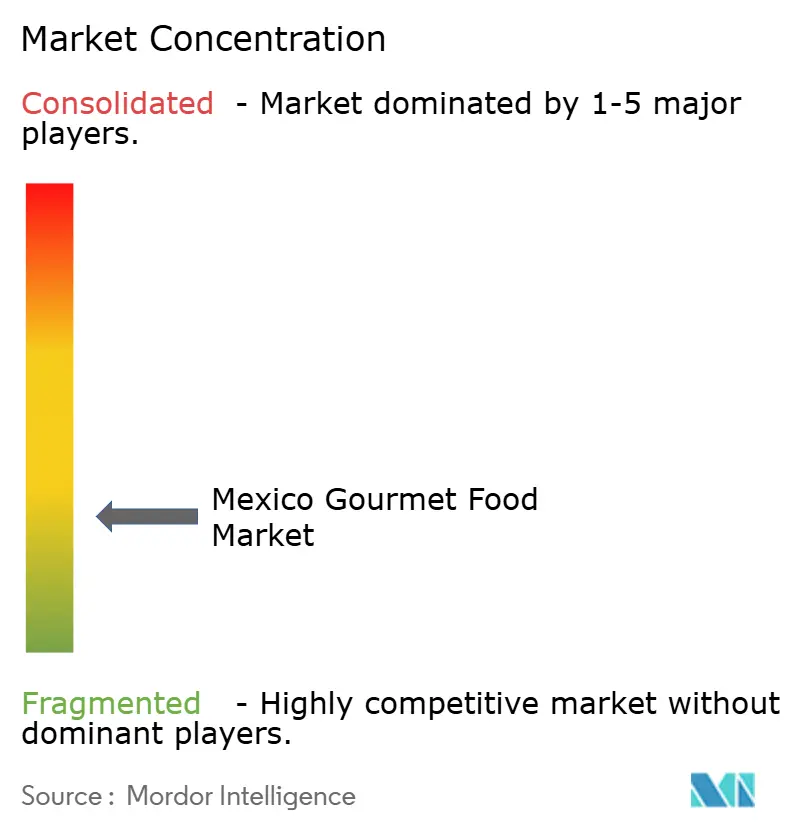
| Market Concentration | Low |
Major Players
*Disclaimer: Major Players sorted in no particular order Image © Mordor Intelligence. Reuse requires attribution under CC BY 4.0. |
|
Mexico Gourmet Food Market Analysis by Mordor Intelligence
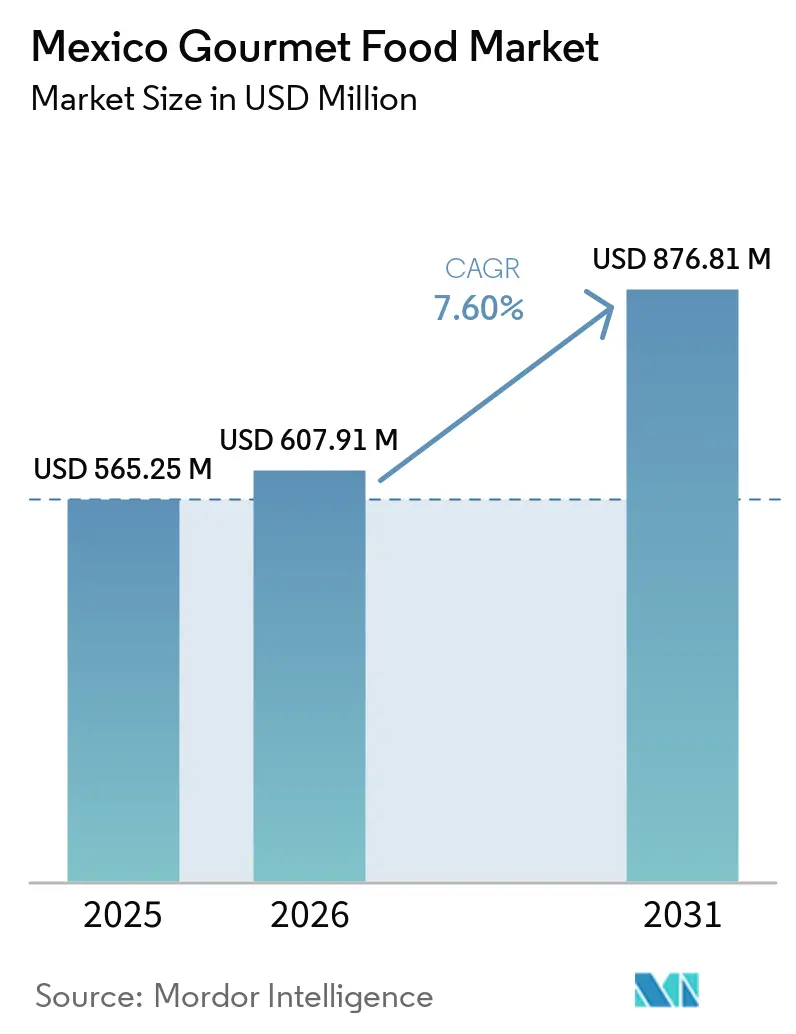
The Mexico gourmet food market size is expected to grow from USD 565.25 million in 2025 to USD 607.91 million in 2026 and is forecast to reach USD 876.81 million by 2031 at a 7.60% CAGR over 2026-2031. The market is expanding steadily, driven by rising demand for premium, artisanal, and regionally distinctive food products. Growing culinary tourism, increasing consumer interest in authentic food experiences, and wider availability through specialty retail and e-commerce are supporting this growth. Manufacturers are strengthening their premium portfolios through product innovation, quality differentiation, and locally sourced ingredients. While multinational companies and domestic producers continue to invest in the market, competition remains fragmented, with artisanal brands also playing an important role. Price sensitivity and supply chain challenges continue to influence market dynamics.
Key Report Takeaways
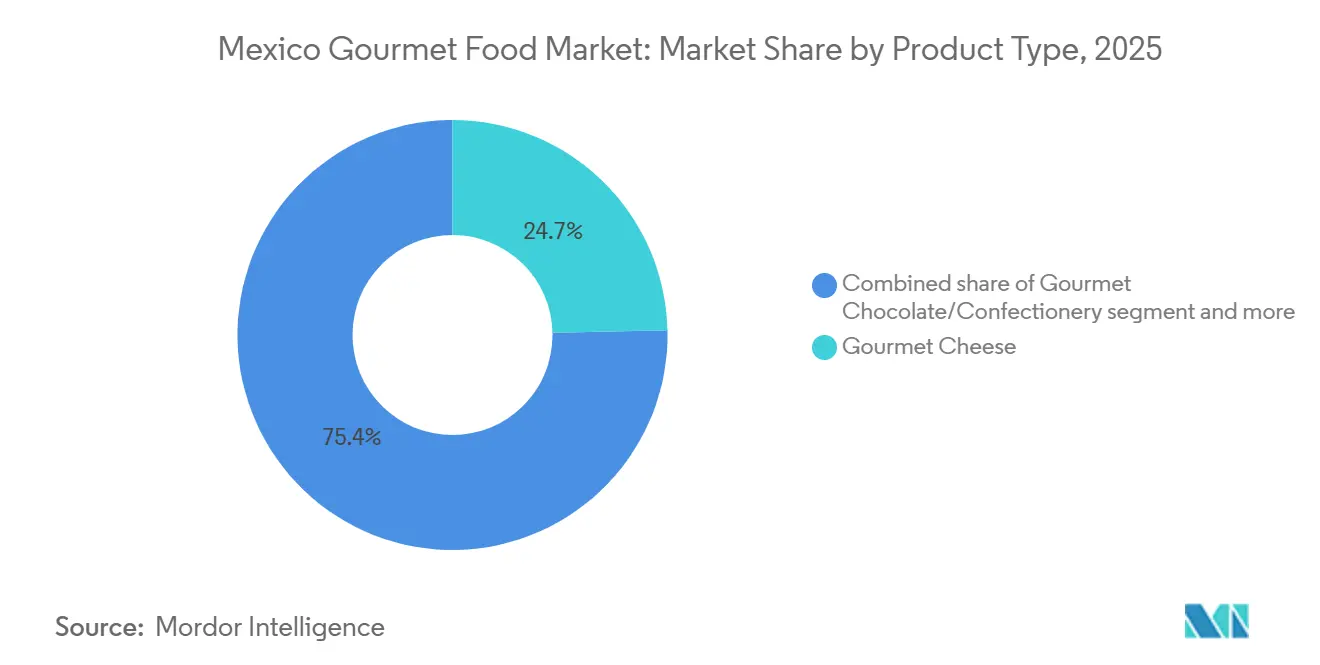
- By product type, gourmet cheese accounted for 24.65% of Mexico's gourmet food market share in 2025, while gourmet chocolate/confectionery is forecast to grow at an 8.74% CAGR during 2026-2031 across Mexico.
- By category, conventional gourmet products accounted for 72.76% of revenue in 2025, while free-from products are forecast to advance at an 8.25% CAGR during 2026-2031, led by urban retail demand in Mexico.
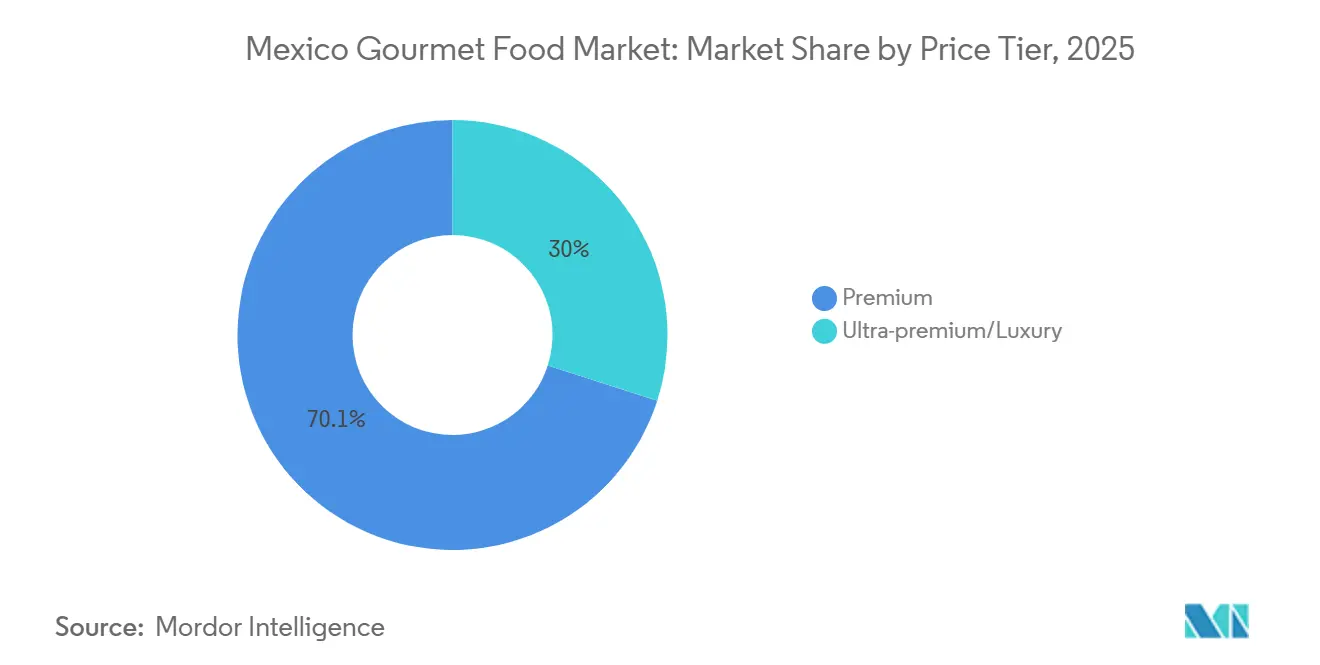
- By price tier, premium products held 70.05% of revenue in 2025, while ultra-premium and luxury products are expected to record a 9.04% CAGR from 2026 to 2031, concentrated in affluent metropolitan areas.
- By distribution channel, off-trade held 62.46% of revenue in 2025 and is forecast to grow at an 8.43% CAGR during 2026-2031, supported by specialty retail and online availability across Mexico.
Note: Market size and forecast figures in this report are generated using Mordor Intelligence’s proprietary estimation framework, updated with the latest available data and insights as of January 2026.
Mexico Gourmet Food Market Trends and Insights
Drivers Impact Analysis*
| Driver | (~) % Impact on CAGR Forecast | Geographic Relevance | Impact Timeline |
|---|---|---|---|
| Growth in disposable income and demand for premium food experiences | +2.0% | National, with concentrated gains in Mexico City, Monterrey, and Guadalajara | Medium term (2–4 years) |
| Expansion of gourmet-focused retail and specialty distribution channels | +1.5% | National, with early gains in Mexico City, Jalisco, and Nuevo León | Short term (≤ 2 years) |
| Growing influence of gastronomy tourism, food content, and culinary media | +1.2% | Mexico City, Oaxaca, Baja California, Jalisco, and Yucatán | Medium term (2–4 years) |
| Growth of premium at-home cooking and gourmet meal-kit experiences | +1.0% | National, highest penetration in urban centers | Short term (≤ 2 years) |
| Rising demand for authentic regional flavors | +0.8% | National, with export-spillover into US Mexican diaspora communities | Long term (≥ 4 years) |
| Product innovation in premium and artisanal foods | +1.0% | National; innovation hubs in Mexico City, Monterrey, and Guanajuato | Medium term (2–4 years) |
| Source: Mordor Intelligence | |||
Growth in disposable income and demand for premium food experiences
Rising household purchasing power is encouraging Mexican consumers to spend more on premium and gourmet food products, including artisanal, specialty, and imported offerings. According to the World Bank, Mexico's household final consumption expenditure totaled USD 1.29 trillion in 2024[1]Source: The World Bank Group, "Households and NPISHs Final consumption expenditure (current US$) - Mexico", worldbank.org. The World Bank further reported that household final consumption expenditure remained at USD 1.28 trillion in 2025, demonstrating sustained consumer spending despite a slight year-on-year moderation. Separately, the Organisation for Economic Co-operation and Development (OECD) reported that household disposable income reached USD 18,682 per person (PPP-converted) in 2024 in Mexico, highlighting the country's growing purchasing capacity[2]Source: Organisation for Economic Co-operation and Development, "OECD Employment Outlook 2026: Mexico", oecd.org. As consumers allocate a larger share of their budgets to premium-quality, authentic, and differentiated food products, demand for gourmet offerings continues to strengthen across retail channels.
Expansion of gourmet-focused retail and specialty distribution channels
The expansion of gourmet supermarkets, specialty food stores, delicatessens, and premium online retail platforms is improving consumer access to high-quality food products across Mexico. Retailers are broadening their assortments of artisanal, imported, and locally sourced gourmet products to meet evolving consumer preferences for premium and differentiated food. The growth of e-commerce and omnichannel retailing is enabling gourmet food brands to reach consumers beyond major metropolitan areas, lowering barriers to market entry for smaller producers. This expanding distribution landscape is increasing product visibility, supporting premium brand development, and driving wider adoption of gourmet food products across the country.
Growing influence of gastronomy tourism, food content, and culinary media
Mexico's internationally recognized culinary heritage and expanding food media ecosystem are increasing consumer interest in gourmet food products by encouraging exploration of regional cuisines and premium dining experiences. According to Mexico's Ministry of Tourism (SECTUR), the country welcomed 26.22 million international visitors in the first quarter of 2026, a 10.2% increase from the same period in 2025[3]Source: Mexico's Ministry of Tourism (SECTUR), "The first quarter of 2026 confirms that Mexico is in fashion: 26.22 million visitors and 12.66 million international tourists", gob.mx. During the same period, 12.66 million international tourists visited Mexico, reflecting a 6.7% year-on-year increase. Foreign exchange earnings from international travelers reached USD 10.287 billion in the first quarter of 2026, highlighting the growing economic contribution of tourism to hospitality, foodservice, and culinary experiences. The growing influence of chef-led restaurants, food festivals, cooking programs, and social media food content is further expanding the visibility and consumption of artisanal, regional, and premium food products across the country.
Growth of premium at-home cooking and gourmet meal-kit experiences
Growing consumer interest in preparing restaurant-quality meals at home is driving demand for gourmet ingredients, premium condiments, specialty sauces, artisanal cheeses, and imported food products. Consumers are increasingly seeking high-quality ingredients that enable authentic culinary experiences while offering greater convenience and customization. This is encouraging food manufacturers and retailers to expand their portfolios with premium recipe kits, curated ingredient selections, and ready-to-cook gourmet offerings. The continued popularity of home cooking, supported by digital recipes, online cooking tutorials, and chef-inspired meal concepts, is creating new opportunities for gourmet food brands across retail and e-commerce channels.
Restraints Impact Analysis*
| Restraint | (~) % Impact on CAGR Forecast | Geographic Relevance | Impact Timeline |
|---|---|---|---|
| Persistent price sensitivity among key consumer segments | -1.5% | National, more pronounced in Tier 2–3 cities and rural areas | Long term (≥ 4 years) |
| Competition from mainstream premium and natural food offerings | -0.8% | National | Medium term (2–4 years) |
| Scalability challenges for artisanal producers | -0.6% | National; rural and semi-urban artisanal production clusters | Medium term (2–4 years) |
| Vulnerability in supply chains for imported and regional specialty inputs | -0.7% | National, concentrated in import-dependent categories | Short term (≤ 2 years) |
| Source: Mordor Intelligence | |||
Persistent price sensitivity among key consumer segments
Despite growing interest in premium food products, price remains a key purchasing factor for a large share of Mexican consumers. The higher prices associated with gourmet foods, driven by premium ingredients, artisanal production methods, and imported products, can discourage repeat purchases among middle- and lower-income households. During periods of economic uncertainty, consumers often shift toward mainstream premium brands or conventional alternatives that offer similar quality perceptions at lower prices. As a result, gourmet food manufacturers face ongoing challenges in expanding their customer base beyond affluent urban consumers while maintaining premium positioning and profitability.
Competition from mainstream premium and natural food offerings
The Mexico gourmet food market faces increasing competition from mainstream food brands expanding their portfolios with premium, organic, natural, and clean-label products at more accessible price points. Large food manufacturers and private-label retailers are introducing products with high-quality ingredients, authentic flavors, and premium packaging, narrowing the distinction between conventional premium and gourmet offerings. This growing overlap makes it more difficult for gourmet brands to justify higher prices and differentiate their products based solely on quality or provenance. As competition intensifies across retail channels, gourmet food producers must invest in product innovation, authenticity, and brand storytelling to maintain their competitive position.
*Our forecasts treat driver/restraint impacts as directional, not additive. The impact forecasts reflect baseline growth, mix effects, and variable interactions.
Segment Analysis
By Product Type: Cheese Anchors the Market While Chocolate Accelerates
Gourmet cheese accounted for 24.65% of the Mexico gourmet food market in 2025, making it the largest product segment. The segment benefits from Mexico's strong dairy heritage and growing consumer preference for premium, artisanal, and specialty cheese varieties. Rising demand for authentic regional products, premium home cooking, and gourmet entertaining continues to support consumption across both retail and foodservice channels. The increasing availability of locally produced and imported specialty cheeses further strengthens the segment's market position.
Gourmet chocolate and confectionery is projected to register the fastest CAGR of 8.74% during 2026–2031, driven by increasing demand for premium chocolates, artisanal confectionery, and high-quality gifting products. Growing consumer interest in origin-specific cacao, craft production, and premium indulgence is supporting segment growth. Gourmet sauces and condiments, gourmet Meat and Seafood, Artisanal Bakery Products, and other specialty gourmet foods continue to expand as consumers seek authentic flavors, premium ingredients, and elevated culinary experiences across multiple food categories.



By Category: Conventional Dominates While Free From Redefines the Growth Ceiling
Conventional gourmet accounted for 72.76% of the Mexico gourmet food market in 2025, making it the dominant category. The segment benefits from strong consumer preference for premium-quality products that emphasize authentic flavors, artisanal production, and superior ingredients without specific dietary claims. Its broad appeal across multiple product categories and price points supports widespread adoption through both retail and foodservice channels. Continued demand for traditional gourmet offerings is expected to sustain the segment's leading market position.
Free from is projected to register the fastest CAGR of 8.25% during 2026–2031, driven by growing consumer awareness of health, wellness, and clean-label food choices. Increasing demand for products free from artificial additives, allergens, and certain ingredients is encouraging manufacturers to expand their premium free-from product portfolios across gourmet food categories. Wider availability through supermarkets, specialty stores, and online retail channels is further supporting market growth as consumers seek products that combine premium quality with evolving dietary preferences.
By Price Tier: Premium Commands the Market While Ultra-Luxury Sets the Ceiling
Premium products accounted for 70.05% of the Mexico gourmet food market in 2025, making them the largest price-tier segment. The segment appeals to consumers seeking higher-quality ingredients, artisanal craftsmanship, and authentic product origins at prices that remain accessible to a broad consumer base. Growing interest in premium food experiences, specialty products, and differentiated flavors continues to support demand across retail and foodservice channels. The balance between quality and affordability reinforces its leading position in the market.
The ultra-premium and luxury segment is projected to register the fastest CAGR of 9.04% during 2026–2031, driven by increasing consumer willingness to spend on exclusive gourmet products and premium culinary experiences. Demand for limited-edition products, artisanal craftsmanship, and premium sourcing is supporting growth within this segment. Rising interest in fine dining, gourmet gifting, and experiential food consumption is further encouraging manufacturers and retailers to expand their ultra-premium product offerings across multiple gourmet food categories.
By Distribution Channel: Off-Trade Consolidates and Diversifies Simultaneously
Off-trade channels accounted for 62.46% of the Mexico gourmet food market in 2025 and are projected to register the fastest CAGR of 8.43% during 2026–2031. The segment benefits from the expanding presence of specialty food stores, gourmet supermarkets, premium grocery retailers, and e-commerce platforms, which improve consumer access to gourmet products. Growing demand for premium at-home dining experiences and convenient purchasing options continues to support channel growth. The wider availability of artisanal, imported, and locally produced gourmet foods through organized retail is further strengthening the segment's position in the market.
On-trade channels continue to play an important role by introducing consumers to premium culinary experiences through fine dining restaurants, hotels, cafés, and specialty foodservice establishments. These venues support product discovery and raise awareness of gourmet ingredients, regional specialties, and artisanal food products. As consumer interest in premium dining experiences grows, on-trade establishments remain an important channel for building brand visibility and supporting broader demand for gourmet foods.
Geography Analysis
Central Mexico is an important market for gourmet foods due to its concentration of specialty food retailers, premium supermarkets, restaurants, and foodservice establishments. Mexico City serves as a major hub for gourmet food retail and dining, offering a broad range of artisanal, imported, and premium food products. The region's established retail infrastructure supports the distribution and availability of gourmet products across multiple channels.
Western Mexico is recognized for its rich culinary traditions and diverse regional food culture, with states such as Jalisco contributing to the country's gastronomic identity. The region has a growing number of specialty restaurants, gourmet food retailers, and hospitality establishments that showcase regional ingredients and artisanal food products. Culinary events and food tourism further strengthen the visibility of gourmet offerings in the region.
Northern and Southern Mexico present distinct characteristics within the gourmet food market. Northern states have well-developed urban retail networks and food manufacturing capabilities that support the availability of premium food products. Southern states, including Oaxaca, Chiapas, and Yucatán, are recognized for their traditional cuisine, artisanal food products, cacao, coffee, cheeses, and other regional specialties. Expanding retail networks and e-commerce platforms are improving access to gourmet food products across both regions.
Competitive Landscape
The Mexico gourmet food market is highly fragmented, with multinational food manufacturers, established domestic food companies, regional specialty producers, and artisanal brands all competing with differentiated gourmet products. Key companies such as Grupo Bimbo, Nestlé S.A., Sigma Foods, Grupo Herdez, S.A.B. de C.V., and La Costeña compete through broad product portfolios, strong distribution networks, and continuous product innovation across multiple gourmet food categories.
Major market participants are expanding their premium product offerings by introducing artisanal, clean-label, and regionally inspired products, while strengthening their presence across modern retail, specialty stores, and e-commerce channels. Companies are also investing in product quality, premium packaging, and locally sourced ingredients to address growing consumer demand for authentic and differentiated food experiences. Strategic partnerships and portfolio expansion continue to intensify competition across premium food categories.
Regional food manufacturers and artisanal producers remain important contributors to the market by offering locally sourced ingredients, traditional recipes, and specialty gourmet products that appeal to consumers seeking authenticity and regional flavors. Their ability to differentiate through craftsmanship, provenance, and niche product offerings supports market diversity. However, limited production capacity and distribution reach remain key challenges for these producers compared with larger, well-established competitors.
Mexico Gourmet Food Industry Leaders
-
Grupo Bimbo
-
Nestlé S.A.
-
Sigma Foods
-
Grupo Herdez, S.A.B. de C.V.
-
La Costeña
- *Disclaimer: Major Players sorted in no particular order

Recent Industry Developments
- June 2026: Grupo La Comer invested MXN 80 million (approximately USD 4.3 million) to relaunch its Sumesa supermarket format with a new store in Coyoacán. The format combines everyday grocery products with premium gourmet items and café spaces, reinforcing the company's strategy to expand gourmet food accessibility through specialized neighborhood retail formats.
- March 2026: Nestlé México announced an investment of USD 455 million to expand production capacity and strengthen its logistics infrastructure in the State of Mexico. The initiative includes factory modernization, production digitalization, and the construction of a new distribution center, reinforcing the company's ability to meet growing demand for food and beverage products across the country.
- January 2026: McCormick & Company completed the acquisition of an additional 25% ownership stake in McCormick de Mexico from Grupo Herdez, increasing its ownership to 75%. The transaction strengthens McCormick's presence in the Mexican market and supports the company's strategy to expand product innovation, category offerings, and distribution across Mexico and the broader Latin American region.


Mexico Gourmet Food Market Report Scope
The Mexico gourmet food market comprises premium-quality food products characterized by superior ingredients, artisanal production methods, authentic regional origins, and premium culinary experiences. The market is driven by growing consumer demand for high-quality, specialty, and value-added food products across retail and foodservice channels. The market is segmented by product type into gourmet cheese, gourmet chocolate and confectionery, gourmet sauces and condiments, gourmet meat and seafood, and other product types. Based on category, the market is segmented into free-from and conventional. By price tier, the market is classified into premium and ultra-premium and luxury. Based on distribution channel, the market is segmented into on-trade and off-trade.
| Gourmet Cheese |
| Gourmet Chocolate/Confectionery |
| Gourmet Sauces/Condiments |
| Gourmet Meat/Seafood |
| Other Types |
| Free From |
| Conventional |
| Premium |
| Ultra-premium/Luxury |
| On-Trade | |
| Off-Trade | Supermarkets/Hypermarkets |
| Specialty Stores | |
| Online Retail Stores | |
| Other Off-Trade Channels |
| By Product Type | Gourmet Cheese | |
| Gourmet Chocolate/Confectionery | ||
| Gourmet Sauces/Condiments | ||
| Gourmet Meat/Seafood | ||
| Other Types | ||
| By Category | Free From | |
| Conventional | ||
| By Price Tier | Premium | |
| Ultra-premium/Luxury | ||
| By Distribution Channel | On-Trade | |
| Off-Trade | Supermarkets/Hypermarkets | |
| Specialty Stores | ||
| Online Retail Stores | ||
| Other Off-Trade Channels | ||


Key Questions Answered in the Report
What is the projected growth rate for gourmet food in Mexico?
The Mexico gourmet food market is projected to grow at a 7.60% CAGR from 2026 to 2031, reaching USD 876.81 million by 2031.
Which product type has the largest share in the Mexico gourmet food market?
Gourmet cheese led product types with a 24.65% share in 2025.
Which product segment is growing fastest in Mexico?
Gourmet chocolate/confectionery is forecast to grow at an 8.74% CAGR during 2026-2031.
What channel is most important for gourmet food sales?
Off-trade held 62.46% of revenue in 2025 and is expected to grow at an 8.43% CAGR through 2031.
Page last updated on:





