
Meat Stabilizer Blends Market Size and Share
Market Overview
| Study Period | 2021 - 2031 |
|---|---|
| Market Size (2026) | USD 2.87 Billion |
| Market Size (2031) | USD 4.31 Billion |
| Growth Rate (2026 - 2031) | 8.52 % |
| Fastest Growing Market | Asia-Pacific |
| Largest Market | Asia-Pacific |
| Market Concentration | Low |
Major Players
*Disclaimer: Major Players sorted in no particular order Image © Mordor Intelligence. Reuse requires attribution under CC BY 4.0. |
|
Meat Stabilizer Blends Market Analysis by Mordor Intelligence
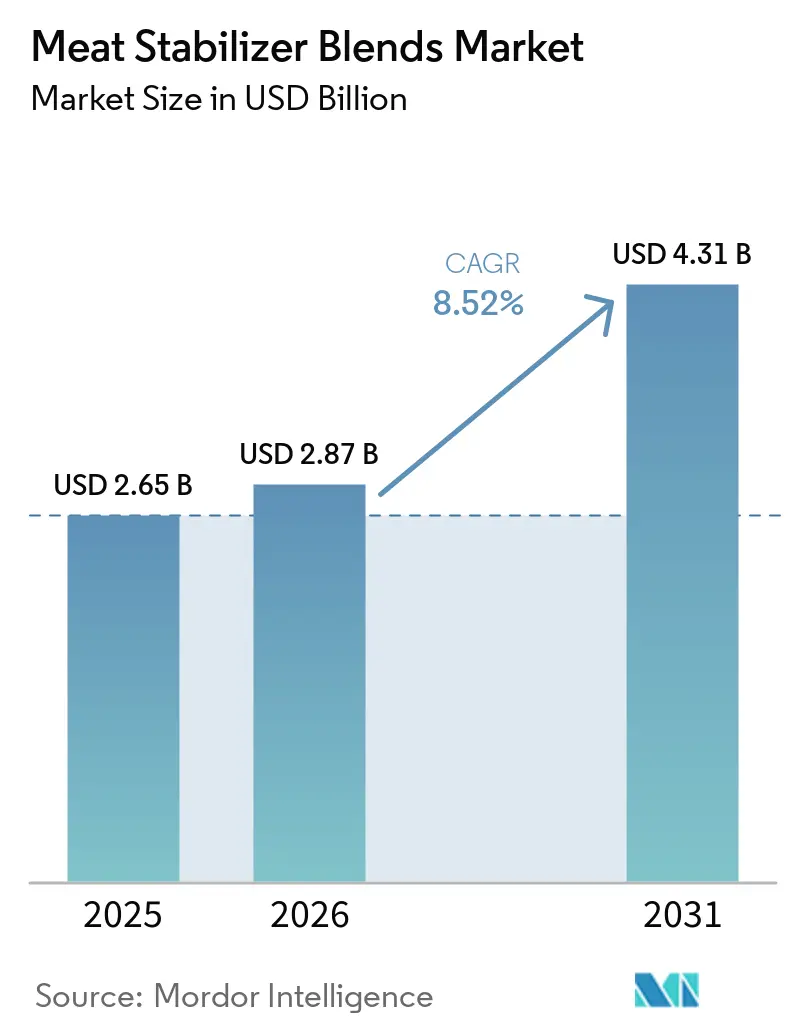
The meat stabilizer blends market was valued at USD 2.65 billion in 2025 and is projected to grow from USD 2.87 billion in 2026 to USD 4.31 billion by 2031, at a CAGR of 8.52% during the forecast period (2026–2031). Growth reflects processors’ need to maintain cooking yield, moisture retention, and batch consistency amid rising raw material costs and stringent product specifications. Phosphate- and starch-based systems support protein solubilization, emulsion stability, water binding, and oxidative control in cooked meat products. Clean-label requirements are driving demand for fibers, functional proteins, starches, and enzyme systems that can partially replace phosphates without compromising product characteristics. Suppliers that offer multifunctional formulations, technical support, and blends tailored to injected, emulsified, frozen, and retorted products are well-positioned to meet these needs.
Key Report Takeaways
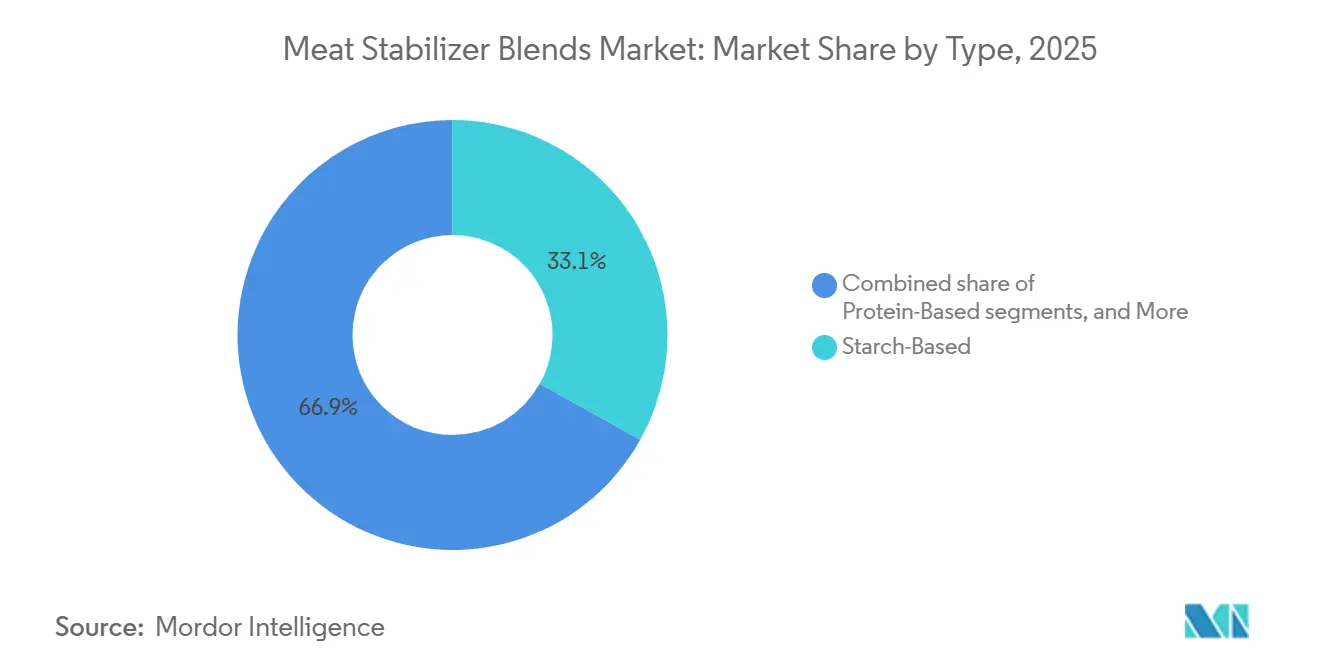
- By source, starch-based blends held 33.12% of the meat stabilizer blends market share in 2025, while protein-based blends are forecast to grow at a 9.15% CAGR through 2031.
- By form, powder blends accounted for 49.22% of the meat stabilizer blends market share in 2025, while liquid blends are forecast to expand at an 8.99% CAGR through 2031.
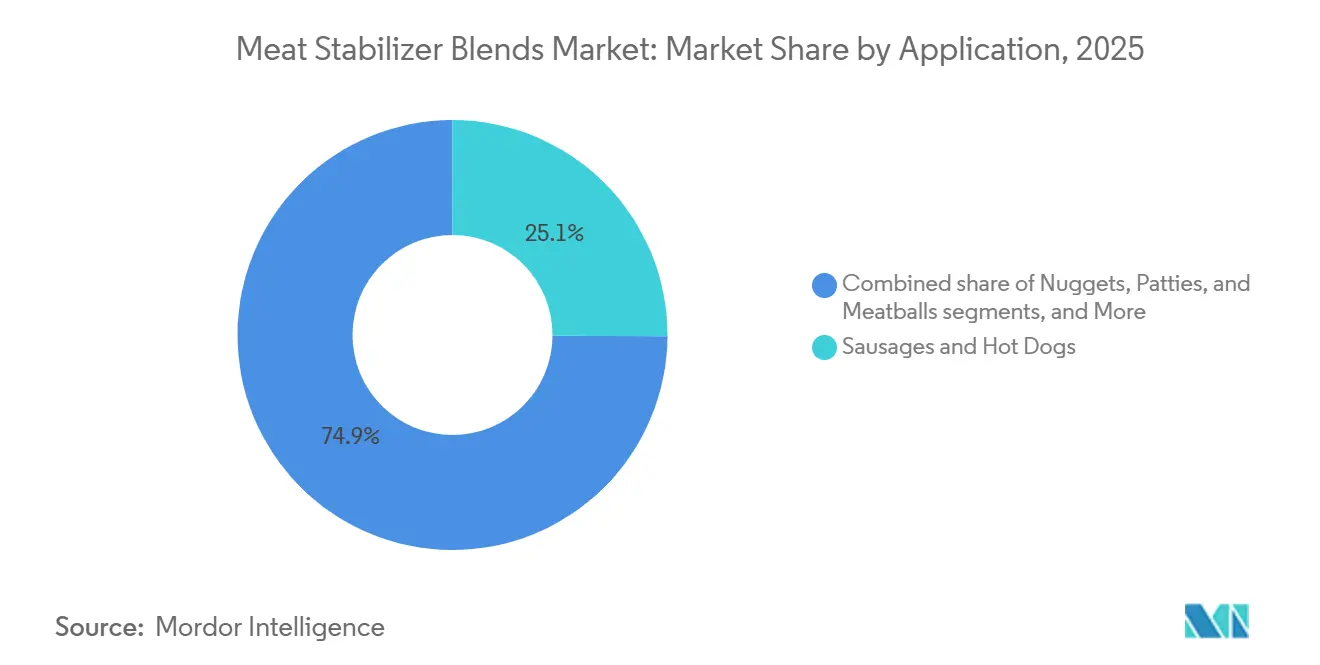
- By application, sausages and hot dogs accounted for 25.12% of the meat stabilizer blends market in 2025, while nuggets, patties, and meatballs are projected to grow at an 8.57% CAGR through 2031.
- By geography, Asia-Pacific accounted for a 45.66% share of the meat stabilizer blends market in 2025 and is forecast to grow at a 9.12% CAGR through 2031.
Note: Market size and forecast figures in this report are generated using Mordor Intelligence’s proprietary estimation framework, updated with the latest available data and insights as of January 2026.
Global Meat Stabilizer Blends Market Trends and Insights
Drivers Impact Analysis*
| Driver | (~) % Impact on CAGR Forecast | Geographic Relevance | Impact Timeline |
|---|---|---|---|
| Rising demand for processed and convenience meat products | +2.5% | Global, with outsized impact in Asia-Pacific and North America | Medium term (2-4 years) |
| Expansion of ready-to-eat and ready-to-cook meat products | +1.8% | Asia-Pacific core, with spillover to the Middle East and Africa and South America | Medium term (2-4 years) |
| Shift toward clean-label and phosphate-free products | +1.5% | North America and Europe, with growing pressure in Asia-Pacific | Long term (≥ 4 years) |
| Increasing demand for better yield and moisture retention | +1.3% | Global, particularly in large-scale poultry and pork processing | Short term (≤ 2 years) |
| Need for improved product stability and shelf life | +1% | Global, concentrated in markets with developed retail cold chains | Medium term (2-4 years) |
| Demand for customized meat stabilizer blends | +0.8% | North America, Europe, and emerging Asia-Pacific markets | Long term (≥ 4 years) |
| Source: Mordor Intelligence | |||
Rising Demand for Processed and Convenience Meat Products
Growing demand for convenient, easy-to-prepare processed meat products is increasing the need for stabilizer systems that ensure consistent product quality. For instance, in September 2025, according to the Agriculture and Horticulture Development Board (AHDB), 59% of individuals in Great Britain consumed processed red meat at least once a week during the 12 months ending February 2025, accounting for 5.1 billion consumption occasions. Convenience remains a key factor, with 57% of meat consumers considering sausages easy to cook and 54% reporting the same for bacon [1]Source: Agriculture and Horticulture Development Board, "Processed red meats continue to play a part in in-home meals", ahdb.org.uk. As processors manufacture sausages, burgers, bacon, ham, and other convenience-oriented products at scale, demand is rising for stabilizer blends that support moisture retention, binding, texture, cooking performance, and product structure.
Expansion of Ready-to-Eat and Ready-to-Cook Meat Products
Rising demand for ready-to-eat and ready-to-cook meat products is increasing the need for stabilizer blends that maintain product structure, moisture retention, binding, and texture during processing, freezing, storage, and reheating. For instance, in the Philippines, pork consumption was forecasted to increase by 4% in 2026, driven by population growth and robust economic expansion. Government measures to maintain inflation within the target range are also expected to improve consumer access to affordable meat products. Additionally, the United States Department of Agriculture (USDA) Foreign Agricultural Service reported that vertically integrated pork companies expanded their portfolios beyond fresh pork to include value-added ready-to-cook and ready-to-eat meals distributed through retail and online channels [2]Source: United States Department of Agriculture, "Livestock and Products Annual", agriexchange.apeda.gov.in.
Shift Toward Clean-Label and Phosphate-Free Products
The shift toward clean-label and phosphate-free meat products is creating opportunities for multifunctional stabilizer systems. For instance, in July 2025, the Multidisciplinary Digital Publishing Institute (MDPI) reported that the clean-label movement is increasing demand for meat products free from synthetic additives, including phosphates [3]Source: MDPI, "Clean-Label Strategies for the Replacement of Nitrite, Ascorbate, and Phosphate in Meat Products: A Review", mdpi.com. Phosphates enhance water-holding capacity, texture, and emulsion stability, while hydrocolloids, dietary fibers, protein isolates, and natural calcium sources can provide similar functionality in phosphate-reduced and phosphate-free meat products. This trend is creating opportunities for stabilizer blends that support water retention, emulsion stability, texture, and structural integrity while meeting clean-label preferences.
Increasing Demand for Better Yield, Stability, and Custom Formulation
Yield optimization is important for processors using meat stabilizer blends, as moisture retention affects product output, consistency, and production economics. Modified starches form gel networks during heating, helping retain moisture and reduce cooking losses in emulsified and reformed meat products. Blends containing fibers, starches, proteins, and hydrocolloids enhance water-binding and texture while offering alternatives to phosphate-based formulations. Processing lines require blends that perform consistently during mixing, freezing, cooking, and retail storage. Suppliers that customize ingredient combinations, dispersion, and processing performance for specific meat products can address variations in formulations, equipment, and processing conditions.
Restraints Impact Analysis*
| Restraint | (~) % Impact on CAGR Forecast | Geographic Relevance | Impact Timeline |
|---|---|---|---|
| Regulatory Restrictions on Phosphates and Synthetic Additives | -0.8% | Europe, China, and increasingly North America | Long term (≥ 4 years) |
| Volatility in Hydrocolloid, Seaweed, Protein, and Starch Prices | -0.7% | Global, with acute exposure in Asia-Pacific seaweed-dependent supply chains | Short term (≤ 2 years) |
| Formulation Challenges in Clean-Label Conversion | -0.5% | North America and Europe | Long term (≥ 4 years) |
| Limited Standardization of Stabilizer Performance Across Meat Products | -0.4% | Global | Medium term (2-4 years) |
| Source: Mordor Intelligence | |||
Regulatory Restrictions and Clean-Label Conversion Challenges
Regulatory requirements shape formulation choices in the meat stabilizer blends market, as additive approvals, permitted use levels, labeling requirements, and product classifications vary across jurisdictions. Manufacturers must align stabilizer systems with applicable regulations while maintaining water retention, texture, emulsion stability, yield, and shelf-life performance. They must also address clean-label requirements, allergen declarations, and ingredient source specifications in domestic and export markets. Variations in meat species, formulations, processing methods, storage conditions, and finished-product handling further influence stabilizer performance and compliance requirements.
Volatility in Hydrocolloid, Seaweed, Protein, and Starch Prices
Ingredient cost volatility influences purchasing and formulation decisions in the meat stabilizer blends market, as blend costs depend on materials with varying levels of agricultural and supply chain exposure. Carrageenan availability depends on seaweed cultivation, particularly in the Philippines and Indonesia, whereas functional proteins, modified starches, and other hydrocolloids may face fluctuations in raw material and input costs. These factors encourage suppliers to enhance sourcing flexibility, diversify ingredient portfolios, and develop cost-efficient formulations while maintaining product performance. Suppliers with strong sourcing networks, stable supply arrangements, and formulation capabilities ensure continuity of supply and help processors address evolving ingredient needs in high-volume meat applications.
*Our forecasts treat driver/restraint impacts as directional, not additive. The impact forecasts reflect baseline growth, mix effects, and variable interactions.
Segment Analysis
By Type: Starch-Based Blends Retain Scale While Protein-Based Systems Grow Faster
Starch-based blends accounted for 33.12% of the market in 2025, making them the largest source segment. Their use in sausages, processed ham, and reformed meat products supports moisture retention and texture consistency. Pre-gelatinized and crosslinked starches provide thermal stability, freeze-thaw resistance, and water binding. Protein-based blends are projected to grow at the fastest rate, with a CAGR of 9.15% through 2031. Functional proteins support moisture retention and are suitable for phosphate-reduced or phosphate-free formulations. Kemin’s Proteus® line demonstrates its use in phosphate-free brine applications as alternatives to conventional phosphate functionality.
Fiber-based blends, including citrus fiber and psyllium-based systems, are increasingly used in sausage and deli meat formulations to enhance water binding, texture, and reformulation capabilities. Hydrocolloid-based blends containing carrageenan, alginate, and gums deliver additional stabilization, binding, and moisture-management benefits in injected ham, restructured meat, and retorted products. Other source systems address specific formulation requirements, providing processors with additional options to improve yield, texture, stability, and processing performance. The broader source landscape continues to benefit from the growing adoption of multifunctional stabilizer systems across processed meat applications.



By Form: Powder Blends Lead Established Processing Lines While Liquid Systems Fit Injection
Powder formulations accounted for 49.22% of the market in 2025, making them the largest segment by form. Their strong position reflects widespread use across established meat processing systems. Powder blends offer extended shelf life, efficient handling, and consistent dosing in high-volume sausage and patty production. Processors can incorporate them directly into dry-mixing operations, while their stability supports use in high-temperature environments where premature hydration can affect performance. The meat stabilizer blends market continues to rely on powder formulations for dry processing, storage stability, and predictable integration into existing formulations.
Liquid blends are projected to record the fastest growth within the form category, expanding at a CAGR of 8.99% through 2031. These systems support brine injection and marination in poultry and whole-muscle pork applications, where uniform ingredient distribution is critical. Liquid formulations deliver functional ingredients at controlled concentrations and enable consistent brine uptake across production batches. Phosphate-free liquid brines with functional proteins and enzyme systems further increase the relevance of purpose-designed liquid stabilizer products. Gel and paste systems remain relevant for canning, retorting, and reformed-meat applications, where pre-dispersed hydrocolloids improve formulation uniformity prior to heat treatment.
By Application: Sausages and Hot Dogs Lead Demand While Nuggets, Patties, and Meatballs Advance
Sausages and hot dogs accounted for 25.12% of the total market value in 2025, making them the largest application segment. Their consistent processing requirements, including water retention, emulsion stability, and texture uniformity, along with established supply relationships, support recurring demand for validated stabilizer systems. Nuggets, patties, and meatballs are projected to grow the fastest, at a CAGR of 8.57% through 2031. Demand in this segment is driven by quick-service restaurant expansion, private-label convenience products, and hybrid meat-and-vegetable products, all of which require effective binding, moisture management, freeze-thaw stability, and consistent texture after cooking.
Processed ham and deli meats require precise injection performance to maintain slicing yield, appearance, moisture retention, and uniform distribution of curing ingredients. Bacon and cured meats require stabilizer systems that manage moisture, improve brine retention, and maintain product consistency throughout curing, smoking, and processing. Canned and retorted meat products require heat-stable systems to maintain texture, prevent moisture separation, and preserve product integrity during high-temperature processing. Other applications include specialized processed meat formats, such as formed, restructured, and emulsified meat products, that require specific binding, stabilization, moisture retention, and texture-management functionalities.
Geography Analysis
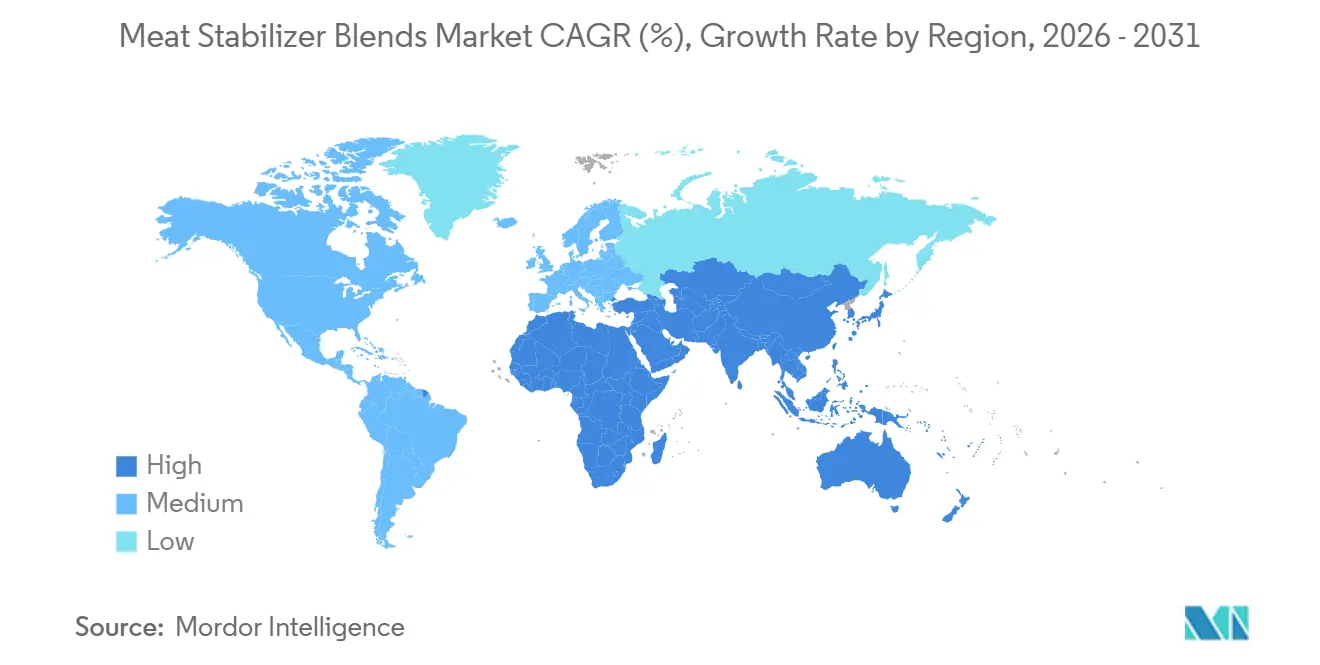
Asia-Pacific accounted for 45.66% of the market share in 2025 and is projected to grow at a CAGR of 9.12% through 2031, making it the largest and fastest-growing regional market. China drives regional demand through its large, well-developed processed meat industry, which requires effective solutions to ensure product quality and processing efficiency. India benefits from expanding cold-chain infrastructure and the wider distribution of chilled and frozen meat products, supporting increased demand across the country. Japan and Australia also contribute significantly through their well-established processed meat industries, where manufacturers prioritize consistent moisture retention, binding, texture, and overall processing performance.
North America is a mature market supported by advanced meat processing systems and strong demand for injection-grade stabilizer formulations. The United States is the region’s key market, driven by established production of sausages, deli meats, bacon, and convenience meat products. Canada and Mexico also contribute to market growth through the expansion of the processed meat and foodservice industries. Europe has stringent additive regulations and strong demand for specialized stabilizer systems for sausages, deli meats, and cured meats. The United Kingdom, Germany, France, Italy, Spain, and the Netherlands support regional demand through their established meat processing industries and growing consumer interest in natural and clean-label formulations.
South America offers significant growth opportunities, led by Brazil's large meat processing and export industry. This industry drives demand for stabilizer blends that ensure consistent quality across varying processing conditions and destination-market requirements. The Middle East and Africa are also gaining importance due to the expansion of modern meat processing facilities and halal-certified production. Saudi Arabia, the United Arab Emirates, and South Africa represent key markets in these regions. Processors require stabilizer systems that enhance moisture retention, binding, texture, and processing consistency while complying with applicable food safety and certification requirements.

Competitive Landscape
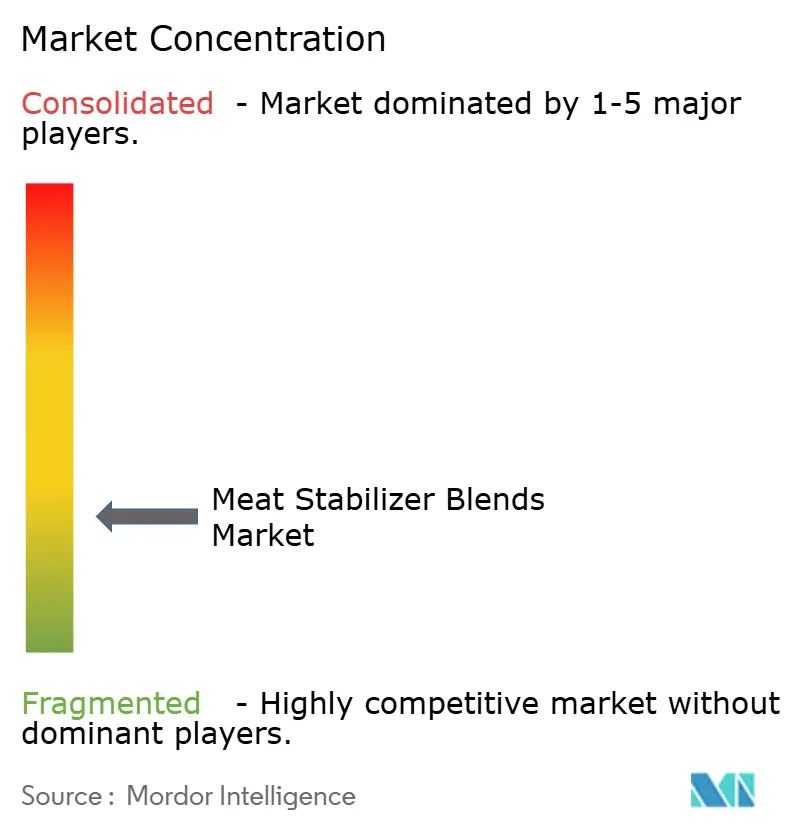
The meat stabilizer blends market is fragmented, with no single supplier controlling pricing or technical standards across the category. Cargill, Kerry Group, and Ingredion compete with specialized suppliers such as Hydrosol and Van Hees, creating a competitive landscape that includes both global ingredient companies and focused formulation providers. Large suppliers leverage broad product portfolios, international distribution networks, and capabilities across multiple ingredient categories. In contrast, specialized companies differentiate through application expertise, customized formulations, and closer alignment with the requirements of sausage, cured meat, and convenience product manufacturers.
Competitive activity is also driven by portfolio expansion, acquisitions, and technological development. Ingredion’s planned acquisition of Tate & Lyle is expected to strengthen its capabilities in texturizers and specialty stabilizers. Kemin’s development of phosphate-free, low-salt, and no-salt brine injection technology highlights the industry’s focus on reformulation and functional alternatives. Solina’s acquisition of New Max Industrial further demonstrates suppliers’ continued expansion into flavoring systems and natural colorants, particularly in emerging regional markets.
Regional and specialized companies can compete effectively by understanding local recipes, processing conditions, and customer requirements while offering faster customization and technical assistance. Hydrosol’s development of phosphate-free, high-protein systems for products such as kebabs, nuggets, and formed ham demonstrates this application-focused approach. Regulatory documentation across multiple jurisdictions, consistent product performance, rapid trials, and responsive technical support remain critical competitive factors. These factors create opportunities for suppliers that combine specialized expertise with reliable service.
Meat Stabilizer Blends Industry Leaders
-
Cargill, Incorporated
-
International Flavors & Fragrances Inc.
-
Ingredion Incorporated
-
Hydrosol GmbH & Co. KG
-
Palsgaard A/S
- *Disclaimer: Major Players sorted in no particular order

Recent Industry Developments
- February 2025: BDF launched BDF GEL MIX A 2.0 and BDF GEL MIX 1.0, stabilizer systems for cooked meat products, fat emulsions, high-extension ham, and bacon. These systems improve water retention, texture, juiciness, thermal stability, and yield.
- May 2025: Sarda Bio Polymers showcased a proprietary hydrocolloid blend for the meat industry at IFFA 2025 in Frankfurt. The blend supports water binding, gelling, and heat resistance with minimal processing and lower energy inputs.


Global Meat Stabilizer Blends Market Report Scope
The meat stabilizer blends market comprises functional ingredient blends that improve the stability, texture, binding, moisture retention, emulsification, and processing performance of meat products. The market is segmented by type, form, application, and geography. By type, it includes starch-based, protein-based, fiber-based, hydrocolloid-based, and other stabilizer blends. By form, the market covers powder, liquid, and other formulations. Key applications include sausages and hot dogs, processed ham and deli meats, bacon and cured meats, nuggets, patties and meatballs, canned and retorted meat products, and other meat applications. The report covers North America, Europe, Asia-Pacific, South America, and the Middle East and Africa, with country-level analysis of major markets and insights into market trends and growth opportunities.
| Starch-Based |
| Protein-Based |
| Fiber-Based |
| Hydrocolloid-Based |
| Others |
| Powder |
| Liquid |
| Others |
| Sausages and Hot Dogs |
| Processed Ham and Deli Meats |
| Bacon and Cured Meats |
| Nuggets, Patties, and Meatballs |
| Canned and Retorted Meat Products |
| Others |
| North America | United States |
| Canada | |
| Mexico | |
| Rest of North America | |
| Europe | United Kingdom |
| Germany | |
| France | |
| Italy | |
| Spain | |
| Netherlands | |
| Rest of Europe | |
| Asia-Pacific | China |
| Japan | |
| India | |
| Australia | |
| Rest of Asia-Pacific | |
| South America | Brazil |
| Rest of South America | |
| Middle East and Africa | South Africa |
| Rest of Middle East and Africa |
| By Type | Starch-Based | |
| Protein-Based | ||
| Fiber-Based | ||
| Hydrocolloid-Based | ||
| Others | ||
| By Form | Powder | |
| Liquid | ||
| Others | ||
| By Application | Sausages and Hot Dogs | |
| Processed Ham and Deli Meats | ||
| Bacon and Cured Meats | ||
| Nuggets, Patties, and Meatballs | ||
| Canned and Retorted Meat Products | ||
| Others | ||
| By Geography | North America | United States |
| Canada | ||
| Mexico | ||
| Rest of North America | ||
| Europe | United Kingdom | |
| Germany | ||
| France | ||
| Italy | ||
| Spain | ||
| Netherlands | ||
| Rest of Europe | ||
| Asia-Pacific | China | |
| Japan | ||
| India | ||
| Australia | ||
| Rest of Asia-Pacific | ||
| South America | Brazil | |
| Rest of South America | ||
| Middle East and Africa | South Africa | |
| Rest of Middle East and Africa | ||


Key Questions Answered in the Report
What is the market size of meat stabilizer blends market?
The meat stabilizer blends market was valued at USD 2.65 billion in 2025 and is estimated to reach USD 2.87 billion in 2026. The market is projected to reach USD 4.31 billion by 2031, growing at a CAGR of 8.52% during the forecast period (2026–2031).
What is driving demand for meat stabilizer blends?
Processors are seeking stronger cooking yield, moisture retention, texture consistency, and cleaner ingredient labels.
Which source type leads sales?
Starch-based blends led with 33.12% share in 2025.
Why are liquid stabilizer systems growing?
Liquid systems fit brine injection and marination processes, and the segment is forecasted to grow at an 8.99% CAGR through 2031.
Page last updated on:


 Your data is secure and never sold or shared.



