
Marketing Data Governance Platform Market Size and Share
Market Overview
| Study Period | 2020 - 2031 |
|---|---|
| Market Size (2026) | USD 1.16 Billion |
| Market Size (2031) | USD 2.45 Billion |
| Growth Rate (2026 - 2031) | 16.85 % |
| Fastest Growing Market | Asia-Pacific |
| Largest Market | North America |
| Market Concentration | Medium |
Major Players *Disclaimer: Major Players sorted in no particular order Image © Mordor Intelligence. Reuse requires attribution under CC BY 4.0. | |
Marketing Data Governance Platform Market Analysis by Mordor Intelligence
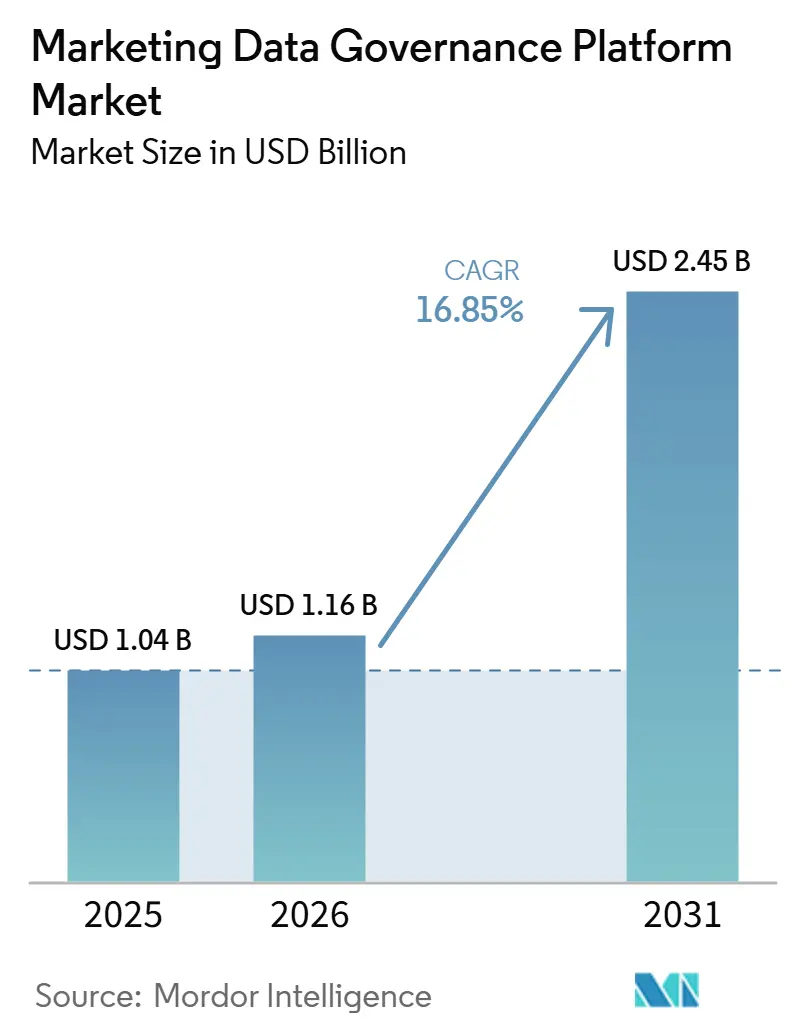
The Marketing data governance platform market size is projected to expand from USD 1.04 billion in 2025 and USD 1.04 billion in 2026 to USD 2.45 billion by 2031, registering a CAGR of 16.85% between 2026 and 2031. The shift toward first-party data has made verified consent, dependable customer records, and traceable data use central to campaign operations. Privacy enforcement and AI transparency rules are also moving governance from a back-office responsibility into daily marketing workflows. Providers are responding by bringing cataloging, quality controls, lineage, privacy, and access management into connected product suites. Cloud delivery creates an opening for organizations that need policy controls across growing campaign volumes without adding infrastructure. At the same time, integration demands, skills shortages, and limited budgets can slow adoption, especially among mid-sized buyers.
Key Report Takeaways
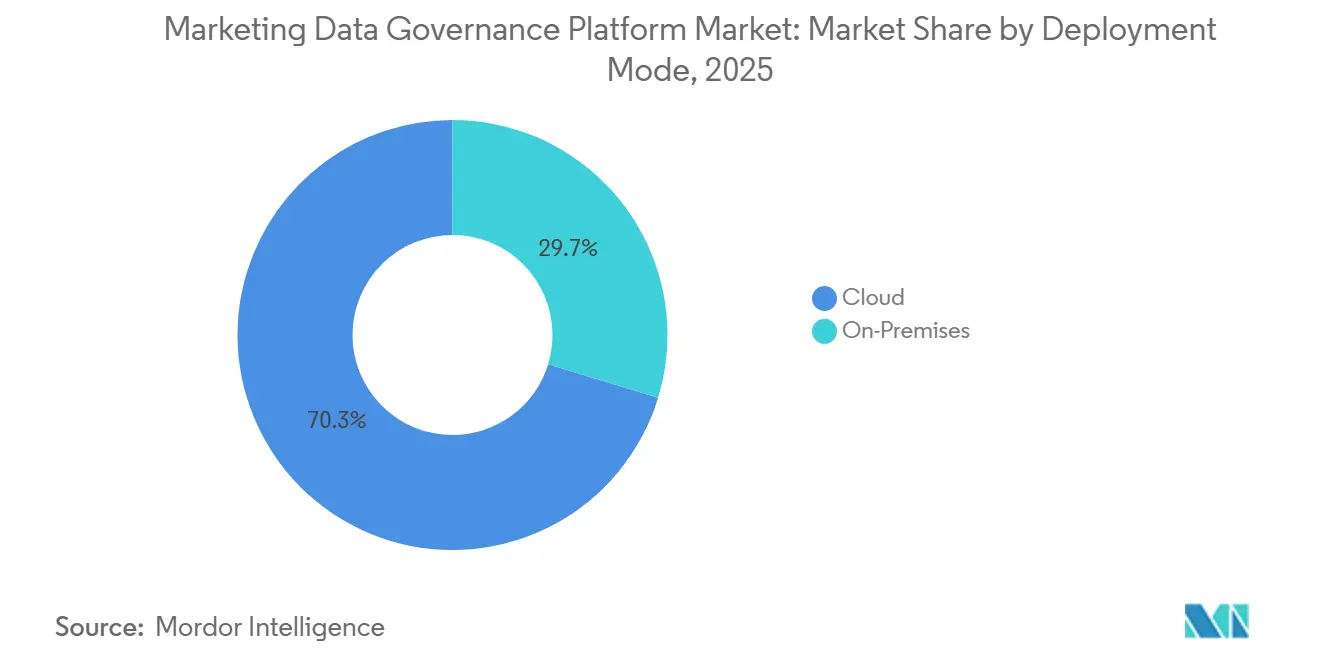
- By deployment mode, cloud accounted for 70.29% of the Marketing Data Governance Platform Market share in 2025, and is projected to expand at 18.31% CAGR through 2031.
- By enterprise size, large enterprises held 72.14% of the Marketing Data Governance Platform Market share in 2025, while small and medium enterprises are projected to expand at a 18.63% CAGR through 2031.
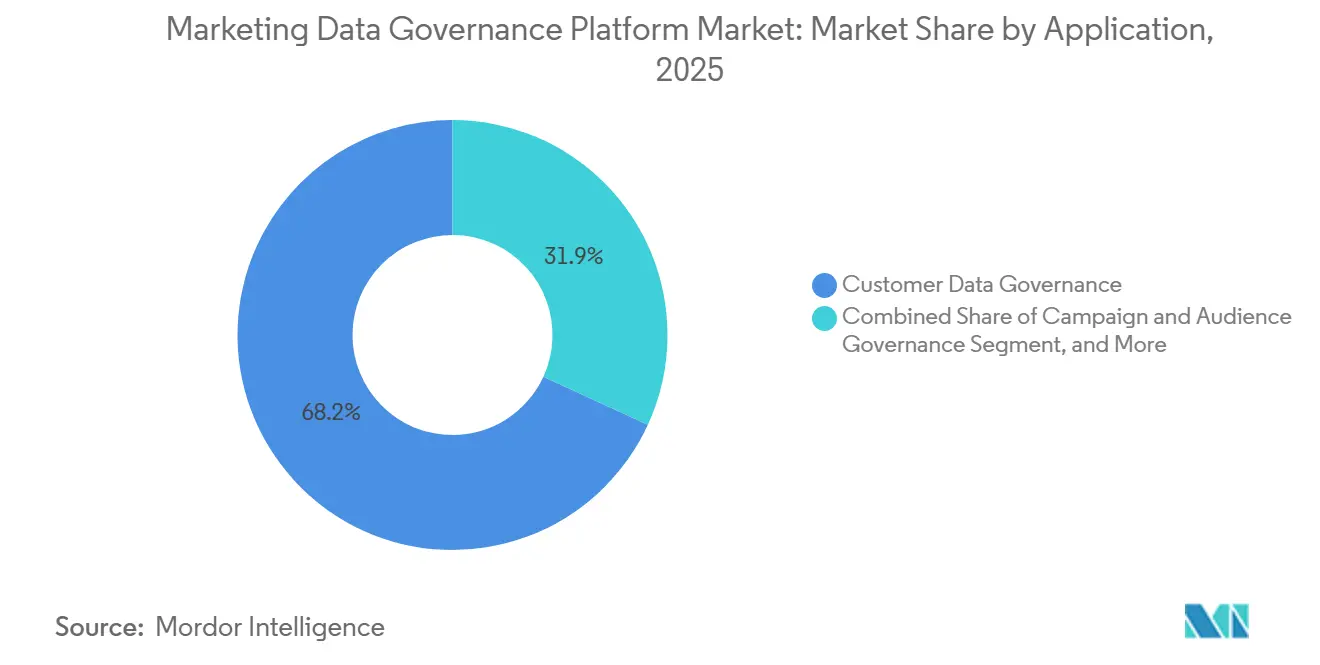
- By application, customer data governance held 68.15% of the Marketing Data Governance Platform Market share in 2025, while consent and preference management is projected to expand at a 17.91% CAGR through 2031.
- By geography, North America held 35.61% of the Marketing Data Governance Platform Market share in 2025, while Asia-Pacific is projected to advance at a 17.56% CAGR through 2031.
Note: Market size and forecast figures in this report are generated using Mordor Intelligence’s proprietary estimation framework, updated with the latest available data and insights as of January 2026.
Global Marketing Data Governance Platform Market Trends and Insights
Drivers Impact Analysis*
| Driver | (~) % Impact on CAGR Forecast | Geographic Relevance | Impact Timeline |
|---|---|---|---|
| First-Party Data Activation Needs | +4.5% | Global, particularly North America and Europe | Short term (≤ 2 years) |
| Privacy-by-Design for Consent-Heavy Campaigns | +3.5% | Europe, North America, Asia-Pacific core, spillover to the Middle East | Short term (≤ 2 years) |
| AI Content and Audience Data Auditability | +3.2% | European Union and United Kingdom, expanding globally | Medium term (2-4 years) |
| Martech Stack Convergence With Catalogs and Lineage | +2.8% | North America and Europe, spillover to Asia-Pacific | Medium term (2-4 years) |
| Real-Time Governance for Omnichannel Decisioning | +2.3% | Global | Medium term (2-4 years) |
| Clean Room and Secure Collaboration Adoption | +1.8% | North America and Europe | Long term (≥ 4 years) |
| Source: Mordor Intelligence | |||
Surge in First-Party Data Activation Needs
The Marketing data governance platform market is supported by the move from third-party signals toward customer data collected directly by organizations. Marketing teams need trusted customer records before they can use personalization, audience development, or measurement tools effectively, which keeps the Marketing data governance platform market tied to everyday campaign performance. The Interactive Advertising Bureau reported that first-party dataset deployment rose from 41% to 71% over 2 years. This change raises the value of controls that define data ownership, quality rules, permitted uses, and lineage across channels. Customer data platforms can support activation, but they do not always provide the policy controls needed across connected systems. Governance tools, therefore, address a practical gap between campaign activation and accountable data use.
Privacy-by-Design Governance for Consent-Heavy Campaigns
Privacy enforcement is making consent design a core requirement for campaign teams rather than a legal review completed at launch. In September 2025, France's data protection authority fined Google EUR 325 million (USD 351 million) for advertisements in Gmail and for its consent choices for personalized advertising. The decision showed that a consent mechanism must allow users to freely opt out of personalized advertising. In December 2025, the same authority fined a loyalty-program operator EUR 3.5 million (USD 3.78 million) for transferring member data to a social network for advertising without a valid legal basis.[1]Commission Nationale de l'Informatique et des Libertés, “Cookies and Advertisements Inserted Between Emails: Google Fined 325 Million Euros by the CNIL,” CNIL, cnil.fr These cases increase demand for record-level controls that apply the right consent rule in each jurisdiction, reinforcing demand across the Marketing data governance platform market. They also make manual checks less workable for organizations managing campaigns across several regions.
AI Content and Audience Data Auditability Requirements
The EU AI Act introduces a new governance requirement for marketing teams that use generative tools and automated audience models. Article 50 transparency obligations apply from August 2, 2026, and require transparency measures for certain AI-generated or manipulated content. Marketing teams need a reliable record of the data, tools, and approvals associated with AI-supported creative and audience decisions. This requirement extends beyond internally developed models, as marketing workflows often rely on AI features in external software. The European Commission's guidance on AI-generated content transparency reinforces the importance of transparency in production workflows. The Marketing data governance platform market can benefit as organizations place audit controls closer to creative approval and media activation.
Martech Stack Convergence With Data Catalogs and Lineage Tools
Marketing teams increasingly need governance controls that work across customer, campaign, analytics, and content systems. A broad stack can create distinct customer identifiers, consent records, and business definitions across applications. Catalog and lineage products are responding by connecting metadata, quality information, and access rules across data environments, expanding the practical scope of the Marketing data governance platform market. In 2025, Atlan introduced Data Quality Studio for Databricks and became a launch partner for Unity Catalog Metrics. Google Cloud also introduced Knowledge Catalog to federate metadata across enterprise applications and data sources. These developments can reduce the manual work required to reconcile marketing data across connected tools.
Restraints Impact Analysis*
| Restraint | (~) % Impact on CAGR Forecast | Geographic Relevance | Impact Timeline |
|---|---|---|---|
| Integration Complexity Across Fragmented Martech Stacks | -1.2% | Global | Short term (≤ 2 years) |
| Limited Data Stewardship Skills in Marketing Teams | -0.9% | Global | Medium term (2-4 years) |
| Slow Governance Workflow Adoption in Revenue Organizations | -0.7% | North America and Europe | Medium term (2-4 years) |
| Budget Pressure on Mid-Market Deployments | -0.5% | North America, Europe, and South America | Long term (≥ 4 years) |
| Source: Mordor Intelligence | |||
High Integration Complexity Across Fragmented Martech Stacks
Integration complexity can delay the value that buyers expect from the Marketing data governance platform market. Each marketing application can use a different schema, identity key, consent format, and data transfer process. Governance teams must map those differences before they can apply policy controls consistently. Composable technology environments can add flexibility, but they require controls to be checked whenever a component changes. Mid-sized organizations often face the largest burden because their technical teams must manage integration work alongside active campaign demands. Native metadata federation can reduce some effort, but it does not remove governance gaps across cloud environments and software-as-a-service applications.
Limited Data Stewardship Skills in Marketing Teams
Marketing functions are expanding their use of customer data faster than they are developing data stewardship skills. Teams may purchase a governance platform but leave key policies, workflows, and ownership roles incomplete. The result can be a minimal configuration rather than consistent enforcement across campaign operations, which can limit realized value from the Marketing data governance platform market. Marketing practitioners also make time-sensitive decisions while managing content, media, and audience activity. This leaves little room for complex manual reviews of data quality or lawful use. The constraint will remain important until products make stewardship tasks clearer and less dependent on specialist technical knowledge.
*Our forecasts treat driver/restraint impacts as directional, not additive. The impact forecasts reflect baseline growth, mix effects, and variable interactions.
Segment Analysis
By Deployment Mode: Cloud Consolidation Across Enterprise Tiers
Cloud deployment held 70.29% of the Marketing data governance platform market share in 2025. This position requires processing consent signals, policy changes, and access decisions across active marketing channels. Cloud environments support continuous lineage updates and policy checks without requiring each organization to build separate local infrastructure. They also work well with cloud warehouses and lakehouse environments that increasingly store customer and campaign data. A 2025 peer-reviewed study found that cloud-based governance frameworks can support security and compliance in marketing analytics through access controls, encryption, and residency measures.
On-premises deployment remains important where data sovereignty, internal security rules, or sector requirements limit cloud use. Financial services, regulated healthcare marketing, and public-sector-related operations often retain greater control over local processing environments. Many organizations instead use hybrid models that keep sensitive processing local while managing governance policies through cloud services. This structure gives teams a central policy layer without requiring every dataset to move immediately. Over the forecast period, hybrid adoption is expected to move more policy management toward cloud control planes.


By Enterprise Size: Large Enterprise Base and Faster SME Growth
Large enterprises accounted for 72.14% of the Marketing data governance platform market share in 2025. Their scale, brand portfolios, and cross-border marketing activity make formal governance systems necessary across many connected teams. These organizations often need one set of policy controls across customer systems, campaign tools, content platforms, and analytics environments. They are also under pressure to document the data used by AI features in high-volume, always-on operations. Large buyers increasingly seek products that combine cataloging with quality, lineage, access, and policy enforcement.
Small and medium enterprises are projected to grow at a 18.63% CAGR through 2031. The Marketing data governance platform market size for this group is strengthened by cloud tools that provide templates and connectors without requiring a large engineering staff. A 2025 IEEE Access study found that SMEs can improve data quality and decision-making by aligning data governance with business strategy and accessible tools. Prebuilt policies can make routine consent, access, and data quality work easier for lean marketing operations teams. Budget limits and skills shortages will still affect the pace at which smaller organizations move from basic controls to wider governance programs.
By Application: Customer Data Foundations and Consent Management Growth
Customer data governance held 68.15% of application revenue in 2025. It provides the base for identity resolution, master data management, data quality, and access controls across customer records. Organizations cannot apply consent or audience policies reliably when customer profiles are incomplete, duplicated, or inconsistently labeled across systems. This makes customer data governance the common starting point for broader marketing data controls. The Marketing data governance platform market relies on this foundation because every subsequent application requires reliable customer information.
Consent and preference management is projected to grow at a 17.91% CAGR through 2031. Privacy rules in Europe, the United States, Singapore, India, and China require organizations to consider how permission is captured, stored, and used. A single global policy setting may not address the different consent requirements that apply across these locations. Campaign and audience governance are gaining importance as AI-built segments require evidence of lawful and approved source data. Content and asset governance remains the smallest application area, but transparency duties for AI-generated content can raise its importance after August 2026.

Geography Analysis
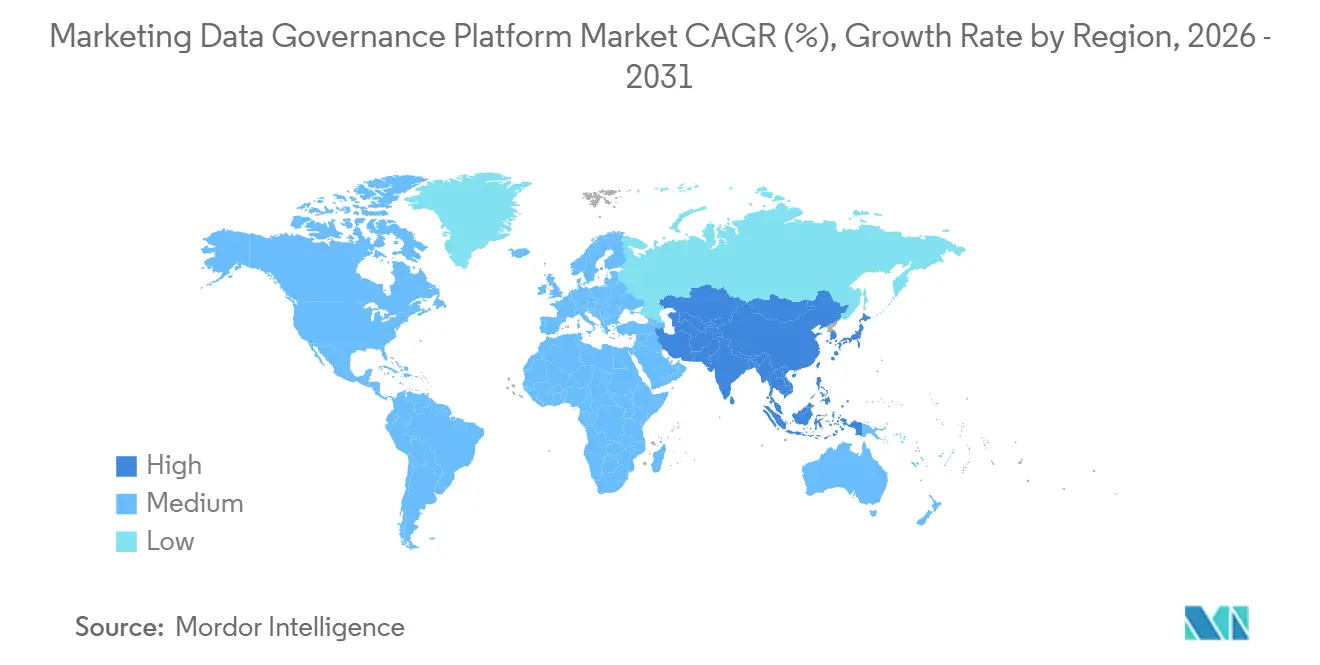
North America accounted for 35.61% of the Marketing data governance platform market share in 2025. The United States combines substantial marketing technology budgets, a dense supplier base, and several state privacy requirements. California, Colorado, Connecticut, Virginia, and Texas have created a more complex compliance setting for organizations operating across state lines. This supports demand for platforms that apply different consent and data-rights rules within shared technology environments. Canada and Mexico add to regional activity as their data protection requirements encourage more formal governance practices.
Europe ranked second in 2025. GDPR compliance requirements and active enforcement of advertising consent rules support the Marketing data governance platform market in Europe. France's data protection authority imposed the EUR 325 million (USD 351 million) fine on Google in September 2025, reinforcing the need for a valid consent-based advertising model. The EU AI Act also makes transparency planning more urgent for organizations that use AI-generated marketing content.[2]European Commission, “AI Act,” Digital Strategy, digital-strategy.ec.europa.eu European buyers, therefore, need governance systems that connect consent, source data, approvals, content records, and internal accountability processes.
Asia-Pacific is projected to grow at a 17.56% CAGR through 2031, the fastest rate among the regions. China, India, Japan, Singapore, Thailand, and South Korea each have distinct data protection frameworks that affect the use of marketing data. Thailand released draft guidance on marketing and lawful bases in July 2026, including separate consent expectations for AI-driven marketing activity and profiling. China and India offer important opportunities because data localization, consent, and enforcement requirements require more than policy documents alone. South America, the Middle East, and Africa account for smaller shares, but Brazil, Saudi Arabia, the UAE, South Africa, and Nigeria are providing a growing regulatory base. These regions can create longer-term demand as digital marketing activity and enforcement capacity develop.

Competitive Landscape
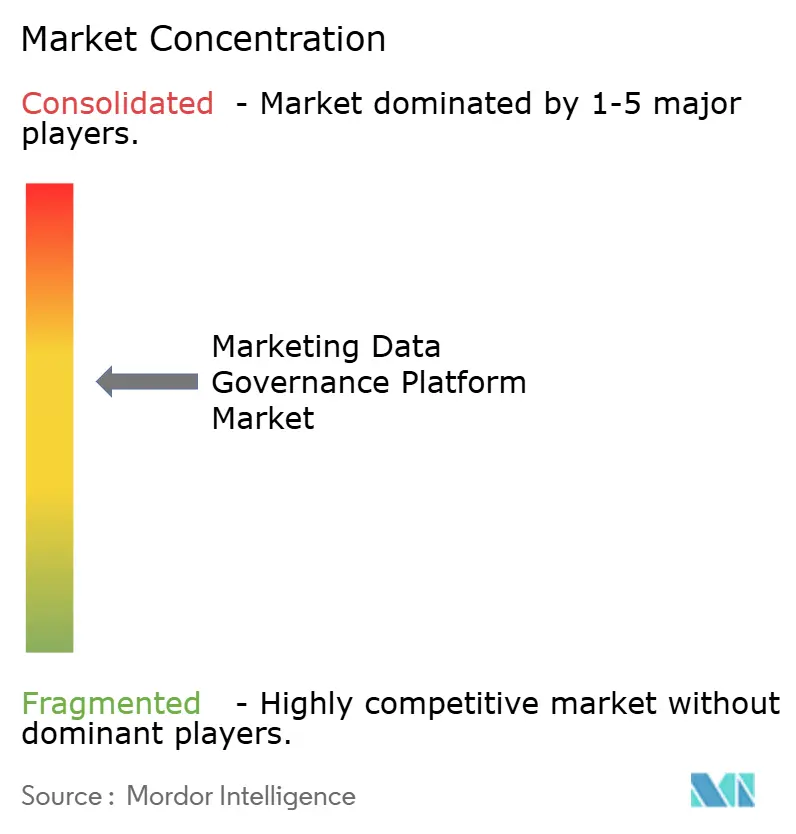
The Marketing data governance platform market is moderately concentrated. Large enterprise software providers compete with focused catalog, privacy, quality, and governance specialists. Salesforce completed its acquisition of Informatica for USD 8 billion in November 2025.[3]Salesforce, “Salesforce Completes Acquisition of Informatica,” Salesforce News, salesforce.com The combination brought cataloging, integration, governance, quality, metadata management, and master data management into the Salesforce portfolio. It raised the competitive value of a connected governance foundation for AI and customer-data workflows.
Specialist suppliers are expanding their AI governance functions to keep pace with enterprise requirements and evolving regulations. In May 2026, Collibra launched AI Command Center for real-time oversight and continuous control across the AI lifecycle. OneTrust's Spring 2026 release added an AI policy manager and guardrail enforcement features aligned with the NIST AI Risk Management Framework and the EU AI Act. These moves show how specialist vendors are extending governance into AI use rather than limiting products to traditional metadata management. Providers also compete through native cloud connections, developer-friendly interfaces, and reusable policy frameworks.
White space remains in governance tools designed for marketing practitioners rather than central IT teams. Mid-market organizations need controls that fit directly into campaign planning, audience activation, content review, and automation workflows. BigID extended data access governance to AI agents in March 2026, applying least-privilege principles to non-human identities and monitoring their data access. Atlan, DataGalaxy, and Reltio continue to build positions through metadata APIs, cloud integrations, and modular policy frameworks. The Marketing data governance platform market is shaped by platform consolidation alongside demand for simpler, marketing-specific controls.
Marketing Data Governance Platform Industry Leaders
IBM Corporation
Microsoft Corporation
Oracle Corporation
SAP SE
Salesforce, Inc.
- *Disclaimer: Major Players sorted in no particular order

Recent Industry Developments
- July 2026: Thailand's Office of the Personal Data Protection Committee published new draft PDPA guidance on marketing and lawful bases, introducing requirements for separate consent for AI-driven marketing activities and additional transparency obligations for profiling. Organizations with Thai marketing operations faced a stricter consent architecture standard aligned with European practice, requiring assessment of existing consent flows across digital marketing pipelines.
- May 2026: Collibra launched its AI Command Center, a real-time automated control solution for agentic AI. The release provided a unified control plane to monitor AI agent behavior, trace decision paths, and continuously enforce governance policies throughout the AI lifecycle. A strategic partnership with AI testing firm Giskard accompanied the launch.
- May 2026: OneTrust released AI governance features in its Spring 2026 update. The release included an AI policy manager and guardrail enforcement with prebuilt policies aligned to the NIST AI Risk Management Framework and the EU AI Act. Organizations can configure and enforce AI governance policies across Databricks and AWS Bedrock environments from the OneTrust platform.
- April 2026: Collibra introduced Collibra Data Access in the 2026.04 preview release. The product incorporated capabilities from its Raito acquisition to add enterprise-grade data access governance and policy enforcement to the Collibra Platform. The release extended governance coverage to the self-service data access layer and enabled consistent policy enforcement across diverse data sources.


Global Marketing Data Governance Platform Market Report Scope
The Marketing Data Governance Platform Market comprises software platforms that help organizations establish, manage, monitor, and enforce governance policies, controls, and standards for marketing-related data, audience data, customer information, consent records, campaign data, and digital content assets. These platforms enable organizations to improve data quality, ensure regulatory compliance, manage customer permissions and preferences, maintain audience integrity, govern marketing assets, and support secure, consistent, and compliant marketing operations across multiple channels. The market is driven by the growing adoption of first-party data strategies, increasing data privacy and compliance requirements, rising investments in customer data platforms (CDPs), and the need to govern marketing data effectively throughout its lifecycle.
The Marketing Data Governance Platform Market Report is Segmented by Deployment Mode (Cloud and On-Premises), Enterprise Size (Large Enterprises, and Small and Medium Enterprises), Application (Customer Data Governance, Consent and Preference Management, Campaign and Audience Governance, and Marketing Content and Asset Governance), and Geography (North America, South America, Europe, Asia-Pacific, Middle East, and Africa). The Market Forecasts are Provided in Terms of Value (USD).
| Cloud |
| On-Premises |
| Large Enterprises |
| Small and Medium Enterprises |
| Customer Data Governance |
| Consent and Preference Management |
| Campaign and Audience Governance |
| Marketing Content and Asset Governance |
| North America | United States |
| Canada | |
| Mexico | |
| South America | Brazil |
| Argentina | |
| Rest of South America | |
| Europe | Germany |
| United Kingdom | |
| France | |
| Italy | |
| Spain | |
| Russia | |
| Rest of Europe | |
| Asia-Pacific | China |
| Japan | |
| India | |
| South Korea | |
| Australia and New Zealand | |
| Rest of Asia-Pacific | |
| Middle East | Saudi Arabia |
| United Arab Emirates | |
| Turkey | |
| Rest of Middle East | |
| Africa | South Africa |
| Nigeria | |
| Rest of Africa |
| By Deployment Mode | Cloud | |
| On-Premises | ||
| By Enterprise Size | Large Enterprises | |
| Small and Medium Enterprises | ||
| By Application | Customer Data Governance | |
| Consent and Preference Management | ||
| Campaign and Audience Governance | ||
| Marketing Content and Asset Governance | ||
| By Geography | North America | United States |
| Canada | ||
| Mexico | ||
| South America | Brazil | |
| Argentina | ||
| Rest of South America | ||
| Europe | Germany | |
| United Kingdom | ||
| France | ||
| Italy | ||
| Spain | ||
| Russia | ||
| Rest of Europe | ||
| Asia-Pacific | China | |
| Japan | ||
| India | ||
| South Korea | ||
| Australia and New Zealand | ||
| Rest of Asia-Pacific | ||
| Middle East | Saudi Arabia | |
| United Arab Emirates | ||
| Turkey | ||
| Rest of Middle East | ||
| Africa | South Africa | |
| Nigeria | ||
| Rest of Africa | ||


Key Questions Answered in the Report
What is the marketing data governance platform market size?
The Marketing data governance platform market was USD 1.04 billion in 2025 and is projected to reach USD 2.45 billion by 2031 at a 16.85% CAGR.
What is driving adoption of marketing data governance platforms?
First-party data use, advertising consent requirements, and AI transparency obligations are increasing the need for auditable customer-data controls.
Which deployment model leads demand?
Cloud held 70.29% of revenue in 2025 because it supports policy enforcement, lineage updates, and connected marketing workflows.
Which buyer group is growing fastest?
Small and medium enterprises are projected to grow at a 18.63% CAGR through 2031 as cloud tools reduce implementation demands.
Which application has the largest share?
Customer data governance held 68.15% of application revenue in 2025 because accurate customer records support all other governance functions.
Which region is growing fastest?
Asia-Pacific is projected to advance at a 17.56% CAGR through 2031, supported by evolving privacy rules across major economies.
Page last updated on:


 Your data is secure and never sold or shared.


