
Marketing Data Management Market Size and Share
Market Overview
| Study Period | 2020 - 2031 |
|---|---|
| Market Size (2026) | USD 11.24 Billion |
| Market Size (2031) | USD 20.16 Billion |
| Growth Rate (2026 - 2031) | 12.39% CAGR |
| Fastest Growing Market | Asia-Pacific |
| Largest Market | North America |
| Market Concentration | Medium |
Major Players *Disclaimer: Major Players sorted in no particular order Image © Mordor Intelligence. Reuse requires attribution under CC BY 4.0. | |
Marketing Data Management Market Analysis by Mordor Intelligence
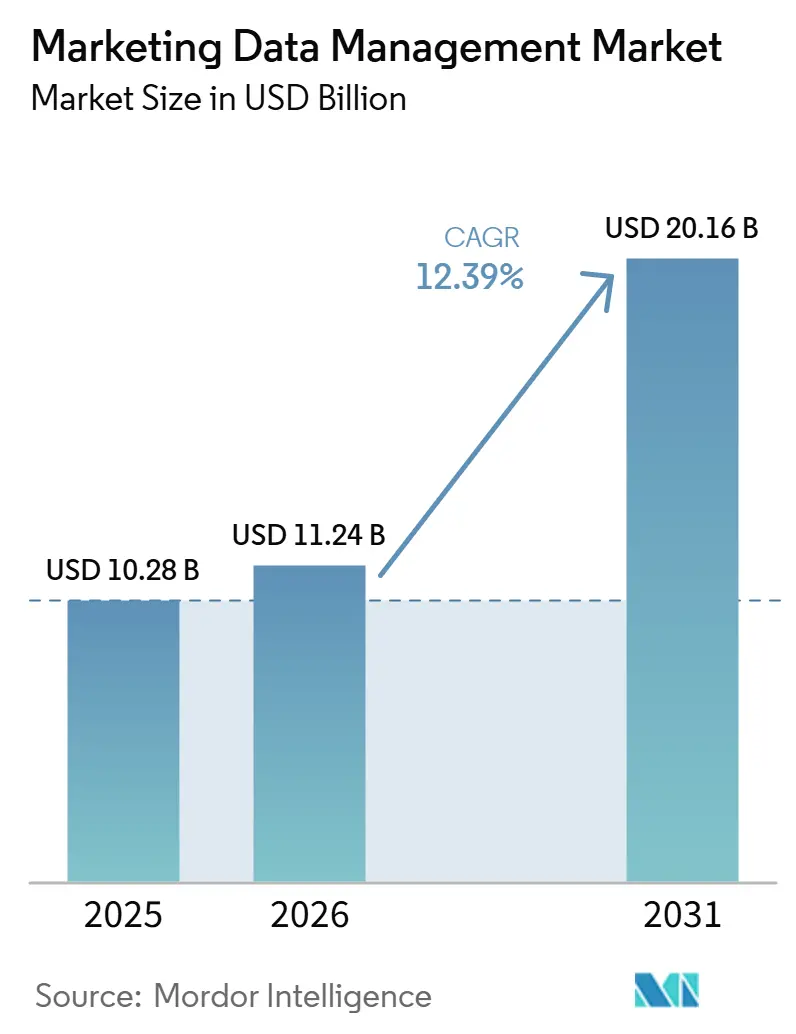
The Marketing Data Management Market size is expected to increase from USD 10.28 billion in 2025 to USD 11.24 billion in 2026 and reach USD 20.16 billion by 2031, growing at a CAGR of 12.39% over 2026-2031. This growth reflects a deeper shift in enterprise marketing operations, where customer data platforms, governance tools, and activation systems are being treated as core infrastructure rather than supporting software. The multiplication of digital touchpoints across connected TV, retail media, mobile commerce, and in-store environments has made it harder for enterprises to unify and activate customer signals without a more structured data layer. The move toward first-party data ownership also supports the Marketing Data Management Market, as brands seek greater control over personalization, attribution, and consent management. Competitive activity is becoming more intense as large platform vendors expand into governance, integration, and metadata management, while warehouse-native vendors compete on openness and interoperability. The strongest opportunities remain with organizations that still operate fragmented data environments and now need systems that can simplify compliance, accelerate activation, and support AI-led decisioning at scale.
Key Report Takeaways
- By solutions, data management platforms held 28.41% of the Marketing Data Management Market share in 2025, while customer data platforms are projected to expand at a 15.82% CAGR through 2031.
- By deployment mode, cloud accounted for 64.73% of the market share in 2025, while hybrid is projected to record the fastest CAGR of 14.29% through 2031.
- By organization size, large enterprises held 62.18% share in 2025, while SMEs are expected to grow at the highest CAGR of 14.63% through 2031.
- By end-user industry, retail and e-commerce captured 23.47% share in 2025, while media and entertainment is projected to expand at a 15.34% CAGR through 2031.
- By geography, North America held 36.82% share in 2025, while Asia-Pacific is projected to record the fastest regional CAGR of 14.81% through 2031.
Note: Market size and forecast figures in this report are generated using Mordor Intelligence’s proprietary estimation framework, updated with the latest available data and insights as of January 2026.
Global Marketing Data Management Market Trends and Insights
Drivers Impact Analysis*
| Driver | (~) % Impact on CAGR Forecast | Geographic Relevance | Impact Timeline |
|---|---|---|---|
| Growing Need for Unified Customer Data Governance | +3.2% | Global | Long term (≥ 4 years) |
| Rising Adoption of AI-Driven Audience Segmentation | +2.8% | Global, with early gains in North America and Western Europe | Short term (≤ 2 years) |
| First-Party Data Monetization Pressure After Cookie Deprecation | +2.0% | North America and Europe | Medium term (2-4 years) |
| Expansion of Omnichannel Campaign Orchestration | +1.8% | Global | Medium term (2-4 years) |
| Demand for Real-Time Personalization Across Digital Touchpoints | +1.4% | North America, Europe, and APAC core | Short term (≤ 2 years) |
| Brand Safety and Consent-Aware Data Activation | +1.0% | Europe and North America | Medium term (2-4 years) |
| Source: Mordor Intelligence | |||
Growing Need for Unified Customer Data Governance
Customer data has long been scattered across CRM systems, commerce platforms, ad tools, and offline records, limiting a clear view of each user. The Marketing Data Management Market is benefiting because enterprises now need governed data environments that can support both regulatory compliance and daily campaign execution. GDPR in Europe, the Digital Personal Data Protection Act in India, and similar frameworks across other regions have pushed governance into the center of platform design. Salesforce reinforced this direction in November 2025 when it completed the acquisition of Informatica, bringing integration, data quality, privacy, metadata, and master data management into a single platform stack.[1]European Parliament and Council of the European Union, “Regulation (EU) 2024/1689,” Official Journal of the European Union, eur-lex.europa.eu France’s CNIL also opened a formal consultation in January 2026 on consent proof standards for marketing data processing, which raised the importance of auditable governance tools across Europe.[2]Salesforce, “Salesforce Completes Acquisition of Informatica,” Salesforce News, salesforce.com
Rising Adoption of AI-Driven Audience Segmentation
AI-led audience segmentation has moved from pilot use into regular marketing operations, increasing the need for cleaner first-party data. HubSpot reported that 87% of marketing professionals were using generative AI in at least 1 recurring workflow in 2026, while 40.8% were using it for audience segmentation.[3]HubSpot, “State of Marketing 2026,” HubSpot Research, hubspot.com The Marketing Data Management Market is benefiting from this shift because segmentation models perform better when they rely on identity-resolved, consent-aware customer records. Salesforce said Data Cloud had 12,000 enterprise customers as of its March 2026 earnings call, highlighting how quickly large organizations were aligning AI use cases with unified customer data environments. The EU AI Act will apply phased requirements from August 2, 2026, increasing documentation, transparency, and supervision requirements for AI systems used for profiling and targeting.
First-Party Data Monetization Pressure After Cookie Deprecation
The Marketing Data Management Market is also being shaped by a lasting change in how brands think about audience access and identity control. Safari, Firefox, and iOS had already reduced reliance on third-party cookies, which kept pressure on brands to invest in first-party data systems even after Google stepped back from a full Chrome change. Adobe reported in 2024 that 49% of marketing strategies still relied on third-party cookie data, down from 75% in 2022, while only 60% of brands felt fully prepared for a post-cookie environment. That readiness gap has kept procurement interest high for platforms that can unify customer profiles, manage consent, and make owned data more useful across channels. Vendors with strong identity resolution and first-party activation capabilities are benefiting most because they help brands convert data ownership into a direct commercial advantage.
Expansion of Omnichannel Campaign Orchestration
Campaign orchestration is no longer just a scheduling layer; it is now more closely tied to real-time decisioning across channels. The Marketing Data Management Market is benefiting because buyers want platforms that can coordinate email, SMS, web, in-app messages, paid media, WhatsApp, and retail media from one governed data environment. CDP Institute said delivery-oriented customer data platforms were the fastest-growing category in the second half of 2025, reflecting stronger enterprise demand for systems that combine data management and campaign execution. Hightouch supported that direction in April 2026 when it raised USD 150 million to expand agentic cross-channel execution capabilities built directly on enterprise cloud data warehouses. Buyers now place more weight on whether a platform can move from governed customer data to live campaign action without long delays or repeated data movement.[4]CDP Institute and Customer Data Alliance, “CDP Industry Update, Second Half 2025,” PRWeb, prweb.com
Restraints Impact Analysis*
| Restraint | (~) % Impact on CAGR Forecast | Geographic Relevance | Impact Timeline |
|---|---|---|---|
| Integration Complexity Across Legacy Marketing Stacks | -1.8% | Global | Medium term (2-4 years) |
| High Compliance Burden for Cross-Border Data Use | -1.2% | Europe and APAC | Medium term (2-4 years) |
| Talent Gap in Data Engineering and MarTech Operations | -0.8% | Global | Short term (≤ 2 years) |
| Vendor Lock-In Risks in Closed Marketing Data Ecosystems | -0.5% | North America and Europe | Long term (≥ 4 years) |
| Source: Mordor Intelligence | |||
Integration Complexity Across Legacy Marketing Stacks
Enterprise marketing stacks have become harder to manage because many companies run separate systems for attribution, personalization, campaign management, and data activation. The Marketing Data Management Market faces friction here because every extra connection can increase schema drift, monitoring work, and recovery effort when source systems change. IBM found that organizations connecting Salesforce to external platforms were nearly 3 times more likely to report highly successful business outcomes, underscoring how strongly integration quality shapes actual returns. Older ETL environments are especially difficult to modernize because they often depend on rigid data logic that breaks when APIs or source fields change. This makes many buyers cautious because the value of better data unification must still be weighed against migration time, operational disruption, and long implementation cycles.
High Compliance Burden for Cross-Border Data Use
Cross-border marketing data use has become more difficult because companies must manage transfer rules, consent expectations, and localization requirements simultaneously. The European Data Protection Board confirmed that the EU-US Data Privacy Framework remains in force, but also highlighted ongoing legal sensitivities around transatlantic transfers. In the Asia-Pacific region, organizations must navigate multiple models, including India’s DPDPA, China’s Personal Information Protection Law, and Vietnam’s Personal Data Protection Law, which took effect on January 1, 2026. The Marketing Data Management Market slows when enterprises need extra time and cost for transfer assessments, local hosting decisions, and region-specific governance architecture before they can scale a platform. The burden is especially heavy for organizations that manage customer data across multiple jurisdictions and still want a single, reliable operating model.
*Our forecasts treat driver/restraint impacts as directional, not additive. The impact forecasts reflect baseline growth, mix effects, and variable interactions.
Segment Analysis
By Solutions: Customer Data Platforms Lead Growth in a Consolidating Solution Ecosystem
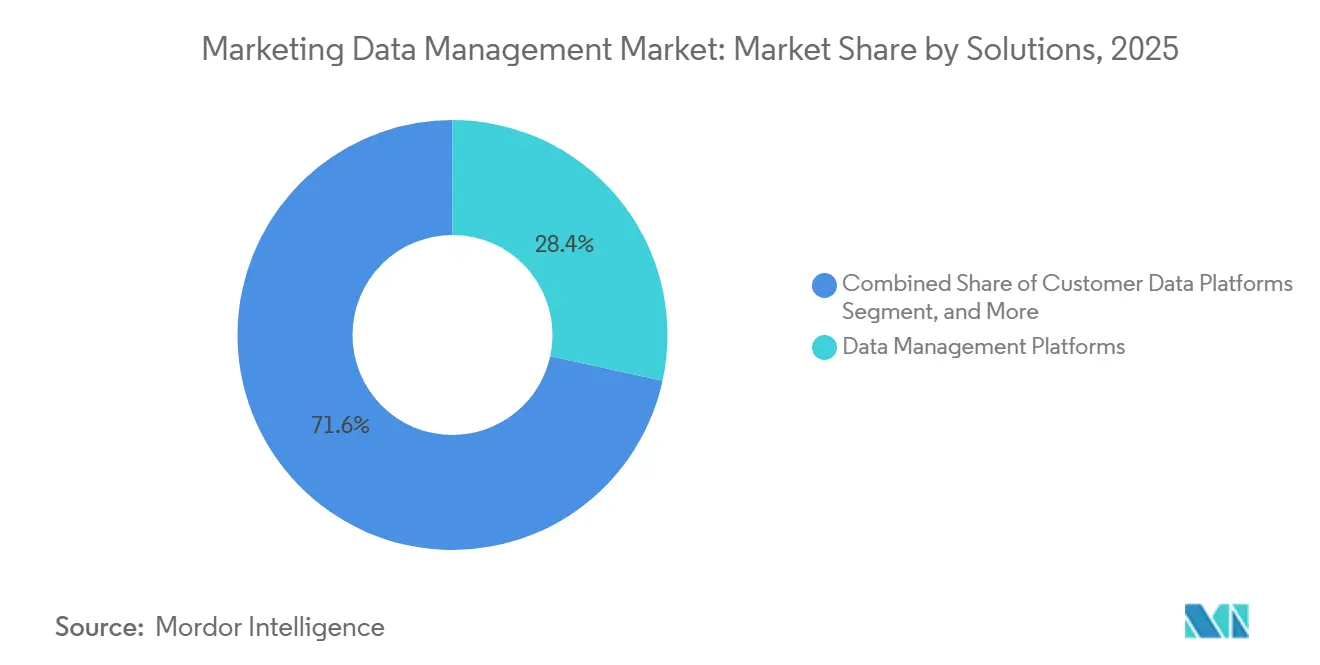
Data management platforms held the largest share by solutions at 28.41% in 2025, making them the leading category within the Marketing Data Management Market by solution mix. Their position came from a long-established role in managing anonymous audience segments for programmatic advertising and cross-site targeting. Even so, their centrality is weakening as enterprises shift from DMP-led workflows to systems built around first-party customer identity. Customer data platforms are projected to expand at a 15.82% CAGR through 2031, which shows where new demand is moving. This growth is tied to the need for unified behavioral, transactional, and CRM data that can support personalization, attribution, and AI-led activation across channels.
The Marketing Data Management industry is also seeing rising demand for data integration and governance tools, as enterprises seek to enable marketing teams to work with cleaner, lineage-tracked data without relying entirely on IT-led operating models. The Salesforce and Informatica combination strengthened this direction by broadening the use case for governed pipelines and metadata management inside marketing operations. Identity resolution solutions are gaining traction in retail media and financial services, where linking online, app, and offline behavior into a single durable customer record is essential. Campaign data orchestration remains the smallest segment by current revenue, but it carries high strategic value because it is the layer where upstream data investments become measurable business outcomes. Treasure AI’s July 2026 recognition in the IDC MarketScape also showed that solution leadership increasingly hinges on combining first-party identity, AI decisioning, and multi-channel execution within a single architecture.



By Deployment Mode: Cloud Infrastructure Anchors Operations While Hybrid Gains Strategic Ground
Cloud deployments accounted for 64.73% of the Marketing Data Management Market share in 2025, maintaining their lead as the leading deployment mode. That lead reflected cloud’s structural advantages in scalability, managed compliance support, and faster integration with platforms such as Snowflake, BigQuery, and Databricks. Enterprises also favored cloud because it reduced part of the in-house engineering burden when new data sources had to be added quickly. This made the cloud especially attractive for companies trying to scale customer data operations across several channels without rebuilding every internal process. As a result, cloud remained the default operating model for much of the new deployment activity.
On-premises deployment still mattered in financial services and healthcare, where data residency rules, security policies, and legacy infrastructure slowed full migration. Hybrid is projected to grow at a 14.29% CAGR through 2031, which shows that many enterprises prefer a staged transition rather than a full cutover. The Marketing Data Management industry is seeing hybrid solutions gain importance as companies seek to preserve links to legacy systems while moving activation and analytics closer to modern cloud environments. Adobe strengthened this model in March 2026 by expanding Change Data Capture support for Salesforce CRM, Microsoft Dynamics, and Marketo Engage, making mixed deployments easier to maintain. Composable CDP architectures further support hybrid adoption because they allow core customer data
By Organization Size: Enterprise Scale Leads While SME Adoption Reshapes the Growth Curve
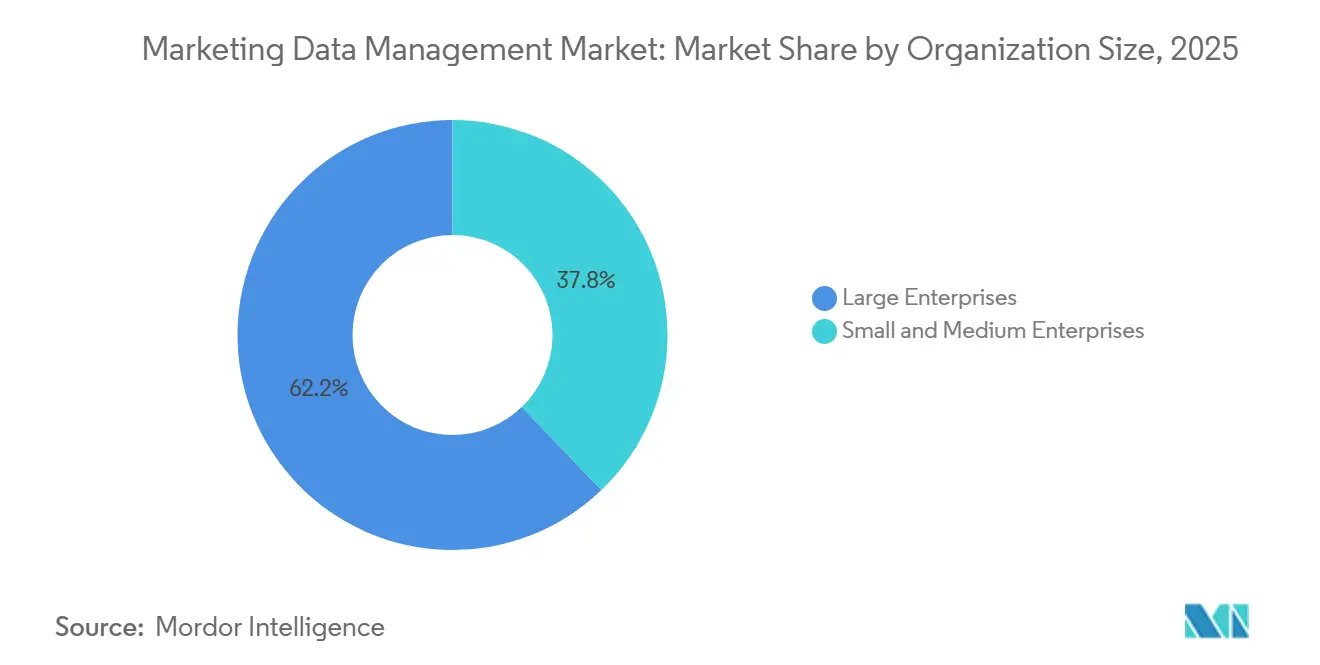
Large enterprises accounted for 62.18% of revenue in 2025, which gave them the leading position by organization size. Their lead reflects larger software budgets, broad multi-channel operations, and the internal data teams needed to manage customer information across CRM, service, commerce, and marketing automation platforms. These organizations often depend on continuous data flows across dozens of source systems, which makes integration, governance, and identity resolution central to daily operations. The Marketing Data Management Market remains strongly shaped by enterprise demand, as these buyers typically require deeper capabilities and larger deployments than smaller companies. Enterprise marketing teams were also operating within a dense installed base of automation tools that increased the value of a unified customer data layer.
SMEs are projected to expand at a 14.63% CAGR through 2031, making them the fastest-growing buyer group in the market. HubSpot reported that SMB adoption of marketing automation platforms reached 51% in 2026, which showed that the base technology stack for more advanced data management was becoming more common in smaller organizations. The OECD also noted in 2025 that the G7 had made AI adoption among smaller enterprises an explicit priority, which supports a favorable policy backdrop for software uptake. Smaller companies still face implementation and talent constraints, but cloud-native pricing and easier deployment models are reducing those barriers. This is gradually broadening the Marketing Data Management Market beyond its earlier concentration in large enterprise accounts.
By End-User Industry: Retail Anchors Revenue as Media and Entertainment Outpaces on Growth
Retail and e-commerce held the largest end-user share at 23.47% in 2025, making it the top revenue contributor within the Marketing Data Management Market size by end-user industry. The segment led because it depends heavily on behavioral data for real-time personalization across web, app, email, and in-store interactions. It also moved earlier than many sectors in building loyalty and first-party data systems that reduce dependence on paid media acquisition. That early investment helped retail and e-commerce stay ahead as enterprises increased spending on identity resolution, consent management, and cross-channel activation. The sector continues to set the pace for practical uses of governed customer data in daily marketing execution.
BFSI remained a major user group because identity resolution and consent management are tied not only to campaign performance but also to regulated customer engagement. Healthcare and life sciences continued to grow through patient education, physician engagement, and commercial use cases that require more precise governance controls. IT and telecom used these platforms to reduce churn and support upsell activity across large subscriber bases through behavioral prediction models. Media and entertainment are projected to grow at a 15.34% CAGR through 2031, as streaming platforms and content providers invest more heavily in monetizing audience data. The Marketing Data Management Market is likely to continue seeing strong demand here because proprietary audience data is becoming a direct source of strategic value rather than just a supporting input for advertising.
Geography Analysis
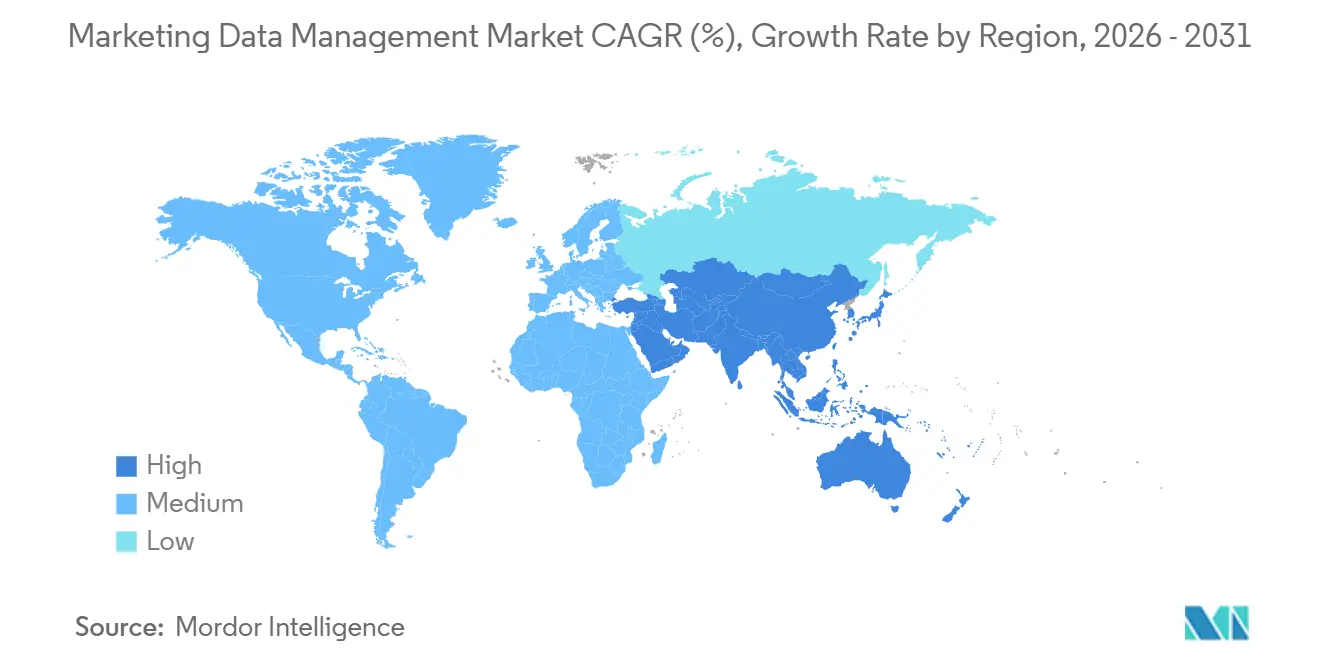
North America held the largest regional share at 36.82% in 2025, making it the leading region in the Marketing Data Management Market. The United States accounted for most of that revenue because it combines high enterprise software spending, a dense vendor base, and a mature ecosystem of system integrators. Canada added steady demand through enterprise digital transformation activity, while Mexico remained a smaller but growing contributor linked to cross-border e-commerce. State-level privacy regulation in the United States also kept governance and consent handling high on procurement agendas. The Marketing Data Management Market remained strongest in North America because buyers there were earlier adopters of integrated customer data and AI-enabled marketing systems.
Europe held a significant secondary share because GDPR made governing customer data handling both a legal and an operational requirement. The EU AI Act added a second compliance layer by introducing phased obligations for AI used for profiling and audience targeting, effective from August 2, 2026. Germany and the United Kingdom remained the largest market centers in the region. France also added momentum through CNIL’s January 2026 consultation on consent proof standards, which increased demand for auditable consent tracking across channels. South America remained smaller in scale, but Brazil continued to stand out as enterprises in retail, financial services, and media invested in first-party data infrastructure under the LGPD framework.
Asia-Pacific is projected to record the fastest regional CAGR of 14.81% through 2031, which makes it the main growth engine for the Marketing Data Management Market. Demand is rising across India, Southeast Asia, South Korea, and Japan as e-commerce expands and enterprise marketing technology budgets deepen. Treasure Data said Japan’s domestic CDP market grew from JPY 17 billion, USD 113 million, in 2020 to JPY 49 billion, USD 324.5 million, in 2025, using the 2025 IRS average exchange rate, and growth was expected to continue toward JPY 75 billion by 2027. Regional compliance complexity is also increasing because China, India, Vietnam, and Singapore are shaping different expectations for localization, transfer rules, and consent architecture. Middle East and Africa remained the smallest regional cluster, but adoption responded well in economies that were investing in digital transformation and enterprise customer engagement infrastructure.

Competitive Landscape
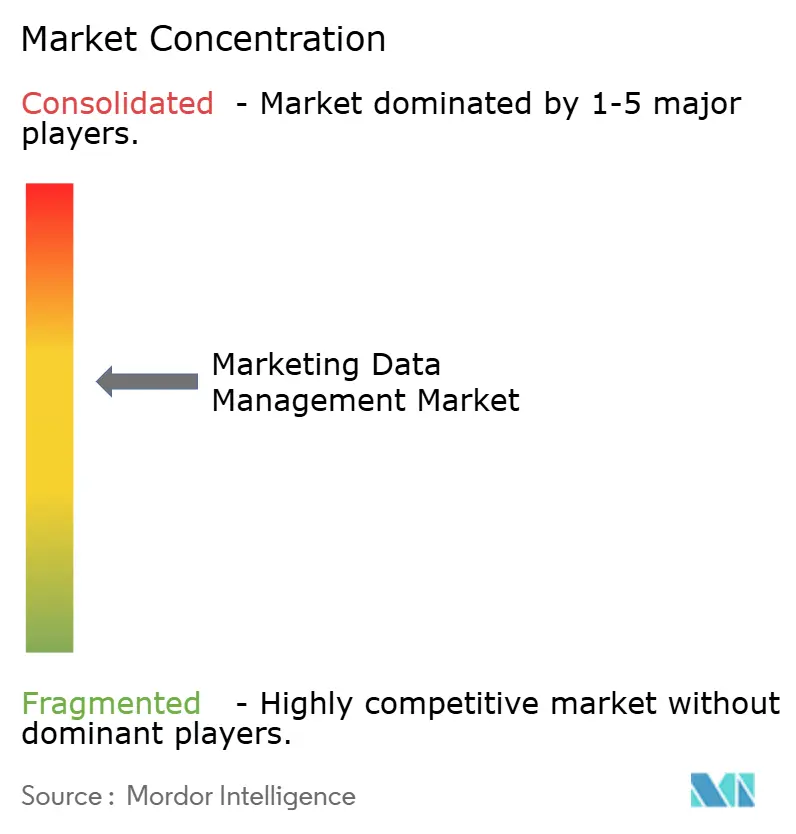
The Marketing Data Management Market remained moderately consolidated at the top tier, with Adobe, Salesforce, Oracle, SAP, and IBM holding strong enterprise relationships built over years of platform adoption. A second group of specialized vendors, including Tealium, Treasure AI, Amperity, ActionIQ, mParticle, and Hightouch, continued to compete on data model flexibility, AI-native functionality, and support for warehouse-native deployment. This created a two-layer structure in which large suite vendors defended their installed bases while specialists sought to win on openness, speed, and architectural fit. The market was therefore shaped not only by scale but also by how effectively vendors could support governance, identity, and activation without forcing unnecessary data duplication. That balance has become more important as buyers try to keep customer data usable across multiple systems rather than locked in a single closed environment.
Salesforce made the most significant structural move in November 2025 when it completed the Informatica acquisition and expanded into integration, governance, quality, metadata, privacy, and master data management within a single platform relationship. Adobe responded in April 2026 with CX Enterprise Coworker, which linked agentic AI orchestration across Real-Time CDP, Customer Journey Analytics, Journey Optimizer, and Marketo Engage on open interoperability standards. Treasure AI also strengthened its standing when it was recognized in July 2026 as a leader for both B2C and B2B AI-enabled customer data platforms. These moves showed that competitive leadership was moving toward vendors that could combine governed first-party data with AI decisioning and multi-channel execution. Buyers increasingly view platform breadth and operational fit as closely linked rather than separate purchase criteria.
White space remained strongest in warehouse-native activation for small- and mid-market buyers, where large-suite platforms have often been harder to deploy and price. Hightouch targeted that gap in April 2026 when it raised USD 150 million to expand its agentic marketing platform built directly on enterprise cloud data warehouses. M&A also continued to shape the market, with BlueConic acquiring Blueshift in June 2026 and MoEngage acquiring Aampe in June 2026 to bring data, decisioning, and multi-channel execution closer together. That pattern suggests continued convergence toward platforms that control both the governance and execution layers. As a result, narrow point solutions are likely to face a harder path to defending standalone positions over time.
Marketing Data Management Industry Leaders
Adobe Inc.
Salesforce, Inc.
Oracle Corporation
SAP SE
IBM Corporation
- *Disclaimer: Major Players sorted in no particular order

Recent Industry Developments
- July 2026: Treasure AI was recognized as a Leader for both B2C and B2B users in the 2026 IDC MarketScape for Worldwide AI-Enabled Customer Data Platforms. The recognition validated Treasure AI's Intelligent Customer Data Platform, which combines identity-resolved first-party data with AI Agent Foundry for autonomous marketing, sales, and service workflows, marking a broader market shift from data storage platforms to AI-native customer operations systems.
- June 2026: MoEngage acquired Aampe, a San Francisco-based agentic AI decisioning platform, in an all-cash deal to bring individual-level autonomous decisioning to its platform serving over 1,350 global consumer brands, including Coca-Cola, Domino's, and SoundCloud. The acquisition completed MoEngage's transition to a full Agentic Customer Engagement Platform and united both companies' AI labs under a single focus on production-scale agentic marketing.
- June 2026: BlueConic acquired Blueshift, an AI-powered cross-channel marketing platform, to create an integrated solution combining first-party behavioral data capture, real-time AI decisioning, and multi-channel execution across web, email, push, in-app, and SMS, in a single stack. The combined entity serves over 600 customers across CPG, retail, direct-to-consumer, and travel and hospitality sectors, positioning it among the first CDPs to natively close the gap between data activation and campaign delivery.
- April 2026: Hightouch completed a USD 150 million Series D financing round at a USD 2.75 billion valuation, led by Growth Equity at Goldman Sachs Alternatives and Bain Capital Ventures. The capital will fund expansion of Hightouch's agentic marketing platform, which operates directly on enterprise cloud data warehouses, Snowflake and BigQuery, for AI-driven campaign orchestration, decisioning, and cross-channel execution. The company reported over 100% revenue growth in each of the prior 2 years.


Global Marketing Data Management Market Report Scope
The marketing data management market encompasses the ecosystem of software solutions and services designed to collect, integrate, govern, and activate marketing-related data across an organization. This market includes specialized platforms such as data management platforms (DMPs), customer data platforms (CDPs), data integration and governance solutions, identity resolution tools, and campaign data orchestration platforms. Deployed across cloud, on-premises, and hybrid environments, these solutions cater to both large enterprises and small and medium enterprises. They enable businesses across various industries including retail, BFSI, healthcare, and media—to break down data silos, ensure data quality and regulatory compliance, and create a unified, actionable view of customer and campaign information. Ultimately, marketing data management solutions empower organizations to enhance audience targeting, optimize campaign performance, and drive personalized customer engagement strategies.
The Marketing Data Management Market Report is Segmented by Solutions (Data Management Platforms, Customer Data Platforms, Data Integration and Governance Solutions, Identity Resolution Solutions, and Campaign Data Orchestration Solutions), Deployment Mode (Cloud, On-Premises, and Hybrid), Organization Size (Large Enterprises, and Small and Medium Enterprises), End-User Industry (Retail and E-Commerce, BFSI, Healthcare and Life Sciences, IT and Telecom, Media and Entertainment, Industrial Manufacturing, Government and Public Administration, and Other End-User Industries), and Geography (North America, South America, Europe, Asia-Pacific, and Middle East and Africa). The Market Forecasts are Provided in Terms of Value (USD).
| Data Management Platforms |
| Customer Data Platforms |
| Data Integration and Governance Solutions |
| Identity Resolution Solutions |
| Campaign Data Orchestration Solutions |
| Cloud |
| On-Premises |
| Hybrid |
| Large Enterprises |
| Small and Medium Enterprises |
| Retail and E-Commerce |
| BFSI |
| Healthcare and Life Sciences |
| IT and Telecom |
| Media and Entertainment |
| Industrial Manufacturing |
| Government and Public Administration |
| Other End-User Industries |
| North America | United States | |
| Canada | ||
| Mexico | ||
| South America | Brazil | |
| Argentina | ||
| Rest of South America | ||
| Europe | Germany | |
| United Kingdom | ||
| France | ||
| Italy | ||
| Spain | ||
| Russia | ||
| Rest of Europe | ||
| Asia-Pacific | China | |
| India | ||
| Japan | ||
| South Korea | ||
| Australia | ||
| Rest of Asia-Pacific | ||
| Middle East and Africa | Middle East | Saudi Arabia |
| United Arab Emirates | ||
| Rest of Middle East | ||
| Africa | South Africa | |
| Nigeria | ||
| Rest of Africa | ||
| By Solutions | Data Management Platforms | ||
| Customer Data Platforms | |||
| Data Integration and Governance Solutions | |||
| Identity Resolution Solutions | |||
| Campaign Data Orchestration Solutions | |||
| By Deployment Mode | Cloud | ||
| On-Premises | |||
| Hybrid | |||
| By Organization Size | Large Enterprises | ||
| Small and Medium Enterprises | |||
| By End-User Industry | Retail and E-Commerce | ||
| BFSI | |||
| Healthcare and Life Sciences | |||
| IT and Telecom | |||
| Media and Entertainment | |||
| Industrial Manufacturing | |||
| Government and Public Administration | |||
| Other End-User Industries | |||
| By Geography | North America | United States | |
| Canada | |||
| Mexico | |||
| South America | Brazil | ||
| Argentina | |||
| Rest of South America | |||
| Europe | Germany | ||
| United Kingdom | |||
| France | |||
| Italy | |||
| Spain | |||
| Russia | |||
| Rest of Europe | |||
| Asia-Pacific | China | ||
| India | |||
| Japan | |||
| South Korea | |||
| Australia | |||
| Rest of Asia-Pacific | |||
| Middle East and Africa | Middle East | Saudi Arabia | |
| United Arab Emirates | |||
| Rest of Middle East | |||
| Africa | South Africa | ||
| Nigeria | |||
| Rest of Africa | |||


Key Questions Answered in the Report
What is the current size and forecast outlook for the Marketing Data Management Market?
The Marketing Data Management Market was valued at USD 10.28 billion in 2025, reached USD 11.24 billion in 2026, and is forecast to reach USD 20.16 billion by 2031 at a 12.39% CAGR.
Which solution type is growing the fastest in the Marketing Data Management space?
Customer data platforms are projected to grow the fastest, with a 15.82% CAGR through 2031, as enterprises shift toward first-party identity and unified profile management.
Why is first-party data becoming more important for enterprise marketing platforms?
Brands want stronger control over personalization, attribution, and consent management as third-party signal reliability has weakened across browsers and mobile ecosystems.
Which deployment model leads revenue today?
Cloud led with 64.73% share in 2025 because it offered scalability, faster integration, and smoother alignment with cloud data warehouses and managed governance tooling.
Which end-user segment contributes the most revenue?
Retail and e-commerce led with 23.47% share in 2025 because the segment relies heavily on behavioral data for loyalty programs, personalization, and real-time activation.
Which region is expected to grow the fastest through 2031?
Asia-Pacific is projected to grow the fastest at a 14.81% CAGR through 2031, supported by e-commerce growth, rising software budgets, and more complex data governance requirements.
Page last updated on:






