
Marine Generators Fastener Market Size and Share
Market Overview
| Study Period | 2021 - 2031 |
|---|---|
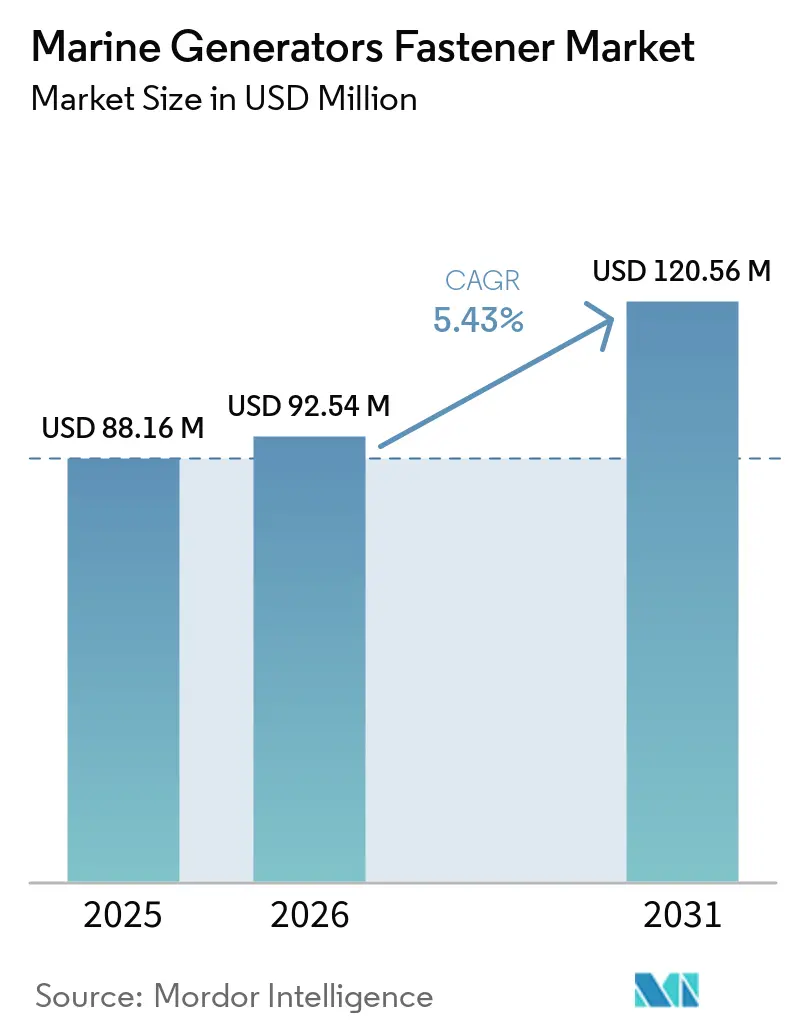
| Market Size (2026) | USD 92.54 Million |
| Market Size (2031) | USD 120.56 Million |
| Growth Rate (2026 - 2031) | 5.43 % |
| Fastest Growing Market | Europe |
| Largest Market | Asia-Pacific |
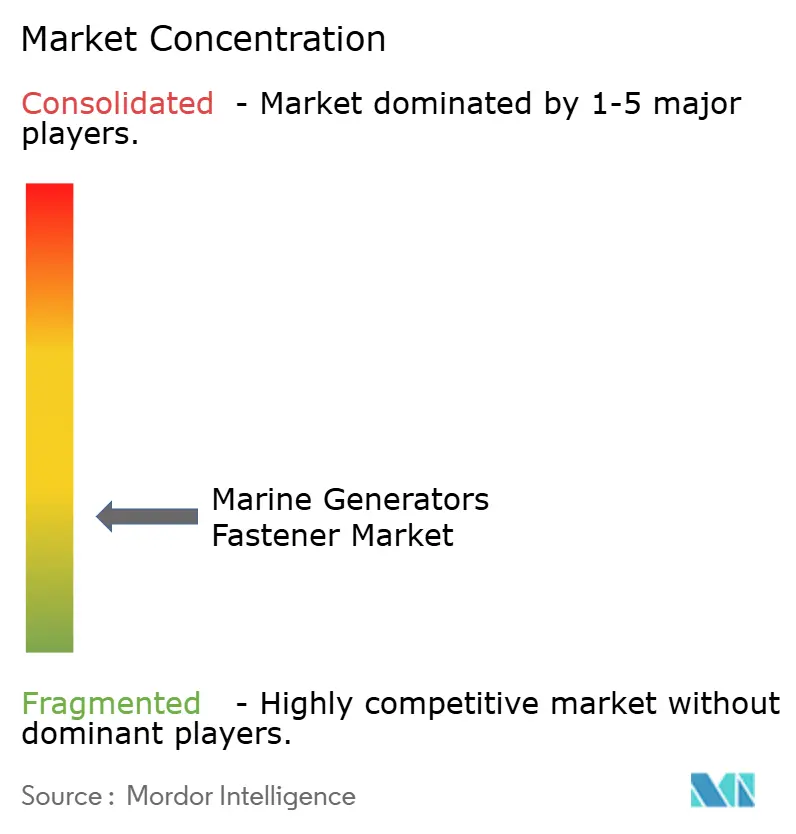
| Market Concentration | Low |
Major Players *Disclaimer: Major Players sorted in no particular order Image © Mordor Intelligence. Reuse requires attribution under CC BY 4.0. | |
Marine Generators Fastener Market Analysis by Mordor Intelligence
The Marine Generators Fastener Market size is expected to grow from USD 88.16 million in 2025 to USD 92.54 million in 2026 and is forecast to reach USD 120.56 million by 2031 at 5.43% CAGR over 2026-2031. The marine generator fasteners market is growing as new vessels add dual-fuel auxiliary systems, battery buffers, and shore-power interfaces. These changes raise the number of fastening points and increase the required performance of materials, coatings, and preload retention. Salt exposure in engine rooms makes generator mounting reliability important because a failed connection can interrupt equipment operation. Shipyards in Korea and China are moving procurement toward products designed for long salt-spray service, which supports demand in both newbuild and retrofit work. The marine generator fasteners market also benefits when shipyards specify materials and assemblies early in vessel design, since those decisions shape long-term replacement demand.
Key Report Takeaways
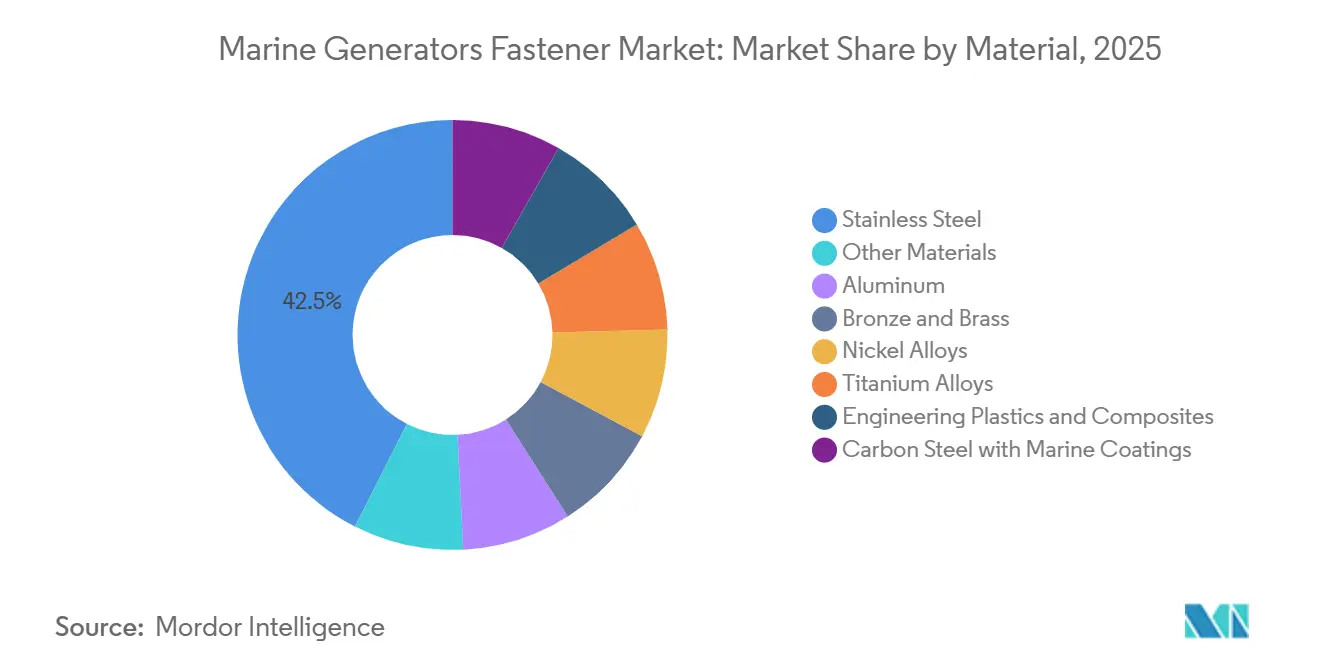
- By material, stainless steel held 42.5% of the marine generator fasteners market share in 2025, while engineering plastics and composites are forecast to grow at a 6.1% CAGR through 2031.
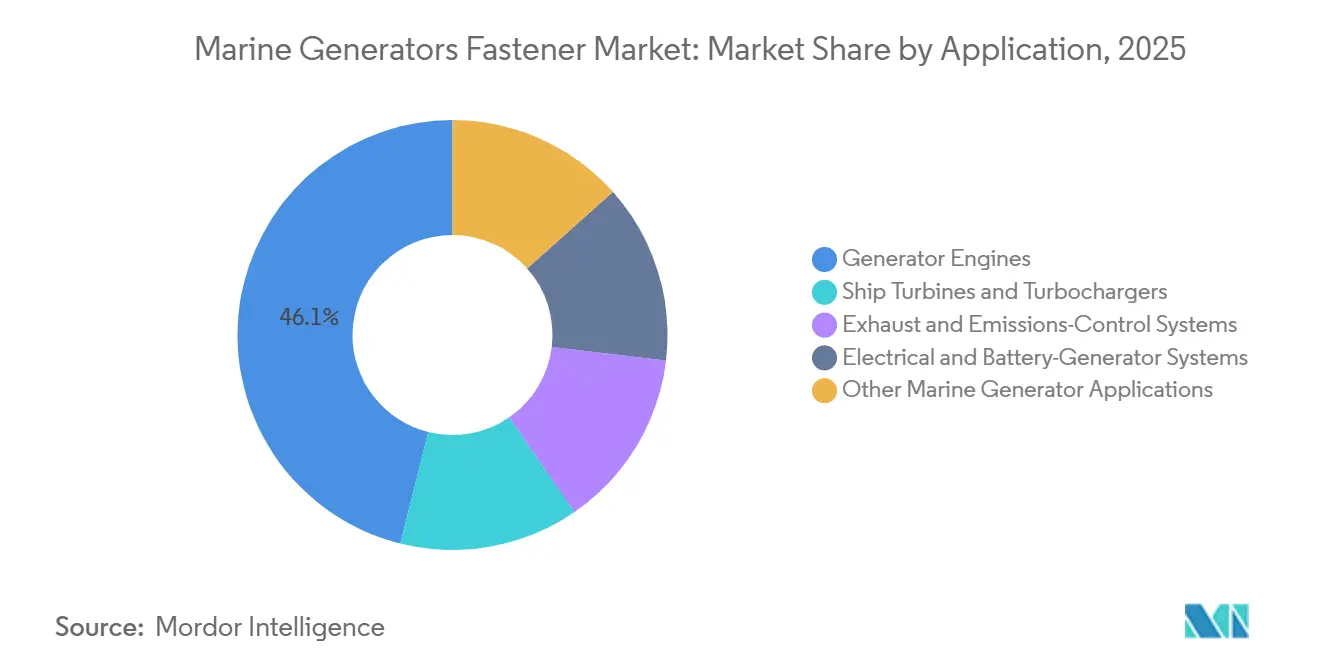
- By application, generator engines accounted for 46.1% of the marine generator fasteners market size in 2025, while electrical and battery-generator systems are forecast to grow at a 6.7% CAGR through 2031.
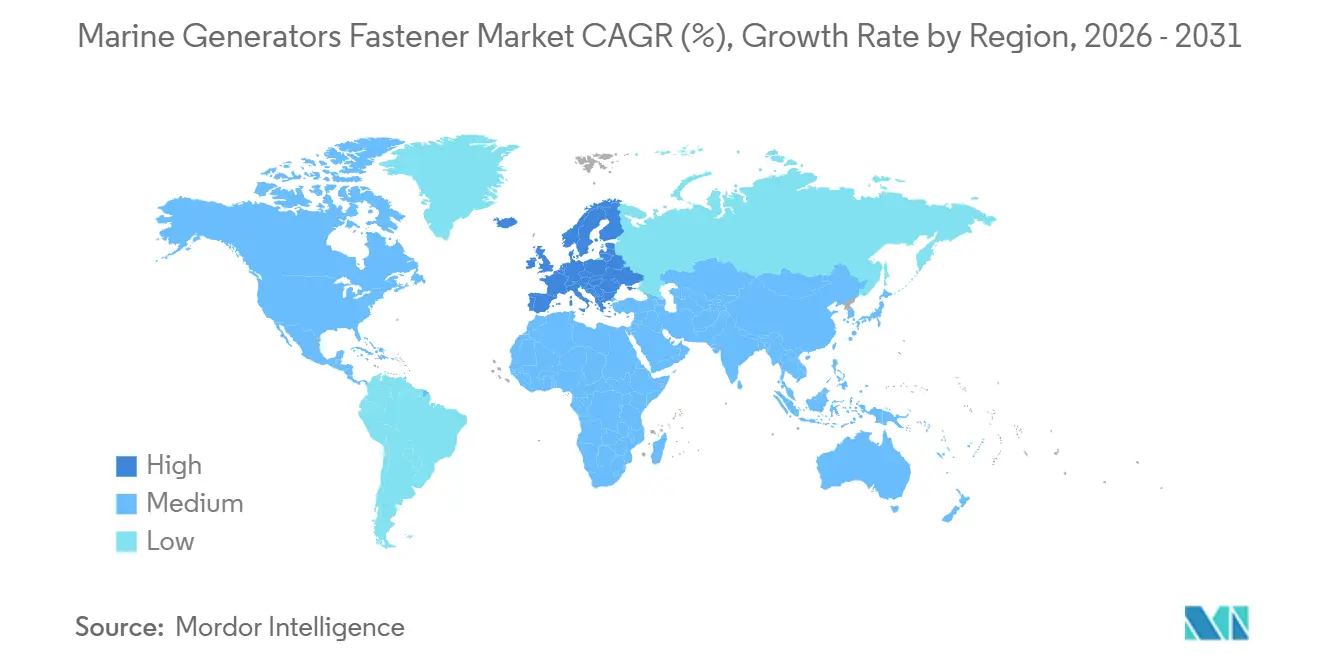
- By geography, Asia-Pacific held 43.5% of revenue in 2025, while Europe is forecast to grow at a 6.6% CAGR through 2031.
Note: Market size and forecast figures in this report are generated using Mordor Intelligence’s proprietary estimation framework, updated with the latest available data and insights as of January 2026.
Market Trends and Insights
Drivers Impact Analysis of Marine Generators Fastener Market*
| Driver | % Impact on CAGR Forecast | Geographic Relevance | Impact Timeline |
|---|---|---|---|
| Fleet Renewal and New-Build Vessel Programs | +1.40% | Global, concentrated in Asia-Pacific (China, South Korea) | Medium term (2-4 years) |
| Offshore Wind and Floating-Energy Expansion | +1.10% | Europe, APAC (South Korea, Japan, Taiwan), MEA spill-over | Long term (≥ 4 years) |
| IMO Corrosion-Prevention Compliance | +0.80% | Global, with early gains in Europe and North Asia | Short term (≤ 2 years) |
| Marine Generator Retrofit and Repowering Cycles | +0.70% | Europe, North America, APAC retrofit yards | Medium term (2-4 years) |
| Sensorized Fastening for Generator Predictive Maintenance | +0.50% | Europe, North America | Long term (≥ 4 years) |
| Dockside Vendor-Managed Fastener Kits | +0.30% | Global major port hubs | Short term (≤ 2 years) |
| Source: Mordor Intelligence | |||
Fleet Renewal and New-Build Vessel Programs
The marine generator fasteners market gains a strong demand base from the current fleet renewal cycle. BIMCO reported that the global shipbuilding orderbook reached 191 million compensated gross tonnes in the first quarter of 2026, equal to 17% of the existing fleet and the highest ratio since 2011[1]. Newbuilding contracting in the 2020s ran 47% above the 2010s average, while 21% of the crude tanker fleet and 17% of the product tanker fleet were more than 20 years old. Each new vessel requires fasteners across generator mounting feet, exhaust flanges, and electrical enclosures. Yard specification lists now influence the grades and coating systems selected for entire vessel classes. The orderbook-to-fleet ratio reached 40% for LNG carriers and 37% for containerships, two vessel categories with complex auxiliary power arrangements.
Offshore Wind and Floating-Energy Expansion
The marine generator fasteners market is supported by vessels serving floating offshore wind projects. ABS expects global floating offshore wind capacity to rise from 270 MW in 2025 to 5 GW by 2035 and to exceed 14 GW by 2040[2]. Anchor-handling and multi-purpose support vessels use diesel or hybrid generator arrays for mooring tensioners and subsea equipment. These vessels operate under inclination and vibration conditions that place added demands on fastening systems. SINTEF’s WindRise project is developing automated fabrication and installation methods for offshore wind jacket substructures, with work continuing through 2026. Nord-Lock Group deployed Boltight hydraulic tensioning technology at a 96 MW offshore wind farm in South Korea that entered commercial operation in May 2025.
IMO Corrosion-Prevention Compliance
The marine generator fasteners market benefits as corrosion protection becomes a more formal part of vessel compliance. The IMO adopted Resolutions MSC.557(108) and MSC.558(108) in May 2024, and the amendments entered into force on January 1, 2026[3]. The amendments address protective coatings in seawater ballast tanks and crude oil cargo tanks. ABS issued corrosion-protection guidance that covers CPS-B, CPS-D, and CPS-V notations for relevant vessels[4]. A corroded generator mounting bolt can create an operational risk for an auxiliary power system. Older vessels facing closer inspection cycles may replace carbon-steel items with coated or stainless alternatives during drydocking.
Marine Generator Retrofit and Repowering Cycles
The marine generator fasteners market also has a demand channel that does not depend on new vessel orders. Retrofit projects for LNG, methanol, and selective catalytic reduction systems progressed through 2025 as suppliers moved work from technical evaluation toward broader commercial use. A retrofit often needs custom-length studs, adapter plates, and additional corrosion protection because the original and replacement generator mounting patterns differ. Combining parts from different equipment manufacturers can create dissimilar-metal connections at fastened interfaces. European repair yards are important for this work because FuelEU Maritime obligations are driving early repowering activity among ferry, short-sea, and coastal fleets. Pre-engineered kits can help drydock contractors obtain matched fastener grades and reduce the risk of incompatible parts.
Restraints Impact Analysis of Marine Generators Fastener Market*
| Restraint | % Impact on CAGR Forecast | Geographic Relevance | Impact Timeline |
|---|---|---|---|
| Nickel, Titanium, and Specialty-Alloy Price Volatility | -0.80% | Global, most acute in markets with stainless or nickel-alloy specifications | Medium term (2-4 years) |
| Certification Delays for Novel Materials and Coatings | -0.60% | Global, particularly Europe and North America | Medium term (2-4 years) |
| Counterfeit and Misidentified Critical Fasteners | -0.40% | Global, concentrated in secondary markets and grey-channel procurement | Short term (≤ 2 years) |
| Galvanic-Corrosion Failure from Multi-Material Generator Assemblies | -0.30% | Global, disproportionate in tropical and high-humidity operating regions | Long term (≥ 4 years) |
| Source: Mordor Intelligence | |||
Nickel, Titanium, and Specialty-Alloy Price Volatility
The marine generator fasteners market remains exposed to the cost of nickel, titanium, and other specialty alloys. The supplied material showed that nickel prices fell from USD 25,638 per tonne in 2022 to USD 16,818 per tonne in 2024. This movement can affect suppliers that quote multi-year contracts for duplex stainless, nickel alloys, or titanium-based products. Producers may find it difficult to align commodity hedging with contract periods for specialized marine items. Index-linked contracts can shift part of that risk to vessel operators. This can slow upgrades to higher-grade alloy fasteners when procurement teams focus on near-term cost control.
Certification Delays for Novel Materials and Coatings
The marine generator fasteners market faces a slower path to adoption for composites and advanced coating systems. Classification society approvals require testing for load capacity and corrosion performance under marine conditions. The supplied material indicated that a typical type-approval process can take 18 to 36 months. This creates a gap between newbuild specifications that seek novel products and retrofit demand that needs immediate availability. Existing approvals give established suppliers an advantage in markets that require class acceptance. Smaller specialists may be unable to fund simultaneous approval work across several classification societies.
*Our forecasts treat driver/restraint impacts as directional, not additive. The impact forecasts reflect baseline growth, mix effects, and variable interactions.
Marine Generators Fastener Market Segment Analysis
By Material:
Stainless Steel Leads Current Demand, While Composites Gain UseStainless steel accounted for 42.5% of the marine generator fasteners market size in 2025, making it the largest material category because it balances corrosion resistance, strength, and practical fabrication. Its corrosion resistance and weldability support use at generator mounts, exhaust flanges, turbocharger housings, and other positions exposed to vibration, heat, and engine-room moisture. Grades 316L and 316Ti remain widely accepted in classification approval lists, which helps suppliers serve standardized shipyard specifications without changing material systems for each vessel. Aluminum is used where vessel weight is a major consideration, especially where the required load and temperature conditions allow its use. Bronze and brass remain relevant near seawater-exposed through-hull positions because of their compatibility with copper-alloy fittings and their established role in marine equipment.
Engineering plastics and composites are forecast to grow at a 6.1% CAGR through 2031, the fastest rate among materials, as hybrid vessels need components that can manage both electrical and corrosion concerns. They can electrically isolate generator enclosures from metallic hull structures, limiting paths for stray current at vulnerable interfaces. This use is important near battery systems that are sensitive to stray voltage at structural joints and need separation from conductive vessel structures. A scientific review identified 45 documented research and commercial uses of sensorized fasteners that apply piezoelectric, fiber-optic Bragg grating, or strain-gauge methods. Nickel and titanium alloys remain suited to exhaust and emission-control positions, while coated carbon steel serves cost-sensitive mounting work when drydock inspection intervals can manage its corrosion risk.

By Application:
Generator Engines Hold Volume, While Electrical Systems Grow FasterGenerator engines represented 46.1% of the marine generator fasteners market size in 2025, supported by the large installed base of diesel and dual-fuel auxiliary sets in commercial fleets. Medium-speed diesel and dual-fuel units contain many fastening positions across mounting frames, heat exchangers, oil systems, exhaust manifolds, and connections that must remain secure during continuous operation. These positions face vibration and thermal cycling that require reliable preload retention and material selection suited to their local operating conditions. Ship turbines and turbochargers also need materials that can sustain high temperatures and rotational vibration without early loss of joint performance. Exhaust and emissions-control systems gained importance after sulfur-cap compliance increased the use of selective catalytic reduction housings and exhaust gas cleaning equipment.
Electrical and battery-generator systems are expected to grow at a 6.7% CAGR through 2031, reflecting the broader shift toward battery buffers, DC connections, and hybrid propulsion interfaces. Battery buffers, DC bus connections, and hybrid propulsion interfaces increase the need for electrically appropriate fastening solutions that prevent unwanted interaction with adjacent metal structures. ABS set out structural health monitoring frameworks for marine vessels and offshore units in its 2025 Smart Functions Guide. This supports attention to instrumented joints in generator machinery, where a remote indication of preload can support planned maintenance. Emergency generator rooms, shaft-generator connections, and auxiliary power take-offs remain smaller but steady applications with demanding vibration and salt-spray requirements.
Geography Analysis
APAC Marine Generators Fastener Market
Asia-Pacific held 43.5% of the marine generator fasteners market share in 2025, reflecting its position as the main center for global vessel construction. Chinese yards captured 70% of global newbuilding contracting by compensated gross tonnes in the first quarter of 2026, while South Korean yards captured 20%. This concentration makes the region central to construction demand and to later maintenance demand from vessels built in its yards. South Korea is active in LNG dual-fuel and hydrogen-ready vessel construction, both of which use more complex power-system arrangements. Japan, Vietnam, Indonesia, and India add demand through repair work, domestic newbuilds, and offshore support vessels that operate in regional energy projects.
Europe Marine Generators Fastener Market
Europe is forecast to grow at a 6.6% CAGR through 2031, the fastest regional rate in the marine generator fasteners market. FuelEU Maritime is encouraging generator repowering at repair yards in Germany, Norway, and the Netherlands, where established drydock capacity can support major equipment changes. The European Commission identifies marine renewable energy as a priority investment area within maritime policy. Offshore wind activity expands the installed base of construction vessels that need reliable high-specification joints during extended offshore operating periods. These conditions support demand from retrofit activity as well as new offshore vessel equipment and reward suppliers that can provide certified parts quickly.
The Americas and MEA Marine Generators Fastener Market
North America is a high-specification but volume-limited region, supported by U.S. Navy, Coast Guard, and offshore support vessel programs that can require demanding material and performance documentation. South America is gaining relevance through Brazilian offshore support vessel construction and Chilean port renewal, which increase requirements for vessel maintenance and local component supply. The Middle East and Africa benefit from port expansion, offshore oil support vessels, and fleet maintenance activity around the Suez Canal, creating recurring needs for repair-ready inventory. The marine generator fasteners market in these regions can favor dockside vendor-managed inventory programs, which help operators avoid service delays caused by unavailable parts during limited generator service windows.
Competitive Landscape
The marine generator fasteners market is fragmented, with no evidence that a small group controls a decisive share of demand. Nord-Lock Group, Howmet Aerospace, Würth Group, and Bossard Holding AG compete with specialized suppliers, including Marine Fasteners, Inc., Dokka Fasteners AS, Sea-Dog Corporation, and Hydrobolt Group. Large suppliers compete through certification coverage, distribution reach, proprietary locking systems, and the ability to serve multiple shipbuilding locations. Specialist vendors compete through application knowledge, small-batch response, and proximity to shipyards and drydocks when replacement parts are required quickly. The marine generator fasteners industry has room for suppliers that can provide mixed-grade kits for specific generator assemblies and maintain consistent documentation for every component.
Howmet Aerospace completed its acquisition of Consolidated Aerospace Manufacturing from Stanley Black & Decker in April 2026 for USD 1.8 billion. The acquired business expands Howmet’s precision fastener capability across industrial applications, including areas where material and locking requirements overlap with marine equipment. Howmet also acquired Brunner Manufacturing in February 2026 for USD 120 million, adding industrial fastening capability. Nord-Lock Group demonstrated its Boltight hydraulic tensioning technology at the South Korean offshore wind project that began commercial operation in May 2025. These moves show how industrial, offshore, and marine applications can share demanding bolted-joint requirements.
BUMAX and Strainlabs commercialized sensorized stainless steel bolts in 2025, with real-time preload monitoring in BUMAX 88 and BUMAX 109 grades from M10 to M27. The marine generator fasteners market can use this capability where manual inspection is difficult in enclosed generator spaces and access during normal operations is restricted. RFID traceability and dockside inventory services are also relevant competitive options for suppliers, especially where counterfeit or misidentified fasteners create maintenance risk. Classification approvals and established inspection histories remain barriers to entry for new materials and suppliers. The marine generator fasteners industry may therefore reward companies that combine certified materials with dependable local availability.
Marine Generators Fastener Industry Leaders
-
Fastenal Company
-
Stanley Black & Decker, Inc.
-
Würth Group
-
Howmet Aerospace, Inc.
-
Nord-Lock Group
- *Disclaimer: Major Players sorted in no particular order
Marine Generators Fastener Market Companies Covered in this Report
- LISI Group
- Stanley Black & Decker, Inc.
- Fastenal Company
- Würth Group
- Nord-Lock Group
- Howmet Aerospace, Inc.
- Böllhoff Group
- Bossard Holding AG
- Bulten AB
- Dokka Fasteners AS
- Hydrobolt Group
- LoneStar Fasteners
- MW Components
- PennEngineering
- Sundram Fasteners Limited
- TR Fastenings Limited
- Birmingham Fastener
- Marine Fasteners, Inc.
- Sea-Dog Corporation
- Fasco Fasteners
Recent Industry Developments in Marine Generators Fastener Market
- April 2026: Howmet Aerospace completed the acquisition of Consolidated Aerospace Manufacturing (CAM) from Stanley Black & Decker for approximately USD 1.8 billion. CAM is a leading global designer and manufacturer of precision fasteners for aerospace and defense applications, and its integration into Howmet's Fastening Systems segment positions the business to expand across industrial gas turbine, wind turbine, and marine power generation fastening applications.
- February 2026: Howmet Aerospace acquired Brunner Manufacturing Co. Inc., a Wisconsin-based industrial fastener producer, for approximately USD 120 million. The acquisition complements Howmet's Fastening Systems product portfolio and enhances growth opportunities in industrial fasteners, including applications covering wind turbines, power generation equipment, and heavy industrial machinery with cross-applicability to marine generator environments.
- December 2025: Nord-Lock Group launched its Defense Virtual Environment, an interactive digital platform showcasing Superbolt multi-jackbolt tensioners, Boltight hydraulic tensioning, and Nord-Lock wedge-locking washers for naval and offshore applications. The platform highlights Superbolt's approval as a NAVSEA Level 1 fastener supplier and MIL-STD-901D certification, reinforcing Nord-Lock Group's positioning in marine defense markets.
- November 2025: Nord-Lock Group's Boltight hydraulic tensioning solutions were successfully deployed at a 96 MW offshore wind farm in South Korea's Yellow Sea, with the project commencing commercial operation. The deployment used Typhoon+ multi-stage tensioners for the MP-TP flange joint, a technology directly transferable to marine vessel generator mounting systems.
Global Marine Generators Fastener Market Report Scope
Marine generator fasteners are mechanical components designed to secure, assemble, and maintain the structural integrity of marine generator systems in harsh marine environments. These fasteners include bolts, nuts, screws, studs, washers, and specialty fastening systems used in generator engines, housings, mounting systems, exhaust systems, fuel systems, cooling systems, electrical enclosures, and auxiliary equipment.
The Marine Generators Fastener Market is segmented by material, application, and geography. By material, the market is segmented into stainless steel, aluminum, nickel alloys, titanium alloys, and engineering plastics and composites. By application, the market is segmented into generator engines, ship turbines, exhaust systems, and electrical and battery-generator systems. The report also covers the market size and forecasts for the global marine generators fastener market across 26 countries in key regions. For each segment, the market sizing and forecasts have been provided on the basis of value (USD).
Segmentation Overview
| Stainless Steel |
| Aluminum |
| Bronze and Brass |
| Nickel Alloys |
| Titanium Alloys |
| Engineering Plastics and Composites |
| Carbon Steel with Marine Coatings |
| Other Materials |
| Generator Engines |
| Ship Turbines and Turbochargers |
| Exhaust and Emissions-Control Systems |
| Electrical and Battery-Generator Systems |
| Other Marine Generator Applications |
| North America | United States |
| Canada | |
| Mexico | |
| Europe | Germany |
| France | |
| Italy | |
| Spain | |
| United Kingdom | |
| Poland | |
| Russia | |
| Rest of Europe | |
| Asia-Pacific | China |
| India | |
| Japan | |
| South Korea | |
| Australia | |
| Indonesia | |
| Vietnam | |
| Thailand | |
| Rest of Asia-Pacific | |
| South America | Brazil |
| Argentina | |
| Chile | |
| Rest of South America | |
| Middle East and Africa | Saudi Arabia |
| United Arab Emirates | |
| Egypt | |
| South Africa | |
| Morocco | |
| Rest of Middle East and Africa |
| By Material | Stainless Steel | |
| Aluminum | ||
| Bronze and Brass | ||
| Nickel Alloys | ||
| Titanium Alloys | ||
| Engineering Plastics and Composites | ||
| Carbon Steel with Marine Coatings | ||
| Other Materials | ||
| By Application | Generator Engines | |
| Ship Turbines and Turbochargers | ||
| Exhaust and Emissions-Control Systems | ||
| Electrical and Battery-Generator Systems | ||
| Other Marine Generator Applications | ||
| By Geography | North America | United States |
| Canada | ||
| Mexico | ||
| Europe | Germany | |
| France | ||
| Italy | ||
| Spain | ||
| United Kingdom | ||
| Poland | ||
| Russia | ||
| Rest of Europe | ||
| Asia-Pacific | China | |
| India | ||
| Japan | ||
| South Korea | ||
| Australia | ||
| Indonesia | ||
| Vietnam | ||
| Thailand | ||
| Rest of Asia-Pacific | ||
| South America | Brazil | |
| Argentina | ||
| Chile | ||
| Rest of South America | ||
| Middle East and Africa | Saudi Arabia | |
| United Arab Emirates | ||
| Egypt | ||
| South Africa | ||
| Morocco | ||
| Rest of Middle East and Africa | ||
Key Questions Answered in the Report
What is the projected value of the marine generator fasteners market by 2031?
The marine generator fasteners market is projected to reach USD 120.56 million by 2031, from USD 92.54 million in 2026, at a 5.43% CAGR. New vessels with dual-fuel auxiliary systems, battery buffers, and shore-power interfaces increase the number and specification of fastening points. Retrofit and repowering work creates a second demand channel that does not rely solely on new vessel deliveries.
Which material leads demand for marine generator fasteners?
Stainless steel led with 42.5% of value in 2025 because it is used across generator mounts, exhaust flanges, and turbocharger housings. Grades 316L and 316Ti support broad use because they are accepted in relevant classification approval lists. Bronze and brass retain roles near seawater-exposed positions, while coated carbon steel serves applications with manageable drydock inspection intervals. Engineering plastics and composites are growing faster because they can provide electrical isolation around battery-adjacent equipment.
Which application is growing fastest for marine generator fasteners?
Electrical and battery-generator systems are forecast to grow at a 6.7% CAGR through 2031 as hybrid power systems add battery buffers and DC connections. These systems need fastening solutions that are suitable for electrical interfaces and metallic hull structures. Generator engines remained the largest application in 2025 because diesel and dual-fuel units have many fastening locations across frames, cooling systems, oil systems, and exhaust manifolds. Ship turbines, turbochargers, and emissions-control equipment also require materials that tolerate heat and vibration.
Which region is the largest buyer of marine generator fasteners?
Asia-Pacific held 43.5% of revenue in 2025, supported by the concentration of shipbuilding activity in China and South Korea. China captured 70% and South Korea 20% of global newbuilding contracting by compensated gross tonnes in the first quarter of 2026. The region also benefits from repair demand, domestic vessel programs, and offshore support vessel activity. Europe is the fastest-growing region, with a forecast 6.6% CAGR through 2031, driven by repowering and offshore wind activity.
Why are marine generator fasteners important in vessel retrofits?
Replacement generators can require custom studs, adapter plates, and corrosion protection because original mounting patterns often do not match new equipment. Retrofit work can also create dissimilar-metal junctions that need careful material selection to limit galvanic corrosion. Pre-engineered kits can help repair yards receive compatible grades and coatings for the full assembly rather than choosing individual components separately. This approach can also support faster work during drydock periods, when equipment downtime has direct operating consequences.
What challenges affect adoption of new fastener materials?
Classification approval can take 18 to 36 months, which can delay the commercial use of novel composites and coating systems. This favors suppliers with existing approvals when repair yards need parts immediately for active retrofit work. Commodity exposure also makes higher-specification nickel, titanium, and specialty-alloy products harder to price under long supply contracts. Counterfeit or misidentified fasteners remain a related concern because incorrect grades can reduce load performance and speed galvanic corrosion. These conditions make traceability, documented certification, dependable local inventory, and appropriate installation practices important when operators select fasteners for critical generator connections across the full vessel service lifecycle over time.