
Malted Barley Market Size and Share
Market Overview
| Study Period | 2022 - 2032 |
|---|---|
| Market Size (2027) | USD 6.14 Billion |
| Market Size (2032) | USD 7.12 Billion |
| Growth Rate (2027 - 2032) | 3.02 % |
| Fastest Growing Market | Asia-Pacific |
| Largest Market | Europe |
| Market Concentration | Low |
Major Players *Disclaimer: Major Players sorted in no particular order Image © Mordor Intelligence. Reuse requires attribution under CC BY 4.0. | |
Malted Barley Market Analysis by Mordor Intelligence
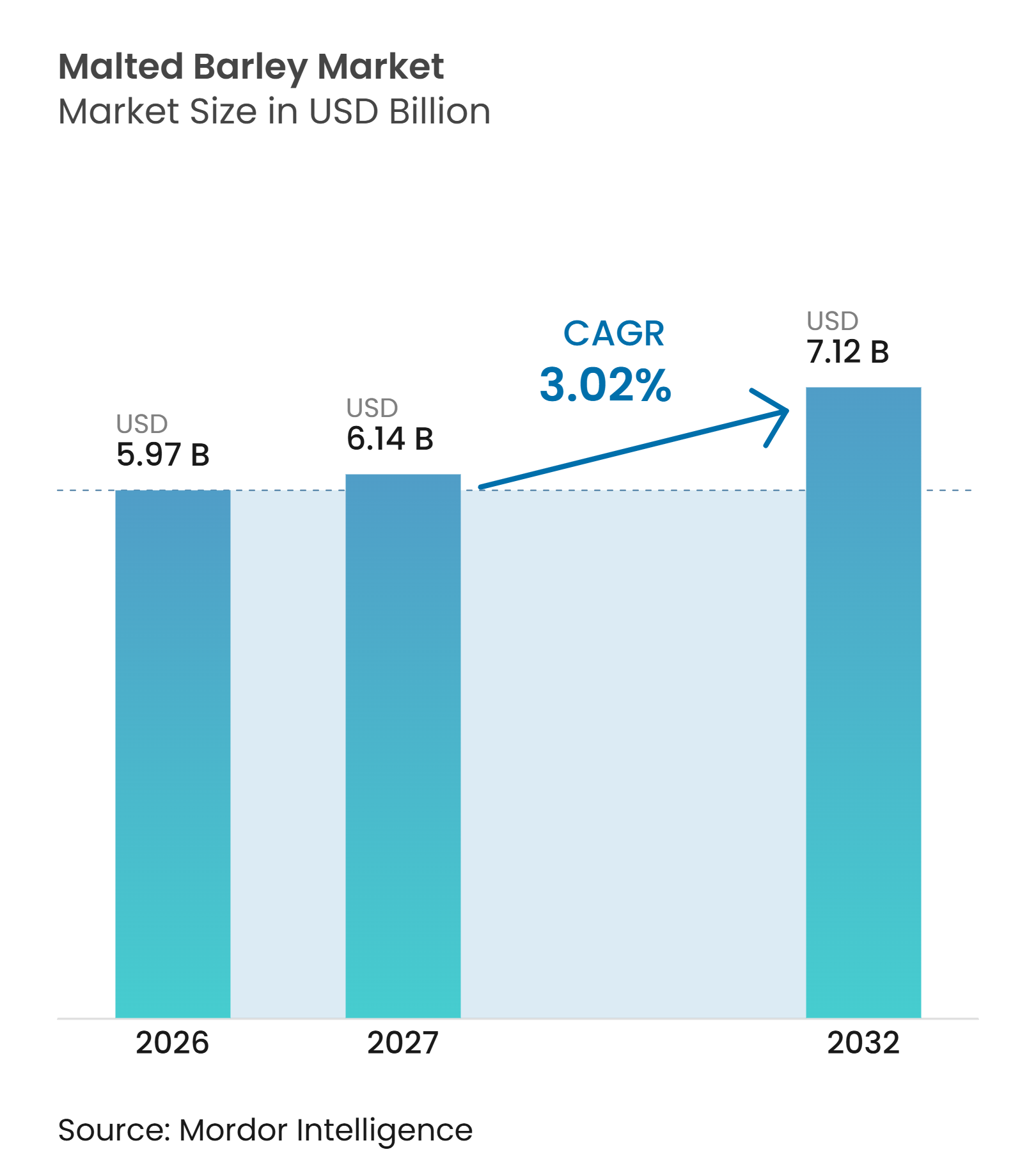
The malted barley market size is expected to grow from USD 5.97 billion in 2026 to USD 6.14 billion in 2027 and is forecast to reach USD 7.12 billion by 2032 at a 3.02% CAGR over 2027-2032. The market is supported by its established role across brewing, distilling, and an expanding range of food and beverage applications. Demand is increasingly shaped by product innovation, evolving consumer preferences, and the growing use of malted barley as a functional ingredient in bakery, confectionery, cereals, and non-alcoholic beverages. Manufacturers are broadening their product portfolios to meet diverse formulation requirements, including specialty malt varieties and ingredients that offer distinctive flavor, color, and functional properties. The growing emphasis on premium beverages, craft brewing, clean-label formulations, and whole-grain ingredients is further expanding opportunities for application. Continuous improvements in processing technologies, product development, and sourcing practices are also supporting market evolution.
Key Report Takeaways
-
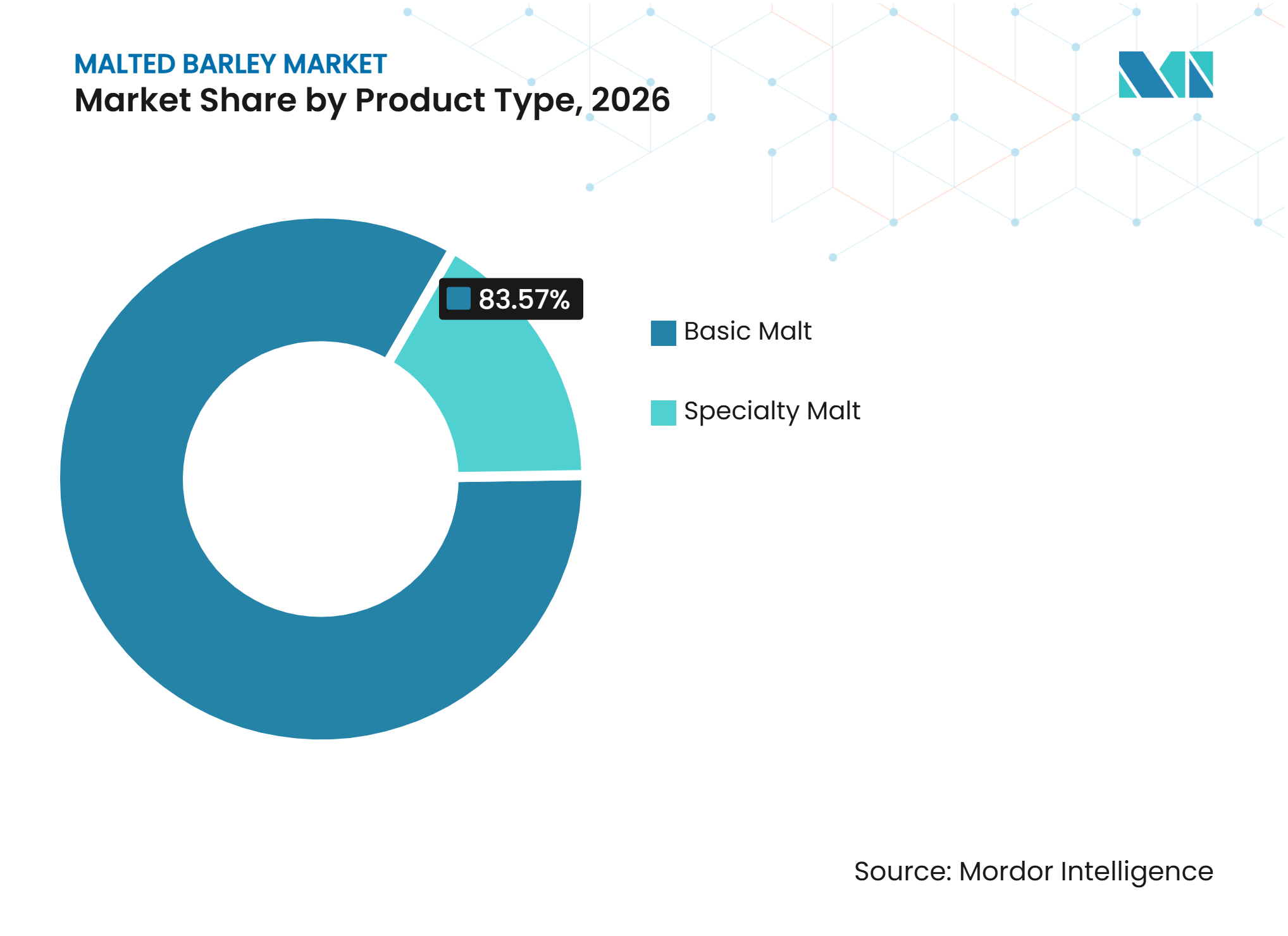
By product type, basic malt held 83.57% of the malted barley market share in 2026, while specialty malt is forecast to grow at a 4.92% CAGR from 2027 to 2032.
-
By form, whole malted barley grain held 49.36% of the malted barley market share in 2026, while malt flour is forecast to grow at a 5.18% CAGR from 2027 to 2032.
-
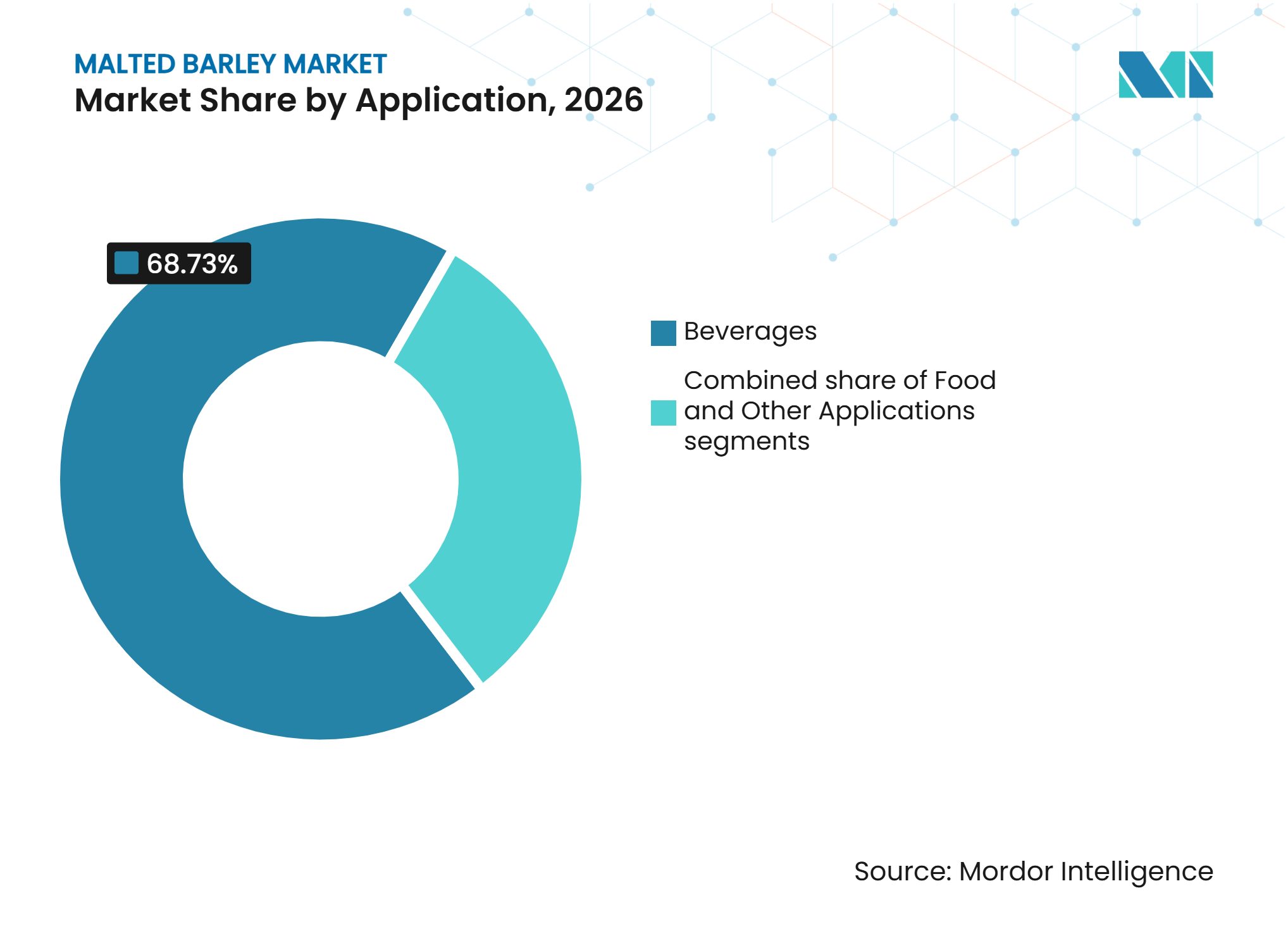
By application, beverages held 68.73% of the malted barley market size in 2026, while food is forecast to grow at a 4.95% CAGR from 2027 to 2032.
-
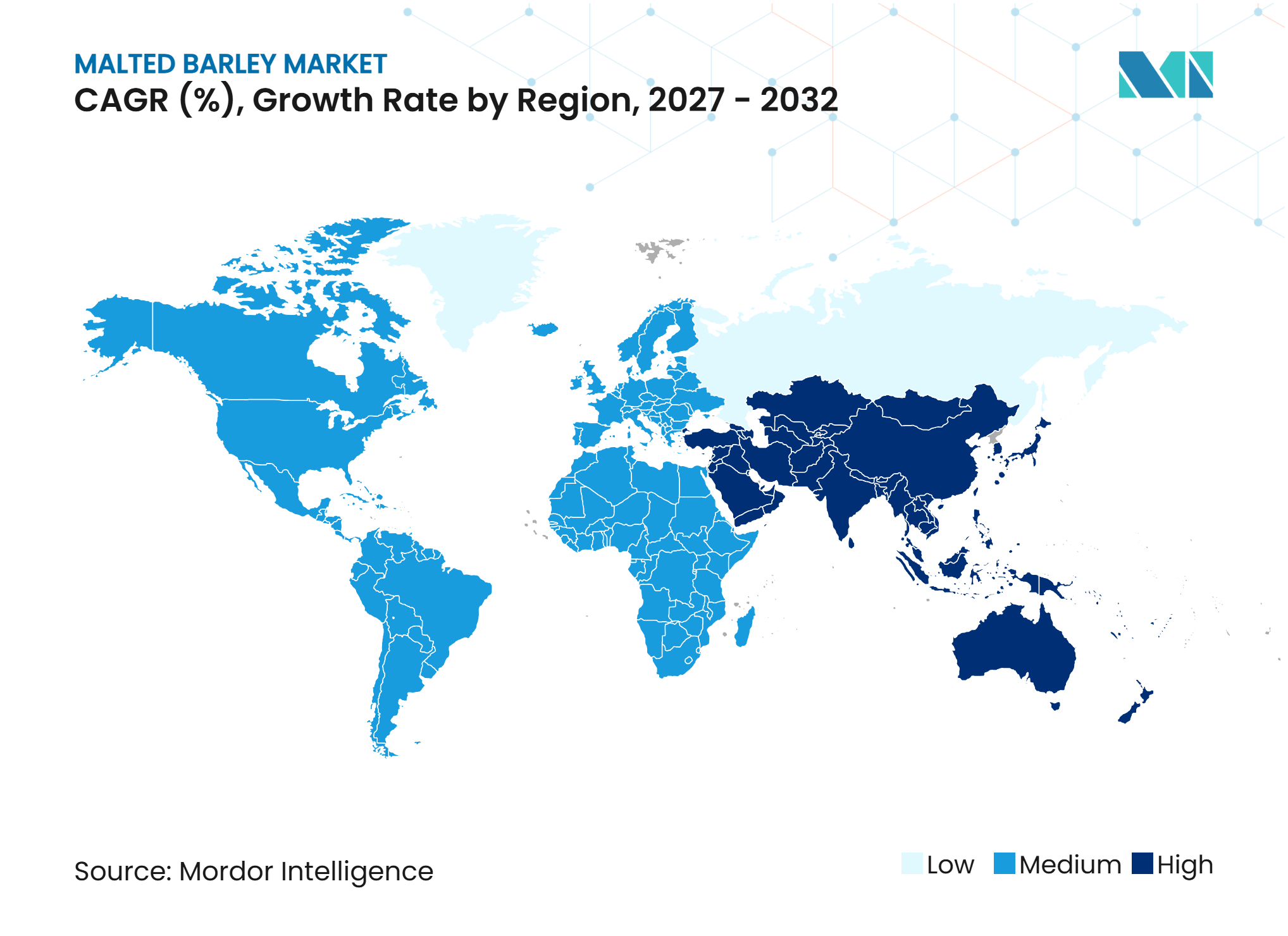
By geography, Europe held a 39.77% share of the malted barley market in 2026, while Asia-Pacific is forecast to grow at a 4.87% CAGR from 2027 to 2032.
Note: Market numbers in this report are based on Mordor Intelligence's proprietary estimation framework, which combines nine months of actuals with Q4 projections for base year 2026.
Market Trends and Insights
Drivers Impact Analysis of Malted Barley Market*
| Driver | (~) % Impact on CAGR Forecast | Geographic Relevance | Impact Timeline |
|---|---|---|---|
| Increasing demand for malted barley in animal feed applications | +0.3% | Global, led by North America and Australia | Medium term (2–4 years) |
| Increasing demand for specialty malts in craft and premium beer production | +0.5% | North America and Europe | Medium term (2–4 years) |
| Growing malt consumption in whisky and malt-based spirits production | +0.3% | Europe, North America | Long term (≥4 years) |
| Rising demand for non-alcoholic malt beverages | +0.5% | Global, particularly the Middle East and Africa, Asia-Pacific, and Europe | Short term (≤2 years) |
| Expanding applications of malt ingredients in bakery and confectionery products | +0.3% | North America, Europe, Asia-Pacific | Medium term (2–4 years) |
| Increasing use of malt ingredients in nutritional and functional food formulations | +0.2% | Asia-Pacific, North America | Long term (≥4 years) |
| Source: Mordor Intelligence | |||
Increasing Demand for Malted Barley in Animal Feed Applications
The growing incorporation of barley into livestock feed formulations is supporting demand for barley-based ingredients across the animal nutrition industry. Its carbohydrate content, energy contribution, and compatibility with different feed formulations make it a useful cereal ingredient for cattle, poultry, and other livestock. According to the United Kingdom Department for Environment, Food and Rural Affairs (DEFRA), barley consumption in animal feed increased by 3.2% in 2025, reflecting its continued use in livestock nutrition[1]. The established role of barley in compound feed production and on-farm feeding practices further supports its utilization by feed manufacturers. This provides an additional source of demand for barley alongside its established industrial applications.
Increasing Demand for Specialty Malts in Craft and Premium Beer Production
The growing emphasis on product differentiation and premiumization in beer production is driving the use of specialty malts, which give brewers greater flexibility to develop distinctive flavor, color, aroma, and body profiles. The Brewers Association reported that craft beer accounted for 13.4% of total beer volume in 2025, underscoring the continued significance of the craft brewing industry [2]. Further reinforcing this, in March 2026, the Brewers Association introduced a dedicated craft malt category at the Great American Beer Festival, requiring participating beers to contain at least 50% malt produced by craft maltsters. The growing recognition of craft malt and the increasing focus on differentiated beer recipes are supporting opportunities for specialty malt varieties, including caramel, roasted, chocolate, and other flavor-enhancing malts.
Growing Malt Consumption in Whisky and Malt-Based Spirits Production
The established use of malted barley as a primary raw material in whisky and malt-based spirits production continues to support demand from distilleries. Its contribution of fermentable sugars and characteristic flavor compounds makes it essential to traditional malt whisky production. According to the Maltsters’ Association of Great Britain (MAGB), 1.12 million metric tons of malt were produced from the 2025 barley crop, of which 52% was allocated to whisky distilling[3]. The substantial allocation of malt to distilling highlights the importance of whisky production as an end-use market for malted barley and supports continued procurement by malt manufacturers and distilleries.
Rising Demand for Non-Alcoholic Malt Beverages
The growing consumer preference for alcohol-free beverages is driving additional demand for malt-based drinks. Non-alcoholic malt beverages are gaining popularity as consumers seek refreshing drinks with distinctive flavors and nutritional benefits without alcohol. Malt provides a characteristic taste, body, and natural sweetness, making it a versatile ingredient in the formulation of these beverages. Manufacturers are expanding their product offerings through flavor variations, improved formulations, and convenient packaging to cater to diverse consumer preferences. The increasing availability of malt-based soft drinks and other non-alcoholic alternatives across retail and foodservice channels is further supporting market demand.
Restraints Impact Analysis of Malted Barley Market*
| Restraint | (~) % Impact on CAGR Forecast | Geographic Relevance | Impact Timeline |
|---|---|---|---|
| Climate-related fluctuations in barley yields and malting-grade quality | -0.4% | Global, particularly Europe and North America | Short to medium term (≤4 years) |
| Limited availability of malting-grade barley varieties | -0.2% | Asia-Pacific, South America, Middle East and Africa | Long term (≥4 years) |
| Rising energy, water, and environmental compliance costs for malt producers | -0.3% | Europe | Medium term (2–4 years) |
| High capital and operating costs associated with malting infrastructure | -0.2% | Global | Long term (≥4 years) |
| Source: Mordor Intelligence | |||
Climate-Related Fluctuations in Barley Yields and Malting-Grade Quality
Climate variability poses a challenge to malted barley production by influencing crop yields, grain development, and the quality characteristics required for malting. Changes in temperature and rainfall patterns, prolonged dry periods, and excessive precipitation can affect barley cultivation and harvesting conditions. These variations may alter grain size, protein content, germination capacity, and other parameters that determine suitability for malting. Inconsistent raw material quality can increase sorting, testing, and processing requirements for malt manufacturers while affecting production planning. Consequently, greater variability in barley-growing conditions can influence the availability and consistency of malting-grade raw materials, creating uncertainty across the malt production supply chain.
Limited Availability of Malting-Grade Barley Varieties
The availability of suitable malting-grade barley varieties is constrained by specific quality and performance requirements that distinguish them from conventional barley used for other purposes. Malt production requires barley with consistent grain size, appropriate protein content, high germination capacity, and uniform moisture characteristics to ensure reliable processing outcomes. Meeting these requirements depends on the availability of suitable cultivars, access to quality-certified seeds, and consistency in agricultural practices. Differences in varietal performance and growing conditions can further influence the suitability of harvested barley for malting applications. Consequently, limited access to barley varieties that consistently meet malting specifications can restrict flexibility in raw material sourcing and create procurement challenges for malt manufacturers.
*Our forecasts treat driver/restraint impacts as directional, not additive. The impact forecasts reflect baseline growth, mix effects, and variable interactions.
Malted Barley Market Segment Analysis
By Product Type:
Specialty Malt Gains Share as Malt Innovation AcceleratesBasic malt accounted for 83.57% of the malted barley market in 2026, supported by its extensive use across conventional brewing, distilling, and industrial food applications. Its dominant position reflects its importance as a core raw material in large-scale malt production, particularly where standardized ingredient characteristics and consistent supply are required. Established processing practices and broad applicability across end-use industries further reinforce demand for basic malt. Its widespread adoption among industrial manufacturers continues to sustain its leading market position.
Specialty malt is projected to register the fastest growth, expanding at a CAGR of 4.92% during 2027–2032, driven by increasing demand for differentiated malt characteristics and greater formulation flexibility. Its ability to provide distinct flavor, color, aroma, and functional properties is supporting its adoption across a wider range of applications. Product innovation and the development of diverse malt varieties are further broadening its commercial applications. Growing interest in customized ingredient specifications and differentiated product formulations is expected to support demand for specialty malt throughout the forecast period.


By Form:
Malt Flour Outpaces Traditional Formats in Food UseWhole malted barley grain accounted for 49.36% of the form segment in 2026, supported by its established use across conventional brewing and distilling processes. Its widespread adoption reflects its suitability for traditional malt processing and established industrial requirements. The format continues to serve as a primary raw material for manufacturers, supported by established practices for handling, storage, and processing. Its broad applicability across conventional end uses reinforces its leading position within the market.
Malt flour is projected to register the fastest growth, expanding at a CAGR of 5.18% during 2027–2032, driven by its increasing utilization across diverse food formulations. Its fine texture, characteristic malt flavor, and functional properties make it suitable for incorporation into various processed food products. Growing interest in versatile ingredients that contribute flavor, color, and texture is supporting their adoption among food manufacturers. Product innovation and the development of specialized malt flour varieties are further expanding its potential applications, supporting its growth throughout the forecast period.
By Application:
Beverages Lead While Food Drives Structural GrowthBeverages accounted for 68.73% of the malted barley market in 2026, supported by the established use of malted barley across beer, whisky, spirits, and non-alcoholic malt beverage production. Its leading position reflects the importance of malt as a core ingredient in beverage manufacturing, contributing fermentable sugars, flavor, color, and body. Established production processes and consistent industrial requirements across beverage applications continue to sustain demand. The broad use of malted barley across traditional and emerging beverage formulations further reinforces the segment's dominant position.
Food is projected to register the fastest growth, expanding at a CAGR of 4.95% during 2027–2032, driven by its increasing incorporation into bakery, confectionery, cereals, and other processed food products. Malted barley ingredients provide distinctive flavor, color, texture, and functional properties, making them suitable for diverse food formulations. Growing interest in versatile ingredients and clean-label product development is further supporting their adoption among food manufacturers. Continued product innovation and the development of malt-based ingredients for specialized food applications are expected to create additional growth opportunities throughout the forecast period.


Geography Analysis
Europe
Europe accounted for the largest share of the malted barley market in 2026, representing 39.77% of global demand, supported by its established malting industry and extensive brewing and distilling infrastructure. The region has a well-developed production base, with major malting operations serving both domestic beverage manufacturers and international customers. Strong integration between barley cultivation, malt processing, and downstream beverage production further supports its market position. Established supply chains, specialized production capabilities, and continued investments in malting infrastructure reinforce Europe's importance in the global malted barley industry. The region also benefits from a long-standing presence of malt manufacturers and established procurement relationships across the food and beverage industries.
Asia-Pacific
Asia-Pacific is projected to grow at a CAGR of 4.87% during 2027-2032, driven by increasing beverage consumption, expanding food processing industries, and growing demand for malt-based products. The development of the brewing industry and rising investments in beverage manufacturing are driving growth in the region's malt consumption. Countries such as India, China, Vietnam, Thailand, and the Philippines contribute to regional demand through their expanding food and beverage industries. The growing availability of malt-based beverages and increasing use of malt ingredients in processed food formulations are further supporting market expansion. Continued development of regional manufacturing capabilities and downstream applications is expected to strengthen Asia-Pacific's position as an important growth market.
North America, South America, and Middle East and Africa
North America, South America, and the Middle East and Africa represent emerging demand centers with distinct consumption and production characteristics. North America benefits from established brewing and distilling industries, alongside growing interest in locally sourced and specialty malt products. South America, particularly Argentina, has an established barley cultivation and malting base that supports regional beverage manufacturing and international supply. Meanwhile, the Middle East and Africa offer opportunities through the growing presence of non-alcoholic malt beverages and expanding food and beverage processing industries. Increased investment in regional production capabilities, broader product availability, and the development of downstream applications are expected to support these regions' contribution to the malted barley market.
Competitive Landscape
Market Concentration
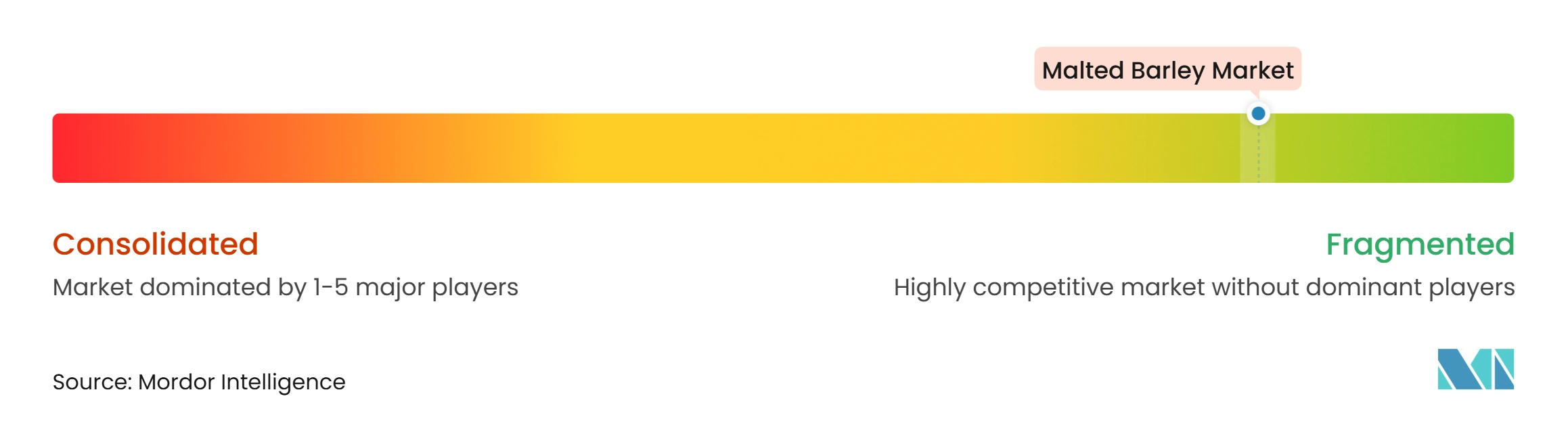
The malted barley market is highly fragmented, with numerous multinational maltsters, regional producers, and independent specialty malt manufacturers. The competitive landscape includes established players such as Boortmalt, Malteurop, Soufflet Malt, Viking Malt, and Rahr Malting Co., which maintain significant positions in the industry through their production capabilities, established customer relationships, and broad product portfolios. Competition is shaped by production scale, raw material sourcing capabilities, product quality, distribution networks, and the ability to serve diverse industrial requirements. The presence of regional and independent maltsters further contributes to the market's fragmented structure.
Leading players are focusing on strengthening their production capabilities, improving operational efficiency, and expanding their product offerings to address evolving customer requirements. Investments in manufacturing infrastructure, processing technologies, quality control, and supply chain optimization are supporting their competitive positioning. Companies are also broadening their specialty malt portfolios and developing value-added malt ingredients to serve a wider range of applications across the food and beverage industries. In addition, greater emphasis on resource efficiency, sustainable production practices, and product innovation is influencing competitive strategies and long-term customer relationships.
Emerging and smaller-scale malt manufacturers are creating additional competition through specialized product portfolios, regional sourcing capabilities, and differentiated production approaches. Several independent producers are focusing on craft and specialty malts, offering distinct flavor profiles and processing characteristics to meet specific customer requirements. Others are exploring opportunities in food-grade malt ingredients and value-added applications, broadening the market beyond conventional brewing and distilling requirements. Their ability to offer customized products, maintain closer relationships with regional customers, and respond to specialized formulation needs is contributing to greater product diversity and competitive activity across the market.
Malted Barley Industry Leaders
-
Boortmalt
-
Malteurop
-
Soufflet Malt
-
Viking Malt
-
Rahr Malting Co.
- *Disclaimer: Major Players sorted in no particular order
Malted Barley Market Companies Covered in this Report
- Boortmalt
- Malteurop
- Soufflet Malt
- Viking Malt
- Mouterij Dingemans
- Rahr Malting Co.
- IREKS GmbH
- Maltexco S.A.
- Barmalt Malting Private Limited
- Palatia Malz
- Muntons plc
- Simpsons Malt Ltd.
- Crisp Malt
- Weyermann Malz
- Briess Malt & Ingredients Co.
- The Swaen Malts
- Malting Company of Ireland Ltd.
- Thomas Fawcett & Sons Ltd.
- COFCO
- Imperial Malts Limited
Recent Industry Developments in Malted Barley Market
- November 2026: Muntons launched Ultra Heavily Peated Malt for distillers. Muntons launched Ultra Heavily Peated Malt to expand its specialty malt portfolio for distilling applications. The product featured phenol levels of at least 90 parts per million (ppm), catering to distillers seeking stronger smoky characteristics in malt-based spirits. The launch strengthened the company's offering of specialty malts for whisky production.
- October 2026: Malteurop acquired and inaugurated the Chunlei malting plant in China. Malteurop acquired an 80% stake in Sheyang Chunlei Malt Co. and officially inaugurated the malting facility near Yancheng, Jiangsu province. The plant had an annual production capacity of 220,000 metric tons of malt. The acquisition expanded Malteurop's production capabilities in China and strengthened its industrial and logistical presence in the Asian market and export markets.
- February 2026: Soufflet Malt partnered with United Breweries to establish a new malthouse in India. Soufflet Malt partnered with United Breweries Limited to develop a new malthouse in South Rajasthan, India. The planned facility had an initial annual malt production capacity of 110,000 metric tons, with provisions for further expansion. The project was intended to supply malt for brewing brands such as Kingfisher and Heineken while supporting local barley sourcing and strengthening India's domestic malting capacity.
Global Malted Barley Market Report Scope
Malted barley refers to barley grains that undergo a controlled germination and drying process to develop the enzymatic, flavor, and functional properties required for various industrial applications. It is primarily used as a raw material in beverage production and as an ingredient in food and other applications. The market is segmented by product type into basic malt and specialty malt; by form into whole malted barley grain, crushed or ground malt, malt flour, and others; by application into beverages, food, and other applications; and by geography into North America, Europe, Asia-Pacific, South America, and the Middle East and Africa. The market forecasts are provided in USD.
Segmentation Overview
| Basic Malt | |
| Specialty Malt | Covers segments like: Caramel/crystal malt, organic malt, etc. |
| Whole Malted Barley Grain |
| Crushed/Ground Malt |
| Malt Flour |
| Others |
| Beverages | Alcoholic Beverages | Beer |
| Spirits | ||
| Non-Alcoholic Beverages | ||
| Food | Bakery | |
| Confectionery | ||
| Cereals | ||
| Other Food Products | ||
| Other Applications |
| North America | United States |
| Canada | |
| Mexico | |
| Rest of North America | |
| Europe | Germany |
| United Kingdom | |
| Italy | |
| France | |
| Spain | |
| Netherlands | |
| Poland | |
| Belgium | |
| Sweden | |
| Rest of Europe | |
| Asia-Pacific | China |
| India | |
| Japan | |
| Australia | |
| Indonesia | |
| South Korea | |
| Thailand | |
| Singapore | |
| Rest of Asia-Pacific | |
| South America | Brazil |
| Argentina | |
| Colombia | |
| Chile | |
| Peru | |
| Rest of South America | |
| Middle East and Africa | South Africa |
| Saudi Arabia | |
| United Arab Emirates | |
| Nigeria | |
| Egypt | |
| Morocco | |
| Turkey | |
| Rest of Middle East and Africa |
| By Product Type | Basic Malt | ||
| Specialty Malt | Covers segments like: Caramel/crystal malt, organic malt, etc. | ||
| By Form | Whole Malted Barley Grain | ||
| Crushed/Ground Malt | |||
| Malt Flour | |||
| Others | |||
| By Application | Beverages | Alcoholic Beverages | Beer |
| Spirits | |||
| Non-Alcoholic Beverages | |||
| Food | Bakery | ||
| Confectionery | |||
| Cereals | |||
| Other Food Products | |||
| Other Applications | |||
| By Geography | North America | United States | |
| Canada | |||
| Mexico | |||
| Rest of North America | |||
| Europe | Germany | ||
| United Kingdom | |||
| Italy | |||
| France | |||
| Spain | |||
| Netherlands | |||
| Poland | |||
| Belgium | |||
| Sweden | |||
| Rest of Europe | |||
| Asia-Pacific | China | ||
| India | |||
| Japan | |||
| Australia | |||
| Indonesia | |||
| South Korea | |||
| Thailand | |||
| Singapore | |||
| Rest of Asia-Pacific | |||
| South America | Brazil | ||
| Argentina | |||
| Colombia | |||
| Chile | |||
| Peru | |||
| Rest of South America | |||
| Middle East and Africa | South Africa | ||
| Saudi Arabia | |||
| United Arab Emirates | |||
| Nigeria | |||
| Egypt | |||
| Morocco | |||
| Turkey | |||
| Rest of Middle East and Africa | |||
Key Questions Answered in the Report
What is the projected size of the malted barley sector by 2032?
The sector is projected to reach USD 7.12 billion by 2032, compared with USD 5.97 billion in 2026.
Which product type holds the largest share of malted barley demand?
Basic malt leads product demand with an 83.57% share in 2026.
Which malted barley form is growing fastest?
Malt flour is the fastest-growing form, with a forecast CAGR of 5.18% from 2027 to 2032.
Which region is forecast to grow fastest?
Asia-Pacific is forecast to grow at a 4.87% CAGR from 2027 to 2032.