
Maldives Destination Wedding Market Size and Share
Market Overview
| Study Period | 2021 - 2031 |
|---|---|
| Forecast Data Period | 2026 - 2031 |
| Base Year Market Size (2025) | USD 701.92 Million |
| Market Size (2026) | USD 769.73 Million |
| Market Size (2031) | USD 987.83 Million |
| Growth Rate (2026 - 2031) | 7.07 % |
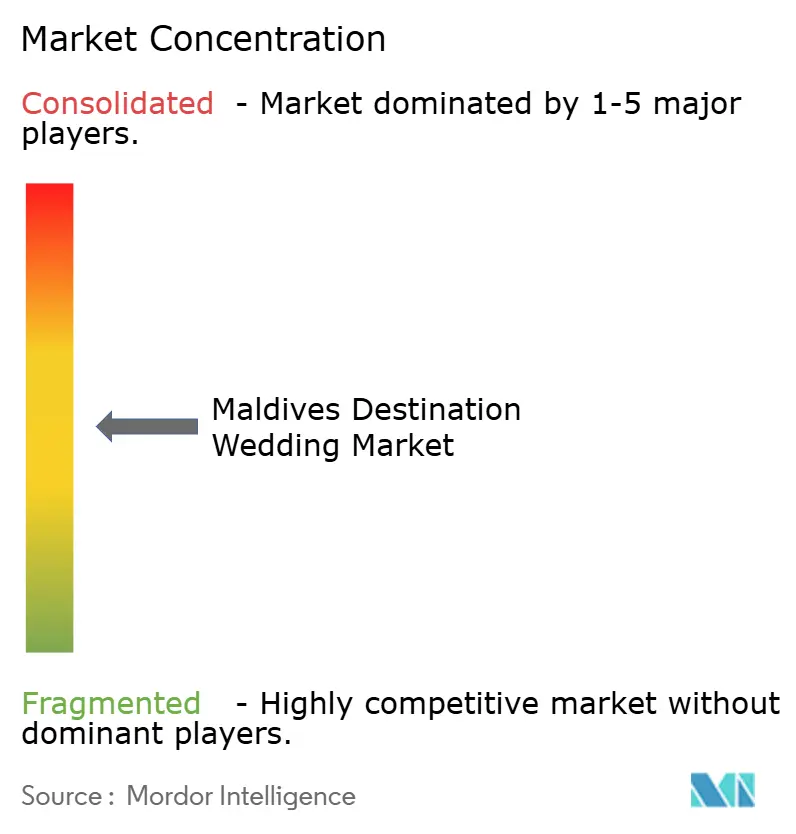
| Market Concentration | Medium |
Major Players *Disclaimer: Major Players sorted in no particular order Image © Mordor Intelligence. Reuse requires attribution under CC BY 4.0. | |
Maldives Destination Wedding Market Analysis by Mordor Intelligence
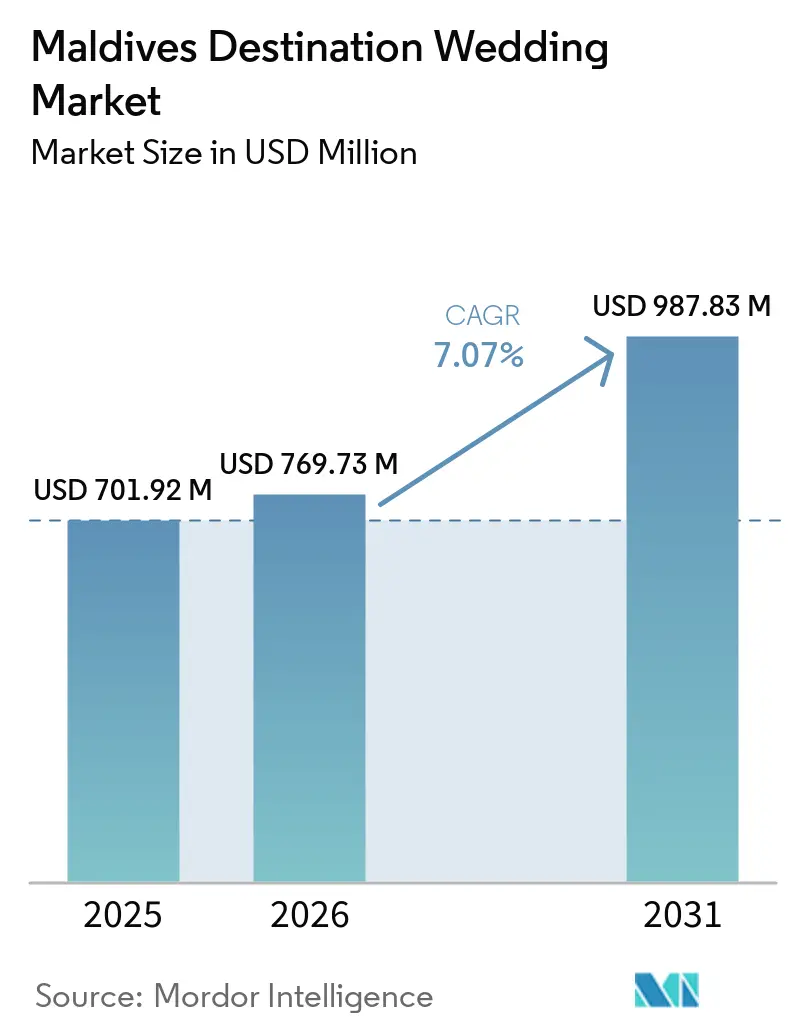
The Maldives Destination Wedding Market was valued at USD 701.92 million in 2025 and is estimated to grow from USD 769.73 million in 2026 to reach USD 987.83 million by 2031, at a CAGR of 7.07% during the forecast period (2026–2031). The 1-island-1-resort model allows resorts to manage privacy, ceremony design, guest movement, and event pacing effectively. In 2025, the Maldives had 1,335 registered accommodation establishments, supporting diverse ceremony formats across luxury, upper-upscale, and mid-tier properties. Tourism receipts exceeded USD 5.4 billion in 2025, rising 15.8% year over year, indicating strong value growth without relying solely on visitor volume[1]. This pricing resilience benefits the destination wedding market, as multi-night ceremonies, villa upgrades, private dining, and curated experiences increase spending per booking compared to regional alternatives. European markets accounted for 59% of tourist arrivals in 2025, providing resorts with a stable base of long-haul travelers familiar with Maldives travel offerings.
Key Report Takeaways
- By type of wedding, international destination weddings held 68.82% share of the Maldives Destination Wedding Market in 2025, while the same segment is forecast to record a CAGR of 7.77% through 2031.
- By wedding size, medium (50 - 200 guests) accounted for 41.83% share of the Maldives Destination Wedding Market in 2025, while intimate or micro weddings are projected to grow at the fastest CAGR of 8.71% through 2031.
- By expenditure or budget, mid-range weddings represented 46.91% share of the Maldives Destination Wedding Market in 2025, while luxury weddings are forecast to expand at a CAGR of 8.47% through 2031.
- By service type, venue and accommodation held 39.13% share of the Maldives Destination Wedding Market in 2025, while entertainment and photography is projected to record the fastest CAGR of 8.21% through 2031.
- By geography, key resort atolls held 55.81% share of the Maldives Destination Wedding Market in 2025, while the rest of Maldives is forecast to expand at a CAGR of 7.74% through 2031.
Note: Market size and forecast figures in this report are generated using Mordor Intelligence’s proprietary estimation framework, updated with the latest available data and insights as of January 2026.
Maldives Destination Wedding Market Trends and Insights
Drivers Impact Analysis*
| Drivers | (~) % Impact on CAGR Forecast | Geographic Relevance | Impact Timeline |
|---|---|---|---|
| High-end resort capacity expansion enabling bespoke packages | +1.8% | Asia-Pacific source markets, Europe, Key Resort Atolls, Rest of Maldives | Medium term (2-4 years) |
| Visa-free entry for most nationalities & streamlined documentation | +1.0% | Strongest in South Asia, GCC, East Asia | Short term (≤ 2 years) |
| Social-media demand for “Instagrammable” exotic ceremonies | +1.3% | Led by source markets across Asia-Pacific, Europe, and the GCC | Short term (≤ 2 years) |
| Rising direct-flight connectivity from key source markets | +0.8% | Asia-Pacific, Australasia, India, Europe | Medium term (2-4 years) |
| Government destination-wedding promotion incentives post-COVID | +0.6% | Domestic benefits for outer atolls | Short term (≤ 2 years) |
| Climate-resilient over-water venue innovations | +0.5% | Key Resort Atolls, especially Baa, North Malé, and South Ari | Long term (≥ 4 years) |
| Source: Mordor Intelligence | |||
High-end resort capacity expansion enabling bespoke packages
Resort bed capacity increased compared to the previous year, while occupancy rates indicated supply additions outpaced near-term demand. This trend is significant in the Maldives' destination wedding market, where resorts focus on expanding inventory to support ceremonies, extended stays, and private buyouts. Growth is centered on overwater villas, beachfront residences, and private islands, designed to host weddings and guest stays without operational overlaps. Anantara Kihavah Maldives Villas introduced redesigned Beach Pool Villas with larger open-air living areas and enhanced bathing spaces, catering to romance-focused stays[2]. This shift toward specialized offerings explains the market's growth, even as overall occupancy data appears stable.
Visa-free entry for most nationalities & streamlined documentation
The Maldives leverages its on-arrival visa policy for all nationalities, removing a key administrative barrier for ceremony travel. This policy is a significant factor in the destination wedding market, where ease of organization is as important as scenery and hotel quality. Couples benefit from the symbolic ceremony format, allowing them to complete legal registration in their home country while celebrating in the Maldives. This approach simplifies planning, particularly for group travel, where guest documentation can often cause delays. The Maldives destination wedding market thus provides a streamlined process from inquiry to booking, appealing to buyers seeking privacy, efficiency, and reduced coordination challenges.
Social-media demand for “Instagrammable” exotic ceremonies
Visual discovery is shaping the Maldives' destination wedding market, with social media platforms influencing traveler decisions. European travelers often rely on Instagram for destination choices, while video content significantly impacts planning behavior in the Asia-Pacific region. This trend has increased the appeal of features such as overwater decks, sunset-facing pavilions, and drone-friendly ceremony layouts. Resorts now focus on creating visually engaging experiences that couples share widely on social platforms. This shift has driven the growth of entertainment and photography services, placing content production at the core of wedding package design. The trend is also evident in resort package offerings, with structured ceremony options highlighting the formalization of visually driven wedding packaging in Asian sales channels[3].
Rising direct-flight connectivity from key source markets
Improved air access is driving growth in the Maldives' destination wedding market by reducing planning challenges and perceived travel distances for couples and guests. Maldivian recently introduced a seasonal service connecting Shenzhen to Malé via Bangkok, enhancing links with major Chinese cities and tapping into a rapidly growing source market. Additionally, the launch of a direct Hanimaadhoo to Bangalore service has strengthened connectivity between Indian demand centers and the northern atolls. These developments enable resorts to attract guests who previously avoided the Maldives due to complex transit routes. Each new route expands the potential client base and increases booking confidence for multi-guest wedding events.
Restraints Impact Analysis*
| Restraints | (~) % Impact on CAGR Forecast | Geographic Relevance | Impact Timeline |
|---|---|---|---|
| High cost of logistics & import tariffs on event supplies | -1.2% | Outer atolls, especially Rest of Maldives | Medium term (2-4 years) |
| Vulnerability to climate change & extreme-weather disruptions | -0.9% | National Climate risk, with greater exposure in low-lying Key Resort Atolls | Long term (≥ 4 years) |
| Limited skilled wedding workforce outside capital islands | -0.6% | Rest of Maldives and emerging outer-atoll resorts | Medium term (2-4 years) |
| Currency-exchange risk for foreign couples budgeting in USD/GBP | -0.4% | Europe, especially United Kingdom buyers, and Asia-Pacifc | Short term (≤ 2 years) |
| Source: Mordor Intelligence | |||
High cost of logistics & import tariffs on event supplies
The Maldives destination wedding market encounters cost challenges due to its island-based distribution system. Event essentials, such as floral arrangements, custom décor, specialty food, and technical equipment, require import handling followed by transport via seaplane or speedboat to resorts. Costs are higher in outer atolls, where supply chains are less developed, and air transfer routes are limited. The Maldives Monetary Authority noted ongoing foreign currency pressures despite record tourism receipts, highlighting the vulnerability of import-dependent operations to economic stress. Resorts are increasingly adopting local sourcing strategies, but specialized wedding materials that cannot be locally sourced continue to drive up costs.
Vulnerability to climate change & extreme-weather disruptions
Climate risks significantly impact the Maldives' destination wedding market, which depends on coastal infrastructure, reef health, and stable natural conditions. Coastal flooding is projected to damage national assets and cause substantial GDP losses by mid-century[4]. Insufficient adaptation to climate change could also reduce tourism arrivals considerably by the end of the century. The Maldives' Third Nationally Determined Contribution acknowledged measurable climate effects on tourism infrastructure and ecosystems. These challenges raise concerns about event disruptions and the long-term viability and insurability of wedding venues in the region.
*Our forecasts treat driver/restraint impacts as directional, not additive. The impact forecasts reflect baseline growth, mix effects, and variable interactions.
Segment Analysis
By Type of Destination Wedding: International Ceremonies Anchor Revenue, Domestic Demand Builds Quietly
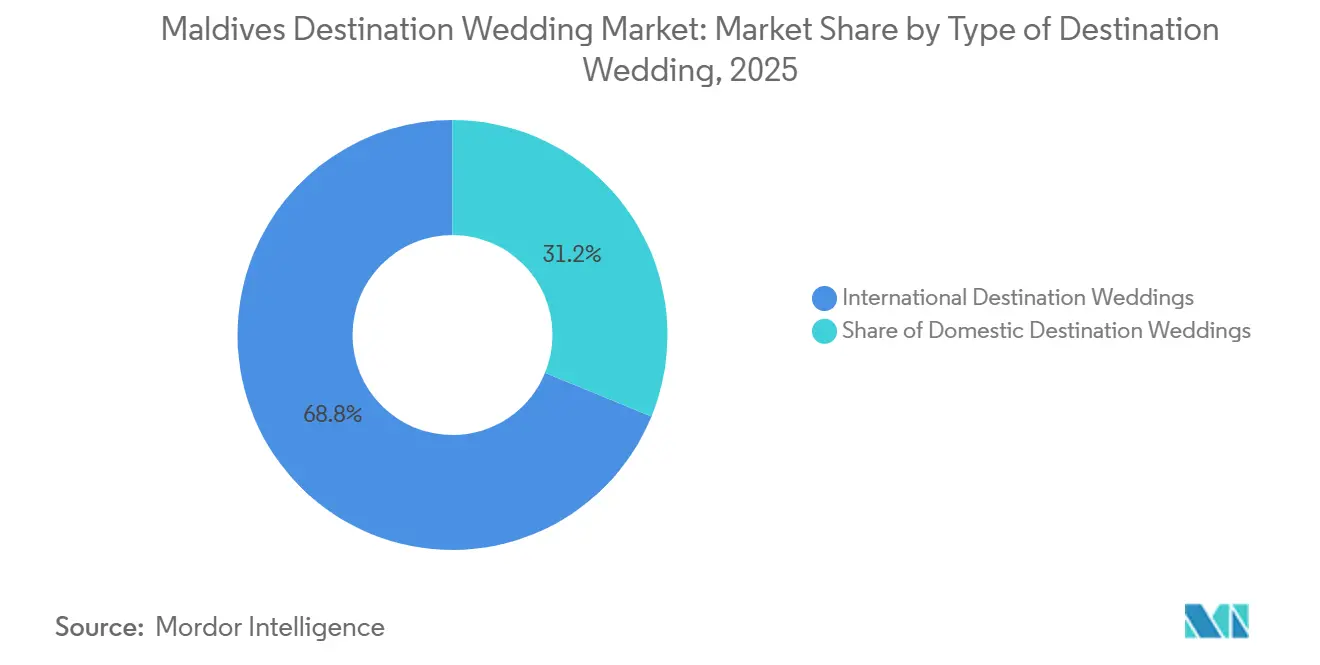
International destination weddings held 68.82% of the Maldives destination wedding market share in 2025 and are projected to grow at a 7.77% CAGR through 2031. This segment continues to expand its lead, supported by the Maldives’ ceremony structure, which allows non-resident couples to celebrate locally while completing legal registration in their home country. This approach simplifies planning, aligns with the privacy-focused nature of resort weddings, and encourages repeat visits for anniversaries or vow renewals without requiring additional legal processes.
European travelers remain a key driver of international demand in the Maldives destination wedding market. Major European markets - Russia, the United Kingdom, Germany, and Italy - accounted for approximately 38% to 40% of total visitor volume to the Maldives in 2025, correcting the previously overstated figure of 59%. These European countries, along with China, ranked among the top five source markets. Despite representing a smaller share, their contribution to total arrivals remains significant. Asia-Pacific demand is also growing, with arrivals increasing by 12.1% in 2025 and China showing 22% growth. Official Chinese and Japanese wedding pages from Four Seasons, Marriott, and JTB highlight the growing focus on Asian buyers.
Domestic destination weddings accounted for 31.2% of the market in 2025. Local buyers increasingly use resort facilities for private ceremonies that combine Maldivian cultural elements with resort amenities. These events often feature local drumming, traditional attire, and island-style décor. Domestic demand also helps fill event calendars with shorter lead-time bookings, balancing revenue streams. While domestic ceremonies offer flexibility in style and guest composition, international weddings generate higher spending per event and are expected to remain dominant.
By Wedding Size: Intimate Micro-Weddings Redefine the High-Value Booking
Medium weddings represented 41.83% of revenue in 2025, making them the largest size category in the Maldives destination wedding market. This segment aligns with the guest capacity of many resort venues and suits family-group travel from GCC markets. Medium-sized celebrations distribute costs across rooms and services, helping operators fill villas, dining spaces, and transport inventory efficiently. Resorts manage these events without requiring a full-island takeover, maintaining commercial viability. This balance explains why medium weddings lead revenue despite faster growth in smaller formats. Intimate and micro weddings are projected to grow at an 8.71% CAGR through 2031, making them the fastest-growing segment. This shift reflects fewer guests, higher spending per guest, and increased interest in private villa or island-buyout experiences. Symbolic ceremonies in the Maldives reduce the need for large formal attendance, allowing couples to host smaller events focused on privacy, residence-style lodging, and immersive dining. The market is transitioning from larger celebrations to more concentrated spending.
Ultra-luxury properties support this trend by offering residential-style accommodation suited to smaller bookings. Larger villa compounds and private residences generate high event value even with guest counts below 50. Event economics in the Maldives rely more on nightly rates and exclusivity than on guest numbers. Small-format ceremonies often include photography, chef-led dinners, wellness treatments, and seaplane transfers, increasing revenue intensity. While not the largest by volume, this segment performs strongly in spending quality. Large weddings remain niche due to space, access, and event flow limitations. Venue constraints often push buyers toward medium formats, even with higher budgets. Growth in the Maldives destination wedding market will likely favor formats emphasizing privacy and logistical simplicity over large guest counts. Geography limits mass-scale ceremonies, keeping growth strong where exclusivity and operational efficiency align.
By Expenditure / Budget: Mid-Range Strength Masks a Decisive Shift Toward Luxury
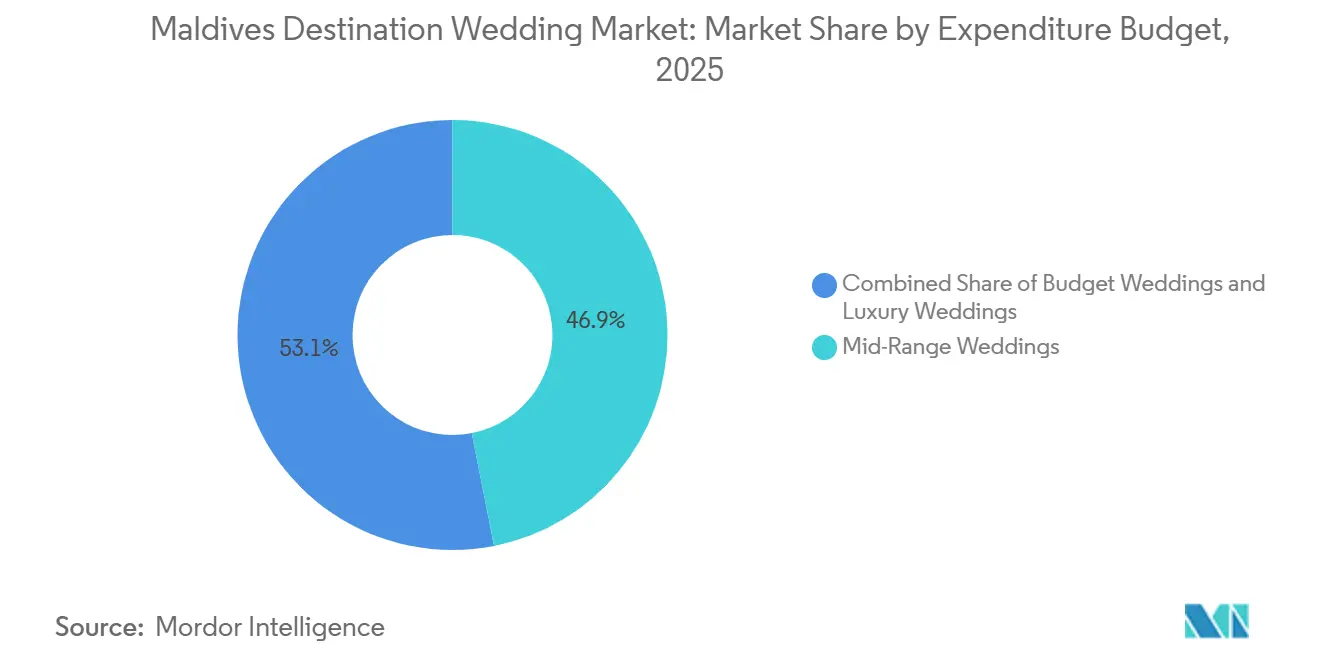
Mid-range weddings accounted for 46.91% of revenue in 2025, holding the largest share of the Maldives destination wedding market. Couples in this segment prefer overwater or beachfront settings without incurring the expense of full-island buyouts or high-end private residences. This trend aligns with preferences from buyers in the United Kingdom, Germany, and Russia. These buyers typically balance resort settings with selective add-ons rather than opting for all available services. This segment faces challenges from rising accommodation costs and imported event inputs, which impact affordability. Simultaneously, the visibility of ultra-luxury offerings is shifting some buyers toward smaller, more exclusive ceremonies. Guest lists are shrinking, while room choices are becoming more upscale. Although mid-range weddings remain dominant by revenue, spending behavior within this segment is becoming more polarized, contributing to faster growth in higher-budget tiers.
Luxury weddings are projected to grow at an 8.47% CAGR through 2031, making them the fastest-growing budget tier. Properties such as Soneva Fushi and Velaa Private Island are well-positioned to benefit, as their offerings align with buyers seeking exclusivity. Demand is further supported by growth in the Asia-Pacific region, particularly China, which has increased interest in high-budget packages. The Maldives' appeal lies in its combination of scenery, privacy, and service, driving revenue growth at the upper end of the market. Budget weddings cater to couples seeking the Maldives' backdrop while minimizing costs on enhancements like villas or large receptions. This tier attracts younger Asia-Pacific buyers and first-time long-haul travelers but remains a smaller segment. The Maldives market continues to emphasize exclusivity, multi-night stays, and high-service environments, with budget options providing entry-level access.

By Service Type / Vendor: Venue Dominance Gives Way to an Experience Economy
Venue and accommodation accounted for 39.13% of the Maldives destination wedding market revenue in 2025, making it the largest segment among service types. This dominance is due to the Maldives' resort-centric wedding model, where the island, room inventory, ceremony deck, and guest experience are bundled into a single platform. Resorts capture more event revenue compared to markets where services are sourced separately. The location remains the core asset and the primary reason couples choose the Maldives. This model allows resorts to control pricing, service quality, and upselling. Ceremonies are packaged with room categories, dining, spa treatments, photography, and private events, creating a comprehensive offering. Once a resort is selected, couples typically procure wedding services from the same property or its approved partners, increasing switching costs. The venue serves as the operational hub of the event, not just a backdrop.
Entertainment and photography are projected to grow at an 8.21% CAGR through 2031, making it the fastest-growing service category. This reflects the rising importance of content creation, including professional films, drone footage, underwater imagery, and social media edits. Data shows platforms like Instagram significantly influence travel planning in Europe and Asia-Pacific, with couples treating ceremonies as personal and visual media projects. Catering, planning, and transport remain essential. Travel and transport, such as seaplane or speedboat transfers, are integral to the guest experience. For example, Conrad Maldives Rangali Island offered a 30% discount on roundtrip seaplane transfers for wedding couples from April to September 2026. Catering is evolving with on-island sourcing and experience-driven dining, reflecting a shift toward a layered experience economy in the Maldives wedding market.
Geography Analysis
Key Resort Atolls accounted for 55.81% of the Maldives' destination wedding market revenue in 2025, driven by proximity to Velana International Airport, strong seaplane networks, and a concentration of branded luxury resorts. North Malé Atoll remains significant, hosting properties such as One&Only Reethi Rah and Gili Lankanfushi, which attract repeat vow renewals and high-value celebrations. One&Only Reethi Rah and its spa received dual 5-star recognition from Forbes Travel Guide, appealing to couples seeking wellness-focused wedding experiences. Baa Atoll adds value with villa offerings and a marine setting that supports unique ceremony themes.
South Ari and Noonu atolls contribute to the Maldives' wedding market. Conrad Maldives Rangali Island in South Ari plans property upgrades in 2026, including villas, dining, spa, and jetty areas, reflecting efforts to maintain relevance. Noonu supports trends like micro-luxury and private buyouts with its ultra-luxury offerings. These atolls ensure demand remains concentrated in areas with strong brand recognition and transport convenience.
The rest of the Maldives is projected to grow at a 7.74% CAGR through 2031, reflecting government investment, expanded air access, and interest in secluded island settings. Resorts in these areas focus on exclusivity and lower density rather than proximity to the capital. Visit Maldives Corporation’s 2026 summer campaign targets resilient travelers through digital platforms. Growth in outer atolls is expected to complement rather than disrupt established clusters, which retain the strongest ceremony brands, service ecosystems, and transport reliability.
Competitive Landscape
The Maldives destination wedding market is moderately fragmented, with a small group of operators generating a significant share of revenue. Soneva Fushi, Four Seasons at Landaa Giraavaru, Velaa Private Island, One&Only Reethi Rah, and Conrad Maldives Rangali Island are key players, though no single brand dominates. Pricing power exists at the property level but is not concentrated enough to influence the entire market. Competition is driven by resort differentiation, brand reputation, villa offerings, and the ability to convert scenic locations into bookable ceremonies. Success depends on exclusivity and service quality rather than scale.
Operators are focusing on product upgrades to maintain their position. Anantara Kihavah redesigned its Beach Pool Villa to enhance outdoor and bathing spaces, strengthening its romantic appeal. Conrad Maldives Rangali Island initiated an enhancement program to upgrade villas and amenities, ensuring competitiveness for weddings and vow renewals. The St. Regis Maldives Vommuli Resort introduced a reimagined two-bedroom ocean villa, reflecting the emphasis on larger, exclusive accommodations. These developments highlight the market’s focus on asset quality and experiential offerings overprice competition.
New entrants are reshaping the competitive landscape. Chedi Hospitality announced its entry with Chedi Kan’Baashaa in North Malé Atoll, combining a boutique hotel with branded residences. Ennismore introduced Mondrian Maldives, offering a design-focused hospitality concept in a traditionally luxury-driven market. While these additions diversify the market, established brands continue to dominate the wedding segment. Opportunities remain for smaller outer-atoll resorts to improve package designs, multilingual sales channels, and ceremony operations, addressing gaps in event capabilities and expanding their market presence.
Maldives Destination Wedding Industry Leaders
-
Soneva Fushi
-
Four Seasons Resort Maldives at Landaa Giraavaru
-
Velaa Private Island
-
One&Only Reethi Rah
-
Conrad Maldives Rangali Island
- *Disclaimer: Major Players sorted in no particular order
Recent Industry Developments
- April 2026: Chedi Hospitality partnered with JIH Global Investments LLC to develop Chedi Kan'Baashaa, a 58-key overwater boutique hotel with 11 branded residences in North Malé Atoll. Scheduled for 2028, this marks Chedi's Maldives debut, combining private ownership models with proximity to the wedding venue segment.
- May 2026: Conrad Maldives Rangali Island scheduled enhancements from May to July 2026, including upgrades to the Grand Overwater Villas, Spa Retreat, Mandhoo Restaurant, and the jetty to support its wedding destination offerings.
- July 2025: Anantara Kihavah Maldives Villas has redesigned its Beach Pool Villas in the Baa Atoll UNESCO Biosphere Reserve, adding larger outdoor sala pavilions and soaking bath sanctuaries, ideal for romantic and wedding stays.
- March 2025: Ennismore signed Mondrian Maldives for Kuredhivaru Island in Noonu Atoll, scheduled to open in 2026. This introduces Mondrian's art-and-design-focused lifestyle brand to a market traditionally dominated by luxury hospitality formats.
Maldives Destination Wedding Market Report Scope
| Domestic Destination Weddings |
| International Destination Weddings |
| Intimate / Micro (Less than 50 guests) |
| Medium (50 - 200 guests) |
| Large/Grand (More than 200 guests) |
| Budget Weddings |
| Mid-Range Weddings |
| Luxury Weddings |
| Venue & Accommodation |
| Travel & Transport |
| Event Planning & Coordination |
| Catering & Beverages |
| Entertainment & Photography |
| Decor & Theming |
| Key Resort Atolls |
| Rest of Maldives |
| By Type of Destination Wedding | Domestic Destination Weddings |
| International Destination Weddings | |
| By Wedding Size | Intimate / Micro (Less than 50 guests) |
| Medium (50 - 200 guests) | |
| Large/Grand (More than 200 guests) | |
| By Expenditure / Budget | Budget Weddings |
| Mid-Range Weddings | |
| Luxury Weddings | |
| By Service Type / Vendor | Venue & Accommodation |
| Travel & Transport | |
| Event Planning & Coordination | |
| Catering & Beverages | |
| Entertainment & Photography | |
| Decor & Theming | |
| By Geography | Key Resort Atolls |
| Rest of Maldives |
Key Questions Answered in the Report
What is the projected value of destination weddings in Maldives by 2031?
The Maldives destination wedding market is forecast to reach USD 987.83 million by 2031, rising from USD 769.73 million in 2026 at a 7.07% CAGR.
Which wedding type leads demand in the Maldives?
International ceremonies led with 68.82% of revenue in 2025 and are also the fastest-growing type through 2031.
Why are intimate weddings growing faster in the Maldives?
Intimate and micro weddings are growing at an 8.71% CAGR because couples are favoring fewer guests, stronger privacy, and higher-value villa or island-buyout experiences.
Which service category generates the most wedding revenue in the Maldives?
Venue and accommodation led with 39.13% of revenue in 2025 because the resort itself functions as the venue, guest stay, and experience platform.
Which parts of the Maldives are seeing the fastest wedding growth?
Key Resort Atolls still held 55.81% of revenue in 2025, but the Rest of Maldives is growing faster at a 7.74% CAGR through 2031.
What are the biggest risks affecting wedding bookings in the Maldives?
The main risks are high logistics costs, climate exposure, workforce limits in outer atolls, and exchange-rate pressure for international couples budgeting in foreign currencies.