
Machine Vision Illumination Controllers Market Size and Share
Market Overview
| Study Period | 2020 - 2031 |
|---|---|
| Market Size (2026) | USD 418.33 Million |
| Market Size (2031) | USD 595.93 Million |
| Growth Rate (2026 - 2031) | 7.33 % |
| Fastest Growing Market | Asia-Pacific |
| Largest Market | Asia-Pacific |
| Market Concentration | Medium |
Major Players *Disclaimer: Major Players sorted in no particular order Image © Mordor Intelligence. Reuse requires attribution under CC BY 4.0. | |
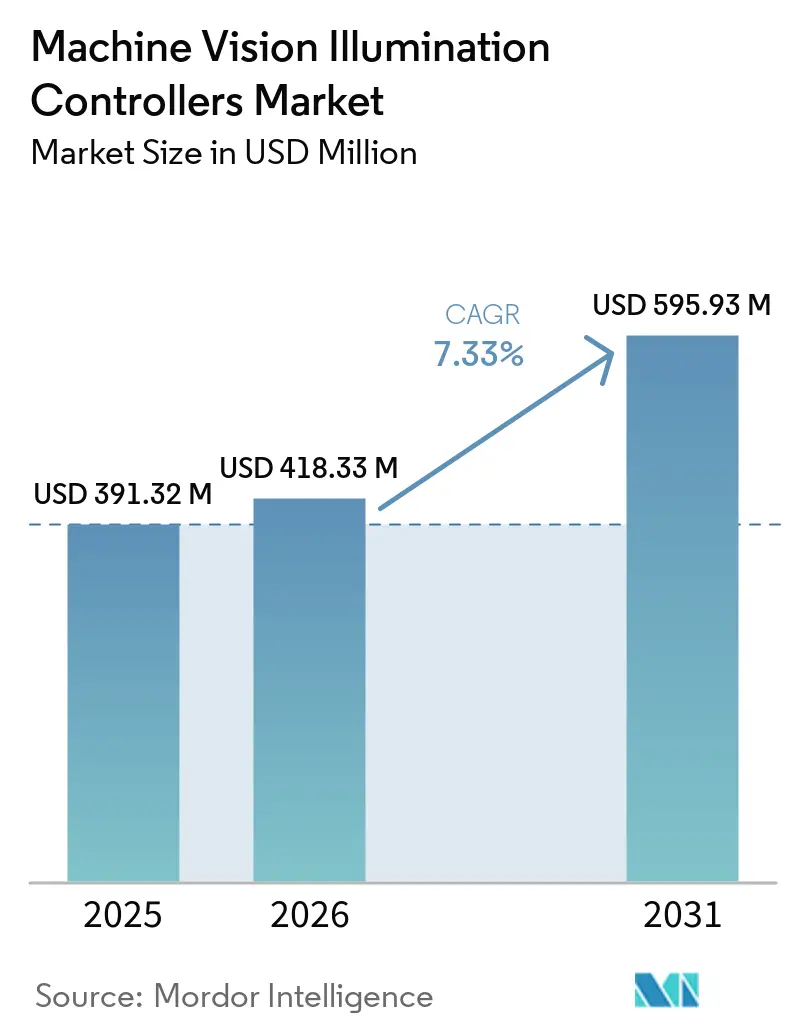
Machine Vision Illumination Controllers Market Analysis by Mordor Intelligence
The machine vision illumination controllers market size is projected to expand from USD 391.32 million in 2025 and USD 418.33 million in 2026 to USD 595.93 million by 2031, registering a CAGR of 7.33% between 2026 to 2031. Demand is moving from end-of-line sampling toward continuous inline inspection on high-throughput lines. Stable, precisely timed lighting helps AI classification systems perform consistently across production batches. Semiconductor, electric vehicle battery, and solar-cell facilities are tightening defect tolerances, which raises requirements for pulse timing, channel control, and factory connectivity. Suppliers are responding with networked controllers, software recipes, and bundled light-controller systems that simplify traceability and support. Input-cost volatility across LED components, power semiconductors, and passive parts may delay upgrades when pricing becomes less predictable.
Key Report Takeaways
- By product type, LED illumination controllers held 68.43% of the Machine Vision Illumination Controllers Market in 2025, while multi-source illumination controllers are projected to expand at a 10.87% CAGR through 2031.
- By controller architecture, standalone illumination controllers held 48.71% of the Machine Vision Illumination Controllers Market share in 2025, while inline illumination controllers are projected to expand at a 9.74% CAGR through 2031.
- By application, defect detection held 31.64% of the Machine Vision Illumination Controllers Market in 2025, while guidance, localization, and robot picking are projected to expand at a 10.96% CAGR through 2031.
- By end-user industry, electronics and semiconductors held 28.93% of the market in 2025, while logistics and warehousing are projected to expand at a 10.83% CAGR through 2031.
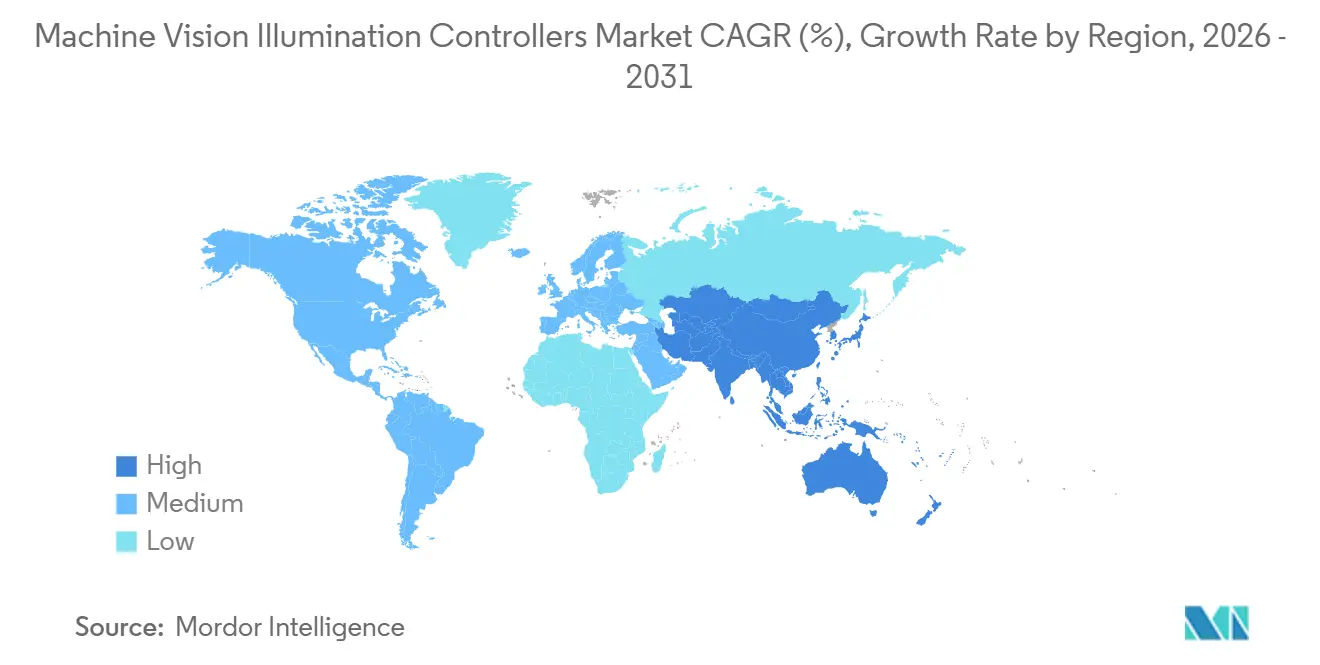
- By geography, Asia-Pacific held 39.87% of the market in 2025 and is projected to expand at a 10.47% CAGR through 2031.
Note: Market size and forecast figures in this report are generated using Mordor Intelligence’s proprietary estimation framework, updated with the latest available data and insights as of January 2026.
Market Trends and Insights
Drivers Impact Analysis of Machine Vision Illumination Controllers Market*
| Driver | (~) % Impact on CAGR Forecast | Geographic Relevance | Impact Timeline |
|---|---|---|---|
| Expansion of Industry 4.0 and Inline Inspection | +2.1% | Global, concentrated in Asia-Pacific and North America | Long term (≥ 4 years) |
| Rising Electronics, Semiconductor, Battery, and Solar Inspection Intensity | +1.8% | Asia-Pacific core, China, South Korea, and Japan, with spillover to North America and Europe | Medium term (2-4 years) |
| Growth of High-Speed Strobe and Multi-Camera Vision Cells | +1.1% | Global, led by Europe and North America | Medium term (2-4 years) |
| Retrofit Replacement of Manual and Constant-Voltage Lighting Controls | +0.9% | North America and Europe, with increasing adoption in Asia-Pacific | Short term (≤ 2 years) |
| Controller-Led Optimization of AI Vision Image Repeatability | +0.7% | Global, with Asia-Pacific and North America leading adoption | Long term (≥ 4 years) |
| Migration to Networked, Software-Defined Illumination | +0.5% | North America and Europe | Long term (≥ 4 years) |
| Source: Mordor Intelligence | |||
Expansion of Industry 4.0 and Inline Inspection
The move from sampling at the end of a line to 100% inline inspection is changing controller specifications across the Machine Vision Illumination Controllers Market. Factories using Industry 4.0 systems place vision cells at more process steps, which increases the installed base of controllers. Controllers must now synchronize with programmable logic controllers, manufacturing execution systems, and robot motion controls. Standard interfaces such as OPC UA and PROFINET allow this coordination across the factory network. The VDMA machine vision working group included 60 active companies in the OPC UA Machine Vision initiative, which released Part 2 of its companion specification in April 2024 and continued certification work in 2025.[1]VDMA, “Automate 2025 Machine Vision Standards Update,” Control Engineering, controleng.com. This transition makes controllers addressable industrial Ethernet nodes and can accelerate replacement decisions in the Machine Vision Illumination Controllers Market as facilities modernize connected production systems.
Rising Electronics, Semiconductor, Battery, and Solar Inspection Intensity
The Machine Vision Illumination Controllers Market benefits from new spending on electronics, semiconductors, batteries, and solar inspection. Global semiconductor equipment billings reached USD 135.1 billion in 2025, and SEMI projects USD 145 billion in 2026 and USD 156 billion in 2027. Wafer inspection, advanced packaging, and printed circuit board inspection depend on controlled and spectrally stable light. BMW Group used inline monitoring at every weld seam and 100% end-of-line inspection for Gen6 battery packs at Plant Woodruff. Solar-cell inspection also uses structured, multi-wavelength illumination to identify coating defects in real time. Semiconductor equipment cycles can create uneven controller orders, so suppliers benefit from diversified end-user exposure in the Machine Vision Illumination Controllers Market.
Growth of High-Speed Strobe and Multi-Camera Vision Cells
High-speed conveyors and robot-guidance cells increasingly use several cameras to inspect one part from different angles. These systems need independent channels that fire at different intensities and pulse widths during the same cycle. Driving LEDs at 10 or more times their continuous current can provide 5 to 10 times rated intensity during 50 to 500 microsecond pulses, but low duty cycles are needed to prevent junction damage.[2]TPL Vision, “TPL Vision Announces Their High Power Strobe Bar Light,” Vision Systems Design, vision-systems.com. External constant-current controllers can keep heat-producing components outside the light head and store energy for high-current pulses. Multi-source controllers are projected to expand at a 10.87% CAGR through 2031 as AI inspection uses image stacks under several lighting conditions in the Machine Vision Illumination Controllers Market. TPL Vision launched its HPS Bar Light in April 2026 with up to 2,500,000 lux at a 200 mm working distance, and an 800 ns rise time.[3]Office of the United States Trade Representative, “Section 301 Tariff Actions,” United States Trade Representative, ustr.gov.
Retrofit Replacement of Manual and Constant-Voltage Lighting Controls
Many production lines still use constant-voltage dimmers or manual brightness settings for vision lighting. Constant-current controllers can maintain steady light output as the LED junction temperature changes. Constant-voltage systems can vary in intensity due to forward voltage shifts, which can affect borderline inspection images. In pharmaceutical and electronics plants, a 1% variation in illumination can shift borderline images across a classification threshold and increase rework. United States Section 301 tariffs of 7.5% to 25% on Chinese-origin LED controllers influence sourcing choices for facilities upgrading their equipment.[4]CCS Group, “CCS Group Opens New Light Lab in Munich,” MVPro Media, mvpromedia.com. CCS Group opened a Light Lab in Munich in September 2025 to support application-specific lighting and retrofit trials in the Machine Vision Illumination Controllers Market for European customers.
Restraints Impact Analysis of Machine Vision Illumination Controllers Market*
| Restraint | (~) % Impact on CAGR Forecast | Geographic Relevance | Impact Timeline |
|---|---|---|---|
| Thermal Stress and LED Overdrive Life Trade-Offs | -1.5% | Global | Short term (≤ 2 years) |
| Integration and Validation Complexity Across Cameras, Lenses, and Surfaces | -1.0% | Global, more pronounced in multi-vendor environments | Medium term (2-4 years) |
| Fragmented Vision Interfaces and Interoperability Requirements | -0.8% | Global | Medium term (2-4 years) |
| Volatile Semiconductor, Power Component, and LED Input Costs | -0.7% | Global, primarily affecting Asia-Pacific-based manufacturers | Short term (≤ 2 years) |
| Source: Mordor Intelligence | |||
Thermal Stress and LED Overdrive Life Trade-Offs
Thermal management limits the use of aggressive controller settings in continuous-duty inspection cells. A 2025 study tracked high-power LEDs for 8,000 hours and found that units operating above their maximum junction temperatures of 85°C and 105°C transitioned from gradual degradation to failure, characterized by silicone cracking and phosphor darkening. LEDs operating within rated limits showed almost no degradation in the same study. A separate 2025 study on green high-power LEDs reported up to a 90% flux reduction over the first 500 hours at elevated forward currents. Manufacturers must set conservative overdrive conditions because premature light failure also creates production downtime, setup work, and validation requirements in the Machine Vision Illumination Controllers Market. RODER Vision recommends operating below 80% of the manufacturer's peak current limit to preserve a margin for production variation and ambient temperature changes.
Integration and Validation Complexity Across Cameras, Lenses, and Surfaces
An illumination controller operates with the camera exposure window, lens aperture, surface reflectance, and light geometry. Mixed-vendor systems usually create the most integration work and the longest commissioning period. Changes to pulse width, intensity, or channel sequencing may require installation and operational qualification records in regulated environments. Metaphase Technologies introduced the Zeto Controller family in June 2026, featuring a DIN-rail design that can drive up to 256 lights from a single touchscreen-equipped hub. The platform supports constant-current drivers and 0-10 V digital dimmers on a single bus, reducing multi-controller wiring. Mid-complexity, multi-camera cells can still require weeks or months of integration, encouraging customers to choose single-vendor packages in the Machine Vision Illumination Controllers Market.
*Our forecasts treat driver/restraint impacts as directional, not additive. The impact forecasts reflect baseline growth, mix effects, and variable interactions.
Machine Vision Illumination Controllers Market Segment Analysis
By Product Type:
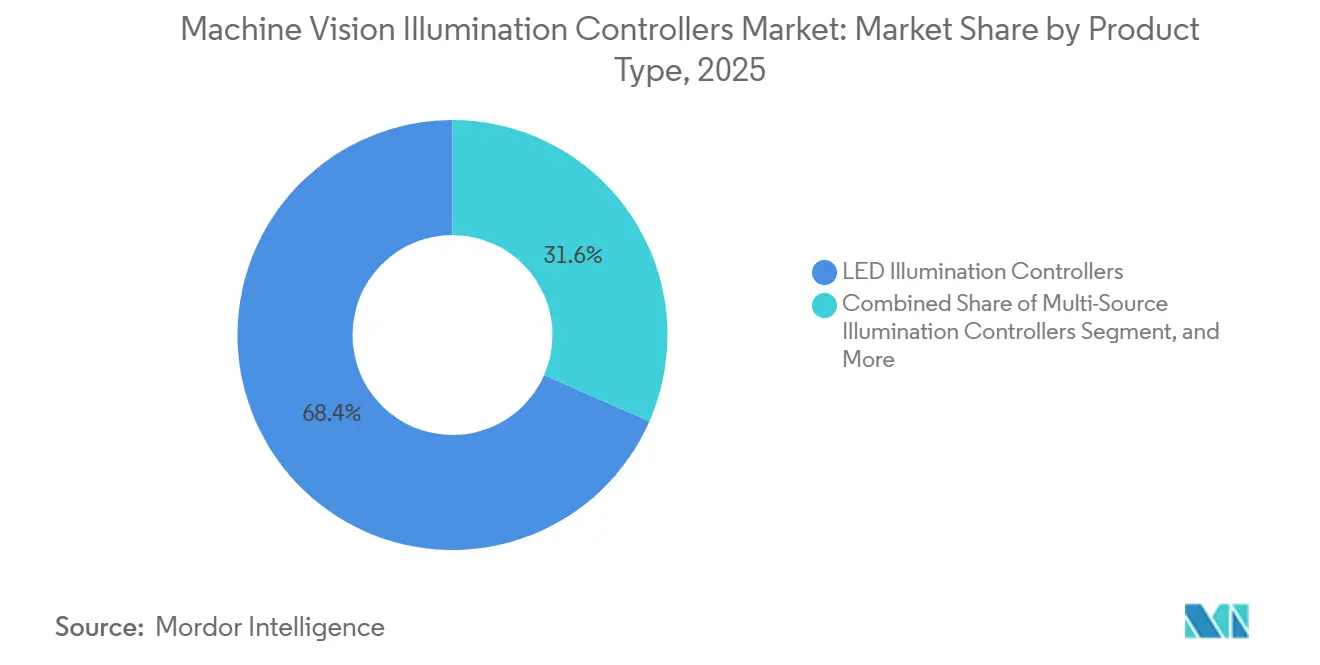
LED Controllers Hold the Largest Installed BaseLED illumination controllers accounted for 68.43% of the Machine Vision Illumination Controllers Market share in 2025. Their position reflects the replacement of fluorescent and xenon lighting, while constant-current drivers provide repeatability with variation below 1%. These units also support strobe overdrive and spectral selection across ultraviolet, visible, and near-infrared wavelengths in the Machine Vision Illumination Controllers Market. The installed base supports aftermarket upgrades to networked, multi-channel controllers with software recipes. EMVA 1288 became ISO 24942 in October 2024, and procurement documents increasingly reference its measurement framework with illumination-repeatability requirements.
Laser controllers serve a high-value niche in semiconductor metrology, medical imaging, and precision measurement, where LED arrays may lack sufficient photon flux density. Multi-source controllers are projected to expand at a 10.87% CAGR from 2026 to 2031. They manage LED and laser combinations or multispectral arrays from one programmable platform. Engineers can change lighting modes during an inspection cycle without hardware changes. AI inspection uses these image stacks to reveal different defect forms, while the controller sequences images within the camera exposure window for the Machine Vision Illumination Controllers Industry.



By Controller Architecture:
Standalone Units Lead and Inline Systems Gain UseStandalone illumination controllers held 48.71% of the market in 2025. Dedicated units keep heat-producing electronics outside the light head and support large capacitors for overdrive storage. They also provide extensive input and output connections for multi-camera synchronization. Gardasoft’s PP1620 provides 16 channels, up to 20 A of pulsed output per channel, a minimum pulse width of 4 microseconds, and Ethernet-based browser control. Integrated controllers serve smaller applications in the Machine Vision Illumination Controllers Market, where simple cabling and deployment matter more than external-unit performance.
Inline illumination controllers are projected to expand at a 9.74% CAGR from 2026 to 2031. These DIN-rail-mounted units sit within machine control cabinets rather than beside the light head. One networked node can manage channels across a multi-station line, reducing wiring. The GenICam 2025.10 package lets inline controllers and cameras work in the same software environment. Telemetry sent to manufacturing execution systems gives inline units a stronger role in connected automation and in the Machine Vision Illumination Controllers Industry.
By Application:
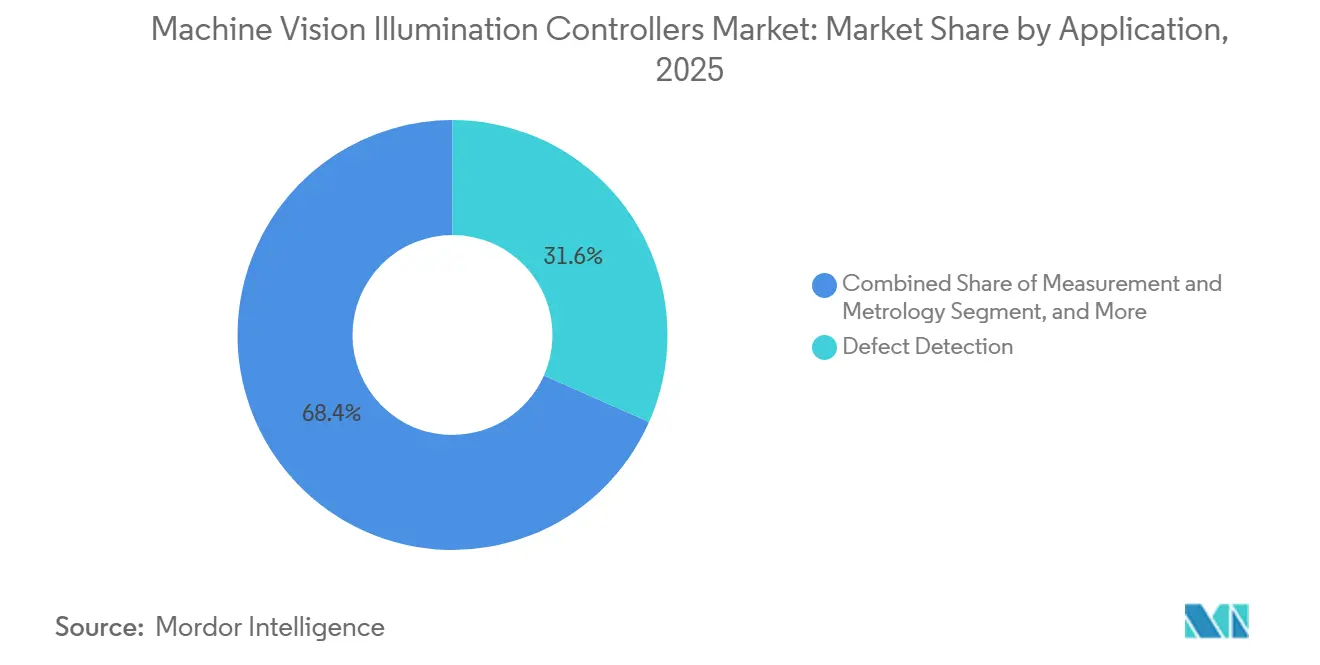
Defect Detection Leads While Robot Guidance AdvancesDefect detection held 31.64% of the Machine Vision Illumination Controllers Market in 2025. It remains the primary commercial driver of vision investment across electronics, automotive, pharmaceuticals, and consumer goods. Scratches, pinholes, and coating voids can appear only at specific angles or wavelengths. Controllers sequence several lighting modes at the camera's frame rate within a single inspection cycle. Measurement, metrology, optical character recognition, label verification, and direct-part marking also depend on controlled, high-contrast illumination in the Machine Vision Illumination Controllers Market.
Guidance, localization, and robot picking are projected to expand at a 10.96% CAGR from 2026 to 2031. Autonomous mobile robots and robotic arms need repeatable light for sub-millimeter position estimates. A 2026 binocular stereo vision study recorded a 99% grasping success rate under favorable lighting and 96% under challenging conditions. ABB launched PickMaster Lite in 2026 with templates that reduce engineering effort by 30% compared with conventional PLC-based solutions. Sorting, identification, traceability, and presence verification extend demand across advanced and routine inspection cells.
By End-User Industry:
Electronics Leads While Logistics Expands FasterElectronics and semiconductors held 28.93% of the market in 2025. Front-end fabrication, advanced packaging, and printed circuit board assembly require lighting suited to silicon, metal, and dielectric surfaces. Automotive and electric vehicle plants also use continuous-duty inspection. BMW Group used inline monitoring at each weld seam and 100% end-of-line inspection for Gen6 battery packs at Plant Woodruff. Food and beverage lines use strobe lighting, while pharmaceutical and medical-device users favor Ethernet-connected controllers with software records in the Machine Vision Illumination Controllers Market.
Logistics and warehousing are projected to expand at a 10.83% CAGR from 2026 to 2031. Fulfillment centers are adding scan tunnels, sortation systems, and robotic picking cells. Barcode reading must work on reflective polypropylene film and matte corrugated surfaces, so controllers switch between overdrive and continuous modes. Smart Vision Lights states that its Lightgistics series can deliver up to 10 times standard continuous-mode brightness at conveyor speeds of 2 to 3.5 meters per second. Metals, glass, plastics, aerospace, defense, security, and surveillance add demand for surface inspection and reliable lower-complexity configurations.
Geography Analysis
APAC Machine Vision Illumination Controllers Market
Asia-Pacific accounted for 39.87% of the Machine Vision Illumination Controllers Market in 2025 and is projected to grow at a 10.47% CAGR from 2026 to 2031. China leads regional production and consumption volumes, while Japan and South Korea serve the high-precision semiconductor and electronics inspection markets with premium controllers. India, Vietnam, Thailand, and Indonesia are expanding electronics assembly and electric-vehicle powertrain capacity. Global semiconductor equipment billings reached USD 135.1 billion in 2025, with important activity in South Korea, Japan, Taiwan, and China. ZEISS SMT announced capacity expansion for high-NA EUV lithography optics and wafer-fab inspection solutions in 2026.
North America and Europe Machine Vision Illumination Controllers Market
North America is the second-largest regional market, supported by semiconductor capacity additions, electric vehicle battery plants, and e-commerce fulfillment expansion. Advanced Illumination, Smart Vision Lights, and Metaphase Technologies serve pharmaceutical, aerospace, and defense customers with demanding specifications. Supply-chain resilience and tariff factors support demand for United States-sourced hardware in some upgrades. Europe has concentrated demand in German automotive and precision manufacturing clusters, where Gardasoft Vision, CCS Europe, and EFFILUX SAS operate a shared Light Lab for application-specific trials. The EU Machinery Regulation is raising documentation and traceability requirements for vision-guided robot cells across the Machine Vision Illumination Controllers Market during its transition period.
MEA and South America Machine Vision Illumination Controllers Market
South America has a smaller but steady demand base, led by Brazilian automotive and food and beverage operations, while Argentina adds demand through agrifood packaging. The Middle East is earlier in inspection automation, with the UAE and Saudi Arabia supporting pharmaceutical, food-processing, and building-materials quality control. Africa's demand centers on South African automotive assembly and metals processing within the Machine Vision Illumination Controllers Market. These regions have lower penetration of precision controllers, creating an installed-base opportunity for competitively priced, mid-performance products with simpler integration.

Competitive Landscape
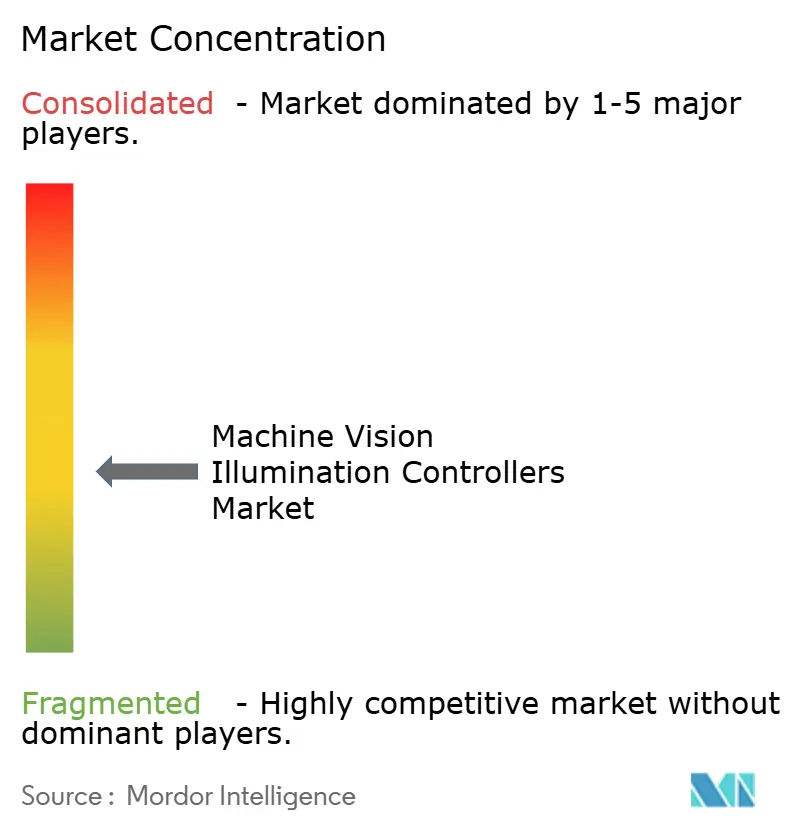
The Machine Vision Illumination Controllers Market is moderately fragmented, with CCS Inc., Gardasoft Vision Limited, Advanced Illumination, Inc., EFFILUX SAS, and TPL Vision Limited holding established positions in precision timing and overdrive control. Their products serve the semiconductor, pharmaceutical, and automotive inspection markets, and they differentiate themselves through pulse-width accuracy, channel isolation, current capacity, trigger compatibility, software recipes, and support for standards. Broader vision-system suppliers bundle illumination control with integrated systems, which can reduce price pressure but limit their role in multi-vendor cells. OPT Machine Vision Tech, CST Machine Vision, HUNSON, and CYUN YI TECHNOLOGY compete on cost and channel reach in the Chinese electronics and electric-vehicle battery inspection markets. This supplier mix supports continued competition across the Machine Vision Illumination Controllers Market.
Software control is becoming more important where multi-source lighting supports AI-based inspection. Metaphase Technologies introduced the Zeto Controller family at Automate 2026 in June 2026, and its DIN-rail platform combines up to 256 lights into a single hub with an embedded web server. The design reduces the wiring burden that can slow commissioning in complex cells. CCS Inc. published patent JP2026110021A in July 2026 for an inspection system that automatically adjusts LED-emission timing against camera-exposure timing. These developments can reduce manual setup and lessen reliance on specialist integrators.
European compliance requirements can create barriers to entry for lighting hardware, as CE marking and IEC 62471 photobiological safety requirements favor suppliers with documented testing capabilities. CCS Group expanded its technical support footprint with the Munich Light Lab in September 2025, while TPL Vision introduced the HPS Bar Light in April 2026 for fast, synchronized inspection. Integrated light-controller bundles are gaining use in Japanese and Korean semiconductor fabs where buyers seek common warranty and traceability terms. This approach creates a distinction in the Machine Vision Illumination Controllers Market between providers of complete application support and low-cost component suppliers.
Machine Vision Illumination Controllers Industry Leaders
CCS Inc.
Gardasoft Vision Limited
Advanced Illumination, Inc.
MORITEX Corporation
Smart Vision Lights, LLC
- *Disclaimer: Major Players sorted in no particular order
Machine Vision Illumination Controllers Market Companies Covered in this Report
- CCS Inc.
- Advanced Illumination, Inc.
- Gardasoft Vision Limited
- Smart Vision Lights, LLC
- KEYENCE Corporation
- MORITEX Corporation
- Basler AG
- EFFILUX SAS
- Metaphase Technologies, Inc.
- MBJ Imaging GmbH
- Leimac Ltd.
- Leistungselektronik JENA GmbH
- RODER SRL
- Opto Engineering S.p.A.
- Phlox Corporation
- LUMIMAX, a brand of iiM GmbH
- TPL Vision Limited
- ViSCO Technologies Corporation
- OPT Machine Vision Tech Co., Ltd.
- Shenzhen UST VIBA Electronica Co., Ltd.
- CYUN YI TECHNOLOGY Co., Ltd.
- Mvotem Optics Co., Ltd.
- PHOTON-TECH INSTRUMENTS Co., Ltd.
- PIQS Co., Ltd.
- CST Machine Vision Co., Ltd.
- HUNSON Co., Ltd.

Recent Industry Developments in Machine Vision Illumination Controllers Market
- September 2026: EFFILUX SAS, CCS Inc., and Gardasoft Vision Limited announced a shared exhibit at VISION Stuttgart 2026, scheduled for October 6-8, 2026 at Booth 10E54. The event marks the first joint presentation by the 3 entities, combining lighting, controller, and application expertise.
- July 2026: CCS Inc. published patent JP2026110021A with the Japan Patent Office. The patent covers an inspection system that adjusts LED emission timing against camera exposure timing to maximize image brightness and reduce manual setup in high-throughput inline vision cells.
- June 2026: Metaphase Lighting Technologies unveiled the Zeto Controller family at Automate 2026 in Chicago. The DIN-rail-mounted platform scales to 256 lights per hub, while CX Plus units provide 40 A strobe output and VX-16 dimmers provide 16 independently programmable 0-10 V channels with optically isolated trigger inputs.
- April 2026: TPL Vision Limited launched the High Power Strobe Bar, Essential ELINE line-scan family, and modular Z-SPOT family. The HPS Bar provides up to 2,500,000 lux at 200 mm with an 800 ns rise time, while the IL-SPOT exceeds 1.3 million lux in strobe mode.


Global Machine Vision Illumination Controllers Market Report Scope
Machine Vision Illumination Controllers are electronic devices that precisely regulate the intensity, timing, and synchronization of light sources in machine vision systems, ensuring optimal image quality, consistency, and repeatability for automated inspection, measurement, and identification across various industrial applications.
The Machine Vision Illumination Controllers Market Report is Segmented by Product Type (LED Illumination Controllers, Laser Illumination Controllers, and Multi-Source Illumination Controllers), Controller Architecture (Integrated Illumination Controllers, Standalone Illumination Controllers, and Inline Illumination Controllers), Application (Defect Detection, Measurement and Metrology, Optical Character Recognition and Verification, Presence, Absence, and Assembly Verification, Guidance, Localization, and Robot Picking, and Sorting, Identification, and Traceability), End-User Industry (Electronics and Semiconductors, Automotive and Electric Vehicles, Food and Beverage, Pharmaceuticals and Medical Devices, Packaging and Printing, Logistics and Warehousing, Metals, Glass, and Plastics, Aerospace and Defense, Security and Surveillance, and Other End-User Industries), and Geography (North America, South America, Europe, Asia-Pacific, Middle East, Africa). The Market Forecasts are Provided in Terms of Value (USD).
| LED Illumination Controllers |
| Laser Illumination Controllers |
| Multi-Source Illumination Controllers |
| Integrated Illumination Controllers |
| Standalone Illumination Controllers |
| Inline Illumination Controllers |
| Defect Detection |
| Measurement and Metrology |
| Optical Character Recognition and Verification |
| Presence, Absence, and Assembly Verification |
| Guidance, Localization, and Robot Picking |
| Sorting, Identification, and Traceability |
| Electronics and Semiconductors |
| Automotive and Electric Vehicles |
| Food and Beverage |
| Pharmaceuticals and Medical Devices |
| Packaging and Printing |
| Logistics and Warehousing |
| Metals, Glass, and Plastics |
| Aerospace and Defense |
| Security and Surveillance |
| Other End-User Industries |
| North America | United States |
| Canada | |
| Mexico | |
| South America | Brazil |
| Argentina | |
| Rest of South America | |
| Europe | Germany |
| United Kingdom | |
| France | |
| Italy | |
| Spain | |
| Rest of Europe | |
| Asia-Pacific | China |
| Japan | |
| India | |
| South Korea | |
| Rest of Asia-Pacific | |
| Middle East | United Arab Emirates |
| Saudi Arabia | |
| Rest of Middle East | |
| Africa | South Africa |
| Rest of Africa |
| By Product Type | LED Illumination Controllers | |
| Laser Illumination Controllers | ||
| Multi-Source Illumination Controllers | ||
| By Controller Architecture | Integrated Illumination Controllers | |
| Standalone Illumination Controllers | ||
| Inline Illumination Controllers | ||
| By Application | Defect Detection | |
| Measurement and Metrology | ||
| Optical Character Recognition and Verification | ||
| Presence, Absence, and Assembly Verification | ||
| Guidance, Localization, and Robot Picking | ||
| Sorting, Identification, and Traceability | ||
| By End-User Industry | Electronics and Semiconductors | |
| Automotive and Electric Vehicles | ||
| Food and Beverage | ||
| Pharmaceuticals and Medical Devices | ||
| Packaging and Printing | ||
| Logistics and Warehousing | ||
| Metals, Glass, and Plastics | ||
| Aerospace and Defense | ||
| Security and Surveillance | ||
| Other End-User Industries | ||
| By Geography | North America | United States |
| Canada | ||
| Mexico | ||
| South America | Brazil | |
| Argentina | ||
| Rest of South America | ||
| Europe | Germany | |
| United Kingdom | ||
| France | ||
| Italy | ||
| Spain | ||
| Rest of Europe | ||
| Asia-Pacific | China | |
| Japan | ||
| India | ||
| South Korea | ||
| Rest of Asia-Pacific | ||
| Middle East | United Arab Emirates | |
| Saudi Arabia | ||
| Rest of Middle East | ||
| Africa | South Africa | |
| Rest of Africa | ||


Key Questions Answered in the Report
What is the Machine Vision Illumination Controllers Market size?
The market is projected at USD 418.33 million in 2026 and is forecast to reach USD 595.93 million by 2031 at a 7.33% CAGR.
Which product category holds the largest share?
LED illumination controllers held 68.43% in 2025 because they offer controllability, strobe capability, and spectral flexibility.
Which controller architecture is expanding fastest?
Inline illumination controllers are projected to expand at a 9.74% CAGR through 2031 as factories adopt networked control cabinets and software recipes.
Which application is expected to expand fastest?
Guidance, localization, and robot picking are projected to expand at a 10.96% CAGR through 2031 as automation requires more repeatable image inputs.
Which end-user sector is projected to expand fastest?
Logistics and warehousing are projected to expand at a 10.83% CAGR through 2031, supported by scan tunnels, sortation systems, and robotic picking.
Which region leads demand?
Asia-Pacific held 39.87% in 2025 and is projected to expand at a 10.47% CAGR through 2031.
Page last updated on:





