
Loose-Leaf Tea Market Size and Share
Market Overview
| Study Period | 2022 - 2032 |
|---|---|
| Market Size (2027) | USD 14.27 Billion |
| Market Size (2032) | USD 20.90 Billion |
| Growth Rate (2027 - 2032) | 7.92 % |
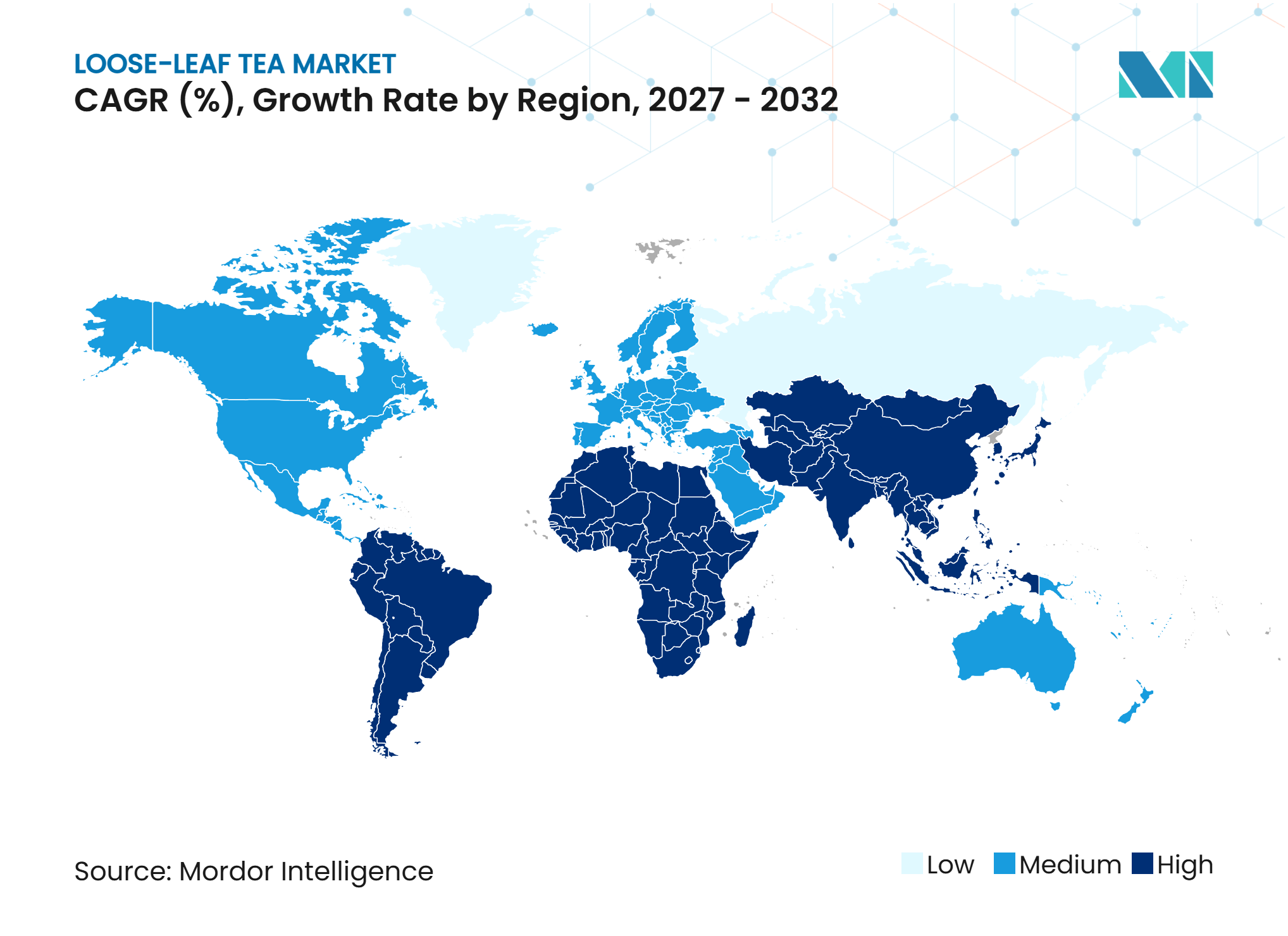
| Fastest Growing Market | Middle East and Africa |
| Largest Market | Asia-Pacific |
| Market Concentration | Low |
Major Players *Disclaimer: Major Players sorted in no particular order Image © Mordor Intelligence. Reuse requires attribution under CC BY 4.0. | |
Loose-Leaf Tea Market Analysis by Mordor Intelligence
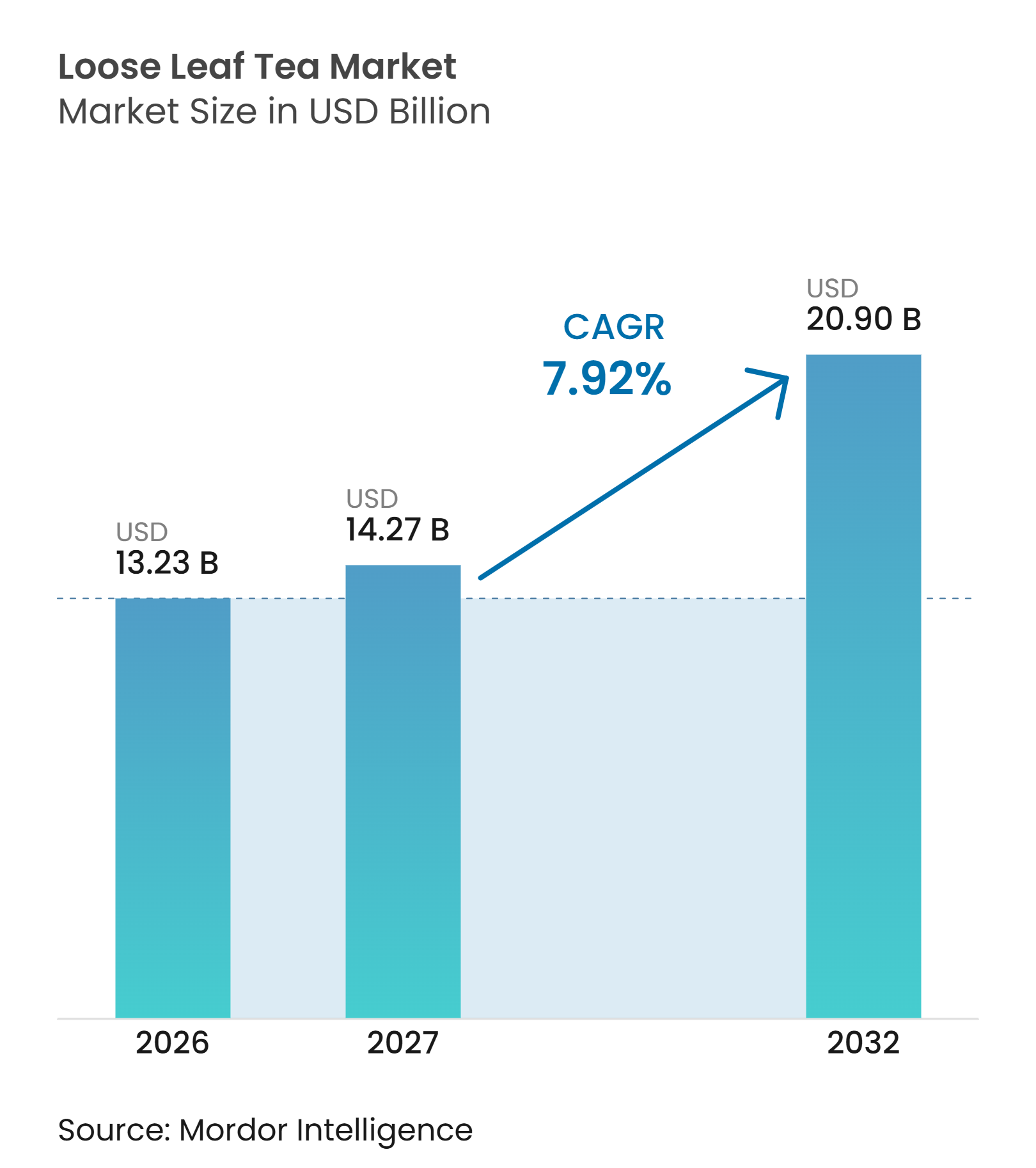
The loose-leaf tea market size is expected to grow from USD 13.23 billion in 2026 to USD 14.27 billion in 2027, and is forecast to reach USD 20.90 billion by 2032, at a 7.92% CAGR over 2027-2032. The loose-leaf tea market is benefiting from growing consumer appreciation for tea origins, leaf quality, and traditional preparation experiences. Increasing demand for premium and single-origin varieties is encouraging brands to emphasize product differentiation and quality. Rising interest in functional blends, organic tea, and specialty varieties is broadening consumer preferences beyond conventional black tea. Expanding e-commerce platforms and specialty tea retailers are improving product accessibility and supporting wider market reach. Greater focus on traceable sourcing, sustainable cultivation, and premium packaging is further strengthening the market's appeal.
Key Report Takeaways
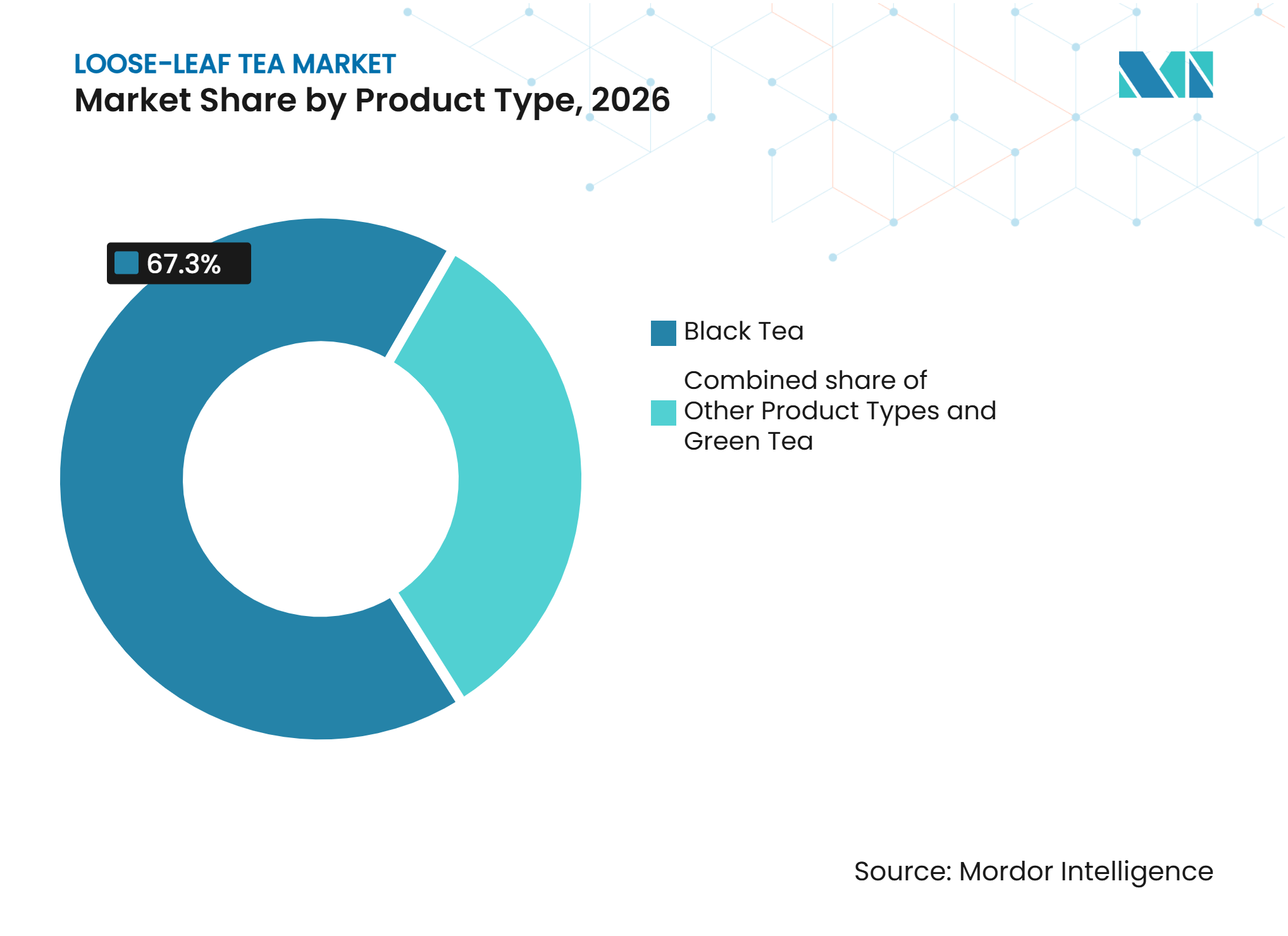
• By product type, black tea held 67.32% of the loose-leaf tea market share in 2026, while other product types are forecast to expand at a CAGR of 8.55% through 2032.
• By category, conventional held 82.19% of the loose-leaf tea market share in 2026, while organic is forecast to expand at a CAGR of 9.12% through 2032.
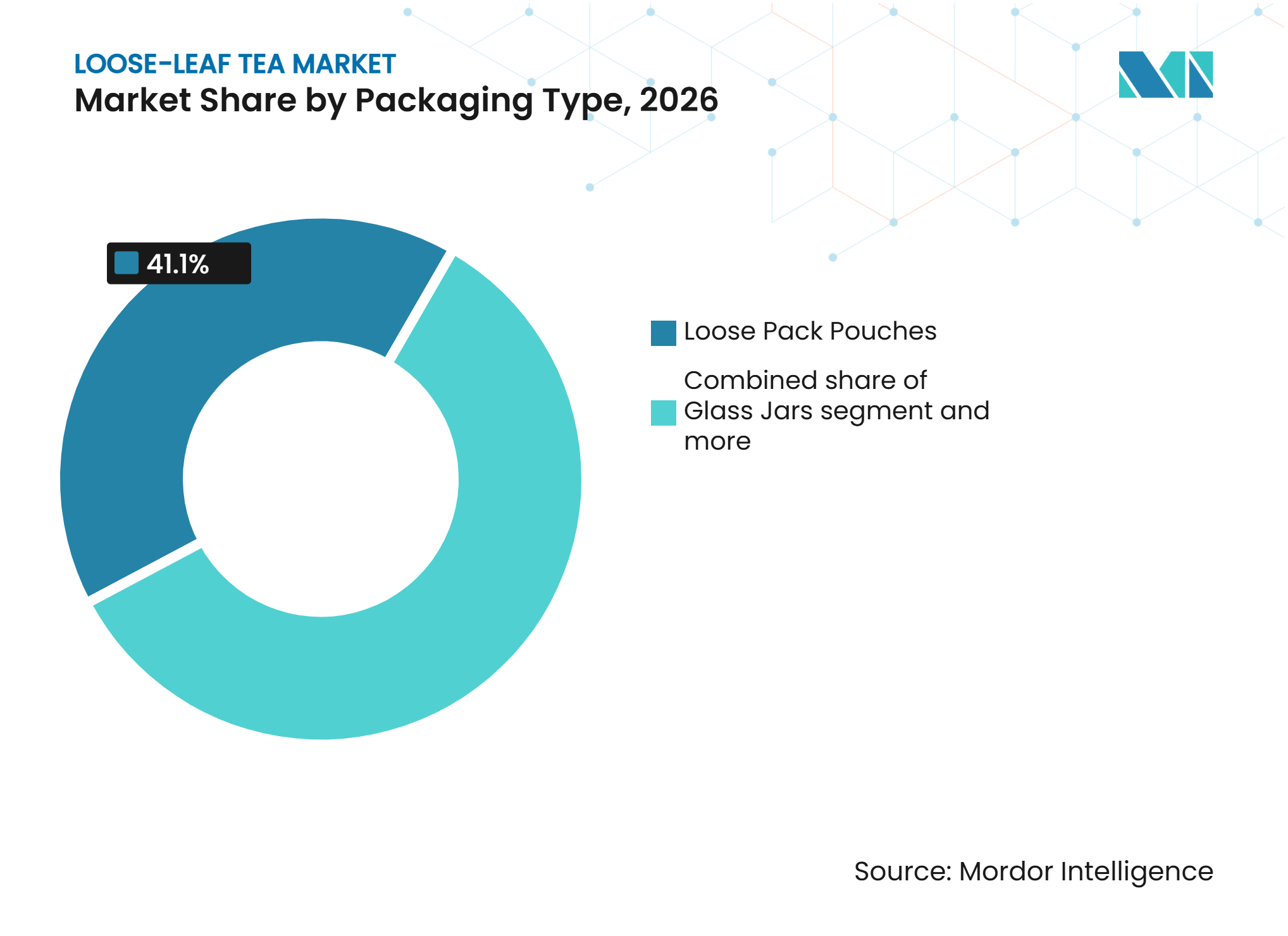
• By packaging type, loose pack pouches held 41.11% of the loose-leaf tea market share in 2026, while glass jars are forecast to expand at a CAGR of 8.53% through 2032.
• By distribution channel, off-trade held 66.16% of the loose-leaf market share in 2026, while on-trade is forecast to expand at a CAGR of 8.21% through 2032.
• By geography, Asia-Pacific held 35.97% of the loose-leaf market share in 2026, while the Middle East and Africa is forecast to expand at a CAGR of 9.54% through 2032.
Note: Market numbers in this report are based on Mordor Intelligence's proprietary estimation framework, which combines nine months of actuals with Q4 projections for base year 2026.
Market Trends and Insights
Drivers Impact Analysis of Loose Leaf Tea Market of Loose-Leaf Tea Market*
| Driver | (~) % Impact on CAGR Forecast | Geographic Relevance | Impact Timeline |
|---|---|---|---|
| Increasing consumer preference for premium and single-origin loose leaf teas | +1.8% | Global, strongest in North America, the United Kingdom, Japan, and urban China | Long term (≥ 4 years) |
| Rising demand for health-oriented and functional tea products | +1.5% | Global, strongest in North America, Europe, and East Asia | Medium term (2-4 years) |
| Expanding demand for diverse and high-quality loose leaf tea varieties | +1.2% | Asia-Pacific, with spillover to North America and Western Europe | Medium term (2-4 years) |
| Increasing popularity of specialty tea houses and premium café experiences | +0.9% | Asia-Pacific, North America, and the United Kingdom | Medium term (2-4 years) |
| Strengthening consumer preference for organic and responsibly sourced teas | +0.8% | Western Europe, North America, and Asia-Pacific | Long term (≥ 4 years) |
| Growing adoption of loose leaf tea as a premium gifting option | +0.7% | East Asia, North America, and Europe | Short term (≤ 2 years) |
| Source: Mordor Intelligence | |||
Increasing Consumer Preference for Premium and Single-Origin Loose Leaf Teas
The loose-leaf tea market is benefiting from growing consumer interest in premium, organic, and origin-specific tea varieties. For instance, in 2026, the German Tea & Herbal Infusions Association highlighted the importance of organic certification in tea purchasing decisions, reflecting consumer interest in product quality and sourcing practices. Similarly, in 2025, according to the Tea Board of India's Annual Report, a 21.0% increase in average Darjeeling tea auction prices, from INR 323.69/kg in 2023–24 to INR 391.68/kg in 2024–25, underscored the value of region-specific tea varieties and supported their premium positioning [1]. Growing interest in tea origin, quality, and distinctive flavors is encouraging producers to expand specialty tea offerings and focus on product differentiation.
Rising Demand for Health-Oriented and Functional Tea Products
Growing health awareness is influencing consumer preferences in the loose-leaf tea market, with increasing attention to beverages that offer wellness-related attributes alongside taste and quality. Consumers are showing greater interest in natural ingredients, plant-based beverages, and tea varieties perceived to support everyday well-being. This is encouraging demand for green tea, herbal infusions, and specialty blends that align with changing lifestyle and dietary preferences. The growing popularity of wellness-oriented beverage choices is also prompting tea producers to diversify their product portfolios, develop blends with distinctive ingredients, and highlight product quality and sourcing practices. These developments are creating opportunities for loose-leaf tea brands to strengthen their functional product offerings and attract consumers seeking alternatives to conventional beverages.
Expanding Demand for Diverse and High-Quality Loose-Leaf Tea Varieties
The loose-leaf tea market is supported by growing global tea consumption and increasing interest in diverse tea varieties. For instance, in May 2026, according to the Food and Agriculture Organization of the United Nations, worldwide per-capita tea consumption increased by 2.1% annually over the last decade [2]. The organization also highlighted the availability of different tea varieties based on oxidation and fermentation techniques, reflecting the diversity of tea products across markets. This diversity allows producers to offer teas with distinct flavor profiles, characteristics, and quality attributes to cater to varying consumer preferences. Additionally, the growing availability of different tea varieties encourages product innovation and portfolio diversification, supporting the development of specialty offerings and strengthening opportunities for loose-leaf tea producers to differentiate their products.
Increasing Popularity of Specialty Tea Houses and Premium Café Experiences
The growing popularity of café culture and social tea-drinking occasions is creating new opportunities for the loose-leaf tea market. For instance, in May 2026, the UK Tea & Infusions Association reported that 26% of male tea drinkers and 11% of female tea drinkers consumed tea in coffee shops or independent cafés, among 1,000 British adults. Additionally, 50% of respondents associated tea with regular social gatherings and catch-ups with loved ones [3]. These consumption patterns highlight opportunities for specialty tea houses and premium cafés to strengthen their tea offerings through diverse varieties, curated selections, and distinctive serving experiences. Such settings also provide opportunities for consumers to explore specialty teas beyond conventional at-home consumption.
Restraints Impact Analysis of Loose Leaf Tea Market of Loose-Leaf Tea Market*
| Restraint | (~) % Impact on CAGR Forecast | Geographic Relevance | Impact Timeline |
|---|---|---|---|
| Climate-driven fluctuations in tea yields and leaf quality | -0.9% | India, Kenya, Sri Lanka, China, and Taiwan | Long term (≥ 4 years) |
| High prices of premium loose leaf teas limiting wider consumer adoption | -0.7% | Global, particularly price-sensitive South Asian and Southeast Asian markets | Medium term (2-4 years) |
| Fragmented tea supply chains and inconsistent sourcing practices | -0.5% | Global, with stronger effects in Africa and smaller Indian growing regions | Medium term (2-4 years) |
| Stringent sourcing, residue, and certification requirements | -0.4% | Western Europe, North America, and Asia-Pacific export corridors | Long term (≥ 4 years) |
| Source: Mordor Intelligence | |||
Climate-Driven Fluctuations in Tea Yields and Leaf Quality
Climate change poses a significant challenge to the loose-leaf tea market by affecting tea cultivation conditions, crop productivity, and leaf quality. Changes in temperature, irregular rainfall, prolonged droughts, and extreme weather events can disrupt growing cycles and create inconsistencies in tea production. These conditions may affect leaf characteristics, flavor profiles, and overall quality, making it difficult for producers to maintain consistent product standards. Increasing climate variability can also raise cultivation costs, disrupt supply availability, and create uncertainty for tea growers and processors. Such production challenges may limit the availability of high-quality leaves and affect the consistency of specialty tea offerings across markets.
High Prices of Premium Loose-Leaf Teas limiting Wider Consumer Adoption
High prices of premium loose-leaf teas can limit their accessibility and wider adoption among price-sensitive consumers. Specialty teas often involve higher cultivation, harvesting, processing, and sourcing costs, which can increase their retail prices compared with conventional tea products. These higher prices may discourage regular purchases, particularly among consumers who prioritize affordability and value for money. Premium loose-leaf teas may also face competition from lower-priced tea bags and other convenient beverage alternatives. As a result, limited affordability can restrict market penetration and make it challenging for premium tea brands to attract a broader consumer base.
*Our forecasts treat driver/restraint impacts as directional, not additive. The impact forecasts reflect baseline growth, mix effects, and variable interactions.
Loose-Leaf Tea Market Segment Analysis
By Product Type:
Black Tea Leads Current Demand While Specialty Varieties ExpandBlack tea accounted for 67.32% of the loose-leaf tea market share in 2026. Black tea holds a strong position in the loose-leaf tea market due to its established consumption patterns across South Asia, the United Kingdom, East Africa, and the Middle East. Its familiar taste and accessible flavor profile make it a common choice for everyday consumption and an entry point for consumers transitioning from tea bags to loose-leaf preparation. Its versatility also supports milk tea, traditional blends, and a wide range of retail and foodservice applications. Established production, blending, and distribution networks further strengthen the segment's market presence. Although consumer interest in specialty tea varieties is increasing, black tea continues to benefit from its broad acceptance and familiarity.
Other product types are projected to expand at a CAGR of 8.55% through 2032. Other tea varieties, including herbal blends, oolong, white tea, and functional infusions, are contributing to the diversification of the loose-leaf tea market. These products attract consumers seeking alternatives to conventional black tea and cater to varied preferences for caffeine-free beverages, distinctive flavors, and wellness-oriented choices. Growing awareness of the unique characteristics and potential benefits of different tea varieties is encouraging interest in specialty blends and innovative product offerings. Clear labeling, detailed ingredient information, and informative product descriptions further help consumers understand these varieties and make informed purchasing decisions.



By Category:
Conventional Tea Provides Scale While Organic Tea Gains MomentumConventional held 82.19% of the loose-leaf tea market share in 2026. Conventional tea maintains a strong position in the loose-leaf tea market, supported by established cultivation practices, wide product availability, and relatively accessible pricing compared with certified organic alternatives. Its broad availability makes it an important offering across mainstream retail channels and enables producers to cater to consumers with different purchasing preferences. The segment also serves markets where affordability, taste, and product quality are key considerations. Growing attention to freshness, consistent flavor, and reliable origin information is encouraging producers to maintain product standards and strengthen consumer confidence.
Organic is forecast to expand at a CAGR of 9.12% through 2032. The organic segment is gaining relevance in the loose-leaf tea market as consumers place greater emphasis on product certification, responsible farming practices, and ingredient transparency. Growing interest in certified organic products is encouraging producers to strengthen organic cultivation practices and invest in traceable agricultural supply chains. Organic loose-leaf tea also aligns with specialty retail and premium gifting preferences, where certification and sourcing information help communicate product quality and authenticity. Increasing attention to sustainable production and transparent sourcing is creating opportunities for tea producers to expand their organic portfolios and reach consumers seeking products that align with their purchasing preferences.
By Packaging Type:
Loose Pack Pouches Support Scale While Glass Jars Build Premium ValueLoose pack pouches held 41.11% of the loose-leaf market share in 2026. Loose-pack pouches play an important role in the loose-leaf tea market due to their convenience, lightweight structure, and suitability for efficient storage and transportation. Resealable closures and protective barrier materials help maintain tea freshness and preserve product quality after opening. Their practical packaging format also supports distribution across supermarkets, specialty tea stores, and online retail channels. Pouches are suitable for everyday tea products as well as smaller trial packs that allow consumers to explore different varieties. Their flexibility in size, design, and material selection also enables brands to combine functional packaging with attractive product presentation and premium positioning.
Glass jars are projected to expand at a CAGR of 8.53% through 2032. Glass jars contribute to the premium positioning of the loose-leaf tea market by providing a transparent presentation that allows consumers to view the tea leaves, color, and botanical ingredients before purchase. Their visual appeal makes them suitable for specialty retail displays, premium gifting, and products featuring whole leaves, flowers, or fruit pieces. Glass packaging also offers reusability and supports refill-based purchasing options, allowing brands to combine attractive presentation with practical storage solutions. Its compatibility with premium packaging designs further helps producers communicate product quality and distinguish their offerings. Pairing glass jars with refill pouches can offer consumers an appealing initial purchase format and convenient options for repeat purchases.

By Distribution Channel:
Off-Trade Provides Reach While On-Trade Builds DiscoveryOff-trade held 66.16% of the loose-leaf market share in 2026. Off-trade channels play an important role in the loose-leaf tea market by providing consumers with convenient access to a wide range of products for home consumption. Supermarkets and hypermarkets support product accessibility through established retail networks and broad product assortments, while specialty stores offer curated selections of premium teas, distinctive blends, and origin-specific varieties. Online retail platforms further expand consumer access by allowing customers to explore different brands and product offerings beyond their local markets. These channels also support routine purchases and repeat buying through convenient product availability. Their combined reach strengthens product visibility and enables loose-leaf tea producers to serve consumers with diverse preferences and price points.
On-trade is projected to expand at a CAGR of 8.21% through 2032. Tea houses, hotels, restaurants, and cafés provide consumers with opportunities to experience loose leaf tea before purchasing it for home consumption. These establishments help introduce consumers to different tea varieties, flavor profiles, and preparation methods, particularly those that may be less familiar to regular tea drinkers. The availability of carefully prepared tea and knowledgeable service can enhance the overall consumption experience and encourage greater interest in premium and specialty loose-leaf products. Seasonal menus, curated tea selections, and in-store tastings also allow operators to introduce new varieties and increase consumer awareness. These experiences can strengthen product familiarity, encourage repeat consumption, and support subsequent purchases through retail and online channels.
Geography Analysis
Asia-Pacific
Asia-Pacific held 35.97% of the loose-leaf tea market share in 2026. China and India have well-established tea production industries and deeply rooted tea consumption traditions, supporting strong demand for loose-leaf tea across different consumer groups. Both countries have diverse consumption patterns, ranging from traditional everyday tea drinking to growing interest in premium and specialty offerings. Urban consumers are increasingly exploring different tea varieties, flavor profiles, and higher-quality products, creating opportunities for single-origin, organic, and specialty loose-leaf teas. The presence of established domestic producers, expanding retail networks, and evolving consumer preferences supports the availability of products across various price points and distribution formats. This combination of traditional consumption habits and emerging premium preferences creates opportunities for loose-leaf tea brands to strengthen their presence and reach a broader consumer base across the region.
Middle East and Africa
Middle East and Africa is forecast to expand at a CAGR of 9.54% through 2032. The Middle East and Africa region combines established tea-drinking traditions with growing urban populations and increasing interest in premium tea products. Loose leaf tea appeals to consumers seeking greater variety, distinctive flavor profiles, and alternatives to conventional tea offerings. Herbal and functional blends also present opportunities as consumer interest in wellness-oriented products and specialty beverages develops. Hotels, restaurants, cafés, and specialty tea houses provide additional avenues to introduce premium loose-leaf varieties and encourage product trials. Premium packaging and gifting formats can further support demand during seasonal celebrations and social occasions. These factors are creating opportunities for loose-leaf tea brands to expand their presence across different consumer groups and consumption occasions.
North America, Europe, and South America
North America, Europe, and South America present distinct growth opportunities for the loose-leaf tea market, with increasing consumer interest in premium products connecting these regional markets. In North America, demand is supported by growing interest in wellness-oriented beverages, specialty tea retailers, and tea-house experiences. Consumers are exploring diverse tea varieties and premium offerings, creating opportunities for brands to expand their product portfolios and strengthen consumer engagement through preparation guidance and specialty blends. In Europe, consumers place greater emphasis on organic certification, product origin, ingredient transparency, and packaging quality. Regulatory requirements concerning organic standards, residue controls, and food labeling also influence product sourcing and market positioning.
Competitive Landscape
Market Concentration
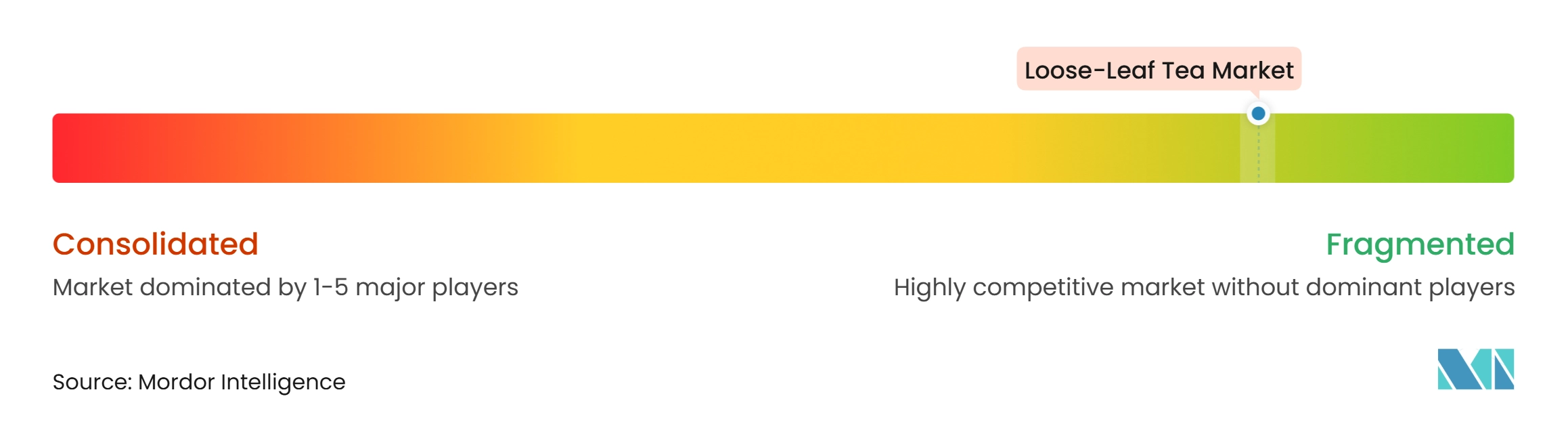
The loose-leaf tea market is fragmented, with competition among established tea manufacturers, multinational beverage companies, specialty tea retailers, and direct-to-consumer brands. Large companies benefit from established brand recognition, extensive distribution networks, production capabilities, and strong retail relationships. Smaller specialty brands differentiate themselves through distinctive tea varieties, sourcing transparency, product quality, and curated offerings. Competition exists across price segments, with established manufacturers catering to mainstream consumers and specialty retailers targeting premium consumers.
Established tea manufacturers and specialty retailers compete through product diversification, quality consistency, and brand positioning. Growing interest in premium and specialty tea varieties is encouraging companies to expand their portfolios and introduce products that address evolving consumption preferences. Product origin, flavor profiles, organic credentials, and packaging quality are becoming important elements of differentiation. Companies are also focusing on strengthening distribution networks and improving accessibility across online and offline retail channels. Consumer engagement and effective communication of product characteristics contribute to brand recognition and purchasing decisions.
Competitive positioning in the loose leaf tea market depends on sourcing credibility, supplier relationships, product differentiation, pricing, and distribution reach. Established companies benefit from their ability to maintain consistent supply and serve multiple geographic markets, while smaller brands can focus on specialized offerings and targeted consumer preferences. Premiumization is encouraging greater attention to product quality, origin, and overall consumption experiences. Expanding digital retail channels are also creating opportunities for brands to reach consumers beyond traditional specialty stores. Companies must balance product innovation with affordability and consistent quality to maintain consumer interest. The ability to adapt portfolios and distribution strategies to regional preferences will remain important for sustaining competitiveness.
Loose-Leaf Tea Industry Leaders
-
Tata Consumer Products Limited
-
Associated British Foods plc (Twinings)
-
ITO EN, LTD.
-
Dharmsala Tea Company
-
Harney & Sons Fine Teas, Inc.
- *Disclaimer: Major Players sorted in no particular order
Loose-Leaf Tea Market Companies Covered in this Report
- Tata Consumer Products Limited
- Associated British Foods plc (Twinings)
- ITO EN, LTD.
- Dharmsala Tea Company
- Harney & Sons Fine Teas, Inc.
- DAVIDsTEA Inc.
- The Republic of Tea, Inc.
- Diaspora Tea & Herb Company, LLC (Rishi Tea)
- Numi Inc., PBC
- Adagio Teas, Inc.
- VAHDAM Teas Private Limited
- T2 Tea Pty Ltd
- ORIENTIS GOURMET (Kusmi Tea)
- Ahmad Tea (UK) Limited (Ahmad Tea Limited)
- Teaxpress Private Limited (Teabox)
- Rare Tea Company Limited
- TEN REN TEA CO., LTD.
- Wittington Investments Limited (Fortnum & Mason Public Limited Company)
- PALAIS DES THÉS
- Camellia Plc (Goodricke Group Limited)
Recent Industry Developments in Loose-Leaf Tea Market
- October 2026: Makaibari introduced its Darjeeling Tea Journey and Harvest Duo gifting collections, featuring premium loose-leaf Darjeeling black, green, and oolong teas. The collections combined selected teas with brewing accessories and premium gift packaging.
- October 2026: Celeste launched its Festive Edit 2026, a premium loose-leaf tea gifting collection featuring single-origin teas, blended teas, and limited-edition Diwali blends. The new blends included Diwali Bloom, a black tea with lavender and rose, and Golden Glow, a green tea with chamomile, marigold, and rosemary.
- March 2026: Newby Teas introduced its Heritage Collection, a new range developed from its original loose-leaf tea offering. Inspired by the company's Chitra Collection of historical tea wares, the range featured loose-leaf teas in packaging that reflects different objects from the collection.
Global Loose-Leaf Tea Market Report Scope
The loose-leaf tea market includes whole-leaf and broken-leaf tea products that are steeped to prepare tea beverages, offering diverse flavors, aromas, and consumption experiences. The market is segmented by Product Type, Category, Packaging Type, Distribution Channel, and Geography. Based on Product Type, it includes Black Tea, Green Tea, and Other Product Types. Based on Category, it covers Conventional and Organic tea. Based on Packaging Type, the categories include Loose Pack Pouches, Tin Caddies, Glass Jars, and Other Packaging Types. Based on Distribution Channel, it covers On-trade and Off-trade, with Off-trade further divided into Supermarkets and Hypermarkets, Convenience/Grocery Stores, Online Retail Stores, Specialty Tea Stores, and Other Distribution Channels. Geographically, the market covers North America, Europe, Asia-Pacific, South America, and the Middle East and Africa.
Segmentation Overview
| Black Tea |
| Green Tea |
| Other Product Types |
| Conventional |
| Organic |
| Loose Pack Pouches |
| Tin Caddies |
| Glass Jars |
| Other Packaging Types |
| On-trade | |
| Off-trade | Supermarkets and Hypermarkets |
| Convenience/Grocery Stores | |
| Online Retail Stores | |
| Specialty Tea Stores | |
| Other Distribution Channels |
| North America | United States |
| Canada | |
| Mexico | |
| Rest of North America | |
| Europe | United Kingdom |
| Germany | |
| France | |
| Italy | |
| Spain | |
| Netherlands | |
| Poland | |
| Belgium | |
| Sweden | |
| Rest of Europe | |
| Asia-Pacific | China |
| Japan | |
| India | |
| Australia | |
| Indonesia | |
| South Korea | |
| Thailand | |
| Singapore | |
| Rest of Asia-Pacific | |
| South America | Brazil |
| Argentina | |
| Colombia | |
| Chile | |
| Peru | |
| Rest of South America | |
| Middle East and Africa | South Africa |
| Saudi Arabia | |
| United Arab Emirates | |
| Nigeria | |
| Egypt | |
| Morocco | |
| Turkey | |
| Rest of Middle East and Africa |
| By Product Type | Black Tea | |
| Green Tea | ||
| Other Product Types | ||
| By Category | Conventional | |
| Organic | ||
| By Packaging Type | Loose Pack Pouches | |
| Tin Caddies | ||
| Glass Jars | ||
| Other Packaging Types | ||
| By Distribution Channel | On-trade | |
| Off-trade | Supermarkets and Hypermarkets | |
| Convenience/Grocery Stores | ||
| Online Retail Stores | ||
| Specialty Tea Stores | ||
| Other Distribution Channels | ||
| By Geography | North America | United States |
| Canada | ||
| Mexico | ||
| Rest of North America | ||
| Europe | United Kingdom | |
| Germany | ||
| France | ||
| Italy | ||
| Spain | ||
| Netherlands | ||
| Poland | ||
| Belgium | ||
| Sweden | ||
| Rest of Europe | ||
| Asia-Pacific | China | |
| Japan | ||
| India | ||
| Australia | ||
| Indonesia | ||
| South Korea | ||
| Thailand | ||
| Singapore | ||
| Rest of Asia-Pacific | ||
| South America | Brazil | |
| Argentina | ||
| Colombia | ||
| Chile | ||
| Peru | ||
| Rest of South America | ||
| Middle East and Africa | South Africa | |
| Saudi Arabia | ||
| United Arab Emirates | ||
| Nigeria | ||
| Egypt | ||
| Morocco | ||
| Turkey | ||
| Rest of Middle East and Africa | ||
Key Questions Answered in the Report
What is the market size of loose-leaf tea?
The loose-leaf tea market is estimated to reach USD 13.23 billion in 2026, increasing to USD 14.27 billion in 2027. The market is projected to grow to USD 20.90 billion by 2032, registering a CAGR of 7.92% during 2027–2032.
Which loose leaf tea type has the largest share?
Black tea held 67.32% share in 2026, supported by established consumption across South Asia, the United Kingdom, East Africa, and the Middle East. It remains a practical category entry point because it works across daily drinking, milk tea, blended formats, retail, and foodservice. Brands can use this familiar segment to introduce consumers to higher-value single-origin and specialty choices.
Which product category is growing fastest?
Organic tea is forecast to grow at a 9.12% CAGR through 2032, supported by certification and transparency preferences. Producers that can meet farming, residue-control, documentation, and export requirements are better placed to participate in this higher-growth part of the category. Retailers also need to explain certification clearly so that shoppers understand the product choice and its value.
Which region will grow fastest through 2032?
Middle East and Africa are forecast to grow at a 9.54% CAGR through 2032, supported by urban demand and premium tea occasions. Success will depend on practical price points, dependable local distribution, a mix of familiar and exploratory products, and clear information for consumers new to specialty loose leaf tea. A tiered range can help companies serve both regular tea drinkers and buyers looking for gifting or wellness products.